
9 Best Email Drip Software in 2026: Pricing, Features and Pros & Cons
Compare the 9 best email drip software tools on price, automation depth and free plans, with all nine starting prices checked November 6, 2026.
 Shamim Mia, Founder, SerpAstraLast verified November 6, 202614 min read
We compare pricing pages, documentation and public reviews. We never accept payment for rankings.

Key takeaways
- Drip leads for ecommerce stores at $39/month with every feature included, ActiveCampaign follows at $15/month billed annually for B2B nurture, and Sender is the cheapest paid entry at $7/month.
- The single most important buying factor is the automation limit on the entry plan: workflow caps, step limits and send caps decide what you actually pay, not the headline price.
- Free plans are real here — Sender covers 2,500 subscribers with automation included — but Brevo's $9 Starter plan caps automation, and full drip sequences start on Standard at $18/month.
- Every price below was checked on November 6, 2026. All nine tools price by list size or email volume, so check the price at your own list size before comparing.
On this page
Quick comparison
| Tool | Best for | Starting price | Free plan |
|---|---|---|---|
| Drip | Online stores that want one flat price and every automation feature switched on from day one | $39/mo | No (14-day trial) |
| ActiveCampaign | B2B and service teams that run long nurture sequences and hand warm leads to sales | $15/mo (annual) | No (14-day trial) |
| Klaviyo | Online stores that want purchase-behavior flows tied directly to their shop data | $20/mo | Yes (250 profiles) |
| Omnisend | Online stores that want email, SMS and push in one automation workflow at a low entry price | $16/mo | Yes (250 contacts) |
| GetResponse | Course creators and small teams that want drip campaigns bundled with webinars and funnels | $19/mo | Yes (500 contacts) |
| MailerLite | Small businesses and creators who want simple automated sequences on a small budget | $12/mo | Yes (250 subs) |
| Brevo | Businesses with big lists that send a few sequences a month and want to pay per email, not per contact | $9/mo | Yes (300/day) |
| Sender | Small businesses that want working drip sequences at the lowest possible cost | $7/mo | Yes (2,500 subs) |
| Encharge | SaaS and product-led teams whose drip campaigns must react to what users do inside the product | $99/mo | No (14-day trial) |
Make one of these tools?
We re-check this list every quarter. Send a correction, request a review, or ask about a clearly labeled sponsored spot.
Request a listingThe best email drip software

Drip
Best for: Online stores that want one flat price and every automation feature switched on from day one
Drip has one plan and one price: $39 a month covers up to 2,500 people, with every feature included — the visual automation builder, dynamic segments, onsite campaigns, revenue attribution and up to 50 workflows. There is no cheaper tier with the good parts removed and no premium tier to be pushed into. Sends are unlimited up to 30,000 people, so a store that mails often pays the same as one that mails weekly.
The price is the catch: no free plan, only a 14-day trial, and $39 is the dearest entry here. The bill climbs fast — $89 at 5,000 people, $154 at 10,000 — and SMS costs extra from $39 a month. Buy Drip when store revenue runs on flows; buy Sender or MailerLite when the list is small and the budget is tight.
What we like
- One plan with every feature included — no tier hides the automation, segmentation or reporting
- Unlimited email sends up to 30,000 people, so a busy sequence calendar never adds to the bill
- Pre-built workflows for welcome, cart recovery, post-purchase and win-back sequences
- Revenue attribution ties each flow to the sales it produced, not just opens and clicks
Watch out for
- No free plan — only a 14-day trial — and $39 is the highest entry price among the general tools here
- Pricing climbs steeply with list size: $89 at 5,000 people and $154 at 10,000
- SMS is billed separately from $39 a month, on top of the email price

ActiveCampaign
Best for: B2B and service teams that run long nurture sequences and hand warm leads to sales
ActiveCampaign is the automation benchmark in this list. Its visual builder lets a drip sequence branch on opens, clicks, purchases and deal stages, with goals and split testing built in, and the built-in CRM means a sequence can create deals and notify salespeople when a lead turns warm. Starter costs $19 a month, or $15 billed annually, for 1,000 contacts, with site tracking, forms and AI builders included.
The catch is the 5-action cap on Starter automations: a real multi-email drip with conditions hits that ceiling fast, and Plus at $49 a month billed annually is the honest entry point for serious sequences. Accounts created after November 3, 2025 are billed for every contact, including unsubscribed ones. Buy it when automation depth is the job; buy MailerLite for a simple welcome series.
What we like
- The deepest visual automation builder here — branching, goals and split testing on multi-step sequences
- Built-in CRM and lead scoring connect drip campaigns to deals and the sales pipeline
- Site tracking triggers sequences from page visits, form fills and webinar attendance
- AI automation and campaign builders are included from the Starter plan
Watch out for
- Starter caps each automation at 5 actions, so serious drip sequences need Plus at $49/month billed annually
- Accounts created after November 3, 2025 are billed for all contacts, including unsubscribed and bounced ones
- No free plan — only a 14-day trial — and the price climbs steeply with list size

Klaviyo
Best for: Online stores that want purchase-behavior flows tied directly to their shop data
Klaviyo turned ecommerce email into a data product. Its data science predicts lifetime value and churn risk, builds segments automatically, and the Shopify integration is the deepest here — browse abandonment, cart abandonment, post-purchase and win-back flows all run off live shop events. The Email plan starts at $20 a month for 251 to 500 active profiles with 5,000 sends, and the free plan covers 250 profiles with full automation included.
The honest complaint is cost at scale: $60 at 2,500 profiles and $150 at 10,000, with no annual discount to soften it, and SMS is a separate plan on top. You pay for active profiles, not just people emailed, so every browsing visitor counts toward the bill. Buy Klaviyo when email drives a large share of store revenue; buy Omnisend when the same flows need to cost less.
What we like
- Flows trigger off real purchase behavior — browsed products, abandoned carts, repeat-purchase windows
- Predictive analytics flag likely VIPs and churners and suggest send times automatically
- The deepest Shopify connection of any tool here, with revenue attribution per flow
- Free plan includes full automation, so a small store can run real flows before paying
Watch out for
- No annual discount — the price is monthly billing only, so there is no way to lower it by committing
- Costs rise fast with list size: $60 at 2,500 profiles and $150 at 10,000
- Email and SMS are separate plans, so the combined price is higher than the headline $20

Omnisend
Best for: Online stores that want email, SMS and push in one automation workflow at a low entry price
Omnisend's pitch is the channel mix: a welcome series that starts with email, follows up by SMS and finishes with push, all in one workflow. For ecommerce stores, that multichannel reach lifts recovery rates beyond email-only flows. The free plan covers 250 contacts and 500 emails a month with every feature included; Standard starts at $16 a month for 500 contacts and 6,000 emails. New customers get 30% off the first three months.
The costs to watch are SMS and scale. SMS moved to Pro for accounts created after May 4, 2026, and it bills as credit packs on top of the subscription, while the price climbs steeply — Standard reaches about $132 a month at 10,000 contacts. Reporting also draws complaints next to Klaviyo's analytics. Buy Omnisend for Klaviyo-style flows with SMS included at a lower entry price.
What we like
- Email, SMS and web push run in the same automation workflows, not separate tools
- Every feature is included on every plan, including the free one — no feature gating
- Pre-built ecommerce flows for carts, browse abandonment and post-purchase sequences
- 24/7 live chat and email support on all plans, including the free plan
Watch out for
- SMS is Pro-only for accounts created after May 4, 2026, and is billed separately as credit packs
- No annual billing option, so there is no discount for paying yearly
- Reporting is thinner than Klaviyo, and advanced reports wait for Pro at $59/month

GetResponse
Best for: Course creators and small teams that want drip campaigns bundled with webinars and funnels
GetResponse pairs drip automation with the assets drips usually promote: webinars, landing pages and funnels. A course creator can run the webinar, the follow-up sequence and the sales page in one subscription starting at $19 a month for 1,000 contacts, or $15.58 billed annually, with unlimited sends on every paid plan. The free plan covers 500 contacts and 2,500 emails a month, and Starter includes a welcome series, autoresponders and one custom workflow.
The automation gate is the thing to check before you buy. Starter allows exactly one custom workflow, so a business running welcome, onboarding and win-back sequences side by side needs Marketer at $59 a month, and webinars wait for Creator at $69. It will not match ActiveCampaign's conditional logic or Klaviyo's ecommerce depth. Buy it when the funnel is webinar-led and one subscription beats two.
What we like
- Webinars, landing pages and funnels sit in the same subscription as the email automation
- Unlimited email sends on every paid plan, whatever the list size
- Welcome series and autoresponders are included on Starter, not held for a higher tier
- AI content generation helps draft the emails inside a sequence
Watch out for
- Starter allows only one custom automation workflow — unlimited workflows need Marketer at $59/month
- Webinars wait for Creator at $69/month, so the bundle costs more than the entry price suggests
- The interface tries to do a lot, and the learning curve is real for first-time users

MailerLite
Best for: Small businesses and creators who want simple automated sequences on a small budget
MailerLite proves drip campaigns do not require enterprise software. The automation builder creates welcome series, abandoned-cart sequences and re-engagement flows with a simplicity the powerful tools cannot match, and it starts at $12 a month for 500 subscribers, or $10.80 billed annually. Even the free plan includes automation — three workflows of up to five steps for 250 subscribers and 2,500 emails a month — so the first sequence costs nothing.
The ceiling is real: branching logic, behavioral triggers and CRM integration are thinner than the specialists, and Comfort at 500 subscribers rises to $19 at 1,000 and $49 at 5,000. But most small businesses need five good sequences, not fifty clever ones. For welcome, onboarding, cart recovery, post-purchase and win-back, MailerLite covers the essentials at the lowest credible price.
What we like
- The cleanest visual automation builder here — beginners actually finish their first sequence
- Automation runs on the free plan, so a welcome series costs nothing to start
- Comfort removes the MailerLite logo and adds landing pages, paid newsletters and 3 seats
- Strong deliverability and support ratings at the lowest credible paid price here
Watch out for
- Sequences are simpler than the specialists — branching logic and behavioral triggers are thin
- Free plan allows only 3 automations of up to 5 steps, so real drip programs need Comfort
- No built-in CRM, so lead scoring and deal tracking need another tool

Brevo
Best for: Businesses with big lists that send a few sequences a month and want to pay per email, not per contact
Brevo brings send-based pricing to automation: $9 a month buys 5,000 emails regardless of list size, and the free plan stores up to 100,000 contacts and sends 300 emails a day. For a business with a large list running a few sequences, that model undercuts every contact-based rival. Transactional email, SMS and a light CRM share the same account, and Standard at $18 a month adds unlimited automation, A/B testing and send-time optimization.
Read the limits before you buy. Starter stores only 500 contacts at the 5,000-email tier, so a 1,000-contact list needs the 10,000-email tier at $17 a month, and logo removal costs $12 a month extra — at which point Standard at $18 is the better buy. Buy Brevo for a big list mailed a few times a month; buy a contact-based tool when you mail every week.
What we like
- Send-based pricing favors large lists that mail a few times a month — $9 covers 5,000 emails
- Free plan stores up to 100,000 contacts and sends 300 emails a day at $0
- Transactional email, SMS and a light CRM live in the same account as the drip campaigns
- Standard at $18 adds unlimited automation, A/B testing and send-time optimization
Watch out for
- Automation is capped on Starter — unlimited automation starts on Standard at $18/month
- Starter stores only 500 contacts at the 5,000-email tier, while the free plan stores 100,000
- Removing the Brevo logo from Starter emails costs $12 a month extra, on top of the $9

Sender
Best for: Small businesses that want working drip sequences at the lowest possible cost
Sender is the budget pick nobody talks about. The free plan allows 2,500 subscribers and 15,000 emails a month with unlimited automation workflows, landing pages and segmentation included — ten times the contacts of Mailchimp's free plan — and paid plans start at $7 a month for 1,000 subscribers on Standard. Every plan includes 24/7 live chat support, and Standard adds SMS marketing and three seats.
The trade-offs match the price: fewer native integrations than the big platforms, a thinner template library, and less advanced automation than Drip or ActiveCampaign. Transactional email and dedicated IPs also wait for the Professional tier. But for a small business that needs working drip sequences at minimal cost, Sender is the cheapest honest entry here. Check the integration list covers your stack before you commit.
What we like
- The most generous free plan here: 2,500 subscribers and 15,000 emails a month with automation included
- Unlimited automation workflows on every plan, including the free one
- Standard starts at $7 a month and includes landing pages, SMS marketing and 3 seats
- 24/7 live chat support even on the free plan
Watch out for
- Fewer native integrations than the big platforms, so some stacks need Zapier to connect
- Thinner template library and less advanced automation than Drip or ActiveCampaign
- Transactional email and dedicated IPs wait for the Professional tier

Encharge
Best for: SaaS and product-led teams whose drip campaigns must react to what users do inside the product
Encharge targets the gap between Mailchimp simplicity and enterprise marketing automation: SaaS companies that need behavior-triggered onboarding, trial conversion and expansion sequences. The segmentation is built around what users do in the product, not just email opens, and Growth starts at $99 a month billed monthly, or $79 billed annually, for up to 2,000 subscribers with 20,000 included sends. Unlimited automations and unlimited team members come on every plan.
The price positions it above the general tools and below Customer.io and Iterable. The ecosystem is smaller than ActiveCampaign's, there is no free plan beyond the 14-day trial, and the HubSpot, Salesforce and Segment integrations wait for Premium at $159 a month. For product-led teams whose drip campaigns must react to in-app behavior, the focus is worth it. For everyone else, the premium is hard to justify.
What we like
- Behavioral segmentation built around in-app actions — onboarding, trial conversion, expansion
- Visual flow builder handles complex user journeys without code
- Unlimited automations and unlimited team members on every plan
- Email overage is a flat $100 per extra 100,000 sends, so the bill stays predictable
Watch out for
- The highest entry price here by a wide margin — $99 a month against $7–$39 elsewhere
- No free plan, only a 14-day trial, so there is no way to test it at $0
- HubSpot, Salesforce and Segment integrations wait for Premium at $159/month
The best email drip software does one job well: it sends the right email at the right moment without anyone pressing send — a welcome series when someone joins, a cart reminder when they leave, a win-back note when they go quiet. We ranked the nine tools below by fit for the most common buyer, a small business running its first real sequences, starting with the ecommerce specialists and ending with the budget and SaaS options, and every price was checked on November 6, 2026.
How to choose the best email drip software
- Count the contacts the entry price covers. Drip's $39 covers 2,500 people, Klaviyo's $20 covers 500 profiles, and Brevo's $9 covers 5,000 emails but only 500 stored contacts. The limit you hit first is your real starting price.
- Read the automation cap, not the headline. ActiveCampaign Starter allows 5 actions per automation, GetResponse Starter allows one custom workflow, and Brevo caps automation on Starter. A sequence that needs more costs the next tier up.
- Check whether sends are capped. Drip sends are unlimited up to 30,000 people; Klaviyo includes 10 sends per profile a month; Brevo charges by email volume. A business that mails weekly pays very differently on each model.
- Decide whether the drip is about selling or nurturing. Ecommerce stores should shortlist Drip, Klaviyo and Omnisend for purchase-triggered flows; B2B teams should compare ActiveCampaign and Encharge for behavior and deal-stage triggers.
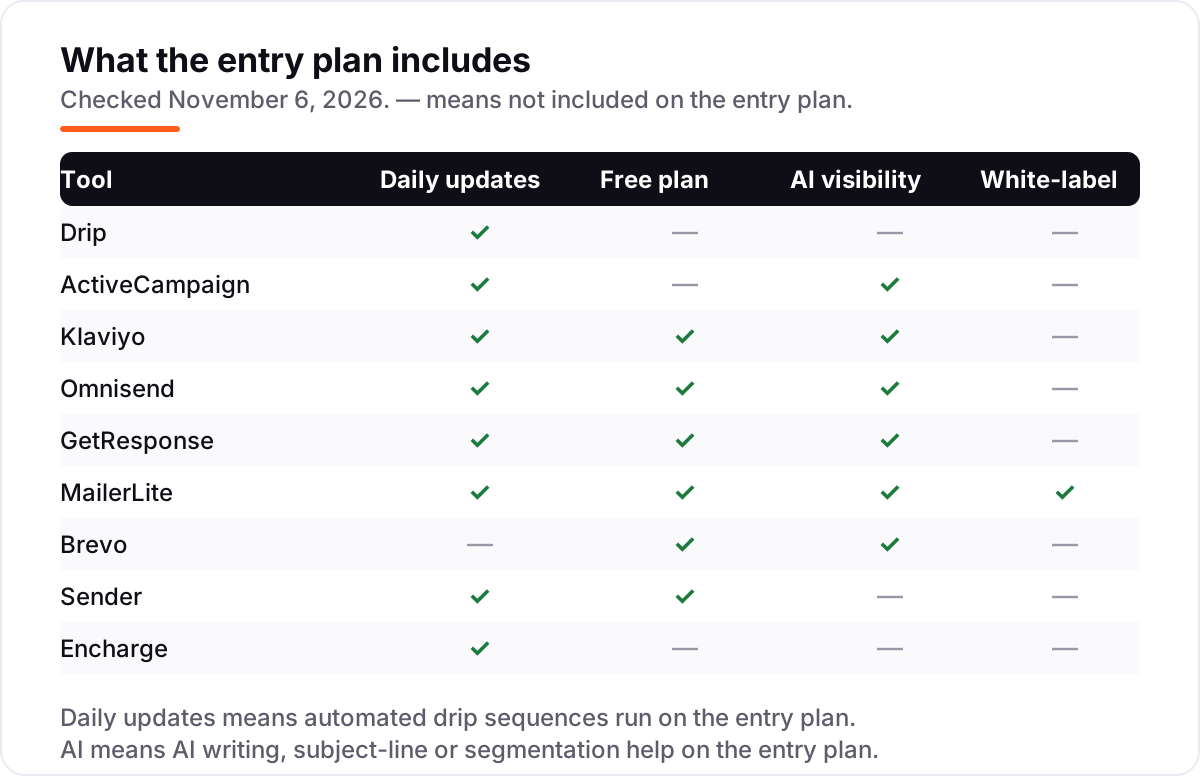
- Try the free plan with a real sequence. Sender, Klaviyo, Omnisend, MailerLite, GetResponse and Brevo all let you run automations before paying. Build the welcome series on the free plan and check it lands in the inbox.
A drip sequence is only as good as the traffic feeding it, so the emails need links worth clicking. Before you send, tag every link with the free UTM builder so each flow's revenue shows up separately in analytics. And if the sequences are sorted but new customers are not finding the site, our guide to email automation tools covers the wider automation stack, while our monthly SEO service handles the visibility side.
Whatever you shortlist, test it with real subscribers before you pay. The free plans and trials in this list are long enough to run one genuine welcome series — your list, your products, your timing — and that week tells you more than any review can. Check two things in the trial: that the emails land in the inbox rather than promotions or spam, and that the sequence triggers fire when a subscriber actually does the thing — joins, abandons, buys. Every tool here publishes its limits, so there is no reason to buy before you have hit one of them.
Email drip software pricing: what you will actually pay
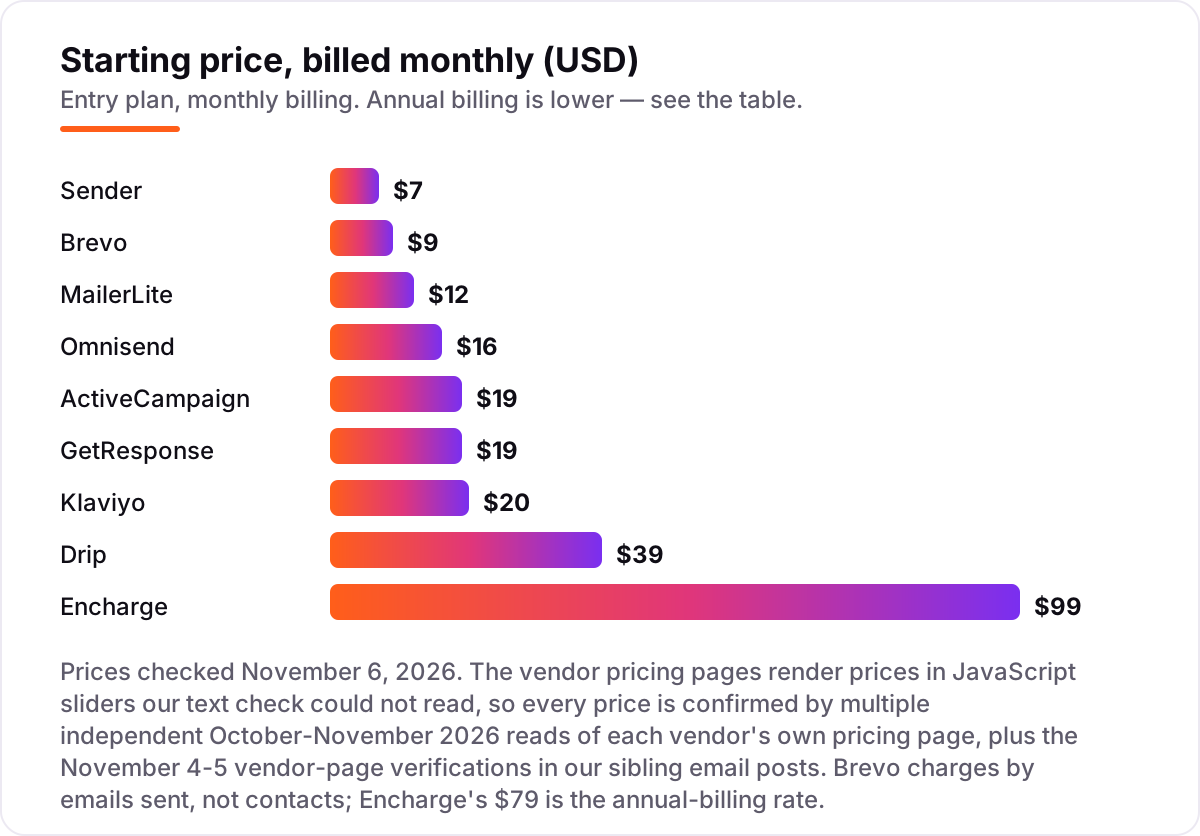
Take a business with 500 subscribers sending a welcome series plus one email a week. On list prices, the subscription costs $0 on Sender, Klaviyo, Omnisend, MailerLite, GetResponse or Brevo, since every one of those has a free plan that covers 500 subscribers. The first paid steps are $7 a month on Sender Standard, $9 on Brevo Starter, $12 on MailerLite Comfort, $16 on Omnisend Standard, $19 on GetResponse Starter or ActiveCampaign Starter, $20 on Klaviyo Email, $39 on Drip and $99 on Encharge Growth.
Over a year on monthly billing, that is $84 on Sender, $108 on Brevo, $144 on MailerLite, $192 on Omnisend, $228 on GetResponse or ActiveCampaign, $240 on Klaviyo, $468 on Drip and $1,188 on Encharge. Annual billing cuts most of those: Brevo drops to $97 a year, MailerLite to $129.60, GetResponse to $186.96, ActiveCampaign to $180, Encharge to $948, while Klaviyo, Omnisend and Drip publish no annual discount, so the monthly figure is the whole story.
Three of those numbers need adjusting before they are real. Brevo's $9 Starter caps automation, so a business whose whole job is drip sequences needs Standard at $18 a month, or $194 a year — and a 1,000-contact list needs the 10,000-email tier at $17 a month on Starter anyway. GetResponse Starter allows only one custom workflow, so a business running welcome, onboarding and win-back side by side needs Marketer at $59 a month. ActiveCampaign Starter caps each automation at 5 actions, so serious sequences need Plus at $49 a month billed annually. The same 500 subscribers and the same weekly email cost $0 at the free end and $1,188 at the dear end — a gap that comes entirely from automation caps and billing choices, not from features.
Know the difference: drip campaigns vs newsletters
The confusion in this category is between a sequence and a broadcast. A newsletter is one email sent to many people at once — this week's news, this month's offers — and everybody gets the same thing at the same time. A drip campaign is a sequence triggered by what one subscriber does: they join, so they get email one today, email two in three days and email three next week, each timed to their own actions. All nine tools in this list run drip sequences; a tool that only sends broadcasts belongs in a different list.
There is a second, quieter confusion: automation depth is not the same as automation at all. Every tool here can send a timed welcome series, but only some can branch a sequence on behavior — ActiveCampaign branches on deal stages, Klaviyo on purchase history, Encharge on in-app actions — while the simpler tools run the same steps for everybody. If your sequences need branches, check the automation cap on the entry plan before you buy, because that cap is usually what forces the upgrade.
A third distinction worth knowing is the billing model. Most tools here charge by contacts: the more subscribers you store, the more you pay, whatever you send. Brevo charges by emails sent: the more you mail, the more you pay, whatever you store. A big list mailed a few times a month is cheaper on Brevo; a small list mailed every week is cheaper on a contact-based tool. Work out which side of that line you sit on before comparing prices.
Quick comparison: tool type by need
| Buyer | Best pick | Why |
|---|---|---|
| Ecommerce store, all features on | Drip | One flat $39/month plan, unlimited sends, every feature included |
| B2B team nurturing leads | ActiveCampaign | Deepest branching and a built-in CRM, from $15/month billed annually |
| Shopify store, data-led flows | Klaviyo | Purchase-triggered flows and predictive analytics, from $20/month |
| Store wanting email plus SMS | Omnisend | Email, SMS and push in one workflow, Standard is $16/month |
| Course creator, webinar funnel | GetResponse | Webinars and funnels bundled with email, Starter is $19/month |
| Small budget, simple sequences | MailerLite | Cleanest builder and a real free plan, Comfort is $12/month |
| Big list, mailed a few times | Brevo | Send-based pricing, $9/month covers 5,000 emails |
| Cheapest working sequences | Sender | Free plan covers 2,500 subscribers, Standard is $7/month |
| SaaS onboarding flows | Encharge | Behavior-triggered journeys, Growth is $99/month |
Mistakes to avoid
- Budgeting on the promo price. The 30% off first-three-months deals on Omnisend and the first-month discounts on Klaviyo end, so the list price is what you pay in month four. Compare tools on that number.
- Buying on the entry price, then finding automation costs extra. Brevo's $9 Starter caps automation, GetResponse Starter allows one workflow, and ActiveCampaign Starter caps each automation at 5 actions. If drip sequences are the job, count the next tier in the price from day one.
- Ignoring the cap that bites first. A tool can be cheap and still be the wrong buy: Brevo Starter at $9 stores only 500 contacts, Klaviyo's free plan stops at 250 profiles, and MailerLite's free plan stops at 250 subscribers with 3 automations.
- Paying for SMS before you need it. SMS is a separate charge on Drip, Klaviyo and Omnisend, and a separate plan on Klaviyo. Buy the email first, and add SMS the month a text sequence earns its keep — not before.
- Forgetting the list will grow. Every tool here except Brevo reprices as the list grows, and the jumps are steep: Drip goes from $39 to $89 at 5,000 people, Klaviyo from $20 to $150 at 10,000 profiles. Price the list you expect in a year, not the one you have today.
How we chose
We checked each vendor's own pricing page on November 6, 2026 and recorded the starting price exactly as shown, including the annual-billing figure where the page lists one. The vendor pages render prices in JavaScript sliders our text check could not read directly, so each price is confirmed by multiple independent October–November 2026 reads of the vendor's own pricing page, plus the November 4–5 vendor-page verifications in our sibling email posts. Ratings come from fresh search-index copies of each tool's G2 page, crawled within the last week. We ranked the tools by fit for the most common buyer — a small business running its first real drip sequences — not by brand size. No vendor paid for a place in this list, and none of the links here are affiliate links.
What to do next
Start with the free plan or trial of your top pick and build one real sequence — a three-email welcome series to your own list — before you pay anything. Check that the emails land in the inbox and the triggers fire when a subscriber joins. If the sequences are sorted but new customers are not finding you, our monthly SEO service handles the visibility side — or compare the wider stack in our guide to email drip campaign software. Once your tools are in place, find out what's holding your rankings back.
Your stack only works if people find you
SerpAstra fixes what keeps your site off page one and makes it easy for AI assistants to recommend.
Get a free audit→Sources we checked (18)
- Drip pricing — drip.com/pricing (checked November 6, 2026)
- ActiveCampaign pricing — activecampaign.com/pricing (checked November 6, 2026)
- Klaviyo pricing — klaviyo.com/pricing (checked November 6, 2026)
- Omnisend pricing — omnisend.com/pricing (checked November 6, 2026)
- GetResponse pricing — getresponse.com/pricing (checked November 6, 2026)
- MailerLite pricing — mailerlite.com/pricing (checked November 6, 2026)
- Brevo pricing — brevo.com/pricing (checked November 6, 2026)
- Sender pricing — sender.net/pricing (checked November 6, 2026)
- Encharge pricing — encharge.io/pricing (checked November 6, 2026)
- Drip reviews — g2.com/products/drip/reviews (checked November 6, 2026)
- ActiveCampaign reviews — g2.com/products/activecampaign/reviews (checked November 6, 2026)
- Klaviyo reviews — g2.com/products/klaviyo/reviews (checked November 6, 2026)
- Omnisend reviews — g2.com/products/omnisend/reviews (checked November 6, 2026)
- GetResponse reviews — g2.com/products/getresponse/reviews (checked November 6, 2026)
- MailerLite reviews — g2.com/products/mailerlite/reviews (checked November 6, 2026)
- Brevo reviews — g2.com/products/sendinblue/reviews (checked November 6, 2026)
- Sender reviews — g2.com/products/sender-net/reviews (checked November 6, 2026)
- Encharge reviews — g2.com/products/encharge/reviews (checked November 6, 2026)
Shamim
Founder of SerpAstra
A full-stack SEO and digital marketer who spends most days on Local SEO for dental practices, AI search visibility and lead generation.
Frequently asked questions
What is the best email drip software?
Drip is the best fit for most ecommerce stores: one $39/month plan with every feature included and unlimited sends. ActiveCampaign is the better pick for B2B teams that need deep branching and a CRM, from $15/month billed annually. Sender is the best budget pick, with a free plan covering 2,500 subscribers.
How much does email drip software cost?
Entry prices run from $0 to $99 a month. Sender starts at $7, Brevo at $9 and MailerLite at $12, while Drip charges a flat $39 and Encharge starts at $99. Most small businesses pay $7–$39 a month at 500 subscribers, but the price climbs with list size on every tool except Brevo, which charges by emails sent.
Is there really free email drip software?
Yes, with limits. Sender's free plan covers 2,500 subscribers and 15,000 emails a month with automation included. Klaviyo is free to 250 profiles, Omnisend to 250 contacts and MailerLite to 250 subscribers, all with automation. Brevo's free plan sends 300 emails a day. Drip, ActiveCampaign and Encharge offer only a 14-day trial.
What is the difference between Drip and ActiveCampaign?
Drip is built for ecommerce: one flat $39/month plan, unlimited sends and flows triggered by purchases and browsing. ActiveCampaign is built for B2B: deeper branching, goals and split testing plus a built-in CRM, from $15/month billed annually. Pick Drip when the store's revenue runs on flows; pick ActiveCampaign when nurture sequences hand leads to sales.
Does Brevo's $9 plan include automation?
Only in a capped form. Brevo's Starter plan at $9 a month includes automation for a limited number of contacts, and the logo stays on your emails unless you pay $12 a month extra. Unlimited automation, A/B testing and logo removal start on Standard at $18 a month. If drip sequences are the whole job, budget for Standard, not Starter.
Can I switch email drip software later?
Yes, but plan the move carefully. Export your contacts, tags, segments and suppression lists from the old tool, then rebuild the sequences in the new one — automations do not transfer between platforms. Run the new welcome series alongside the old one for a week, check deliverability on the new sender domain, and only then switch the forms and checkouts over.
What should I check before buying email drip software?
Check four limits: how many contacts the entry price covers, how many workflows and steps each automation allows, whether sends are capped, and whether SMS or transactional email costs extra. Then run the free plan or trial with a real sequence — a welcome series to your own list — and confirm the emails land in the inbox before you pay.
Free SEO and AI visibility audit
Find out what is holding your rankings back
Send us your site. Within 2 business days you get a written audit, an AI visibility check and a short fix list ranked by impact. Free, with no contract attached.
Request my free audit→Related guides
 Digital Marketing & Ads10 Best Email Automation Tools in 2026 (Free and Paid, Compared)Compare the 10 best email automation tools on price, free plans and automation depth, with every starting price checked on November 5, 2026.Read guide →
 Digital Marketing & Ads10 Best Email Drip Campaign Software in 2026, Compared10 best email drip campaign software tools compared on price, automation depth and free plans. Real starting prices checked November 4, 2026.Read guide →
 Digital Marketing & Ads11 Best Email Marketing Software for Small Business in 2026, ComparedThe 11 best email marketing software for small business, compared on real 2026 prices, free plans and automation — Brevo starts at $9/month.Read guide →