
Best Email Hosting Services for 2026: 11 Providers Ranked by Value
Compare the 11 best email hosting service providers for small business on price, storage and free plans, with every price checked November 6, 2026.
 Shamim Mia, Founder, SerpAstraLast verified November 6, 202614 min read
We compare pricing pages, documentation and public reviews. We never accept payment for rankings.

Key takeaways
- Google Workspace is the best fit for most businesses at $7/user/month; Microsoft 365 matches it at $7 for Outlook teams, and Zoho Mail is the budget pick at $1/user/month with a free plan for up to five users.
- The single most important buying factor is the renewal price: Hostinger's $0.39, IONOS's $1.10 and GoDaddy's $1.99 are first-term rates that rise to $1.59, $2 and $4.99.
- Only Zoho Mail has a genuinely free business plan; every other provider here charges from the first mailbox or offers a trial only.
- Storage per mailbox decides the real cost: 2 GB on IONOS Basic and 5 GB on Zoho Lite and Hostinger Starter run out fast, while DreamHost gives 25 GB and Fastmail 60 GB.
On this page
Quick comparison
| Tool | Best for | Starting price | Free plan |
|---|---|---|---|
| Google Workspace | Small businesses that want Gmail on their own domain plus Docs, Drive and Meet in one plan | $7/mo | No (14-day trial) |
| Microsoft 365 | Teams that live in Outlook and need desktop Word, Excel and PowerPoint with their email | $7/mo | No (1-month trial) |
| Zoho Mail | Small teams that want the cheapest serious business email, with a free plan for up to five users | $1/mo | Yes (free plan) |
| Proton Mail | Businesses that handle sensitive mail and want end-to-end encryption under Swiss privacy law | $6.99/mo | No (14-day trial) |
| Fastmail | Small teams that want a fast, private, independent inbox with strong alias control | $5/mo | No (30-day trial) |
| IONOS | Solo owners who want the cheapest mailbox plus a free domain for three years | $1.10/mo | No (money-back only) |
| Hostinger | Budget buyers who will prepay four years for the lowest per-mailbox price anywhere | $0.39/mo | No (money-back only) |
| Bluehost | Businesses already hosted on Bluehost that want email in the same dashboard | $1.67/mo | No (1-month trial) |
| DreamHost | Businesses that want plain mailboxes with strong spam filtering and no renewal jump | $1.67/mo | No (money-back only) |
| GoDaddy | GoDaddy customers who want Titan-powered email with their domain and hosting | $1.99/mo | No (no trial) |
| Namecheap | Solo owners who registered their domain at Namecheap and need one cheap mailbox | $1.24/mo | No (30-day trial) |
Make one of these tools?
We re-check this list every quarter. Send a correction, request a review, or ask about a clearly labeled sponsored spot.
Request a listingThe best email hosting service

Google Workspace
Best for: Small businesses that want Gmail on their own domain plus Docs, Drive and Meet in one plan
Google Workspace is the default for a reason: Gmail on your own domain, with Docs, Drive and Meet in the same $7 subscription. Business Starter gives each user 30 GB of pooled storage, Gemini help inside Gmail, video meetings for 100 people, and the admin controls to add users, groups and aliases in minutes.
The trade-off is that there is no free plan and no cheap tier to fall back on: every mailbox costs $7 a month from day one, and the 300-user cap means a fast-growing company eventually moves to Enterprise. Buy Google Workspace when the team already lives in Gmail and Drive; buy Microsoft 365 when the work happens in Outlook and desktop Office.
What we like
- The default business email choice: Gmail on your own domain with 30 GB pooled storage per user
- Gemini AI is included in Gmail on Business Starter, not held for a higher tier
- Docs, Sheets, Drive and Meet come in the same $7, so email is part of a full office suite
- Strong spam filtering and search, plus admin controls for users, groups and aliases
Watch out for
- No free plan — only a 14-day trial, so every mailbox costs $7 a month from day one
- Pooled storage is 30 GB per user on Starter, the smallest allowance among the suites here
- Business plans cap at 300 users, so larger teams must move to Enterprise pricing

Microsoft 365
Best for: Teams that live in Outlook and need desktop Word, Excel and PowerPoint with their email
Microsoft 365 is the other default, built around Exchange email and Outlook. Business Basic costs $7 a user a month on annual billing and adds Teams, SharePoint and 1 TB of OneDrive per user, plus the web and mobile versions of Word, Excel and PowerPoint. It is the email most corporate clients already use, which matters when first impressions arrive in an inbox.
The catch is the July 2026 price rise: Basic went from $6 to $7, so older roundups quoting $6 are out of date, and desktop Office apps still wait for Standard at $14. There is no free plan, only a one-month trial, and Copilot AI is a paid add-on. Choose Microsoft 365 when Outlook and Office files are the team's daily work; choose Google Workspace when the team prefers the browser.
What we like
- Exchange email with Outlook, Teams and 1 TB of OneDrive per user in the $7 Business Basic plan
- The email most corporate clients already use, so sending from Outlook raises no eyebrows
- Web and mobile Office apps are included, with desktop apps one tier up on Standard
- Business plans cover up to 300 users with admin controls and security defaults
Watch out for
- Business Basic has no desktop Office apps — those start on Business Standard at $14/user/month
- The July 1, 2026 price rise took Basic from $6 to $7, so older comparisons quoting $6 are out of date
- No free plan — only a 1-month trial, and Copilot AI costs extra on every plan

Zoho Mail
Best for: Small teams that want the cheapest serious business email, with a free plan for up to five users
Zoho Mail is the value pick because the numbers are so far from the suites: Mail Lite costs $1 a user a month billed annually, with 5 GB per mailbox, IMAP and POP access, and the Zia AI assistant. The Forever Free plan covers up to five users on a custom domain at $0, which no other provider here matches.
The limits are real. The free plan has no IMAP access and is only offered in select regions, and 5 GB per mailbox fills up fast for heavy senders — the step up is Mail Premium at $4. Pick Zoho Mail when the budget matters most and the team is small; pick a suite when documents, meetings and storage need to live in the same subscription.
What we like
- The cheapest paid business email here: Mail Lite is $1/user/month billed annually
- A real free plan covers up to 5 users on a custom domain with 5 GB each
- IMAP, POP and the Zia AI assistant come with the $1 Mail Lite plan
- Streams, shared inboxes and eWidget connect mail to Zoho CRM and other Zoho apps
Watch out for
- The free plan has no IMAP or POP access and is only offered in select regions
- Mail Lite gives 5 GB per mailbox, so heavy senders need Mail Premium at $4/user/month
- Support and setup take more effort than Google or Microsoft, and the ecosystem is Zoho-first

Proton Mail
Best for: Businesses that handle sensitive mail and want end-to-end encryption under Swiss privacy law
Proton Mail is the privacy-first choice: zero-access encryption means Proton itself cannot read stored mail, and the company sits under Swiss privacy law. Mail Essentials costs $6.99 a user a month billed annually and includes 15 GB per user, three custom domains, ten addresses per user, plus Proton Calendar and Drive.
The price buys privacy, not a suite. At $6.99 it costs as much as Google Workspace or Microsoft 365 but includes no office apps, and standard mail apps need the Proton Bridge app installed on each machine. Choose Proton Mail when clients or regulators expect encryption; choose a suite when the team needs documents and meetings in the same plan.
What we like
- Zero-access encryption means Proton itself cannot read stored mail, under Swiss jurisdiction
- Mail Essentials includes 15 GB per user, 3 custom domains and 10 addresses per user
- Calendar, Drive and a document editor come with the mail plan at no extra charge
- No ads and no tracking, with a 30-day money-back guarantee on top of the trial
Watch out for
- Standard IMAP clients need the Proton Bridge app, which adds setup on every machine
- At $6.99 a user it costs as much as the suites but includes no office apps beyond calendar and Drive
- Search is weaker than Gmail or Outlook, and subjects are not end-to-end encrypted

Fastmail
Best for: Small teams that want a fast, private, independent inbox with strong alias control
Fastmail is the independent inbox done properly: no ads, no tracking, and a clean, fast interface with strong search, rules and snoozing. Business Standard costs $5 a user a month billed annually and gives custom-domain email with 60 GB per user, plus Masked Email aliases that create a fresh address for every sign-up.
The gaps are scope and scale. There is no free plan and no office suite, the $3 Basic tier does not allow custom domains, and the G2 rating rests on only 17 reviews. Pick Fastmail when the inbox itself is the product and privacy matters; pick Google Workspace or Microsoft 365 when the team also needs documents, storage and meetings.
What we like
- Standard gives custom-domain email with 60 GB per user at $5/user/month billed annually
- Masked Email creates disposable aliases for sign-ups, a genuinely useful privacy feature
- Fast search, rules and snoozing in a clean inbox with no ads and no tracking
- Open standards throughout: IMAP, JMAP, CalDAV and CardDAV, with apps on every platform
Watch out for
- No free plan — only a 30-day trial, and the $3 Basic tier does not allow custom domains
- Only 17 G2 reviews, so the rating rests on a much smaller base than the suites here
- No office suite: documents and meetings need separate tools

IONOS
Best for: Solo owners who want the cheapest mailbox plus a free domain for three years
IONOS wins on headline price: Mail Basic 1 costs $1.10 a month on a three-year term and bundles a free domain for as long as the plan runs, which makes it a neat buy for a brand-new business. The webmail is ad-free with spam filtering and device sync, and Mail Business at $3 a user adds 50 GB per mailbox when 2 GB runs out.
Read the term before buying. The $1.10 rate needs three years paid upfront and renews at $2 a month, and a single mailbox with 2 GB of storage is thin for a busy inbox. Choose IONOS when one cheap mailbox and a free domain are the whole job; choose Zoho Mail when the team needs more than one mailbox at a low price.
What we like
- The cheapest headline rate here: Mail Basic 1 is $1.10 a month on a 3-year term
- A free domain is bundled for as long as the plan runs, which suits a brand-new business
- Ad-free webmail with spam filtering and device sync on every plan
- Mail Business at $3 a user adds 50 GB per mailbox and team tools when 2 GB runs out
Watch out for
- Mail Basic 1 covers a single mailbox with only 2 GB of storage
- The $1.10 rate needs a 3-year term paid upfront and renews at $2 a month
- Support and billing complaints are common, and cancelling takes care

Hostinger
Best for: Budget buyers who will prepay four years for the lowest per-mailbox price anywhere
Hostinger is the cheapest per-mailbox price in this list, with a catch attached: Business Email Starter costs $0.39 a mailbox a month, but only on a 48-month term paid upfront, and it renews at $1.59. Each mailbox is standalone, so there is no hosting bundle to buy first, and Standard at $0.99 raises storage to 20 GB.
The math still works for patient buyers: ten mailboxes cost $46.80 for the first year of the term, against $840 on Google Workspace. But 5 GB per mailbox fills fast, there is no free trial, and the renewal is four times the intro rate. Pick Hostinger when a long prepay is acceptable and the budget is tiny; pick DreamHost when a stable monthly price matters more.
What we like
- The lowest per-mailbox price in this list: Starter is $0.39 a mailbox a month on a 48-month term
- Every plan is a standalone mailbox, so there is no hosting bundle to buy first
- Standard at $0.99 adds 20 GB per mailbox for less than a dollar more
- A buy-two-get-one-free mailbox offer runs on 12-month terms and longer
Watch out for
- The $0.39 rate needs a 48-month prepay and renews at $1.59 a mailbox a month
- Starter gives only 5 GB per mailbox, so attachments pile up fast
- No free trial — only a 30-day money-back guarantee, and support is ticket-first

Bluehost
Best for: Businesses already hosted on Bluehost that want email in the same dashboard
Bluehost Professional Email suits businesses already hosted on Bluehost: one login covers hosting, domain and email, and the entry plan costs $1.67 a mailbox a month on a 12-month term with 10 GB of storage. Calendar, contacts, undo send and spam filtering come included, and Plus at $2.50 adds 50 GB and team chat.
The $1.67 rate is an intro: it renews at $2.50 a mailbox a month, and the service is Titan email resold under the Bluehost name, so support routes through Bluehost. Pick Bluehost when the website already lives there and one dashboard matters; pick DreamHost or Namecheap when email is bought on its own and the renewal price is the deciding factor.
What we like
- Professional Email starts at $1.67 a mailbox a month on a 12-month term with 10 GB
- One login covers hosting, domain and email, with setup in the same dashboard
- Calendar, contacts, undo send and spam filtering come on the entry plan
- Plus at $2.50 adds 50 GB, send-later and team chat for growing teams
Watch out for
- The $1.67 rate is a 12-month intro that renews at $2.50 a mailbox a month
- Entry storage is 10 GB, and AI writing tools wait for the Ultra tier at $5.83
- Email is a Titan resell, so support routes through Bluehost rather than the mail provider

DreamHost
Best for: Businesses that want plain mailboxes with strong spam filtering and no renewal jump
DreamHost is the steady-price pick among the budget hosts: Professional Email costs $1.67 a mailbox a month on yearly billing, $1.99 month to month, with no promo-to-renewal jump — the price is the price. Each mailbox gets 25 GB, the largest storage among the budget hosts here, with ad-free webmail, mobile sync and 24/7 spam defence.
The limits are modest. There is no free plan, only a 30-day money-back guarantee, email is a paid add-on on the cheapest hosting plan, and a 100-email-per-hour sending limit can pinch bulk senders. Choose DreamHost when a stable price and roomy mailboxes matter more than the lowest intro rate; choose Hostinger when the budget is the whole decision.
What we like
- The yearly rate is $1.67 a mailbox a month with no promo-to-renewal jump — the price is the price
- 25 GB per mailbox, the largest storage among the budget hosts here
- 24/7 spam defence with filtering, virus and phishing protection built in
- Ad-free webmail with mobile and desktop sync, and no hosting bundle required
Watch out for
- No free plan — only a 30-day money-back guarantee on the standalone email plan
- Email is a paid add-on on the cheapest hosting plan, free only for the first 3 months
- A 100-email-per-hour sending limit can pinch teams that send in bulk

GoDaddy
Best for: GoDaddy customers who want Titan-powered email with their domain and hosting
GoDaddy Professional Email is Titan email sold under the GoDaddy name: Pro Light costs $1.99 a mailbox a month for the first year, with 10 GB of storage, Titan webmail, calendars and IMAP support for any mail app. Domain, hosting and email sit in one GoDaddy account, and read receipts, send-later and follow-up reminders come on the entry plan.
The renewal is the story: Pro Light rises to $4.99 a mailbox a month after year one, more than double the intro rate, and the AI writing tools wait for Pro Plus. GoDaddy also resells Microsoft 365 email, so check which product line the checkout shows. Pick GoDaddy when the domain and hosting already live there; pick Namecheap when the renewal price is what matters.
What we like
- Professional Email Pro Light starts at $1.99 a mailbox a month for the first year
- Titan webmail adds read receipts, send-later and follow-up reminders on the entry plan
- Domain, hosting and email sit in one GoDaddy account with 24/7 support
- IMAP and POP work with any mail app, so the mailbox is not locked to webmail
Watch out for
- The $1.99 rate is a first-year intro that renews at $4.99 a mailbox a month
- Pro Light gives only 10 GB, and the Titan AI writing tools wait for Pro Plus
- GoDaddy also resells Microsoft 365 email, so the two product lines are easy to confuse

Namecheap
Best for: Solo owners who registered their domain at Namecheap and need one cheap mailbox
Namecheap Private Email is the simplest cheap mailbox for a domain registered at Namecheap: Launch costs $14.88 a year for one mailbox with 5 GB of email storage, full IMAP, POP and SMTP access, and a 30-day free trial that needs no credit card. A promo code cuts the first term further, to $0.89 a mailbox a month.
Launch covers exactly one mailbox, so a team pays for the bigger Expand or Scale bundle plus extra mailboxes, and there is no monthly plan — billing is annual or two-year only. Pick Namecheap when one mailbox on a domain you already own is the whole job; pick Zoho Mail when the team needs several mailboxes at a low yearly price.
What we like
- Launch is $14.88 a year for one mailbox — the cheapest yearly-billed mailbox from a major company
- IMAP, POP and SMTP work with any mail app, with webmail, calendar and contacts included
- A 30-day free trial needs no credit card, and promo codes cut the first term further
- Extra mailboxes can be added to a plan instead of buying a whole new bundle
Watch out for
- Launch covers a single mailbox, so a team pays for a bigger bundle plus extra mailboxes
- Only 5 GB per mailbox on Launch, with no mobile sync on the entry tier
- Annual or two-year billing only — there is no monthly plan to test the fit
The best email hosting service gives your business an address on its own domain — [email protected] instead of a free Gmail address — with storage, spam filtering and sync across every device. We ranked the 11 providers below by fit for the most common buyer: a small business that wants professional email without paying for a suite it will never open, and every price was checked on the vendor's own pricing page on November 6, 2026.
How to choose the best email hosting service
- Count mailboxes, not users. Every provider here charges per mailbox or per user, so a 10-person team pays ten times the headline rate — except on plans that bundle several mailboxes, like Namecheap Expand.
- Check storage per mailbox. IONOS Basic gives 2 GB and Zoho Lite 5 GB, while DreamHost gives 25 GB and Fastmail 60 GB. A mailbox that fills up forces an upgrade mid-year.
- Read the renewal price, not the intro price. Hostinger's $0.39, IONOS's $1.10 and GoDaddy's $1.99 are first-term rates; the renewal is $1.59, $2 and $4.99. DreamHost is the only budget host here with no renewal jump.
- Decide suite or mailbox-only. Google Workspace and Microsoft 365 bundle documents, storage and meetings for $7; Zoho Mail, Fastmail and the budget hosts sell the mailbox alone for $1 to $5.
- Check migration and IMAP. Moving old mail needs a migration tool and IMAP access — Zoho's free plan has neither, so a team that imports mail should start on a paid plan.
- Check the free plan's limits. Only Zoho Mail has a genuinely free business plan, and it covers five users in select regions with no IMAP. Everyone else charges from the first mailbox or offers a trial only.
Email is one system in your stack, not the whole stack. If the business also needs to be found online, our guide to marketing platforms for small business SEO covers the visibility side. And before you publish new pages for the services you sell, run your titles through the free SERP snippet preview tool — it shows exactly how the title and description will look in Google.
Whatever you shortlist, try it with real mail before you pay. The trials in this list run 14 to 30 days — long enough to move one real mailbox, send and receive from your phone and desktop, and check that spam filtering and search behave. Check two things in the trial: that old mail imports cleanly, and that the mailbox syncs the same on every device you use.
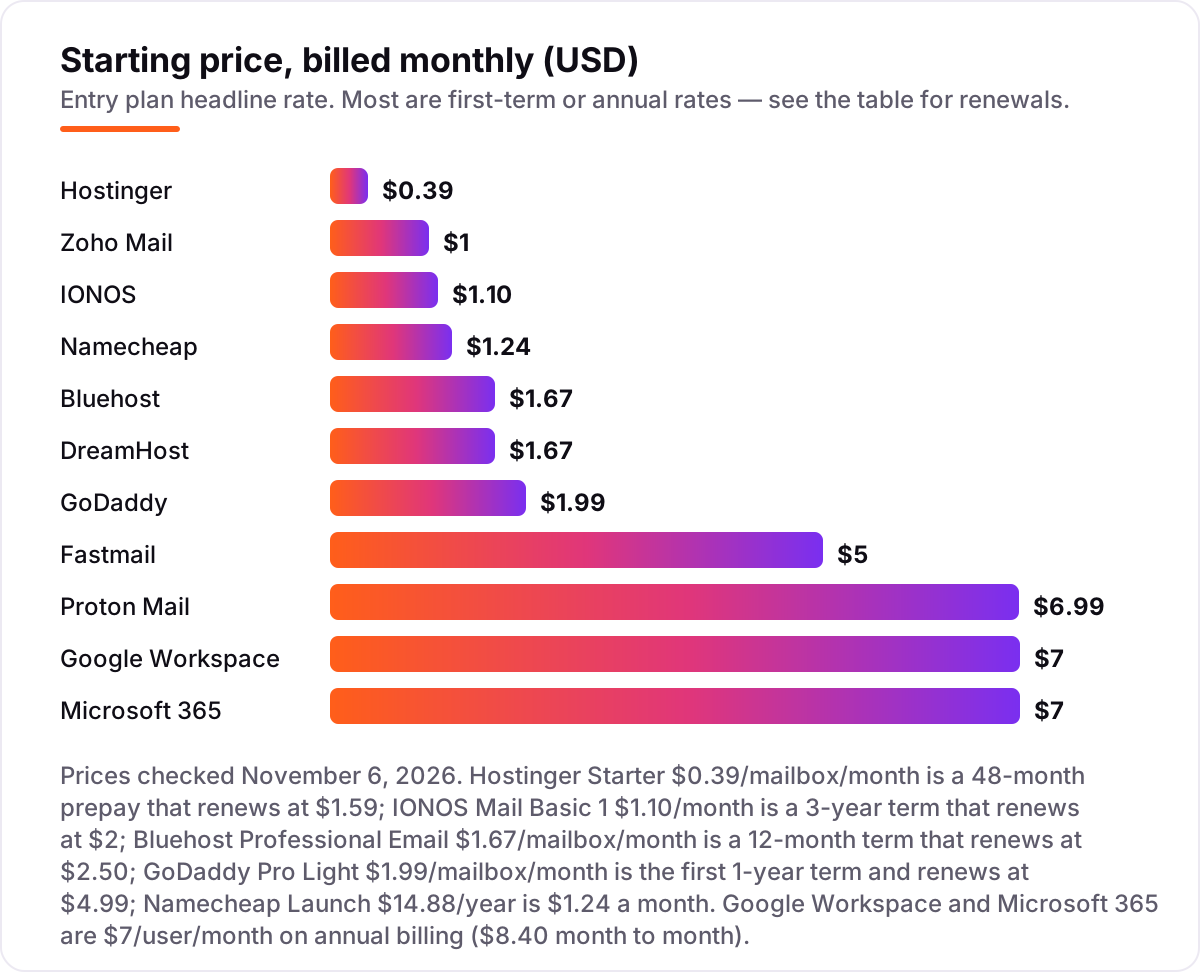
Email hosting service pricing: what you will actually pay
Take a 10-person team that needs one mailbox each, in the first year. On list prices, the bill is $46.80 on Hostinger Starter, $120 on Zoho Mail Lite, $200.40 on Bluehost Professional Email or DreamHost Professional Email, $238.80 on GoDaddy Pro Light, $600 on Fastmail Standard, $838.80 on Proton Mail Essentials, and $840 on Google Workspace Business Starter or Microsoft 365 Business Basic. Two of those numbers need adjusting before they are real: IONOS Mail Basic 1 covers a single mailbox, so a 10-person team needs a bigger IONOS plan or ten single plans, and Namecheap Launch covers one mailbox for $14.88 a year, so a team needs the Expand or Scale bundle instead.
Renewals change the picture. In year two, the same 10 mailboxes cost $190.80 on Hostinger at $1.59, $300 on Bluehost at $2.50, $598.80 on GoDaddy at $4.99, and $240 on IONOS at $2 if the team bought ten Basic 1 plans. DreamHost stays at $200.40 because its price has no renewal jump, and the suites stay at $840 because $7 is the list price, not an intro. The gap between the cheapest first year and the cheapest renewal is the number to budget on: Hostinger is $46.80 in year one and $190.80 in year two.
Three costs sit outside every number above. First, storage upgrades: a team that outgrows 5 GB per mailbox pays for the next tier, which is $4 on Zoho Mail Premium or $2.79 on Hostinger Standard. Second, the domain itself, which most hosts charge separately after the first year — IONOS bundles one free, the rest do not. Third, migration help if the team cannot move mail itself, which the suites and the bigger hosts include and the budget hosts charge for. If email marketing is also on the shopping list, that is a different product — see our guide to the best email marketing software for small business.
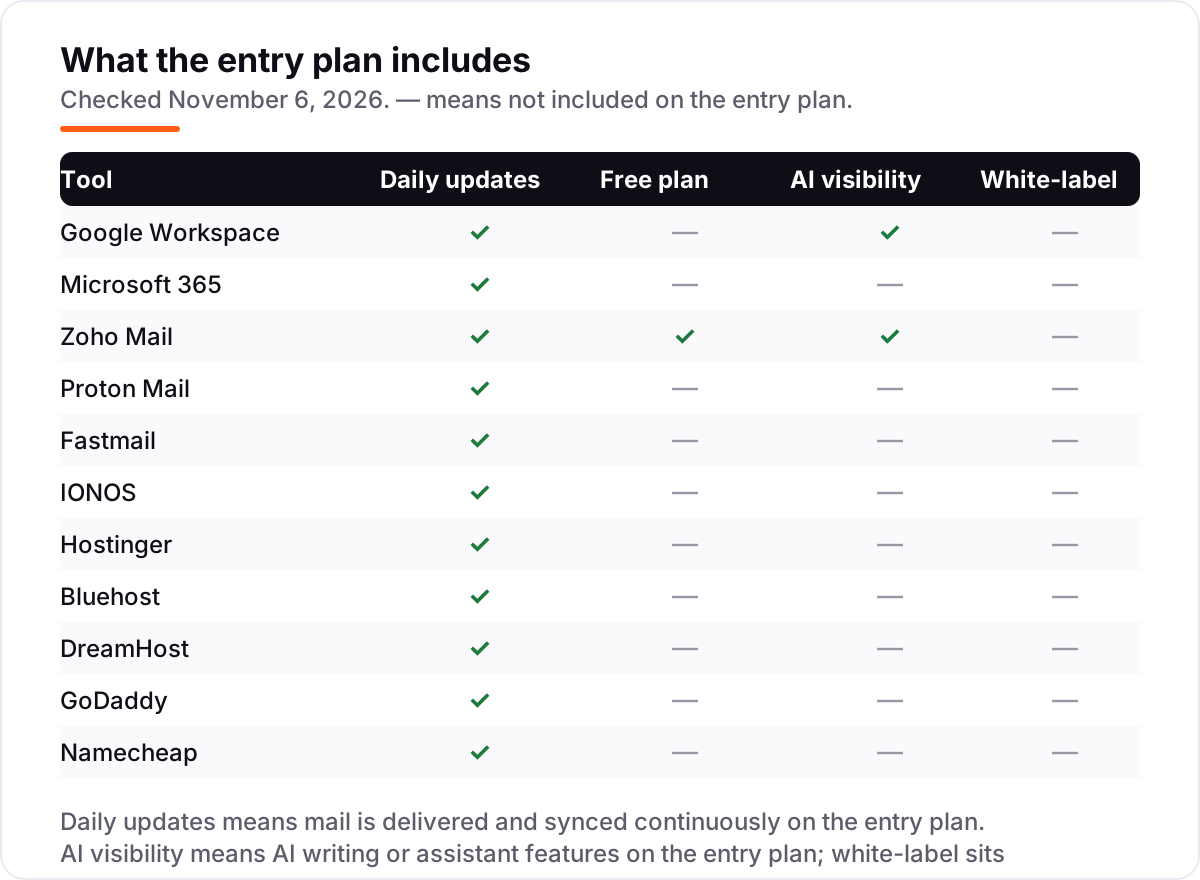
Know the difference: email hosting vs web hosting email vs email marketing
The confusion in this category is between three products that all say "email". Email hosting is a dedicated mailbox service: your address on your domain, with its own storage, spam filtering and support. Web hosting email is a mailbox bundled with a hosting plan, usually sharing the website's storage, with weaker spam filtering and sending limits — fine for a contact form, risky as the address customers write to. Email marketing is a third product entirely: tools like Mailchimp send campaigns to lists, and they are not inboxes at all.
There is a second, quieter confusion: a free Gmail or Outlook address is not business email hosting. It works, but the address belongs to Google or Microsoft, not to your domain, and customers notice the difference. A custom-domain mailbox costs as little as $1 a month, so the free address saves almost nothing and costs credibility on every message.
A third distinction worth knowing is a resold suite versus the suite itself. GoDaddy sells Microsoft 365 email and Bluehost sells Titan email under their own names, at their own prices, with their own support. The mailbox underneath is the same, but the renewal price, the trial terms and the support queue are the reseller's. Buying direct from Microsoft or Titan is not always cheaper — GoDaddy's first year is cheaper than Microsoft's — but the renewal usually is not.
Quick comparison: tool type by need
| Buyer | Best pick | Why |
|---|---|---|
| Most small businesses | Google Workspace | Gmail, Docs and Meet in one plan, from $7/user/month |
| Outlook and Office teams | Microsoft 365 | Exchange email with Teams and 1 TB OneDrive, from $7/user/month |
| Tightest budget | Zoho Mail | Free plan for up to 5 users, paid plans from $1/user/month |
| Privacy-first teams | Proton Mail | Zero-access encryption under Swiss law, from $6.99/user/month |
| One cheap mailbox | Namecheap | A single mailbox for $14.88 a year, with a 30-day trial |
| Lowest intro price | Hostinger | Starter is $0.39 a mailbox a month on a 48-month prepay |
Mistakes to avoid
- Budgeting on the intro price. Hostinger's $0.39, GoDaddy's $1.99 and IONOS's $1.10 all end. The renewal — $1.59, $4.99 and $2 — is what you pay in year two, so compare tools on that number.
- Buying a 2 GB mailbox for a busy inbox. IONOS Basic gives 2 GB and Zoho Lite 5 GB. A team that keeps every attachment will hit the ceiling within months and pay for the upgrade anyway.
- Paying for a suite when only email is needed. Google Workspace and Microsoft 365 cost $7 a user for documents, storage and meetings. If the team only needs mail, Zoho Mail or Fastmail does the job for $1 to $5.
- Skipping the migration check. Moving old mail needs IMAP access and a migration tool. Zoho's free plan has no IMAP, so test the import on a paid plan before cancelling the old host.
- Forgetting the domain. The mailbox is worthless without the domain it sits on. IONOS bundles a free domain; every other host here charges for it separately after the first year, so price it in.
How we chose
We checked each vendor's own pricing page on November 6, 2026 — via fresh crawls of the vendors' own pages, since direct page fetches were unavailable that day — and recorded the starting price exactly as shown, including the annual-billing figure where the page lists one, and we ranked the tools by fit for the most common buyer, a small business that wants professional email on its own domain. Microsoft 365 Business Basic is $7 after the July 1, 2026 rise from $6, so older roundups quoting $6 are out of date. We left Rackspace Email out: reports say its price rose to $10/user/month in March 2026 while older roundups still quote $2.99, and its pricing page would not load to settle the figure. We show no rating for IONOS, Hostinger, Bluehost, DreamHost, GoDaddy or Namecheap because their G2 listings cover web hosting, not email, and we would rather show no rating than the wrong product's score. No vendor paid for a place in this list, and none of the links here are affiliate links.
What to do next
Start with the trial or free plan of your top pick and move one real mailbox first — yours. Send and receive from your phone and desktop, import a month of old mail, and check that spam filtering and search behave before moving the team. If the inbox is sorted but new customers are not finding you, our monthly SEO service handles the visibility side — or compare providers in our guide to SEO companies for small business. Once your tools are in place, find out what's holding your rankings back.
Your stack only works if people find you
SerpAstra fixes what keeps your site off page one and makes it easy for AI assistants to recommend.
Get a free audit→Sources we checked (16)
- Google Workspace pricing — workspace.google.com/pricing (checked November 6, 2026)
- Microsoft 365 business plans — microsoft.com (checked November 6, 2026)
- Zoho Mail pricing — zoho.com/mail/pricing (checked November 6, 2026)
- Proton Mail business pricing — proton.me/business/mail/pricing (checked November 6, 2026)
- Fastmail pricing — fastmail.com/pricing (checked November 6, 2026)
- IONOS email hosting — ionos.com/office-solutions/email-hosting (checked November 6, 2026)
- Hostinger Business Email — hostinger.com/business-email (checked November 6, 2026)
- Bluehost Professional Email — bluehost.com/professional-email (checked November 6, 2026)
- DreamHost email hosting — dreamhost.com/email (checked November 6, 2026)
- GoDaddy Professional Business Email — godaddy.com (checked November 6, 2026)
- Namecheap Private Email — namecheap.com/hosting/email (checked November 6, 2026)
- Google Workspace reviews — g2.com/products/google-workspace/reviews (checked November 6, 2026)
- Microsoft 365 reviews — g2.com/products/microsoft365/reviews (checked November 6, 2026)
- Zoho Mail reviews — g2.com/products/zoho-mail/reviews (checked November 6, 2026)
- Proton Mail for Business reviews — g2.com/products/proton-mail-for-business/reviews (checked November 6, 2026)
- Fastmail reviews — g2.com/products/fastmail/reviews (checked November 6, 2026)
Shamim
Founder of SerpAstra
A full-stack SEO and digital marketer who spends most days on Local SEO for dental practices, AI search visibility and lead generation.
Frequently asked questions
What is the best email hosting service?
Google Workspace is the best fit for most small businesses: Gmail on your own domain with Docs, Drive and Meet for $7/user/month. Microsoft 365 is the better pick for Outlook and desktop Office users at the same $7. Zoho Mail is the best budget option at $1/user/month, with a free plan for up to five users.
How much does business email hosting cost?
Entry prices run from $0.39 to $7 per mailbox a month. Hostinger Starter is $0.39 on a 48-month prepay, Zoho Mail Lite is $1, and the suites — Google Workspace and Microsoft 365 — are $7/user/month. A 10-person team pays $46.80 to $840 in the first year, before renewals, which are higher on every intro-priced host.
Is there a free email hosting service for business?
Only one provider here has a genuinely free business plan: Zoho Mail's Forever Free plan covers up to five users on a custom domain with 5 GB each, though it has no IMAP access and is only offered in select regions. Every other provider charges from the first mailbox or offers a trial of 14 to 30 days.
Google Workspace or Microsoft 365: which is better for email?
Both cost $7/user/month on annual billing, so pick by habit, not price. Google Workspace wins for browser-first teams that want Gmail, Docs and Meet in one place. Microsoft 365 wins for teams that live in Outlook and need desktop Word, Excel and PowerPoint, which start on Standard at $14.
Can I keep my email address if I switch email hosts?
Yes. Your address belongs to your domain, not your host, so it moves with you. Point the MX records at the new provider, import the old mail through the provider's migration tool, and keep the old account live for a week so nothing is lost in transit. Every provider in this list offers migration help or a step-by-step guide.
What is the difference between email hosting and web hosting email?
Email hosting is a dedicated mailbox service with its own storage, spam filtering and support. Web hosting email is a mailbox bundled with a hosting plan, usually sharing the site's storage and with weaker spam filtering and sending limits. If email is how customers reach you, a dedicated host is the safer buy.
Do I need a suite like Google Workspace, or is a mailbox enough?
A mailbox is enough if email is the whole job: Zoho Mail, Fastmail or a budget host covers it for $1 to $5 a month. A suite pays off when the team also needs documents, cloud storage and meetings in one subscription with one admin panel. Buying a suite for email alone wastes about $6 a user a month.
Free SEO and AI visibility audit
Find out what is holding your rankings back
Send us your site. Within 2 business days you get a written audit, an AI visibility check and a short fix list ranked by impact. Free, with no contract attached.
Request my free audit→Related guides
 Digital Marketing & Ads11 Best Email Marketing Software for Small Business in 2026, ComparedThe 11 best email marketing software for small business, compared on real 2026 prices, free plans and automation — Brevo starts at $9/month.Read guide →
 Digital Marketing & Ads8 Best Email Marketing Platforms for Startups in 2026, Compared8 best email marketing platforms for startups compared on price, free plans and automation, with real starting prices checked on the vendors’ own pages.Read guide →
 SEO & AI Search12 Best Marketing Platforms for Small Business SEO in 2026, ComparedThe 12 best marketing platforms for small business SEO, compared on real prices, SEO tools and AI visibility. Every price checked November 1, 2026.Read guide →