
7 Best Email Marketing Platforms for Creators in 2026, Compared
7 best email marketing platforms for creators compared on price, free plans and monetization. Real prices checked November 4, 2026, sorted by creator need.
 Shamim Mia, Founder, SerpAstraLast verified November 4, 202616 min read
We compare pricing pages, documentation and public reviews. We never accept payment for rankings.

Key takeaways
- Kit is the best all-round pick for creators at $39/month, beehiiv is the best newsletter-first platform at $59/month, and Substack costs nothing until you earn — it takes 10% of paid subscriptions.
- The single most important buying factor is how the platform charges as you grow: per subscriber, per contact, per email sent, or as a share of your revenue.
- Free plans are real here — Kit covers 10,000 subscribers free and beehiiv 2,500 — but automations and branding removal are what force the first upgrade.
- Every price below was checked on the vendor's own pricing page on November 4, 2026, except Mailchimp's, whose page could not be opened that day; its $13 figure is disclosed as third-party-sourced in How we chose.
On this page
Quick comparison
| Tool | Best for | Starting price | Free plan |
|---|---|---|---|
| Kit | Full-time creators who want email, automations and selling in one place | $39/mo | Yes (10,000 subs) |
| beehiiv | Newsletter-first creators who want to grow a publication and earn from paid subscriptions | $59/mo | Yes (2,500 subs) |
| Substack | Writers whose product is the newsletter itself and who want built-in discovery | 10% of paid revenue | Yes (unlimited) |
| MailerLite | Budget-conscious creators with a modest list who want full features for the lowest price | $12/mo | Yes (250 subs) |
| Flodesk | Creators who want the prettiest emails in the list and sell digital products | $25/mo | Yes (no sending) |
| Mailchimp | Creators who also run a store or a team and want the widest integration library | $13/mo | Yes (250 contacts) |
| Brevo | Creators who email a large list rarely and want the lowest paid starting price | $9/mo | Yes (300/day) |
Make one of these tools?
We re-check this list every quarter. Send a correction, request a review, or ask about a clearly labeled sponsored spot.
Request a listingThe best email marketing platforms for creators

Kit
Best for: Full-time creators who want email, automations and selling in one place
Kit is the creator default: the free plan covers up to 10,000 subscribers with unlimited broadcasts, landing pages and forms, and the Creator plan adds the visual automation builder, sequences and integrations that turn a list into income. It sells digital products and paid newsletters in the same account, with Kit taking 3.5% plus 30 cents per sale, so a creator can run the business from one login.
The catch is the September 2025 reprice, which more than doubled Creator to $39 a month at 1,000 subscribers, and the price climbs at every subscriber band, reaching $139 a month at 10,000. The free plan has no sequences or visual automations, so the first welcome series usually forces the upgrade. Buy Kit when email, automations and selling belong together; buy beehiiv when the newsletter itself is the product.
What we like
- Free plan covers up to 10,000 subscribers with unlimited broadcasts, landing pages and forms
- Visual automation builder and sequences turn a list into income, with paid newsletters and digital products in the same account
- No sending limits on any plan, plus free migration from another platform on paid plans
Watch out for
- Creator entry price more than doubled in the September 2025 reprice, to $39/month at 1,000 subscribers
- The free plan has no sequences or visual automations, so the first welcome series forces an upgrade
- Price climbs at every subscriber band — $139/month at 10,000 subscribers

beehiiv
Best for: Newsletter-first creators who want to grow a publication and earn from paid subscriptions
Beehiiv is built for newsletter-first creators who want to grow and monetize a publication rather than run a general marketing suite. The free plan covers 2,500 subscribers with unlimited sends, a hosted website and the recommendation network, and the Lite plan adds paid subscriptions with a 0% platform fee, automations, A/B testing and the ad network. Every plan includes the website, podcast, community and digital products.
The October 2026 reprice renamed the plans — Scale became Lite, Max became Pro — and raised the Lite entry price to $59 a month billed monthly at 1,000 subscribers. Branding removal and the sponsorship storefront wait for Pro at $109 a month. Beehiiv is the pick when growth and paid subscriptions are the goal; it is less suited to creators who need deep ecommerce or CRM features.
What we like
- Free plan covers 2,500 subscribers with unlimited sends, a hosted website and the recommendation network
- Lite takes a 0% platform fee on paid subscriptions and adds automations, A/B testing and the ad network
- Every plan includes the website, podcast, community and digital products
Watch out for
- Lite entry price rose to $59/month billed monthly in the October 2026 reprice
- Branding removal and the sponsorship storefront wait for Pro at $109/month
- Less suited to creators who need deep ecommerce or CRM features

Substack
Best for: Writers whose product is the newsletter itself and who want built-in discovery
Substack is the only tool here with no monthly bill: publishing is free at any list size, with a custom domain, email and web publishing, and paid subscriptions built in. Readers discover you through the Substack app and network, which no other platform offers, and you set your monthly, annual or founding-member prices. For a writer whose product is the newsletter itself, that combination is hard to beat.
The cost arrives as a percentage: Substack keeps 10% of every paid subscription payment, and Stripe adds about 2.9% plus 30 cents per payment plus a 0.7% recurring billing fee. That cut never falls as you grow, so once paid revenue passes a few hundred dollars a month, a flat-fee platform like beehiiv gets cheaper. Choose Substack for discovery and simplicity; leave when the 10% costs more than a subscription.
What we like
- Free to publish at any list size, with a custom domain, email and web publishing included
- Readers discover you through the Substack app and network, which no other tool here offers
- Paid subscriptions, monthly, annual and founding-member tiers are built in, with no monthly bill
Watch out for
- Substack keeps 10% of every paid subscription, and the cut never falls as you grow
- Stripe adds about 2.9% plus 30 cents per payment plus a 0.7% recurring billing fee
- You do not own the reader relationship the way you do on your own domain and list

MailerLite
Best for: Budget-conscious creators with a modest list who want full features for the lowest price
MailerLite is the cheapest full-featured option in this list: Comfort starts at $12 a month for up to 500 subscribers and includes the AI writing assistant, preference center, smart sending and 50 automations, while Power at $25 removes every cap — unlimited emails, automations, forms and seats. Every paid plan gets the same features; you pay more only for a bigger list or more sending.
The free plan shrank twice in 2026 and now covers just 250 subscribers and 2,500 emails a month, so it is a trial rather than a home. Comfort also caps monthly sends at ten times your subscriber tier, which is generous for a weekly newsletter but tight for daily senders. Pick MailerLite when budget matters and your list is modest; pick Kit or beehiiv when you need the creator-specific selling and referral tools.
What we like
- Comfort starts at $12/month and includes the AI writing assistant, preference center and 50 automations
- Every paid plan gets the same features — you pay more only for a bigger list or more sending
- Power at $25/month removes every cap: unlimited emails, automations, forms and seats
Watch out for
- Free plan shrank twice in 2026 and now covers just 250 subscribers and 2,500 emails a month
- Comfort caps monthly sends at ten times your subscriber tier, which is tight for daily senders
- No creator-specific selling or referral tools to match Kit and beehiiv

Flodesk
Best for: Creators who want the prettiest emails in the list and sell digital products
Flodesk is the design-first pick: its templates are the prettiest in this list, every paid plan includes unlimited email sends, and the editor makes a branded newsletter fast even for a creator with no design background. The free plan covers forms, landing pages and link-in-bio pages, Lite adds sending and analytics from $25 a month, and the Everything plan adds unlimited checkouts, sales pages and abandoned-cart automations.
The flat-rate unlimited plan Flodesk was famous for was retired for new members in December 2025, so pricing now scales with active subscribers like everyone else — Lite reaches $72 a month at 10,000. Lite also allows only one workflow and keeps Flodesk branding on emails; unlimited workflows and branding removal need Pro. Choose Flodesk when beautiful emails are the priority; choose MailerLite when the same money must buy more automation.
What we like
- Every paid plan includes unlimited email sends, with the most polished templates in this list
- Lite starts at $25/month with analytics, designer templates and audience segmentation
- Everything adds unlimited checkouts, sales pages, payment plans and abandoned-cart automations
Watch out for
- The flat-rate unlimited plan was retired for new members in December 2025, so pricing now scales with subscribers
- Lite allows only one workflow and keeps Flodesk branding on emails
- Unlimited workflows and branding removal need Pro at $28/month

Mailchimp
Best for: Creators who also run a store or a team and want the widest integration library
Mailchimp is the biggest name in this list and the most connected: hundreds of integrations, the widest template library, and a free plan covering 250 contacts. Essentials starts at $13 a month for 500 contacts with 5,000 monthly sends, and Standard at $20 adds multi-step automations, predictive segmentation and dynamic content. For a creator who also runs a store or a team, that ecosystem is the argument.
The billing is the trap to watch: Mailchimp counts unsubscribed and non-subscribed contacts toward your tier, so a list with dead addresses costs more than the same list elsewhere, and the price climbs steeply — Essentials is $75 a month at 5,000 contacts. The free plan has no automation at all. Pick Mailchimp for integrations and scale; pick MailerLite or Brevo when the same list should cost less.
What we like
- Hundreds of integrations and the widest template library in this list
- Essentials starts at $13/month for 500 contacts with 5,000 monthly sends
- Standard at $20/month adds multi-step automations, predictive segmentation and dynamic content
Watch out for
- Mailchimp counts unsubscribed and non-subscribed contacts toward your billing tier
- Price climbs steeply — Essentials is $75/month at 5,000 contacts
- The free plan has no automation at all

Brevo
Best for: Creators who email a large list rarely and want the lowest paid starting price
Brevo is the cheapest way into email marketing here: Starter costs $9 a month for 5,000 emails, and the free plan sends 300 emails a day to up to 100,000 contacts. It prices by email volume rather than list size, so a creator who emails a large list twice a month pays far less than per-subscriber pricing, and Starter includes the AI content generator, segmentation and forms.
Each paid tier caps the contacts you may store — 500 contacts on the $9 tier — so a 5,000-contact list belongs on a higher-volume tier at about $32 a month. Automation, A/B testing and landing pages wait for Standard at $18 a month, and removing the Brevo logo from Starter costs extra. Choose Brevo when you send rarely to a big list; choose MailerLite when automations matter from day one.
What we like
- Starter costs $9/month for 5,000 emails, the lowest paid starting price in this list
- Prices by email volume, not list size, so a big list emailed twice a month stays cheap
- Free plan sends 300 emails a day to up to 100,000 contacts
- Starter already includes the AI content generator, segmentation and forms
Watch out for
- Each paid tier caps stored contacts — 500 contacts on the $9 tier, so bigger lists need a higher tier
- Automation, A/B testing and landing pages wait for Standard at $18/month
- Removing the Brevo logo from Starter costs extra
The best email marketing platforms for creators in 2026 are not the biggest names in email marketing — they are the ones built around how creators actually earn: a newsletter that grows, a welcome sequence that sells, and a paid tier that does not punish success. This list is sorted by fit for a working creator, from the all-rounder to the budget picks, with real prices checked on November 4, 2026.
What an email marketing platform actually does
An email marketing platform stores your subscribers, sends your emails, and automates the follow-ups — the welcome sequence, the abandoned-cart nudge, the paid-subscription renewal. The good ones also give you landing pages, forms and a way to take money, so the list becomes a business rather than a mailing list. The scale of the category is large: Brevo alone says more than 600,000 customers use its platform.
The platforms differ in what they charge for. Some charge per subscriber, some per contact stored, some per email sent, and one — Substack — charges a share of what you earn. That billing model matters more than the headline price, because the same list can cost $9 a month on one platform and $59 on another. Read the pricing section of each card before you compare the numbers.
Newsletter-first platforms
Beehiiv and Substack are built for one job: publishing a newsletter and earning from it. They give you a hosted website, email and web publishing, and paid subscriptions out of the box, and they grow through reader networks — beehiiv through its recommendation network and ad network, Substack through its app and discovery feed. Neither is a general marketing suite, and neither tries to be.
Pick this group when the newsletter is the product. If you also sell courses, run a store, or need a CRM, the all-rounders below fit better. The trade-off is focus: a newsletter platform does its one job well and stays out of the way, while a suite does more jobs adequately.
Creator all-rounders
Kit and Flodesk are the two platforms built around the creator business as a whole. Kit pairs email with visual automations, sequences and built-in selling — digital products, paid newsletters and memberships in the same account. Flodesk pairs email with design: the most polished templates here, plus checkouts and sales pages on its Everything plan.
Both charge by subscriber count, and both raised prices in the last year — Kit in September 2025, Flodesk by retiring its flat-rate unlimited plan in December 2025. Pick this group when email, automation and selling belong together. Pick the newsletter-first group when publishing is the whole business.
Budget and volume-priced options
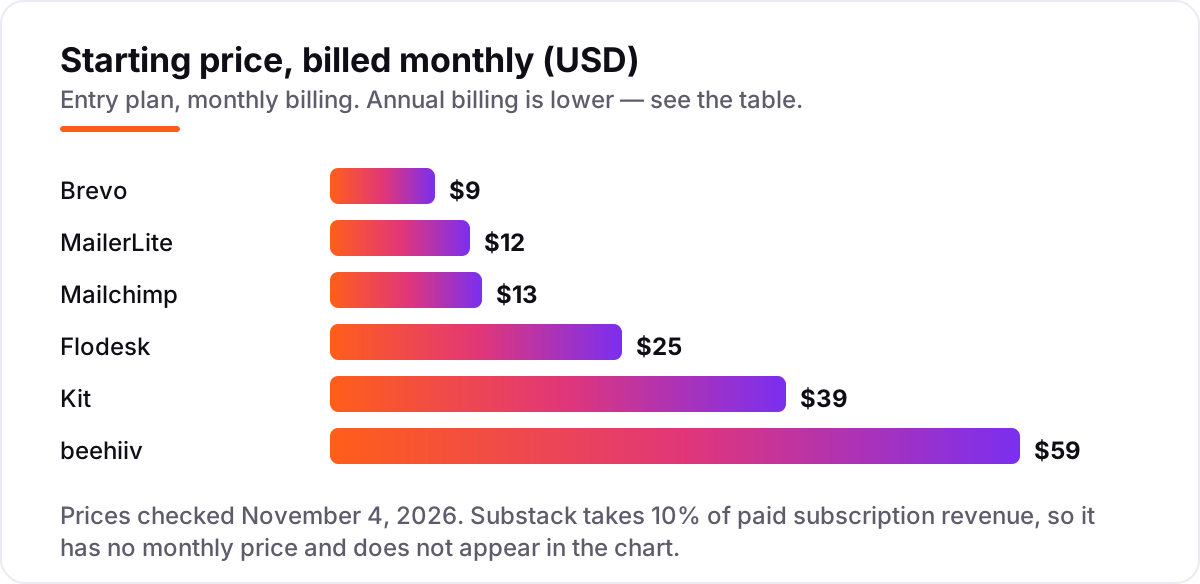
MailerLite, Brevo and Mailchimp are the value end of this list, and they reach low prices in three different ways. MailerLite charges the least per subscriber and gives every paid plan the same features. Brevo charges per email sent, so a big list emailed twice a month stays cheap. Mailchimp is the generalist: the most integrations and templates, with a price that climbs fastest as the list grows.
Pick this group when the budget is the constraint. MailerLite suits a modest list sent weekly, Brevo suits a large list sent rarely, and Mailchimp suits a creator who also runs a store or a team and will use the integrations. All three have real free plans, but all three gate automations or branding behind a paid tier.
Monetization: where the money goes
The monthly fee is only half the cost. When you sell, the platform takes a cut: Substack keeps 10% of paid subscription revenue, Kit takes 3.5% plus 30 cents per sale, beehiiv takes 0% of paid subscriptions and digital product revenue, and Flodesk Checkout adds no platform fee on top of Stripe. Stripe's card processing — about 2.9% plus 30 cents per payment — applies on top wherever you sell.
Work it out at two sizes. At $500 a month of paid subscription revenue, Substack's 10% costs about $50, almost exactly beehiiv Lite's $49 a month billed annually — a wash. At $1,000 a month, Substack costs about $100 while beehiiv still costs $49, so the flat fee wins by about $51 a month. The rule is simple: while paid revenue is small, the percentage platform is cheaper; once it passes a few hundred dollars a month, the flat fee is cheaper.
If you want the traffic that feeds the list in the first place, our guide to email marketing for local business covers list-building basics, and marketing automation for small business explains the sequences worth building first.
Email marketing platforms for creators pricing: what you will actually pay
Take a creator with a 1,000-subscriber list sending a weekly newsletter. On monthly billing, Kit Creator costs $39 a month, or $468 a year; beehiiv Lite costs $59 a month, or $708 a year; Flodesk Lite costs $25 a month, or $300 a year; Mailchimp Essentials costs $13 a month, or $156 a year; MailerLite Comfort costs $12 a month, or $144 a year; Brevo Starter costs $9 a month, or $108 a year. Substack costs $0 a month — until readers pay, when its 10% fee applies.
Annual billing cuts the bill where it exists: Kit drops from $39 to $33 a month, or $396 a year — a $72 saving; beehiiv drops from $59 to $49 a month, or $588 a year — a $120 saving; Flodesk drops from $25 to $19 a month, or $228 a year — also a $72 saving; MailerLite drops from $12 to $10.80 a month, or $129.60 a year; Brevo drops from $9 to $8.08 a month, or $96.96 a year. Mailchimp publishes no annual figure in this list, so its $156 a year is the monthly rate times twelve.
The headline price is not the whole bill, because each plan's limits decide what you actually pay. Kit's $39 covers 1,000 subscribers and climbs at every band, reaching $139 a month at 10,000; Brevo's $9 tier caps stored contacts at 500, so a 5,000-contact list needs a higher-volume tier at about $32 a month; Flodesk Lite keeps Flodesk branding on emails and allows only one workflow. And on Substack the bill is the fee, not a subscription: at $500 a month of paid subscription revenue, the 10% cut is $50 a month, or $600 a year — more than Kit's $396 annual bill for the same list. Price the plan at the list size you will have in a year, on annual billing, with the selling fees included.
Know the difference: newsletter-first platforms vs creator all-rounders
The confusion in this category is between two kinds of tool that both send email but serve different businesses. Newsletter-first platforms — beehiiv and Substack — are built around publishing a newsletter and earning from it: a hosted website, email and web publishing, paid subscriptions out of the box, and growth through a reader network. Creator all-rounders — Kit and Flodesk — are built around the creator business as a whole: email plus visual automations, sequences, and built-in selling of digital products, courses and memberships.
The second confusion is the monetization model, which is really a choice about who bears the risk. Substack takes 10% of paid subscription revenue and charges no monthly fee, so it costs nothing while you earn nothing; beehiiv charges a flat $59 a month and takes 0% of paid subscriptions, so it costs the same whether you earn $50 or $5,000. Kit sits between the two: a flat $39 a month plus 3.5% plus 30 cents per sale. If the newsletter is the product, the newsletter-first platforms fit; if email is one part of a business that also sells, the all-rounders fit; and if the budget is the constraint, the volume-priced options — MailerLite, Brevo and Mailchimp — do the sending without the creator-specific selling tools.
Quick comparison: tool type by need
| Buyer | Best pick | Why |
|---|---|---|
| Full-time creator, email plus selling | Kit | $39/month, automations and checkout in one account |
| Newsletter-first, growth and paid subs | beehiiv | $59/month, 0% fee on paid subscriptions |
| Writer who wants discovery, no monthly bill | Substack | Free to publish; 10% of paid revenue only |
| Tightest budget, full features | MailerLite | $12/month, same features on every paid plan |
| Design-first emails | Flodesk | $25/month, best templates, unlimited sends |
| Store or team, most integrations | Mailchimp | $13/month, widest integration library |
| Big list, emailed rarely | Brevo | $9/month, priced by emails sent |
How to choose the best email marketing platforms for creators
- Work out what you are being charged for. Per subscriber, per contact, per email sent or a share of revenue — the model decides the bill more than the headline price. A 5,000-contact list costs $75 on Mailchimp Essentials, $49 on MailerLite Comfort and about $32 on Brevo Starter.
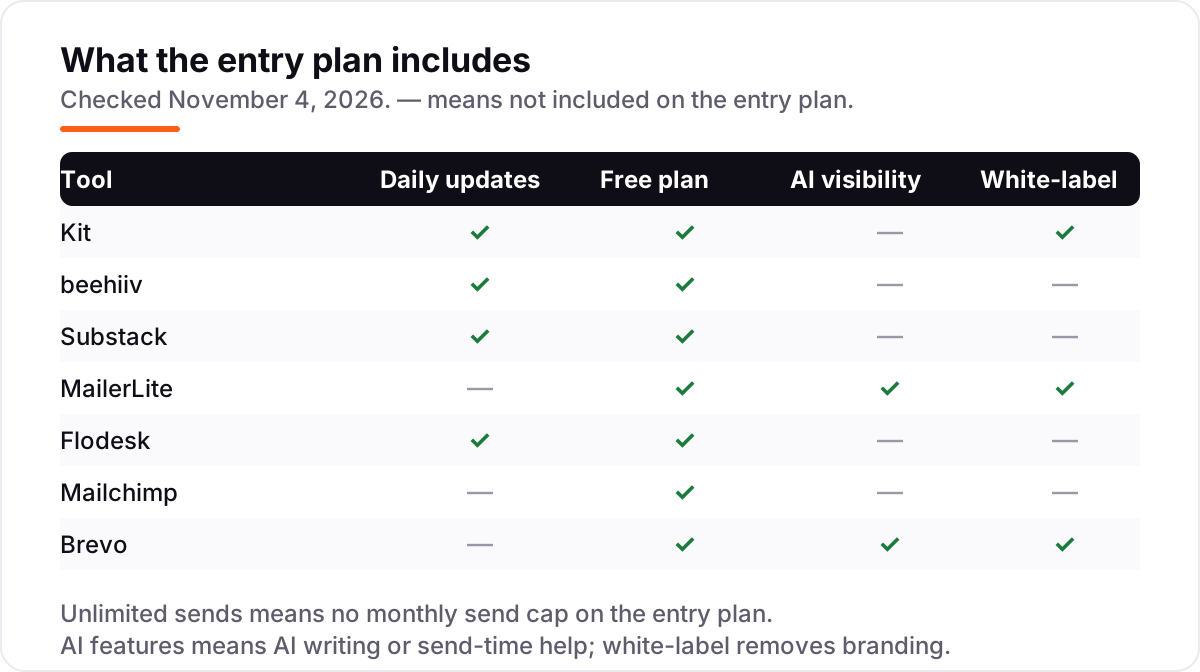
- Check what the free plan actually allows. Kit's free plan covers 10,000 subscribers but has no automations; Flodesk's free plan cannot send email at all. The first welcome sequence is usually what forces the upgrade.
- Price the paid tier, not the free one. Work out what the plan costs at the list size you will have in a year, and check whether the price steps up at every band.
- Check the selling fees. If paid subscriptions are the income, compare the platform's cut: 0% on beehiiv, 3.5% plus 30 cents on Kit, 10% on Substack.
- Try before you pay. Every tool here has a free plan or a free trial. Send a real campaign to your real list and check deliverability and the unsubscribe rate before committing.
Before you write the emails themselves, run your subject lines through the free SERP snippet preview tool — it shows exactly how your titles will look in Google, which is where most new subscribers find you.
Mistakes to avoid
- Comparing monthly prices without checking the billing model. A $9 plan priced per email sent and a $39 plan priced per subscriber are not comparable until you know your list size and sending frequency.
- Ignoring what counts toward the bill. Mailchimp charges for unsubscribed contacts, Brevo caps stored contacts per tier, and Kit auto-upgrades you to the next subscriber band.
- Paying for a suite when you only need a newsletter. A newsletter platform at $0–$59/month beats a general marketing suite you only use for sending.
- Trusting a directory price. Kit, beehiiv and Flodesk all repriced in the last year; older guides still show the old figures. Always check the vendor's own page.
- Forgetting the revenue cut. A free platform that takes 10% of paid subscriptions costs more than a $49/month platform once paid revenue passes about $500 a month.
How we chose
We opened each vendor's own pricing page on November 4, 2026 and recorded the starting price exactly as shown. Three pages render their prices in interactive calculators or sliders, so their monthly-billing figures are the vendors' published values as read from those pages in October 2026, with the plan structure and yearly-billing figures confirmed on the vendor pages today: Kit ($39/month Creator at 1,000 subscribers), beehiiv ($59/month Lite) and Brevo ($9/month Starter). Mailchimp's pricing page could not be opened on November 4, 2026 — the fetch service returned rate-limit errors — so its $13 Essentials figure is third-party-sourced from multiple independent reads of mailchimp.com/pricing in October 2026 that all agree, and is not presented as vendor-verified today. Substack publishes no pricing page; its 10% fee comes from its own help center as reported by multiple sources. No ratings are shown because no G2 or Capterra page could be opened today. We ranked the tools by fit for the most common buyer — a creator growing a newsletter and earning from it — not by brand size. No vendor paid for a place in this list, and none of the links here are affiliate links.
What to do next
Start with the decision path above: work out your billing model, check the free plan's real limits, and price the paid tier at next year's list size. Then take the free plan or trial of your top pick and send a real campaign to your real list for a month. If the emails land in the inbox and the automations save you time, you have your tool. If the emails are sorted but new subscribers are not finding you, our monthly SEO service handles the visibility side. Once your tools are in place, find out what's holding your rankings back.
Your stack only works if people find you
SerpAstra fixes what keeps your site off page one and makes it easy for AI assistants to recommend.
Get a free audit→Sources we checked (7)
- Kit pricing — kit.com/pricing (checked November 4, 2026)
- beehiiv pricing — beehiiv.com/pricing (checked November 4, 2026)
- Substack — free to publish; 10% fee on paid subscriptions (substack.com, checked November 4, 2026)
- MailerLite pricing — mailerlite.com/pricing (checked November 4, 2026)
- Flodesk pricing — flodesk.com/pricing (checked November 4, 2026)
- Mailchimp pricing — mailchimp.com/pricing/marketing (last read October 2026; page could not be opened November 4, 2026)
- Brevo pricing — brevo.com/pricing (checked November 4, 2026)
Shamim
Founder of SerpAstra
A full-stack SEO and digital marketer who spends most days on Local SEO for dental practices, AI search visibility and lead generation.
Frequently asked questions
What is the best email marketing platform for creators in 2026?
Kit is the best all-round pick: email, automations and selling in one place from $39/month, with a free plan covering 10,000 subscribers. If the newsletter itself is the product, beehiiv is the better pick at $59/month with a 0% fee on paid subscriptions. Writers who want discovery and no monthly bill should start on Substack.
How much does email marketing cost for creators?
Between $9 and $59 a month at the entry level. Brevo starts at $9, MailerLite at $12, Mailchimp at $13, Flodesk at $25, Kit at $39 and beehiiv at $59. Substack has no monthly fee and instead takes 10% of paid subscription revenue. Every platform here has a free plan, but the free tiers all limit automations, sending or branding.
Is there a free email marketing platform for creators?
Yes. Kit is free for up to 10,000 subscribers, beehiiv for up to 2,500, and Substack is free to publish at any list size. MailerLite covers 250 subscribers free, Mailchimp 250 contacts, and Brevo sends 300 emails a day free. The catch is consistent: free plans limit automations and keep the vendor's branding on your emails.
Kit vs beehiiv: which is better for a newsletter?
Beehiiv is better when the newsletter is the business: it is built for publication growth, with the recommendation network, ad network and a 0% fee on paid subscriptions. Kit is better when email is one part of a creator business that also sells courses, products or memberships, because it bundles automations, sequences and checkout in the same account.
Is Substack really free?
Publishing is free at any list size, and there is no monthly bill. You pay only when readers pay you: Substack keeps 10% of every paid subscription payment, and Stripe adds about 2.9% plus 30 cents per payment plus a 0.7% recurring billing fee. That 10% never falls, so once paid revenue passes a few hundred dollars a month, a flat-fee platform is cheaper.
What should creators check before paying for an email platform?
Four things: what the price is based on — subscribers, contacts, emails sent or revenue share — since the same list can cost $9 or $59 depending on the model; whether automations are included or gated behind a higher tier; whether the vendor's branding stays on your emails; and what the platform takes when you sell, from 0% on beehiiv to 10% on Substack.
Can I switch email platforms later?
Yes, and every tool here offers free migration or list import, but switching still costs time: automations, templates and landing pages do not transfer, and you must re-warm your sending reputation on the new platform. Pick the platform that fits the business you will have in a year, not just the list you have today, and keep a backup export of your subscribers.
Free SEO and AI visibility audit
Find out what is holding your rankings back
Send us your site. Within 2 business days you get a written audit, an AI visibility check and a short fix list ranked by impact. Free, with no contract attached.
Request my free audit→Related guides
 MarketingEmail marketing for local businesses (that customers actually open)Email marketing for local businesses: build a list the right way, send emails customers open, and turn past customers into repeat bookings without spam.Read guide →
 MarketingMarketing automation for small businesses: what to automate (and what not to)Marketing automation for small businesses, explained: what to automate first, what to keep human, and the tools that save hours without losing customers.Read guide →
 AI, Data & Analytics8 Best AI Tools for Content Creators in 2026 (Free and Paid, Compared)The 8 best ai tools for content creators, compared on price, free plans and strengths — writing, design, video. Prices checked on vendor sites, Nov 2, 2026.Read guide →