
12 Best Email Marketing Software for Beginners in 2026, Compared
12 best email marketing software for beginners compared on price, free plans and automation. Real starting prices, gathered November 4, 2026.
 Shamim Mia, Founder, SerpAstraLast verified November 4, 202618 min read
We compare pricing pages, documentation and public reviews. We never accept payment for rankings.

Key takeaways
- MailerLite is the best pick for most beginners: a clean editor, automation and an AI writing assistant from $12/month. Brevo is the cheapest paid entry at $9/month, and Kit is free up to 10,000 subscribers.
- Free plans are real here — SendPulse sends 15,000 emails a month free, and Kit is free to 10,000 subscribers.
- The single most important buying factor is how the price is counted: by contacts, by sends, or by emails sent. A $9 plan can cost $48 at 5,000 contacts.
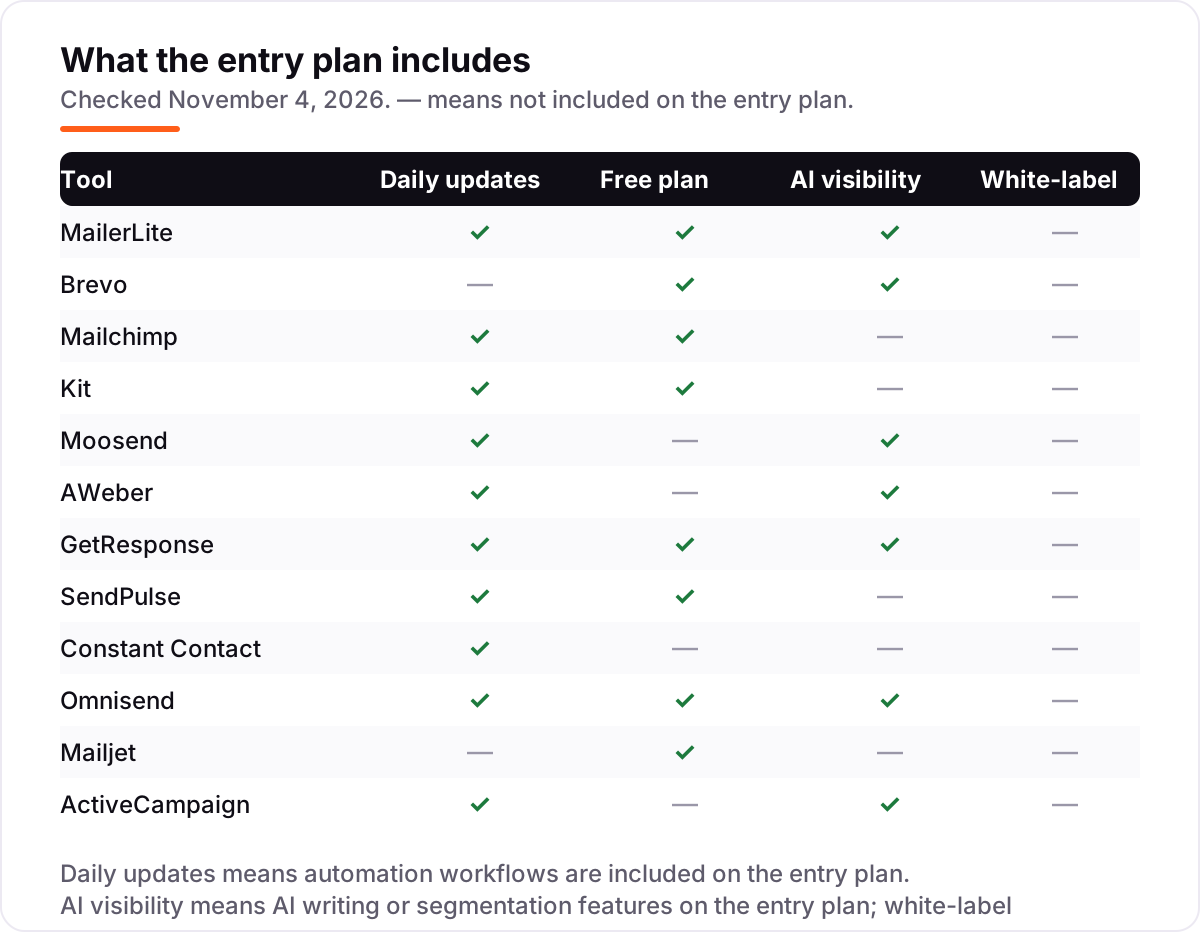
- Automation is not in every entry plan: Brevo and Mailjet hold it for higher tiers, while MailerLite, Moosend and AWeber include it from the start.
- Prices below are third-party sourced: the vendor pricing pages could not be opened on November 4, 2026, so each figure comes from a page that read the vendor's own pricing page in October 2026. No ratings are shown, because no G2 or Capterra page could be opened today.
On this page
Quick comparison
| Tool | Best for | Starting price | Free plan |
|---|---|---|---|
| MailerLite | Beginners who want the easiest editor and the cheapest full-featured paid plan | $12/mo | Yes (250 subscribers) |
| Brevo | Beginners who send occasionally and want the cheapest paid entry point | $9/mo | Yes (300 emails/day) |
| Mailchimp | Beginners who want the best-known brand and the widest integration library | $13/mo | Yes (250 contacts) |
| Kit | Creators and bloggers who sell courses, downloads or a paid newsletter | $39/mo | Yes (10,000 subscribers) |
| Moosend | Budget senders who mail often and want unlimited sends for one flat price | $9/mo | No (30-day trial) |
| AWeber | Small businesses that want a long-established tool with automation from the cheapest plan | $15/mo | No (14-day trial) |
| GetResponse | Beginners who want webinars and funnels in the same subscription as email | $19/mo | Yes (500 contacts) |
| SendPulse | Small businesses that want email plus chatbots, SMS and a CRM in one account | $12/mo | Yes (15,000 emails/mo) |
| Constant Contact | Event-led small businesses and nonprofits that want phone support on every plan | $12/mo | No (30-day trial) |
| Omnisend | Online stores on Shopify or WooCommerce that want ecommerce automation | $16/mo | Yes (250 contacts) |
| Mailjet | Senders who want marketing and transactional email on one plan | $9/mo | Yes (6,000 emails/mo) |
| ActiveCampaign | Beginners who plan to grow into serious automation and a built-in CRM | $19/mo | No (14-day trial) |
Make one of these tools?
We re-check this list every quarter. Send a correction, request a review, or ask about a clearly labeled sponsored spot.
Request a listingThe best email marketing software for beginners
MailerLite
Best for: Beginners who want the easiest editor and the cheapest full-featured paid plan
MailerLite is the easiest tool in this list to learn, and the Comfort plan is the cheapest full-featured paid plan here at $12 a month for 500 subscribers. The editor is clean, the automation builder is visual, and Comfort includes an AI writing assistant, unlimited emails and three user seats. The free plan covers 250 subscribers and 2,500 emails a month, with automation included, so a beginner can build a welcome sequence before paying.
The trade-offs are support and tax. There is no phone support on any plan, and MailerLite adds VAT or sales tax at checkout, so the $12 headline is not the final bill. The free plan was also cut in 2026 from 1,000 subscribers to 250. Start here if you want the gentlest learning curve and the lowest full-featured price.
What we like
- Comfort costs $12/month for 500 subscribers with unlimited emails — the cheapest full-featured paid plan here
- Automation workflows and an AI writing assistant are included on Comfort, not held for a higher tier
- The free plan includes automation, landing pages and a website builder, so you can learn the tool before paying
Watch out for
- No phone support on any plan — help is email and chat only
- The free plan was cut to 250 subscribers and 2,500 emails a month in 2026, so growing lists outgrow it fast
- Prices exclude VAT and sales tax, which MailerLite adds at checkout

Brevo
Best for: Beginners who send occasionally and want the cheapest paid entry point
Brevo is the cheapest paid entry in this list: Starter costs $9 a month for 5,000 emails, and the free plan stores up to 100,000 contacts while sending 300 emails a day. Because Brevo charges by emails sent rather than contacts stored, it suits a big list that is mailed rarely. Starter includes an AI content generator, advanced segmentation and a drag-and-drop editor.
The catches are in the fine print. Starter caps contacts at 500 on the entry tier, the Brevo logo stays on your emails unless you pay $12 a month extra, and marketing automation starts on Standard at $18 a month. A beginner who mails weekly will also find the send-based bill climbs with every campaign. Pick Brevo when your list is large, your sending is light, and $9 a month is the budget.
What we like
- Starter at $9/month is the lowest paid entry in this list, with an AI content generator included
- You pay by emails sent, not contacts stored — the free plan holds up to 100,000 contacts
- Advanced segmentation is included on Starter, which most rivals hold for higher tiers
Watch out for
- Starter caps contacts at 500 on the entry tier, and the Brevo logo stays unless you pay $12/month extra
- Marketing automation starts on Standard ($18/month), not Starter
- The send-based price climbs with every campaign, so frequent senders can outgrow the cheap entry fast

Mailchimp
Best for: Beginners who want the best-known brand and the widest integration library
Mailchimp is the name most beginners already know, and Essentials is a solid first paid plan at $13 a month for 500 contacts. It includes A/B testing, every template, three user seats and 24/7 email and chat support, and it connects to almost any store, site builder or CRM through the largest integration library in this list. The free plan covers 250 contacts and 500 sends a month.
The price is the problem as you grow. Essentials jumps to $45 a month at 2,500 contacts and $110 at 10,000, and Mailchimp bills for unsubscribed contacts sitting in your audience, so a neglected list still costs money. The free plan was also cut to 250 contacts in February 2026. Choose Mailchimp for the brand, the integrations and the support — and budget for the price ladder, not just the $13 entry.
What we like
- Essentials includes A/B testing, all templates and 24/7 email and chat support from $13/month
- The largest integration library in this list, so it connects to almost any store or site builder
- Three user seats on Essentials, so a small team can share one account
Watch out for
- The price climbs steeply with contacts — Essentials is $45/month at 2,500 contacts and $110 at 10,000
- Mailchimp bills for unsubscribed and non-subscribed contacts sitting in your audience
- The free plan was cut to 250 contacts and 500 sends a month in February 2026

Kit
Best for: Creators and bloggers who sell courses, downloads or a paid newsletter
Kit, formerly ConvertKit, is built for creators who sell things: courses, downloads, coaching and paid newsletters. The free Newsletter plan covers up to 10,000 subscribers, the largest free tier in this list, and Creator adds unlimited visual automations and sequences, polls and Kit Commerce. Kit takes no cut of subscription revenue, which matters once a paid newsletter earns real money.
Creator is also the most expensive entry here at $39 a month for 1,000 subscribers, after a September 2025 price rise that more than doubled the old rate. The price climbs steeply too: $139 a month at 10,000 subscribers. And every sale through Kit Commerce carries a 3.5% plus 30-cent transaction fee. Pick Kit if you are a creator who will sell to the list; pick a cheaper tool if you only send a newsletter.
What we like
- The free Newsletter plan covers up to 10,000 subscribers — the largest free tier in this list
- Creator adds unlimited visual automations and sequences, plus polls and Kit Commerce
- Kit takes no cut of subscription revenue, only standard transaction fees on sales
Watch out for
- Creator costs $39/month at 1,000 subscribers after the September 2025 reprice — the highest entry price here
- The price rises steeply with list size: Creator is $139/month at 10,000 subscribers
- Kit takes 3.5% plus 30 cents on every sale through its commerce tools

Moosend
Best for: Budget senders who mail often and want unlimited sends for one flat price
Moosend is the simplest deal in this list: one Pro plan, unlimited emails, and a price set only by contacts. Pro starts at $9 a month for 500 contacts, or $7 billed annually, and includes automation workflows, an AI Writer, A/B testing, landing pages and five user seats. If you mail four times a week, the unlimited sends make Moosend cheaper than every send-counted rival at the same list size.
There is no free plan, only a 30-day trial, so the meter starts on day 31. The price also rises with contacts — $48 a month at 5,000 and $88 at 10,000 — and pay-as-you-go email credits start at $350, so occasional senders cannot buy small batches. Moosend is the right pick for a frequent sender on a tight budget who wants everything included for one flat price.
What we like
- Unlimited email campaigns and sends from $9/month — no send caps to count
- Automation workflows, an AI Writer and A/B testing are all included on the one Pro plan
- Five user seats included, so a small team fits on the cheapest plan
Watch out for
- No free plan — only a 30-day trial, so you pay from day 31
- The price rises with contacts: Pro is $48/month at 5,000 contacts and $88 at 10,000
- Pay-as-you-go email credits start at $350, so occasional senders cannot buy small batches

AWeber
Best for: Small businesses that want a long-established tool with automation from the cheapest plan
AWeber has sold email marketing since 1998, and Lite is a straightforward first paid plan at $15 a month for 500 subscribers, with 24/7 support included. Lite includes three automations, three landing pages, the full template library and AI subject lines, so a beginner can build a welcome sequence on the cheapest plan. There is no free plan — only a 14-day trial — so budget for $15 a month from the start.
Lite is tightly capped: one email list, three automations, three landing pages and one custom segment. AWeber branding stays on Lite emails, sales carry a 1% transaction fee, and the price climbs with subscribers — $60 a month at 5,000. AWeber suits a beginner who wants a long-established tool with real features on the cheapest plan; look elsewhere if you need many lists or automations.
What we like
- Lite includes 3 automations, 3 landing pages and AI subject lines from $15/month
- Lite costs $15/month for 500 subscribers with 24/7 support included
- A long-established tool — AWeber has sold email marketing since 1998
Watch out for
- Lite is capped at 1 email list, 3 automations, 3 landing pages and 1 custom segment
- AWeber branding stays on Lite emails, and sales carry a 1.0% transaction fee
- The price climbs with subscribers: Lite is $60/month at 5,000 subscribers

GetResponse
Best for: Beginners who want webinars and funnels in the same subscription as email
GetResponse is the all-in-one of this list: email, landing pages, funnels, webinars and courses in one subscription. Starter costs $19 a month for 1,000 contacts and includes unlimited emails, autoresponders, unlimited landing pages and an AI email generator, plus 24/7 chat support. The free plan covers 500 contacts with unlimited newsletters, which is generous for a first list.
The bundle has edges. Webinars are not in Starter — they need the Creator plan at $69 a month or a $40 add-on — and Starter includes only one custom automation workflow, with unlimited workflows held for Marketer at $59. The entry price is also set at 1,000 contacts, so a list of 100 pays the same $19. Choose GetResponse when webinars or funnels are on your roadmap, not just email.
What we like
- Unlimited email sends on every plan, including the free plan for 500 contacts
- Starter includes an AI email generator, autoresponders and unlimited landing pages
- One subscription covers email, funnels, webinars and courses as you grow into the higher plans
Watch out for
- Webinars need the Creator plan ($69/month) or a $40/month add-on — they are not in Starter
- Starter includes only one custom automation workflow; unlimited workflows need Marketer ($59/month)
- The entry price is set at 1,000 contacts, so a list of 100 pays the same $19 as a list of 1,000

SendPulse
Best for: Small businesses that want email plus chatbots, SMS and a CRM in one account
SendPulse gives beginners the most generous free plan in this list: 500 subscribers and 15,000 emails a month, with automation flows included. Standard costs $12 a month for 500 subscribers and adds unlimited emails, A/B testing and three user seats. The same account also runs chatbots, SMS, web push and a CRM, so a small business can run several channels without a second subscription.
The catch is that each extra channel is priced separately, so the $12 email price is not the whole bill. Standard also caps you at 10 automation flows, three landing pages and three domains, which a growing business will hit. Pick SendPulse if you want the biggest free send allowance and a multichannel account; pick a simpler tool if you only need email.
What we like
- The free plan sends 15,000 emails a month — the most generous free send allowance here
- Standard includes unlimited emails, A/B testing and automation from $12/month
- Chatbots, SMS, web push and a CRM live in the same account, with pay-as-you-go email credits from $48
Watch out for
- Each extra channel is priced separately, so the email price is not the whole bill
- Standard caps you at 10 automation flows, 3 landing pages and 3 domains

Constant Contact
Best for: Event-led small businesses and nonprofits that want phone support on every plan
Constant Contact is the support-first pick: phone, chat and email help come with every plan, including Lite at $12 a month for 500 contacts, and the 30-day free trial is tied with Moosend for the longest in this list. Lite includes event registration tools and a single-step automation, and the platform is built for nonprofits, clubs and event-led businesses that mail a regular newsletter and sell tickets.
There is no free plan — it was removed in June 2025 — so the trial is the only free taste. Lite also jumps from $12 to $30 a month the moment you pass 500 contacts, and it allows no segmentation or A/B testing, which Standard adds at $35. Choose Constant Contact when phone support and events matter more than automation depth or the lowest price.
What we like
- Phone, chat and email support come with every plan, including the $12 Lite tier
- A 30-day free trial with no credit card required — tied with Moosend for the longest trial in this list
- Built-in event registration and SMS options suit nonprofits and event-led businesses
Watch out for
- No free plan — the free plan was removed in June 2025
- Lite jumps from $12 to $30 a month the moment you pass 500 contacts
- Lite allows only single-step automation, with no segmentation or A/B testing

Omnisend
Best for: Online stores on Shopify or WooCommerce that want ecommerce automation
Omnisend is built for online stores, and it shows: abandoned-cart, welcome and post-purchase flows, product recommendations and pop-ups are core features, not add-ons. Standard costs $16 a month for 500 contacts and includes unlimited automations, web push notifications and 24/7 live chat. The free plan includes all features for 250 contacts, so a new store can set up its flows before paying.
The price climbs steeply with contacts — Standard is $132 a month at 10,000 — and SMS is a separate add-on for new sign-ups rather than included. Billable contacts also include non-subscribers such as checkout customers, so the count runs higher than your subscriber list. Pick Omnisend if you sell online; a plain newsletter is cheaper elsewhere.
What we like
- Built for stores: abandoned-cart, welcome and post-purchase flows plus product recommendations
- The free plan includes all features for 250 contacts, with 24/7 live chat support
- Unlimited automations, pop-ups and web push notifications on the Standard plan
Watch out for
- The price climbs steeply with contacts: Standard is $132/month at 10,000 contacts
- SMS is a separate add-on for new sign-ups, not included in Standard
- Billable contacts include non-subscribers such as checkout customers, so the count runs higher than your subscriber list

Mailjet
Best for: Senders who want marketing and transactional email on one plan
Mailjet is the dual-purpose tool in this list: one account sends marketing campaigns and transactional email, with SMTP and an API included. Starter costs $9 a month for 8,000 emails and 2,000 contacts, and the free plan sends 6,000 emails a month to 1,000 contacts with no credit card required. From Essential at $19 a month, contacts are unlimited and the bill follows sends, not list size.
The gap is automation: Essential has none, and it starts on Premium at $29 a month. Starter also caps contacts at 2,000, and support is email-only on Essential. Mailjet is the right pick for a sender who needs receipts, password resets and newsletters from one account; it is the wrong pick if automated welcome or abandoned-cart sequences are the priority.
What we like
- One plan covers marketing campaigns and transactional email, with SMTP and an API included
- The free plan sends 6,000 emails a month to 1,000 contacts with no credit card required
- Contacts are unlimited from Essential ($19/month), so the bill follows sends, not list size
Watch out for
- No marketing automation until Premium ($29/month) — Essential has none
- Starter caps contacts at 2,000 and sends at 8,000 a month
- Email support only on Essential — no chat or phone

ActiveCampaign
Best for: Beginners who plan to grow into serious automation and a built-in CRM
ActiveCampaign has the strongest automation in this list, and Starter brings a surprising amount of it for $15 a month billed annually at 1,000 contacts: multi-step workflows, an AI automation builder, a built-in CRM, 250+ templates and A/B testing. It is the tool to pick when email is not just a newsletter but the engine of follow-up, lead scoring and sales.
It is also the least beginner-friendly way in. There is no free plan, only a 14-day trial, Starter caps each automation at five actions and allows one user, and the price rises steeply — $149 a month at 10,000 contacts — with AI and SMS as paid extras. Buy ActiveCampaign when you will use the automation daily; otherwise the cheaper tools here do the same newsletter for less.
What we like
- The strongest automation in this list, with multi-step workflows and an AI automation builder on Starter
- A built-in CRM comes with every plan, so contacts and deals live next to campaigns
- Starter includes 250+ templates, A/B testing and 10x contact sends a month
Watch out for
- No free plan — only a 14-day trial, so you pay from the start
- Starter caps each automation at 5 actions and allows only 1 user
- The price rises steeply: Starter is $149/month at 10,000 contacts, and AI and SMS extras add to the bill
What email marketing software actually does
The best email marketing software for beginners does three jobs: it stores your subscriber list, it sends your emails, and it sends the right email automatically when someone joins, buys or goes quiet. That is the whole product at the beginner level. You write a newsletter or a welcome email, the tool delivers it, and it shows you who opened it and who clicked. Everything else — landing pages, segmentation, A/B testing, AI writing — is a bonus on top of those three jobs, and the tools in this list differ mostly in which bonuses they include at the cheapest price.
People search for this category three ways — email marketing software, email marketing tools and newsletter software — and they all mean the same thing. The products differ in how they charge: some bill by contacts, some by emails sent, and some by emails sent with unlimited contacts. The price follows the billing model, not just the features, which is why a $9 plan can cost $48 at 5,000 contacts while a $19 plan stays $19.
One number shows why the tool matters more than the template: in EmailToolTester's January 2024 seed test of 15 email platforms, Constant Contact placed 91.7% of test emails in the inbox or Promotions tab, the second-best result in the test. The same test ranked Mailchimp among the five worst for deliverability. The lesson is that the sending platform, not just the subject line, decides whether subscribers ever see your email — so a beginner should weigh deliverability and support as heavily as price.
Free options first
If your list is small, you may not need to pay at all. SendPulse sends 15,000 emails a month free to 500 subscribers, and Kit is free up to 10,000 subscribers. MailerLite, Brevo, Mailchimp, GetResponse, Omnisend and Mailjet also have free plans. The free tiers are honest products, not demos — but they cap out fast, and the moment your list passes the limit, the paid plan is cheaper than the time you lose exporting and re-importing contacts.
For a brand-new newsletter, start with one of these free plans and upgrade when the list grows past the limit. For anything that earns money — a store, a course, a paid newsletter — skip the free tier: the automation, branding removal and reporting that matter start on the paid plans. Moosend, Constant Contact, ActiveCampaign and AWeber have no free plan at all, only trials, so they belong on the list only once you are ready to pay.
Email marketing pricing: what you will actually pay
Take a list of 1,000 subscribers mailed four times a month — 4,000 emails. On monthly billing, Brevo Starter covers it for $17 a month (the 10,000-email tier), MailerLite Comfort is $19, Mailjet Starter is $9 for 8,000 emails, Mailchimp Essentials is $26.50, Moosend Pro is $16, AWeber Lite is $25, GetResponse Starter is $19, SendPulse Standard is $18, Constant Contact Lite is $30, Omnisend Standard is $20, Kit Creator is $39, and ActiveCampaign Starter is $19 month-to-month or $15 billed annually. The spread at the same list size is $9 to $39 — and the cheapest plan is not the cheapest tool once you count what is included.
Now grow the same list to 10,000 subscribers. MailerLite Comfort is $89 a month, Mailchimp Essentials is $110, Kit Creator is $139, ActiveCampaign Starter is $149, Omnisend Standard is $132, and Moosend Pro is $88. Brevo is the odd one out: its bill follows sends, so a 10,000-contact list mailed four times a month needs the 40,000-email tier, not a contact tier. The worked example shows the rule: price the list size you will have in six months, not the one you have today, and check whether the plan counts contacts, sends or both.
Before you pay for any of these, run your campaign links through the free UTM builder so every email click shows up correctly in your analytics — it takes a minute and it is the difference between knowing an email worked and guessing.
Contacts, sends and emails: three different price meters
The biggest buyer confusion in this category is the price meter. Contact-priced tools — Mailchimp, MailerLite, Kit, AWeber, GetResponse, Constant Contact, Omnisend and ActiveCampaign — charge for the size of your list. A bigger list always costs more, even if you mail once a month. Send-priced tools — Brevo — charge for how many emails you send, so a big list mailed rarely stays cheap and a small list mailed daily gets expensive. Mailjet sits in between: it charges by emails sent, with unlimited contacts from Essential, so the bill follows volume rather than audience size.
The second confusion is what counts. Mailchimp bills for unsubscribed and non-subscribed contacts sitting in your audience, so a list that has collected dead addresses costs money until you archive them. Omnisend counts non-subscribers such as checkout customers as billable contacts. Brevo caps how many contacts you can store on its cheapest tiers — 500 on the $9 entry tier — even though its free plan stores 100,000. Read the meter before you compare the headline price, because two tools at $12 a month can bill very differently for the same list.
Cheapest paid plans and all-in-one suites
The 12 tools in this list split into two camps. The budget camp — Brevo, Moosend, Mailjet, MailerLite and SendPulse — sells email at $9 to $12 a month with the essentials included and little else. They are the right pick when the newsletter is the whole job and the budget is tight. The suites — GetResponse and ActiveCampaign, with Kit and Omnisend in their own niches — bundle email with webinars, funnels, a CRM or ecommerce automation, and charge more for it.
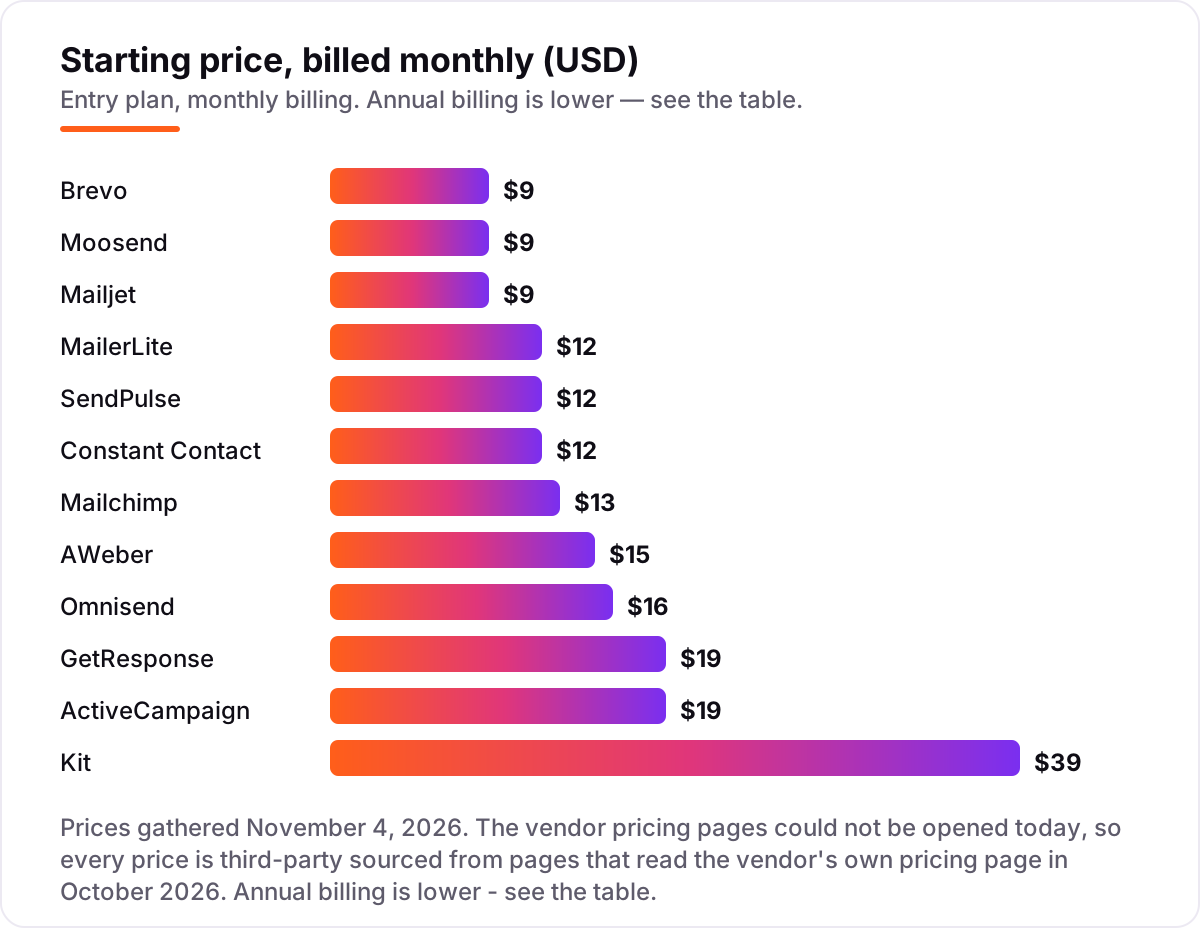
The right camp depends on what you already pay for. If you need webinars, GetResponse replaces a separate webinar subscription. If you need a CRM and serious automation, ActiveCampaign replaces a separate CRM. If you only need to send a newsletter, a $9 to $12 budget plan does the same job for a third of the price. The chart below shows the entry price of each tool on monthly billing; the comparison table at the top shows the annual figure where one exists.
Creators, stores and automation power
Three tools in this list are built for one buyer each, and they win their niche even though they lose on headline price. Kit is built for creators: the free plan covers 10,000 subscribers, Creator adds unlimited visual automations, and Kit Commerce lets a creator sell courses and paid newsletters without giving up a cut of subscription revenue. Omnisend is built for stores: abandoned-cart and post-purchase flows, product recommendations and pop-ups are core features, and the free plan includes all of them for 250 contacts. ActiveCampaign is built for automation: multi-step workflows, an AI automation builder and a built-in CRM come with every plan, including Starter.
The rest of the list is general-purpose, and that is a strength for a beginner who does not yet know their niche. MailerLite, Brevo, Mailchimp, AWeber, SendPulse, Constant Contact, Mailjet, Moosend and GetResponse all send a good newsletter, and the choice between them is mostly price, free-plan size or trial length, and support. If you already know you are a creator, a store owner or an automation buyer, pick the specialist. If you do not know yet, pick the cheapest general tool with a free plan and switch later — the list exports with a CSV file.
Our monthly SEO service is built for the next step after the email tool is in place: getting the site itself found, so the list keeps growing without paid ads.
Know the difference: priced by contacts, by sends, or by emails
The confusion in this category is between three price meters that share the same headline numbers. Contact-priced tools — Mailchimp, MailerLite, Kit, AWeber, GetResponse, Constant Contact, Omnisend and ActiveCampaign — charge for the size of your list, so a bigger list always costs more even if you mail once a month. Send-priced tools — Brevo — charge for how many emails you send, so a big list mailed rarely stays cheap and a small list mailed daily gets expensive. Mailjet sits in between: it charges by emails sent, with unlimited contacts from Essential, so the bill follows volume rather than audience size.
There is a second, quieter confusion: what counts as a contact. Mailchimp bills for unsubscribed and non-subscribed contacts sitting in your audience, so a list that has collected dead addresses costs money until you archive them. Omnisend counts non-subscribers such as checkout customers as billable contacts. Brevo caps how many contacts you can store on its cheapest tiers — 500 on the $9 entry tier — even though its free plan stores 100,000. Read the meter before you compare the headline price, because two tools at $12 a month can bill very differently for the same list.
A third distinction worth knowing is a free plan versus a free trial. Eight tools here have a real free plan — MailerLite, Brevo, Mailchimp, Kit, GetResponse, SendPulse, Omnisend and Mailjet — with a monthly send or contact limit and no expiry date. Four have only a trial: Moosend (30 days), Constant Contact (30 days), ActiveCampaign (14 days) and AWeber (14 days). A trial ends on a date, a free plan ends at a limit, so budget for the day the trial converts if you pick a trial-only tool.
Quick comparison: tool type by need
| Buyer | Best pick | Why |
|---|---|---|
| Absolute beginner, lowest cost | MailerLite | $12/month, easiest editor, automation and AI included |
| Big list, mailed rarely | Brevo | $9/month, priced by sends, free plan stores 100,000 contacts |
| Frequent sender on a budget | Moosend | $9/month, unlimited sends, everything in one plan |
| Creator selling courses or a paid newsletter | Kit | Free to 10,000 subscribers, commerce built in |
| Online store | Omnisend | Abandoned-cart flows and product recommendations from $16/month |
| Needs webinars and funnels too | GetResponse | Webinars, funnels and courses in one subscription |
| Wants phone support and events | Constant Contact | Phone help on every plan, 30-day trial, event tools |
| Plans to grow into serious automation | ActiveCampaign | Strongest workflows and a built-in CRM from $15/month billed annually |
How to choose the best email marketing software for beginners
- Count your subscribers first. Under 500, the free plans cover you. Over 1,000, the per-subscriber price decides — Brevo, Moosend and MailerLite win on cost.
- Count your sends. If you mail weekly or more, unlimited-send plans (Moosend, MailerLite, GetResponse, SendPulse) beat send-counted plans. If you mail monthly, Brevo's send pricing is the cheapest way to hold a big list.
- Pick your one automation. A welcome email is the automation every beginner needs. Make sure the plan you pick includes it — Brevo Starter and Mailjet Essential do not.
- Decide specialist or general. Creator, store owner or automation buyer: pick Kit, Omnisend or ActiveCampaign. Everyone else: pick the cheapest general tool with a free plan.
- Try before you pay. Every tool in this list has a free plan or a free trial. Send a real campaign to your real list for a week and check the open rate against the previous tool before committing.
Mistakes to avoid
- Comparing headline prices without checking the meter. A $9 plan priced by sends and a $9 plan priced by contacts bill very differently for the same list.
- Ignoring what counts as a contact. Mailchimp bills for unsubscribed contacts; Omnisend bills for checkout customers. Clean the list before you compare prices.
- Paying for a suite when you only need email. A $12 budget plan beats a $19 suite you only use for newsletters.
- Trusting a directory price. MailerLite renamed its plans in 2026 — Growing Business is now Comfort at $12, and Advanced is now Power at $25. Old pages still show the old names and prices.
- Forgetting the trial ends. Set a reminder for the day the trial converts, especially on Moosend, Constant Contact and ActiveCampaign, which have no free plan to fall back to.
How we chose
We gathered each price on November 4, 2026 from third-party pages that read the vendor's own pricing page in October 2026, because the vendor pricing pages could not be opened on the day of writing. No price here is presented as verified on the vendor's own page today, and every figure names its plan and contact or send tier so it can be checked. No G2 or Capterra ratings are shown, because no review page could be opened today — ratings are omitted rather than estimated. We ranked the tools by fit for the most common buyer — a beginner sending a first newsletter to a small list — not by brand size. No vendor paid for a place in this list, and none of the links here are affiliate links.
What to do next
Start with the decision path above: count your subscribers, count your sends, and decide specialist or general. Then take the free plan or trial of your top pick and send a real campaign to your real list. If the open rate holds and the editor makes sense, you have your tool. Once your tools are in place, find out what's holding your rankings back.
Your stack only works if people find you
SerpAstra fixes what keeps your site off page one and makes it easy for AI assistants to recommend.
Get a free audit→Sources we checked (15)
- MailerLite pricing — mailerlite.com/pricing
- Brevo pricing — brevo.com/pricing
- Mailchimp pricing — mailchimp.com/pricing/marketing
- Kit pricing — kit.com/pricing
- Moosend pricing — moosend.com/pricing
- AWeber pricing — aweber.com/pricing
- GetResponse pricing — getresponse.com/pricing
- SendPulse pricing — sendpulse.com/pricing
- Constant Contact pricing — constantcontact.com/pricing
- Omnisend pricing — omnisend.com/pricing
- Mailjet pricing — mailjet.com/pricing
- ActiveCampaign pricing — activecampaign.com/pricing
- EmailToolTester deliverability seed test, quoted in the Campaigner Mailchimp vs Constant Contact comparison
- MailerLite 2026 plan rename and prices — emailsoftwareinsights.com
- Kit pricing ladder — professionalstoolkit.com
Shamim
Founder of SerpAstra
A full-stack SEO and digital marketer who spends most days on Local SEO for dental practices, AI search visibility and lead generation.
Frequently asked questions
What is the best email marketing software for beginners?
MailerLite is the best pick for most beginners: a clean editor, automation and an AI writing assistant from $12/month, with a free plan to learn on. If you send rarely and your list is large, Brevo at $9/month is cheaper. Creators who sell courses or paid newsletters should start with Kit, which is free up to 10,000 subscribers.
How much does email marketing software cost for a beginner?
Between $0 and $39 a month at the entry level. Brevo, Moosend and Mailjet start at $9/month, MailerLite, SendPulse and Constant Contact at $12, and Kit Creator at $39. Most beginners can start free — SendPulse sends 15,000 emails a month free — and pay only once the list grows past the free limits.
Is there a free email marketing software for beginners?
Yes, with limits. SendPulse sends 15,000 emails a month free to 500 subscribers, and Kit is free up to 10,000 subscribers. MailerLite, Brevo, Mailchimp, GetResponse, Omnisend and Mailjet also have free plans. Moosend, Constant Contact, ActiveCampaign and AWeber have trials instead of free plans.
What is the difference between pricing by contacts and pricing by sends?
Contact pricing charges for the size of your list — Mailchimp, MailerLite and Kit work this way, so the bill rises as the list grows. Send pricing charges for how many emails you send — Brevo works this way, so a big list mailed rarely stays cheap. Mailjet charges by emails sent with unlimited contacts from Essential, which suits senders whose list grows faster than their sending.
Do I need automation as a beginner?
You need one automation: a welcome email that goes out the moment someone subscribes. MailerLite, Moosend, AWeber, Kit, SendPulse and Omnisend include automations on their entry plans, so you can set it up on day one. Brevo and Mailjet hold automation for higher tiers, so check before you buy if a welcome sequence matters to you.
Can I switch email marketing tools later?
Yes. Every tool in this list imports contacts from a CSV file and exports your list the same way, so moving is a weekend job, not a rebuild. The part that takes time is rebuilding automations and templates, which do not transfer between tools. Start on a free plan, and switch once you know which features you actually use.
Which email marketing tool is best for an online store?
Omnisend. It is built for stores on Shopify and WooCommerce, with abandoned-cart, welcome and post-purchase flows plus product recommendations from $16/month. Brevo is the budget alternative for stores that mail rarely, and Mailchimp fits stores that already use its integrations. A plain newsletter tool will not give you cart recovery.
Free SEO and AI visibility audit
Find out what is holding your rankings back
Send us your site. Within 2 business days you get a written audit, an AI visibility check and a short fix list ranked by impact. Free, with no contract attached.
Request my free audit→Related guides
 MarketingEmail marketing for local businesses (that customers actually open)Email marketing for local businesses: build a list the right way, send emails customers open, and turn past customers into repeat bookings without spam.Read guide →
 MarketingMarketing automation for small businesses: what to automate (and what not to)Marketing automation for small businesses, explained: what to automate first, what to keep human, and the tools that save hours without losing customers.Read guide →
 SEO & AI Search12 Best Marketing Platforms for Small Business SEO in 2026, ComparedThe 12 best marketing platforms for small business SEO, compared on real prices, SEO tools and AI visibility. Every price checked November 1, 2026.Read guide →