
12 Best Email Newsletter Platforms for 2026 (Pros, Cons and Pricing)
Compare the 12 best email newsletter platforms on price, free plans and paid-subscription fees, with every price checked on November 6, 2026.
 Shamim Mia, Founder, SerpAstraLast verified November 6, 202614 min read
We compare pricing pages, documentation and public reviews. We never accept payment for rankings.

Key takeaways
- Mailchimp is the best fit for most senders at $13/month; Brevo follows at $9/month for large lists emailed a few times, and MailerLite at $12/month for small teams that want a clean editor.
- The billing model matters more than the headline price: Brevo charges by emails sent, most tools by subscribers, and Substack takes 10% of paid subscription revenue with no monthly fee.
- The single most important buying factor is the limit that forces your next upgrade: contact caps, send caps and subscriber tiers decide what you actually pay, not the entry price.
- Seven of the 12 tools have a free plan, but the free tiers shrank in 2026 — Mailchimp allows 250 contacts and MailerLite 250 subscribers, while Kit covers 10,000 and beehiiv 2,500.
On this page
Quick comparison
| Tool | Best for | Starting price | Free plan |
|---|---|---|---|
| Mailchimp | Small businesses that want the most familiar all-in-one newsletter tool, with templates and integrations everywhere | $13/mo | Yes (free plan) |
| Brevo | Senders with a large list who email a few times a month and want to pay for sends, not subscribers | $9/mo | Yes (free plan) |
| MailerLite | Small teams that want a clean editor, honest subscriber pricing and strong support at a low price | $12/mo | Yes (free plan) |
| Kit | Creators and writers who sell courses, paid newsletters or digital products to their audience | $39/mo | Yes (free plan) |
| beehiiv | Newsletter-first publishers who want a website, paid subscriptions and growth tools in one place | $59/mo | Yes (free plan) |
| Constant Contact | Owners who want phone support and simple broadcast newsletters without learning automation | $12/mo | No (30-day trial) |
| GetResponse | Small businesses that want newsletters plus webinars, landing pages and funnels in one account | $19/mo | Yes (free plan) |
| AWeber | Long-running small lists that want dependable delivery and a team that answers the phone | $15/mo | No (14-day trial) |
| ActiveCampaign | Businesses that want serious automation and CRM depth behind a regular newsletter | $19/mo | No (14-day trial) |
| Ghost | Writers who want their own publication website, with a newsletter and memberships they fully own | $18/mo | No (14-day trial) |
| Substack | Writers who want to publish and charge readers with zero setup and zero monthly fee | Free; 10% of paid revenue | Yes (free to publish) |
| Moosend | Budget senders with 500 to 25,000 contacts who want unlimited sends and full automation on one plan | $9/mo | No (30-day trial) |
Make one of these tools?
We re-check this list every quarter. Send a correction, request a review, or ask about a clearly labeled sponsored spot.
Request a listingThe best email newsletter platform

Mailchimp
Best for: Small businesses that want the most familiar all-in-one newsletter tool, with templates and integrations everywhere
Mailchimp is the default recommendation for a reason: it is the easiest newsletter tool to start with, the templates look good out of the box, and it connects to almost everything a small business already uses. Essentials costs $13 a month for 500 contacts and adds A/B testing and simple automation flows, while Standard costs $20 and adds multi-step automation and predictive segments. The free plan covers 250 contacts and 500 emails a month.
The catch is the contact counting. Unsubscribed contacts count toward the tier until you archive them, and the price jumps to $75 a month at 5,000 contacts. There is also no annual discount on the marketing plans, so the monthly price is the price. Pick Mailchimp when you want the familiar, well-connected option and your list is still small.
What we like
- The widest template library and integration list here — it connects to almost every store, CRM and form tool
- Essentials adds A/B testing and simple automation flows at $13 a month, with 24/7 email and chat support
- The free plan covers 250 contacts and 500 emails a month, enough to test a real newsletter before paying
- Landing pages and signup forms are built in, so a newsletter can start without a website
Watch out for
- The bill climbs fast with list size: Essentials is $75 a month at 5,000 contacts, up from $13 at 500
- Unsubscribed contacts count toward the contact tier until you archive them, which inflates the price
- Multi-step automation and predictive segments wait for Standard at $20 a month

Brevo
Best for: Senders with a large list who email a few times a month and want to pay for sends, not subscribers
Brevo wins on the pricing model. Because you pay for emails sent rather than contacts stored, a business with a big list and a monthly newsletter pays $9 a month for 5,000 emails while contact-based rivals charge for every subscriber. The free plan allows 300 emails a day and stores up to 100,000 contacts, which covers many small newsletters entirely. Starter removes the daily cap and adds email support.
The trap is the contact cap hidden inside the send tiers. The $9 tier stores only 500 contacts, so a 1,000-subscriber list needs the 10,000-email tier at $17 a month, and a 5,000-subscriber list needs the 20,000-email tier at $32. Automation and A/B testing also wait for Standard at $18. Pick Brevo when your list is large and your sending is light.
What we like
- Send-based pricing beats every contact-priced rival for big lists emailed a few times a month
- The free plan allows 300 emails a day and stores up to 100,000 contacts — the most generous here
- SMS, WhatsApp and transactional email live in the same account, so one login covers every message
- Starter removes the daily send cap and adds email support, plus AI content tools
Watch out for
- The 5,000-email Starter tier stores only 500 contacts — a 1,000-subscriber list needs the $17 tier
- Marketing automation, A/B testing and landing pages wait for Standard at $18 a month
- Removing the Brevo logo from emails costs another $12 a month on Starter

MailerLite
Best for: Small teams that want a clean editor, honest subscriber pricing and strong support at a low price
MailerLite is the value pick because its pricing is the most honest: it counts active subscribers only, so dead addresses never push the bill up. Comfort costs $12 a month for up to 500 subscribers, or $10.80 billed yearly, and includes 50 automations, the AI writing assistant, logo removal and 3 seats. The editor is clean and setup is fast, and the free plan covers 250 subscribers and 2,500 emails a month.
Watch the send cap and the automation ceiling. Comfort allows 10 times the subscriber tier in monthly sends, so the entry tier tops out at 5,000 emails a month, and complex journeys with several triggers need Power at $25. The price also rises with the list: $19 a month at 1,000 subscribers. Pick MailerLite for a low, predictable bill and a tool that stays out of the way.
What we like
- Counts active subscribers only — unsubscribed and bounced contacts never push the price up
- Comfort includes 50 automations, the AI writing assistant and logo removal at $12 a month
- The editor is the cleanest here, and reviewers praise its support more than any other budget tool here
- Free plan covers 250 subscribers and 2,500 emails a month with 2 seats
Watch out for
- Comfort caps sends at 10 times the subscriber tier — 5,000 emails a month at the entry tier
- Automation is capped at 50 workflows on Comfort; complex journeys need Power at $25 a month
- The free plan was cut twice since 2025, from 500 subscribers to 250, so check the current limit before relying on it

Kit
Best for: Creators and writers who sell courses, paid newsletters or digital products to their audience
Kit, formerly ConvertKit, is built for people whose business is their audience: writers, coaches, podcasters and course sellers. Subscribers are organized by tags rather than lists, so one person can sit in several segments without being counted twice. Creator costs $39 a month for up to 1,000 subscribers, or $390 a year, and adds unlimited visual automations, unlimited email sequences and Kit Commerce for selling digital products.
The free Newsletter plan is the most generous here, covering up to 10,000 subscribers, but it has no automations — sequences and visual automations need the paid plan. Creator is also the dearest entry for a general newsletter at this size, and every sale carries a 3.5% plus 30-cent fee. Pick Kit when the newsletter is the business, not a side channel.
What we like
- Tag-based subscribers beat lists for creators who sell to segments of one audience
- Kit Commerce sells digital products and paid newsletters with a 3.5% plus 30-cent fee per sale
- The free Newsletter plan covers up to 10,000 subscribers — the largest free tier here
- Free migration from other tools, with visual automations and unlimited sequences on Creator
Watch out for
- Creator starts at $39 a month for 1,000 subscribers — triple Mailchimp Essentials at the same size
- Every sale carries a 3.5% plus 30-cent fee on all plans, including the free one
- The price rises steeply: $89 a month at 5,000 subscribers

beehiiv
Best for: Newsletter-first publishers who want a website, paid subscriptions and growth tools in one place
beehiiv is the only tool here built around the newsletter itself rather than around marketing email. It gives you a website, a newsletter, paid subscriptions, an ad network and a recommendation network in one account, and it takes 0% of paid subscription revenue — only Stripe's processing fee applies. Lite costs $59 a month for up to 1,000 subscribers, or $49 billed yearly, and the price stays flat up to 100,000 subscribers.
The free plan is genuinely usable, covering 2,500 subscribers with unlimited sends, but paid subscriptions, automations and the ad network need Lite. The October 2026 reprice raised Lite from $43 to $49 a month billed yearly, and branding removal still waits for Pro at $109. Pick beehiiv when the newsletter is a publication you plan to monetize, not just a mailing list.
What we like
- Paid subscriptions cost 0% in platform fees — only Stripe's 2.9% plus 30 cents per payment
- The ad network and paid recommendation network turn a growing list into revenue without selling anything
- Free plan covers 2,500 subscribers with unlimited sends, a website and the recommendation network
- Flat pricing up to 100,000 subscribers on Lite, so growth does not reprice every step
Watch out for
- Lite repriced on October 1, 2026, from $43 to $49 a month billed yearly — $59 billed monthly
- Removing beehiiv branding and running multiple publications wait for Pro at $109 a month
- The most expensive entry here for a small list: $59 a month against $9 to $19 for the general tools

Constant Contact
Best for: Owners who want phone support and simple broadcast newsletters without learning automation
Constant Contact is the simplest tool here, and that is the point. Lite costs $12 a month for 500 contacts and covers the drag-and-drop editor, templates, list import and scheduling — a broadcast newsletter, nothing more. There is no free plan since June 2025, only a 30-day trial with no credit card, and the trial allows just 100 sends in total. Prepaying 12 months cuts Lite to $10.20 a month.
The trade-off is scope and scale. Lite has no automation, segmentation or A/B testing — those need Standard at $35 a month — and the price climbs steeply as the list grows, reaching about $80 a month at 5,000 contacts. Pick Constant Contact when you want a human on the phone and a newsletter you can send in an afternoon.
What we like
- Phone support is included, which none of the cheaper tools here offer on their entry plan
- Lite is a straightforward broadcast tool: editor, templates, scheduling and list import for $12 a month
- A 30-day trial with no credit card lets you build and upload a real list before paying
- Event management and surveys are built in, which suits clubs, churches and local groups
Watch out for
- No free plan since June 2025 — the 30-day trial allows only 100 sends in total
- Lite is broadcast only: no automation, segmentation or A/B testing, which need Standard at $35 a month
- The price climbs steeply with list size: Lite is about $80 a month at 5,000 contacts

GetResponse
Best for: Small businesses that want newsletters plus webinars, landing pages and funnels in one account
GetResponse is the all-in-one of this list: newsletters, autoresponders, landing pages and webinars in a single account. Starter costs $19 a month for 1,000 contacts, or $15.58 billed yearly, and includes unlimited monthly sends, an AI email generator, landing pages and signup forms. The free plan covers 500 contacts and 2,500 newsletters a month, which is enough to run a small newsletter for free.
The limit to watch is automation. Starter allows exactly one custom automation workflow, so anything beyond a welcome series needs Marketer at $59 a month. Annual billing saves 18%, but annual plans are non-refundable, so pay monthly until you are sure. Pick GetResponse when webinars or landing pages matter as much as the newsletter itself.
What we like
- Unlimited monthly sends on every plan — no send cap to watch, whatever the list size
- Webinars and a landing page builder are built in, which no other tool at this price offers
- Starter includes an AI email generator and autoresponders at $19 a month
- Free plan covers 500 contacts and 2,500 newsletters a month
Watch out for
- Starter allows only one automation workflow — unlimited workflows need Marketer at $59 a month
- Annual billing saves 18% but annual plans are non-refundable, so test monthly first
- The price rises with list size: Starter is $54 a month at 5,000 contacts

AWeber
Best for: Long-running small lists that want dependable delivery and a team that answers the phone
AWeber is the veteran of this list, in business since 1998, and it still sells the same promise: dependable delivery and a support team that answers. Lite costs $15 a month for up to 500 subscribers, or $150 a year, and includes 3 team seats, 3 landing pages, 3 automations and a custom segment. Paid subscriptions carry a low fee of 1% on Lite and 0.6% on Plus.
The pricing page shows no free plan, only a 14-day trial — though AWeber's own help pages still describe a Free plan, so the entry path is confusing. Lite is also tightly capped, with one list and no branding removal, and the price rises with every subscriber band: $25 a month at 1,000 subscribers. Pick AWeber when reliability and support matter more than the newest features.
What we like
- Lite includes 3 team seats at $15 a month, where most rivals charge per seat or allow one
- Paid subscriptions carry a low fee: 1% on Lite and 0.6% on Plus
- A 14-day trial of the paid plans needs no long-term contract to start
- Landing pages, automations and a custom segment are included on the entry plan
Watch out for
- No free plan on the pricing page — only a 14-day trial, though help pages still describe a Free plan
- Lite is tightly capped: 1 list, 3 landing pages, 3 automations and no branding removal
- At 1,000 subscribers Lite is $25 a month, and the price rises with every subscriber band

ActiveCampaign
Best for: Businesses that want serious automation and CRM depth behind a regular newsletter
ActiveCampaign is the automation heavyweight of this list. Starter costs $19 a month for 1,000 contacts, or $15 billed yearly, and includes 10,000 sends a month, segmentation and business goals, with automations of up to 5 actions each. It is rated 4.4 out of 5 on G2 from 14,840 reviews — the largest review base here — and the 14-day trial needs no credit card.
The catch is that Starter is a stripped-down version of a much bigger platform. Landing pages wait for Plus at $59 a month, only one seat is included, and accounts created after November 3, 2025 are billed for all contacts, including unsubscribed ones. Pick ActiveCampaign when the newsletter is one step in a longer automated journey, not the whole job.
What we like
- The best automation builder in this list, with segmentation and goals on the entry plan
- Starter includes 10,000 sends a month — 10 times the contact count — at $19 a month
- A 14-day free trial needs no credit card, and paid plans carry a 30-day refund guarantee
- Rated 4.4 out of 5 on G2 from 14,840 reviews, the largest review base here
Watch out for
- Starter caps automations at 5 actions each and allows only 1 seat — a 3-seat team needs Pro
- Landing pages wait for Plus at $59 a month, so a newsletter-only buyer pays for CRM depth they may not use
- Accounts created after November 3, 2025 are billed for all contacts, including unsubscribed ones

Ghost
Best for: Writers who want their own publication website, with a newsletter and memberships they fully own
Ghost is a publishing platform, not just an email tool: a website, a blog, a newsletter and a member list in one open-source codebase. The hosted version, Ghost(Pro), starts at $18 a month for up to 1,000 members, or $15 billed yearly, and takes 0% of subscription revenue on every plan. The software itself is free to self-host — you pay only for the server.
The entry plan has one hard limit: Starter cannot take payments at all. Paid subscriptions need Publisher at $35 a month billed monthly, which also adds custom themes and three staff users. Starter allows one staff user and official themes only, and Ghost(Pro) gives no refunds. Pick Ghost when you want to own the publication, the list and the design.
What we like
- Ghost takes 0% of subscription revenue on every plan — only Stripe fees apply
- A real website, blog, newsletter and member list in one open-source platform you can self-host free
- Starter costs $18 a month billed monthly, or $15 billed yearly, for up to 1,000 members
- Memberships and email are built in, with no separate newsletter tool to bolt on
Watch out for
- Starter cannot take payments at all — paid subscriptions need Publisher at $35 a month
- Only Ghost's official themes on Starter; custom themes need Publisher
- One staff user on Starter, and Ghost(Pro) gives no refunds

Substack
Best for: Writers who want to publish and charge readers with zero setup and zero monthly fee
Substack is the simplest deal in this list: publishing is free at any list size, with no subscriber cap and no send limit, and paid subscriptions work out of the box. There is no plan to buy, no tier to unlock and no monthly bill until readers pay. Discovery through Notes and recommendations helps new readers find the publication without any marketing setup.
The cost is the 10% cut. Substack keeps 10% of every paid subscription forever, and Stripe adds 2.9% plus 30 cents per payment and a 0.7% billing fee — so on an $8 monthly subscription you keep about $6.61. At $500 a month in paid revenue the fee alone is $50 a month. Pick Substack to start free and pay only when readers pay you.
What we like
- Free to publish at any list size, with no subscriber cap and no send limit
- Paid subscriptions work out of the box, with no plan to buy or tier to unlock
- Built-in discovery through Notes and recommendations helps new readers find the publication
- No monthly bill at all until readers pay — the cost scales exactly with revenue
Watch out for
- Substack keeps 10% of every paid subscription forever, plus Stripe's 2.9% plus 30 cents and a 0.7% billing fee
- At $500 a month in paid revenue the 10% fee is $50 a month — more than most flat-fee tools here
- No automation, no custom design control and no way to lower the percentage as you grow

Moosend
Best for: Budget senders with 500 to 25,000 contacts who want unlimited sends and full automation on one plan
Moosend is the budget pick that refuses to feel budget: a single paid plan, Pro, includes automation workflows, landing pages, A/B testing and an AI Writer from the first tier. It costs $9 a month for 500 contacts, or $7 billed annually, with unlimited sends at every tier — so a weekly newsletter never hits a send cap. The 30-day trial needs no credit card and gives full access.
The weakness is the entry path and the ecosystem. There is no free plan, only the 30-day trial capped at 1,000 contacts, and the integration list is shorter than Mailchimp's or ActiveCampaign's. Moosend is also now part of Constant Contact, so its long-term direction is less certain. Pick Moosend when the budget is tight and the newsletter goes out every week.
What we like
- One plan with everything included — automation, landing pages and A/B testing from the first tier
- Unlimited sends at every tier, so a weekly newsletter never hits a send cap
- Pro starts at $9 a month for 500 contacts, or $7 billed annually
- A 30-day free trial with no credit card gives full access to the builder and automation
Watch out for
- No free plan — only the 30-day trial, capped at 1,000 contacts
- Moosend is now part of Constant Contact, so the product's long-term direction is less certain
- Fewer integrations than Mailchimp or ActiveCampaign, and no built-in CRM
The best email newsletter platform for a small business or creator is the one that charges fairly for the list you will have in a year, not the list you have today. We ranked the 12 tools below by fit for the most common buyer — someone sending a regular newsletter to a growing list — starting with the familiar all-in-one tools, then the newsletter-first publishers, and ending with the budget pick, and every price was checked on the vendor's own pricing page on November 6, 2026.
How to choose the best email newsletter platform
- Count the list you will have in a year, not today. A 500-subscriber list costs $9 to $19 a month on most tools here; at 5,000 subscribers the same tools cost $48 to $89. Price the tier you will reach, not the one you start on.
- Check what the entry tier actually includes. Constant Contact Lite is broadcast only, Kit's free plan has no automations, and Ghost Starter cannot take payments. The missing feature is usually the upgrade trigger.
- Decide how you will earn from the list. Substack takes 10% of paid revenue, beehiiv takes 0% from Lite, and Ghost takes 0% from Publisher. If subscriptions are the plan, the revenue share matters more than the monthly fee.
- Work out whether you pay by subscriber, by send or by revenue. Brevo bills by emails sent, most tools by subscribers, and Substack by revenue. A large list emailed once a month is cheapest on Brevo; a small list emailed weekly is cheapest on a subscriber-priced tool.
- Check the free plan's real limit. Kit covers 10,000 subscribers free, beehiiv 2,500, and Brevo 300 emails a day — but Mailchimp and MailerLite both cut their free plans to 250 in 2026.
A newsletter is one system in your stack, not the whole stack. If the business also needs to be found online, our monthly SEO service handles the visibility side. And before you publish the landing page your newsletter links to, run your titles through the free SERP snippet preview tool — it shows exactly how the title and description will look in Google.
Whatever you shortlist, try it with real subscribers before you pay. The free plans and trials in this list are long enough to send two or three genuine issues — your list, your content, your sending rhythm — and those issues tell you more than any review can. Check two things in the trial: that your emails land in the inbox rather than promotions or spam, and that moving your list in and out is a clean export rather than a locked-in migration.
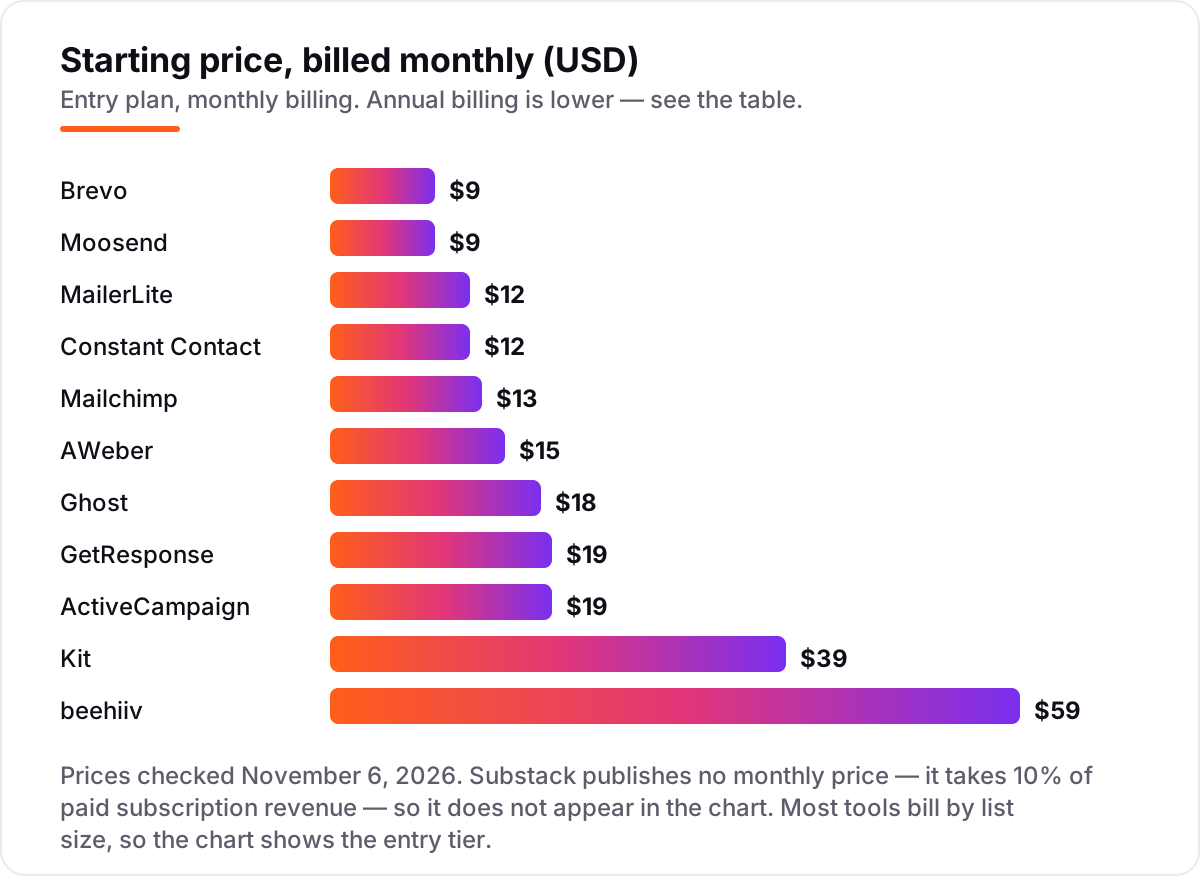
Email newsletter platform pricing: what you will actually pay
Take a weekly newsletter with 1,000 subscribers, sending four issues a month. On list prices, the monthly bill is $9 on Moosend Pro at 500 contacts — but a 1,000-contact list needs its $16 tier — $17 on Brevo Starter at the 10,000-email tier, $18 on Ghost Starter, $19 on MailerLite Comfort, GetResponse Starter and ActiveCampaign Starter, $25 on AWeber Lite, $26 on Mailchimp Essentials at the 1,500-contact tier, $30 on Constant Contact Lite, $39 on Kit Creator and $59 on beehiiv Lite. Substack costs $0 until readers pay.
Over a year on monthly billing, that is $192 on Moosend, $204 on Brevo, $216 on Ghost, $228 on MailerLite, GetResponse and ActiveCampaign, $300 on AWeber, $312 on Mailchimp, $360 on Constant Contact, $468 on Kit and $708 on beehiiv — a $516 gap between the cheapest and dearest paid options for the same 1,000 subscribers and the same four sends a month. The gap comes entirely from the billing model and the tier the list lands in, not from features.
Two costs sit outside every number above. First, the revenue share: a newsletter earning $500 a month from paid subscriptions pays Substack $50 a month in platform fees, on top of Stripe's 2.9% plus 30 cents per payment and a 0.7% billing fee. Second, the annual discount: most tools here cut 10% to 20% for yearly billing — MailerLite Comfort drops to $10.80 a month, Kit Creator to about $33, and beehiiv Lite to $49 — so the yearly bill is lower than twelve monthly payments. If you run a business newsletter rather than a creator publication, the visibility tools differ too — see our guide to the best email marketing platforms for newsletters.
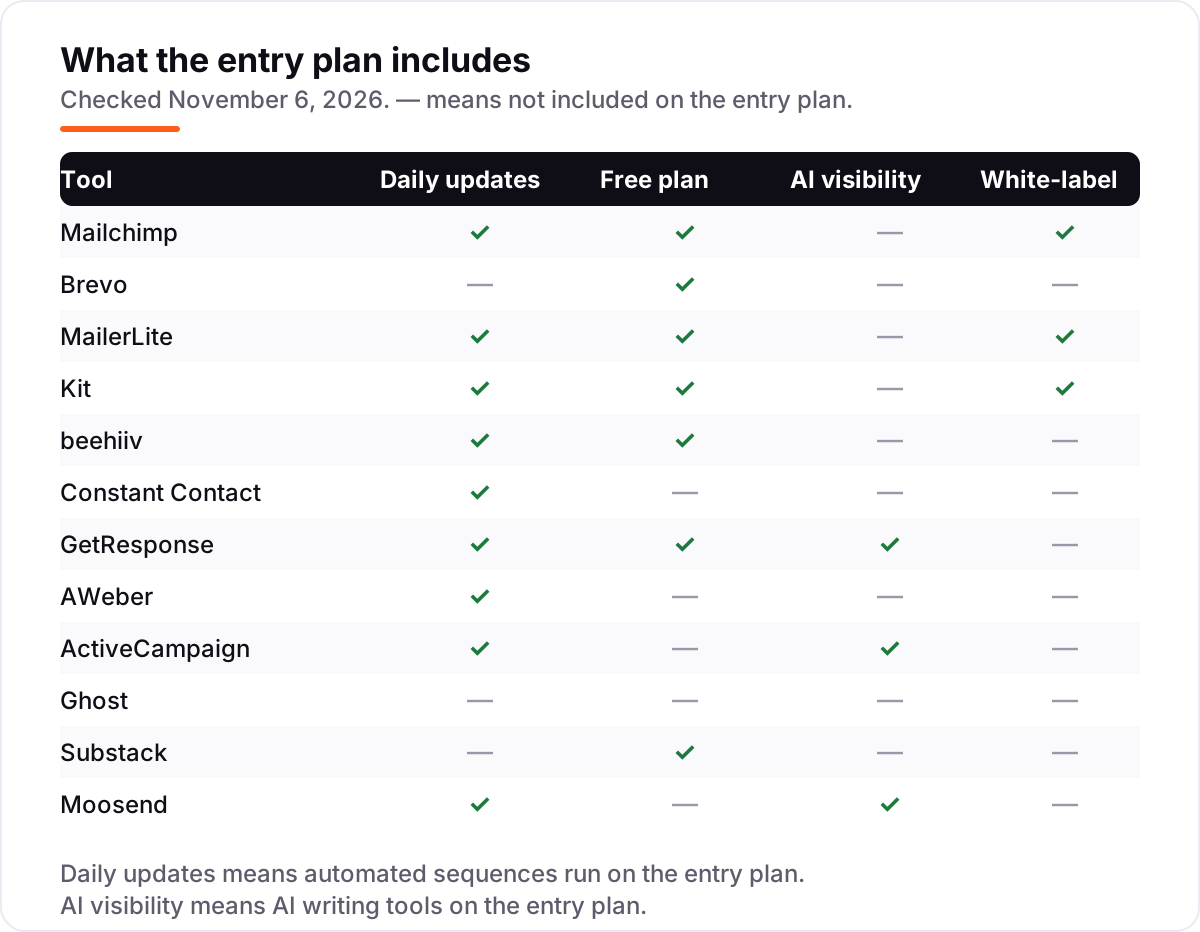
Know the difference: newsletter platform vs email marketing software
The confusion in this category is between a publishing tool and a marketing tool. A newsletter platform is built around publishing: a website, paid subscriptions and reader growth, like beehiiv, Substack and Ghost. Email marketing software is built around campaigns and automation: sending, segmenting and following up, like Mailchimp, ActiveCampaign and GetResponse. Every tool in this list can send a newsletter, but only the publishing tools host your publication and sell subscriptions.
There is a second, quieter confusion: a free plan is not the same as a free trial. Kit, beehiiv, Brevo, MailerLite, Mailchimp and GetResponse have free plans that last indefinitely within their limits. Constant Contact, AWeber, ActiveCampaign, Ghost and Moosend have only trials — 14 or 30 days — after which the account stops sending until you pay. A trial is a deadline; a free plan is a home.
A third distinction worth knowing is the billing meter. Subscriber-priced tools charge for the size of the list, so cleaning dead addresses saves money. Send-priced tools like Brevo charge for volume, so a big list emailed rarely is cheap. Revenue-priced tools like Substack charge nothing until you earn, then take a share forever. The cheapest tool for one sender can be the dearest for another, and the meter — not the headline price — decides which.
Quick comparison: tool type by need
| Buyer | Best pick | Why |
|---|---|---|
| Most small businesses | Mailchimp | The familiar all-in-one, from $13/month for 500 contacts |
| Large list, light sending | Brevo | Pay by emails sent, from $9/month for 5,000 emails |
| Small team on a budget | MailerLite | Clean editor and honest pricing, from $12/month |
| Creator selling to an audience | Kit | Tag-based subscribers and selling tools, from $39/month |
| Publisher monetizing a newsletter | beehiiv | Paid subscriptions at 0% platform fees, from $59/month |
| Writer starting free | Substack | Free to publish at any size, then 10% of paid revenue |
| Writer who wants to own the site | Ghost | Own publication and 0% revenue fees, from $18/month |
| Cheapest full automation | Moosend | Unlimited sends and automation, from $9/month |
Mistakes to avoid
- Budgeting on the entry tier. The $9 to $19 headline price covers 500 to 1,000 subscribers. At 5,000 subscribers the same tools cost $48 to $89 a month, so price the list you will have in a year.
- Buying on the free plan, then finding the feature you need costs extra. Kit's free plan has no automations, Ghost Starter cannot take payments, and Constant Contact Lite has no automation at all. If the feature is the reason you are buying, count the paid tier in the price from day one.
- Ignoring the meter. A subscriber-priced tool punishes a stale list, a send-priced tool punishes frequent sending, and Substack punishes success. Match the meter to how you actually send.
- Paying for a revenue share before you have revenue. Substack is free until readers pay, which is the right deal at $0 to $300 a month in paid revenue — but at $500 a month the 10% fee is $50, more than most flat-fee tools here.
- Forgetting the second cost: migration. Moving a list is easy, but moving automations, templates and landing pages is not. Pick the tool you can live with for two years, not the one with the cheapest first month.
How we chose
We checked each vendor's own pricing page on November 6, 2026 and recorded the starting price exactly as shown, including the annual-billing figure where the page lists one, and we ranked the tools by fit for the most common buyer — a small business or creator sending a regular newsletter — not by brand size. The vendor pricing pages render in JavaScript, so direct fetches returned empty pages; we verified the prices against fresh search-index copies of the vendors' own pricing pages and multiple independent October and November 2026 reads, all of which agreed. Ratings come from fresh search-index copies of the exact G2 review pages, checked the same day. Two facts deserve a note: AWeber's pricing page shows a 14-day trial only, though its help pages still describe a Free plan, so we follow the pricing page; and Moosend's price comes from its pricing-page calculator as read in late October 2026. No vendor paid for a place in this list, and none of the links here are affiliate links.
What to do next
Start with the free plan or trial of your top pick and send two or three real issues to your real list. Check that the emails land in the inbox, that the editor feels fast rather than fiddly, and that the bill at your one-year list size is one you can live with. If the newsletter is sorted but new readers are not finding you, our guide to the best email marketing platforms for creators covers the growth side. Once your tools are in place, find out what's holding your rankings back.
Your stack only works if people find you
SerpAstra fixes what keeps your site off page one and makes it easy for AI assistants to recommend.
Get a free audit→Sources we checked (24)
- Mailchimp pricing — mailchimp.com/pricing (checked November 6, 2026)
- Brevo pricing — brevo.com/pricing (checked November 6, 2026)
- MailerLite pricing — mailerlite.com/pricing (checked November 6, 2026)
- Kit pricing — kit.com/pricing (checked November 6, 2026)
- beehiiv pricing — beehiiv.com/pricing (checked November 6, 2026)
- Constant Contact pricing — constantcontact.com/pricing (checked November 6, 2026)
- GetResponse pricing — getresponse.com/pricing (checked November 6, 2026)
- AWeber pricing — aweber.com/pricing.htm (checked November 6, 2026)
- ActiveCampaign pricing — activecampaign.com/pricing (checked November 6, 2026)
- Ghost pricing — ghost.org/pricing (checked November 6, 2026)
- Substack features — substack.com/features (checked November 6, 2026)
- Moosend pricing — moosend.com/pricing (checked November 6, 2026)
- Mailchimp on G2 — g2.com/products/mailchimp/reviews (checked November 6, 2026)
- Brevo on G2 — g2.com/products/brevo-brevo/reviews (checked November 6, 2026)
- MailerLite on G2 — g2.com/products/mailerlite/reviews (checked November 6, 2026)
- Kit on G2 — g2.com/products/convertkit-kit/reviews (checked November 6, 2026)
- beehiiv on G2 — g2.com/products/beehiiv/reviews (checked November 6, 2026)
- Constant Contact on G2 — g2.com/products/constant-contact/reviews (checked November 6, 2026)
- GetResponse on G2 — g2.com/products/getresponse/reviews (checked November 6, 2026)
- AWeber on G2 — g2.com/products/aweber/reviews (checked November 6, 2026)
- ActiveCampaign on G2 — g2.com/products/activecampaign/reviews (checked November 6, 2026)
- Ghost on G2 — g2.com/products/ghost/reviews (checked November 6, 2026)
- Substack on G2 — g2.com/products/substack/reviews (checked November 6, 2026)
- Moosend on G2 — g2.com/products/moosend/reviews (checked November 6, 2026)
Shamim
Founder of SerpAstra
A full-stack SEO and digital marketer who spends most days on Local SEO for dental practices, AI search visibility and lead generation.
Frequently asked questions
What is the best email newsletter platform?
Mailchimp is the best fit for most senders: the widest template and integration library, a free plan for 250 contacts, and Essentials from $13 a month. Brevo is the better pick for large lists emailed a few times a month, since it charges by sends, and beehiiv is the best pick for publishers who want to sell paid subscriptions.
How much does an email newsletter platform cost?
Entry prices run from $0 to $59 a month. Brevo and Moosend start at $9 a month, MailerLite at $12, Mailchimp at $13 and Kit at $39. At 1,000 subscribers the monthly bill runs from $16 on Moosend to $59 on beehiiv. Substack charges nothing monthly and takes 10% of paid subscription revenue instead.
Is there a free email newsletter platform?
Yes, with limits. Kit's free plan covers up to 10,000 subscribers but has no automations, beehiiv's covers 2,500 with unlimited sends, and Brevo's allows 300 emails a day. Mailchimp and MailerLite both cut their free plans to 250 contacts or subscribers in 2026. Substack is free to publish at any list size.
What is the difference between a newsletter platform and email marketing software?
A newsletter platform is built around publishing: a website, paid subscriptions and reader growth, like beehiiv, Substack and Ghost. Email marketing software is built around campaigns and automation, like Mailchimp, ActiveCampaign and GetResponse. Every tool here can send a newsletter, but only the publishing tools sell subscriptions and host your publication.
Can I switch email newsletter platforms later?
Yes, and most tools here offer free migration. Export your subscriber list with tags and custom fields, import it into the new tool, and move your signup forms and templates before you send the first campaign. Plan the move between sends, and keep the old account live for a month so unsubscribes and bounces still land somewhere.
Should I pick beehiiv or Substack for a paid newsletter?
Pick Substack if you want zero setup and zero monthly cost: it is free until readers pay, then takes 10% of revenue. Pick beehiiv if the list will earn more than about $490 a month, since Lite at $49 a month billed yearly costs less than Substack's 10% at that point, and beehiiv takes 0% of subscription revenue.
Do I need a paid plan to sell newsletter subscriptions?
It depends on the tool. Substack and AWeber let you sell subscriptions with no monthly plan beyond the revenue share or the Lite fee. beehiiv needs Lite at $59 a month, Ghost needs Publisher at $35 a month, and Kit sells through Kit Commerce on any plan. Mailchimp, Brevo and MailerLite have no native paid-subscription billing.
Free SEO and AI visibility audit
Find out what is holding your rankings back
Send us your site. Within 2 business days you get a written audit, an AI visibility check and a short fix list ranked by impact. Free, with no contract attached.
Request my free audit→Related guides
 Digital Marketing & Ads7 Best Email Marketing Platforms for Newsletters in 2026, Compared7 best email marketing platforms for newsletters compared on price, free plans and monetization. Prices checked on vendor pricing pages, November 4, 2026.Read guide →
 Digital Marketing & Ads7 Best Email Marketing Platforms for Creators in 2026, Compared7 best email marketing platforms for creators compared on price, free plans and monetization. Real prices checked November 4, 2026, sorted by creator need.Read guide →
 Digital Marketing & Ads8 Best Email Marketing Platforms for 2026 (Pros, Cons and Pricing)8 best email marketing platforms compared on real starting prices, free plans and automation. Brevo $9/month, Mailchimp $13. Checked Nov 4, 2026.Read guide →