
12 Best Email Software for Small Business in 2026, Compared
Compare the 12 best email software for small business on price, free plans, send limits and automation, with every price checked November 6, 2026.
 Shamim Mia, Founder, SerpAstraLast verified November 6, 202614 min read
We compare pricing pages, documentation and public reviews. We never accept payment for rankings.

Key takeaways
- Mailchimp leads at $13/month, Brevo and Moosend follow at $9/month, and Zoho Campaigns is the cheapest paid plan at $4/month — but the price that matters is the one at your contact count, not the headline.
- Eight of the twelve tools have a free plan; Kit's reaches 10,000 subscribers and Zoho Campaigns covers 2,000 contacts, while Constant Contact, ActiveCampaign and Moosend offer trials only.
- The single most important buying factor is the limit that forces your next upgrade: contact caps, send caps and seat counts decide what you actually pay, not the headline price.
- Automation is not equal across plans: Brevo Starter has none, Constant Contact Lite has one template, and GetResponse Starter allows one custom workflow — check the plan before you buy for automation.
On this page
Quick comparison
| Tool | Best for | Starting price | Free plan |
|---|---|---|---|
| Mailchimp | Small businesses that want the best-known email tool, with the widest template and integration choice | $13/mo | Yes (free plan) |
| Brevo | Senders with a large list who email a few times a month and want to pay by volume sent, not contacts stored | $9/mo | Yes (free plan) |
| Constant Contact | Beginners and event-driven businesses that want phone support and simple tools in one place | $12/mo | No (30-day trial) |
| MailerLite | Small businesses that want a clean, simple tool with every email feature on the paid plan | $12/mo | Yes (free plan) |
| GetResponse | Small businesses that want email, landing pages, webinars and automation in one subscription | $19/mo | Yes (free plan) |
| ActiveCampaign | Small businesses that want deep automation and a CRM without paying for a separate platform | $19/mo | No (14-day trial) |
| Kit | Creators and newsletter-first businesses that sell digital products to their list | $39/mo | Yes (free plan) |
| AWeber | Small businesses that want 24/7 human support and a free plan that stays free | $15/mo | No (14-day trial) |
| HubSpot Marketing Hub | Small businesses already running on HubSpot CRM that want email inside the same record | $20/mo/seat | Yes (free plan) |
| Zoho Campaigns | Small businesses already on Zoho that want the cheapest paid email plan in this list | $4/mo | Yes (free plan) |
| Moosend | Small businesses that send often and want unlimited sends with automation at the lowest price | $9/mo | No (30-day trial) |
| Omnisend | Online stores that want email, SMS and web push in one ecommerce-focused tool | $16/mo | Yes (free plan) |
Make one of these tools?
We re-check this list every quarter. Send a correction, request a review, or ask about a clearly labeled sponsored spot.
Request a listingThe best email software for small business

Mailchimp
Best for: Small businesses that want the best-known email tool, with the widest template and integration choice
Mailchimp is the safe default in this list because almost everyone has heard of it, and that familiarity pays off: templates, freelancers and how-to guides are everywhere, and more than 300 integrations connect it to shops, CRMs and social tools. Essentials costs $13 a month for 500 contacts and 5,000 sends, with A/B testing, basic automation and 24/7 support included, and the free plan covers 250 contacts and 500 sends a month.
The catch is how fast the price climbs with the list. At 1,000 contacts Essentials costs $26.50 a month, and multi-step automation waits for Standard at $20 a month. Phone support needs Premium at $350 a month. Buy Mailchimp when you want the best-known tool and the widest help available; buy Brevo or MailerLite when the list will grow past 1,000 contacts soon.
What we like
- The best-known email tool here, so templates, guides and freelancer help are easy to find
- Free plan covers 250 contacts and 500 sends a month with no time limit
- More than 300 integrations cover shops, CRMs and social tools
- Built-in analytics and send-time optimization on paid plans
Watch out for
- Essentials caps at 500 contacts for $13/month, so the price climbs steeply as the list grows
- Multi-step automation and predictive segments wait for Standard at $20/month
- Support on paid plans is email and chat only; phone support needs Premium at $350/month

Brevo
Best for: Senders with a large list who email a few times a month and want to pay by volume sent, not contacts stored
Brevo prices by emails sent, not contacts stored, which is the whole reason it sits this high. Starter costs $9 a month for 5,000 emails, and a sender with a big list who emails twice a month pays far less here. The free plan sends 300 emails a day, and SMS, WhatsApp, transactional email and a basic CRM share the same account, so one login covers most small-business messaging.
The catch is the contact cap hiding inside the volume tiers: the $9 tier stores only 500 contacts, so a 5,000-person list needs a higher tier. Removing the Brevo logo costs another $12 a month on Starter, and automation waits for Standard at $18 a month. Buy Brevo when your list is large and your sending is occasional; buy a per-contact tool when you email a small list every day.
What we like
- Volume pricing suits big lists: $9/month covers 5,000 emails, and the bill follows sends, not contacts
- Free plan sends 300 emails a day with no time limit
- SMS, WhatsApp, transactional email and a basic CRM sit in the same account
- AI content tools are included on Starter, not held for a higher tier
Watch out for
- The $9 tier stores only 500 contacts, so a bigger list needs a pricier volume tier
- Removing the Brevo logo costs $12/month extra on Starter
- Marketing automation and A/B testing wait for Standard at $18/month

Constant Contact
Best for: Beginners and event-driven businesses that want phone support and simple tools in one place
Constant Contact is the easiest tool here for a first-time sender. The editor is plain and friendly, event management is built in rather than bolted on, and phone support comes with every paid plan — a rarity in this list. Lite costs $12 a month for 500 contacts and 5,000 sends, with social posting, forms and Canva in the same account.
The trade-offs are the trial and the automation ceiling. There is no free plan, only a 30-day trial with 100 sends, and Lite includes a single automation template, so real automation needs Standard at $35 a month. The price also rises steeply with the list: Lite is $30 a month at 1,000 contacts. Pick Constant Contact when you run events and want a human on the phone; pick MailerLite when you want a free plan and automation included.
What we like
- The friendliest editor here for first-time senders, with event management built in
- Phone and chat support included on every paid plan
- Social posting and Canva integration sit in the same account
- AI campaign builder writes and lays out campaigns on Standard
Watch out for
- No free plan, only a 30-day trial with 100 sends
- Lite includes only one automation template; real automation needs Standard at $35/month
- Price rises steeply with list size: Lite is $30/month at 1,000 contacts
MailerLite
Best for: Small businesses that want a clean, simple tool with every email feature on the paid plan
MailerLite wins on simplicity: one paid plan carries every email feature, so there is no ladder to climb for landing pages, A/B testing or automation. Comfort costs $12 a month for 500 subscribers and 5,000 emails, and the free plan covers 250 subscribers with automation, landing pages and websites included. The editor is the cleanest here, with three editors and smart sending built in.
The limits are the free plan and support. The free tier stops at 250 subscribers and 2,500 emails a month, and live chat support waits for the Power plan at $25 a month. There is no built-in CRM, so contact management pairs with a separate tool. Choose MailerLite when you want the whole feature set at the entry price; choose HubSpot when the CRM matters as much as the email.
What we like
- Every paid feature is on Comfort: no feature ladder to climb for landing pages or A/B testing
- Cleanest editor here, with three editors and smart sending built in
- Free plan includes automation, landing pages and websites
- 30% nonprofit discount, the largest in this list
Watch out for
- Free plan stops at 250 subscribers and 2,500 emails a month
- Live chat support waits for the Power plan at $25/month
- No built-in CRM; it pairs with a separate tool for contact management

GetResponse
Best for: Small businesses that want email, landing pages, webinars and automation in one subscription
GetResponse is the all-in-one pick because Starter bundles more than email: landing pages, popups, forms and one custom automation workflow sit alongside unlimited sends for $19 a month, or $15.58 a month billed annually, for 1,000 contacts. The free plan covers 500 contacts and 2,500 emails a month, and the AI email writer is included even there.
The catch is the automation ceiling and the pricing page itself. Full marketing automation waits for Marketer at $59 a month, and the page shows promotional annual rates next to the standard $15.58 figure, so read the rate you will renew at. Webinar and course tools also sit on higher tiers. Buy GetResponse when landing pages and unlimited sends matter; buy ActiveCampaign when automation depth matters more.
What we like
- Unlimited sends on every plan, so frequent mailers never pay per email
- Landing pages, popups, forms and one automation workflow on Starter
- Free plan covers 500 contacts with the AI email writer included
- Webinar hosting and ecommerce tools share the same account on higher tiers
Watch out for
- Full marketing automation waits for Marketer at $59/month; Starter allows one custom workflow
- The pricing page shows promotional annual rates alongside the standard $15.58 rate
- Webinar and course tools sit on higher tiers, not Starter

ActiveCampaign
Best for: Small businesses that want deep automation and a CRM without paying for a separate platform
ActiveCampaign is the automation pick, and the gap is real: multi-step workflows, branching and triggers come on the entry plan, not a higher tier. Starter costs $19 a month, or $15 a month billed annually, for 1,000 contacts and 10,000 sends, with a built-in CRM and more than 950 integrations, the widest in this list. AI features, including an automation builder, are included on Starter.
The trade-offs are the trial and the seat count. There is no free plan, only a 14-day trial, and Starter covers one user, so a second seat needs Plus at $49 a month. The interface also feels crowded until the automation setup is learned. Choose ActiveCampaign when journeys and segmentation are the job; choose MailerLite or Brevo when you mainly send newsletters.
What we like
- The deepest automation here, with multi-step workflows on the entry plan
- Built-in CRM and sales automation, so email and deals share one record
- More than 950 integrations, the widest in this list
- AI features, including an automation builder, are included on Starter
Watch out for
- No free plan, only a 14-day trial
- Starter covers one user; a second seat needs Plus at $49/month
- The interface feels crowded until the automation setup is learned

Kit
Best for: Creators and newsletter-first businesses that sell digital products to their list
Kit is built for creators, and its free plan shows it: up to 10,000 subscribers at $0, with unlimited forms and landing pages and unlimited broadcasts. The paid Creator plan costs $39 a month for 1,000 subscribers, with unlimited sends, a visual automation builder and the ability to sell digital products and paid newsletters from the same account. Annual billing gives two months free.
The catch is the price once you pay. At $39 a month, Creator is the priciest entry plan here, and visual automation plus advanced reporting wait for Creator Pro at $79 a month. Email design is also plainer than Mailchimp or MailerLite, with fewer templates. Pick Kit when the list is the business; pick MailerLite when a newsletter is one channel among several.
What we like
- The most generous free plan here: up to 10,000 subscribers at $0
- Unlimited sends on every plan, with no per-email charges
- Visual automation builder that maps subscriber journeys clearly
- Sells digital products and paid newsletters from the same account
Watch out for
- The priciest entry plan here at $39/month for 1,000 subscribers
- Visual automation and advanced reporting wait for Creator Pro at $79/month
- Email design is plainer than Mailchimp or MailerLite, with fewer templates

AWeber
Best for: Small businesses that want 24/7 human support and a free plan that stays free
AWeber has served small businesses since 1998, and it still feels built for them: 24/7 live support on every plan, and a 14-day free trial — AWeber has no free tier. Lite costs $15 a month, or $12.50 a month billed annually, and adds AI writing tools and web push notifications.
The limits are the caps on Lite: 3 automations and 3 landing pages, so Plus at $30 a month removes them. There is no free plan — Lite at $15 a month is the entry point — and template design feels dated next to Mailchimp and MailerLite. Choose AWeber when you want a human on call at any hour; choose MailerLite when design polish matters more than support hours.
What we like
- 24/7 live support on every plan, including the free plan
- Free plan covers 500 subscribers with automation and landing pages included
- AI writing tools and web push notifications on Lite
- A small-business specialist since 1998, with deliverability as the headline feature
Watch out for
- Lite allows only 3 automations and 3 landing pages; Plus at $30/month removes the caps
- Free plan caps at 500 subscribers and 3,000 emails a month
- Template design feels dated next to Mailchimp and MailerLite

HubSpot Marketing Hub
Best for: Small businesses already running on HubSpot CRM that want email inside the same record
HubSpot Marketing Hub makes sense when the CRM is the center of the business. Email, forms, live chat and the contact record share one database, so a campaign and a deal never live in two places. Starter costs $20 a month per seat, with a $7-a-seat annual promo for new customers, and the free plan covers 2 users and 2,000 sends a month with no time limit.
The catch is the per-seat math and the automation wall. A three-person team pays $60 a month before the promo, and workflows and sequences wait for Professional at $890 a month — a steep jump. Buy HubSpot when the CRM matters as much as the email; buy ActiveCampaign when you want automation and a CRM at a small-business price.
What we like
- Email, CRM, forms and live chat share one contact record
- Free plan covers 2 users and 2,000 sends a month with no time limit
- Removes HubSpot branding from emails on Starter
- The largest integration marketplace of any CRM-first tool here
Watch out for
- Starter is priced per seat, so a three-person team pays $60/month before the promo
- Workflows and sequences wait for Professional at $890/month
- The $7/seat annual price is a new-customer promotion, not the standard rate

Zoho Campaigns
Best for: Small businesses already on Zoho that want the cheapest paid email plan in this list
Zoho Campaigns is the budget pick by a wide margin: Standard costs $4 a month for 500 contacts with unlimited emails, and the free plan covers 2,000 contacts and 6,000 emails a month for 5 users — the biggest free plan by contacts in this list. Standard includes A/B testing, basic workflows and 10 users, and it syncs natively with Zoho CRM.
The trade-offs are polish and depth. Template customization is limited, the interface feels dated, and advanced automation, scoring and dynamic content wait for Professional at $6 a month. Support runs on business hours, not 24/7. Pick Zoho Campaigns when the budget is tight and the business already runs on Zoho; pick MailerLite when design and support matter more.
What we like
- The cheapest paid plan here at $4/month, with unlimited emails
- The biggest free plan by contacts: 2,000 contacts and 6,000 emails a month
- Native sync with Zoho CRM, so contacts and campaigns share one record
- Standard includes A/B testing, basic workflows and 10 users
Watch out for
- Template customization is limited and the interface feels dated
- Advanced automation, scoring and dynamic content wait for Professional at $6/month
- Support is email and phone on business hours, not 24/7

Moosend
Best for: Small businesses that send often and want unlimited sends with automation at the lowest price
Moosend is the cheapest way to send often: Pro costs $9 a month for 500 contacts with unlimited sends, and the plan bundles automation, landing pages, forms, A/B testing and an AI writer rather than gating them behind higher tiers. Annual billing drops it to $7 a month. It also carries the highest G2 score in this list, 4.6 out of 5 from 746 reviews.
The catches are the trial and the auto-upgrade. There is no free plan, only a 30-day trial, and going over the contact cap upgrades the account at once and charges the difference immediately. The integration list is also shorter than Mailchimp or ActiveCampaign. Choose Moosend when you send several times a week; choose Brevo when you send rarely and want a free plan.
What we like
- Unlimited sends on Pro, so frequent mailers never pay per email
- Automation, landing pages, forms and A/B testing all on the entry plan
- AI writer included on Pro at no extra cost
- Highest G2 score in this list at 4.6/5 from 746 reviews
Watch out for
- No free plan, only a 30-day trial
- Going over the contact cap auto-upgrades the account and charges the difference at once
- Fewer integrations than Mailchimp or ActiveCampaign

Omnisend
Best for: Online stores that want email, SMS and web push in one ecommerce-focused tool
Omnisend is the ecommerce pick because its automations are built for stores: abandoned-cart, welcome-series and win-back flows come pre-built, and the store syncs deeply with Shopify and WooCommerce. Standard costs $16 a month for 500 contacts and 6,000 emails, with email, SMS and web push in one account, and the free plan covers 250 contacts and 500 emails a month.
The catch is SMS. It needs the Pro plan at $59 a month, so Standard is email and push only, and reporting is shallower than Mailchimp or ActiveCampaign. The free plan is also small at 250 contacts. Pick Omnisend when you sell online and want store automations out of the box; pick Mailchimp when the business is not a store.
What we like
- Pre-built ecommerce automations for abandoned carts, welcome series and win-backs
- Email, SMS and web push in one account, with deep Shopify and WooCommerce sync
- AI segment builder and forms AI assistant on the Standard plan
- 24/7 support on every plan, including the free plan
Watch out for
- SMS needs the Pro plan at $59/month; Standard is email and push only
- Reporting is shallower than Mailchimp or ActiveCampaign
- No free plan beyond 250 contacts and 500 emails a month
The best email software for small business does one job well: it gets a message from your business into a customer's inbox, on time, looking right on a phone, and without you rebuilding the campaign every week. We ranked the twelve tools below by fit for the most common buyer — a US owner with a list of a few hundred contacts — starting with the best-known tool and ending with the ecommerce specialist, and every price was checked on the vendor's own pricing page on November 6, 2026.
How to choose the best email software for small business
- Count your contacts first. Every tool here prices by list size, and the entry tier usually stops at 500 contacts: Mailchimp is $13 a month at 500 and $26.50 at 1,000, so the price at your real list size is the price that matters.
- Count your sends, not just your contacts. Brevo charges by emails sent, Moosend and GetResponse allow unlimited sends, and most others cap monthly sends at 10 times your contact count — a weekly sender and a monthly sender pay differently on the same plan.
- Check what automation the entry plan actually includes. Brevo Starter has none, Constant Contact Lite has one template, and GetResponse Starter allows one custom workflow, while ActiveCampaign and Moosend put real automation on the entry plan.
- Decide whether email is the job or part of a bigger stack. HubSpot and Zoho Campaigns make sense beside their CRMs, Omnisend makes sense beside a store, and Kit makes sense when the newsletter is the business.
- Try the free plan with a real campaign before you pay. Eight tools here have one, and a genuine send — your list, your template, your subject lines — tells you more than any review can.
Email is one system in your stack, not the whole stack. If the business also needs to be found online, our monthly SEO service handles the visibility side, and our guide to email marketing software for small business covers the marketing-platform angle in more depth. And before you publish new pages for the services you sell, run your titles through the free SERP snippet preview tool — it shows exactly how the title and description will look in Google.
Whatever you shortlist, check two things in the trial: that the editor builds the email you actually want to send without a workaround, and that the automation you need is on the plan you would buy, not a higher tier. Every tool here lets you import contacts and send a test campaign before paying, so there is no reason to buy before you have sent one real email through it.
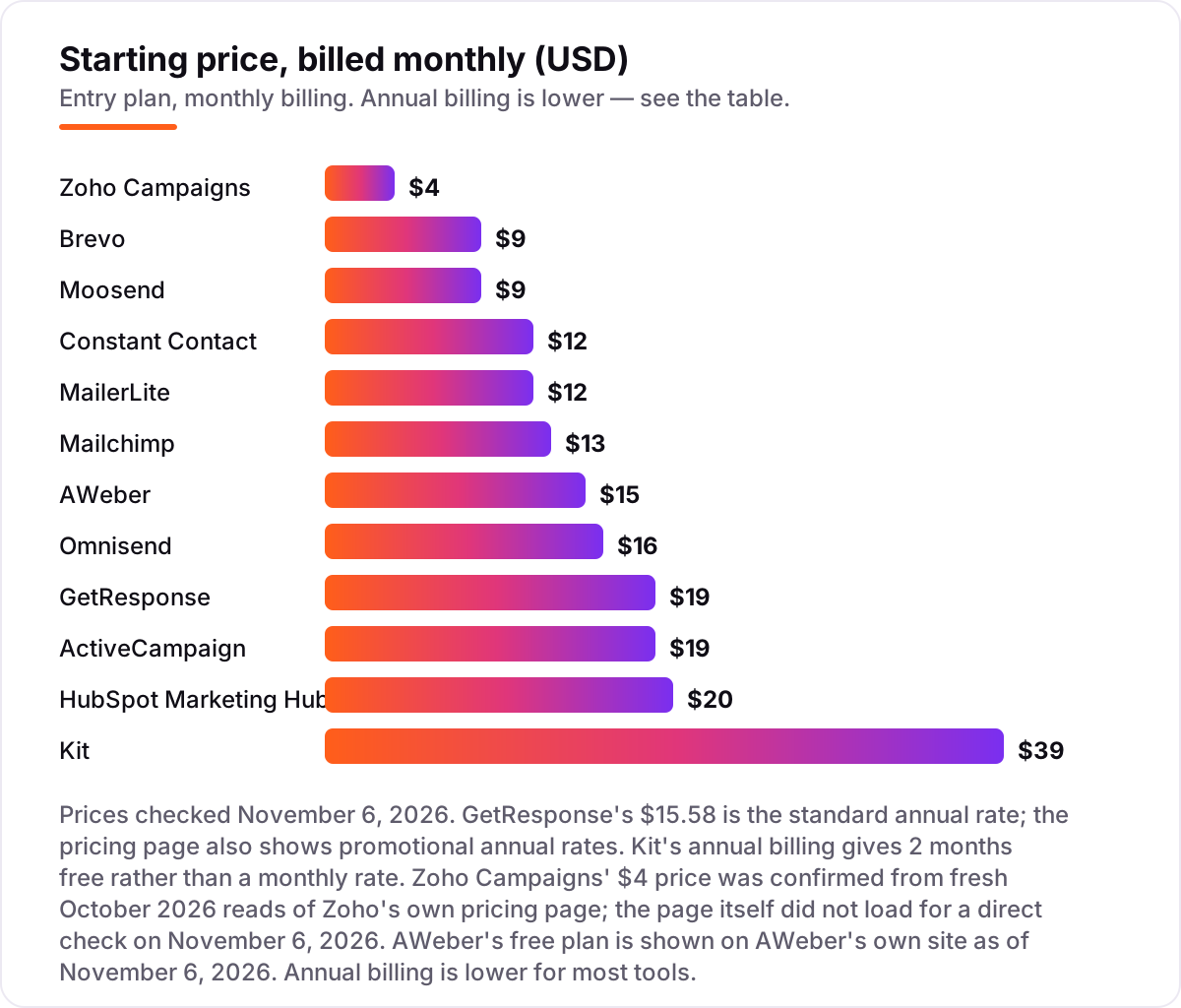
Email software for small business pricing: what you will actually pay
Take a small business with 500 contacts that sends one email a week, with one person running it. On monthly billing, a year costs $48 on Zoho Campaigns, $108 on Brevo or Moosend, $144 on Constant Contact or MailerLite, $156 on Mailchimp, $180 on AWeber, $192 on Omnisend, $228 on GetResponse or ActiveCampaign, $240 per seat on HubSpot and $468 on Kit. The same list and the same four emails a month cost $48 a year at the cheap end and $468 at the dear end — a $420 gap that comes entirely from the pricing model, not from features.
Paying annually narrows the gap: Zoho Campaigns drops to $36 a year, Moosend to $84, Brevo to about $97, MailerLite to $130, Mailchimp to $133, AWeber to $150, ActiveCampaign to $180, GetResponse to $187 and Kit to $390, since its annual billing gives two months free. HubSpot's new-customer promo drops a single seat to $84 a year, but it renews at the $20-a-seat standard rate, so budget on $240 a seat for year two. No annual figure is listed for Constant Contact or Omnisend in the prices above, so compare those two on the monthly rate.
Three costs sit outside every number above. First, the contact tier: at 1,000 contacts Mailchimp Essentials is $26.50 a month and Constant Contact Lite is $30, so a growing list doubles the bill on those two while Brevo and Moosend rise more slowly. Second, SMS: Constant Contact adds 500 messages for $10 a month, and Omnisend needs Pro at $59 a month for SMS at all. Third, the seat count on HubSpot and ActiveCampaign: a second person means a second seat or a higher tier. If email is the channel that brings customers back, compare it with the automation tools that keep them coming — see our guide to email automation tools.
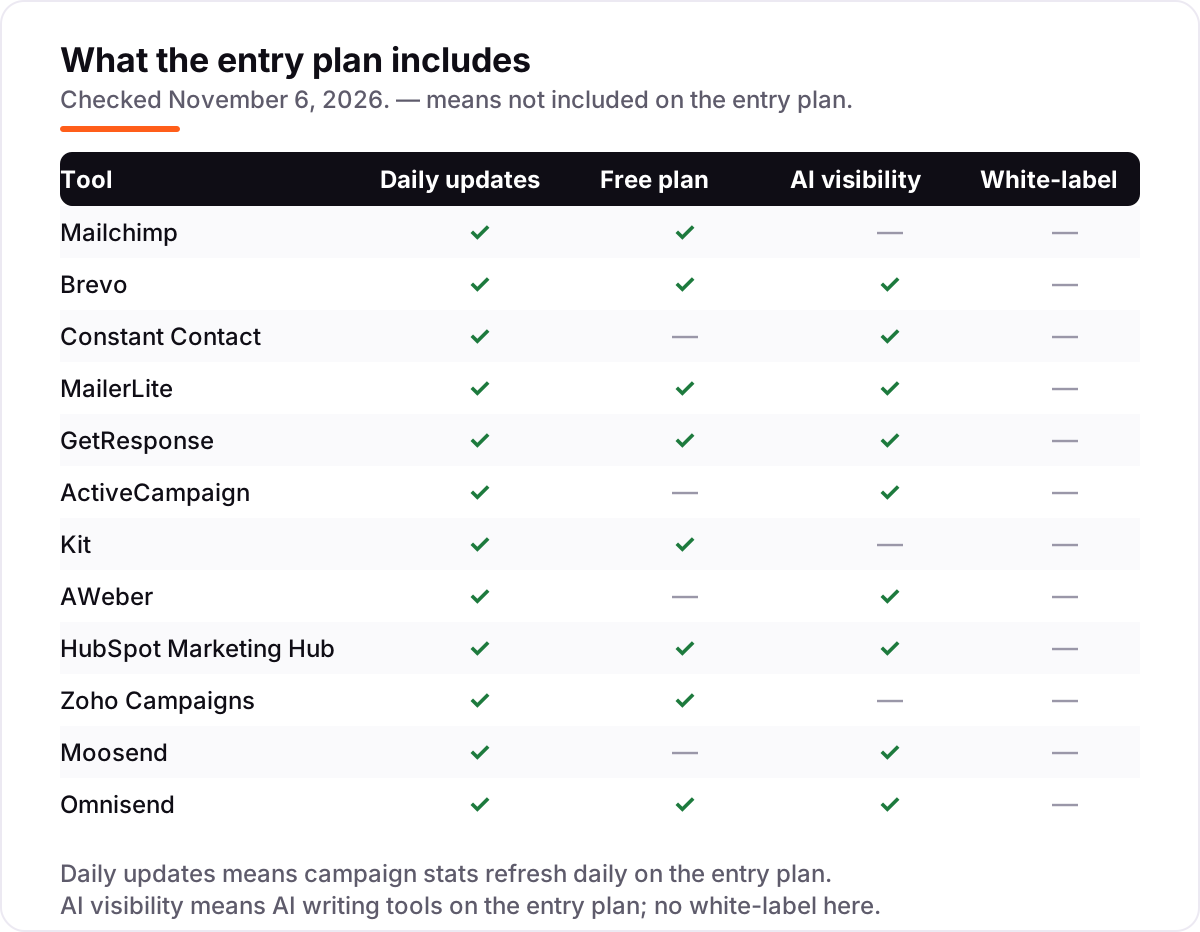
Know the difference: email marketing software vs email hosting
The confusion in this category is between three different jobs that all have "email" in the name. Email marketing software — every tool in this list — sends campaigns and automations to a list of subscribers who opted in. Email hosting gives your team inboxes at your own domain, like Gmail or Outlook, so you can send and receive one-to-one mail. Transactional email sends receipts, password resets and order updates, one message at a time, triggered by an action.
Most small businesses need the first two and sometimes the third. Buying email hosting when you need campaigns leaves you sending newsletters from an inbox, which trips spam filters and gives you no open or click data. Buying marketing software when you need inboxes leaves your team with no address to reply from. Brevo and Omnisend cover transactional sending as well as campaigns, which is why they suit stores, but none of the twelve replaces a hosted inbox.
A second distinction worth knowing is the send cap versus the contact cap. Most tools here cap monthly sends at 10 times your contact count, so a 500-contact plan allows 5,000 sends a month. Brevo instead charges by sends, and Moosend, GetResponse and Kit allow unlimited sends, so a business that emails three times a week pays very differently on those models than on a 10-times plan.
Quick comparison: tool type by need
| Buyer | Best pick | Why |
|---|---|---|
| Solo owner on a $0 budget | Zoho Campaigns | Free plan covers 2,000 contacts; paid plan is $4/month |
| Most small businesses | Mailchimp | The best-known tool, from $13/month, with the widest help and integrations |
| Large list, occasional sends | Brevo | $9/month for 5,000 emails; the bill follows sends, not contacts |
| Business that lives on automation | ActiveCampaign | Multi-step workflows and a CRM from $19/month |
| Creator selling to a list | Kit | Free plan to 10,000 subscribers; paid plans from $39/month |
| Online store | Omnisend | Ecommerce automations and SMS from $16/month |
Mistakes to avoid
- Budgeting on the free plan, then finding automation costs extra. Brevo Starter has no automation and Constant Contact Lite has one template — if flows are the point, the entry price is not your price.
- Buying on the headline price, then hitting the contact cap. Mailchimp is $13 a month at 500 contacts and $26.50 at 1,000; check the price at the list size you will have in six months, not the one you have today.
- Ignoring the send cap. A 500-contact plan usually allows 5,000 sends a month, so three emails a week to the whole list needs a higher tier or an unlimited-sends tool like Moosend or GetResponse.
- Paying for SMS before you need it. SMS is a separate charge on most tools here — Omnisend needs Pro at $59 a month — so buy the email plan first and add SMS the month you actually text customers.
- Importing a purchased list. Every tool here requires opt-in subscribers, and cold outreach to a bought list gets accounts closed and domains blocklisted. Grow the list with signup forms instead.
How we chose
We checked each vendor's own pricing page on November 6, 2026 and recorded the starting price exactly as shown, including the annual-billing figure where the page lists one, and we ranked the tools by fit for the most common buyer — a US small business owner with a few hundred contacts — not by brand size. Two prices need a note: Zoho Campaigns' $4 figure was confirmed from fresh October 2026 reads of Zoho's own pricing page, because the page itself did not load for a direct check on November 6, 2026; and GetResponse's $15.58 is the standard annual rate, while its page also shows promotional annual rates. AWeber's own pricing page lists no free plan — only a 14-day free trial — so older roundups that say it has one are out of date. Ratings are G2 scores checked November 6, 2026. No vendor paid for a place in this list, and none of the links here are affiliate links.
What to do next
Start with the free plan or trial of your top pick and send one real campaign through it. Check that the editor builds the email you want, the automation you need is on the plan you would buy, and the reports show opens and clicks clearly before you commit to a year. If email is sorted but new customers are not finding you, our monthly SEO service handles the visibility side. Once your tools are in place, find out what's holding your rankings back.
Your stack only works if people find you
SerpAstra fixes what keeps your site off page one and makes it easy for AI assistants to recommend.
Get a free audit→Sources we checked (24)
- Mailchimp pricing — mailchimp.com/pricing (checked November 6, 2026)
- Brevo pricing — brevo.com/pricing (checked November 6, 2026)
- Constant Contact pricing — constantcontact.com/pricing (checked November 6, 2026)
- MailerLite pricing — mailerlite.com/pricing (checked November 6, 2026)
- GetResponse pricing — getresponse.com/pricing (checked November 6, 2026)
- ActiveCampaign pricing — activecampaign.com/pricing (checked November 6, 2026)
- Kit pricing — kit.com/pricing (checked November 6, 2026)
- AWeber pricing — aweber.com/pricing.htm (checked November 6, 2026)
- HubSpot Marketing Hub pricing — hubspot.com/pricing/marketing (checked November 6, 2026)
- Zoho Campaigns pricing — zoho.com/campaigns/pricing (checked November 6, 2026)
- Moosend pricing — moosend.com/pricing (checked November 6, 2026)
- Omnisend pricing — omnisend.com/pricing (checked November 6, 2026)
- Mailchimp G2 reviews — g2.com/products/intuit-mailchimp-email-marketing/reviews (checked November 6, 2026)
- Brevo G2 reviews — g2.com/products/sendinblue/reviews (checked November 6, 2026)
- Constant Contact G2 reviews — g2.com/products/constant-contact/reviews (checked November 6, 2026)
- MailerLite G2 reviews — g2.com/products/mailerlite/reviews (checked November 6, 2026)
- GetResponse G2 reviews — g2.com/products/getresponse/reviews (checked November 6, 2026)
- ActiveCampaign G2 reviews — g2.com/products/activecampaign/reviews (checked November 6, 2026)
- Kit G2 reviews — g2.com/products/convertkit-kit/reviews (checked November 6, 2026)
- AWeber G2 reviews — g2.com/products/aweber/reviews (checked November 6, 2026)
- HubSpot Marketing Hub G2 reviews — g2.com/products/hubspot-marketing-hub/reviews (checked November 6, 2026)
- Zoho Campaigns G2 reviews — g2.com/products/zoho-campaigns/reviews (checked November 6, 2026)
- Moosend G2 reviews — g2.com/products/moosend/reviews (checked November 6, 2026)
- Omnisend G2 reviews — g2.com/products/omnisend/reviews (checked November 6, 2026)
Shamim
Founder of SerpAstra
A full-stack SEO and digital marketer who spends most days on Local SEO for dental practices, AI search visibility and lead generation.
Frequently asked questions
What is the best email software for small business?
Mailchimp is the best fit for most small businesses: the best-known tool, the widest help and integrations, from $13/month with a free plan. Brevo is the better pick for large lists that email rarely, since it charges by sends, and ActiveCampaign is the better pick when automation depth matters most.
How much does email software for a small business cost?
Entry prices run from $0 to $39 a month. Eight tools here have free plans, and the first paid plans cost $4–$20 a month at 500 contacts. A 500-contact list typically costs $48–$468 a year on monthly billing, before SMS add-ons and the cost of growing past the entry contact tier.
Is there really free email software for small business?
Yes, with limits. Kit's free plan covers up to 10,000 subscribers, Zoho Campaigns covers 2,000 contacts and 6,000 emails a month, and Mailchimp, Brevo, MailerLite, GetResponse, HubSpot and Omnisend all have free plans. Constant Contact, ActiveCampaign, AWeber and Moosend offer free trials instead.
What is the difference between email marketing software and email hosting?
Email marketing software sends campaigns and automations to a list of subscribers; email hosting gives your team inboxes at your domain, like Gmail or Outlook. They solve different jobs, and most small businesses need both. Transactional email, which sends receipts and password resets, is a third job, handled by some of these tools and by dedicated services.
Can I switch email software later?
Yes, but plan the move carefully. Export your contacts with their consent records, tags and segments, then import them into the new tool and warm up the sending domain before the first big campaign. Automations and templates do not transfer, so rebuild the essential flows first and keep the old account live for a month.
Does email software include SMS marketing?
Some of it does, and some of it charges extra. Brevo, Omnisend and HubSpot include SMS in some plans, while Constant Contact adds 500 messages for $10 a month. Check whether SMS is bundled or billed per message before you buy, because per-message pricing can pass the email subscription on a busy month.
Free SEO and AI visibility audit
Find out what is holding your rankings back
Send us your site. Within 2 business days you get a written audit, an AI visibility check and a short fix list ranked by impact. Free, with no contract attached.
Request my free audit→Related guides
 Digital Marketing & Ads11 Best Email Marketing Software for Small Business in 2026, ComparedThe 11 best email marketing software for small business, compared on real 2026 prices, free plans and automation — Brevo starts at $9/month.Read guide →
 Digital Marketing & Ads10 Best Email Automation Tools in 2026 (Free and Paid, Compared)Compare the 10 best email automation tools on price, free plans and automation depth, with every starting price checked on November 5, 2026.Read guide →
 SEO & AI Search12 Best Marketing Platforms for Small Business SEO in 2026, ComparedThe 12 best marketing platforms for small business SEO, compared on real prices, SEO tools and AI visibility. Every price checked November 1, 2026.Read guide →