
12 Best Enterprise Marketing Platforms in 2026, Compared
12 best enterprise marketing platforms compared on price, channels and AI features. Only 4 publish a starting price — the rest are custom quote.
 Shamim Mia, Founder, SerpAstraLast verified November 4, 202616 min read
We compare pricing pages, documentation and public reviews. We never accept payment for rankings.
Key takeaways
- HubSpot is the best all-round pick for most teams: a free plan, published prices from $20/month per seat and a native CRM. Salesforce Marketing Cloud Engagement is the deepest enterprise stack from $1,250/month billed annually, and Insider One is the highest-rated platform here at 4.8/5 on G2.
- Eight of the 12 platforms publish no starting price at all — Marketo, Eloqua, Braze, Iterable, Bloomreach, Insider, MoEngage and SAP Emarsys are all custom quote, so budget for a sales conversation, not a checkout.
- The single most important buying factor is your pricing unit: seats, contacts, profiles or monthly active users change the bill by an order of magnitude at the same audience size.
- Every price below was checked on the vendor's own pricing page on November 4, 2026, except ActiveCampaign, whose $19/month Starter price ($15 billed annually) is third-party sourced — it no longer publishes prices. Ratings are G2, with review counts shown.
On this page
Quick comparison
| Tool | Best for | Starting price | Free plan |
|---|---|---|---|
| HubSpot Marketing Hub | Mid-size and enterprise teams that want CRM, email and automation in one platform instead of a separate stack | $20/mo per seat | Yes (free plan) |
| Salesforce Marketing Cloud Engagement | Large enterprises already on Salesforce that need journey orchestration across email, mobile and web at scale | $1,250/mo | No (demo only) |
| Adobe Marketo Engage | B2B enterprises with long sales cycles that need lead scoring, nurturing and revenue attribution | Custom quote | No (demo only) |
| Braze | Consumer brands with serious mobile apps that need cross-channel orchestration and real-time personalization | Custom quote | No (free trial) |
| Iterable | Large B2C brands that need AI-driven cross-channel journeys and strong customer support | Custom quote | No (demo only) |
| Oracle Eloqua | Large B2B teams standardized on Oracle CX that need contact-band capacity and sales alignment | Custom quote | No (demo only) |
| Bloomreach | Ecommerce teams that need a CDP, personalization and campaign automation in one platform | Custom quote | No (demo only) |
| Insider One | Retail and ecommerce brands that want one vendor across web, app, email, SMS and WhatsApp | Custom quote | No (demo only) |
| MoEngage | Mobile-first B2C teams that want AI-led lifecycle marketing without heavy analytics tooling | Custom quote | Yes (free Starter) |
| SAP Emarsys | Retail and ecommerce brands on SAP that need AI-driven omnichannel campaigns and loyalty | Custom quote | No (demo only) |
| ActiveCampaign | Growing teams that want the strongest automation builder at a mid-market price before going enterprise | $19/mo | No (14-day trial) |
| Klaviyo | Ecommerce and DTC brands that want email and SMS revenue driven by segmentation and predictive data | $20/mo | Yes (free plan) |
Make one of these tools?
We re-check this list every quarter. Send a correction, request a review, or ask about a clearly labeled sponsored spot.
Request a listingThe best enterprise marketing platforms
HubSpot Marketing Hub
Best for: Mid-size and enterprise teams that want CRM, email and automation in one platform instead of a separate stack
HubSpot is the only platform in this list you can start using without talking to sales: the free plan covers email, forms and live chat, and Starter costs $20 per seat per month with published pricing. Because the CRM is native, contacts, deals and campaigns share one database, so there is no sync middleware to maintain. Breeze AI assistants and 192 integrations come standard, and the interface is the easiest enterprise tool here to learn.
The catch is the price curve. Enterprise costs $3,600 a month plus a mandatory $7,000 onboarding fee, and the bill climbs with every 10,000-contact block you add. Reporting and attribution are good but not as deep as Salesforce or Marketo for complex B2B models. Choose HubSpot when you want one platform your whole team will actually use; choose Salesforce when your data model outgrows it.
What we like
- Only platform here with a genuinely usable free plan plus published per-seat pricing, so you can start without a sales call
- Native CRM means contacts, deals and campaigns share one database — no sync middleware to maintain
- Breeze AI assistants and 192 integrations come standard, and the interface is the easiest in this list to learn
Watch out for
- Enterprise ($3,600/month) carries a mandatory $7,000 one-time onboarding fee, and Professional and Enterprise require annual contracts
- Costs climb fast once you add marketing contacts — Enterprise includes 10,000, then $100/month per extra 10,000-contact block
- Reporting and attribution depth still trail Salesforce and Marketo for complex B2B revenue models

Salesforce Marketing Cloud Engagement
Best for: Large enterprises already on Salesforce that need journey orchestration across email, mobile and web at scale
Marketing Cloud Engagement is the heavyweight in this list. Journey Builder lets you orchestrate email, SMS, push, WhatsApp and advertising from one canvas, and because it sits on the Salesforce platform, Sales Cloud, Service Cloud and Data Cloud all share one customer record. Einstein adds predictive send-time and engagement scoring, and Agentforce Marketing agents can now run parts of a campaign on their own. For an enterprise already on Salesforce, nothing else integrates this deeply.
The price of that depth is complexity. G2 reviewers report implementations of three to six months, and the $1,250-a-month Pro edition is only the entry point — Corporate and Enterprise editions climb sharply, and every edition needs an annual contract. Buy it when your team has the operations staff to run it; smaller teams will get more from HubSpot for less money and less setup.
What we like
- Journey Builder orchestrates email, SMS, push, WhatsApp and advertising from one canvas at true enterprise scale
- Deepest Salesforce integration: Sales Cloud, Service Cloud and Data Cloud share one customer record
- Einstein predictive send-time, engagement scoring and Agentforce Marketing agents are built in
Watch out for
- Steepest learning curve in this list — G2 reviewers repeatedly cite complex setup and a 3–6 month implementation
- Annual contract required and the Pro edition is only the start; Corporate and Enterprise editions climb sharply
- Einstein and Agentforce features need clean Data Cloud data to deliver value, which is a project of its own

Adobe Marketo Engage
Best for: B2B enterprises with long sales cycles that need lead scoring, nurturing and revenue attribution
Marketo Engage is the B2B automation benchmark, and it shows in the details: Smart Campaigns trigger on almost any behavior, engagement programs run multi-month nurture without manual work, and lead scoring grades every prospect before sales ever sees them. The four packages — Growth, Select, Prime and the top tier — scale by database size, and account-based marketing with lead-to-account mapping is built in from Select up.
There are two honest costs. First, Adobe publishes no prices, so every deal is a custom annual quote and benchmarking takes real effort. Second, the interface feels dated and the learning curve is real — teams usually need a dedicated marketing operations specialist. Pick Marketo when your sales cycle is long and complex; pick HubSpot when you want the same ideas with less operational weight.
What we like
- Smart Campaigns, engagement programs and lead scoring are still the benchmark for B2B marketing operations
- Account-based marketing with lead-to-account mapping is built in from Select up
- Native CRM integrations with Salesforce and Microsoft Dynamics keep sales and marketing on one record
Watch out for
- No published prices at all — every package is a custom annual quote priced by database size
- Interface feels dated next to newer tools, and new users face a real learning curve
- Predictive audiences and advanced journey analytics sit on Prime, not the entry Growth package

Braze
Best for: Consumer brands with serious mobile apps that need cross-channel orchestration and real-time personalization
Braze is built for brands that live in the app. One customer profile, fed by real-time event streaming, drives push, in-app messages, SMS, email and web from a single Canvas journey, and Liquid personalization lets every message adapt to the individual without a developer. G2 reviewers rate it 4.5 out of 5 — the highest engagement-platform score in this list — and cite ease of use more than any other quality.
The trade-off is price opacity. Braze publishes no prices, contracts are annual and priced by monthly active users, and third-party benchmarks put entry deals around $60,000 a year. Reporting is also thinner than the journey tooling. Choose Braze when mobile engagement is the business; choose Iterable or MoEngage when you want similar orchestration with a gentler entry point.
What we like
- Canvas journey builder with Liquid personalization is the most flexible in this list for app-first brands
- Real-time event streaming powers push, in-app, SMS, email and web from one customer profile
- Highest-rated engagement platform here on G2 (4.5/5), with ease of use its most-cited strength
Watch out for
- No published prices — annual contracts are quote-based, priced by monthly active users, and third-party benchmarks start around $60,000 a year
- Reporting feels thin next to the journey tooling, per G2 reviewers
- Salesforce agreed to acquire Braze in October 2026, so the roadmap now sits inside the Salesforce orbit

Iterable
Best for: Large B2C brands that need AI-driven cross-channel journeys and strong customer support
Iterable is the AI-led alternative to Braze. Workflow Studio runs email, SMS, push and in-app campaigns from one canvas, and the AI layer — predictive goals, Brand Affinity and send-time optimization — adjusts journeys as behavior changes instead of waiting for a marketer to rebuild them. Support is a genuine differentiator: Iterable scores 8.8 out of 10 for quality of support on G2, the best among the engagement platforms in this list.
Like Braze, Iterable publishes no prices, so budgeting starts with a sales conversation and the quote scales with contacts and channels. Setup takes around three months and non-technical marketers face a learning curve. Pick Iterable when you want AI-driven journeys plus a support team that answers; pick Braze when real-time app messaging is the priority.
What we like
- AI-powered journey optimization with predictive goals, Brand Affinity and send-time optimization built in
- Workflow Studio handles email, SMS, push and in-app from one canvas with strong experimentation
- Quality of support scores 8.8 on G2 — the highest support score among the engagement platforms here
Watch out for
- No published prices — quotes are annual and scale with contacts and channels
- Setup is steep for non-technical marketers, with a roughly 3-month implementation
- Reporting depth trails the journey tooling, and landing-page building is weaker than rivals

Oracle Eloqua
Best for: Large B2B teams standardized on Oracle CX that need contact-band capacity and sales alignment
Eloqua is the workhorse for B2B teams that already run on Oracle. Campaign Canvas and Program Canvas orchestrate multi-step nurture across email, web and mobile, lead scoring runs at the account level so sales gets conversation-ready opportunities, and the platform handles contact databases in the millions on Oracle Cloud Infrastructure. More than 500 prebuilt integrations connect it to the rest of the Oracle CX suite.
The honest downsides are the interface and the buying process. Eloqua holds the lowest G2 score in this list at 3.9 out of 5, with reviewers citing dated screens and slow support, and there is no simple pricing page — contracts are annual and priced by contact band. Choose Eloqua when your stack is Oracle; choose Marketo when you want the same B2B depth with a stronger reviewer record.
What we like
- Handles massive contact databases with enterprise-grade performance on Oracle Cloud Infrastructure
- Campaign Canvas and Program Canvas orchestrate multi-step nurture with account-level lead scoring
- More than 500 prebuilt integrations, with native ties to Oracle CX Sales, Unity CDP and Infinity analytics
Watch out for
- No simple pricing page — Oracle sells annual contracts priced by contact band, and quotes start from sales
- Lowest G2 score in this list (3.9/5), with reviewers citing a dated interface and slow support
- Email and landing-page builders feel rigid and often need HTML help for anything custom

Bloomreach
Best for: Ecommerce teams that need a CDP, personalization and campaign automation in one platform
Bloomreach is the ecommerce specialist in this list. Its built-in CDP unifies customer and product data in real time, so segmentation and personalization run on live commerce behavior — what a shopper just viewed, not what a nightly batch import recorded. Loomi AI turns that data into product recommendations and personalized campaigns across web, email and SMS, and G2 reviewers rate it 4.6 out of 5 for feature depth.
It is priced like an enterprise platform: custom annual contracts that depend on products, profiles, traffic and message volume, with no published starting point. Time-to-value also runs slower than simpler tools. Choose Bloomreach when your catalog and customer data are the advantage; choose Klaviyo when email and SMS revenue is the job and the budget is smaller.
What we like
- Loomi AI unifies real-time customer and product data for personalization across web, email and SMS
- Built-in CDP means segmentation runs on live commerce data, not nightly batch imports
- Rated 4.6/5 on G2 with feature depth and data unification its most-cited strengths
Watch out for
- Custom annual pricing only — costs depend on products, profiles, traffic and message volume
- G2 reviewers call it expensive, and time-to-value runs slower than simpler tools
- Ecommerce-first design means B2B lead management is thinner than Marketo or Eloqua

Insider One
Best for: Retail and ecommerce brands that want one vendor across web, app, email, SMS and WhatsApp
Insider One is the highest-rated platform in this list at 4.8 out of 5 on G2, and the scores are broad: it leads on setup, support and ease of use, not just features. One platform covers web, app, email, SMS, WhatsApp, push and on-site search, with Sirius AI building predictive audiences and orchestrating journeys across more than 100 native integrations. For a retail brand that wants one vendor for every channel, the breadth is the pitch.
Breadth is also the caveat: some channels inside the suite are stronger than others, and WhatsApp and SMS often meter separately from the base contract. Pricing is modular and quote-based, with nothing published. Choose Insider when you want the widest channel coverage in one contract; choose Bloomreach when the CDP and product data matter more than channel count.
What we like
- Highest G2 score in this list (4.8/5), leading on setup, support and ease of use
- Sirius AI powers predictive audiences and journey orchestration across 100+ native integrations
- Widest native channel set here: web, app, email, SMS, WhatsApp, push and on-site search in one platform
Watch out for
- No published prices — modular, quote-based annual contracts, and WhatsApp and SMS often meter separately
- Breadth means depth varies: some channels are stronger than others inside the same suite
- Smaller presence outside retail and ecommerce, so B2B references are thinner

MoEngage
Best for: Mobile-first B2C teams that want AI-led lifecycle marketing without heavy analytics tooling
MoEngage is the value pick among the engagement platforms. Its free Starter plan covers up to 10,000 monthly tracked users with push and behavioral segmentation, so a small app team can run real lifecycle campaigns before spending anything. Sherpa AI adds predictive segmentation and AI decisioning with no-code setup, and native analytics are built in, so you need less external BI to judge what a journey actually did.
The paywall arrives at 10,000 users: Growth and Enterprise are custom-quoted by monthly tracked users, and WhatsApp and some AI predictions are add-ons. The integration marketplace is also smaller than Braze or Salesforce. Choose MoEngage when you want AI-led lifecycle marketing on a startup budget; choose Braze when your scale and integration needs outgrow it.
What we like
- Only engagement platform here with a free plan — Starter covers 10,000 monthly tracked users
- Sherpa AI drives predictive segmentation, AI decisioning and journey optimization with no-code setup
- Native analytics are built in, so teams need less external BI to see what a journey actually did
Watch out for
- Growth and Enterprise plans are custom-quoted, priced by monthly tracked users with add-ons for WhatsApp and AI predictions
- Free Starter caps at 10,000 monthly tracked users, so growing apps hit the paywall fast
- Smaller integration marketplace than Braze or Salesforce for niche tools
SAP Emarsys
Best for: Retail and ecommerce brands on SAP that need AI-driven omnichannel campaigns and loyalty
SAP Emarsys is the retail omnichannel engine in the SAP family. Campaigns across email, SMS, push, web and ads run from one audience record, AI product recommendations and predictive sending are built in, and loyalty, referral and coupon tooling is native rather than bolted on. For a retailer that already runs SAP Commerce or S/4HANA, the integration payoff is real — customer, order and loyalty data flow without middleware.
Outside the SAP world the case weakens: setup is complex, G2 reviewers flag a long learning curve and query limitations, and pricing is entirely quote-based. Choose Emarsys when your stack is SAP and retention is the goal; choose Insider when you want similar omnichannel breadth without the SAP dependency.
What we like
- AI product recommendations, predictive sending and Smart Insight analytics are built into the platform
- Omnichannel campaigns across email, SMS, push, web and ads run from one audience record
- Loyalty, referral and coupon tooling is native, not a bolt-on, for retail retention programs
Watch out for
- No published prices — annual contracts are quoted by SAP on audience size and modules
- Initial setup is complex, with G2 reviewers flagging a long learning curve and query limitations
- Deepest value comes with SAP Commerce or SAP S/4HANA, so non-SAP stacks get less of the integration payoff

ActiveCampaign
Best for: Growing teams that want the strongest automation builder at a mid-market price before going enterprise
ActiveCampaign earns its place here on the strength of its automation builder: branching, goals and split actions, plus a built-in CRM, landing pages and lead scoring in one login. The Enterprise tier adds SSO, custom reporting and a dedicated rep from $145 a month billed annually, so a growing team can scale without migrating. One warning: the Starter plan caps automations at five actions, so most serious users need Plus at $49 a month from day one.
One pricing caveat: ActiveCampaign no longer publishes prices on its own pricing page — we opened it on November 4, 2026 and found no figures — so the $19-a-month Starter price ($15 billed annually) is third-party sourced; confirm it with sales. Accounts created after November 3, 2025 are billed for all contacts, including unsubscribed and bounced ones.
What we like
- Visual automation builder is the best in the mid-market, with branching, goals and split actions
- Built-in CRM, landing pages and lead scoring mean small teams can run sales and marketing in one login
- Enterprise tier adds SSO, custom reporting and a dedicated rep from $145/month billed annually
Watch out for
- ActiveCampaign no longer publishes prices on its pricing page, so the $19/$15 figures below are third-party sourced, not vendor-verified
- Starter caps automations at 5 actions and 1 user, so serious users need Plus ($49/month) from day one
- Accounts created after November 3, 2025 are billed for all contacts, including unsubscribed and bounced ones

Klaviyo
Best for: Ecommerce and DTC brands that want email and SMS revenue driven by segmentation and predictive data
Klaviyo is the ecommerce revenue engine in this list. Its Shopify integration is the deepest here, every campaign and flow carries revenue attribution, and segmentation runs on purchase behavior rather than list membership. The paid Email plan starts at $20 a month for 500 active profiles and includes predictive analytics, AI subject lines and ten times your profile count in sends. It also has the most transparent pricing here: a published ladder with a self-serve calculator.
The bill scales with the list, not the sends: $30 a month at 1,000 profiles, $150 at 10,000, and the Email+SMS bundle price is not published at all. Push, in-app and web personalization are also thinner than Braze or Insider. Choose Klaviyo when email and SMS drive your revenue; choose Bloomreach or Insider when you need the full omnichannel suite around them.
What we like
- Deepest Shopify and ecommerce integrations here, with revenue attribution on every campaign and flow
- Predictive analytics, AI subject lines and 10x send allowance are included on the paid Email plan
- Published price ladder with a self-serve calculator — the most transparent pricing in this list
Watch out for
- Pricing is per active profile, so the bill climbs fast as the list grows — $150/month at 10,000 profiles
- Email and SMS are the core; push, in-app and web personalization are thinner than Braze or Insider
- Email+SMS bundle pricing is not published, so the combined cost needs a quote
What the best enterprise marketing platforms actually do
The best enterprise marketing platforms do one job: they take everything you know about a customer and turn it into the next message that customer should get, on the channel they actually use. That means a shared customer record, segmentation, journey automation across email, SMS, push and web, and reporting that ties a campaign back to revenue. The twelve tools in this list all do that job — they differ in who they are built for, which channels they cover best, and how they charge for it.
One number shows how differently buyers rate them: HubSpot Marketing Hub holds a 4.4 out of 5 rating across 16,050 reviews on G2, the largest review base in this list, while Insider One holds the highest score at 4.8 out of 5 across 1,415 reviews. Both figures come from G2, checked November 4, 2026. The gap is not about quality — it is about fit. HubSpot is rated by everyone from solo founders to enterprises; Insider is rated mostly by retail teams that bought it for one specific job.
B2B automation first
Marketo Engage, Oracle Eloqua and Salesforce Marketing Cloud Engagement are the B2B core of this list. They are built around long sales cycles: lead scoring, multi-month nurture programs, account-based marketing and a clean handoff to sales. HubSpot sits at the lighter end of the same camp — the same ideas, but with a free plan and published prices, and without the dedicated marketing operations role the others assume.
If your buyers take months to decide and your sales team lives in a CRM, start here. The question to settle first is which CRM you already run: Marketo and Eloqua both integrate deeply with Salesforce and Dynamics, Salesforce Marketing Cloud is the native choice for Salesforce shops, and Eloqua is the native choice for Oracle CX.
Cross-channel engagement for consumer brands
Braze, Iterable and MoEngage are built for the opposite buyer: consumer brands whose customers live in an app or on a phone. Their unit is the individual, not the lead — real-time behavior triggers push, in-app and SMS journeys, and AI adjusts the journey as behavior changes. Braze leads on real-time app messaging, Iterable leads on AI optimization and support, and MoEngage leads on value, with a free plan up to 10,000 monthly tracked users.
Ecommerce and retail specialists
Bloomreach, Insider One, SAP Emarsys and Klaviyo are built around the store. Bloomreach leads with its CDP and product data, Insider leads on channel breadth and the highest G2 score in this list, Emarsys leads for SAP retailers with native loyalty, and Klaviyo leads on transparent pricing and Shopify depth. All four tie campaigns to revenue, not just opens — which is the metric a retail team actually reports on.
If you sell online, shortlist from this group first and only look at the B2B or engagement tools if your use case crosses over — for example, a retailer with a serious mobile app should compare Insider and Braze side by side before deciding.
The lower-cost way in
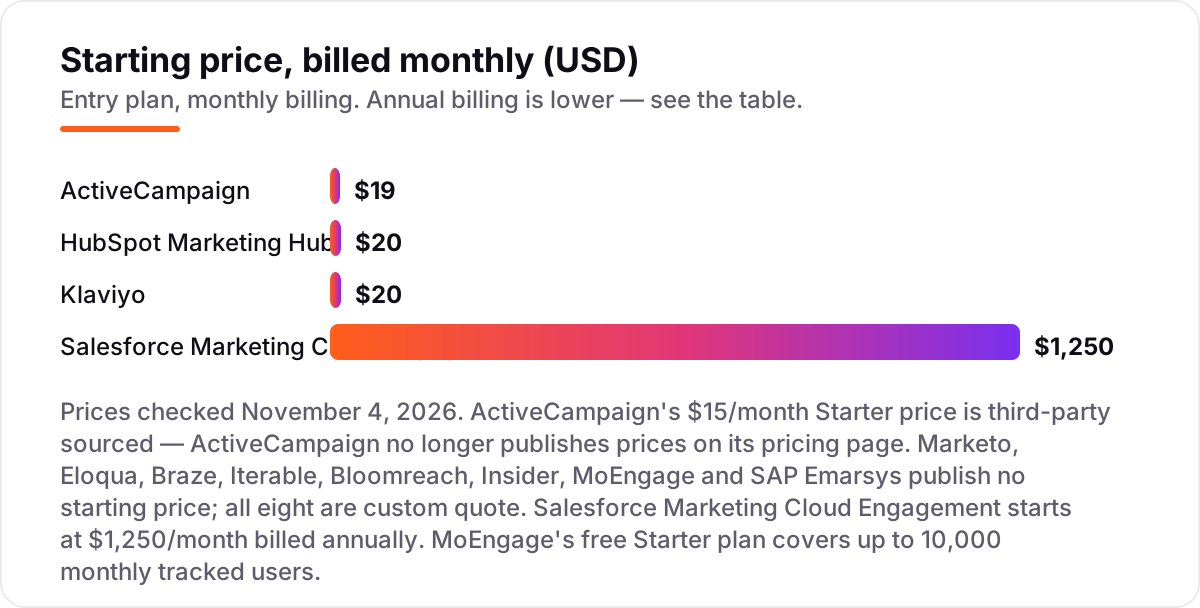
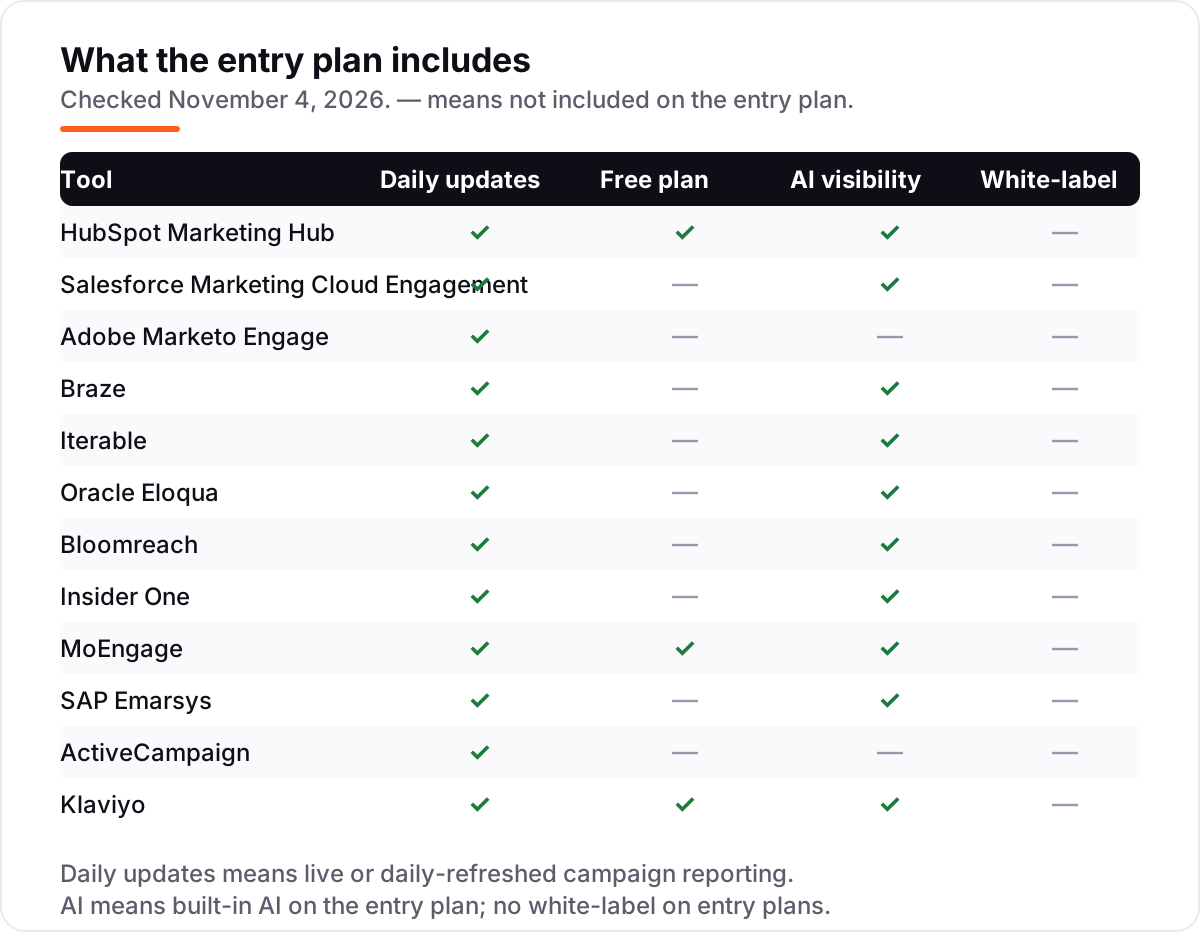
Only four platforms in this list publish a starting price, and three of them cost $20 a month or less to start: ActiveCampaign from $19, HubSpot and Klaviyo from $20. MoEngage goes further with a genuinely free Starter plan. That does not make them cheap at enterprise scale — Klaviyo charges per active profile and ActiveCampaign charges per contact, so both climb steeply as the audience grows — but it does make them the only platforms you can evaluate without a sales call.
For a smaller team, start with one of these and upgrade when the audience outgrows the pricing unit. For anything enterprise, treat the published price as the floor, not the budget: the quote is where the real number lives. Our monthly SEO service works the same way — the audit is free, the retainer follows the scope.
Enterprise marketing platforms pricing: what you will actually pay
Take a five-person marketing team with a 1,000-contact list and a 500-profile email list, buying for a full year. HubSpot Starter costs $20 per seat per month, so five seats are $100 a month, or $1,200 a year. Klaviyo's Email plan starts at $20 a month for 500 active profiles, or $240 a year. ActiveCampaign Starter is $19 a month billed monthly for 1,000 contacts ($15 billed annually, or $180 a year) — but those figures are third-party sourced, because ActiveCampaign no longer publishes prices on its own site. Salesforce Marketing Cloud Engagement Pro is $1,250 a month billed annually, or $15,000 a year. The same team pays $180 a year at the low end (on annual billing) and $15,000 at the high end, and the units are not the same — seats, profiles, contacts and a whole-org license — so treat these as entry points, not like-for-like quotes.
Three costs sit outside those numbers. First, the eight custom-quote platforms — Marketo, Eloqua, Braze, Iterable, Bloomreach, Insider, MoEngage and SAP Emarsys — cannot be priced at all until sales replies, so a team comparing them against HubSpot's $1,200 a year has no number to compare with. Second, the entry tier is rarely the enterprise tier: HubSpot Enterprise is $3,600 a month plus a mandatory $7,000 onboarding fee, and Klaviyo rises to $150 a month at 10,000 profiles. Third, the metered extras: WhatsApp and SMS often bill separately, and Salesforce and Marketo implementations commonly take three to six months of staff time. Budget the quote, the onboarding and the metered channels together — the starting price is the floor, not the bill.
Know the difference: B2B automation vs cross-channel engagement
The confusion in this category is between two kinds of platform that share the same job title. B2B automation platforms are built around the lead: Marketo, Eloqua and Salesforce Marketing Cloud score leads, run multi-month nurture programs and hand conversation-ready opportunities to sales, and HubSpot does the same ideas at the lighter end. Cross-channel engagement platforms are built around the individual customer: Braze, Iterable and MoEngage watch real-time behavior and trigger push, in-app and SMS journeys as that behavior changes. The first kind answers "which accounts are ready to buy"; the second answers "what should this person get next".
A retailer or ecommerce team faces a third shape: Bloomreach, Insider, SAP Emarsys and Klaviyo are built around the store, tying campaigns to product data, loyalty and revenue rather than to leads or app behavior. Pick the shape that matches your buyer first — B2B teams start with Marketo or Eloqua, app-first consumer brands start with Braze or Iterable, and stores start with Insider or Bloomreach — and only then compare tools inside that shape. Buying the wrong shape is the most expensive mistake in this list, because the platform will still work; it will just work on the wrong problem.
Quick comparison: tool type by need
| Buyer | Best pick | Why |
|---|---|---|
| Most teams, one platform | HubSpot Marketing Hub | Free plan, published prices from $20/seat, native CRM |
| Enterprise already on Salesforce | Salesforce Marketing Cloud | Journey Builder plus Einstein, from $1,250/month |
| B2B with long sales cycles | Marketo or Eloqua | Lead scoring, nurture and ABM built for complex deals |
| App-first consumer brand | Braze or Iterable | Real-time journeys and AI optimization across channels |
| Retail or ecommerce | Insider One or Bloomreach | Highest G2 score (4.8) and CDP-led personalization |
| Smallest budget that scales | MoEngage or Klaviyo | Free Starter to 10,000 users; Email from $20/month |
How to choose: a short decision path
- Name your pricing unit first. Seats, contacts, profiles or monthly active users — the unit decides the bill at your audience size, and it differs on every platform here.
- Match the tool to the buyer, not the feature list. B2B teams need lead scoring and CRM handoff; consumer brands need real-time journeys; retailers need product data and loyalty.
- Check what is metered separately. WhatsApp, SMS, AI features and extra contacts are often add-ons, even on annual contracts.
- Count the implementation. Salesforce and Marketo commonly take three to six months; HubSpot, Klaviyo and MoEngage can go live in weeks.
- Run the free tier or trial with real data. HubSpot, Klaviyo and MoEngage all let you test before you buy — use your actual audience, not a demo list, and check the numbers against your current tool before signing.
Before you send your first campaign from a new platform, run your subject lines and preview text through the free SERP snippet preview tool — it shows exactly how the title and description will look in Google, and the same discipline applies to email subject lines.
Mistakes to avoid
- Comparing headline prices across different pricing units. $20 a seat, $20 a profile and $1,250 an org are not comparable numbers — price them all at your audience size.
- Treating a custom quote as a starting price. Eight of these twelve vendors publish nothing; the quote is the price, and it moves with your contact count, channels and term.
- Ignoring the onboarding and implementation bill. HubSpot Enterprise adds a $7,000 onboarding fee, and Salesforce and Marketo implementations commonly run three to six months of staff time.
- Trusting a directory price. ActiveCampaign still shows $15 a month on directories, but that is the annual-billed figure — monthly billing is $19 — and the vendor no longer publishes prices, so confirm any figure with sales before budgeting.
- Buying channels you will not use. A platform with WhatsApp, push and in-app messaging costs more than email alone; if you only send email, a simpler tool wins. Our guide to marketing automation for small business covers the lighter end of this market.
How we chose
We checked each vendor's own pricing page on November 4, 2026 and recorded the starting price exactly as shown. Four platforms publish one; the other eight — Marketo, Eloqua, Braze, Iterable, Bloomreach, Insider, MoEngage and SAP Emarsys — publish no starting price and are listed as custom quote. One exception is disclosed plainly: ActiveCampaign no longer publishes prices on its pricing page, so its $19-a-month Starter figure ($15 billed annually) is third-party sourced, not vendor-verified. Ratings come from G2, checked November 4, 2026, with review counts shown. We ranked the tools by fit for the most common buyer — a team choosing one platform to run email, journeys and reporting — not by brand size. No vendor paid for a place in this list, and none of the links here are affiliate links.
What to do next
Start with the decision path above: name your pricing unit, match the tool to your buyer type, and check what is metered separately. Then take the free plan or trial of your top pick — HubSpot, Klaviyo or MoEngage — and run a real campaign against your current tool for two weeks. If the numbers and the workflow hold up, request like-for-like quotes from the custom-quote vendors on your shortlist. Once your tools are in place, find out what's holding your rankings back.
Your stack only works if people find you
SerpAstra fixes what keeps your site off page one and makes it easy for AI assistants to recommend.
Get a free audit→Sources we checked (24)
- HubSpot Marketing Hub pricing — hubspot.com/pricing/marketing (checked November 4, 2026)
- HubSpot Marketing Hub on G2 — 4.4/5, 16,050 reviews (checked November 4, 2026)
- Salesforce Marketing Cloud pricing — salesforce.com/products/marketing-cloud/pricing (checked November 4, 2026)
- Salesforce Marketing Cloud on G2 — 4.1/5, 4,852 reviews (checked November 4, 2026)
- Adobe Marketo Engage — business.adobe.com/products/marketo.html (no published prices; custom quote, checked November 4, 2026)
- Adobe Marketo Engage on G2 — 4.1/5, 3,345 reviews (checked November 4, 2026)
- Braze — braze.com (no published prices; custom quote, checked November 4, 2026)
- Braze on G2 — 4.5/5, 1,987 reviews (checked November 4, 2026)
- Iterable — iterable.com (no published prices; custom quote, checked November 4, 2026)
- Iterable on G2 — 4.4/5, 842 reviews (checked November 4, 2026)
- Oracle Eloqua — oracle.com/cx/marketing/automation (no published pricing page; custom quote, checked November 4, 2026)
- Oracle Eloqua on G2 — 3.9/5, 628 reviews (checked November 4, 2026)
- Bloomreach — bloomreach.com (no published prices; custom quote, checked November 4, 2026)
- Bloomreach on G2 — 4.6/5, 777 reviews (checked November 4, 2026)
- Insider One — useinsider.com (no published prices; custom quote, checked November 4, 2026)
- Insider One on G2 — 4.8/5, 1,415 reviews (checked November 4, 2026)
- MoEngage — moengage.com (Growth/Enterprise custom quote; free Starter to 10,000 MTUs, checked November 4, 2026)
- MoEngage on G2 — 4.5/5, 525 reviews (checked November 4, 2026)
- SAP Emarsys — emarsys.com (no published prices; custom quote, checked November 4, 2026)
- SAP Emarsys on G2 — 4.2/5, 669 reviews (checked November 4, 2026)
- ActiveCampaign pricing — activecampaign.com/pricing (no prices published on the page, checked November 4, 2026; $19/month Starter ($15 billed annually) figure third-party sourced)
- ActiveCampaign on G2 — 4.4/5, 14,842 reviews (checked November 4, 2026)
- Klaviyo pricing — klaviyo.com/pricing (checked November 4, 2026)
- Klaviyo on G2 — 4.6/5, 1,360 reviews (checked November 4, 2026)
Shamim
Founder of SerpAstra
A full-stack SEO and digital marketer who spends most days on Local SEO for dental practices, AI search visibility and lead generation.
Frequently asked questions
What is the best enterprise marketing platform in 2026?
HubSpot Marketing Hub is the best all-round pick for most teams: a free plan, published pricing from $20/month per seat and a native CRM. Salesforce Marketing Cloud Engagement is the deepest enterprise stack, and Insider One is the highest-rated platform in this list at 4.8/5 on G2. The right choice depends on whether you need B2B automation, cross-channel engagement or ecommerce personalization.
How much does an enterprise marketing platform cost?
Only four of the twelve platforms here publish a starting price: ActiveCampaign from $19/month, HubSpot and Klaviyo from $20/month, and Salesforce Marketing Cloud Engagement from $1,250/month billed annually. The other eight are custom quote, and third-party benchmarks put entry contracts for Braze and Marketo in the tens of thousands of dollars a year.
Why do most enterprise marketing platforms not publish prices?
Because the price depends on your audience size, channels, data volume and contract term, so a single number would mislead more than it helps. Vendors quote annually against those variables. The honest way to compare is to request like-for-like quotes with the same contact count, channels and term, and to ask what is metered separately.
What is the difference between a marketing automation platform and a customer engagement platform?
Marketing automation platforms like Marketo and Eloqua are built around B2B campaigns: lead scoring, nurture programs and sales handoff. Customer engagement platforms like Braze, Iterable and MoEngage are built around the individual customer: real-time behavior, push and in-app messaging, and AI-driven journeys. Many enterprises run one of each.
Is there a free enterprise marketing platform?
Not at enterprise scale, but three platforms here have free tiers worth trying: HubSpot has a free plan with basic email and forms, Klaviyo is free up to 250 active profiles, and MoEngage's free Starter plan covers 10,000 monthly tracked users. All three cap out fast — the free tier is a trial of the workflow, not a long-term home.
HubSpot vs Salesforce Marketing Cloud: which should an enterprise choose?
Choose HubSpot if you want one platform your whole team adopts quickly, with a native CRM and published prices. Choose Salesforce Marketing Cloud Engagement if you already run Salesforce and need journey orchestration at massive scale with Einstein AI. HubSpot wins on ease and transparency; Salesforce wins on depth and ecosystem.
What should I check before signing an enterprise marketing platform contract?
Four things: which unit sets the price (seats, contacts, profiles or monthly active users), what counts toward that unit, which channels and AI features are metered separately, and what the renewal uplift and overage rates are. Get the quote in writing with the same scope from every vendor, and confirm the implementation timeline before you sign.
Free SEO and AI visibility audit
Find out what is holding your rankings back
Send us your site. Within 2 business days you get a written audit, an AI visibility check and a short fix list ranked by impact. Free, with no contract attached.
Request my free audit→Related guides
 SEO & AI Search12 Best Marketing Platforms for Small Business SEO in 2026, ComparedThe 12 best marketing platforms for small business SEO, compared on real prices, SEO tools and AI visibility. Every price checked November 1, 2026.Read guide →
 MarketingMarketing automation for small businesses: what to automate (and what not to)Marketing automation for small businesses, explained: what to automate first, what to keep human, and the tools that save hours without losing customers.Read guide →
 MarketingEmail marketing for local businesses (that customers actually open)Email marketing for local businesses: build a list the right way, send emails customers open, and turn past customers into repeat bookings without spam.Read guide →