
9 Best Event Marketing Platforms for 2026 (Pros, Cons and Pricing)
9 best event marketing platforms compared with real prices, G2 ratings and free plans. Find the right fit for conferences, webinars and ticketed events.
 Shamim Mia, Founder, SerpAstraLast verified November 4, 202611 min read
We compare pricing pages, documentation and public reviews. We never accept payment for rankings.

Key takeaways
- Whova is the highest-rated platform here at 4.8/5 on G2, while Eventbrite is the easiest way in: free to publish, with a 3.7% + $1.79 fee per paid ticket. Bizzabo starts at $499 per user per month billed annually.
- Most dedicated event platforms are sold by custom quote — Cvent, Splash and Goldcast publish no starting price, so budget from a sales conversation, not a price page.
- The single most important buying factor is the pricing model: per-ticket fees, per-event quotes and per-seat subscriptions punish different event shapes, so price your real event before you compare.
- Free plans exist — Eventbrite for free events, Zoho Backstage and Splash for small programs — but the attendee and branding limits arrive fast.
- Every price and rating below was checked on November 4, 2026. Where a vendor page could not be read directly that day, the post says exactly where the figure came from.
On this page
Quick comparison
| Tool | Best for | Starting price | Free plan |
|---|---|---|---|
| Eventbrite | Small teams and creators running public ticketed events who want built-in discovery | Per ticket: 3.7% + $1.79 | Yes (free events) |
| Whova | Conference and association organizers who need attendee networking and a mobile event app | Custom quote | Yes (free events) |
| Cvent | Enterprise teams running large conference programs with venue sourcing and room blocks | Custom quote | No (demo only) |
| Bizzabo | B2B marketing teams running sponsor-heavy conferences who need lead capture | $499/user/mo (annual) | No (demo only) |
| Splash | Field marketing teams that need on-brand event pages, invites and emails fast | Custom quote | Yes (limited) |
| Goldcast | B2B demand-generation teams running webinars and virtual events for pipeline | Custom quote | No (demo only) |
| Zoho Backstage | Small teams that want an all-in-one event platform with 0% ticketing commission | $119/mo | Yes (100 attendees) |
| HubSpot Marketing Hub | Teams already on HubSpot CRM who promote events by email and want registrations in the CRM | $20/seat/mo | Yes (free CRM) |
| Brevo | Small teams promoting events mainly by email and SMS on a tight budget | $9/mo | Yes (300/day) |
Make one of these tools?
We re-check this list every quarter. Send a correction, request a review, or ask about a clearly labeled sponsored spot.
Request a listingThe best event marketing platforms

Eventbrite
Best for: Small teams and creators running public ticketed events who want built-in discovery
Eventbrite is the fastest way to put a ticketed event on sale. Publishing is free, there is no monthly subscription, and the built-in marketplace does real promotion work: Eventbrite says it has helped transact 270 million tickets across 4.7 million events, so people browsing for things to do can find your event without you buying ads. The organizer app handles check-in from a phone, and the optional Pro plan adds email marketing from $15 a month.
The catch is the per-ticket math. On a $100 ticket you pay $5.49 in service fees plus 2.9% payment processing, so a sold-out 500-person event costs about $2,745 in fees before the processing charge. Event pages also carry limited branding options, so the page never looks fully like your own site. Pick Eventbrite when discovery and speed matter more than the fee line.
What we like
- Free to publish — unlimited free events cost nothing, and paid tickets carry no monthly subscription
- Built-in discovery marketplace: Eventbrite says it has helped transact 270 million tickets across 4.7 million events
- Organizer app turns phones into QR check-in scanners, and the optional Pro plan adds email marketing from $15/month
Watch out for
- Per-ticket fees add up fast: 3.7% + $1.79 per ticket plus 2.9% payment processing on every paid order
- Event-page branding is limited — reviewers note you cannot fully white-label the page to match your own brand

Whova
Best for: Conference and association organizers who need attendee networking and a mobile event app
Whova is the conference app attendees actually open. The agenda, speaker profiles, announcements and community boards live in one place, and the matchmaking, messaging and meetup tools give people a reason to talk before the first session starts. Reviewers rate it 4.8 out of 5 on G2 — the highest score in this list — and praise the support team most after ease of use.
The platform itself is sold by custom quote per event, so budget from a sales conversation, not a price page; third-party reports put typical quotes in the low-to-mid four figures per event. The ticket fee is the lowest here at 3.0% plus $0.99 per paid ticket, and free tickets cost nothing. Choose Whova when the hallway conversations are the point of the event.
What we like
- Highest G2 rating in this list at 4.8/5 from 1,970 reviews, with reviewers praising ease of use and support
- Community boards, matchmaking, messaging and meetups turn the attendee app into the networking engine
- Lower ticket fee than Eventbrite at 3.0% + $0.99 per paid ticket, with no fee on free tickets
Watch out for
- Platform pricing is a custom quote per event, so two events the same size can be quoted very different amounts
- The attendee app is web-first in places, and reviewers note heavy Wi-Fi dependence in large venues
Cvent
Best for: Enterprise teams running large conference programs with venue sourcing and room blocks
Cvent is the platform large event programs standardize on. Registration, event websites, the Attendee Hub, OnArrival check-in and badging, venue sourcing and room blocks all sit in one contract, and the integration list runs past 200 tools. It earned the highest G2 Grid score in the event management category for Fall 2026, and support runs 24/7 with a live representative.
Everything is quoted, so there is no number to compare before the sales call — independent procurement data puts a typical mid-market contract near $19,500 a year, before per-registrant fees and implementation. Setup is also the heaviest here, with rollouts commonly taking one to three months. Buy Cvent when the event program is big enough to justify an enterprise contract.
What we like
- The deepest event suite here: registration, event websites, Attendee Hub, OnArrival check-in and badging, venue sourcing and room blocks
- More than 200 integrations and a venue marketplace that no other platform in this list matches
- Highest G2 Grid score in the event management category for Fall 2026, with 24/7 live-representative support
Watch out for
- Quote-only pricing with annual contracts — third-party data puts typical mid-market contracts around $19,500 a year and up
- Steep learning curve: reviewers report rollouts of one to three months and a heavy setup effort

Bizzabo
Best for: B2B marketing teams running sponsor-heavy conferences who need lead capture
Bizzabo is built for B2B conferences where sponsors pay the bills. The Event Experience OS covers registration, event websites, a mobile app, virtual events and analytics, and the Klik SmartBadges let attendees exchange contacts with a tap — Bizzabo reports nearly 1 million contact exchanges since the badges launched in 2022. Native HubSpot, Marketo and Salesforce integrations push those leads into the CRM.
The price is published, which is rare in this category: $499 per user per month billed annually, with a three-user minimum, so the floor is $17,999 a year. There is no single-event option, and the badge hardware costs extra. Pick Bizzabo when sponsor leads are the metric the event is judged on.
What we like
- Event Experience OS covers registration, event websites, mobile app, virtual events and analytics in one login
- Klik SmartBadges turn networking into captured leads — Bizzabo reports nearly 1 million contact exchanges since 2022
- Native HubSpot, Marketo and Salesforce integrations carry event leads straight into the CRM
Watch out for
- Annual subscription only — no single-event purchase, and the $17,999-a-year floor is steep for infrequent events
- Klik SmartBadge hardware is priced separately, and reviewers note the website editor gets fiddly on complex agendas

Splash
Best for: Field marketing teams that need on-brand event pages, invites and emails fast
Splash is the design-first option. Event pages, invites and emails look polished straight out of the templates, and reviewers say a page can go live in minutes without a designer or a developer. Every paid plan includes unlimited events and unlimited registrations, and the two-way Salesforce sync keeps the guest list and the CRM in agreement.
The trade-off is price transparency: Pro and Enterprise are sold by quote, and third-party estimates disagree widely, from about $12,500 a year to a median contract near $27,000. Large guest lists can also slow the interface down. Choose Splash when the event page is a brand asset and speed to publish matters.
What we like
- Design-first event pages, invites and emails — reviewers say pages go live in minutes without a designer or a developer
- Unlimited events and unlimited registrations on every paid plan, with no hidden fees
- Two-way Salesforce sync plus Marketo, HubSpot and Slack integrations keep registrations in the CRM
Watch out for
- No published price — Pro and Enterprise are sold by quote, and third-party estimates disagree widely
- Guest-list management slows down on very large lists, per G2 reviewers

Goldcast
Best for: B2B demand-generation teams running webinars and virtual events for pipeline
Goldcast is the event platform for demand-generation teams. Webinars, digital events and field events run on one system, and the engagement data flows into HubSpot and Salesforce so sales can follow up on the people who actually paid attention. Content Lab then turns the recording into clips, blogs and social posts with AI, so one event produces a month of content.
Pricing is custom quote only, and third-party estimates put entry around $15,000 a year — confirm with a quote before you budget. G2 reviewers also flag reporting as the weak spot, with custom reports taking extra work. Buy Goldcast when webinars are a pipeline channel, not a one-off broadcast.
What we like
- Built for pipeline: webinars, digital events and field events with engagement data that flows into HubSpot and Salesforce
- Content Lab turns one event recording into clips, blogs and social posts with AI, so the event keeps working after it ends
- Recording Studio captures broadcast-quality video with a branded stage and backstage controls
Watch out for
- No published price — events are sold by custom quote, and third-party estimates put entry around $15,000 a year
- Reporting is a weak spot in G2 reviews: exports and custom reports take extra work

Zoho Backstage
Best for: Small teams that want an all-in-one event platform with 0% ticketing commission
Zoho Backstage is the value pick in this list. Essentials costs $119 a month, or $99 a month billed annually, and covers unlimited events, a drag-and-drop event website, RSVP management, check-in and badging — plus 0% commission on ticket sales, so you keep every dollar of ticket revenue. A pay-per-event option from $299 an event suits teams that run one event a year.
The limits are attendee counts: Essentials caps at 200 attendees per event, and bigger conferences need Premium at $249 a month. The 4.4 out of 5 G2 rating also rests on only 29 reviews, far fewer than the other platforms here. Pick Backstage when you want a full event platform without giving up a cut of ticket sales.
What we like
- 0% commission on ticket sales — you keep all ticket revenue, which no other platform in this list offers
- Unlimited events on every paid plan, with a drag-and-drop website builder, RSVP management and check-in included
- Pay-per-event option from $299 an event suits teams that run one event a year
Watch out for
- Essentials caps at 200 attendees per event, so bigger conferences need Premium ($249/month) or the top-tier plan
- Only 29 G2 reviews, so the 4.4/5 rating rests on a much smaller base than the other platforms here

HubSpot Marketing Hub
Best for: Teams already on HubSpot CRM who promote events by email and want registrations in the CRM
HubSpot Marketing Hub is the event marketing pick for teams that already live in HubSpot. Invites, landing pages, registration forms and follow-up emails run in the same CRM as the rest of the marketing, so there is no sync to build or break. Starter costs $20 a month per seat with 1,000 marketing contacts included, and a new-customer promotion can cut that to $7 a seat.
HubSpot is not an event platform in the full sense: there is no native event app, check-in or badging, so onsite work needs another tool. Costs also climb with contacts — Professional jumps to $890 a month. Choose HubSpot when the event is a campaign inside a CRM-led marketing program, not a standalone production.
What we like
- Event invites, landing pages and registration forms live in the same CRM as the rest of the marketing, so no sync to maintain
- Starter includes 1,000 marketing contacts, removes HubSpot branding, and adds email automation and landing pages
- The largest review base in this list: 4.4/5 from 16,050 G2 reviews
Watch out for
- Starter is priced per seat and per 1,000 marketing contacts, so a growing list raises the bill fast — Professional jumps to $890/month
- Event features are email, landing pages and forms; there is no native event app, check-in or badging
Brevo
Best for: Small teams promoting events mainly by email and SMS on a tight budget
Brevo is the cheapest way to promote an event in this list. Starter costs $9 a month for 5,000 emails, and the free plan sends 300 emails a day, so a small team can run invites, reminders and follow-ups without a budget line. Email, SMS, WhatsApp and transactional messages sit in one account, and Brevo charges by emails sent rather than contacts stored.
The $9 tier is deliberately thin: no marketing automation or A/B testing, only 500 stored contacts, and the Brevo logo stays on emails unless you pay a $12 monthly add-on. Brevo also runs the promotion, not the event — registration and check-in need another tool. Pick Brevo when email is the main channel and the budget is the constraint.
What we like
- Cheapest entry in this list: Starter from $9/month for 5,000 emails, with a free plan sending 300 emails a day
- Email, SMS, WhatsApp and transactional messages in one account, with landing pages from Standard
- Prices by emails sent, not contacts stored, so a large list you email rarely stays cheap
Watch out for
- Starter has no marketing automation or A/B testing — those start on Standard at $18/month
- Starter stores only 500 contacts at the $9 tier, and the Brevo logo stays unless you pay a $12/month add-on
This list of the best event marketing platforms is for marketers who run conferences, webinars and ticketed events and want one system to promote them, register attendees and prove the pipeline. We ranked the nine platforms below by fit for the most common buyer — a small or mid-size marketing team running a handful of events a year — not by brand size.
How to choose the best event marketing platforms
Event marketing platforms differ in what they charge for and what they include, so start from your event shape, not the feature list.
- Count the pricing unit. Per-ticket fees punish expensive tickets, per-seat subscriptions punish large teams, and per-event quotes punish frequent events. Price your real event on each model before you compare.
- Check what is actually included. Registration, ticketing, an attendee app, check-in and the CRM sync are separate line items on some platforms and bundled on others.
- Ask about the attendee app. If networking is the point of the event, the app matters more than the registration form — and it is the feature reviewers mention most.
- Follow the data. Registrations should land in your CRM or email tool without a manual export, or the post-event follow-up will not happen.
- Read the contract, not the price page. Annual minimums, implementation fees and renewal increases are where event-platform bills grow.
Event marketing platform pricing: what you will actually pay
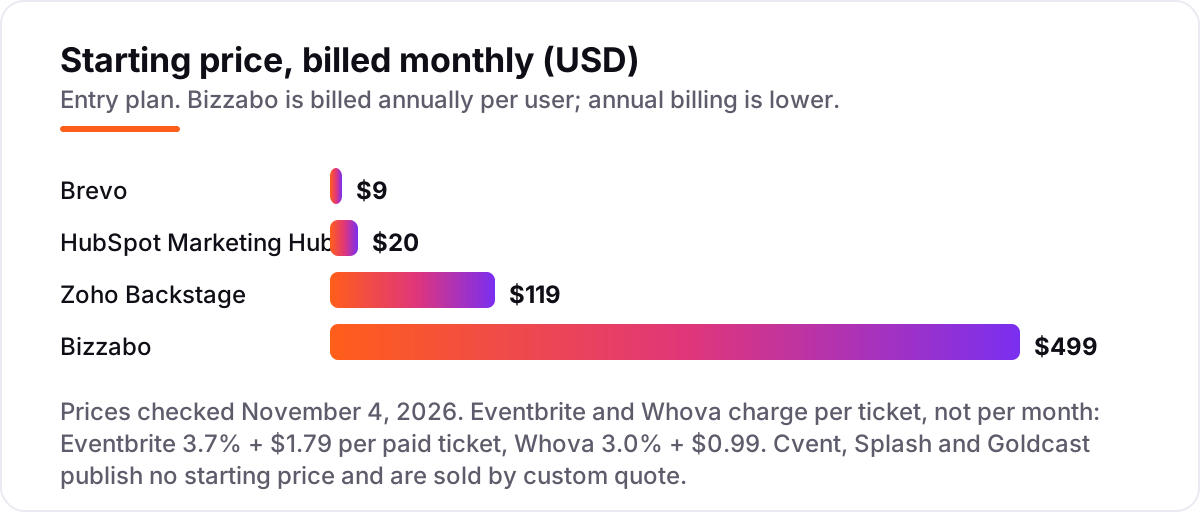
Take a 500-person conference with $100 tickets. On Eventbrite you pay 3.7% plus $1.79 per ticket — $5.49 a ticket, or $2,745 for the room — plus 2.9% payment processing on each order. On Whova the ticket fee is lower, 3.0% plus $0.99, or $3.99 a ticket and $1,995 for the room, but the platform itself is a custom per-event quote on top. Zoho Backstage Essentials would cost $119 for the month, with no cut of ticket sales at all, while Bizzabo starts at $17,999 a year before any ticket fees.
Three patterns explain most of the price spread. Per-ticket platforms look free until the room fills up; per-seat and per-event quotes look expensive until you run the tenth event; and the cheapest monthly price is rarely the cheapest event — the ticket fee and the contract length decide that. If you run one big event a year, a per-ticket or pay-per-event platform wins. If you run a monthly webinar program, a subscription wins. Track every invite link with the free UTM builder so you know which channel actually filled the room.
One more cost hides in the fine print: implementation and onboarding. Cvent and Bizzabo both include a dedicated success manager and structured onboarding in the contract, which is part of why their first-year bill runs higher than the headline price. Zoho, Brevo and HubSpot are self-serve at the entry level, so there is no onboarding charge — but also no one to call when the guest list will not import. Ask every vendor what the first invoice actually contains before you sign.
Know the difference: ticketing, registration and promotion are three different jobs
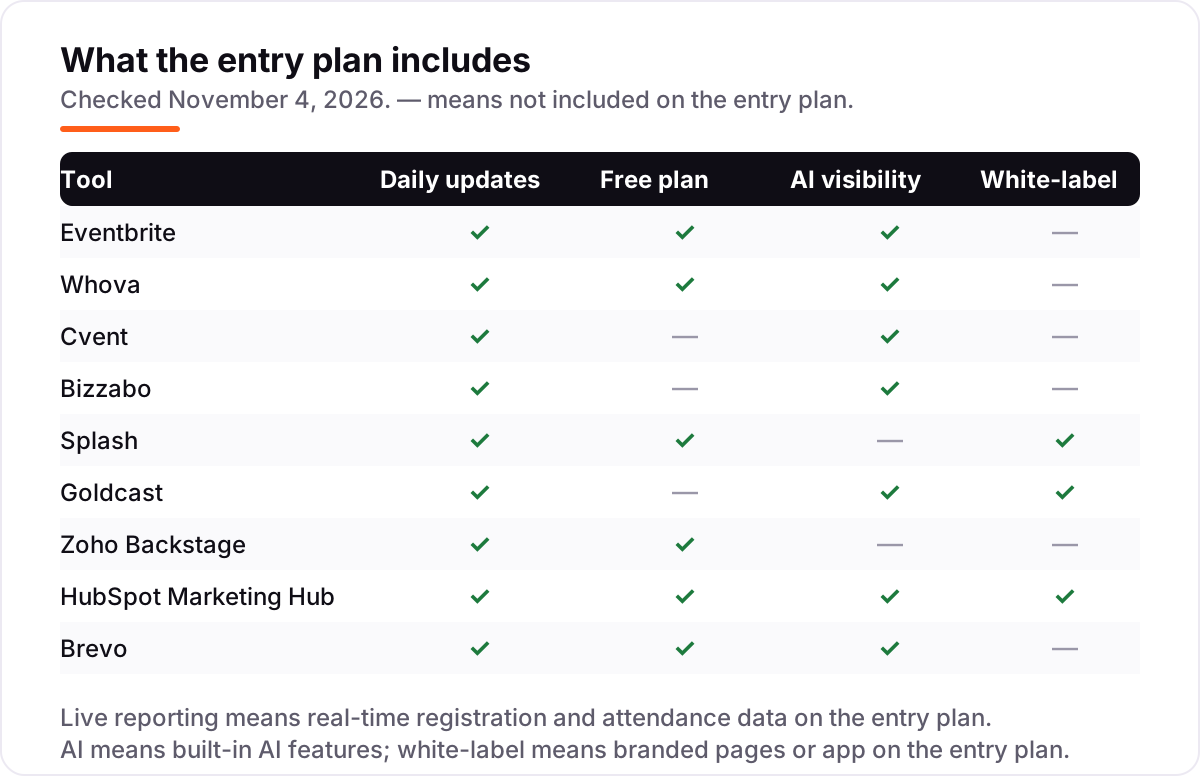
Buyers confuse these three jobs, and vendors encourage it. Ticketing sells the ticket and takes a cut. Registration collects the attendee's details, sessions and dietary requirements. Promotion fills the room in the first place — emails, ads, landing pages and the marketplace listing. Eventbrite does all three, but it is strongest at ticketing and discovery. HubSpot and Brevo do promotion well and leave registration and check-in to someone else. Cvent, Bizzabo and Whova cover registration and the onsite experience, and expect you to bring the audience or buy the promotion separately. Splash and Goldcast sit in the middle: Splash covers promotion and registration with on-brand pages, invites and emails, and Goldcast covers promotion and the virtual event itself, turning webinars into pipeline. Zoho Backstage covers registration and ticketing with 0% commission, but leaves wider promotion to an email tool.
If you buy one platform to do all three jobs, check the weakest job first, because that is the one you will feel on event day. A beautiful registration form does not fill seats, and a great email tool does not check anyone in at the door. If event pages are part of a wider marketing program, our monthly SEO service keeps them visible in search between events.
Quick comparison: tool type by need
| Buyer | Best pick | Why |
|---|---|---|
| Small team, public ticketed events | Eventbrite | Free to publish, marketplace discovery, 3.7% + $1.79 per ticket |
| Conferences and associations | Whova | Highest-rated app, networking built in, 3.0% + $0.99 per ticket |
| Large enterprise programs | Cvent | Full suite plus venue sourcing, quoted annually |
| Sponsor-led B2B conferences | Bizzabo | Klik badges turn handshakes into CRM leads, from $17,999/year |
| Brand-led field events | Splash | On-brand pages in minutes, unlimited events, custom quote |
| Webinars that must create pipeline | Goldcast | Events plus AI content repurposing, custom quote |
| Small teams on a budget | Zoho Backstage | $99/month billed annually, 0% ticket commission |
| Teams already on HubSpot | HubSpot Marketing Hub | Invites and forms in the CRM, $20/seat/month |
| Email-first promotion | Brevo | $9/month for 5,000 emails, free plan included |
How we chose
We checked each vendor's own pricing page on November 4, 2026 and recorded the starting price exactly as shown. Cvent's pricing page timed out when we tried to open it that day, so its custom-quote status rests on multiple independent pricing guides from October 2026, all of which agree Cvent publishes no price. Brevo's and HubSpot's pages opened but render prices in JavaScript, so their figures are the standard catalog prices — Brevo $9 a month from its own published pricing file, HubSpot $20 a seat — confirmed across several independent sources; the HubSpot promo price is $7 a seat for new customers only. Zoho's page also renders prices in JavaScript; its $119 monthly and $99 annual Essentials figures reconcile with the 17% yearly saving shown on the page and with the vendor-provided pricing on its G2 profile. Ratings come from G2 pages opened on November 4, 2026, with review counts shown. Bizzabo's $499 per user per month was read on its own pricing page that day. For Splash and Goldcast, third-party estimates range from about $12,500 to $15,000 a year, but neither vendor publishes a price, so both are listed as custom quote and no figure is asserted. We ranked by fit for the most common buyer — a small or mid-size marketing team — not by brand size. No vendor paid for a place in this list, and none of the links here are affiliate links.
What to do next
Start with your next event, not the feature list: count the attendees, the ticket price and how often you run events, then price that event on the two or three platforms that fit your shape. Run the free plan or demo with your real agenda and your real guest list before you sign anything. If the numbers work and the reports make sense to a sponsor or a manager, you have your platform. Once your tools are in place, find out what's holding your rankings back.
Your stack only works if people find you
SerpAstra fixes what keeps your site off page one and makes it easy for AI assistants to recommend.
Get a free audit→Sources we checked (18)
- Eventbrite pricing — eventbrite.com/organizer/pricing (checked November 4, 2026)
- Eventbrite on G2 — 4.3/5, 914 reviews (checked November 4, 2026)
- Whova pricing — whova.com/pricing (checked November 4, 2026)
- Whova on G2 — 4.8/5, 1,970 reviews (checked November 4, 2026)
- Cvent pricing — cvent.com (page timed out November 4, 2026; custom-quote status from independent guides, October 2026)
- Cvent on G2 — 4.3/5, 2,456 reviews (checked November 4, 2026)
- Bizzabo pricing — bizzabo.com/pricing (checked November 4, 2026)
- Bizzabo on G2 — 4.3/5, 448 reviews (checked November 4, 2026)
- Splash pricing — splashthat.com/pricing (checked November 4, 2026)
- Splash on G2 — 4.4/5, 377 reviews (checked November 4, 2026)
- Goldcast pricing — goldcast.io/pricing (checked November 4, 2026)
- Goldcast on G2 — 4.7/5, 238 reviews (checked November 4, 2026)
- Zoho Backstage pricing — zoho.com/backstage/pricing.html (checked November 4, 2026)
- Zoho Backstage on G2 — 4.4/5, 29 reviews (checked November 4, 2026)
- HubSpot Marketing Hub pricing — hubspot.com/pricing/marketing (checked November 4, 2026)
- HubSpot Marketing Hub on G2 — 4.4/5, 16,050 reviews (checked November 4, 2026)
- Brevo pricing — brevo.com/pricing (checked November 4, 2026)
- Brevo on G2 — 4.5/5, 2,775 reviews (checked November 4, 2026)
Shamim
Founder of SerpAstra
A full-stack SEO and digital marketer who spends most days on Local SEO for dental practices, AI search visibility and lead generation.
Frequently asked questions
What is the best event marketing platform in 2026?
Whova is the highest-rated in this list at 4.8/5 on G2, and it is the best pick for conferences where networking matters. Eventbrite is the best starting point for public ticketed events because publishing is free. Enterprise teams with large programs should shortlist Cvent, and B2B teams that live on sponsor leads should look at Bizzabo.
How much does an event marketing platform cost?
From free to about $18,000 a year at the entry level. Eventbrite and Whova charge per ticket — 3.7% + $1.79 and 3.0% + $0.99 respectively — while Zoho Backstage starts at $119 a month and Brevo at $9 a month. Cvent, Splash and Goldcast are custom quote only, and Bizzabo starts at $499 per user per month billed annually.
Is there a free event marketing platform?
Yes, with limits. Eventbrite is free for free events, Zoho Backstage has a free plan for up to 100 attendees per event, and Splash has a limited free plan. Brevo's free plan sends 300 emails a day for event promotion. Free plans work for a single small event; a regular program outgrows them fast.
What is the difference between event marketing and event management software?
Event marketing fills the room: promotion, invites, landing pages and registration. Event management runs the event itself: agendas, check-in, badging, the attendee app and onsite logistics. Most platforms in this list do both to some degree, but HubSpot and Brevo are marketing-first, while Cvent and Whova lean toward management and the onsite experience.
Do I need a separate ticketing tool?
Usually not. Eventbrite, Whova, Zoho Backstage and Splash all sell tickets inside the platform, and most take a percentage or a per-ticket fee for it. The exception is Zoho Backstage, which charges 0% commission. If you already sell tickets elsewhere, check that your event platform integrates with it before you buy.
Can an event marketing platform replace my email tool?
It can if you pick HubSpot or Brevo, which are email platforms first and event tools second. The dedicated event platforms — Cvent, Bizzabo, Whova, Splash and Goldcast — all send event emails, but they expect you to keep a separate email tool or CRM for the rest of your marketing. Check the native integrations before you assume the sync exists.
What should I check before paying for an event marketing platform?
Four things: which pricing unit you are buying — per ticket, per event, per seat or per year — and what it costs for your real event; the attendee cap on the entry plan; whether registrations flow into your CRM without manual exports; and whether the contract is annual with a minimum. All four vary widely across the nine platforms in this list.
Free SEO and AI visibility audit
Find out what is holding your rankings back
Send us your site. Within 2 business days you get a written audit, an AI visibility check and a short fix list ranked by impact. Free, with no contract attached.
Request my free audit→Related guides
 Digital Marketing & Ads8 Best Email Marketing Platforms for 2026 (Pros, Cons and Pricing)8 best email marketing platforms compared on real starting prices, free plans and automation. Brevo $9/month, Mailchimp $13. Checked Nov 4, 2026.Read guide →
 Digital Marketing & Ads8 Best All-In-One Marketing Platforms in 2026, ComparedCompare the 8 best all-in-one marketing platforms on price, free plans and automation, with every price verified in November 2026 and sorted by buyer.Read guide →
 Digital Marketing & Ads12 Best Enterprise Marketing Platforms in 2026, Compared12 best enterprise marketing platforms compared on price, channels and AI features. Only 4 publish a starting price — the rest are custom quote.Read guide →