
Best Fleet Dispatch Software for 2026: 10 Options Compared by Use Case
Compare the 10 best fleet dispatch software options for 2026, with real prices, free plans and G2 ratings, sorted by telematics, delivery and field service use.
 Shamim Mia, Founder, SerpAstraLast verified November 7, 202617 min read
We compare pricing pages, documentation and public reviews. We never accept payment for rankings.
Key takeaways
- Samsara, Motive and Verizon Connect lead for connected trucking fleets, but all three price by custom quote; the route-first picks start at $39 per driver a month (OptimoRoute), $50 per user (Upper) and $150 a month (Routific, free for 100 orders).
- Fleet dispatch splits into two worlds: telematics platforms for trucking fleets and route-first tools for local delivery. Know which world you live in before you compare prices.
- The single most important buying factor is the billing unit: per vehicle, per driver, per user, per order or per task. The same five-driver team costs $185 to $619 a month depending on the unit.
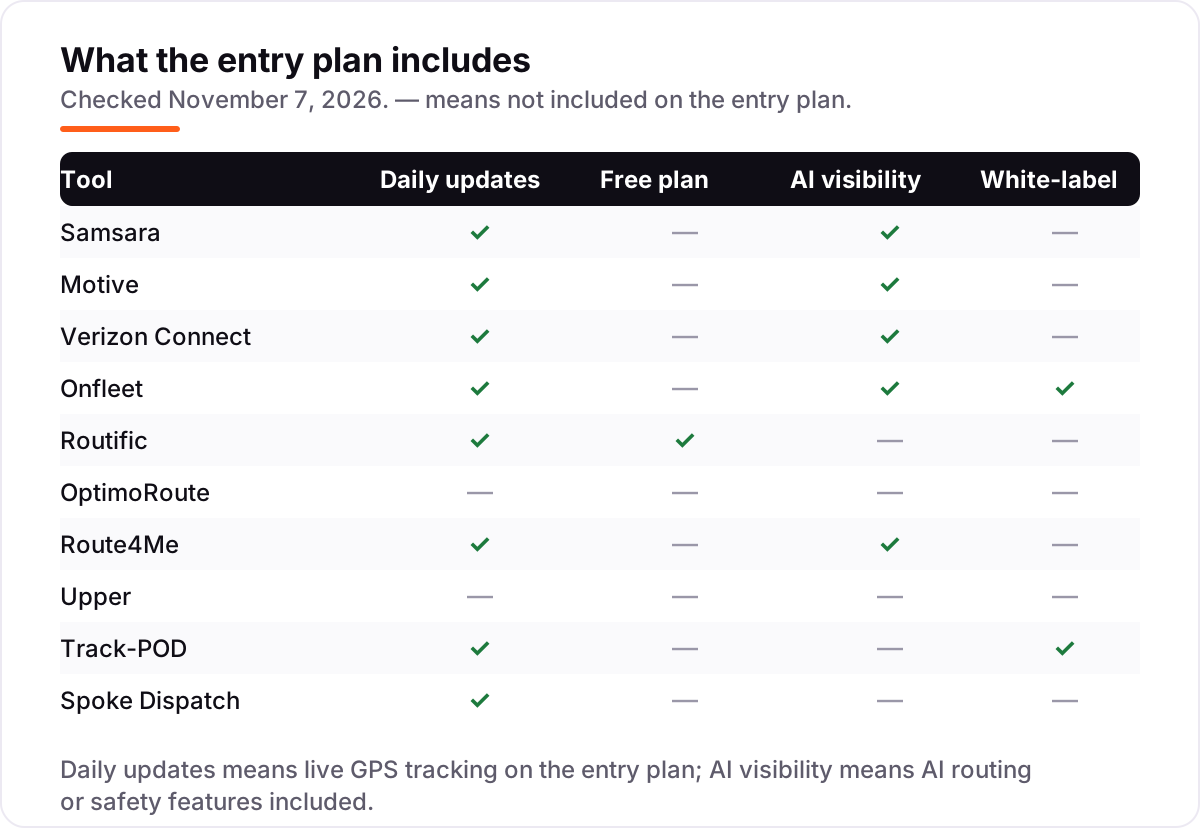
- Four of the ten tools publish no starting price, and the cheapest headline price is rarely the cheapest bill once hardware, SMS and add-ons are counted.
On this page
Quick comparison
| Tool | Best for | Starting price | Free plan |
|---|---|---|---|
| Samsara | Mid-size and large fleets that want one platform for GPS tracking, AI dash cams, ELD compliance and dispatch | Custom quote | No (demo) |
| Motive | Trucking and regional fleets where ELD compliance and driver safety come first | Custom quote | No (demo) |
| Verizon Connect | Large and mid-size fleets that already run on Verizon and need tracking, routing and compliance together | Custom quote | No (demo) |
| Onfleet | Delivery businesses that need automated dispatch, live customer tracking and proof of delivery at volume | $619/mo | No (14-day trial) |
| Routific | Small delivery teams that want simple multi-stop route optimization with no per-driver fees | Free; $150/mo | Yes (free plan) |
| OptimoRoute | Delivery and field-service teams that prefer per-driver pricing and want a long evaluation | $39/driver/mo | No (30-day trial) |
| Route4Me | Businesses running delivery and field service side by side that need one routing platform for both | Custom quote | No (7-day trial) |
| Upper | Lightweight last-mile teams that want routing, dispatch and proof of delivery without task caps | $50/user/mo | No (7-day trial) |
| Track-POD | B2B distribution fleets of 10 to 50 vehicles that want delivery management and a shipper portal in one subscription | $59/driver/mo | No (7-day trial) |
| Spoke Dispatch | Solo drivers and tiny courier teams that need routes planned in minutes with no per-driver fees | $125/mo | No (7-day trial) |
Make one of these tools?
We re-check this list every quarter. Send a correction, request a review, or ask about a clearly labeled sponsored spot.
Request a listingThe best fleet dispatch software

Samsara
Best for: Mid-size and large fleets that want one platform for GPS tracking, AI dash cams, ELD compliance and dispatch
Samsara is the platform the rest of this list is measured against. One login covers GPS tracking, AI dash cams, ELD compliance, fuel reporting, equipment monitoring and maintenance, so dispatchers see the operation instead of one slice. The Connected Operations Cloud is built for fleets that run 20 vehicles or more, and it shows: the depth is real, but so is the sales process.
The catch is commercial, not technical. Samsara publishes no prices, quotes per fleet, and asks for a three-year contract, with GPS units and cameras billed as separate line items. Third-party buyer data puts core telematics in the high-$20s to high-$30s per vehicle a month, but your quote will differ. Buy Samsara when one vendor for tracking, safety and compliance is worth a sales process; buy a route-first tool when dispatch alone is the job.
What we like
- The deepest connected-operations platform: GPS, AI dash cams, ELD, fuel and maintenance in one login
- Largest review base in this list, with consistently high marks for ease of use and real-time tracking
- Strong API and integration ecosystem, plus OEM integrations with Ford and GM vehicles
- AI safety coaching and in-cab alerts are core to the platform, not an add-on
Watch out for
- No published pricing — every deal is a custom quote, and hardware is billed separately
- Three-year contracts are typical, so switching away is slow and costly
- Overkill for fleets under about 20 vehicles that only need routing

Motive
Best for: Trucking and regional fleets where ELD compliance and driver safety come first
Motive grew up as the ELD compliance tool truckers actually liked, then expanded into a full operations platform: fleet management, driver safety, equipment monitoring, maintenance, spend management and workforce tools. The AI dash cam side competes directly with Samsara, and the Motive Card adds fuel-spend control that most dispatch tools ignore.
For dispatch specifically, Motive is stronger on the trucking side — loads, hours of service and compliance — than on multi-stop last-mile route optimization. If the fleet runs long-haul or regional trucking with compliance exposure, Motive is the natural pick. Pure delivery teams should look at the route-first tools below, where the per-driver and per-order prices are published and the trial is self-serve.
What we like
- Full ELD and hours-of-service compliance built in, with IFTA reporting and driver logs
- AI dash cams with 360-degree visibility and automated safety coaching
- Motive Card adds fuel-spend control that most dispatch tools ignore
- Reviewers praise the clean interface and responsive support
Watch out for
- Quote-based pricing with no public numbers, and contracts are typically multi-year
- Stronger on trucking, loads and compliance than on multi-stop last-mile route optimization
- Recent reviewers report occasional connectivity issues and slow video retrieval

Verizon Connect
Best for: Large and mid-size fleets that already run on Verizon and need tracking, routing and compliance together
Verizon Connect brings the carrier's network muscle to fleet management: GPS tracking, AI dash cams, asset tracking, ELD compliance and field-service dispatch coordination in one platform. The OEM integrations let compatible Ford and GM vehicles connect over the air with no hardware install, which simplifies rollout for large fleets.
It is an enterprise platform with enterprise friction: custom quotes, implementation effort and a product surface that can overwhelm small teams. For organizations already standardized on Verizon or running hundreds of vehicles across job sites, the scale story is compelling. Smaller fleets will find simpler tools faster to deploy, and will pay a published price instead of negotiating one.
What we like
- Near-real-time GPS tracking with strong reporting across large, mixed fleets
- AI video telematics and driver safety scoring included in the platform
- OEM integrations let compatible Ford and GM vehicles connect with no hardware install
- Field-service dispatch with routing, geofenced arrivals and job completion tracking
Watch out for
- Custom quotes only, with enterprise sales friction and implementation effort
- Lowest G2 score in this list at 3.8, with reviewers citing support and billing problems
- Product surface is broad enough to overwhelm small teams

Onfleet
Best for: Delivery businesses that need automated dispatch, live customer tracking and proof of delivery at volume
Onfleet is built for delivery operations rather than trucking: dispatchers assign jobs automatically based on driver proximity, availability and priority, drivers get a clean mobile app, and customers get live tracking links with proactive notifications. Proof of delivery, analytics and integrations with ordering systems round out a package designed for restaurants, grocers, pharmacies and courier companies.
Reviewers praise the automation but flag occasional route optimization quirks and a UI that takes training. Pricing scales with delivery volume rather than seats, which suits growing operations — but the $619 starting point means a team doing a few hundred deliveries a month pays far more per delivery than on Routific or Spoke Dispatch. For a delivery business outgrowing spreadsheets and group chats, Onfleet is the classic next step.
What we like
- Automated task assignment by driver proximity, availability and priority
- Real-time driver tracking with branded customer tracking pages and proactive notifications
- Unlimited users and drivers on every plan, with API and webhook access included
- Courier Suite add-on ($299 a month) adds client portals, rate tables and invoicing
Watch out for
- Launch starts at $619 a month, so small teams pay enterprise money for delivery volume
- Pricing scales with completed tasks, so a busy month can push the bill up
- Reviewers flag occasional route optimization quirks and a learning curve in the interface

Routific
Best for: Small delivery teams that want simple multi-stop route optimization with no per-driver fees
Routific keeps the promise small and keeps it well: upload stops, get optimized routes, send them to drivers. Every pricing tier includes the full feature set, which removes the tier-guessing game, and the entry point is low enough for a five-driver operation to evaluate without a sales call. Customer notifications and proof of delivery cover the basics.
It will not replace a full dispatch operation with client portals and multi-shipper billing. But for small teams whose main problem is in what order each driver should visit the stops, Routific is one of the fastest tools to value in the category. The free tier covers 100 orders a month, so a tiny operation may never pay at all.
What we like
- Every tier includes the full feature set, so there is no tier-guessing game
- Free for the first 100 orders a month, which covers very small operations entirely
- A 4.8 G2 score, tied for the highest in this list, with reviewers praising ease of use and support
- Driver app is free and runs on any iOS or Android phone
Watch out for
- Per-order pricing means a high-volume month costs far more than the $150 flat tier
- No automated dispatch engine or client portal for courier businesses
- Lighter on enterprise integrations than Onfleet or Track-POD

OptimoRoute
Best for: Delivery and field-service teams that prefer per-driver pricing and want a long evaluation
OptimoRoute competes head-on with Routific for the route-optimization buyer: multi-stop planning with time windows, vehicle capacities and driver constraints, plus mobile apps and customer notifications. The per-driver pricing model is transparent and the trial period is among the longest in the category, which makes evaluation genuinely low-risk.
Choose between Routific and OptimoRoute on pricing mechanics: all-features-every-tier versus per-driver scaling. Both beat spreadsheets by a wide margin; neither pretends to be a trucking telematics platform. Watch the Lite cap of 700 orders planned at once — a team planning a full week ahead will hit it and need Pro at $49 a driver a month.
What we like
- Transparent per-driver pricing that scales cleanly with team size
- Multi-stop planning with time windows, vehicle capacities and driver constraints
- 30-day free trial, the longest evaluation in this list
- No contract, no setup fees, and a 10% discount for paying annually
Watch out for
- Live tracking, analytics and customer notifications wait for Pro at $49 a driver a month
- Lite caps at 700 orders planned at once, so large route sets need the next tier
- Per-driver costs add up fast once the team grows past about 15 drivers

Route4Me
Best for: Businesses running delivery and field service side by side that need one routing platform for both
Route4Me is the veteran of the route-planning space, and its distinguishing trait is range: it handles last-mile delivery routes and field-service scheduling — technicians with appointments, not just drop-offs — in one platform. That makes it the pick for businesses like HVAC, pest control or home services that deliver goods and send techs.
Watch the add-ons. SMS notifications, geofencing and some e-commerce integrations cost extra, so model the total before comparing headline prices. And note the pricing change: Route4Me stopped publishing fixed prices in January 2026, so every subscription is now configured through a sales conversation. For mixed delivery-plus-service operations, though, few tools cover both jobs this completely.
What we like
- Covers both last-mile delivery routing and field-service scheduling in one platform
- Mature optimization engine with more than 3 billion miles optimized, per the vendor
- Real-time tracking and dynamic route changes included on the platform plans
- Broad integration options, including marketplace add-ons for industry workflows
Watch out for
- No fixed pricing since January 2026 — every subscription is configured through a sales conversation
- SMS notifications, geofencing and some e-commerce integrations cost extra as add-ons
- Interface shows its age in places compared with newer route-first tools

Upper
Best for: Lightweight last-mile teams that want routing, dispatch and proof of delivery without task caps
Upper targets the team that finds Onfleet too much and spreadsheets too little: straightforward route planning, driver apps, proof of delivery and customer tracking at a price small operations can justify. It shows up consistently in last-mile roundups as the lightweight alternative, and its per-user pricing means the cost stays flat whether each driver handles 20 stops or 200.
Expect less sophistication in automated dispatch rules and reporting. GPS tracking and proof of delivery wait for the Professional plan at $48 a user a month, so Starter buyers should check what is actually included before they commit. For a local courier, florist delivery arm or small food distributor, that trade is usually fine.
What we like
- Flat per-user pricing with unlimited tasks on every plan — no order caps or overage fees
- Route optimization included on all plans, including Starter
- Free route planner handles up to 20 stops with no account required
- Reviewers praise its ease of use and real-time tracking, with a 4.8 G2 score from 11 reviews
Watch out for
- GPS tracking and proof of delivery need Professional at $48 a user a month, not Starter
- Monthly billing costs $50 a user, 25% more than the $40 annual rate
- Less depth in analytics and automation than Onfleet or Track-POD

Track-POD
Best for: B2B distribution fleets of 10 to 50 vehicles that want delivery management and a shipper portal in one subscription
Track-POD is an all-in-one delivery management platform. It pairs fast route optimization with rich electronic proof of delivery, live tracking, customer notifications and strong analytics, and it offers both per-driver and per-order pricing, which helps teams match costs to how they actually operate. A shipper portal for B2B customers sets it apart from the route-only tools.
The catch is the three-driver minimum on per-driver plans: a two-van business pays for a seat it does not use. Per-order pricing starts at $285 a month for 1,500 orders, so low-volume teams should run the numbers both ways before choosing a model. For B2B distribution fleets of 10 to 50 vehicles, Track-POD covers the whole delivery day in one subscription.
What we like
- Two billing models — per driver or per order — so costs match how the fleet actually works
- All-in-one delivery management: routing, live tracking, ePOD, analytics and a shipper portal
- Barcode load check and custom proof-of-delivery templates included on Advanced
- Reviewers praise its ease of use and real-time tracking, which streamline the delivery process
Watch out for
- Per-driver plans start at three drivers, so a two-van business pays for a seat it does not use
- No free plan, and the per-order model starts at $285 a month for 1,500 orders
- Mobile interface draws occasional complaints in G2 reviews

Spoke Dispatch
Best for: Solo drivers and tiny courier teams that need routes planned in minutes with no per-driver fees
Spoke Dispatch is the new name for Circuit for Teams: the company rebranded in late 2025, and getcircuit.com now redirects to spoke.com. Its strength is speed — paste in addresses, get an optimized route, hand it to the driver. For owner-operators and teams under five drivers, it is often all the software they need.
Do not mistake it for dispatch infrastructure. There is no automated assignment engine, no client portal and no deep analytics. But as the last step before real dispatch software, or as the permanent answer for tiny fleets, Spoke Dispatch earns its loyal following — and the free Route Planner app means a solo driver can start without paying at all.
What we like
- Unlimited drivers on Dispatch — pricing is by stops, not by seat
- Fastest tool here to learn: paste addresses, get an optimized route, send it to drivers
- Formerly Circuit for Teams, with a 4.7 G2 score and reviewers praising the intuitive interface
- Free Route Planner app covers one driver with up to 10 stops per route
Watch out for
- Dispatch is priced by stops, so a high-volume month costs more than the $125 starting tier
- No automated assignment engine or client portal — it is routing, not dispatch infrastructure
- Live driver tracking is newer here than on the telematics platforms
The best fleet dispatch software depends on which fleet you run: a trucking operation needs telematics, ELD compliance and AI dash cams, while a local delivery team needs fast route optimization and proof of delivery. We ranked the ten tools below by fit for the most common buyer, starting with the connected telematics platforms and ending with the lightweight route-first tools, and every price was checked on the vendor's own pricing page on November 7, 2026.
How to choose the best fleet dispatch software
- Name your world first. Telematics platforms (Samsara, Motive, Verizon Connect) suit trucking fleets; route-first tools (Routific, OptimoRoute, Upper, Spoke Dispatch) suit local delivery. Buying across the line wastes money.
- Check the billing unit. Per vehicle, per driver, per user, per order and per task all price the same team differently — work out your cost on your own numbers before you compare headline prices.
- Count the hardware. Telematics platforms need GPS units and dash cams installed in every vehicle, billed separately; route-first tools run on the drivers' own phones.
- Ask about ELD compliance. US trucking fleets need electronic logging by law; last-mile delivery vans usually do not. Do not pay for compliance you do not need.
- Test with real stops. A 30-day trial with your actual addresses tells you more than any demo. Check that routes respect time windows, vehicle capacity and driver hours.
Dispatch is one system in your stack, not the whole stack. If the business also needs to be found online, our monthly SEO service handles the visibility side, and our guide to taxi dispatch software covers the passenger side of the same problem. Before you publish new pages for the services you sell, run your titles through the free SERP snippet preview tool — it shows exactly how the title and description will look in Google.
Whatever you shortlist, try it with real data before you pay. The free plans and trials in this list are long enough to run one genuine week of routes — your stops, your drivers, your time windows — and that week tells you more than any review can. Check two things in the trial: that the optimized routes actually save miles against your current plan, and that drivers can follow them on their own phones without calling dispatch for help.
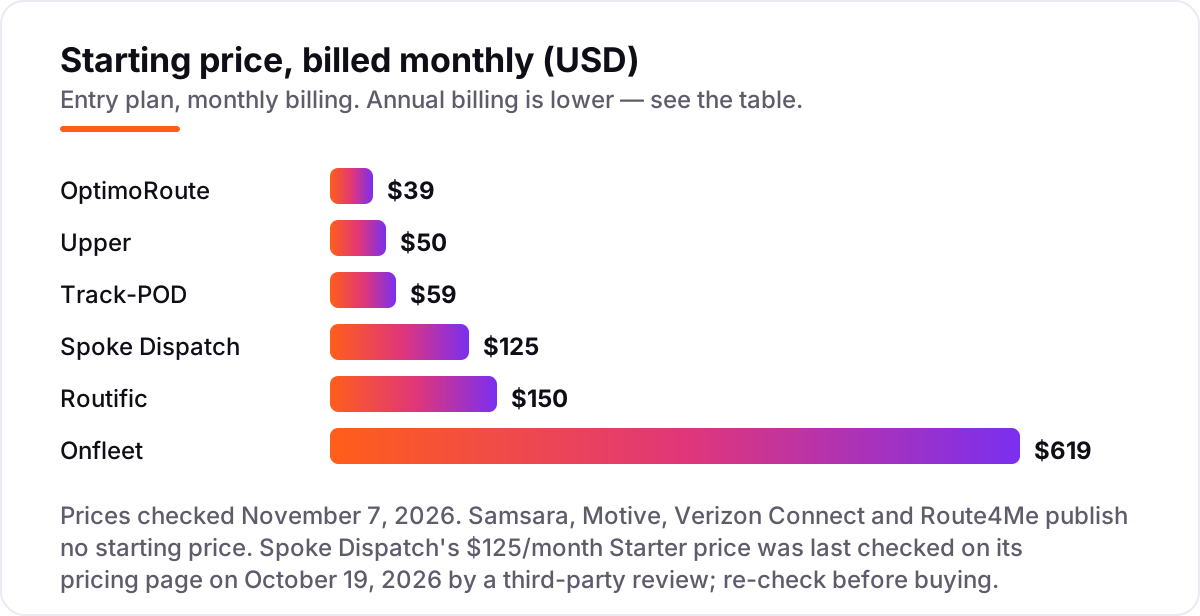
Fleet dispatch software pricing: what you will actually pay
Take a five-driver delivery team running about 2,500 orders a month. On list prices, the subscription costs $125 a month on Spoke Dispatch Starter (1,000 stops included, then 4 cents a stop), $150 on Routific (plus per-order charges above 1,000 orders), $195 on OptimoRoute Lite at $39 a driver, $250 on Upper Starter at $50 a user, $295 on Track-POD Advanced at $59 a driver, and $619 on Onfleet Launch for 2,500 tasks. Two of those numbers need adjusting before they are real: Routific charges 15 cents an order for orders 1,001 to 2,000 and 13 cents for the next 500, which brings 2,500 orders to $365 a month, and Spoke Dispatch adds $60 for the 1,500 stops above its allowance, bringing it to $185.
Over a year, that is $2,220 on Spoke Dispatch, $2,340 on OptimoRoute Lite, $3,000 on Upper Starter, $3,540 on Track-POD Advanced, $4,380 on Routific and $7,428 on Onfleet Launch. The same five drivers and the same 2,500 orders cost $2,220 a year at the cheap end and $7,428 at the dear end — a $5,208 gap that comes entirely from the billing unit, not from features. Annual billing narrows it a little: OptimoRoute Lite drops to $35.10 a driver, Upper Starter to $40 a user and Track-POD Advanced to $49 a driver.
Three costs sit outside every number above. First, hardware: the telematics platforms need GPS units and dash cams in every vehicle, and third-party buyer data puts Samsara hardware at $99 to $148 per vehicle before the software quote even starts. Second, SMS: customer notifications are billed per message on most route-first tools, so a team texting every customer pays on top of the subscription. Third, invoicing: courier businesses that bill clients by the job need a separate invoicing flow — see our guide to invoicing software for small business — or Onfleet's Courier Suite add-on at $299 a month.
Know the difference: dispatch software vs fleet management software
The confusion in this category is between a job and a platform. Dispatch software does one job: it assigns drivers, plans routes and tracks deliveries in real time. Fleet management software is the platform around that job: maintenance schedules, fuel reporting, ELD compliance, asset tracking and driver safety scoring, with dispatch as one module among many.
That is why the prices look so different. Samsara, Motive and Verizon Connect sell fleet management platforms with dispatch inside, which is why they price by custom quote and bundle hardware. Routific, OptimoRoute, Upper and Spoke Dispatch sell dispatch and routing only, which is why their prices are published, month-to-month and hardware-free. Neither side is overpriced for what it does — they are different products.
A second distinction worth knowing is route planning versus dispatch. A route planner (Spoke's free app, Upper's free planner) puts stops in the best order for one driver. Dispatch adds the team layer: assigning jobs across drivers, rebalancing when a driver calls in sick, and telling customers where their delivery is. If you have one driver, a planner is enough. If you have five, you need dispatch.
Quick comparison: tool type by need
| Buyer | Best pick | Why |
|---|---|---|
| Trucking fleet, 20+ vehicles | Samsara | One platform for tracking, safety and compliance, custom quote |
| Trucking fleet where ELD comes first | Motive | Compliance and AI dash cams, custom quote |
| Large fleet already on Verizon | Verizon Connect | Carrier-scale tracking and dispatch, custom quote |
| Delivery business at volume | Onfleet | Automated dispatch, from $619/month |
| Small delivery team, simple routing | Routific | Free to 100 orders, then $150/month |
| Team that prefers per-driver pricing | OptimoRoute | Lite from $39/driver/month |
| Delivery plus field service | Route4Me | One platform for both, custom quote |
| Lightweight last-mile team | Upper | Unlimited tasks, from $50/user/month |
| B2B distributor, 10–50 vehicles | Track-POD | Per-driver or per-order billing, from $59/driver/month |
| Tiny courier team | Spoke Dispatch | Routing without per-driver fees, from $125/month |
Mistakes to avoid
- Comparing headline prices across billing units. $39 a driver, $50 a user, $150 a month and $619 a month are not comparable until you multiply each by your own team size and volume.
- Forgetting the hardware bill. Telematics quotes are software only. GPS units, dash cams and installation are separate line items — budget for them before you sign a three-year contract.
- Buying ELD compliance you do not need. Last-mile delivery vans are usually exempt from electronic logging rules. Paying for a compliance platform to route parcels is money spent on the wrong problem.
- Ignoring the cap that bites first. A tool can be cheap and still be the wrong buy: OptimoRoute Lite caps at 700 orders planned at once, and Upper Starter leaves GPS tracking and proof of delivery to the next tier.
- Skipping the trial with real stops. A demo with ten addresses proves nothing. Run one real week — your stops, your time windows, your drivers — before you commit to a year.
How we chose
We checked each vendor's own pricing page on November 7, 2026 and recorded the starting price exactly as shown, including the annual-billing figure where the page lists one, and we ranked the tools by fit for the most common buyer — a fleet or delivery operation choosing dispatch software — not by brand size. Samsara, Motive, Verizon Connect and Route4Me publish no starting price, so they are listed as custom quote; third-party estimates of their per-vehicle rates are mentioned in the cards but not presented as vendor prices. Spoke Dispatch's $125 a month Starter price was last checked on its own pricing page on October 19, 2026 by a third-party review, because the page did not load for us directly, and should be re-checked before buying. Track-POD carries no rating here because the freshest G2 copy of its review page we could verify was more than three days old; we would rather show no rating than a stale one. No vendor paid for a place in this list, and none of the links here are affiliate links.
What to do next
Start with the free plan or trial of your top pick and run one real week of routes through it. Check that the optimized routes save miles against your current plan and that drivers can follow them on their own phones without calling dispatch. If the routes are sorted but new customers are not finding you, our monthly SEO service handles the visibility side — or compare the passenger side in our guide to taxi dispatch software. Once your tools are in place, find out what's holding your rankings back.
Your stack only works if people find you
SerpAstra fixes what keeps your site off page one and makes it easy for AI assistants to recommend.
Get a free audit→Sources we checked (20)
- Samsara pricing — samsara.com/pricing (checked November 7, 2026)
- Motive pricing — gomotive.com/pricing (checked November 7, 2026)
- Verizon Connect pricing — verizonconnect.com/pricing (checked November 7, 2026)
- Onfleet pricing — onfleet.com/pricing (checked November 7, 2026)
- Routific pricing — routific.com/pricing (checked November 7, 2026)
- OptimoRoute pricing — optimoroute.com/pricing (checked November 7, 2026)
- Route4Me pricing — route4me.com/get-started (checked November 7, 2026)
- Route4Me subscription and pricing FAQ — support.route4me.com (checked November 7, 2026)
- Upper pricing — upperinc.com/pricing (checked November 7, 2026)
- Track-POD pricing — track-pod.com/pricing (checked November 7, 2026)
- Spoke Dispatch pricing — spoke.com/dispatch/pricing (last checked October 19, 2026, third-party review)
- Samsara reviews — g2.com (checked November 7, 2026)
- Motive reviews — g2.com (checked November 7, 2026)
- Verizon Connect reviews — g2.com (checked November 7, 2026)
- Onfleet reviews — g2.com (checked November 7, 2026)
- Routific reviews — g2.com (checked November 7, 2026)
- OptimoRoute reviews — g2.com (checked November 7, 2026)
- Route4Me reviews — g2.com (checked November 7, 2026)
- Upper reviews — g2.com (checked November 7, 2026)
- Spoke Dispatch reviews — g2.com (checked November 7, 2026)
Shamim
Founder of SerpAstra
A full-stack SEO and digital marketer who spends most days on Local SEO for dental practices, AI search visibility and lead generation.
Frequently asked questions
What is the best fleet dispatch software?
Samsara is the best fit for most connected trucking fleets: GPS, AI dash cams, ELD compliance and dispatch in one platform, rated 4.5 on G2. For last-mile delivery, Onfleet leads at volume, while Routific and OptimoRoute are the better picks for small teams, starting at $150 a month and $39 a driver a month.
How much does fleet dispatch software cost?
Route-first tools start at $39 per driver a month (OptimoRoute), $50 per user (Upper) or $125 to $150 a month flat (Spoke Dispatch, Routific). Onfleet starts at $619 a month. Samsara, Motive, Verizon Connect and Route4Me publish no prices, so expect a custom quote per vehicle.
Is there free fleet dispatch software?
Routific is free for up to 100 orders a month, with all features included. Spoke offers a free Route Planner app for one driver with up to 10 stops per route, and Upper has a free route planner for up to 20 stops. The telematics platforms have no free plan, only demos.
What is the difference between fleet dispatch software and fleet management software?
Dispatch software assigns drivers, plans routes and tracks deliveries in real time. Fleet management software is broader: it adds maintenance, fuel, compliance and asset tracking. Samsara, Motive and Verizon Connect are fleet management platforms with dispatch inside; Routific, OptimoRoute and Spoke Dispatch are dispatch and routing tools only.
Do I need ELD compliance in my dispatch software?
If the fleet runs commercial trucks in the US, yes: electronic logging devices are legally required for most interstate drivers. Samsara, Motive and Verizon Connect all include ELD and hours-of-service compliance. Pure last-mile delivery tools like Routific, Upper and Spoke Dispatch do not, because their vehicles are usually exempt.
Can I switch fleet dispatch software later?
Yes, but plan the move around your contract. Telematics platforms typically lock you into multi-year terms with proprietary hardware, so switching means new devices and installation. Route-first tools are month-to-month with no hardware, so you can export your stops and driver lists and be running on the new tool within a week.
What happened to Circuit for Teams?
Circuit rebranded as Spoke in late 2025. Circuit for Teams became Spoke Dispatch, and the single-driver app became the Spoke Route Planner. The product, pricing and reviews carried over under the new name, so older Circuit reviews and comparisons still describe the same tool.
Free SEO and AI visibility audit
Find out what is holding your rankings back
Send us your site. Within 2 business days you get a written audit, an AI visibility check and a short fix list ranked by impact. Free, with no contract attached.
Request my free audit→Related guides
 Accounting, Tax & FinanceBest Taxi Dispatch Software for 2026: 7 Options Compared by Use CaseCompare the 7 best taxi dispatch software options on price, free plans, white-label apps and AI dispatch, with every price checked November 4, 2026.Read guide →
 Consumer AppsBest Apps for Box Truck Loads (2026): 12 Apps Worth DownloadingCompare the 12 best app for box truck loads options on price, free plans and reviews — 9 are free — with every price checked November 4, 2026.Read guide →
 Accounting, Tax & Finance11 Best Invoicing Software for Small Business in 2026, Compared11 best invoicing software for small business compared on price, free plans and payment fees. Prices checked on vendor pricing pages, November 2, 2026.Read guide →