
8 Best FP&A Software for Startups in 2026, Compared
Compare the 8 best FP&A software for startups on runway forecasts, scenario planning, integrations and real cost, from free spreadsheets to quoted platforms.
 Shamim Mia, Founder, SerpAstraLast verified November 2, 20269 min read
We compare pricing pages, documentation and public reviews. We never accept payment for rankings.

Key takeaways
- Most seed-stage startups can plan in Google Sheets for free and pair it with Puzzle, whose Starter plan is free until $20,000 a month in transactions and reports burn and runway.
- LivePlan from $20 a month and PlanGuru from $99 a month are the cheapest dedicated planning tools with published prices.
- Cube is the only dedicated FP&A platform here with published pricing, from $1,500 a month, which suits a Series A or B team with a finance hire.
- Runway, Jirav and Fathom do not print a price on their pricing pages: Runway and Jirav are quoted, and Fathom prices by company through a calculator with a 14-day free trial.
On this page
Quick comparison
| Tool | Best for | Starting price | Free plan |
|---|---|---|---|
 Runway | Scaling startups with a first finance hire preparing board packs and the next funding round | Custom quote | No |
 Cube | Series A and B startups with a finance hire who plan in spreadsheets and want published pricing | From $1,500/mo | No (demo) |
 Jirav | Startups that want three-statement forecasts tied to QuickBooks or Xero, often through their CPA | Custom quote | No (demo) |
 Fathom | Startups and their accountants who want management reports, cash flow forecasts and consolidation | Calculator price | 14-day trial |
 LivePlan | Pre-seed founders who need a business plan and investor-ready projections | From $20/mo | No |
 PlanGuru | Bootstrapped startups that want three-way forecasts and scenarios without a quoted platform | From $99/mo | No (free trial) |
 Puzzle | Seed-stage SaaS startups on Stripe that want burn and runway from the ledger itself | Free to $20K/mo; Starter $30/mo | Yes (free to $20K/mo) |
 Google Sheets | Pre-seed and seed teams that want a shareable model before paying for FP&A software | Free | Yes (free) |
Make one of these tools?
We re-check this list every quarter. Send a correction, request a review, or ask about a clearly labeled sponsored spot.
Request a listingThe best FP&A software for startups
Runway
Best for: Scaling startups with a first finance hire preparing board packs and the next funding round

Runway is a modern FP&A platform built around the jobs a startup finance lead actually does: revenue forecasts, headcount plans, expense budgets and the fundraising model investors will pick apart. Scenarios live in sandboxed versions of the model, so you can test a slower hiring plan without breaking the board version, and drill-ins take any summary number down to the transactions behind it.
It connects to more than 750 tools, including QuickBooks Online, Xero, NetSuite, Rippling, Gusto, Stripe and HubSpot. Runway says its pricing is tiered per user but publishes no figures, and its own material targets companies from about 50 employees, typically with a first finance hire. For a ten-person seed team, it is probably early.
What we like
- Modules for revenue forecasting, expense management, headcount planning and fundraising preparation
- Scenario planning in sandboxed model versions that merge back under control
- 750+ integrations including QuickBooks Online, Xero, NetSuite, Rippling, Gusto, Stripe, Salesforce and HubSpot
Watch out for
- No published price; Runway describes tiered per-user pricing without figures
- Aimed at companies from about 50 employees, so very early teams may find it more than they need
- No free trial is mentioned, only an interactive demo
Cube
Best for: Series A and B startups with a finance hire who plan in spreadsheets and want published pricing
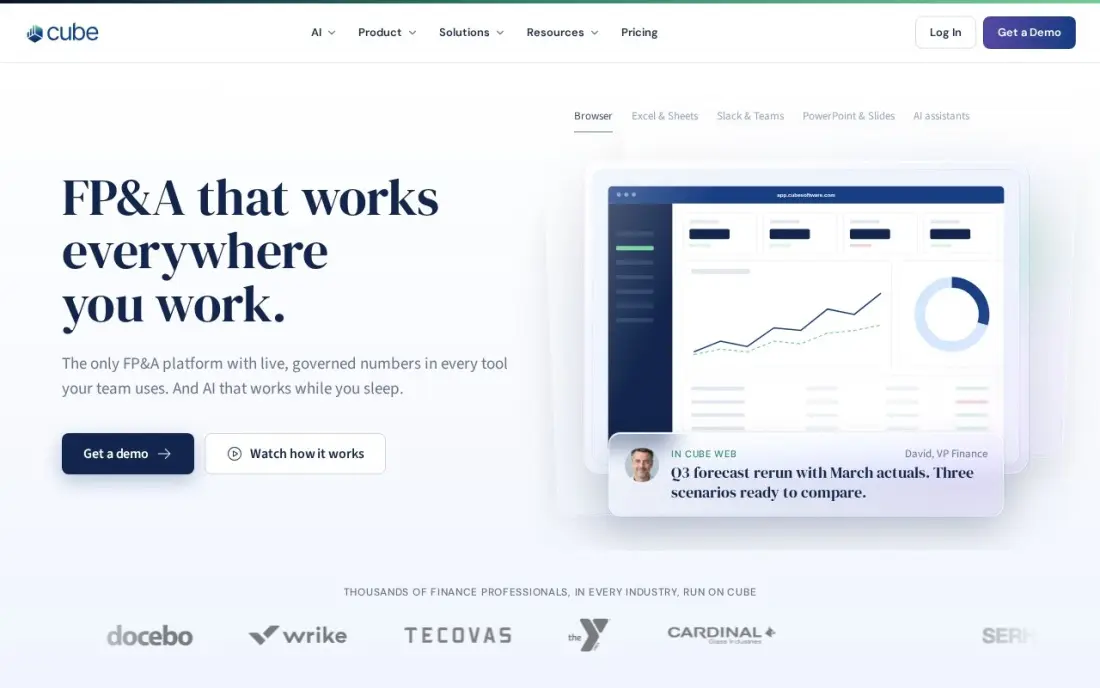
Cube keeps planning in Excel or Google Sheets, with two-way sync to a central model, so a startup's existing spreadsheet becomes a governed plan rather than being thrown away. AI forecasting and scenario planning are built in, and apps for Slack and Microsoft Teams bring numbers to the people asking for them. It is the only dedicated FP&A platform in this list that publishes its price.
That price is $1,500 a month for Cube Go and $2,800 a month for Pro, with implementation and onboarding fees on top. It is sold only in the US and Canada. For a seed-stage company that is a large commitment; for a Series B team with a controller, it is a clear and comparable number.
What we like
- The only FP&A platform here with published pricing: Go from $1,500/month, Pro from $2,800/month
- Spreadsheet-native planning in Excel and Google Sheets with two-way sync
- AI-powered forecasting and scenario planning, with apps for Slack and Microsoft Teams
Watch out for
- Entry price of $1,500/month is steep for startups and very small teams
- Sold in the US and Canada only, so teams elsewhere cannot buy it
- Implementation and onboarding fees sit on top of the subscription
Jirav
Best for: Startups that want three-statement forecasts tied to QuickBooks or Xero, often through their CPA
Jirav builds driver-based three-statement models, so a hiring plan shows its effect on the profit and loss, balance sheet and cash in one place. Autoforecast creates a first forecast from historicals and seasonality in one click, and it connects to QuickBooks, Xero, NetSuite, Sage Intacct, Gusto, Excel and Google Sheets. Many outsourced CPA and fractional CFO firms use it to serve startup clients.
Jirav publishes no starting price, and third-party figures disagree, so treat it as a quote and expect a five-figure annual contract. Workforce planning is thinner than in larger platforms. If your outsourced accountant already runs Jirav, using theirs is often cheaper than buying your own.
What we like
- Three-statement pro forma modeling with driver-based forecasts across profit and loss, balance sheet and cash flow
- Autoforecast builds forecasts from historicals and seasonality with one click
- Connects to QuickBooks, Xero, NetSuite, Sage Intacct, Gusto, Excel and Google Sheets
Watch out for
- No published starting price on the vendor site, so the entry cost needs a sales conversation
- Third-party figures disagree with each other, so budget for a five-figure annual contract
- Workforce planning is thinner than in the enterprise platforms
Fathom
Best for: Startups and their accountants who want management reports, cash flow forecasts and consolidation
Fathom turns accounting data into management reports a founder can send to the board: KPIs, commentary, cash flow forecasts and performance tracking. Consolidated groups are free with no limit, which helps a startup with a US company and a foreign subsidiary, and accounting firms can run a whole portfolio of clients through Fathom Portfolio.
Fathom bills monthly per billable company, with no contracts or minimum term, but the pricing page prints no figure; the price comes from an interactive calculator, so run it for your setup. There is a 14-day free trial with all functionality included. It is a reporting and forecasting tool rather than a full planning platform.
What we like
- Reporting, forecasting and performance tracking in Fathom Pro
- Consolidated groups are free, with no limit on how many you create
- Pay-as-you-go monthly billing with no contracts or minimum term
Watch out for
- No price printed on the pricing page; the figure comes from an interactive calculator
- No annual billing option is mentioned
- Built for reporting and forecasting rather than deep driver-based headcount models
LivePlan
Best for: Pre-seed founders who need a business plan and investor-ready projections

LivePlan is the cheapest dedicated tool here for a founder who needs projected financials and a plan to go with them. Step-by-step planning and 500-plus sample plans produce lender- and investor-ready statements, and the performance dashboards compare actual results with the plan once the company is trading. Standard costs $20 a month billed monthly.
QuickBooks and Xero sync and up to 10 forecast scenarios need Premium at $40 a month. There is no free plan or trial, only a 35-day money-back guarantee, and the forecasting is simpler than PlanGuru or Fathom. It is a good first model, and most startups outgrow it after a priced round.
What we like
- Step-by-step business planning with 500-plus sample plans and lender-ready financial statements
- Premium adds QuickBooks and Xero sync, up to 10 forecast scenarios and industry benchmarking
- Performance dashboards compare actuals against the plan, which is the budget check most owners skip
Watch out for
- No free plan and no free trial — only a 35-day money-back guarantee
- Standard has no QuickBooks or Xero sync and no scenarios; those need Premium at $40/month
- Forecasting is simpler than PlanGuru or Fathom, and G2 reviewers call the pricing model hard to justify long-term
PlanGuru
Best for: Bootstrapped startups that want three-way forecasts and scenarios without a quoted platform

PlanGuru is dedicated budgeting and forecasting software at a published price: Single Entity costs $99 a month, a vendor-supplied figure on its G2 pricing page. It builds three-way forecasts across the profit and loss, balance sheet and cash flow, with budgets up to 10 years, 20-plus forecasting methods, unlimited scenarios and workforce planning.
It does no bookkeeping, and imports from QuickBooks and Xero run manually rather than syncing. Consolidation needs the $399 plan, and owners new to budgeting report a learning curve. It is rated 4.5 out of 5 on G2, with reviewers praising support and value against larger FP&A tools.
What we like
- The only dedicated budgeting tool in this list: 10-year budgets, 20-plus forecasting methods and unlimited scenarios
- Three-way forecasts (profit and loss, balance sheet, cash flow) with KPIs, ratios and workforce planning
- Rated 4.5/5 on G2, with reviewers praising the support team and the price against larger FP&A tools
Watch out for
- At $99/month it costs more than the accounting suites, and it does no bookkeeping — you still need QuickBooks or Xero
- Imports from QuickBooks and Xero run manually rather than syncing automatically
- G2 reviewers note a learning curve for owners new to budgeting, and consolidation needs the $399 plan
Puzzle
Best for: Seed-stage SaaS startups on Stripe that want burn and runway from the ledger itself

Puzzle is accounting software, not FP&A, and it is here because for many seed-stage startups the first planning question is simply how many months of runway are left. Puzzle answers that from the books: AI categorises transactions, Stripe syncs natively, and the dashboard reports burn rate, runway and MRR. Starter costs $30 a month and is free until $20,000 in monthly transaction volume.
Plan names and prices have shifted during 2026, so confirm the lineup before signing, and custom revenue recognition sits on Scale from $360 a month. It serves US entities only and does not file taxes. Pair it with a spreadsheet model and you have a working finance stack for very little.
What we like
- AI categorises transactions and checks accuracy continuously, so the books stay close to real time
- Native Stripe sync with burn rate, runway and MRR reporting built for founders
- Flat pricing per company, not per user, so the whole team can work in the ledger
- Starter is free until $20,000 in monthly transaction volume
Watch out for
- Young platform with tier names and prices that have shifted during 2026, so confirm the current lineup before signing
- Custom revenue recognition sits on the Scale plan from $360 a month, not on Starter or Core
- US entities only, and it does not file income taxes
Google Sheets
Best for: Pre-seed and seed teams that want a shareable model before paying for FP&A software
Most startup financial models still begin in a spreadsheet, and Google Sheets is free with any Google account. Real-time co-editing and comments let a founder and an advisor work on the same model, sheets hold up to 10 million cells, and Excel files open directly, which matters when an investor sends their own template.
The limits appear as the model grows: Sheets slows on very large files, there are no controls over who changed an assumption, and actuals must be pasted in by hand. Some Gemini features need a paid Workspace plan from $7 a user a month billed annually. When you spend more time updating the model than using it, move to a tool above.
What we like
- Free for anyone with a Google account, with real-time co-editing and comments built in
- Up to 10 million cells per spreadsheet, with pivot tables, charts and Apps Script automation
- Opens and saves Excel files directly, so sharing with Excel users needs no conversion step
Watch out for
- Slows down on very large files; Excel handles heavy models and big datasets better
- No desktop app with full offline power — offline mode is limited compared with Excel
- Some Gemini in Sheets features need a paid Google Workspace plan
The best FP&A software for startups answers three questions every month: how much cash is left, how long it lasts, and what changes if the plan does. For most young companies the right tool changes with the stage, from a free spreadsheet at pre-seed to a dedicated planning platform once a finance hire joins. We compared eight options across that path, and every price below comes from the vendor's own pricing page or our verified tool database, checked in November 2026.
How to choose the best FP&A software for startups
- Match the tool to the stage. A seed team with one founder doing the finances needs a model and clean books; a Series B company with a controller needs governed planning, scenarios and board reporting.
- Start from your accounting system. Check that the tool connects to the ledger you use, whether QuickBooks Online, Xero, NetSuite or Puzzle, so actuals flow in without copying.
- Model headcount properly. Salaries are most of a startup's burn, so a planning tool should handle start dates, raises, benefits and payroll taxes per role.
- Insist on scenarios. A base case, a slower-growth case and a late-round case are what investors and boards ask for.
- Ask for the price in writing. Several FP&A platforms do not publish prices; get the first-year total, including implementation, before a demo turns into a contract.
- Keep the investor template in mind. Excel and Google Sheets compatibility matters when investors send their own model formats.
Planning tells you how long the cash lasts; growth decides whether you need the next round. If organic acquisition is part of the plan, our monthly SEO service runs it, and our guide to cash flow software covers the short-term cash side.
FP&A software for startups pricing: what you will actually pay
Take a startup moving through three stages. At pre-seed, Google Sheets costs $0 and LivePlan Standard costs $20 a month billed monthly, so $240 a year, or $480 a year on Premium at $40 for the accounting sync. At seed, PlanGuru Single Entity costs $99 a month, so $1,188 a year, and Puzzle's ledger is free until $20,000 a month in transactions, then $30 a month on Starter.
At Series A or B, Cube Go costs $1,500 a month, so $18,000 a year before implementation fees, and Pro costs $2,800 a month, or $33,600 a year. Runway and Jirav publish no prices, and Jirav is commonly a five-figure annual contract. Fathom bills monthly per company through its online calculator. The step from $1,188 to $18,000 a year is large, so most startups should only make it when a finance hire will use the tool every day.
Know the difference: spreadsheet model vs FP&A platform
A spreadsheet model is flexible and free. A founder can build a revenue build, a hiring plan and a cash forecast in an afternoon, share it with an investor and change any assumption. The weaknesses arrive later: actuals have to be pasted in by hand, nobody knows who changed a formula, and the model breaks a little more each month as the business grows.
An FP&A platform connects to the ledger, payroll and CRM, so actuals update themselves, and it keeps versions, permissions and scenarios under control. Runway, Cube and Jirav work this way, and Cube keeps the spreadsheet interface on top. The cost is money and setup time. Most startups are better off with a disciplined spreadsheet until the model, not the business, becomes the bottleneck.
Quick comparison: tool type by need
| Buyer | Best pick | Why |
|---|---|---|
| Scaling startups with a finance lead | Runway | Headcount, revenue and fundraising models, custom quote |
| Spreadsheet-loving finance teams | Cube | Published pricing from $1,500/month, Excel and Sheets sync |
| Startups with an outsourced CPA | Jirav | Three-statement driver models, custom quote |
| Board reporting and consolidation | Fathom | Reports and forecasts, free consolidated groups, 14-day trial |
| Pre-seed business plans | LivePlan | Investor-ready projections from $20/month |
| Bootstrapped three-way forecasts | PlanGuru | 10-year budgets and scenarios from $99/month |
| Burn and runway from the books | Puzzle | Free until $20,000/month in transactions |
| First model at $0 | Google Sheets | Free, shareable, opens Excel templates |
Mistakes to avoid
- Buying a platform before you have clean books. FP&A software forecasts from your actuals; if the ledger is wrong, the forecast is too.
- Modelling revenue top-down. "1% of the market" is not a plan; build revenue from leads, conversion and price.
- Forgetting payroll taxes and benefits. Headcount costs more than salary, and the gap shortens runway.
- Running one scenario. A single forecast is a guess; keep at least a base and a downside case.
- Signing an annual FP&A contract too early. If nobody will open the tool weekly, it is shelfware.
How we chose
We read each vendor's pricing page in November 2026, and where a vendor publishes no price, we say so rather than repeat a third-party estimate. We ranked the tools by fit for the most common buyer, a venture-backed or bootstrapped startup between pre-seed and Series B, weighting published pricing, accounting integrations and how well each handles runway and scenarios. Ratings come from G2 where we cite them. No vendor paid for a place in this list, and none of the links here are affiliate links.
What to do next
Build or tidy one model with three scenarios in a spreadsheet, connect it to clean monthly actuals and use it for a quarter. If updating it takes more than a few hours a month, trial a platform that matches your stage. When growth is the assumption that matters most, book a free SEO consultation.
Frequently asked questions
What is the best FP&A software for startups?
It depends on stage. A pre-seed or seed startup is usually best served by Google Sheets plus a ledger such as Puzzle that reports burn and runway. Cube, from $1,500 a month, suits a Series A or B team with a finance hire, and Runway is built for scaling companies of about 50 employees and up.
How much does FP&A software cost for a startup?
Published prices range from $0 for Google Sheets and $20 a month for LivePlan Standard to $99 a month for PlanGuru and $1,500 a month for Cube Go. Runway and Jirav are quoted, and Fathom prices by company through an online calculator.
When should a startup buy FP&A software?
Usually when the spreadsheet model takes more time to update than to use, when a board needs monthly reporting against plan, or when a finance hire joins. Before that, a spreadsheet plus clean books does the job.
Is there free FP&A software for startups?
Google Sheets is free and is where most startup models begin. Puzzle's accounting Starter plan is free until $20,000 a month in transactions and reports burn and runway, and Fathom offers a 14-day free trial.
What is the difference between FP&A software and accounting software?
Accounting software records what happened and produces actual statements. FP&A software uses those actuals to forecast, budget and model scenarios. Startups need both, and most FP&A tools connect to QuickBooks Online, Xero or NetSuite.
What should a startup financial model include?
Revenue drivers, a headcount plan, operating expenses, cash burn and runway, and the three statements tied together. Investors also expect scenarios showing what happens if growth is slower or the next round takes longer.
Sources we checked (11)
- Runway — runway.com/llm-info (checked November 19, 2026)
- Cube — www.cubesoftware.com/blog/financial-planning-software (checked November 2, 2026)
- Jirav — www.jirav.com (checked November 2, 2026)
- Fathom — fathomhq.com/pricing/calculator (checked November 19, 2026)
- LivePlan — www.g2.com/products/liveplan/pricing (checked November 2, 2026)
- LivePlan reviews on G2 (checked November 2, 2026)
- PlanGuru — www.g2.com/products/planguru/pricing (checked November 2, 2026)
- PlanGuru reviews on G2 (checked November 2, 2026)
- Puzzle — puzzle.io/pricing (checked November 2, 2026)
- Google Sheets — sheets.google.com (checked November 10, 2026)
- Google Sheets reviews on G2 (checked November 10, 2026)
Make one of these tools?
We re-check this list every quarter. Send a correction, request a review, or ask about a clearly labeled sponsored spot.
Request a listingShamim
Founder of SerpAstra
A full-stack digital marketer and SEO strategist covering technical and local SEO, AI search visibility, paid ads and lead generation for local businesses, e-commerce brands and SaaS teams.
Free SEO and AI visibility audit
Find out what is holding your rankings back
Send us your site. Within 2 business days you get a written audit, an AI visibility check and a short fix list ranked by impact. Free, with no contract attached.
Request my free audit→Related buying guides
 Accounting & Finance8 Best Software for Financial Modeling in 2026, ComparedCompare the 8 best software for financial modeling, from Excel and Google Sheets to FP&A platforms like Cube and Jirav, on model depth, scenarios and real cost.Read guide →
 Accounting & Finance8 Best Cash Flow Software in 2026, ComparedCompare the 8 best cash flow software on 13-week forecasts, scenarios, accounting sync and real monthly cost, with every price checked on vendor pricing pages.Read guide →
 Accounting & Finance8 Best Enterprise Budgeting Software in 2026, ComparedCompare the 8 best enterprise budgeting software on driver-based planning, consolidation, Excel fit, rollout time and real cost, checked on vendor pages.Read guide →