
12 Best Inventory Tracking Software for Small Business in 2026, Compared
The 12 best inventory tracking software for small business, compared on real prices, free plans and stock features. Prices checked November 10, 2026.
 Shamim Mia, Founder, SerpAstraLast verified November 10, 202614 min read
We compare pricing pages, documentation and public reviews. We never accept payment for rankings.
Key takeaways
- Zoho Inventory is the best value for most small businesses: a free plan and paid tiers from $29/month billed annually. Square starts free and Sortly costs $49/month.
- The single most important buying factor is what the price is metered on: orders, items, users or locations. The meter decides your real bill, not the headline price.
- Free plans exist — Zoho, Square, Sortly and Katana all have one — but barcode, batch and multi-location features usually need a paid tier.
- Every price below was checked on the vendor's own pricing page on November 10, 2026. Ratings are G2, with review counts shown; four tools show no rating because their G2 pages were not verified today.
On this page
Quick comparison
| Tool | Best for | Starting price | Free plan |
|---|---|---|---|
| Zoho Inventory | Small retailers and online sellers who want a free plan and low paid tiers priced by order volume | $29/mo (annual) | Yes (50 orders/mo) |
| Square for Retail | Single-location shops that want to start free and take card payments at the counter | $0 (Free) | Yes ($0) |
| Sortly | Small teams and warehouses that track stock visually with photos and QR codes | $49/mo | Yes (100 items) |
| Finale Inventory | Ecommerce sellers and small warehouses that ship high order volumes from several channels | $63/mo (annual) | No (trial) |
| Lightspeed Retail | Independent retailers who need POS, inventory and ecommerce in one system | $89/mo (annual) | No (trial) |
| inFlow Inventory | Small wholesalers and distributors who sell B2B and need private customer portals | $99/mo (annual) | No (14-day trial) |
| QuickBooks Online | Small businesses that already run their books on QuickBooks and want inventory in the same login | $140/mo | Yes (no inventory) |
| Fishbowl | Distributors and manufacturers on QuickBooks who need deep stock control and EDI | $229/mo (annual) | No (demo) |
| Katana | Small manufacturers who make products to order and sell on Shopify or Amazon | $299/mo | Yes (30 SKUs) |
| Unleashed | Product businesses that run Xero or QuickBooks and need batch and serial tracking | $99/mo | No (14-day trial) |
| Cin7 Core | Growing multichannel sellers who need inventory, orders and purchasing in one system | $349/mo | No (14-day trial) |
| Ordoro | Online sellers who ship hundreds of orders a month and want inventory with their labels | $499/mo | No (15-day trial) |
Make one of these tools?
We re-check this list every quarter. Send a correction, request a review, or ask about a clearly labeled sponsored spot.
Request a listingThe best inventory tracking software

Zoho Inventory
Best for: Small retailers and online sellers who want a free plan and low paid tiers priced by order volume
Zoho Inventory is the best value pick for most small businesses because the free plan is genuinely usable: 50 orders a month, one user and one location, with no time limit. Paid Standard starts at $29 a month billed annually and covers 500 orders, three users and two locations, with composite items, dropshipping and backordering included. Pricing is per organization rather than per user, so adding staff does not raise the bill.
The catch is the meter. Everything is priced by monthly order volume, so a busy season can push you into Premium at $79 a month billed annually, and barcode, serial and batch tracking sit on Premium too. If your order count is steady and under 500 a month, Zoho is hard to beat; if you ship thousands of orders, price the next tier before you commit.
What we like
- Free plan covers 50 orders a month, and Standard starts at $29/month billed annually
- Pricing is per organization, not per user, so adding staff does not raise the bill
- Integrates with Zoho Books, Shopify, Amazon and QuickBooks Online
Watch out for
- Price climbs with monthly order volume, so a busy month can push you to the next tier
- Barcode generation, serial tracking and batch tracking need Premium ($79/month billed annually) or higher

Square for Retail
Best for: Single-location shops that want to start free and take card payments at the counter
Square for Retail is the cheapest way to start tracking stock, because the starting price is zero. The Free plan covers sales, basic inventory and payments at Square's standard processing rate, and a small shop can run on it for a long time before needing anything else. Plus at $49 a month per location adds purchase orders, vendor management and advanced inventory counts, and Premium at $149 adds multi-location and loyalty tooling.
The lock-in is the processing. You cannot bring your own processor to Square, so the per-transaction fee is not negotiable, and card fees apply on every sale even on the Free plan. Shops that outgrow the free inventory features usually land on Plus, which at $49 per location still undercuts most dedicated inventory tools.
What we like
- Free plan covers sales, basic stock tracking, low-stock alerts and an online store
- Plus at $49/month per location adds purchase orders, vendors and cost-of-goods reports
- No contract and no annual billing: cancel or switch plans at any time
Watch out for
- You cannot bring your own payment processor, so card rates are not negotiable
- Purchase orders and cost reporting need Plus ($49/month per location)

Sortly
Best for: Small teams and warehouses that track stock visually with photos and QR codes
Sortly is the simplest visual tracker in this list, and that is the point. Every item gets a photo, a folder and a QR code, and stock counts happen by scanning with a phone instead of typing SKUs into a spreadsheet. The Advanced plan costs $49 a month and covers 500 unique items with two users, and the free plan covers 100 items for a single user.
Watch the annual price: the $24 a month figure on the yearly toggle is a first-year promotion for new customers, and yearly plans renew at a 20% discount after that, so budget against year two, not year one. Sortly is the right pick for a small team that counts stock by hand; it is the wrong pick for a seller who needs purchase orders on the cheapest plan.
What we like
- Photo-based item records make stock counts fast for non-technical staff
- QR code labels and in-app barcode scanning work from a phone
- Free plan covers 100 items, so a tiny stockroom can start without paying
Watch out for
- Advanced caps at 500 unique items, so larger catalogues need Ultra ($149/month) or higher
- Purchase orders start on Ultra, not on the entry Advanced plan

Finale Inventory
Best for: Ecommerce sellers and small warehouses that ship high order volumes from several channels
Finale Inventory is built for sellers who ship volume. The Starter plan costs $63 a month billed annually and covers up to 100,000 products, with multichannel order management and warehouse support that cheaper tools do not offer. It also carries the highest G2 score in this list at 4.8 out of 5 from 41 reviews.
The trade-off is the ladder. Starter covers only two users, and the next tiers jump to $166 and $291 a month billed annually, so a growing team should price the step up before signing. There is no free plan, only a trial. Pick Finale when order volume is the problem; pick Zoho or Square when the catalogue is small and the budget is tight.
What we like
- Starter at $63/month billed annually covers up to 100,000 products
- Strong multichannel order and warehouse support for growing sellers
- Highest G2 score in this list at 4.8/5
Watch out for
- No free plan, only a trial, and the entry Starter plan covers just 2 users
- Higher tiers jump to $166 and $291 a month billed annually, so growth is pricey

Lightspeed Retail
Best for: Independent retailers who need POS, inventory and ecommerce in one system
Lightspeed Retail is the inventory-first pick for stores with real stock complexity. Basic at $89 a month on annual billing covers POS, payments and core inventory with purchase orders and low-stock alerts, plus basic ecommerce. Core at $149 adds the multi-location transfers and advanced reporting that growing chains need, and Plus at $289 adds forecasting, order recommendations and API access.
The trade-off is commitment: the best price needs an annual contract, and setup takes real work compared with Square. Each plan includes one register, so a second till costs extra. Choose Lightspeed when the shop floor and the stockroom are the same problem; choose Square when a single counter and a free start matter more.
What we like
- Basic includes POS, inventory management, purchase orders and basic ecommerce
- Core adds multi-location transfers, advanced reporting and a mobile scanner app
- Card-present processing is 2.6% + 10c through Lightspeed Payments on every plan
Watch out for
- One register per plan, so extra registers cost more
- Best price needs annual billing; month-to-month is $109 for Basic

inFlow Inventory
Best for: Small wholesalers and distributors who sell B2B and need private customer portals
inFlow Inventory is the wholesaler pick in this list. Lite starts at $99 a month billed annually with two team members and one location, and every plan includes unlimited products, sales and purchase orders. The B2B Showroom gives each customer a private portal with their own products and prices, which is the feature that separates inFlow from the retail-first tools here.
Two costs sit outside the headline price. Core and above require a one-time $499 onboarding package, and serial and lot tracking are $39 a month add-ons below the top tier. If you sell wholesale and need customer-specific pricing, inFlow earns its price; if you sell only to consumers, the retail tools above do the same job for less.
What we like
- Unlimited products, sales and purchase orders on every plan
- B2B Showroom portals with per-customer products and prices
- Rated 4.4/5 on G2 with the strongest ease-of-setup scores in this list
Watch out for
- Core and above require a one-time $499 onboarding package
- Serial and lot tracking are $39/month add-ons below the top tier

QuickBooks Online
Best for: Small businesses that already run their books on QuickBooks and want inventory in the same login
QuickBooks Online belongs in this list for one reason: many small businesses already run their books on it, and Plus adds inventory tracking to the same login. Plus costs $140 a month and covers five users, 40 classes and locations, project profitability and budgets, alongside invoicing, bills and bank feeds. New customers get 50% off for the first three months.
Do not buy the cheapest plan by mistake. Simple Start at $38 and Essentials at $85 have no inventory tracking at all, and the user caps force the next tier fast: one user on Simple Start, three on Essentials, five on Plus. Buy QuickBooks when the books and the stockroom should share one subscription; buy a dedicated tracker when inventory is the whole job.
What we like
- Plus tracks inventory, projects and profitability alongside the general ledger
- One subscription covers invoicing, bills, bank feeds and stock in one place
- New customers get 50% off for the first 3 months
Watch out for
- Inventory tracking starts on Plus at $140/month; Simple Start ($38) and Essentials ($85) have none
- User caps force the next tier: 1 user on Simple Start, 3 on Essentials, 5 on Plus

Fishbowl
Best for: Distributors and manufacturers on QuickBooks who need deep stock control and EDI
Fishbowl is the QuickBooks-native workhorse in this list. Essentials costs $229 a month billed annually and includes two users with unlimited locations, orders and volume, plus real-time inventory, SKU tracking, reorder points and mobile barcode scanning. The two-way QuickBooks sync posts inventory movements cleanly to the ledger, which keeps finance and ops on the same numbers.
The buying process is the catch. There is no free plan and no click-to-start trial; you talk to sales, and an implementation package is required with every purchase, priced by quote. Manufacturing features live on the separate Fishbowl Advanced platform, which starts higher. Pick Fishbowl when QuickBooks is already the system of record and the stock is complex.
What we like
- Two-way QuickBooks sync posts inventory movements cleanly to the ledger
- Essentials includes unlimited locations, orders and volume for 2 users
- Growth adds fulfillment, automated reordering and ecommerce integrations
Watch out for
- Every purchase requires an implementation package, priced by quote on top of the subscription
- No free plan and no self-serve trial; you buy through sales and a demo

Katana
Best for: Small manufacturers who make products to order and sell on Shopify or Amazon
Katana is the maker pick in this list. Core costs $299 a month and includes multi-level bills of materials, manufacturing orders, forecasting and real-time stock across sales channels, with QuickBooks and Xero integrations. Unlimited users and integrations come with the paid plan, and a free plan with 30 SKUs lets a small maker try the workflow before paying.
The base price is not the whole price. Lot tracking costs $249 a month extra and production routings $199, and sales-order volume and extra locations add usage charges on top. A manufacturer needing full traceability should budget around $498 a month before usage fees. Pick Katana when you build what you sell; pick a reseller tool when you only buy and resell finished goods.
What we like
- Multi-level bills of materials and manufacturing orders included in Core
- Real-time stock across sales channels with QuickBooks and Xero integrations
- Unlimited users and integrations on the paid Core plan
Watch out for
- Lot tracking and production routings are paid add-ons ($249 and $199/month), not in Core
- Sales-order volume and extra locations add usage charges on top of the $299 base

Unleashed
Best for: Product businesses that run Xero or QuickBooks and need batch and serial tracking
Unleashed is the Xero sidekick in this list: it runs beside your accounting software rather than replacing it. Lite starts at $99 a month on the US page with three users, 100 sales orders a month and batch and serial tracking, and Core at $399 adds the production module and more. Multi-warehouse tracking and deep Xero and QuickBooks Online integrations come standard.
Count the whole stack before you compare prices. Unleashed needs a separate Xero or QuickBooks subscription, and order-volume upgrades run from $70 to $490 a month once you pass 100 orders. Pick Unleashed when batch and serial tracking beside Xero matter; pick Zoho when one subscription should cover both stock and books.
What we like
- Lite starts at $99/month on the US page with batch and serial tracking
- Deep Xero and QuickBooks Online integrations with multi-warehouse support
- Production and manufacturing module available as a $69/month add-on on Core
Watch out for
- Lite covers only 100 sales orders a month; order-volume upgrades run $70 to $490/month
- Needs a separate Xero or QuickBooks subscription, so the real monthly cost is higher

Cin7 Core
Best for: Growing multichannel sellers who need inventory, orders and purchasing in one system
Cin7 Core is the most complete system in this list for a growing multichannel seller. Standard costs $349 a month and covers 6,000 sale orders a year with five users, two integrations and unlimited inventory locations, plus built-in purchasing, production, CRM and accounting modules. More than 700 integrations connect it to Shopify, Amazon and other sales channels.
The price is the first thing a small team runs into. At $349 a month with no free plan, Cin7 only makes sense once order volume justifies it, and forecasting and POS are paid add-ons on top. Older directories still show Advanced at $999 a month; the vendor's own pages now list it at $1,199. Pick Cin7 when several channels and a warehouse outgrow the cheaper tools.
What we like
- Standard covers 6,000 sale orders a year with 5 users and unlimited locations
- 700+ integrations across Shopify, Amazon and other sales channels
- Built-in purchasing, production, CRM and accounting modules
Watch out for
- Starts at $349/month, the second-highest entry price in this list
- No free plan; forecasting and POS are paid add-ons

Ordoro
Best for: Online sellers who ship hundreds of orders a month and want inventory with their labels
Ordoro sits in the gap between label printers and full inventory systems. Its Pro plan costs $499 a month and bundles inventory management, kitting, purchase orders and multi-warehouse tracking with discounted USPS rates and batch label printing. Automation rules and shipping presets cut the manual work out of fulfilling hundreds of orders a month.
Read the plan names carefully before you buy. Express at $59 a month is shipping only, with no inventory management, and dropshipping automation is a separate $299 a month module. A seller who needs shipping plus inventory plus dropshipping pays for three products. Pick Ordoro when labels and stock leave from the same desk every day.
What we like
- Pro bundles inventory, kitting, purchase orders and multi-warehouse tracking
- Discounted USPS rates and batch label printing in the same workflow
- Automation rules and shipping presets cut manual label work
Watch out for
- Inventory management only starts on Pro at $499/month; Express ($59) is shipping only
- Dropshipping automation is a separate $299/month module
The best inventory tracking software for small business is the one that matches how you actually sell: a shop with a counter needs different stock control than an online seller shipping hundreds of orders a week. This list ranks 12 tools by fit for the most common buyer — a small business owner tracking a few hundred to a few thousand items — not by brand size, with every price checked on the vendor's own pricing page on November 10, 2026.
How to choose the best inventory tracking software for small business
- Count what the price is metered on. Zoho charges by monthly orders, Sortly by unique items, inFlow by team members and locations. The meter decides your bill, so count your orders, items and users before you compare prices.
- Match the tool to the sales channel. Counter shops need POS with inventory (Square, Lightspeed); online sellers need multichannel order sync (Zoho, Finale, Cin7); wholesalers need B2B portals (inFlow).
- Check the feature tier, not just the plan name. Barcode, batch and serial tracking often sit one or two tiers above the entry plan — on Zoho they need Premium, on inFlow they are add-ons.
- Count locations and registers. Lightspeed includes one register per plan and Zoho caps locations by tier, so a second shop or warehouse can force an upgrade.
- Try the free plan or trial with real stock. Import your actual catalogue, count it once, and check the numbers against a manual count before you pay.
Quick comparison: tool type by need
| Buyer | Best pick | Why |
|---|---|---|
| Smallest budget, free start | Zoho Inventory or Square | Free plans that actually track stock, paid tiers from $29/month |
| Shop with a counter | Square or Lightspeed Retail | POS and inventory in one system, from $0 or $89/month |
| Visual stock counts by phone | Sortly | Photos and QR codes from $49/month, free for 100 items |
| High-volume online seller | Finale Inventory | 100,000 products on the entry plan from $63/month |
| Wholesaler selling B2B | inFlow Inventory | Private customer portals from $99/month billed annually |
| Books and stock in one login | QuickBooks Online Plus | Inventory with the ledger at $140/month |
| Maker building what they sell | Katana | Bills of materials from $299/month, free plan to try |
| Multichannel seller at scale | Cin7 Core | Inventory, orders and purchasing from $349/month |
Inventory tracking pricing: what you will actually pay
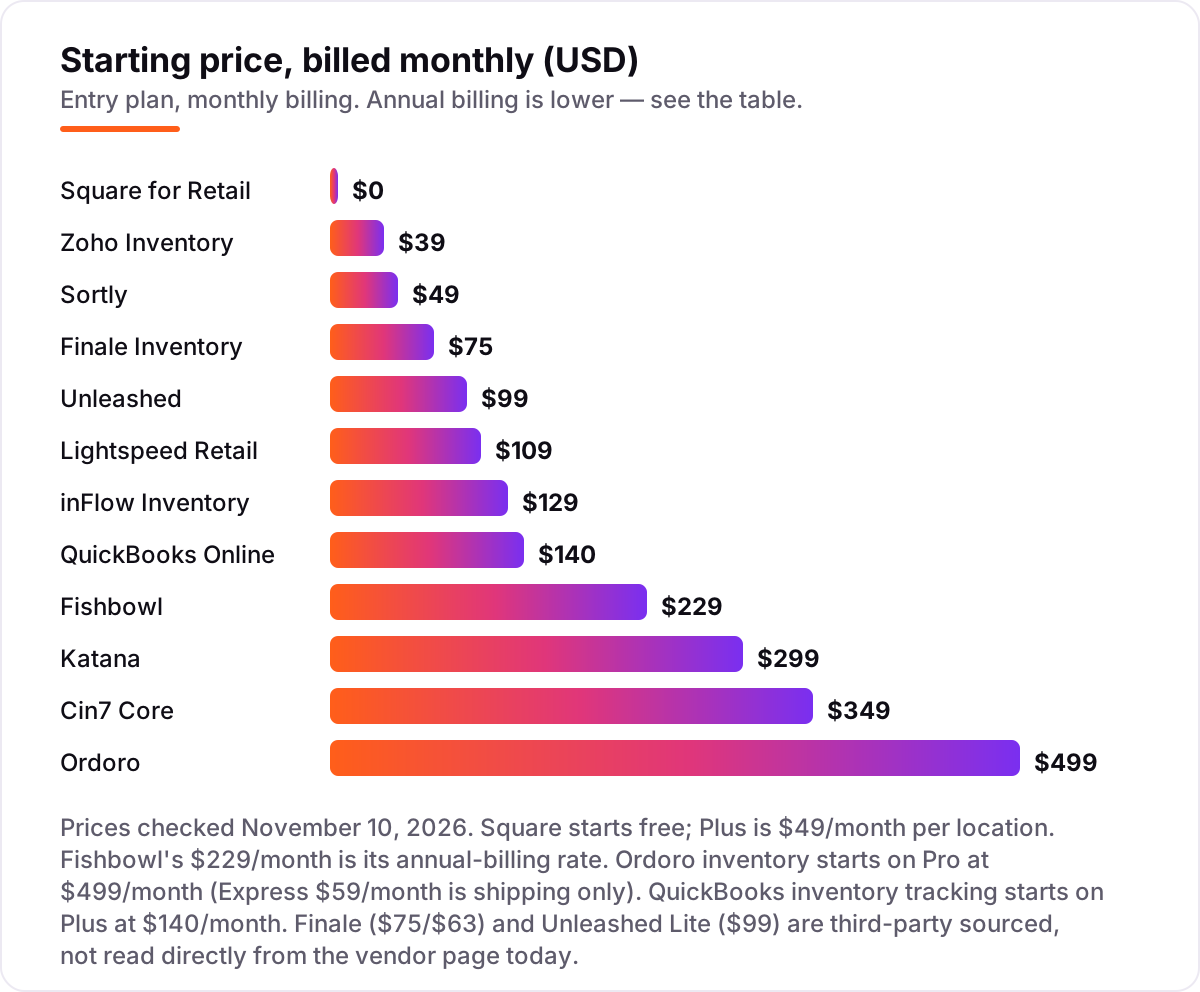
Take a small online seller with 400 orders a month, two staff and one warehouse. On Zoho Inventory, Standard at $29 a month billed annually covers 500 orders, three users and two locations, so the year costs $348. The same seller on inFlow Lite at $99 a month billed annually pays $1,188 a year, and on Cin7 Core Standard at $349 a month pays $4,188 a year — for the same 400 orders.
The gap is the meter. Zoho charges by orders, inFlow by team members and locations, Cin7 by orders per year plus users, and Sortly by unique items. A seller with 400 orders but 2,000 items pays $29 a month on Zoho and $149 on Sortly Ultra, because Sortly's $49 Advanced plan caps at 500 items. Before you compare headline prices, write down your orders per month, your item count, your users and your locations, then find the cheapest plan that covers all four — that number, not the starting price, is what you will actually pay.
Inventory tracking vs inventory management: know the difference
Tracking and management sound like the same job, and vendors use the words interchangeably, which is where buyers get caught. Tracking is the narrow job: knowing what you have, where it sits and how many are left. Management is everything around it: purchase orders, reorder points, forecasting, kitting, supplier records and demand planning.
Every tool in this list tracks stock. The difference is how much management comes with the entry plan. Sortly tracks beautifully but purchase orders start on Ultra; Zoho Standard includes purchase orders but not forecasting; Cin7 Core includes purchasing and production from Standard. If your problem is miscounts and lost stock, buy tracking and save the money. If your problem is stockouts and over-ordering, you need management — and the tool that looks expensive on tracking may be the cheap one once forecasting is included. Our monthly SEO service works the same way: the right scope first, then the tool.
How we chose
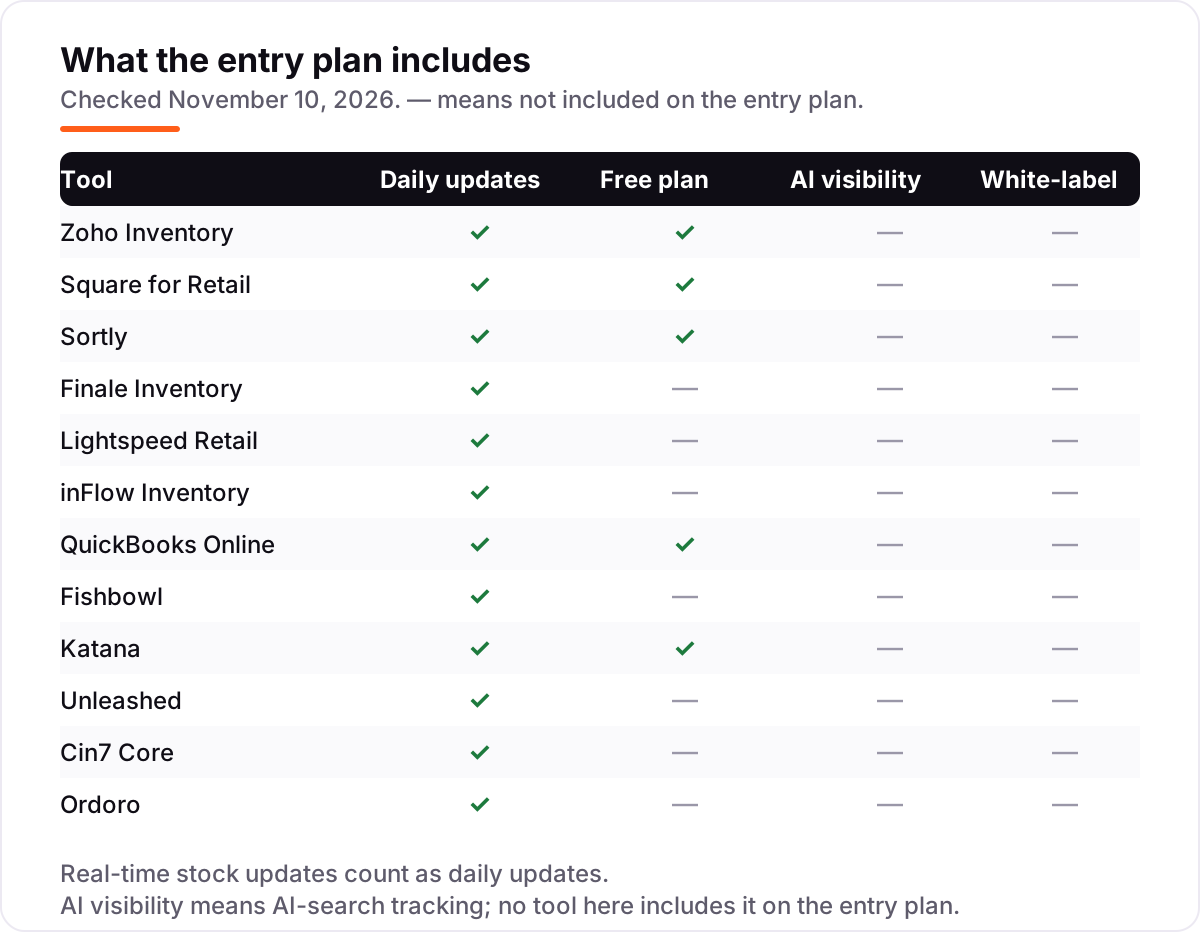
We checked each vendor's own pricing page on November 10, 2026 and recorded the starting price exactly as shown, including the annual-billing figure where the page lists one. Where the cheapest plan does not include inventory tracking — QuickBooks Online Simple Start and Essentials, and Ordoro Express — we priced the cheapest plan that does, and said so in the card. Two prices are third-party sourced rather than read directly from the vendor's page today: Finale Inventory's Starter ($75 a month, $63 billed annually) comes from SpotSaaS, citing Finale's official site, and Unleashed's US Lite ($99 a month) comes from October–November 2026 pricing reviews of Unleashed's US page. Ratings come from G2 pages checked the same day; Square, QuickBooks Online, Unleashed and Ordoro show no rating because their G2 pages were not verified today, not because they are unrated. We ranked the tools by fit for the most common buyer — a small business owner tracking a few hundred to a few thousand items — not by brand size. No vendor paid for a place in this list, and none of the links here are affiliate links. Before you publish new product pages for the stock you track, run your titles through the free SERP snippet preview tool — it shows exactly how the title and description will look in Google.
What to do next
Start with your four numbers: orders per month, item count, users and locations. Then take the free plan or trial of your top pick and run your real catalogue through it for a week — import the stock, count it once, and check the numbers against a manual count. If the counts match and the reports make sense, you have your tool. Once your tools are in place, find out what's holding your rankings back.
Your stack only works if people find you
SerpAstra fixes what keeps your site off page one and makes it easy for AI assistants to recommend.
Get a free audit→Sources we checked (20)
- Zoho Inventory pricing — zoho.com/us/inventory/pricing (checked November 10, 2026)
- Zoho Inventory on G2 — 4.4/5, 92 reviews (checked November 10, 2026)
- Square pricing — squareup.com/us/en/pricing (checked November 10, 2026)
- Sortly pricing — sortly.com/pricing (checked November 10, 2026)
- Sortly on G2 — 4.3/5, 27 reviews (checked November 10, 2026)
- Finale Inventory pricing — finaleinventory.com/pricing (checked November 10, 2026)
- Finale Inventory on G2 — 4.8/5, 41 reviews (checked November 10, 2026)
- Lightspeed Retail pricing — lightspeedhq.com/pricing (checked November 10, 2026)
- Lightspeed Retail on G2 — 4.0/5, 294 reviews (checked November 10, 2026)
- inFlow Inventory pricing — inflowinventory.com/software-pricing (checked November 10, 2026)
- inFlow Inventory on G2 — 4.4/5, 58 reviews (checked November 10, 2026)
- QuickBooks Online pricing — quickbooks.intuit.com/pricing (checked November 10, 2026)
- Fishbowl pricing — fishbowlinventory.com/pricing (checked November 10, 2026)
- Fishbowl on G2 — 4.0/5, 274 reviews (checked November 10, 2026)
- Katana pricing — katanamrp.com/pricing (checked November 10, 2026)
- Katana on G2 — 4.4/5, 131 reviews (checked November 10, 2026)
- Unleashed pricing — unleashedsoftware.com/pricing (checked November 10, 2026)
- Cin7 Core pricing — cin7.com/pricing (checked November 10, 2026)
- Cin7 Core on G2 — 4.2/5, 345 reviews (checked November 10, 2026)
- Ordoro pricing — ordoro.com/pricing (checked November 10, 2026)
Shamim
Founder of SerpAstra
A full-stack SEO and digital marketer who spends most days on Local SEO for dental practices, AI search visibility and lead generation.
Frequently asked questions
What is the best inventory tracking software for small business?
Zoho Inventory is the best value for most small businesses: a free plan and paid tiers from $29/month billed annually, with order, user and location limits that fit a small catalogue. Square is the cheapest start at $0, and Sortly is the simplest at $49/month. Sellers shipping high volumes should look at Finale or Cin7 Core instead.
How much does inventory tracking software cost?
From $0 to $499 a month at the entry level. Square starts free, Zoho from $29/month billed annually, Sortly $49, Finale $63 billed annually, inFlow $99 billed annually, QuickBooks Plus $140, Fishbowl $229 billed annually, Katana $299, Cin7 Core $349 and Ordoro Pro $499. The meter matters more than the headline: orders, items, users or locations decide the real bill.
Is there free inventory tracking software?
Yes, with limits. Zoho Inventory is free for 50 orders a month, Square is free for a single location, Sortly is free for 100 items and Katana is free for 30 SKUs. Free plans work for a tiny stockroom; once you need purchase orders, batch tracking or a second location, a paid plan is cheaper than the time you lose to spreadsheets.
What is the difference between inventory tracking and inventory management?
Tracking is the narrower job: knowing what you have, where it sits and how many are left. Management adds the decisions around it: purchase orders, reorder points, forecasting, kitting and supplier management. Every tool in this list tracks stock; the dearer ones also manage ordering and forecasting, so buy tracking when counts are the problem and management when reordering is.
Do I need POS with my inventory tracking software?
Only if you sell in person. Square and Lightspeed bundle a till with their inventory, which suits shops with a counter. If you sell only online, a standalone tracker like Zoho, inFlow or Finale is cheaper, and your sales channels already handle checkout. A maker selling at markets can start on Square Free and add Plus later.
Can I switch inventory software later?
Yes, but plan the move. Export your product list, stock counts, supplier records and open purchase orders as CSV files before you cancel, and run both systems for two weeks so the counts can be reconciled. Most tools in this list import CSV catalogues, and the switch is cheapest when stock is low, such as after a seasonal sale.
Free SEO and AI visibility audit
Find out what is holding your rankings back
Send us your site. Within 2 business days you get a written audit, an AI visibility check and a short fix list ranked by impact. Free, with no contract attached.
Request my free audit→Related guides
 SEO & AI Search10 Best Accounting Software for Small Business with Inventory in 2026, Compared10 best accounting software for small business with inventory, compared on price, stock depth and free plans. Prices checked November 2, 2026.Read guide →
 SEO & AI Search7 Best Ecommerce Platforms for SEO in 2026 (Pros, Cons and Pricing)The 7 best ecommerce platform for SEO picks compared on price, SEO controls and ease of use, with real 2026 prices checked on each vendor's pricing page.Read guide →
 SEO & AI Search11 Best Retail Analytics Software in 2026, Compared11 best retail analytics software tools compared on price, from free POS analytics to enterprise in-store tracking. Prices checked November 2, 2026.Read guide →