
10 Best Learn to Read Apps for Kids in 2026: Free and Paid Apps Ranked
Compare the 10 best learn to read apps for kids for ages 2 to 8 on price, free plans and phonics teaching, with every price checked November 4, 2026.
 Shamim Mia, Founder, SerpAstraLast verified November 4, 202614 min read
We compare pricing pages, documentation and public reviews. We never accept payment for rankings.
Key takeaways
- Khan Academy Kids is the best free pick at $0, Duolingo ABC is the best free phonics app at $0, and ABCmouse is the strongest paid all-rounder at $14.99 a month.
- The single most important buying factor is the teaching method: a phonics curriculum teaches a child to decode new words, while a book library only helps once a child can already read a little.
- Free plans are real here — Khan Academy Kids and Duolingo ABC cost nothing at all, and Starfall unlocks everything for $35 a year.
- Annual billing cuts most subscriptions by 30–50%: Homer drops from $119.88 to $59.99 a year, and Reading Eggs from $167.88 to $99.99.
On this page
Quick comparison
| Tool | Best for | Starting price | Free plan |
|---|---|---|---|
| Khan Academy Kids | Parents who want a complete, free early-learning app for a child aged 2 to 8 | Free | Yes (free) |
| ABCmouse | Parents of a 2- to 8-year-old who want one app covering reading, math, science and art | $14.99/mo | Yes (Basic tier) |
| Reading Eggs | Parents who want a structured, lesson-by-lesson phonics curriculum for ages 2 to 13 | $13.99/mo | No (30-day trial) |
| Homer | Parents who want a personalized reading plan that adapts to one child's level | $9.99/mo | No (30-day trial) |
| Duolingo ABC | Parents who want a free, ad-free phonics app for a preschooler or first grader | Free | Yes (free) |
| Starfall | Parents who want the cheapest paid reading app, built on classroom phonics | $5.99/mo | Yes (free tier) |
| Epic | Parents of a child who already reads a little and needs a huge library of books to practice on | $9.99/mo | Yes (Basic) |
| Hooked on Phonics | Parents who want phonics on screen plus workbooks and storybooks in the mail | $12.99/mo | No ($1 first month) |
| Teach Your Monster to Read | Parents of a 3- to 6-year-old who learns best through a game with a character to care about | $8.99 once | Yes (free on web) |
| Lingokids | Parents of a 2- to 8-year-old who want play-based English and reading games with strong parent controls | $13.49/mo | Yes (Basic tier) |
Make one of these tools?
We re-check this list every quarter. Send a correction, request a review, or ask about a clearly labeled sponsored spot.
Request a listingThe best learn to read apps for kids

Khan Academy Kids
Best for: Parents who want a complete, free early-learning app for a child aged 2 to 8
Khan Academy Kids is the best place to start because it costs nothing and covers the whole job: reading, phonics, math and social-emotional skills for children aged 2 to 8. The app holds more than 4,000 activities, videos and books, all free, with no ads, no subscriptions and no in-app purchases. A parent dashboard shows what the child practiced and where they struggled.
The trade-off is focus. Reading sits inside a broad curriculum, so a child who only needs phonics will spend time on math and songs too, and the lessons are gentler than a dedicated phonics program. Start here before paying for anything: if your child reads happily for a month on Khan Academy Kids, you may never need a subscription. Pay for a phonics app only when you want a tighter, step-by-step reading path.
What we like
- Completely free for families: 4,000+ activities, videos and books with no ads, no subscriptions and no in-app purchases
- Built with the Stanford Graduate School of Education and aligned to Head Start and Common Core standards
- Covers reading, phonics, math and social-emotional skills in one app for ages 2 to 8
- Parent dashboard shows what the child practiced and which skills need more work
Watch out for
- Reading is one subject among several, so it is less focused than a phonics-only app
- No offline mode for the full library on every device
- School reporting costs $5 per student a year for districts, not for families

ABCmouse
Best for: Parents of a 2- to 8-year-old who want one app covering reading, math, science and art
ABCmouse is the biggest name in early learning: more than 13,000 activities across reading, math, science, art and music, organized into a step-by-step path for ages 2 to 8. The personalized Reading and Math Learning Paths adjust to the child's level, and one subscription covers up to 3 child profiles with progress reports for parents. The app is KidSAFE and COPPA certified, with no third-party ads.
The catch is the price. Monthly billing at $14.99 is the dearest monthly rate in this list, and the $45 first-year annual price renews at $79.99, so the second year costs nearly twice the first. The free Basic tier allows 10 activities a day, which is enough to test it. Buy ABCmouse when you want one app for the whole early curriculum; buy a phonics-only app when reading is the only gap.
What we like
- 13,000+ activities across reading, math, science, art and music for ages 2 to 8
- Personalized Reading and Math Learning Paths that adjust to the child's level
- Up to 3 child profiles on one subscription, with progress tracking for parents
- KidSAFE and COPPA certified, with no third-party ads in the paid app
Watch out for
- Monthly billing at $14.99 is the most expensive monthly rate in this list
- The $45 first-year annual price renews at $79.99 a year, so the second year costs more
- Reading sits inside a broad curriculum, so a child who only needs phonics pays for subjects they will not use

Reading Eggs
Best for: Parents who want a structured, lesson-by-lesson phonics curriculum for ages 2 to 13
Reading Eggs is the most structured reading curriculum in this list. Its lessons walk a child from letter sounds through blending, sight words and comprehension, ending at chapter books, and the program covers ages 2 to 13 — so one subscription grows from preschool into elementary school. A placement test puts each child at the right level, and up to 4 children can share one subscription with their own profiles.
The pricing needs care. The US page sells Reading & Math together at $13.99 a month, or $99.99 a year, and there is no cheaper reading-only plan on that page. The 30-day free trial is generous — long enough to finish the placement test and a dozen lessons. Choose Reading Eggs when you want a curriculum with a clear sequence; choose Homer when you want a shorter, more playful path.
What we like
- Step-by-step phonics lessons that take a child from letter sounds to chapter books
- Covers ages 2 to 13, so one subscription grows from preschool into elementary reading
- Up to 4 children on one subscription, each with their own profile and placement test
- KidSAFE certified, with a 30-day free trial on every plan
Watch out for
- The entry plan bundles math with reading; there is no reading-only plan on the US pricing page
- Monthly billing at $13.99 is near the top of this list; the value is in the annual plan
- Homeschool Max at $41.90 a month is a separate, much pricier tier for full homeschooling
Homer
Best for: Parents who want a personalized reading plan that adapts to one child's level
Homer builds a reading plan around your child. After a short quiz about age and interests, it serves 1,000+ lessons in phonics, sight words and the alphabet, adjusted as the child improves. Up to 4 children can have profiles on one subscription, the app works offline, and the parent dashboard tracks progress and prints practice sheets. The 30-day free trial is the longest in this list.
The price gap between billing choices is the widest here: $9.99 a month is $119.88 a year, while the annual plan is $59.99 — exactly half. Pay annually if you commit, and use the trial to check the app runs well on your device first. Pick Homer when you want lessons shaped to one child; pick Reading Eggs when you want a longer, more traditional curriculum.
What we like
- 1,000+ lessons built around phonics, sight words and the alphabet, personalized to the child
- Up to 4 child profiles, with a parent dashboard and printable practice sheets
- Works offline, so reading practice does not need a connection
- 30-day free trial, longer than most apps in this list
Watch out for
- Monthly billing at $9.99 is double the annual equivalent of $4.99 a month
- The library is smaller than Epic's or ABCmouse's, and it leans on its own stories
- Some parents report app glitches and slow customer support in public reviews
Duolingo ABC
Best for: Parents who want a free, ad-free phonics app for a preschooler or first grader
Duolingo ABC is the best free phonics app in this list, and it is free in the fullest sense: no ads, no in-app purchases, no subscription, no locked lessons. It holds 700+ short lessons that teach the alphabet, phonics, sight words and early writing through stories and games, for children from preschool to first grade. Lessons work offline, and the game-like rewards keep young children coming back.
The limit is the ceiling. The content stops at about first-grade level, so a child who reads fluently will outgrow it within a year, and parents get no dashboard to track progress. Treat Duolingo ABC as the free starter: pair it with a library app like Epic when the child starts reading real books, and move to a curriculum app when the lessons run out.
What we like
- Completely free with no ads and no in-app purchases — the whole app is the free tier
- 700+ bite-sized lessons covering the alphabet, phonics, sight words and early writing
- Works offline, so lessons travel without a connection
- Made by the Duolingo team, with the same game-like rewards that keep children practicing
Watch out for
- Covers only preschool to first grade, so children outgrow it fast
- No parent dashboard or detailed progress reports
- No desktop version; it runs on phones and tablets only

Starfall
Best for: Parents who want the cheapest paid reading app, built on classroom phonics
Starfall is the budget pick, and it earns the spot on teaching quality as well as price. Run by a nonprofit since 2002, it teaches phonics through songs, games and stories that teachers have used in classrooms for two decades. A Home Membership costs $35 a year and unlocks 700+ activities for the whole household, on any device. The free tier covers the alphabet and basic reading games.
Buy it the cheap way. The in-app subscription costs $5.99 a month, or about $72 a year — more than double the $35 website membership — so sign up at store.starfall.com instead of inside the app. The design looks older than its rivals, but the phonics is sound. Pick Starfall when the budget is tight and you trust a classroom-tested program over shiny graphics.
What we like
- The cheapest paid option here: a $35 a year Home Membership unlocks 700+ activities
- Nonprofit phonics program used in classrooms since 2002, trusted by teachers
- Free tier covers the alphabet and basic reading games, so you can try before paying
- Membership covers the whole household on any computer, tablet or phone
Watch out for
- The $35 a year Home Membership must be bought on the website, not in the app
- The app subscription costs $5.99 a month, which is more than twice the membership's monthly equivalent
- Design and games feel older than newer apps, and the math section is thin

Epic
Best for: Parents of a child who already reads a little and needs a huge library of books to practice on
Epic is a library, not a teacher — and that is exactly what a child needs once they can sound out words. It holds 40,000+ books, audiobooks and learning videos for children up to 12, with Read-To-Me books, quizzes and reading badges that turn practice into a habit. Up to 4 children can have profiles, and a parent dashboard shows what each child read. Epic Basic gives a free taste of the library.
Do not buy Epic for a child who cannot read yet: with no phonics curriculum, a true beginner will stare at books they cannot decode. The App Store shows several monthly prices, so check the plan offered to you before subscribing. Buy Epic as the second app, after a phonics app has taught the basics — that is where its huge library pays off.
What we like
- 40,000+ books, audiobooks and learning videos — the largest library in this list
- Read-To-Me books, audiobooks and quizzes that build fluency and comprehension
- Up to 4 child profiles, with reading badges and a parent dashboard
- Free for educators, and the Basic tier lets a family sample the library at no cost
Watch out for
- It is a library, not a reading teacher: there is no phonics curriculum for a true beginner
- The App Store lists several monthly prices ($7.99 to $13.99), so what you pay depends on the plan shown to you
- Free for educators, but families pay — there is no free full tier for home use

Hooked on Phonics
Best for: Parents who want phonics on screen plus workbooks and storybooks in the mail
Hooked on Phonics is the only app in this list that also teaches off the screen. The monthly subscription pairs the Learn to Read app with a practice pack in the mail: a workbook, two or three storybooks and stickers, matched to the lessons the child just finished. Hooked on Spelling and Hooked on Math are included, up to 3 children can share one subscription, and a 30-day money-back guarantee covers the first month.
The price is the catch. At $12.99 a month plus about $2.99 shipping, a year costs close to $192 — the most in this list — and the $1 first month auto-renews, so set a reminder if you only want the trial. Buy it when your child learns better with paper in hand; buy a cheaper app-only plan when the screen alone is enough.
What we like
- Pairs the app with monthly practice packs: workbooks, storybooks and stickers in the mail
- Step-by-step Learn to Read program built on phonics, with a 30-day money-back guarantee
- Hooked on Spelling and Hooked on Math apps are included in the subscription
- Up to 3 children on one subscription, on up to 3 devices
Watch out for
- Monthly billing at $12.99 plus about $2.99 shipping makes it one of the priciest options here
- The $1 first month auto-renews, so you must cancel or downgrade deliberately
- Aimed at ages 3 to 8, so older children outgrow the program quickly
Teach Your Monster to Read
Best for: Parents of a 3- to 6-year-old who learns best through a game with a character to care about
Teach Your Monster to Read turns phonics into a game children actually ask to play. Your child builds a monster, then guides it through three games — First Steps, Fun With Words and Champion Reader — that teach letter sounds, blending and reading, built with academics from Roehampton University. The whole game is free on a computer, and the mobile app costs $8.99 once, with no ads and no in-app purchases.
Two things to know before you buy. The app price has risen from $4.99 to $8.99, and the makers say the app will move to a subscription model in early 2027 — so the one-time deal will not last. The game also ends where fluent reading begins, so plan a library app next. Buy it now, while the one-time price still exists, if your child loves games.
What we like
- Three phonics games (First Steps, Fun With Words, Champion Reader) built with Roehampton University academics
- Free to play in full on a computer, with no ads and no in-app purchases anywhere
- A single one-time app purchase covers all three games, with no subscription on the current version
- Made by a charity, the Usborne Foundation, and used by more than 50 million children
Watch out for
- The app moves to a subscription model in early 2027, so the one-time price will not last
- The game covers phonics and early reading only; there is no library for fluent readers
- No parent dashboard with detailed progress reports on the current version

Lingokids
Best for: Parents of a 2- to 8-year-old who want play-based English and reading games with strong parent controls
Lingokids is a play app first, a reading app second. Its 4,000+ games, songs and videos cover 18 subjects for ages 2 to 8, with reading and early literacy woven through them, and Plus adds up to 4 child profiles, offline mode, screen-time limits and a Progress Center for parents. The free Basic tier gives 10 games a day with no payment details, and the whole app is ad-free.
Price varies by where you subscribe: $13.49 a month on the website, but $14.99 to $15.99 in the App Store, so buy on the website. Because reading is one subject among many, Lingokids suits a younger child who needs general English play; a child who is ready to read needs a phonics app beside it. Try the free tier first — 10 games a day is enough to judge it.
What we like
- 4,000+ games, songs and videos for ages 2 to 8, with reading among 18 subjects
- Plus adds up to 4 child profiles, offline mode, screen-time limits and a Progress Center
- Free Basic tier gives 10 games a day with no payment details needed
- Ad-free throughout, with content reviewed for young children
Watch out for
- Plus costs $13.49 a month on the website, but App Store prices differ ($14.99 to $15.99 a month)
- Reading is one of 18 subjects, so it is broader and less reading-focused than the phonics apps
- The free Basic tier allows only 10 games a day, which runs out fast on a long car ride
The best learn to read apps for kids do one job well: they teach a child to turn letters into sounds, sounds into words, and words into stories — in short sessions a 4-year-old will actually finish. We ranked the ten apps below by fit for the most common buyer, a parent of a 3- to 7-year-old who is just starting to read, and every price was checked on the vendor's own pricing page on November 4, 2026.
How to choose the best learn to read apps for kids
- Match the method to the child. A phonics curriculum (Reading Eggs, Homer, Starfall) teaches decoding step by step; a library app (Epic) only works once a child can already read a little.
- Start free before you pay. Khan Academy Kids and Duolingo ABC cost nothing at all, and most paid apps offer a 7- to 30-day free trial — run the trial with your real child before subscribing.
- Check the age ceiling. Duolingo ABC stops at about first grade, while Reading Eggs runs to age 13. A short ceiling means buying a second app within a year.
- Count the children. Reading Eggs, Homer, Lingokids and Epic cover up to 4 children on one subscription, so a family with two readers pays once, not twice.
- Check the device. Some apps need a tablet or phone, and Duolingo ABC has no desktop version, so confirm the app runs on the device your child actually uses.
Two checks cost nothing and save a bad purchase. First, sit with your child through the first three lessons and watch whether they sound out words or just tap pictures — the best app makes them read, not watch. Second, check the reading level of the books your child will meet next: our free readability checker tool scores any text you paste in, so you can tell whether a book is a stretch or a frustration before you hand it over.
Whatever you shortlist, try it with your real child before you pay. The free plans and trials in this list are long enough to run two genuine weeks — real lessons, real progress, real complaints — and those two weeks tell you more than any review can. Check two things in the trial: that the lessons get harder as your child improves, and that your child asks to play again the next day. Every app here is built for children aged 2 to 8, so there is no reason to buy before your child has tried it.
Learn to read apps for kids pricing: what you will actually pay
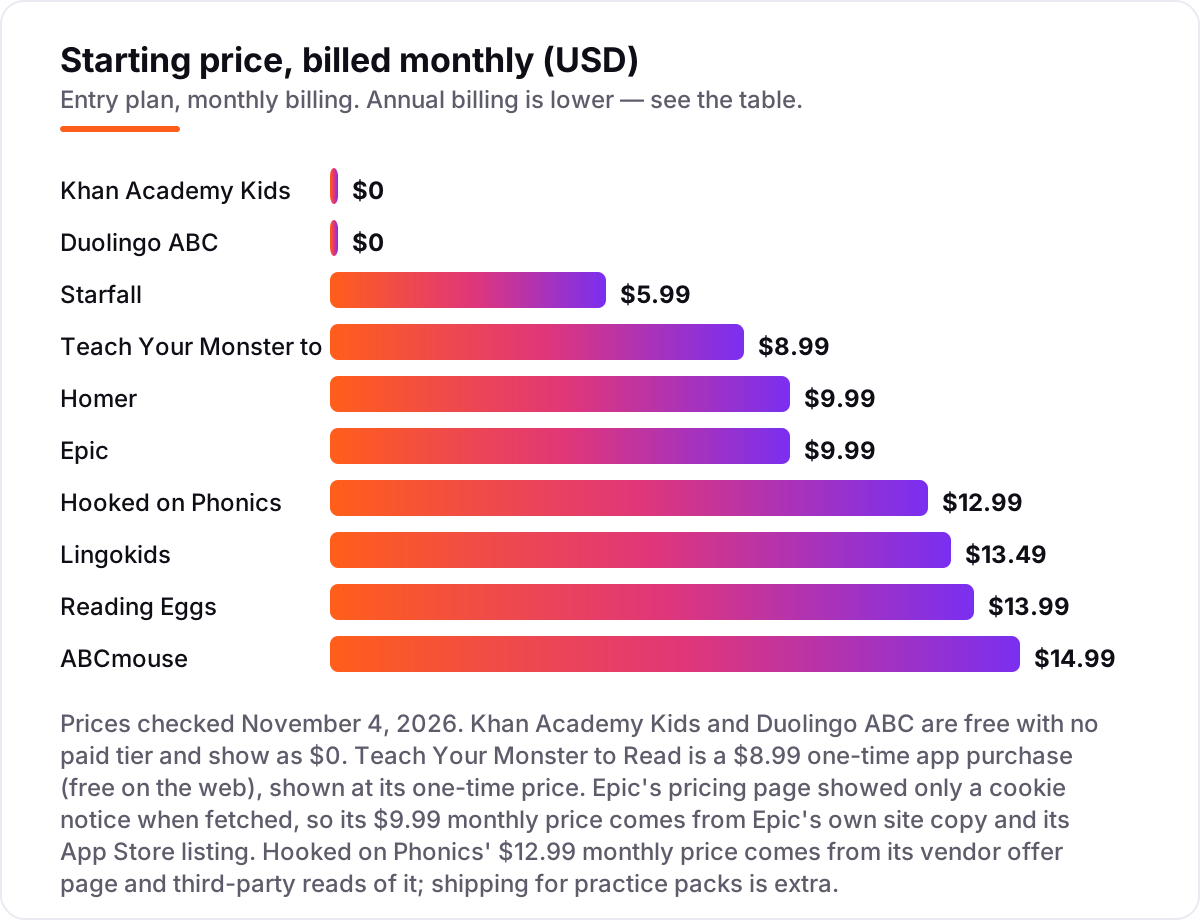
Take a family with two children, aged 4 and 6, sharing one subscription for a year. On list prices, the year costs $0 on Khan Academy Kids or Duolingo ABC, $8.99 once on Teach Your Monster to Read, $35 on Starfall's Home Membership, $59.99 on Homer billed annually, $99.99 on Reading Eggs billed annually, $119.88 on Epic billed monthly, $161.88 on Lingokids billed annually, and $155.88 on Hooked on Phonics billed monthly — plus about $35.88 in shipping for the practice packs, or $191.76 in total.
Two of those numbers need adjusting before they are real. First, the monthly figures assume you stay on monthly billing all year: Homer drops to $59.99 and Reading Eggs to $99.99 the moment you switch to annual billing, so paying monthly for a full year wastes $59.89 on Homer and $67.89 on Reading Eggs. Second, ABCmouse's first year is the cheapest paid year here at $45 on the annual plan, but it renews at $79.99 — so the second year costs $34.89 more than the first, and a family that forgets the renewal pays for it.
The range is wide: $0 to $191.76 for a year of one app for two children. The free apps are genuinely free, not trials, so a family can spend a full year at $0 and still cover phonics properly. If you do pay, the best value is Starfall at $35 a year or Homer at $59.99, and the dearest honest option is Hooked on Phonics, where the mailed practice packs are the reason for the price. One more cost to check before you commit: a second device is free on every app here, but a second subscription is not — every app in this list covers multiple children on one subscription, so never buy a second one for a sibling.
Know the difference: a reading app vs a library of books
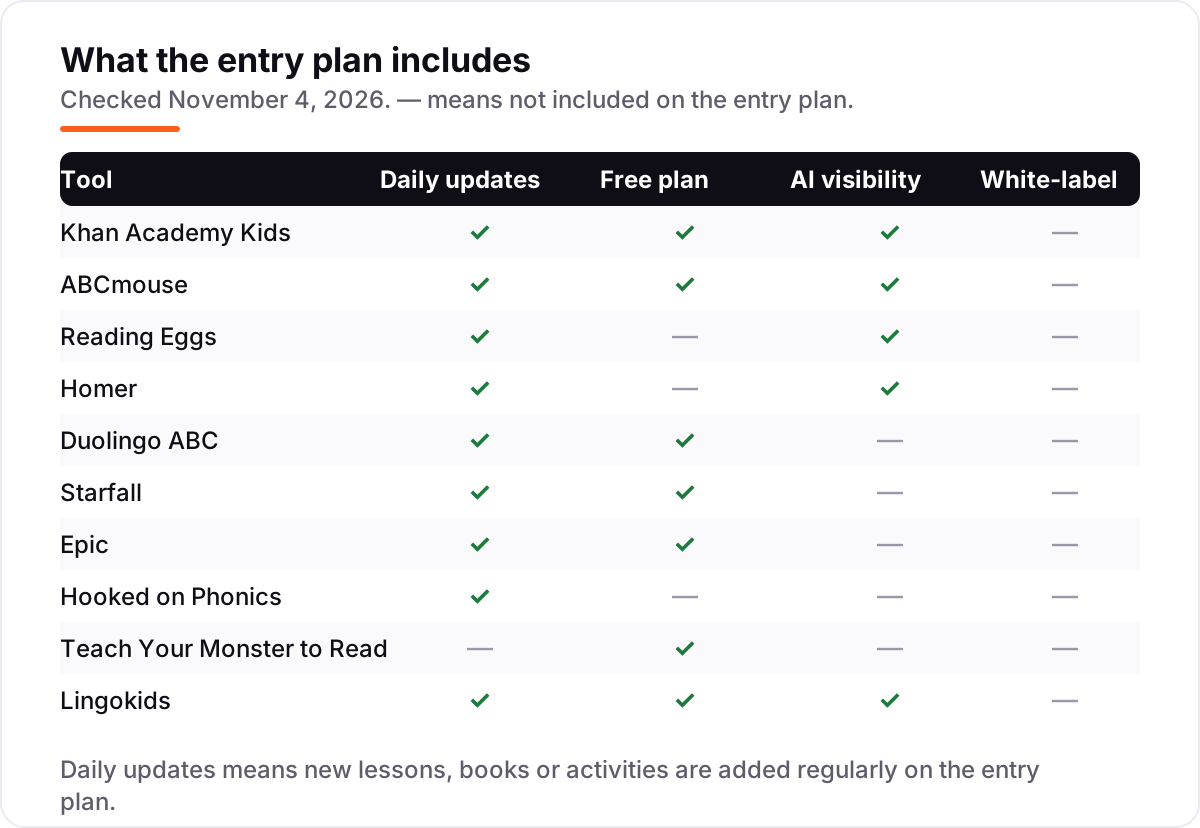
The confusion in this category is between a teacher and a shelf. A reading app teaches: it introduces letter sounds in order, drills blending, tests sight words and moves the child to harder text only when they are ready. A library app like Epic is a shelf: 40,000 books a child can open, but it assumes the child can already decode the words on the page. A true beginner handed Epic will flip pictures; the same child handed Reading Eggs will learn to sound out "cat" by the end of the week.
There is a second, quieter confusion: a general learning app is not a reading app. ABCmouse, Khan Academy Kids and Lingokids all teach reading, but they also teach math, science, songs and art — reading is one subject among many. A phonics app like Homer, Starfall or Hooked on Phonics spends the whole session on letters and words. If reading is the gap, buy the phonics app; if the whole early curriculum is the gap, buy the general app.
A third distinction worth knowing is free versus freemium. Khan Academy Kids, Duolingo ABC and the web version of Teach Your Monster to Read are free in full — every lesson, no locked content. Starfall, ABCmouse and Lingokids are freemium: a free tier with a real but limited slice, and the full program behind a subscription. Both are honest models, but only the first kind costs $0 forever.
Quick comparison: tool type by need
| Buyer | Best pick | Why |
|---|---|---|
| Parent who wants to pay nothing | Khan Academy Kids | Full early-learning app, free forever, no ads, from $0 |
| Best all-round paid app | ABCmouse | 13,000+ activities for ages 2–8, from $14.99/month |
| Most structured phonics curriculum | Reading Eggs | Step-by-step lessons to chapter books, from $13.99/month |
| Personalized lessons for one child | Homer | Adaptive 1,000+ lesson path, from $9.99/month |
| Cheapest paid option | Starfall | Full access for $35 a year, or $5.99 a month in the app |
| Child who already reads a little | Epic | 40,000+ books to practice on, from $9.99/month |
Mistakes to avoid
- Paying before trying the free tier. Khan Academy Kids and Duolingo ABC cost $0 forever, and every paid app here has a free tier or a trial. A month on a free app may show you never needed to pay.
- Buying a library for a beginner. Epic's 40,000 books are useless to a child who cannot decode yet. Teach letter sounds first with a phonics app, then buy the library.
- Paying monthly for a full year. Annual billing halves Homer ($119.88 to $59.99) and cuts Reading Eggs by $67.89. If you will use the app for a year, pay annually from the start.
- Buying the in-app subscription instead of the website membership. Starfall costs $5.99 a month in the app but $35 a year on its website — the same content for less than half the price.
- Forgetting the auto-renewal. Hooked on Phonics' $1 first month and ABCmouse's $45 first year both renew at the full price. Put the renewal date in your calendar the day you subscribe.
How we chose
We checked each vendor's own pricing page on November 4, 2026 and recorded the starting price exactly as shown, including the annual-billing figure where the page lists one, and we ranked the apps by fit for the most common buyer — a parent of a 3- to 7-year-old just starting to read — not by brand size. Two prices are not from the vendor's own page: Epic's pricing page showed only a cookie notice when fetched, so its $9.99 monthly price comes from Epic's own site copy and its App Store listing, and Hooked on Phonics' $12.99 price comes from its vendor offer page with third-party reads confirming it. This list carries no review ratings because G2 and Capterra have almost no coverage of children's consumer apps — ABCmouse, for example, has only 4 G2 reviews — and we would rather show no rating than a thin one. No vendor paid for a place in this list, and none of the links here are affiliate links.
What to do next
Start with Khan Academy Kids or Duolingo ABC and run two real weeks of lessons with your child. Check that the lessons get harder as they improve and that they ask to play again the next day. If they do, add a phonics app for the teaching and Epic for the books once they can decode. If the apps are sorted but new customers are not finding your own site, our monthly SEO service handles the visibility side. Once your tools are in place, find out what's holding your rankings back.
Your stack only works if people find you
SerpAstra fixes what keeps your site off page one and makes it easy for AI assistants to recommend.
Get a free audit→Sources we checked (12)
- Khan Academy Kids pricing — khanacademy.org/kids/pricing (checked November 4, 2026)
- ABCmouse pricing — abcmouse.com/learn/abcmouse/abcmouse-vs-homer/11387 (checked November 4, 2026)
- Reading Eggs pricing — readingeggs.com/pricing (checked November 4, 2026)
- Homer pricing — learnwithhomer.com (checked November 4, 2026)
- Duolingo ABC — duolingo.com/abc (checked November 4, 2026)
- Starfall membership — store.starfall.com/membership (checked November 4, 2026)
- Starfall membership help — help.starfall.com/help/help-me-choose-a-membership (checked November 4, 2026)
- Epic pricing — getepic.com/pricing (checked November 4, 2026)
- Epic App Store listing — apps.apple.com/us/app/epic-kids-books-reading/id719219382 (checked November 4, 2026)
- Hooked on Phonics offer — letters.hookedonphonics.com/us/longform/read-guaranteed-mt2-10Off.html (checked November 4, 2026)
- Teach Your Monster to Read — teachyourmonster.org/teach-your-monster-to-read-overview (checked November 4, 2026)
- Lingokids Plus pricing — help.lingokids.com/hc/en-us/articles/115005120505 (checked November 4, 2026)
Shamim
Founder of SerpAstra
A full-stack SEO and digital marketer who spends most days on Local SEO for dental practices, AI search visibility and lead generation.
Frequently asked questions
What is the best learn to read app for kids?
Khan Academy Kids is the best pick for most families: it is completely free, covers reading and phonics for ages 2 to 8, and has no ads. If you want a paid curriculum, Reading Eggs has the most structured phonics sequence, while ABCmouse offers the biggest activity library.
Are there really free learn to read apps for kids?
Yes. Khan Academy Kids and Duolingo ABC are completely free with no paid tier, no ads and no in-app purchases. Teach Your Monster to Read is free in full on a computer. Starfall, ABCmouse and Lingokids also have free tiers, but their full libraries need a paid plan.
How much do learn to read apps for kids cost?
Paid apps in this list cost $5.99 to $14.99 a month on monthly billing. Annual billing is much cheaper: Starfall is $35 a year, Homer $59.99, Reading Eggs $99.99 and Lingokids $161.88. A year of one paid app runs $35 to about $192 including shipping.
What age should a child start using a reading app?
Most apps in this list target ages 2 to 8, and the best starting age is 3 to 4, when children learn letter sounds. Start with a free app like Khan Academy Kids or Duolingo ABC, keep sessions to 10 to 15 minutes, and read paper books together as well.
Is ABCmouse or Reading Eggs better for learning to read?
Reading Eggs is better for learning to read itself: its lessons follow a clear phonics sequence from letter sounds to chapter books. ABCmouse is better as an all-round app, with reading plus math, science and art. Choose Reading Eggs for reading alone, ABCmouse for the whole early curriculum.
Do reading apps replace books and teachers?
No. Apps are best as short, daily practice between real reading time. A phonics app teaches decoding, but fluency grows from reading paper books aloud with an adult, and a teacher spots struggles an app cannot. Use the app for 10 to 20 minutes a day, not as the whole reading diet.
Can two children share one reading app subscription?
Yes, on most apps here. Reading Eggs covers up to 4 children, Homer and Lingokids up to 4 profiles, ABCmouse up to 3, and Epic up to 4. Starfall's $35 Home Membership covers the whole household. Only Teach Your Monster to Read has no multi-child profiles on the current version.
Free SEO and AI visibility audit
Find out what is holding your rankings back
Send us your site. Within 2 business days you get a written audit, an AI visibility check and a short fix list ranked by impact. Free, with no contract attached.
Request my free audit→Related guides
 AI, Data & Analytics7 Best AI Spanish Learning Apps in 2026: Free and Paid Apps RankedThe 7 best ai spanish learning apps of 2026, ranked with real prices, free plans and AI conversation features — pick the app that fits how you actually study.Read guide →
 SEO & AI Search10 Best Platforms for SEO for Education in 2026, ComparedThe best platform for seo for education, compared: 10 picks with 2026 prices, free plans and SEO controls. WordPress, Finalsite and HubSpot, ranked for schools.Read guide →
 AI, Data & Analytics9 Best AI Chatbot Apps for Small Business in 20269 best AI chatbot apps for small business compared on price, free plans and AI features, with real starting prices checked November 2, 2026.Read guide →