
10 Best Local Job Search Platforms for 2026 (Pros, Cons and Pricing)
Compare the 10 best local job search platforms for 2026 on price, free posting and local reach, with every price checked November 12, 2026 for US job seekers.
 Shamim Mia, Founder, SerpAstraLast verified November 12, 202613 min read
We compare pricing pages, documentation and public reviews. We never accept payment for rankings.

Key takeaways
- Indeed leads for most local searches at $0 to start, with LinkedIn from $0, Monster+ Pro at $299 a month and ZipRecruiter by custom quote.
- The single most important buying factor is the pricing model: free posts, pay-per-click auctions, flat subscriptions and per-post fees buy very different amounts of local reach.
- Seven of the 10 platforms are free for job seekers, and five cost employers $0 to start — but free posts are capped, and visibility usually needs sponsorship.
- Every price below was checked on November 12, 2026. ZipRecruiter, Glassdoor, CareerBuilder and Jobcase publish no starting price, so those figures are custom quotes.
On this page
Quick comparison
| Tool | Best for | Starting price | Free plan |
|---|---|---|---|
| Indeed | Job seekers and small employers who want the widest pool of local listings | Free; Sponsored $5/day | Yes (free plan) |
| Job seekers and employers hiring professional, office and skilled roles locally | Free; Promoted ~$7/day | Yes (free plan) | |
| ZipRecruiter | Job seekers who want matched alerts and one-tap applications, and employers who want fast applicant flow | Custom quote | Yes (free for seekers) |
| Glassdoor | Job seekers who research pay and culture before applying, and employers who care about their reviews | Custom quote | Yes (free for seekers) |
| Snagajob | Restaurants, retail stores and warehouses hiring hourly and shift workers nearby | Free; Sponsored per click | Yes (free listings) |
| Monster | Small employers who want a published price and resume search on one subscription | $8/day; Pro $299/mo | No (pay as you go) |
| SimplyHired | Small employers who want free distribution without managing another paid account | Free | Yes (free posting) |
| CareerBuilder | Mid-market employers hiring in volume who already use a recruiting suite | Custom quote | No (no free posting) |
| Craigslist | Local trades, gig and immediate-start roles where applicants prefer a no-friction local ad | $10–$75 per post | No (paid per post) |
| Jobcase | Hourly and frontline workers who want a community around the job search, not just listings | Custom quote | Yes (free for seekers) |
Make one of these tools?
We re-check this list every quarter. Send a correction, request a review, or ask about a clearly labeled sponsored spot.
Request a listingThe best local job search platform

Indeed
Best for: Job seekers and small employers who want the widest pool of local listings
Indeed is the starting point for most local job searches, and the reason is volume: it carries more listings in more US towns than any other platform here, with distance, pay, shift and job-type filters built for nearby work. Job seekers search free, set alerts by ZIP code and apply without an account in many cases, while employers get up to three free job posts a month, each live for 30 days.
The catch is that free visibility has shrunk. Since March 31, 2026, jobs sent through single-source feeds get no free exposure at all, and free posts sit far down the results in busy markets. Sponsored Jobs start at $5 a day or $150 a month, billed per click or per started application. Start free, sponsor the roles that matter, and watch cost per application before raising the budget.
What we like
- The largest pool of local listings in the US, with radius, pay and shift filters built for nearby work
- Free for job seekers, and employers get 3 free posts a month before paying anything
- Sponsored Jobs start at $5 a day or $150 a month, with budgets the employer controls
- Listings posted on Indeed can also appear on Glassdoor, since the two merged in July 2026
Watch out for
- Free posts are capped at 3 a month and lose visibility fast without sponsorship
- Sponsored spend is an auction, so the same role can cost far more in a competitive city
- Single-source XML feeds get no free visibility since March 31, 2026

Best for: Job seekers and employers hiring professional, office and skilled roles locally
LinkedIn is the local job search platform for professional work: office, skilled and management roles where who you know and what you have done both matter. A job seeker can check mutual connections at the employer, see the hiring manager's profile and apply with a profile instead of a fresh resume each time. Employers get one free job post at a time, active for 14 days.
The free post is a genuine trial, not a hiring channel: it pauses after 14 days, stops appearing in search once it hits a free application limit of roughly 10 to 30, and then needs promotion. Promoted posts run on a pay-per-click auction with an employer-reported minimum near $7 to $10 a day. Use LinkedIn for professional roles and passive candidates; use Indeed or Snagajob for hourly volume.
What we like
- The only platform here where a job seeker can see who they know at the employer before applying
- One free job post per account, so a small employer can try it with no spend at all
- Promoted posts reach passive candidates who are not searching any job board
- Profiles, skills and recommendations give employers more signal than a resume alone
Watch out for
- Only one free job post at a time, and it pauses after 14 days
- Promoted posts run on a pay-per-click auction with no published rate card
- Job Slots for always-on posting cost $200 to $1,000 a month and need an annual contract

ZipRecruiter
Best for: Job seekers who want matched alerts and one-tap applications, and employers who want fast applicant flow
ZipRecruiter earns its place on matching, not on volume. Its AI invites candidates whose profiles fit the role, sends matched alerts to job seekers, and lets them apply with one tap, which is why it holds the highest G2 score in this list at 4.8 from 1,445 reviews. One post also distributes to more than 100 job boards, so a local opening reaches candidates who never visit ZipRecruiter itself.
Employers pay for that reach with opacity: there is no published rate card, and every quote is set by industry, location, company size and slot count. Third-party guides put Standard at roughly $299 to $399 a month per job slot, but ZipRecruiter has not confirmed those figures, so budget from your own quote. Start with the 4-day trial and a single slot before committing to a subscription.
What we like
- The highest G2 score in this list at 4.8 from 1,445 reviews, with AI matching that invites candidates to apply
- Distributes one post to 100-plus job boards, so a local role reaches beyond ZipRecruiter itself
- One-tap apply and matched alerts make it the fastest application flow here for job seekers
- Free for job seekers, with resume alerts that surface new local roles as they appear
Watch out for
- No published rate card — every employer gets a custom quote after a trial or sales call
- Employer-reported Standard pricing of about $299 to $399 a month per job slot is not a vendor price
- No free plan for employers, only a 4-day free trial

Glassdoor
Best for: Job seekers who research pay and culture before applying, and employers who care about their reviews
Glassdoor is the research layer of a local job search: candidates check employee reviews, salary ranges and interview reports before they apply, so a strong profile does real hiring work and a weak one quietly turns people away. Job seekers use it free, and a basic employer profile costs nothing — a small business can respond to reviews and publish culture content without a contract.
Do not shop Glassdoor as a standalone job board any more. It merged into Indeed, Inc. on July 1, 2026, and job ads now run through Indeed Sponsored Jobs from $5 a day or $150 a month, appearing on Glassdoor as part of the same buy. Employer branding is still sold separately and quoted per account. Use Glassdoor to vet employers and manage your reputation; buy the listing on Indeed.
What we like
- The only platform here where candidates read real employee reviews, salaries and interview reports before applying
- Job listings posted on Indeed can appear on Glassdoor at no extra cost
- A free basic employer profile lets a small business respond to reviews and show its culture
- Salary data helps job seekers filter local roles by realistic pay before they apply
Watch out for
- No separate job posting product any more — job ads run through Indeed since the July 2026 merger
- Employer branding packages are quote-based, with third-party benchmarks starting near $5,000 a year
- A few negative reviews can suppress applications no matter how good the listing is

Snagajob
Best for: Restaurants, retail stores and warehouses hiring hourly and shift workers nearby
Snagajob is the hourly specialist in this list. Restaurants, shops and warehouses post shift work, and job seekers browse by pay per shift, distance and start date in an app built for people comparing nearby shifts — not for office careers. Listings are free with no strict limit, according to Snagajob's own employer documentation, and sponsored jobs bill only when a candidate clicks to apply.
There is no monthly price to compare, which is both the appeal and the risk: sponsored spend is whatever budget the employer sets, at per-click rates that vary by title, city and competition. The $89 a month figure that circulates in directories is not confirmed by Snagajob's own pages, so do not budget from it. Post free first, sponsor only the shifts that stay empty, and read any sales contract carefully before signing.
What we like
- Built for hourly and shift work, so local restaurant, retail and warehouse roles are the core audience
- Free listings with no strict limit, and sponsored jobs bill only when a candidate clicks to apply
- Job seekers see pay per shift in the app, which suits hourly workers comparing nearby shifts
- Owned by JobGet since November 2024, keeping the hourly focus while the parent grows the pool
Watch out for
- No published monthly price — sponsored spend is per apply click and varies by role and city
- The $89 a month figure in third-party directories is not confirmed by Snagajob's own pages
- Larger contracts are individually quoted and can auto-renew with 90 days' notice on price changes

Monster
Best for: Small employers who want a published price and resume search on one subscription
Monster is the veteran here, and in 2026 it is also the most transparent about price: Monster+ Standard starts at $8 a day, pay as you go, and Pro is $299 a month with 299 credits included. A promoted job publishes to Monster, CareerBuilder and partner sites at once — the two boards were sold together to BOLD in 2025 — and Pro adds resume search.
The credit system is the part to understand before paying. One credit is $1, and credits drain whether a candidate clicks or the employer opens a resume — a resume view costs 2 credits, so heavy searching eats the visibility pool. Standard's starting budget reads $8 a day on one Monster page and $18 on another. Start on Standard for one role; move to Pro only when resume search is part of the plan.
What we like
- One of the few large boards that publishes real prices: Standard from $8 a day, Pro $299 a month
- A Pro subscription publishes the job to Monster, CareerBuilder and partner sites at once
- Pro includes resume search at 2 credits per view, so employers can contact candidates directly
- 30 years of brand recognition still draws candidates for trades, healthcare and clerical roles
Watch out for
- Credits drain from the same pool whether a candidate clicks or the employer views a resume
- Standard's starting daily budget differs between Monster's own pages ($8 to $18 a day)
- Free posting is unclear for new employers — the old one-job free option may no longer be offered

SimplyHired
Best for: Small employers who want free distribution without managing another paid account
SimplyHired is the free distribution layer of this list: employers post at $0, job seekers search free with salary estimates beside the listings, and posts syndicate to more than 100 partner boards. Because Indeed owns SimplyHired, listings can also surface on Indeed, which makes it a useful second door into the same audience without a second subscription to manage.
That is also its limit. Employer posting now routes through Indeed, so a business already posting there gains little from a separate SimplyHired account, and there is no resume search, candidate messaging or applicant tracking built in. Treat SimplyHired as free reach for a one-off hire, not as a hiring system — and if you need to contact candidates directly, expect per-contact fees that SimplyHired does not publish.
What we like
- Posting is free for employers, and listings can also appear on Indeed, which owns it
- Free for job seekers, with salary estimates shown next to local listings
- Syndication to 100-plus partner boards gives a free post wider reach than it looks
- No subscription to manage — a one-off hire costs nothing in platform fees
Watch out for
- Employer posting now routes through Indeed, so it adds little beyond what Indeed already gives
- No resume search or candidate messaging built in — it is a listing layer, not a hiring tool
- Per-contact fees of roughly $9 to $13 are reported by third parties and not published by SimplyHired

CareerBuilder
Best for: Mid-market employers hiring in volume who already use a recruiting suite
CareerBuilder has moved away from selling single job posts and toward bundled recruiting for employers hiring in volume: job distribution, background checks, sourcing tools and a resume database in one suite. It is strongest for junior to mid-level and non-IT roles, where its candidate pool runs broad, and a promoted post now publishes to Monster and CareerBuilder together.
A small employer posting one local role should not start here. There is no self-serve price and no free posting, the sales process is built around contracts, and its employer page now routes buyers to Monster+ plans from $8 a day. The $219 to $599 a month plan prices still quoted in directories are stale. Buy CareerBuilder as part of a volume hiring suite; buy Monster+ Standard for a single opening.
What we like
- Volume hiring tools — distribution, background checks and sourcing — in one employer suite
- Promoted posts publish to Monster and CareerBuilder together, doubling the audience for one buy
- Resume database access is built into its plans, with up to 50 resume views a day on paid tiers
- Strong for junior to mid-level and non-IT roles, where its candidate pool is broadest
Watch out for
- No self-serve job post for a single opening — pricing is custom and sales-led
- Its employer page now routes to Monster+ plans, so the standalone CareerBuilder product is fading
- Older $219 to $599 a month plan prices in directories are stale and no longer published

Craigslist
Best for: Local trades, gig and immediate-start roles where applicants prefer a no-friction local ad
Craigslist is the oldest local option here and still the cheapest in small markets: $10 per job post, with the fee rising to $75 in the largest US metros, according to its own posting-fees page. There is no subscription, no account setup and no hiring software to learn — the ad goes live in one city, and applicants reply by phone or email the same day.
It works because it is local and frictionless, and it fails for the same reason. There is no screening, no applicant tracking and no resume database, so every reply lands in an inbox, and spam and interview no-shows are common. Use Craigslist for trades, gigs and immediate-start roles where a phone call is the interview; use a real job board when the role needs screening, tracking or a paper trail.
What we like
- The cheapest paid local option in small markets at $10 per job post, with no subscription
- Hyper-local by design: one ad reaches only the city it is posted in
- No account setup or hiring software to learn — post the ad and take calls the same day
- Still effective for trades, gigs and immediate-start roles where applicants check the local board first
Watch out for
- No applicant tracking, screening or resume database — it is a classified ad, not a hiring tool
- Spam replies and interview no-shows are common, so phone-screening fast is essential
- No free tier for US job posts, and the fee rises to $75 in the largest metros

Jobcase
Best for: Hourly and frontline workers who want a community around the job search, not just listings
Jobcase is the community pick in this list: a free platform where hourly and frontline workers search jobs, build resumes and trade advice with people doing the same work. It counts more than 110 million registered members, with about 20 million logging in each month, and its AI Career Coach and matched alerts cost job seekers nothing.
Employers should know the other side of that model before budgeting. Workers pay nothing; employers pay, and the employer price is by quote only — there is no published rate for promoting a single job, and promoted-job figures reported elsewhere run from $99 to $249 without vendor confirmation. Job seekers should start here for free; employers should get a written quote and compare it with Indeed's $150 monthly minimum first.
What we like
- Free for job seekers, with a community where hourly workers share advice and employer experiences
- AI Career Coach and matched alerts are free for every job seeker
- 110 million-plus registered members, with about 20 million people logging in each month
- Resume builder and job alerts are built in, so a worker can search and apply from one profile
Watch out for
- Employer pricing is by quote only — no published rate for a single promoted job
- Job search is free for workers, but the employer side is sales-led and opaque on price
- Email volume draws complaints from some job seekers, so alerts need managing
The best local job search platform is the one that shows real openings near you first, not the one with the most listings nationwide — and the right one depends on whether you are looking for work or hiring for it. The 10 platforms below are ranked by fit for the most common buyer, a US job seeker searching within driving distance and a small employer filling one to three local roles, and every price was checked on November 12, 2026.
How to choose the best local job search platform
- Set the radius before anything else. A platform is only local if it filters by distance, ZIP code and commute time — check that first, because a national pool with no radius filter wastes every search.
- Check who pays and how. Job seekers search free everywhere here; employers pay through free posts, pay-per-click auctions, flat subscriptions or per-post fees, and the model decides the real cost.
- Match the platform to the role. LinkedIn fits professional work, Snagajob and Jobcase fit hourly and shift work, Craigslist fits trades and gigs — the same opening gets different applicants on each.
- Check the free-post caps. Indeed stops at 3 free posts a month, LinkedIn at 1 at a time, and free posts lose visibility fast in busy markets — a free plan that nobody sees is not a free plan.
- Read the reviews before you apply. Glassdoor shows pay, culture and interview reports for the employer, so check it even when the listing came from another platform.
- Track cost per application, not cost per post. An auction click is cheap and an application is what matters — price the hire, not the listing.
A local listing only helps if local people see it. If the business is not showing up when people nearby search, our local SEO service covers that side. And once hires start coming in, the free Google review link generator makes a one-tap review link for the front desk, so new staff can ask happy customers for reviews.
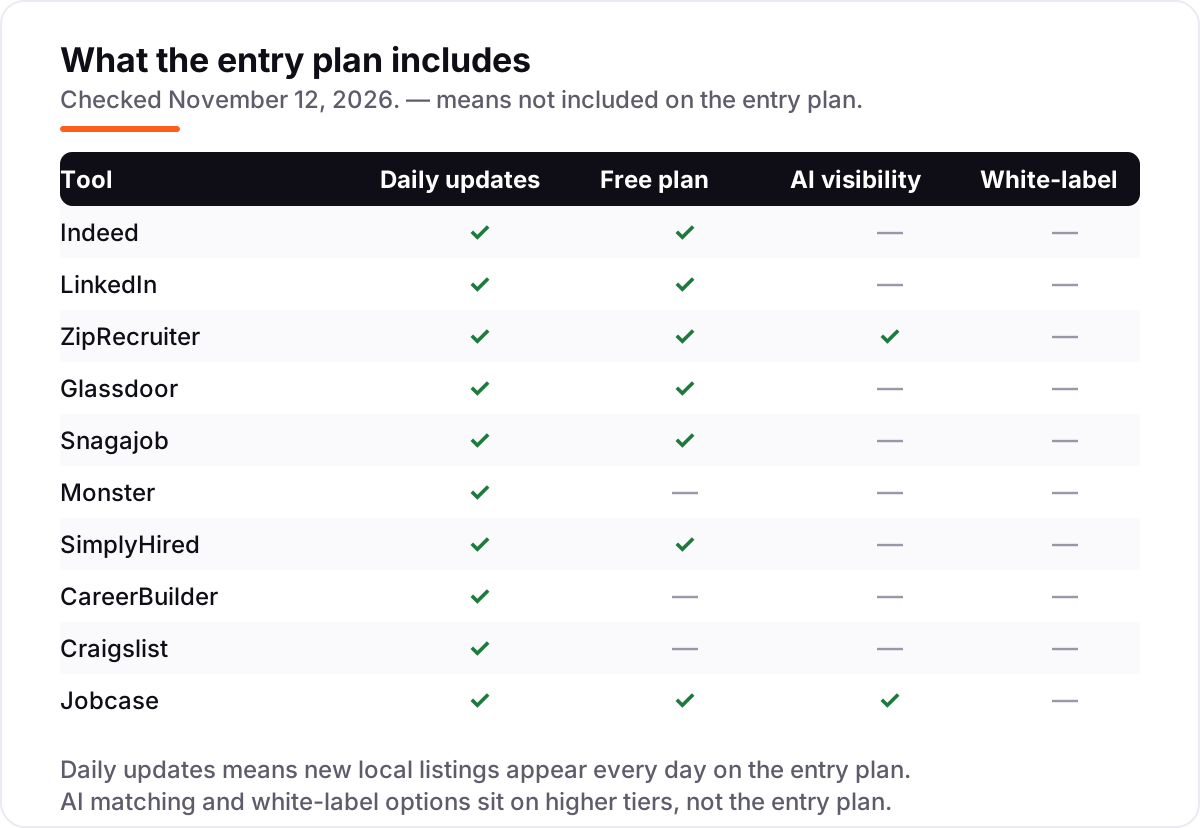
Whatever you shortlist, try it with real searches before you pay. Post one role on the free tier, run one week of searches as a job seeker, and check two things: that new listings in your radius appear daily, and that applications actually arrive. Every platform here offers a free tier or a trial, so there is no reason to buy a subscription before the platform has proven it reaches your town.
Job search platform pricing: what you will actually pay
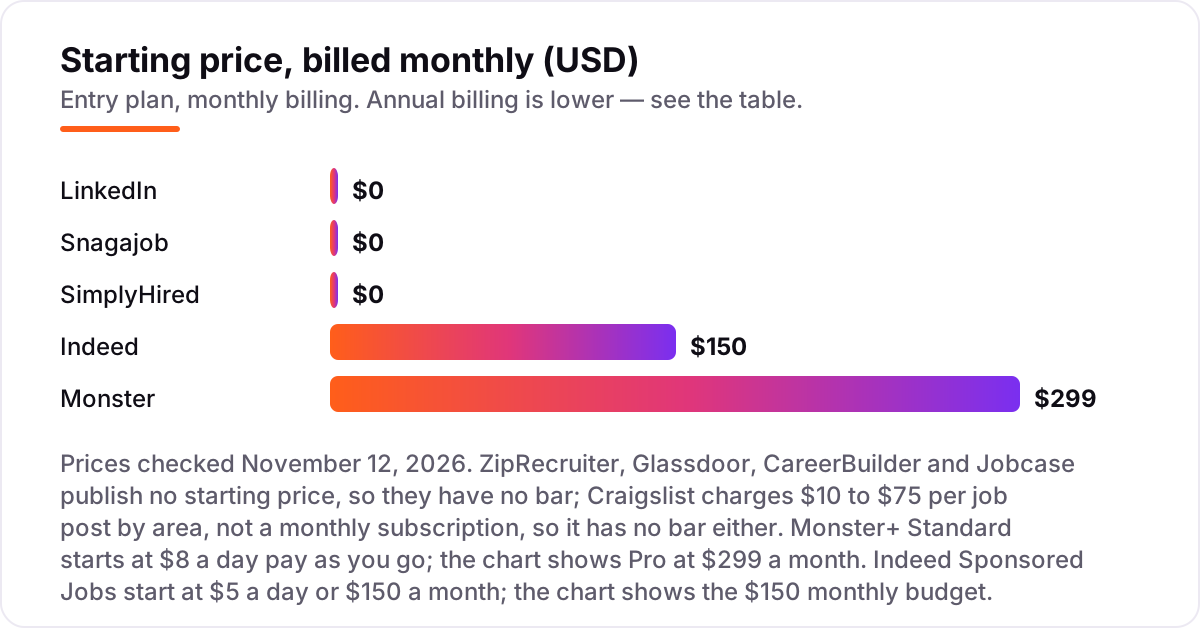
Take a small employer filling three local roles in one month. On list prices, the posting spend is $0 on SimplyHired, Snagajob free listings and Jobcase's free tier, $0 on LinkedIn's single free post, and $0 on Indeed's three free posts — five of the ten platforms cost nothing to start. Sponsoring one Indeed role for the month costs $150 on the monthly budget, or about $150 at the $5-a-day minimum; promoting one LinkedIn role at $10 a day costs about $300; and promoting one Monster+ Standard role at $8 a day costs about $240 for 30 days.
Add the paid options and the picture changes. Monster+ Pro is $299 a month with 299 credits, ZipRecruiter's Standard is employer-reported at roughly $299 to $399 a month per job slot, and three Craigslist posts in a mid-size city at $35 each cost $105. Over a year, one sponsored Indeed role at $150 a month costs $1,800, Monster+ Pro costs $3,588, and a single ZipRecruiter slot at $299 a month costs $3,588 — before any resume search, screening or agency fee.
The benchmark to judge those numbers against is the cost of a bad hire, not the cost of a post. SHRM's benchmarking data puts the average cost per hire at nearly $4,700, which is more than a year of one sponsored Indeed role. Spend the money where applications arrive: start free on three platforms, track cost per application for two weeks, and put the budget behind the one that fills the role.
Know the difference: job boards, aggregators and classifieds
The confusion in this category is what kind of platform you are using, not which brand is biggest. A job board like Indeed, Monster or Snagajob hosts its own listings and takes applications itself. An aggregator like SimplyHired or ZipRecruiter's distribution pulls listings from many boards into one search, so the same role appears in several places at once. A classified like Craigslist sells a local ad and nothing else — no screening, no tracking, no resume database.
The type decides what you get for the money. A board charges for visibility and applications; an aggregator charges for reach; a classified charges a flat fee per ad and leaves the rest to you. That is why the same three roles cost $0 on SimplyHired, $150 on Indeed and $105 on Craigslist: three different products, not three prices for the same thing.
There is a second confusion worth clearing up: Glassdoor is no longer a separate job board to buy. Since it merged into Indeed, Inc. on July 1, 2026, its job ads run through Indeed Sponsored Jobs, and what Glassdoor still sells on its own is employer branding — profile control, review responses and analytics, quoted per account. Search Glassdoor for free, read the reviews, and buy the listing on Indeed.
Quick comparison: tool type by need
| Buyer | Best pick | Why |
|---|---|---|
| Job seeker who wants the widest local pool | Indeed | Most listings in most towns, free to search, 3 free posts for employers |
| Professional hiring or job hunting | Free post, network signal, promoted posts from about $7/day | |
| Hourly or shift work nearby | Snagajob | Free listings, pay-per-apply sponsorship, pay-per-shift filters |
| Researching pay and culture first | Glassdoor | Reviews, salaries and interview reports beside the listings |
| Employer who wants a published price | Monster | Standard from $8/day, Pro $299/month, CareerBuilder included |
| One-off hire on a $0 budget | SimplyHired | Free posting with syndication to 100-plus boards |
Mistakes to avoid
- Budgeting on the subscription alone. A $150 sponsored post is cheap; a $4,700 average cost per hire is the real number to beat, so track cost per application, not cost per post.
- Comparing monthly prices across different models. A free post, a pay-per-click auction, a $299 subscription and a $35 classified ad are four different products — price the hire, not the headline.
- Ignoring the free-post caps. Indeed stops at 3 free posts a month and LinkedIn at 1 at a time, and free posts fade fast in busy markets. Plan sponsorship for the roles that matter.
- Buying Glassdoor as a standalone job board. Its job ads run through Indeed since the July 2026 merger — pay Indeed once instead of shopping for a Glassdoor rate that no longer exists.
- Trusting directory prices. ZipRecruiter's $299 to $399, Snagajob's $89 and CareerBuilder's $219 to $599 are all third-party or stale figures, not vendor prices — get a written quote before budgeting.
How we chose
We checked each vendor's own pricing page on November 12, 2026 and recorded the starting price exactly as shown, or as a custom quote where the vendor publishes no price. Two notes on method: browser page reads failed on November 12, so prices were verified through fresh search-index crawls of the vendors' own pricing pages (crawled November 10–12, 2026) plus independent reads dated October–November 2026. Four prices are third-party-sourced, not vendor-verified, and are labeled as such: ZipRecruiter's Standard at roughly $299 to $399 a month per job slot, Snagajob's $89 a month directory figure (which Snagajob's own pages do not confirm), CareerBuilder's old $219 to $599 plan prices, and LinkedIn promoted posts from about $7 a day. Ratings come from G2 pages crawled within the last 3 days: ZipRecruiter 4.8 from 1,445 reviews, LinkedIn 4.5 from 1,270, Indeed 4.3 from 694, Monster 4.1 from 219, Glassdoor 4.0 from 147 and CareerBuilder 4.1 from 88. Snagajob, SimplyHired, Craigslist and Jobcase show no rating because no G2 or Capterra page with a score was available. No vendor paid for a place in this list, and none of the links here are affiliate links.
What to do next
Start with the free tier of your top pick and run one real week of searches or one real posting through it. As a job seeker, set the radius, pay floor and alerts, and check whether new local roles appear daily. As an employer, post one role free, track how many applications arrive and what each one costs, and only then sponsor the roles that stay open. If the business is sorted but new customers are not finding it, our monthly SEO service handles the visibility side — or compare providers in our guide to SEO companies for small business. Once your tools are in place, find out what's holding your rankings back.
Frequently asked questions
What is the best local job search platform?
Indeed is the best fit for most local searches, with the widest pool of listings and 3 free posts a month for employers. LinkedIn is best for professional roles at $0 to start, Snagajob for hourly and shift work, and Glassdoor for researching pay and culture before applying.
How much does it cost to post a job locally?
It ranges from $0 to about $299 a month. Indeed gives 3 free posts a month, then Sponsored Jobs from $5 a day or $150 a month. LinkedIn gives 1 free post, Monster+ Standard starts at $8 a day, and Craigslist charges $10 to $75 per post by city.
Is there a free local job search platform?
Yes, several. Job seekers search free on all 10 platforms here. Employers post free on Indeed (3 a month), LinkedIn (1 at a time), Snagajob, SimplyHired and Jobcase's free tier, while Craigslist charges $10 to $75 per US job post.
What is the difference between Indeed and Glassdoor now?
They are one purchase since Glassdoor merged into Indeed, Inc. on July 1, 2026. Job ads run through Indeed Sponsored Jobs from $5 a day or $150 a month and can appear on Glassdoor. Glassdoor still sells employer branding separately, quoted per account.
Do I need to pay to find a local job?
No. Searching and applying are free on every platform in this list, including Indeed, LinkedIn, ZipRecruiter, Glassdoor and Jobcase. Paywalls sit on the employer side — sponsored visibility, resume search and branding — not on the job seeker side at all.
Which platform is best for hourly and shift work near me?
Snagajob is built for hourly and shift work, with free listings and pay-per-apply sponsorship. Jobcase is the free community pick for frontline workers. Indeed also works well for hourly roles, and Craigslist is still effective for trades and immediate-start jobs.
Can I switch job search platforms later?
Yes, and most job seekers use two or three at once. Set the same radius, pay floor and alerts on each, compare which one surfaces new local roles first, and keep the one that delivers. Employers should track cost per application per platform before renewing anything.
Sources we checked (16)
- Indeed employer pricing — indeed.com/hire/pricing (checked November 12, 2026)
- LinkedIn free vs promoted jobs help — linkedin.com/help (checked November 12, 2026)
- ZipRecruiter pricing — ziprecruiter.com/pricing (checked November 12, 2026)
- Glassdoor for employers — glassdoor.com/employers (checked November 12, 2026)
- Snagajob employers — snagajob.com/employers (checked November 12, 2026)
- Monster+ pricing — hiring.monster.com/pricing (checked November 12, 2026)
- SimplyHired employers — simplyhired.com/employers (checked November 12, 2026)
- CareerBuilder employers — employer.careerbuilder.com (checked November 12, 2026)
- Craigslist posting fees — craigslist.org/about/help/posting_fees (checked November 12, 2026)
- Jobcase — jobcase.com (checked November 12, 2026)
- Indeed on G2 — 4.3/5, 694 reviews (checked November 12, 2026)
- LinkedIn Job Search on G2 — 4.5/5, 1,270 reviews (checked November 12, 2026)
- ZipRecruiter on G2 — 4.8/5, 1,445 reviews (checked November 12, 2026)
- Glassdoor on G2 — 4.0/5, 147 reviews (checked November 12, 2026)
- Monster on G2 — 4.1/5, 219 reviews (checked November 12, 2026)
- CareerBuilder Job Board on G2 — 4.1/5, 88 reviews (checked November 12, 2026)
Make one of these tools?
We re-check this list every quarter. Send a correction, request a review, or ask about a clearly labeled sponsored spot.
Request a listingShamim
Founder of SerpAstra
A full-stack SEO and digital marketer who spends most days on Local SEO for dental practices, AI search visibility and lead generation.
Free SEO and AI visibility audit
Find out what is holding your rankings back
Send us your site. Within 2 business days you get a written audit, an AI visibility check and a short fix list ranked by impact. Free, with no contract attached.
Request my free audit→Related buying guides
 Business Software8 Best Local Job Listings Apps in 2026: Free and Paid Apps RankedCompare the 8 best local job listings app picks for 2026: free apps, real prices and local filters, with every price checked November 4, 2026.Read guide →
 HR & Payroll9 Best Free Recruitment Software for Small Business in 2026, ComparedCompare the 9 best free recruitment software for small business on free-plan limits, paid upgrades and ratings, with every price checked November 6, 2026.Read guide →
 HR & Payroll12 Best Recruiting Software for Small Business in 2026, ComparedCompare the 12 best recruiting software for small business options on price, free plans, job-board reach and AI features, with prices checked November 6, 2026.Read guide →