
Best Media Buying Software for 2026: 7 Options Compared by Use Case
Compare the 7 best media buying software options for 2026 — DSPs, performance TV and out-of-home — with real prices, free plans and G2 ratings.
 Shamim Mia, Founder, SerpAstraLast verified November 5, 202612 min read
We compare pricing pages, documentation and public reviews. We never accept payment for rankings.

Key takeaways
- StackAdapt is the best fit for most buyers — a self-serve DSP with no minimum spend and a custom quote; The Trade Desk follows for enterprise spend, and Choozle is the only DSP here with a flat published price at $99 a month.
- AdRoll is the only free start: its self-serve Ads plan costs $0 and you pay only for media, while MNTN's budget calculator starts at $5,000 a month.
- The single most important buying factor is the minimum that gates your first campaign: media-spend floors, quarterly commitments and sales-led onboarding decide what you actually pay, not the headline price.
- Five of the seven tools publish no price at all, so budget on the media spend plus the platform fee — on a DSP that fee is often embedded in the CPM and never appears as a line item.
On this page
Quick comparison
| Tool | Best for | Starting price | Free plan |
|---|---|---|---|
| StackAdapt | Agencies and mid-market teams running connected TV inside a multi-channel programmatic plan | Custom quote | No |
| The Trade Desk | Enterprise teams and agencies spending six figures a month across the open internet | Custom quote | No |
| Basis Technologies | Agencies that plan, buy and bill connected TV, search and social for many clients in one system | Custom quote | No |
| MNTN | DTC brands spending $5,000 or more a month who want TV measured like a performance channel | Custom quote | No |
| Choozle | Small agencies and in-house teams that want a self-serve DSP with a flat, published monthly fee | $99/mo | No |
| AdRoll | Ecommerce brands that want retargeting running quickly, starting free and paying only for media | Free | Yes (free) |
| AdQuick | Brands buying billboards, transit and other out-of-home media alongside their digital campaigns | Custom quote | No |
Make one of these tools?
We re-check this list every quarter. Send a correction, request a review, or ask about a clearly labeled sponsored spot.
Request a listingThe best media buying software

StackAdapt
Best for: Agencies and mid-market teams running connected TV inside a multi-channel programmatic plan
StackAdapt is the easiest DSP in this list to start on, because it is the only one that states plainly on its own plans page that there is no minimum spend. You sign up, fund an account and buy across seven channels — connected TV, display, native, video, audio, digital out-of-home and in-game — from one login, with a Creative Studio and forecasting tools built in rather than bolted on.
The catch is the fee structure: the platform fee is embedded in the CPM, so you never see a separate line for it, and self-serve access needs an application first. Choose StackAdapt when you want one DSP for several channels and a team that answers the phone; choose The Trade Desk when the spend is large enough to justify a negotiated enterprise contract.
What we like
- No minimum spend required to get started, per the vendor's own plans page — the only DSP here that says so plainly
- Seven channels in one platform: connected TV, display, native, video, audio, digital out-of-home and in-game
- Highest reviewer count here at 923 G2 reviews, with reviewers praising the responsive support team and the intuitive campaign setup
- Built-in Creative Studio and forecasting tools, with self-serve, managed or hybrid support on every tier
Watch out for
- Self-serve access is subject to an application and approval process, so signup is not instant
- The platform fee is embedded in the CPM rather than charged separately, which hides the true cost of inventory
- Practitioner guides put the practical floor at $50 to $100 a day per line item — below that, the optimization has too little data

The Trade Desk
Best for: Enterprise teams and agencies spending six figures a month across the open internet
The Trade Desk is the enterprise end of this list: an independent demand-side platform that buys display, video, audio, native and connected TV across the open internet, with no owned media to steer your spend toward. Its Kokai platform adds Koa AI optimization, and the UID2 identity framework keeps your audiences addressable as third-party cookies disappear.
Everything about it is negotiated. There is no published price, no self-serve signup and no trial — access runs through a sales conversation, and third-party reports put entry near $100,000 a quarter with a platform fee of 15–20% of media on top. Buy it when the budget is six figures a month and the team has real trading expertise; buy StackAdapt when it is not.
What we like
- Independent DSP — owns no media, so it never steers spend toward its own inventory
- Buys display, video, audio, native and connected TV across the open internet in one platform
- Kokai platform with Koa AI optimization; the company says it weighs 15 million ad opportunities a second
- UID2 identity framework keeps audiences addressable as cookies disappear, and OpenPath buys premium inventory direct
Watch out for
- No published price and no self-serve signup — access runs through a sales conversation
- Third-party reports put entry near $100,000 a quarter, with a platform fee of 15–20% of media spend on top
- G2 reviewers cite a steep learning curve and slow report generation, plus a fee for nearly every feature

Basis Technologies
Best for: Agencies that plan, buy and bill connected TV, search and social for many clients in one system
Basis Technologies is the agency system in this list rather than a pure DSP: programmatic, search, social and site-direct buying sit in one interface, and the billing automation reconciles delivery numbers and creates client invoices — the workflow other DSPs leave to spreadsheets. Compass AI allocates spend across channels and audiences, and Market Trends benchmarks your campaigns against 250,000-plus line items.
The trade-off is price and complexity. Pricing is entirely quote-based, a platform license plus media fees, which makes Basis costlier than a pure DSP, and reviewers note a learning curve and an interface that can feel dated. Choose Basis when the agency runs many clients and billing is the bottleneck; choose StackAdapt when buying alone is the job.
What we like
- The only DSP here united with search, social and site-direct buying in a single interface
- Billing automation reconciles delivery numbers and creates invoices, which is the agency workflow other DSPs leave out
- Compass AI allocates spend across channels and audiences, and Market Trends benchmarks against 250,000+ line items
- G2 reviewers praise the flexibility for smaller-budget clients and the responsive support team
Watch out for
- Pricing is entirely quote-based, with a platform license plus media fees that make it costlier than pure DSPs
- G2 reviewers cite a learning curve and an interface that can feel dated in places
- One G2 reviewer says the connected-TV toolset still needs work, with too few pre-set deals available

MNTN
Best for: DTC brands spending $5,000 or more a month who want TV measured like a performance channel
MNTN is the performance-TV specialist: it buys connected TV the way a search campaign is bought, with direct deals across 150-plus premium streaming networks and measurement built for conversions rather than reach. Verified Visits matches site visits to exposed households, and the self-serve builder can take a campaign live in under an hour.
There is no published price — every quote runs through a sales conversation — but the homepage budget calculator starts at $5,000 a month, and reported minimums have moved over time, from $25,000 a month to $500 a campaign. Confirm the current floor before you budget. Pick MNTN when TV must prove revenue; pick StackAdapt when TV is one channel among several.
What we like
- Direct deals with 150+ premium streaming networks, bought and measured like digital media
- Verified Visits matches site visits to exposed households, with an incrementality dashboard for eligible campaigns
- Creative-as-a-Subscription bundles professional video production into the media spend through QuickFrame
- Mountain Match AI targeting and a self-serve campaign builder that can go live in under an hour
Watch out for
- No published price — every quote runs through a sales conversation
- Reported minimums have changed over time, from $25,000 a month to $500 a campaign, so confirm the current floor before budgeting
- Third-party comparisons note the platform fee is bundled into media rather than broken out transparently

Choozle
Best for: Small agencies and in-house teams that want a self-serve DSP with a flat, published monthly fee
Choozle is the budget DSP in this list, and the only one with a flat published price: a single recurring subscription of $99 a month, confirmed on the vendor's own billing help page. It covers the platform, unlimited advertiser accounts, analytics and dashboard reporting, and access to more than 60 premium third-party data providers, with no annual contract and cancellation in-platform.
The $99 fee is only part of the commitment. Choozle asks for a healthy budget of $15,000 in media spend per quarter, and the first account balance fill-up is $500, so a small test budget still means real money. Choose Choozle when the team is small, the spend is steady and a flat fee beats a quote; choose StackAdapt when there is no quarterly spend to commit.
What we like
- The only DSP here with a flat published price: $99 a month, confirmed on the vendor's own billing help page
- Self-serve platform with unlimited advertiser accounts and access to 60+ premium third-party data providers
- Access to 98% of premium inventory across digital channels, per the vendor's own platform page
- No annual contract — the subscription renews month to month and can be cancelled in-platform
Watch out for
- Choozle asks for $15,000 in media spend per quarter, so the $99 fee is only part of the commitment
- No free plan and no free trial — a credit card is required to activate the subscription
- G2 reviewers note that fees for extra features can add up, and the platform has less depth than enterprise DSPs

AdRoll
Best for: Ecommerce brands that want retargeting running quickly, starting free and paying only for media
AdRoll is the free start in this list: the self-serve Ads plan costs $0, and you pay only for the media you buy. One pixel runs retargeting across display, native, video and connected TV, with reporting and audience segmentation included, so an ecommerce brand can have its first retargeting campaign live the same day it signs up.
The free plan has edges. Connected social ads and unlimited email wait for Marketing & Ads Plus, which AdRoll's own blog puts from $36 a month, while app-market listings show $40 — confirm the figure before budgeting. And while G2 reviewers praise the ease of use, Trustpilot reviews run far lower. Pick AdRoll when retargeting is the job and the budget starts at zero.
What we like
- The only free entry here: the self-serve Ads plan costs $0, and you pay only for the media you buy
- One pixel runs retargeting across display, native, video and connected TV without babysitting campaigns
- Marketing & Ads Plus adds connected social ads, unlimited email and free monthly ad credits from $36 a month
- Highest reviewer volume here after StackAdapt, at 787 G2 reviews, with ease of use the most-cited strength
Watch out for
- The free Ads plan covers display, native, video and connected TV, but connected social ads and email need Marketing & Ads Plus
- AdRoll's own blog puts Marketing & Ads Plus from $36 a month, while app-market listings show $40 — confirm the current figure before budgeting
- G2 reviewers praise ease of use, but Trustpilot reviews run far lower at 1.6/5, mostly about billing and support

AdQuick
Best for: Brands buying billboards, transit and other out-of-home media alongside their digital campaigns
AdQuick is the only out-of-home specialist in this list: it plans, buys and measures billboards, transit, murals and other outdoor media in one platform, with predictive performance and zip-code lookalike tools and more than 1,000 behavioral and demographic audience indexes. There is no minimum spend on the platform itself — you pay per placement, not a monthly subscription.
Every campaign is priced per placement through a sales conversation, and those minimums vary widely, so one billboard can cost more than a month of digital media. There is also no G2 listing for AdQuick, so we show no reviewer score for it. Pick AdQuick when outdoor is part of the media plan; pick a DSP when the whole budget stays on screens.
What we like
- The only out-of-home specialist here: plan, buy and measure billboards, transit, murals and more in one platform
- Predictive performance and zip-code lookalike tools, plus 1,000+ behavioral and demographic audience indexes
- No minimum spend on the platform itself — you pay per placement, not a monthly subscription
- Measurement tools tie outdoor exposure back to web visits and store traffic
Watch out for
- No published price — every campaign is priced per placement through a sales conversation
- No G2 listing was found for AdQuick, so there is no independent reviewer score to show here
- Out-of-home minimums vary by placement, so a single billboard can cost more than a month of digital media
The best media buying software puts your budget where the audience actually is — across display, video, connected TV and out-of-home — and tells you what each dollar did. We ranked the seven tools below by fit for the most common buyer, a mid-market team or agency buying programmatic media for the first time, and every price was checked on the vendor's own page or review listing on November 5, 2026.
How to choose the best media buying software
- Start with the minimum, not the feature list. StackAdapt states no minimum spend; Choozle asks for $15,000 in media per quarter; MNTN's calculator starts at $5,000 a month. The floor you can afford decides the shortlist before any feature does.
- Ask where the platform fee lives. On most DSPs it is embedded in the CPM, so the media looks dearer and no line item explains why. Only Choozle publishes a flat fee; everywhere else, ask the sales team to break it out.
- Match the channels to the plan. If the whole budget is connected TV, MNTN is the specialist; if it spans seven channels, StackAdapt or Basis fits; if billboards are in the mix, only AdQuick covers them.
- Check who does the trading. Self-serve suits teams with a media buyer; managed service suits teams without one. StackAdapt, Basis and MNTN all offer both, while The Trade Desk assumes your team already knows how to trade.
- Tag everything before you spend. Whatever you shortlist, build your campaign links with the free UTM builder tool first, so every click is attributed to the right channel, campaign and creative from day one.
Media buying is one system in your stack, not the whole stack. If the ads send traffic to pages that do not rank, our guide to display advertising software covers the creative side, and the AI search optimization service covers the visibility side. Before you commit to a DSP, run one real campaign on a small budget — $1,000 to $2,000 of media — and check three things: that the reporting matches your analytics, that the support team answers, and that the CPMs hold up against the walled gardens you already buy on.
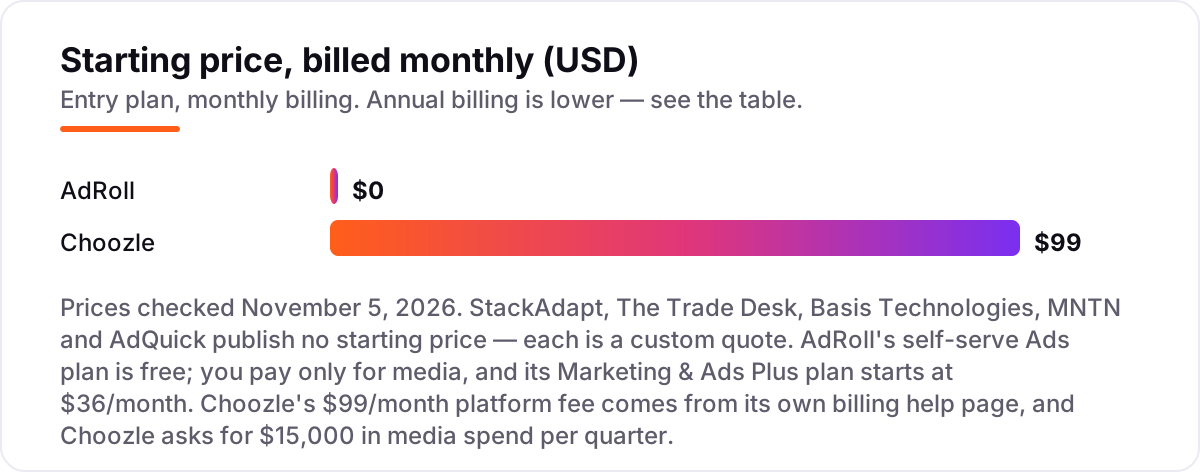
Media buying software pricing: what you will actually pay
Take a team with a $10,000-a-month media budget. On AdRoll's free Ads plan, the platform costs $0, so the full $10,000 goes to media. On Choozle, the platform fee is $99 a month, so $10,000 of media costs $10,099 all in — though Choozle expects $15,000 in media per quarter, so a $10,000 monthly budget clears that bar comfortably. On StackAdapt there is no minimum spend and no separate platform fee, so the $10,000 is media too, with the fee embedded in the CPMs you pay.
The quote-based tools are where the math gets murky. MNTN's budget calculator starts at $5,000 a month, so a $10,000 budget fits, but the platform fee is bundled into media rather than broken out. The Trade Desk and Basis are negotiated contracts: third-party reports put The Trade Desk's platform fee at 15–20% of media spend, which would add $1,500–$2,000 a month to a $10,000 budget, and Basis adds a platform license on top of media fees. AdQuick is priced per placement, so a single billboard can cost more than the whole $10,000 digital budget.
Over a year, the $10,000-a-month team pays $120,000 in media on AdRoll or StackAdapt, $121,188 on Choozle, and $138,000–$144,000 on The Trade Desk once the reported platform fee is counted. The gap between the cheapest and dearest route is roughly $18,000–$24,000 a year on the same media — which is why the fee structure matters more than the headline price. If you want the full picture on the channels themselves, our guide to connected TV advertising platforms breaks down the streaming side.
One more cost to check before you commit: creative. MNTN bundles professional video production into the media spend through QuickFrame, StackAdapt includes a Creative Studio, and the other DSPs expect you to bring finished ads. If your team has no creative resource, a tool with production included can be cheaper than the cheapest platform fee.
Contract length is the last number to check before you sign. Choozle renews month to month and can be cancelled in-platform, which is the most flexible term in this list; StackAdapt runs without a long-term contract, per its own pricing page; and The Trade Desk, Basis and MNTN are all negotiated agreements where the term, the minimum and the fee are set in the contract. A twelve-month commitment at $5,000 a month is a $60,000 promise, so ask for the exit terms — early-termination fees, minimum-spend true-ups and notice periods — in writing before the first dollar of media runs.
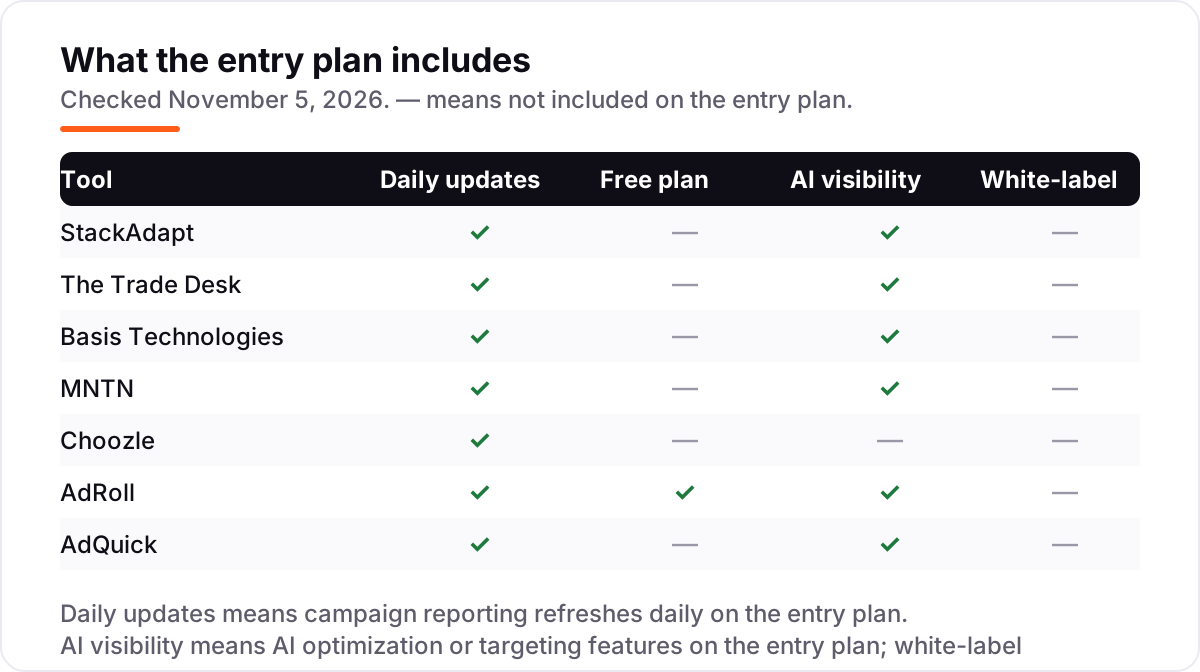
Know the difference: a DSP vs the ad platforms you already use
The confusion in this category is between a demand-side platform and the ad managers you already know. Google Ads and Meta Ads Manager sell you their own inventory: Google sells Google, Meta sells Meta. A DSP buys inventory across thousands of publishers — display, video, audio and connected TV — from one login, bidding in real time. That is the whole point of media buying software: one buyer, the open web, instead of a separate login per publisher.
There is a second, quieter confusion: a DSP is not an ad server. An ad server stores and delivers the creative and counts the impressions; a DSP decides which impression to buy and at what price. Most teams need both, and several tools here bundle the serving in. If a vendor calls itself a DSP but only sells its own inventory, it is a walled garden with a different label — the independence of The Trade Desk, which owns no media at all, is the test case for what a DSP should be.
A third distinction is self-serve versus managed. Self-serve means your team runs the campaigns; managed means the vendor's traders run them for a fee. StackAdapt, Basis and MNTN all offer both, and the right choice depends on whether you have a media buyer in-house. A managed contract on a tool you could run yourself is the most common way to overpay in this category.
Quick comparison: tool type by need
| Buyer | Best pick | Why |
|---|---|---|
| Most mid-market buyers | StackAdapt | Self-serve DSP, seven channels, no minimum spend, custom quote |
| Enterprise teams | The Trade Desk | Independent DSP with the deepest inventory, custom quote |
| Agencies with many clients | Basis Technologies | Buying plus billing automation in one system, custom quote |
| TV that must prove revenue | MNTN | Performance TV with visit-level attribution, custom quote |
| Small team, flat fee | Choozle | Self-serve DSP at $99 a month, no annual contract |
| Ecommerce retargeting, free start | AdRoll | Free Ads plan, pay only for media, Plus from $36 a month |
| Out-of-home in the mix | AdQuick | Billboards and transit bought like digital, custom quote |
Mistakes to avoid
- Budgeting on the platform fee and forgetting the media. A $99-a-month DSP is not a $99-a-month buy: Choozle expects $15,000 in media per quarter, and MNTN's calculator starts at $5,000 a month. The media is the budget; the platform fee is the rounding.
- Signing a managed contract when you could run it yourself. Managed service on a DSP you could self-serve is the most common overpay in this category. Start self-serve, and buy managed help only when the team has no trader.
- Comparing CPMs across tools without asking what is inside them. A DSP that embeds its fee in the CPM looks dearer on media and cheaper on fees than one that breaks it out. Ask every vendor to show the fee separately before you compare.
- Buying TV on impressions alone. Connected TV bought on reach is a brand buy; bought on Verified Visits or site actions, it is a performance buy. Decide which one you are buying before you pick the tool.
- Forgetting the creative. A DSP without a creative resource is a fast way to burn media budget on unfinished ads. MNTN bundles production in; StackAdapt includes a Creative Studio; the rest expect you to bring finished creative.
How we chose
We checked each vendor's own pricing page on November 5, 2026 and recorded the starting price exactly as shown — or as a custom quote where the vendor publishes none. Choozle's $99 a month comes from its own billing help page, and AdRoll's $36-a-month Plus figure comes from AdRoll's own blog, since its pricing page lists package names without dollar amounts. AdQuick carries no review rating because no G2 listing was found for it, and we would rather show no rating than a stale or estimated one. The Trade Desk's 15–20% platform fee is a third-party-reported figure, not a vendor price. No vendor paid for a place in this list, and none of the links here are affiliate links.
What to do next
Start with the tool that matches your minimum: AdRoll if the budget starts at zero, Choozle if a flat $99 a month fits, StackAdapt if you want several channels with no minimum spend. Run one small campaign — $1,000 to $2,000 of media — and check that the reporting matches your analytics before you commit to a year. If the ads are sorted but new customers are not finding you, our monthly SEO service handles the visibility side — or compare the channels in our guide to digital advertising platforms. Once your tools are in place, find out what's holding your rankings back.
Your stack only works if people find you
SerpAstra fixes what keeps your site off page one and makes it easy for AI assistants to recommend.
Get a free audit→Sources we checked (11)
- StackAdapt plans and packages — stackadapt.com/plans-and-packages (checked November 5, 2026)
- StackAdapt G2 reviews — g2.com/products/stackadapt/reviews (checked November 5, 2026)
- The Trade Desk G2 reviews — g2.com/products/the-trade-desk/reviews (checked November 5, 2026)
- Basis Technologies G2 reviews — g2.com/products/basis/reviews (checked November 5, 2026)
- MNTN Performance TV G2 reviews — g2.com/products/mntn-performance-tv/reviews (checked November 5, 2026)
- Choozle billing help — help.choozle.com/managing-your-billing-settings (checked November 5, 2026)
- Choozle G2 reviews — g2.com/products/choozle/reviews (checked November 5, 2026)
- AdRoll pricing — adroll.com/pricing (checked November 5, 2026)
- AdRoll vs Google Ads — adroll.com/blog/adroll-vs-google-ads (checked November 5, 2026)
- AdRoll G2 reviews — g2.com/products/adroll/reviews (checked November 5, 2026)
- AdQuick platform — adquick.com (checked November 5, 2026)
Shamim
Founder of SerpAstra
A full-stack SEO and digital marketer who spends most days on Local SEO for dental practices, AI search visibility and lead generation.
Frequently asked questions
What is the best media buying software?
StackAdapt is the best fit for most buyers: a self-serve DSP with no minimum spend, seven channels and the strongest G2 support scores here. The Trade Desk is the better pick for enterprise teams spending six figures a month, and AdRoll is the best free start for ecommerce retargeting.
How much does media buying software cost?
It ranges from free to a negotiated quote. AdRoll's self-serve plan costs $0 and Choozle charges a flat $99 a month, but five of the seven tools here publish no price at all. Expect the platform fee to run 10–20% of media spend on enterprise DSPs, often embedded in the CPM rather than billed separately.
What is a DSP, and do I need one?
A demand-side platform buys ad inventory across many publishers from one login, bidding in real time. You need one when you buy display, video or connected TV across the open web at real volume. If you only buy on Google and Meta, their own ad managers already do the job.
Is there really free media buying software?
Only one tool here is free to start: AdRoll's self-serve Ads plan costs $0, and you pay only for the media you buy. Every other tool charges a platform fee, a subscription or a negotiated quote — and on all of them, the media spend itself is always extra.
The Trade Desk vs StackAdapt: which should I choose?
Choose StackAdapt when you want self-serve access, no minimum spend and hands-on support at mid-market budgets. Choose The Trade Desk when the spend is six figures a month, the team has trading expertise, and you need the deepest inventory and identity tools — and can accept a negotiated contract and a learning curve.
Can media buying software buy billboards?
Most DSPs cannot — they buy digital inventory only. AdQuick is the exception in this list: it plans, buys and measures billboards, transit and murals, with predictive performance tools and audience indexes. StackAdapt also covers digital out-of-home screens, but not physical billboards.
Free SEO and AI visibility audit
Find out what is holding your rankings back
Send us your site. Within 2 business days you get a written audit, an AI visibility check and a short fix list ranked by impact. Free, with no contract attached.
Request my free audit→Related guides
 Digital Marketing & Ads10 Best Display Advertising Software in 2026, ComparedThe 10 best display advertising software tools compared on price, reach and ease of use, from Google Ads to The Trade Desk. Checked November 4, 2026.Read guide →
 Digital Marketing & Ads10 Best Digital Advertising Platforms in 2026, ComparedCompare the 10 best digital advertising platforms on price, minimum budgets, targeting and AI tools — every figure checked November 4, 2026.Read guide →
 Digital Marketing & Ads12 Best CTV Advertising Platforms for 2026 (Pros, Cons and Pricing)Compare the 12 best CTV advertising platforms on price, minimum budgets, targeting and measurement — every figure checked live on November 4, 2026.Read guide →