
9 Best Microsegmentation Tools in 2026 (Free and Paid, Compared)
Compare the 9 best microsegmentation tools for 2026 — Illumio, Guardicore, Cisco and more — on enforcement model, free trials and quote-based pricing.
 Shamim Mia, Founder, SerpAstraLast verified November 10, 202613 min read
We compare pricing pages, documentation and public reviews. We never accept payment for rankings.

Key takeaways
- Illumio is the best fit for most enterprises: host-based segmentation across data centres, clouds and endpoints, priced per protected workload by quote. Akamai Guardicore follows for process-level depth, and Cisco Secure Workload for Cisco-centric estates.
- The single most important buying factor is the enforcement model: host-agent, hypervisor, identity-based or cloud-delivered enforcement decides what you can segment without rebuilding the network.
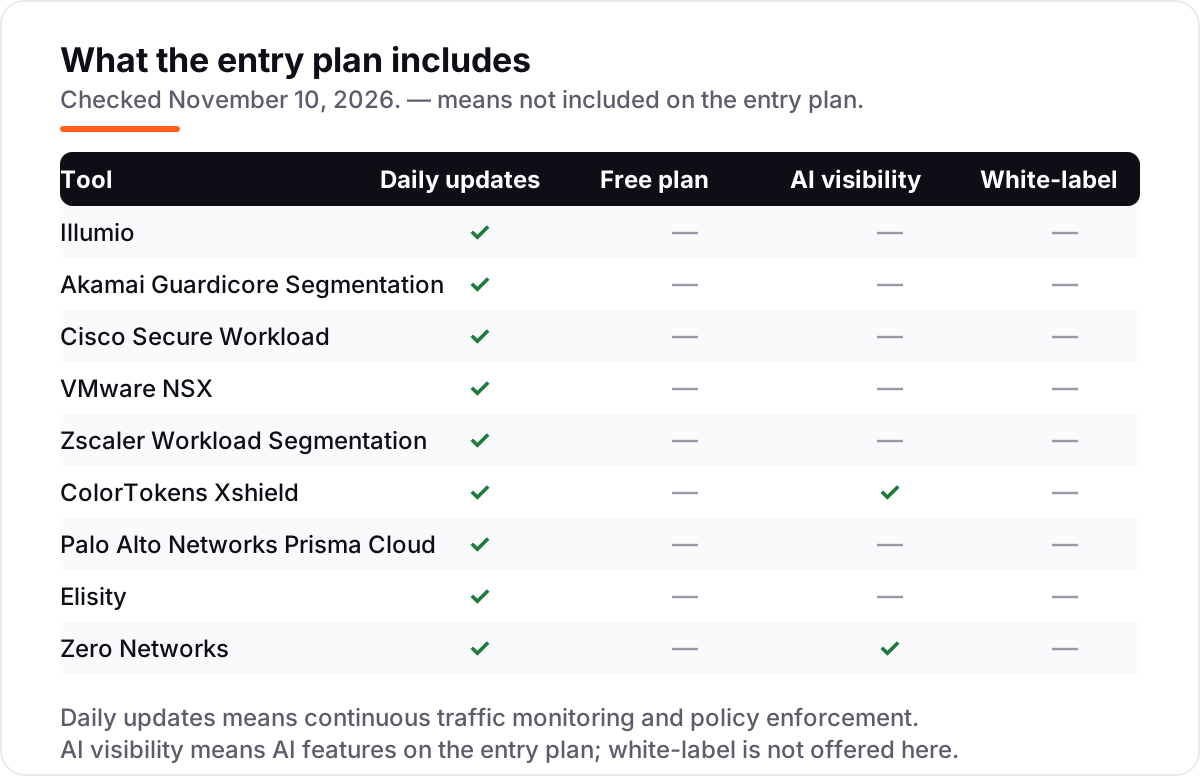
- No vendor here publishes a price — all nine price by quote under annual contracts, usually per protected workload, so run a proof of concept on real traffic before comparing costs.
- Every price below was checked on the vendor's own pricing or product page on November 10, 2026, using fresh search-index crawls where the vendor page could not be opened directly; ratings are G2 only, and six tools carry no rating because no fresh G2 page could be verified.
On this page
Quick comparison
| Tool | Best for | Starting price | Free plan |
|---|---|---|---|
| Illumio | Enterprise security teams segmenting hybrid data centres, clouds and endpoints who want host-based enforcement without rebuilding the network | Custom quote | No (free trial) |
| Akamai Guardicore Segmentation | Security teams in hybrid data centres who want process-level visibility and built-in deception alongside segmentation | Custom quote | No |
| Cisco Secure Workload | Cisco-centric enterprises that want workload telemetry and segmentation policy from the vendor already running their network | Custom quote | No |
| VMware NSX | VMware estates that want segmentation enforced in the hypervisor, close to each virtual machine | Custom quote | No |
| Zscaler Workload Segmentation | Organisations already running the Zero Trust Exchange that want segmentation extended from users to workloads | Custom quote | No |
| ColorTokens Xshield | Regulated enterprises that need segmentation across IT, OT and IoT, with compliance evidence built in | Custom quote | No |
| Palo Alto Networks Prisma Cloud | Cloud-native teams already on Palo Alto Networks that want segmentation inside a wider cloud security platform | Custom quote | No (30-day trial) |
| Elisity | Healthcare and manufacturing teams that need identity-based segmentation across IT and OT without installing agents | Custom quote | No |
| Zero Networks | Mid-size enterprises that want automated segmentation live in weeks rather than a year-long firewall project | Custom quote | No (PoC only) |
Make one of these tools?
We re-check this list every quarter. Send a correction, request a review, or ask about a clearly labeled sponsored spot.
Request a listingThe best microsegmentation tools

Illumio
Best for: Enterprise security teams segmenting hybrid data centres, clouds and endpoints who want host-based enforcement without rebuilding the network
Illumio is the reference point for host-based microsegmentation. It maps traffic between workloads, builds policy from the flows it observes, and enforces controls through the host's own firewall, so segmentation does not depend on VLANs or firewall-rule rewrites. That model works the same in a data centre, a public cloud and on endpoints, which is why large enterprises with mixed estates keep choosing it.
The buying reality is the quote. Illumio prices per protected workload under annual contracts and publishes no list price, so the only public numbers are marketplace listings — $109,000 a year for 250 workloads on AWS Marketplace, as reported in September 2026. Gartner Peer Insights named it a Customers' Choice for 2026, with 98% of 59 reviewers saying they would recommend it. Start here unless you already live inside Cisco, VMware or Zscaler.
What we like
- Host-based enforcement uses the operating system's own firewall, so policy follows workloads across data centres, clouds and endpoints
- Application dependency maps are built from observed traffic, so policies start from what workloads actually do, not from guesses
- Named a Customers' Choice in Gartner Peer Insights' 2026 Voice of the Customer for microsegmentation, with 98% of reviewers saying they would recommend it
Watch out for
- No published price — every deal is a quote per protected workload, and costs climb steeply at small scale
- G2 reviewers note logs cannot be streamed directly to a SIEM, which limits some monitoring workflows

Akamai Guardicore Segmentation
Best for: Security teams in hybrid data centres who want process-level visibility and built-in deception alongside segmentation
Guardicore, now part of Akamai, segments data centres and cloud workloads with agent-based enforcement and a clear map of east-west traffic. Its difference is depth: process-to-packet mapping shows which process opened each connection, and built-in deception adds a detection layer most rivals sell separately. Label-based policies group workloads by attributes, so one rule can cover a whole application tier.
The trade-off is the kernel-level agent that makes that depth possible. Reviewers flag rare host crashes from a faulty driver as the platform's biggest operational risk, and frequent major releases disrupt operations. Pricing is per workload by quote, with no published figure. Choose Guardicore when process-level detail and deception matter more than the lightest possible agent.
What we like
- Process-to-packet mapping shows exactly which process opened each connection, the deepest per-flow context in this list
- Built-in deception adds a detection layer most rivals sell as a separate product
- Label-based policies group workloads by attributes, so one rule can cover a whole application tier
Watch out for
- The kernel-level agent that enables the deep visibility is also the main operational risk — reviewers flag rare host crashes from a faulty driver
- Frequent major version releases disrupt operations, per G2 reviewers

Cisco Secure Workload
Best for: Cisco-centric enterprises that want workload telemetry and segmentation policy from the vendor already running their network
Cisco Secure Workload, formerly Tetration, combines workload telemetry with segmentation policy for data centres and clouds. It collects every flow — nothing is sampled — then recommends policies from the behaviour it observes, and enforces them through agents or Cisco firewall integration. For teams already running Cisco networking, that native fit cuts deployment friction.
Two things to check before signing. Cisco has announced HyperShield, an AI-based autonomous micro-segmentation product, and while existing Tetration licences will be honoured for the move, buyers should confirm Secure Workload's roadmap on a multi-year deal. Pricing is per workload equivalent by quote, with no published figure and no free trial. It is the natural pick for Cisco-centric enterprises, and a harder sell anywhere else.
What we like
- Complete, unsampled telemetry: every flow is collected, so the application dependency map misses nothing
- Automatic policy recommendations turn observed behaviour into enforcement rules without hand-writing firewall changes
- Compliance mapping and auditing show which conversations fall outside approved policy
Watch out for
- Cisco's new HyperShield is the AI-based successor, so buyers should confirm Secure Workload's roadmap before signing a multi-year deal
- Policy enforcement cannot adjust dynamically as application needs change, and the dashboard takes time to learn

VMware NSX
Best for: VMware estates that want segmentation enforced in the hypervisor, close to each virtual machine
VMware NSX puts segmentation in the hypervisor: its distributed firewall enforces policy at the kernel, close to each virtual machine, with no agent on the guest. Switching, routing, load balancing and firewalling share one console, and policy stays consistent across the data centre and VMware's multi-cloud environments.
The catch is Broadcom's licensing. The distributed firewall is now a licensed add-on rather than part of the core NSX licence, and per-core pricing makes NSX one of the priciest entries in this list — G2 reviewers call the cost prohibitive for smaller teams. There is no published price and no free trial. Buy NSX when the estate is already VMware; buying VMware just for segmentation rarely pays.
What we like
- The distributed firewall enforces policy at the hypervisor kernel, so segmentation works without agents on every guest
- One console covers switching, routing, load balancing and firewalling for the whole virtual estate
- Consistent policy across data centre and multi-cloud VMware environments from a single control plane
Watch out for
- The distributed firewall is now a licensed add-on under Broadcom's model, not part of the core NSX licence, per G2 reviewers
- Broadcom's per-core licensing makes it one of the priciest ways into this list, and smaller teams find the architecture complex

Zscaler Workload Segmentation
Best for: Organisations already running the Zero Trust Exchange that want segmentation extended from users to workloads
Zscaler Workload Segmentation extends the Zero Trust Exchange from users to workloads, controlling east-west traffic between servers and cloud instances with identity-based policy. Enforcement runs through Zscaler's cloud rather than an appliance in each site, and the same policy model covers user access and workload traffic.
That integration is also the limitation: the product only makes sense as part of a Zscaler commitment, and bought alone it is the wrong shape for a first segmentation project. Zscaler publishes no price for it — the pricing page lists modules without figures — and G2 has no reviews for the workload product yet. Choose it when the Zero Trust Exchange is already the platform, not when shopping for a standalone tool.
What we like
- Extends the same zero-trust policy model from user-to-application access to workload-to-workload traffic
- Cloud-delivered enforcement, so there is no segmentation appliance to deploy or patch in each site
- Identity-based controls follow workloads as they move between data centres and clouds
Watch out for
- Only makes sense inside a Zscaler commitment — bought alone it is the wrong shape for a first segmentation project
- No G2 reviews exist yet for the workload product, so peer evidence is thin compared with the rest of this list

ColorTokens Xshield
Best for: Regulated enterprises that need segmentation across IT, OT and IoT, with compliance evidence built in
ColorTokens positions its Xtended ZeroTrust Platform as a single system for visibility, microsegmentation, zero trust network access and endpoint protection. Xshield covers data centre servers, cloud workloads, containers, endpoints and OT/IoT devices, including agentless coverage for legacy systems that cannot run an agent.
Its most distinctive feature is Xshield AI, which lets teams interrogate the environment in plain English instead of writing queries, and Breach Response Levels that apply pre-built containment policies in one step. Pricing is per protected asset by quote, with no published figure, and the G2 base is thin at five reviews. It suits regulated enterprises that need IT, OT and IoT segmented together.
What we like
- One platform covers data centre servers, cloud workloads, containers, endpoints and OT/IoT devices, including agentless coverage for legacy systems
- Xshield AI answers plain-English questions about the environment, so teams can interrogate traffic without writing queries
- Breach Response Levels let incident teams apply pre-built zero-trust policies to compromised assets in one step
Watch out for
- Only five G2 reviews exist, so peer evidence is thin, and the G2 page has not been freshly crawled
- Sold as an enterprise platform, so smaller teams will find the sales-led process and the price heavy

Palo Alto Networks Prisma Cloud
Best for: Cloud-native teams already on Palo Alto Networks that want segmentation inside a wider cloud security platform
Prisma Cloud brings microsegmentation through identity-based controls inside Palo Alto's cloud security platform, covering hosts, containers and serverless functions across the application lifecycle. For teams already running Palo Alto firewalls or Cortex tooling, segmentation shares a console with posture, workload protection and runtime data instead of becoming another silo.
Palo Alto is rebranding Prisma Cloud as Cortex Cloud, so buyers currently face two product names and a migration during the contract — ask what the move means for existing policies. Licensing is credit-based with no published price, and a 30-day trial is available on request. It is the right pick for cloud-native Palo Alto customers, and the wrong first segmentation tool for anyone else.
What we like
- Identity-based microsegmentation sits inside a full cloud security platform, so posture, workload and runtime data share one console
- Covers hosts, containers and serverless functions across the application lifecycle in one product
- A 30-day free trial is available, the only trial among the platform-scale tools here besides Illumio
Watch out for
- Palo Alto is rebranding Prisma Cloud as Cortex Cloud, so buyers face two product names and a migration during the contract
- Credit-based licensing is the hardest in this list to estimate without a sales engagement, and Palo Alto publishes no price

Elisity
Best for: Healthcare and manufacturing teams that need identity-based segmentation across IT and OT without installing agents
Elisity does identity-based microsegmentation without agents: it enforces least-privilege policy through the switches an organisation already owns, so there is no agent to deploy, no hardware to buy and no network rebuild. Simulation mode lets teams test policies with zero downtime before enforcing them, which suits production OT environments.
The buyer should weigh two things. IonQ agreed in October 2026 to acquire Elisity in a deal valued at up to $1.3 billion, expected to close in the fourth quarter of 2026, so ask how the roadmap and support change after the deal. And the peer base is small — 26 Gartner Peer Insights ratings — so reference checks matter. It fits healthcare and manufacturing teams segmenting IT and OT together.
What we like
- Agentless enforcement through the switches you already own — no agents, hardware or network rebuild
- Identity-based policy follows users, devices and workloads instead of IP addresses that change
- Simulation mode lets teams test policies with zero downtime before enforcing them
Watch out for
- IonQ agreed in October 2026 to acquire Elisity, so buyers should ask how the roadmap and support change after the deal closes
- A small vendor with a small peer-review base — 26 Gartner Peer Insights ratings — so reference checks matter more than usual

Zero Networks
Best for: Mid-size enterprises that want automated segmentation live in weeks rather than a year-long firewall project
Zero Networks automates segmentation: it closes internal pathways by default and opens them only when needed, with identity-based controls that follow users, devices, AI agents and applications. The vendor says customers segment more than 90% of their network within 90 days, and it earned a 5 out of 5 in Gartner Peer Insights' 2026 Voice of the Customer report, based on 25 verified reviews.
It is the youngest vendor here, founded in 2019, and the product is still maturing — some features vary by operating system, per Gartner reviewers. There is no G2 listing and no published price; evaluation runs through a sales-led proof of concept. Choose Zero Networks when deployment speed matters most and a year-long firewall project is not an option.
What we like
- Automated policy creation closes internal pathways by default and opens them only when needed, with no manual rule-writing
- Customers report segmenting more than 90% of their network within 90 days, the fastest time-to-value claim in this list
- Earned a 5 out of 5 in Gartner Peer Insights' 2026 Voice of the Customer for microsegmentation, based on 25 verified reviews
Watch out for
- A young vendor founded in 2019, so the product is still maturing and some features vary by operating system
- No G2 listing and no published price — evaluation runs through a sales-led proof of concept
The best microsegmentation tools in 2026 do one job: stop an attacker who gets into one workload from moving sideways to the rest of the estate. We ranked the nine tools below by fit for the most common buyer — an enterprise security team segmenting a hybrid mix of data centre, cloud and endpoint workloads — starting with the most proven host-based platforms and ending with the fastest automated options, and every price was checked on the vendor's own pricing or product page on November 10, 2026.
How to choose the best microsegmentation tools
- Pick the enforcement model first. Host agents (Illumio, Guardicore), hypervisor enforcement (VMware NSX), identity-based controls (Elisity, Zero Networks) and cloud delivery (Zscaler) each segment different things — the model decides what you can protect without rebuilding the network.
- Count the workloads you will actually protect. Every vendor prices per protected workload, device or identity, so a quote for 100 workloads and a quote for 5,000 are different products in practice. Count servers, cloud instances, containers and endpoints separately before asking for prices.
- Check what runs without an agent. Legacy systems, OT devices and some appliances cannot run an agent at all. If your estate has them, the agentless options (Elisity, ColorTokens, NSX for virtual machines) matter more than any feature list.
- Ask how policy is built. Tools that generate policy from observed traffic (Illumio, Cisco, Zero Networks) deploy faster than tools that need hand-written rules, and simulation mode (Elisity) lets you test before enforcing.
- Weigh the platform you already own. Segmentation bought inside Cisco, VMware, Zscaler or Palo Alto costs less to run than a standalone tool, because the console, the agents and the support contract already exist.
Segmentation is one layer of the security stack, not the whole stack. Our guide to network security software for small business covers the wider perimeter and endpoint side. And before you publish new pages about the services you sell, run your titles through the free SERP snippet preview tool — it shows exactly how the title and description will look in Google.
Whatever you shortlist, evaluate it on your real traffic before you pay. Only two tools here offer a self-serve trial — Illumio and Prisma Cloud — and the rest evaluate through a demo or a proof of concept. Run the proof of concept on a real application tier, not a lab, and check two things: that the traffic map matches what you know about the application, and that the policy it recommends would not break a real workflow. A vendor that will not run a proof of concept on your traffic is telling you something.
Microsegmentation pricing: what you will actually pay
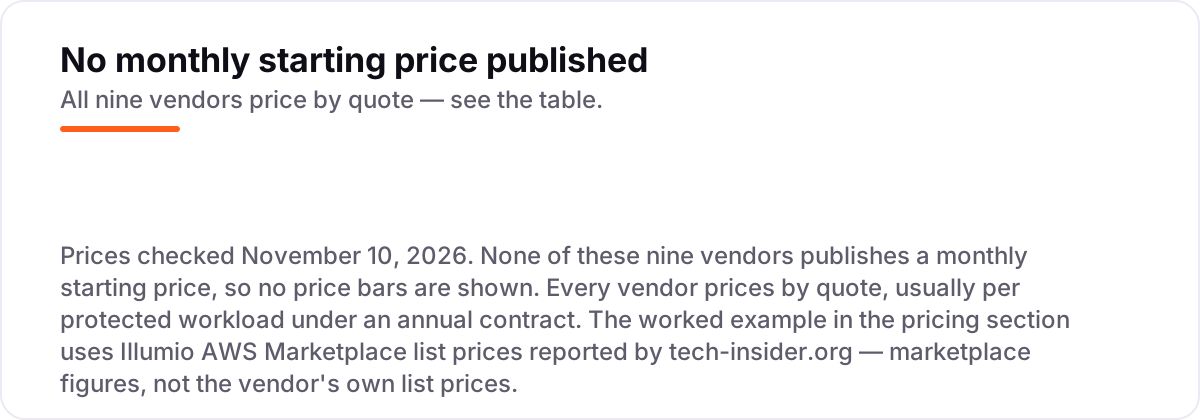
None of the nine vendors publishes a price, so the honest answer to "what will it cost" is a quote tied to your workload count — and the worked example below uses the only public numbers available, which are marketplace list prices, not vendor list prices. AWS Marketplace lists Illumio's Breach Containment Platform at $109,000 a year for 250 secured workloads, and Illumio CloudSecure at $38,400 a year for 100 workloads, as reported from the marketplace listings in September 2026. At those list prices, a 250-workload estate costs $109,000 a year and a 100-workload estate costs $38,400 a year — and both figures are list prices before enterprise discounting, which is steep in this category.
The per-workload cost falls fast as the count rises: buyer-reported Illumio pricing runs roughly $30 to $80 per workload a year below 1,000 workloads, dropping to roughly $10 to $12 at 50,000-workload scale. That is why two buyers can pay wildly different amounts for the same product, and why comparing vendors on a single per-workload figure is misleading. Get each quote at your real workload count, on the same count, and confirm what is included — cloud and endpoint coverage, for example, are not always in the base price.
Three costs sit outside every quote above. First, the licence is only part of the spend: policy tuning, deployment services and training make up most of the three-year total cost, so ask what services are bundled and what is billed separately. Second, the contract length matters — multi-year enterprise agreements commonly discount list prices by a quarter or more, which is why a one-year quote looks expensive next to a three-year one. Third, the platform you already own changes the maths: segmentation bought as an extension of Cisco, VMware, Zscaler or Palo Alto reuses consoles, agents and support contracts you already pay for, while a standalone tool adds a new one. If you run a regulated business, the compliance evidence matters too — see our guide to security compliance tools for SaaS companies.
Know the difference: microsegmentation vs network segmentation
The confusion in this category is between segmenting the network and segmenting the workload. Network segmentation divides the network into zones — usually with VLANs and firewall rules — and it stops at the zone boundary: everything inside a zone can still talk to everything else in that zone. Microsegmentation enforces policy at the workload or identity level, so the rules follow a server, container or device wherever it moves, even inside the same zone.
That difference is what stops lateral movement. When ransomware lands on one server in a flat network, it scans the zone and spreads to neighbours that share no business reason to communicate. With microsegmentation, the compromised workload can only reach the handful of services its policy allows, so the blast radius is one workload, not one zone. The two approaches complement each other rather than compete: zones set the coarse boundaries, and microsegmentation controls the traffic inside them.
There is a second, quieter confusion: microsegmentation is not zero trust network access. ZTNA controls user-to-application access — who can reach which application — while microsegmentation controls workload-to-workload traffic, which is the east-west traffic that never touches a user. Most enterprises need both, and several tools in this list (Zscaler, ColorTokens, Prisma Cloud) sell them together. If a vendor pitches user access as segmentation, ask specifically how it controls server-to-server traffic.
Quick comparison: tool type by need
| Buyer | Best pick | Why |
|---|---|---|
| Most enterprises, hybrid estate | Illumio | Host-based enforcement across data centre, cloud and endpoints, by quote |
| Deepest per-flow detail | Akamai Guardicore Segmentation | Process-level visibility plus built-in deception, by quote |
| Cisco-centric enterprise | Cisco Secure Workload | Complete telemetry and automatic policy, by quote |
| VMware estate | VMware NSX | Hypervisor-native distributed firewall, by quote |
| Zero Trust Exchange customer | Zscaler Workload Segmentation | Segmentation as part of the platform, by quote |
| Fastest deployment, mid-size team | Zero Networks or Elisity | Automated or agentless segmentation, by quote |
Mistakes to avoid
- Comparing quotes at different workload counts. A quote for 100 workloads and a quote for 5,000 are not comparable — per-workload pricing falls steeply with volume, so get every vendor to price the same count.
- Buying on the marketplace list price. The AWS Marketplace figures in this guide are list prices before discounting; nobody pays them after a real procurement conversation, so treat them as a ceiling, not a budget.
- Ignoring what cannot run an agent. Legacy systems and OT devices cannot run an agent, so a host-agent tool leaves them unsegmented unless the plan covers agentless enforcement for them.
- Enforcing policy on day one. Every tool here can run in monitor mode first — watch the traffic, check the recommended policy against real workflows, and enforce only when the map is right. Enforcing blind breaks applications.
- Forgetting the roadmap question. Cisco is moving toward HyperShield, Palo Alto is rebranding Prisma Cloud as Cortex Cloud, and IonQ is acquiring Elisity — ask each vendor what happens to your policies and licences after the change before signing a multi-year deal.
How we chose
We checked each vendor's own pricing or product page on November 10, 2026 and recorded the starting price exactly as shown — in every case that is a custom quote, because none of the nine publishes a price — and we ranked the tools by fit for the most common buyer, an enterprise security team segmenting a hybrid estate, not by brand size. Two prices in this list are not on the vendor's own page: the Illumio marketplace figures in the pricing section come from AWS Marketplace listings as reported by tech-insider.org in September 2026, and they are marketplace list prices, not the vendor's own list prices. Ratings come from G2 only, and only three tools carry one: Illumio (4.5/5, 64 reviews), Cisco Secure Workload (4.7/5, 5 reviews) and VMware NSX (4.4/5, 93 reviews), each verified from a fresh search-index copy of the G2 page. The other six carry no rating because no fresh G2 page could be verified — Guardicore's G2 page was last crawled 357 days ago with conflicting scores, Zscaler's workload product has no G2 reviews, ColorTokens' G2 page was last crawled 24 days ago, and Prisma Cloud, Elisity and Zero Networks have no G2 listing. The Gartner Peer Insights scores mentioned in the Illumio, Elisity and Zero Networks cards come from the vendors' own announcements and Gartner's published reports, not from G2. No vendor paid for a place in this list, and none of the links here are affiliate links.
What to do next
Start with the enforcement model, not the vendor: decide whether your estate needs host agents, hypervisor enforcement, identity-based controls or cloud delivery, then shortlist the two or three tools that match. Run a proof of concept on one real application tier and check that the traffic map matches reality before you enforce anything. If you want a second opinion on the detection side, our guide to managed detection and response software covers what happens after segmentation fails. If the tools are sorted but new customers are not finding you, our monthly SEO service handles the visibility side. Once your tools are in place, find out what's holding your rankings back.
Your stack only works if people find you
SerpAstra fixes what keeps your site off page one and makes it easy for AI assistants to recommend.
Get a free audit→Sources we checked (16)
- Illumio pricing — illumio.com/pricing (checked November 10, 2026; no published price)
- Illumio on G2 — 4.5/5, 64 reviews (checked November 10, 2026)
- Illumio 2026 Gartner Peer Insights Customers' Choice — 4.8/5, 59 reviews, 98% would recommend (checked November 10, 2026)
- Akamai Guardicore Segmentation — akamai.com (checked November 10, 2026; no published price)
- Cisco Secure Workload — cisco.com (checked November 10, 2026; no published price)
- Cisco Secure Workload on G2 — 4.7/5, 5 reviews (checked November 10, 2026)
- VMware NSX — vmware.com (checked November 10, 2026; no published price)
- VMware NSX on G2 — 4.4/5, 93 reviews (checked November 10, 2026)
- Zscaler pricing — zscaler.com/pricing (checked November 10, 2026; no published price)
- ColorTokens pricing — colortokens.com/pricing (checked November 10, 2026; no published price)
- Prisma Cloud trial — start.paloaltonetworks.com (checked November 10, 2026; 30-day trial)
- Elisity — elisity.com (checked November 10, 2026; no published price)
- Zero Networks — zeronetworks.com (checked November 10, 2026; no published price)
- Illumio AWS Marketplace list prices, reported September 2026 — tech-insider.org
- Zero Networks 5/5 in Gartner Peer Insights 2026 Voice of the Customer, 25 reviews (checked November 10, 2026)
- IonQ to acquire Elisity, October 2026 — salesaf.com (checked November 10, 2026)
Shamim
Founder of SerpAstra
A full-stack SEO and digital marketer who spends most days on Local SEO for dental practices, AI search visibility and lead generation.
Frequently asked questions
What is the best microsegmentation tool in 2026?
Illumio is the best fit for most enterprises: host-based enforcement, traffic maps built from observed flows, and the strongest peer recognition in this list. Akamai Guardicore is the better pick when process-level detail and deception matter, and Cisco Secure Workload is the natural choice for teams already running Cisco networking.
How much does microsegmentation cost?
No vendor in this list publishes a price — every quote is per protected workload under an annual contract, and mid-size estates should budget six figures a year. The only public numbers are marketplace listings: Illumio's Breach Containment Platform lists at $109,000 a year for 250 workloads on AWS Marketplace, as reported in September 2026. Volume discounts are steep, so get quotes at your real workload count.
Is there a free microsegmentation tool?
None of the nine tools in this list has a free plan. Illumio offers a free trial and Palo Alto offers a 30-day Prisma Cloud trial on request; the rest sell through demos or a proof of concept. Open-source options such as Calico exist for Kubernetes, but they cover container networking rather than the full data-centre and endpoint segmentation these tools provide.
What is the difference between microsegmentation and network segmentation?
Network segmentation divides the network into zones, usually with VLANs and firewall rules, and it stops at the zone boundary. Microsegmentation enforces policy at the workload or identity level, so the rules follow a server, container or device wherever it moves. The two complement each other: zones set the coarse boundaries, and microsegmentation controls the traffic inside them.
Illumio vs Guardicore: which should I choose?
Choose Illumio when you want the simplest host-based model at scale, with policy built from observed traffic and enforcement through the host firewall. Choose Guardicore when you need process-level detail — knowing exactly which process opened each connection — plus built-in deception. Guardicore's kernel-level agent gives deeper visibility but carries more operational risk than Illumio's lighter approach.
Do I need an agent on every workload?
It depends on the enforcement model. Illumio, Guardicore and Cisco Secure Workload use agents on protected hosts; VMware NSX enforces in the hypervisor instead, so guests need no agent; Elisity enforces through your existing switches with no agents at all; Zscaler routes traffic through its cloud. Agentless options suit estates with legacy systems that cannot run an agent.
Free SEO and AI visibility audit
Find out what is holding your rankings back
Send us your site. Within 2 business days you get a written audit, an AI visibility check and a short fix list ranked by impact. Free, with no contract attached.
Request my free audit→Related guides
 IT, Security & DevOps9 Best Network Security Software for Small Business in 2026, ComparedCompare the 9 best network security software for small business options on price, free plans and firewalls, with every price checked November 7, 2026.Read guide →
 IT, Security & DevOps9 Best MDR Software for Small Business Security in 2026, ComparedCompare the 9 best mdr software for small business security options on price, 24/7 SOC cover and free trials, with every price checked November 7, 2026.Read guide →
 IT, Security & DevOps9 Best Security Compliance Tools for SAAS Companies in 2026, ComparedCompare the 9 best security compliance tools for saas companies on price, frameworks and evidence automation, with every price checked November 7, 2026.Read guide →