
7 Best Open Source Email Marketing Software in 2026, Compared
Compare the 7 best open source email marketing software tools on price, free plans and self-hosting, with every price checked November 5, 2026.
 Shamim Mia, Founder, SerpAstraLast verified November 5, 202613 min read
We compare pricing pages, documentation and public reviews. We never accept payment for rankings.

Key takeaways
- Mautic and listmonk cost $0 for the software itself — the most complete free automation suite and the lightest high-volume newsletter tool — while the cheapest hosted plan is phpList Hosted at $12 a year.
- Ghost(Pro) Starter is $180 a year for up to 1,000 members, MailPoet Business is $120 a year at 500 subscribers, and FluentCRM Pro is a flat $129 a year with unlimited contacts.
- Self-hosted is not free overall: you still pay for a server and a sending service, and deliverability, updates and backups are your job — budget for those before you pick a tool.
On this page
Quick comparison
| Tool | Best for | Starting price | Free plan |
|---|---|---|---|
| Mautic | Teams that want a full marketing automation suite — campaigns, segments, lead scoring and landing pages — for $0 | $0/yr | Yes (free download) |
| listmonk | Publishers who send high-volume newsletters and want the lightest, fastest self-hosted option | $0/yr | Yes (free) |
| Ghost | Creators and publishers who want a blog, newsletter and paid memberships in one open source product | $180/yr | Yes (self-hosted) |
| MailPoet | WordPress site owners who want newsletters and WooCommerce emails inside the dashboard | $120/yr | Yes (Starter) |
| FluentCRM | WordPress and WooCommerce sites that want CRM, automation and email in one flat annual fee | $129/yr | Yes (core plugin) |
| Keila | Privacy-focused newsletters in the EU that want unlimited contacts with no per-subscriber fees | €96/yr | Yes (self-hosted) |
| phpList | Small senders who want the cheapest possible hosted plan or a veteran free tool on plain PHP hosting | $12/yr | Yes (free) |
Make one of these tools?
We re-check this list every quarter. Send a correction, request a review, or ask about a clearly labeled sponsored spot.
Request a listingThe best open source email marketing software

Mautic
Best for: Teams that want a full marketing automation suite — campaigns, segments, lead scoring and landing pages — for $0
Mautic is the only tool here that tries to match the big SaaS suites feature for feature: campaigns, drip sequences, lead scoring, landing pages, forms and A/B testing all ship in the free download, with no contact caps and no feature gates. It is open source under the GPL, and the community shipped version 7.2 in September 2026, with security fixes still landing in October.
The catch is the running of it. You install Mautic on your own server, keep it updated and connect a sending service, and deliverability is your responsibility. Managed hosting exists but starts at €247.50 a month, so the free route is strictly do-it-yourself. Pick Mautic when you want serious automation without a SaaS bill and you have someone technical to run it.
What we like
- The most complete free tool here: campaigns, drip sequences, lead scoring, landing pages and forms in one install
- No contact caps, no feature gates and no per-email fee — the bill is your server and your sending provider
- A large community and a marketplace of plugins, plus a full REST API for custom integrations
- Actively maintained: Mautic 7.2 shipped in September 2026, with security fixes still landing in October
Watch out for
- Self-hosting is real work: updates, backups and deliverability are yours to manage
- The interface feels dated next to modern SaaS tools, and setup takes longer than a hosted signup
- Managed hosting starts at €247.50 a month, so the cheap route is strictly do-it-yourself

listmonk
Best for: Publishers who send high-volume newsletters and want the lightest, fastest self-hosted option
listmonk is the lightest tool in this list: a single Go binary backed by PostgreSQL, with lists, campaigns, SQL segmentation, transactional email, bounce handling and analytics. It is free under the AGPLv3 with no paid tier, no subscriber caps and no per-send fees, and it is built for volume — the project is used to send millions of emails per campaign on modest hardware.
The trade-off is scope. There is no visual automation builder, so drip sequences need the API or an external tool, and you must bring your own SMTP relay or a service such as Amazon SES before anything sends. Pick listmonk when the job is sending a lot of newsletters cheaply and you do not need a full marketing suite.
What we like
- A single Go binary with PostgreSQL as its only dependency — installs in minutes and runs on modest hardware
- Built for volume: it handles millions of subscribers and is used to send millions of emails per campaign
- No subscriber caps, no per-send fees and no paid tier — every feature ships in the free download
- Clean analytics, bounce processing and a public campaign archive included at no cost
Watch out for
- No visual automation builder — drip sequences need the API or an external tool
- You bring your own sending: an SMTP relay or a service such as Amazon SES is required
- Single-tenant by design, so agencies that run many clients need one install per client

Ghost
Best for: Creators and publishers who want a blog, newsletter and paid memberships in one open source product
Ghost is a publishing platform first and an email tool second: you write posts, send them as newsletters and run paid memberships from the same product. The software is free under the MIT license, and the hosted version, Ghost(Pro), starts at $15 a month billed annually for up to 1,000 members, with unlimited email sends and 0% taken from subscription revenue.
The limit to watch is monetization: Starter cannot sell paid subscriptions, so a paid newsletter needs Publisher at $29 a month billed annually, and the price rises with member count past 1,000. There is no automation builder or lead scoring either. Pick Ghost when the newsletter is the product and the blog is the home for it.
What we like
- Publishing and email in one product: posts, newsletters and memberships without a second tool
- Unlimited email sends on every Ghost(Pro) plan, and Ghost takes 0% of subscription revenue
- Modern editor and fast, clean themes — the nicest writing experience in this list
- Self-hosted is free under the MIT license, with the code fully open
Watch out for
- Starter cannot sell paid subscriptions — monetizing needs Publisher at $29 a month billed annually
- Ghost(Pro) prices rise with member count past 1,000, so a big list costs more than the headline $15
- No built-in automation sequences or CRM-style lead scoring — it is a publisher, not a marketing suite

MailPoet
Best for: WordPress site owners who want newsletters and WooCommerce emails inside the dashboard
MailPoet is a WordPress plugin that keeps email inside the dashboard: newsletters, signup forms, post notifications and WooCommerce emails all run from the same place. The Starter plan is free for up to 500 subscribers and 5,000 emails a month through the MailPoet sending service, and paid Business plans start at $10 a month at 500 subscribers, with unlimited sending.
The limits are the ones on the free plan: MailPoet branding on emails and the 5,000-email monthly cap, plus pricing that climbs with subscriber count on paid plans. It is also WordPress-only, so it cannot serve a site that does not run WordPress. Pick MailPoet when your site is already WordPress and you want email without a second login.
What we like
- Lives inside WordPress: build and send newsletters without leaving the dashboard
- WooCommerce integration sends abandoned-cart and purchase emails from the same plugin
- Free Starter covers 500 subscribers and 5,000 emails a month, with unlimited sending on paid plans
- Post-notification emails turn new blog posts into newsletters automatically
Watch out for
- WordPress-only — it cannot run a standalone site or a non-WordPress store
- The free plan adds MailPoet branding to emails and caps sending at 5,000 emails a month
- Paid plans are priced by subscriber count, so the bill grows with the list like any SaaS tool

FluentCRM
Best for: WordPress and WooCommerce sites that want CRM, automation and email in one flat annual fee
FluentCRM is a WordPress CRM and email marketing plugin that charges a flat annual fee instead of pricing by contact: Pro costs $129 a year for one site and covers unlimited contacts, campaigns, sequences and automations. It plugs into forms, memberships, courses and WooCommerce, so a purchase or a signup can trigger a whole email sequence without a second tool.
Two things to budget for: email marketing and automation need the paid Pro license, since the free core covers CRM basics only, and you must connect your own SMTP service before anything sends reliably. It is also WordPress-only. Pick FluentCRM when your business already runs on WordPress and you want one flat fee instead of a bill that grows with the list.
What we like
- Flat annual pricing: one $129 license covers unlimited contacts and unlimited emails
- Deep WordPress integration: forms, memberships, courses and WooCommerce triggers work natively
- Automation builder with sequences, smart links and behaviour-based triggers on the Pro plan
- Your data never leaves your server, and there are no per-contact fees as the list grows
Watch out for
- Email marketing and automation need the paid Pro license — the free core covers CRM basics only
- You must connect your own SMTP service, such as Amazon SES, before anything sends reliably
- WordPress-only, so it is no use to a business that does not run WordPress

Keila
Best for: Privacy-focused newsletters in the EU that want unlimited contacts with no per-subscriber fees
Keila is a small, privacy-focused newsletter app written in Elixir and licensed under the AGPL-3.0, with no proprietary premium features: the self-hosted app is the whole product. It covers contacts, signup forms, campaigns, segmentation and delivery, and the hosted option, Keila Cloud, starts at €8 a month for 2,000 emails, with unlimited contacts and projects on every plan.
The trade-off is size: Keila is a younger, smaller project than Mautic or Ghost, so there are fewer plugins and fewer community answers, and there is no built-in CRM or landing-page builder. Keila Cloud also has no free tier. Pick Keila when subscriber privacy matters most and you want a simple newsletter tool with no per-contact fees.
What we like
- AGPL-3.0 with no proprietary premium features — the self-hosted app is the whole product
- Unlimited contacts and projects on every plan, including the €8 Cloud tier
- EU-hosted Cloud option with GDPR-friendly data handling and double opt-in forms
- Actively developed: version 0.30.3 shipped in September 2026 with transactional email and MJML templates
Watch out for
- A smaller project than Mautic or Ghost, so fewer plugins, themes and community answers
- Keila Cloud has no free tier — the cheapest managed route is €8 a month
- No native CRM or landing-page builder; it is a newsletter tool, not a marketing suite

phpList
Best for: Small senders who want the cheapest possible hosted plan or a veteran free tool on plain PHP hosting
phpList is the veteran of this list: a free, open source newsletter manager under the AGPLv3 that runs on plain PHP and MySQL hosting, with lists, segmentation, bounce handling and analytics. Version 3.6.17 shipped in August 2026, so the project is still actively maintained, and the hosted version starts at $1 a month for 9,000 messages and up to 3,000 subscribers.
The weakness is the experience: the interface looks dated, and G2 reviewers note a steeper learning curve than modern tools, with basic automation and templates. Hosted pricing is also confusing, with the $1 plan sitting beside a pay-per-message table that starts at $8 a month. Pick phpList when you want the cheapest hosted plan or a simple free tool on hosting you already pay for.
What we like
- Free and open source, with one of the longest track records in this list
- The $1-a-month hosted plan is the cheapest managed option in this list
- Runs on plain PHP and MySQL hosting — no Docker, Node or special server setup
- Strong consent and double opt-in handling, which suits GDPR-regulated lists
Watch out for
- The interface looks dated, and G2 reviewers note a steeper learning curve than modern tools
- Automation and templates are basic next to Mautic, listmonk or Ghost
- Hosted pricing is confusing: a $1-a-month plan sits beside a pay-per-message table starting at $8 a month
The best open source email marketing software gives you the whole job — lists, campaigns, automation and analytics — without a monthly bill that grows with every subscriber. The seven tools below are all genuinely open source: you can download the code, run it on your own server and keep your subscriber data in your own database. Four of them cost nothing at all beyond hosting and sending, and the other three charge for a managed plan or a Pro license, from $1 a month to $129 a year. Every price was checked on November 5, 2026.
How to choose the best open source email marketing software
- Decide hosted or self-hosted first. Mautic, listmonk, Keila and phpList run on your server; Ghost(Pro), phpList Hosted and Keila Cloud run the server for you. Self-hosting saves money and keeps your data, but updates, backups and deliverability become your job.
- Count what the bill is based on. MailPoet charges by subscriber, Keila Cloud by emails sent, Ghost(Pro) by members, and FluentCRM by site count. The limit you hit first — subscribers, sends or members — is your real price.
- Check the sending setup. Self-hosted tools do not send mail themselves; you connect an SMTP relay or a service such as Amazon SES. Hosted plans and MailPoet include sending, which is why their prices are higher.
- Match the tool to the job. Mautic is the automation suite, listmonk the high-volume sender, Ghost the publisher, MailPoet and FluentCRM the WordPress options, Keila the privacy pick and phpList the cheapest hosted plan.
- Check the release history before you commit. A project with no release in a year is a warning sign. Mautic, phpList and Keila all shipped releases in the second half of 2026, so none of the tools here is abandoned.
Email is one system in your stack, not the whole stack. If you also need the business to be found online, our guide to email marketing software for small business compares the hosted SaaS options side by side. And when your campaigns link back to your site, build the links with the free UTM builder tool so you can see which newsletter actually brings visitors.
Support is the other thing to price. Mautic and Ghost have commercial support and paid hosting behind them; listmonk, Keila and phpList are community-supported, which means forums and GitHub issues rather than a helpdesk. If nobody on your team is comfortable reading documentation and logs, the hosted plans are worth their price.
Whatever you shortlist, try it with real data before you commit. The free downloads and free plans in this list are enough to send one genuine campaign — your list, your template, your sending setup — and that campaign tells you more than any review can. Check two things in the trial: that emails land in the inbox rather than spam, and that unsubscribes and bounces are handled automatically.
Email marketing software pricing: what you will actually pay
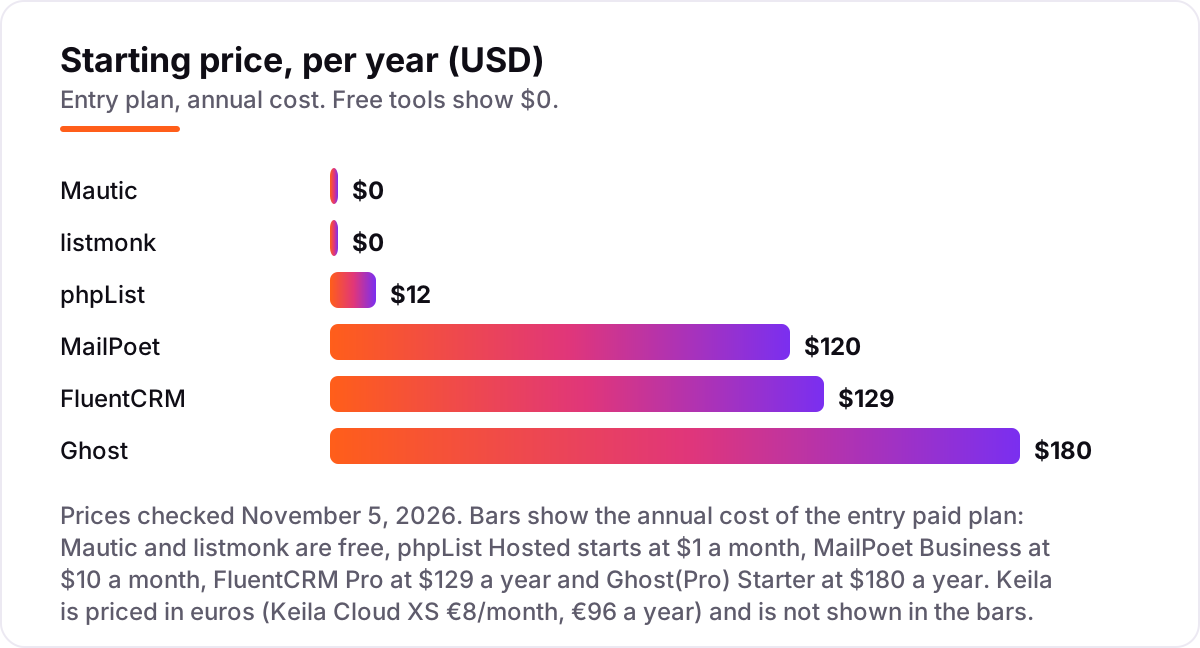
Take a small business with 500 subscribers sending four campaigns a month — 2,000 emails. On list prices, the software costs $0 a year on Mautic or listmonk, $12 on phpList Hosted, €96 on Keila Cloud XS, $120 on MailPoet Business, $129 on FluentCRM Pro and $180 on Ghost(Pro) Starter. The same 500 people and the same four campaigns cost $0 at the cheap end and $180 at the dear end — and the gap is the service, not the software: the free tools make you run the server and the sending.
Three numbers need adjusting before they are real. First, Keila Cloud XS covers exactly 2,000 emails a month, so a fifth campaign in a month moves you to the S plan at €16 a month. Second, Ghost(Pro) Starter caps at 1,000 members and MailPoet Business climbs with subscriber count, so both cost more as the list grows. Third, the $0 tools are not $0 overall: you still pay for a server and a sending service, which bill separately from the software.
The sending bill deserves its own line. Self-hosted tools need a sending provider, and the cheapest well-known options bill per thousand emails, so 2,000 emails a month costs well under a dollar in sending fees. The real cost of self-hosting is the server — a small virtual server costs about $5 a month — and the time you spend keeping it updated. Add those two numbers to the $0 software price before comparing with a hosted plan.
If you run a WordPress site rather than a standalone list, the numbers change again — see our guide to the best email marketing platforms for startups for the hosted options. And remember that every price here is the entry plan: the step-up plans are where automation, extra users and support live.
Know the difference: open source vs hosted email marketing
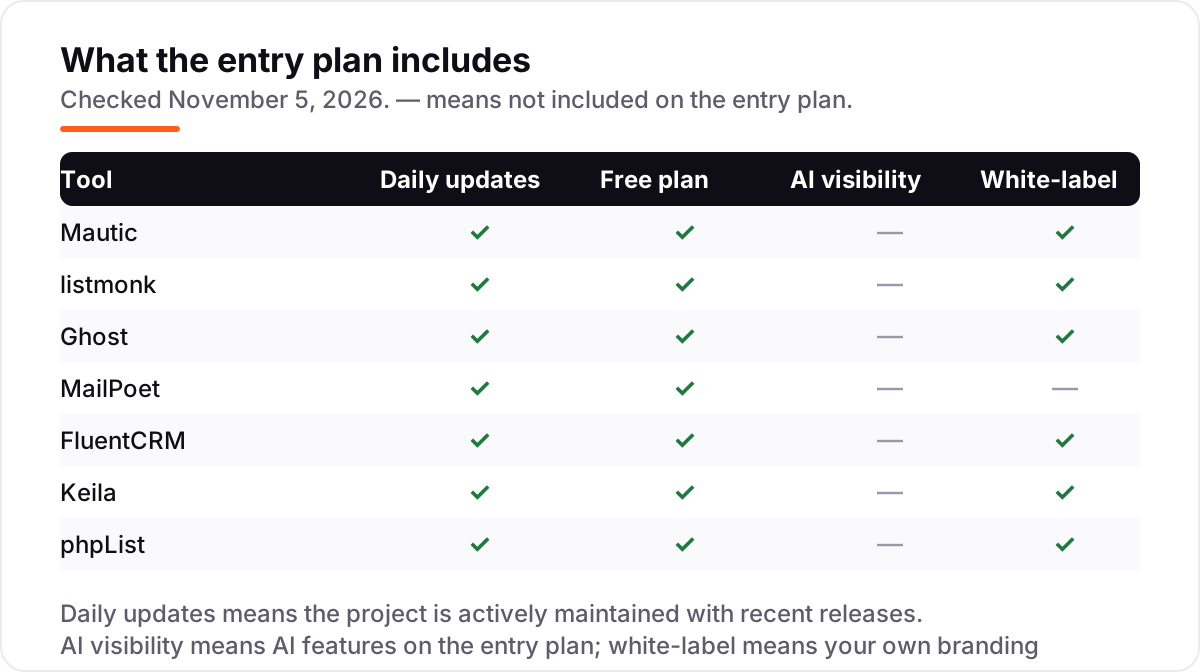
The confusion in this category is between owning the software and renting the service. Open source tools give you the code: you install it, you hold the subscriber data, and no vendor can raise the price or close your account. Hosted email services rent you the same job: they run the servers, handle deliverability and answer support tickets, and in return they charge by subscriber or by send.
There is a second distinction worth knowing: free software is not free sending. Every email still travels through a server and a sending provider, and those cost money whether the software is free or not. The self-hosted tools in this list make that cost visible — a server bill and a per-thousand-email bill — while hosted plans fold it into one monthly price.
A third distinction is the license. Ghost is MIT, which is the most permissive; Mautic is GPL; and listmonk, Keila and phpList are AGPL, which requires you to share the source code if you offer a modified version as a service. For most small businesses running the software as-is, the license changes nothing day to day — but read it before you build a business on top of one of these tools.
One more difference is the exit. With an open source tool, your lists, templates and history live in your own database, so switching tools means exporting data you already own. With a hosted service, the export depends on the vendor's goodwill and formats. That is why the open source route suits businesses that treat the subscriber list as an asset they must control.
Quick comparison: tool type by need
| Buyer | Best pick | Why |
|---|---|---|
| Small business that wants everything free | Mautic | Full automation suite for $0, no contact caps |
| High-volume newsletter on a budget | listmonk | Single binary, no caps, $0 |
| Creator or publisher with a newsletter | Ghost | Blog and newsletter in one, $180 a year hosted |
| WordPress site with a store | MailPoet | WooCommerce emails in the dashboard, free to 500 subscribers |
| WordPress site that wants CRM and automation | FluentCRM | Flat $129 a year, unlimited contacts |
| Privacy-first newsletter in the EU | Keila | Unlimited contacts, Cloud from €8 a month |
Mistakes to avoid
- Budgeting $0 and forgetting the server and the sending. The software is free, but the server and the sending provider are not. Add a small server bill and a per-thousand-email sending bill before you call any tool free.
- Buying on the free tier, then finding the cap. MailPoet Starter caps at 5,000 emails a month, Keila Cloud XS at 2,000, and Ghost(Pro) Starter at 1,000 members. The cap you hit first decides your real price.
- Assuming open source means no support. Mautic and Ghost have commercial support and paid hosting behind them; listmonk, Keila and phpList are community-supported. If nobody on your team reads documentation and logs, pay for a hosted plan.
- Ignoring deliverability. Self-hosted sending needs SPF, DKIM and DMARC set up correctly, plus a reputable relay. Skipping that step puts your mail in spam no matter how good the software is.
- Choosing a tool your team cannot run. Self-hosting needs someone comfortable with a server. If that person leaves, the tool becomes a liability — pick the hosted plan instead.
How we chose
We checked each vendor's own pricing page on November 5, 2026 and recorded the starting price exactly as shown, including the annual figure where the page lists one. The browser fetch tool was down on November 5, so three prices were verified from fresh search-index crawls of the vendor's own pages and independent October and November reads: Keila Cloud XS at €8 a month (vendor page read October 5, 2026, matching two November reads), MailPoet Business from $10 a month at 500 subscribers (vendor page read October 17, 2026, matching a November 3 read) and phpList Hosted from $1 a month (vendor hosted page, matching a November 4 comparison quoting the same figure). The price bars show the annual cost of the entry paid plan, because most tools here are free or priced yearly; Keila is priced in euros and is named in the chart footnote instead of the bars.
We ranked the tools by fit for the most common buyer — a small business that wants email marketing without a bill that grows with every subscriber — not by brand size. Ratings come from G2 review pages: Mautic, Ghost and MailPoet from pages crawled within three days of this check, FluentCRM and phpList from G2 pages crawled on November 1, 2026. listmonk and Keila have no G2 listing, so no rating is shown for them rather than an estimated one. No vendor paid for a place in this list, and none of the links here are affiliate links.
What to do next
Start with the free download or free plan of your top pick and send one real campaign through it. Check that emails land in the inbox, that unsubscribes work, and that the reports show opens and clicks before you commit to a year. If the email side is sorted but new customers are not finding you, our monthly SEO service handles the visibility side — or compare providers in our guide to open source SEO software. Once your tools are in place, find out what's holding your rankings back.
Your stack only works if people find you
SerpAstra fixes what keeps your site off page one and makes it easy for AI assistants to recommend.
Get a free audit→Sources we checked (14)
- Mautic — mautic.org (checked November 5, 2026)
- listmonk — listmonk.app (checked November 5, 2026)
- Ghost pricing — ghost.org/pricing (checked November 5, 2026)
- MailPoet pricing — mailpoet.com/pricing (checked November 5, 2026)
- MailPoet plans and limits — kb.mailpoet.com (checked November 5, 2026)
- FluentCRM pricing — fluentcrm.com/pricing (checked November 5, 2026)
- Keila Cloud pricing — keila.io/pricing (checked November 5, 2026)
- phpList pricing — phplist.com/pricing-comparison (checked November 5, 2026)
- phpList Hosted — phplist.com/hosted (checked November 5, 2026)
- Mautic on G2 — g2.com/products/mautic-mautic/reviews (checked November 5, 2026)
- Ghost on G2 — g2.com/products/ghost/reviews (checked November 5, 2026)
- MailPoet on G2 — g2.com/products/mailpoet/reviews (checked November 5, 2026)
- FluentCRM on G2 — g2.com/products/fluentsoft-inc-fluentcrm/reviews (checked November 5, 2026)
- phpList on G2 — g2.com/products/phplist/reviews (checked November 5, 2026)
Shamim
Founder of SerpAstra
A full-stack SEO and digital marketer who spends most days on Local SEO for dental practices, AI search visibility and lead generation.
Frequently asked questions
What is the best open source email marketing software?
Mautic is the best fit for most buyers: a full marketing automation suite — campaigns, segments, lead scoring, landing pages and A/B testing — free under the GPL, with no contact caps. listmonk is the better pick for high-volume newsletters, and Ghost is the better pick for creators who publish and send from one product.
Is open source email marketing software really free?
The software is free, but running it is not. Mautic, listmonk, Keila and phpList cost $0 to download, yet you still pay for a server and a sending service, and you do the maintenance. The cheapest managed route is phpList Hosted at $1 a month; Ghost(Pro) Starter is $15 a month billed annually.
Do I need a server to run open source email software?
Only for the self-hosted tools. Mautic, listmonk, Keila and phpList run on your own server, which you install and maintain. Ghost, MailPoet and FluentCRM also have hosted or plugin routes: Ghost(Pro) runs the server for you, and the two WordPress plugins run inside a site you already have.
What is the difference between Mautic and listmonk?
Mautic is a full marketing automation suite with drip sequences, lead scoring, landing pages and forms; listmonk is a focused newsletter and mailing list manager built for sending volume. Mautic suits teams that want automation, listmonk suits publishers that send a lot of email and want the lightest tool that does the job.
Can I send emails for free with these tools?
Yes, up to a point. MailPoet's free Starter sends 5,000 emails a month to 500 subscribers, and phpList Hosted has a free trial account for 300 messages. The self-hosted tools send as much as your server and sending provider allow, but the sending provider itself bills per thousand emails.
Which open source email tool is best for WordPress?
MailPoet if email is the job: newsletters, post notifications and WooCommerce emails inside the dashboard, free to 500 subscribers. FluentCRM if you also want CRM and automation: it adds sequences, segmentation and store triggers for a flat $129 a year, with unlimited contacts.
Free SEO and AI visibility audit
Find out what is holding your rankings back
Send us your site. Within 2 business days you get a written audit, an AI visibility check and a short fix list ranked by impact. Free, with no contract attached.
Request my free audit→Related guides
 Digital Marketing & Ads11 Best Email Marketing Software for Small Business in 2026, ComparedThe 11 best email marketing software for small business, compared on real 2026 prices, free plans and automation — Brevo starts at $9/month.Read guide →
 Digital Marketing & Ads8 Best Email Marketing Platforms for Startups in 2026, Compared8 best email marketing platforms for startups compared on price, free plans and automation, with real starting prices checked on the vendors’ own pages.Read guide →
 SEO & AI Search11 Best Open Source SEO Software in 2026, Compared11 best open source seo software compared on price, features and what each one actually does. Every price checked on the vendor's own site, November 1, 2026.Read guide →