
9 Best Platforms for Content for Manufacturing in 2026, Compared
Compare the 9 best platform for content for manufacturing options for 2026 on price, free plans and features, with every price checked November 12, 2026.
 Shamim Mia, Founder, SerpAstraLast verified November 12, 202614 min read
We compare pricing pages, documentation and public reviews. We never accept payment for rankings.

Key takeaways
- Storyblok leads for most manufacturing marketing teams at $99 a month, with Sanity from $15 a seat a month and Contentful Lite at $300 a month.
- The single most important buying factor is where product data lives: a CMS alone cannot fix dirty SKU data — that job belongs to a PIM or to content federation.
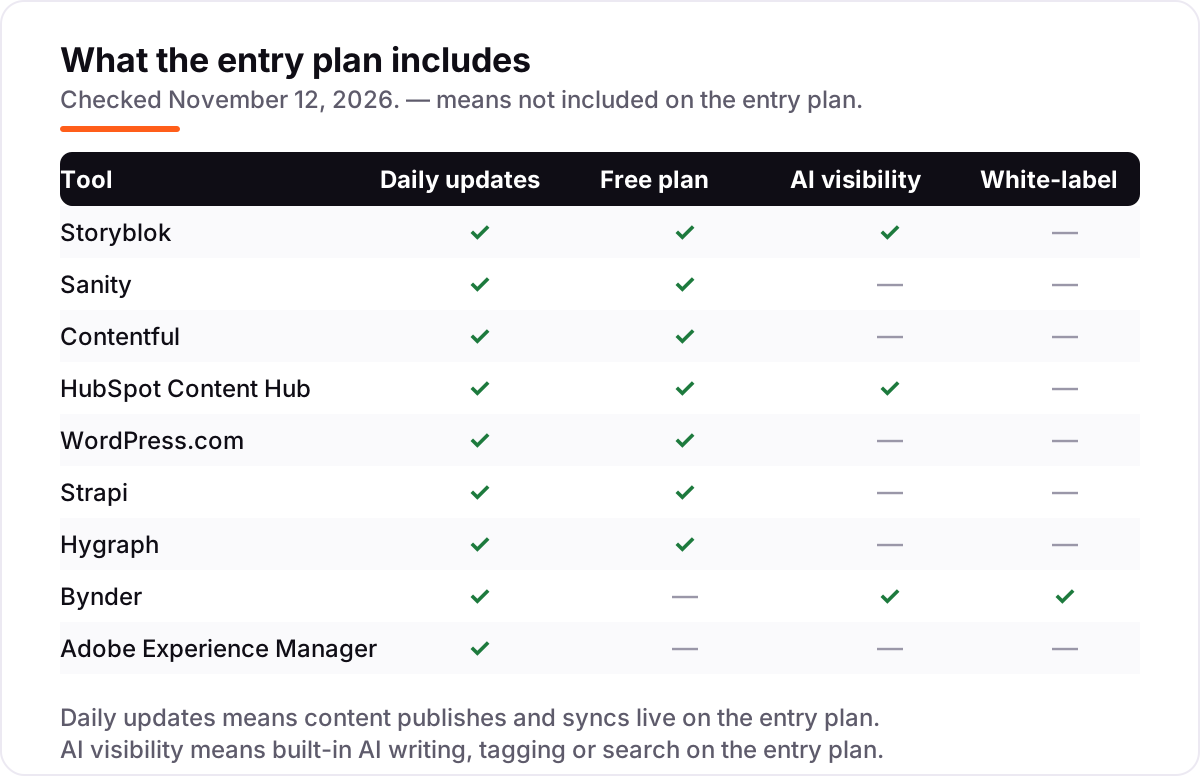
- Seven of the 9 tools have a genuinely free plan or edition — Storyblok, Sanity, Contentful, HubSpot, WordPress.com, Strapi and Hygraph — but Contentful's free plan bans commercial use and Strapi Cloud has no free plan.
- Every price below was checked on the vendor's own pricing page or a fresh search-index copy of it on November 12, 2026. Ratings are G2, with review counts shown.
On this page
Quick comparison
| Tool | Best for | Starting price | Free plan |
|---|---|---|---|
| Storyblok | Manufacturing marketing teams that want marketers editing product pages without developer help | $99/mo | Yes (free plan) |
| Sanity | Developer-led manufacturers that want structured product content at the lowest paid entry price | $15/seat/mo | Yes (free plan) |
| Contentful | Larger manufacturers running many brands, sites and locales from one content hub | $300/mo | Yes (free plan) |
| HubSpot Content Hub | Manufacturers already on HubSpot CRM that want website, blog and landing pages in one place | $20/seat/mo | Yes (free tools) |
| WordPress.com | Small manufacturers that want a familiar website with plugins, backups and staging | $40/mo | Yes (free plan) |
| Strapi | Manufacturers with developers who want open-source control and managed hosting without a big contract | $35/mo | Yes (free edition) |
| Hygraph | Manufacturers that need product data from ERP, PIM and CMS systems in one GraphQL API | $199/mo | Yes (free plan) |
| Bynder | Manufacturers with large photo, video and CAD asset libraries that need brand control | Custom quote | No (demo only) |
| Adobe Experience Manager | Enterprise manufacturers already on Adobe tools that need multi-site, multi-language delivery | Custom quote | No (demo only) |
Make one of these tools?
We re-check this list every quarter. Send a correction, request a review, or ask about a clearly labeled sponsored spot.
Request a listingThe best content platforms for manufacturing

Storyblok
Best for: Manufacturing marketing teams that want marketers editing product pages without developer help
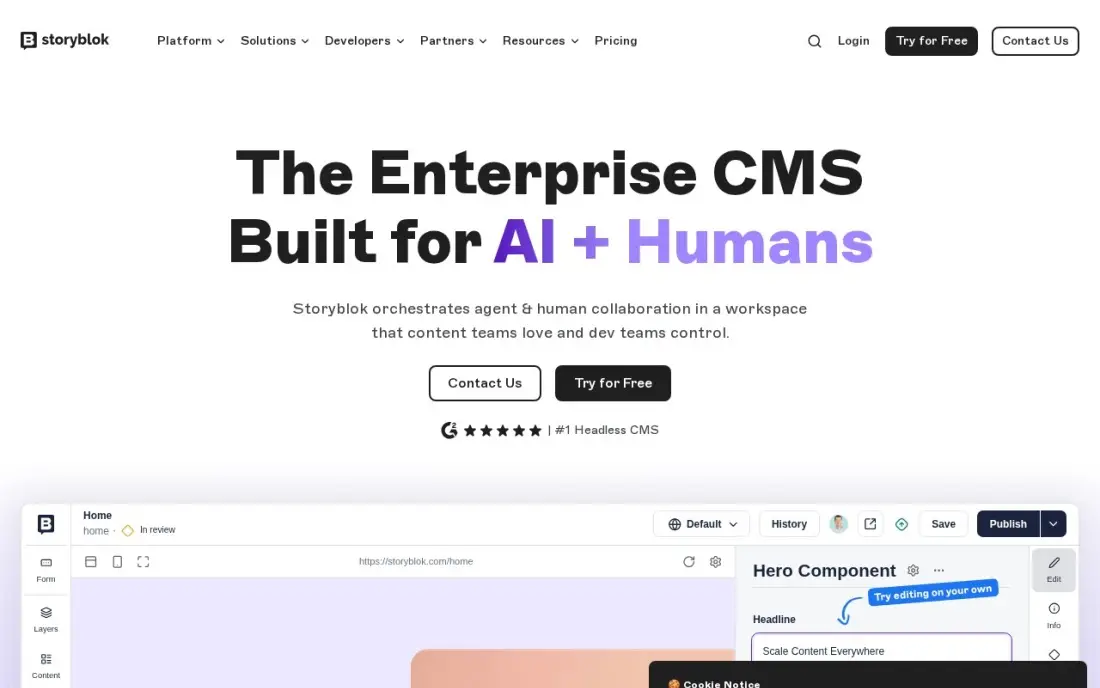
Storyblok is the easiest CMS in this list for a manufacturing marketing team to actually use: the visual editor shows the page as it is built, so product managers can change a product page, a spec sheet or a landing page without waiting on a developer. Content lives in structured blocks, which keeps product names, images and copy consistent across the website, the dealer portal and the mobile app.
Growth at $99 a month covers five seats, 1 million API requests and 400 GB of traffic, with AI credits on every plan for drafting and translation. The catch is the step up: a sixth seat costs $15 a month, extra locales cost $20 each, and single sign-on waits for the custom-priced Premium plan. Pick Storyblok when marketers, not developers, will do the daily editing.
What we like
- A visual editor lets marketers change product pages, spec sheets and landing pages without a developer
- Structured content blocks keep product data, images and copy consistent across the website, app and dealer portals
- AI credits come with every plan, including Starter, for drafting and translating content
- A free Starter plan covers 1 seat, 100,000 API requests a month and 100 GB of traffic
Watch out for
- Growth covers 5 seats, so a bigger team pays $15 a month for each extra seat
- Locales beyond the included two cost $20 a month each
- Single sign-on, custom roles and the GraphQL API sit on custom-priced Premium and Elite plans

Sanity
Best for: Developer-led manufacturers that want structured product content at the lowest paid entry price
Sanity is the cheapest way into a serious content platform, and it carries the highest G2 score in this list at 4.7 from 967 reviews. The free plan covers up to 20 seats and 10,000 documents with public datasets, and Growth at $15 per seat a month adds private datasets, more roles and pay-as-you-go overages instead of hard caps. Viewers are always free, so the whole plant can read content without raising the bill.
The catch is that the bill follows headcount: five paid seats cost $75 a month, twenty cost $300, and API, bandwidth and asset overages sit on top. The editor is code-shaped, so a manufacturer without developers will move slower than on Storyblok. Pick Sanity when developers lead the content work and the team wants the lowest paid entry price.
What we like
- The cheapest paid entry here: Growth is $15 per seat a month, and viewers are always free
- The free plan already covers 20 seats and 10,000 documents, so small teams may never pay
- Real-time collaboration lets engineers, marketers and product managers edit the same content live
- Structured content and GROQ queries feed the same product data to the website, apps and print catalogues
Watch out for
- Growth is priced per seat, so a 20-person editing team pays $300 a month before usage
- Usage overages for API requests, bandwidth and assets stack on top of the seat price
- Custom roles and API-level permissions need the custom-priced Enterprise plan

Contentful
Best for: Larger manufacturers running many brands, sites and locales from one content hub
Contentful is the enterprise headless standard in this list: the most mature platform, the broadest app marketplace and the cleanest model for running many brands, sites and languages from one hub. Lite at $300 a month covers 20 users, 3 locales, 1 million API calls and 100 GB of CDN bandwidth, with scheduled publishing, comments and tasks for editorial teams. Salesforce completed its acquisition of Contentful in September 2026, and published prices are unchanged.
The pricing shape is the problem for smaller manufacturers: there is no plan between Free and the $300 Lite, and Lite still ships with only a Starter Space of 10,000 records — a larger Lite Space costs another $850 a month. The free plan also bans commercial use. Pick Contentful when the business runs several brands or a dozen locales and needs the scale.
What we like
- The most mature headless CMS here, with the broadest integration ecosystem for commerce and PIM tools
- Content models, roles and locales scale cleanly across many brands, sites and languages
- Scheduled publishing, comments and tasks come with Lite for editorial teams
- A large marketplace of apps connects product data, translation and analytics without custom code
Watch out for
- The jump from Free to Lite is $300 a month with no mid-tier plan in between
- Lite still includes only a Starter Space; a larger Lite Space costs $850 a month on top
- The free plan bans commercial use, so a manufacturer cannot run production content on it

HubSpot Content Hub
Best for: Manufacturers already on HubSpot CRM that want website, blog and landing pages in one place
HubSpot Content Hub is the right pick for a manufacturer already running HubSpot CRM: the website, blog and landing pages live in the same system as contacts, deals and quotes, and every page can be traced back to revenue. Starter at $20 a seat a month includes AI content tools that draft and remix posts from one brief, and one seat opens all six Hubs at Starter level. There is no onboarding fee on Content Hub.
The limit is page count: Starter allows 30 website pages and 30 landing pages, so a manufacturer with a large product catalogue outgrows it and faces Professional from $500 a month. The $7 a month annual figure is a new-customer promo, not the standard price. Pick HubSpot when the CRM already runs the business and the site is small.
What we like
- One seat opens the whole Starter Customer Platform: Content Hub plus Marketing, Sales, Service, Data and Commerce Hubs
- AI content tools draft and remix blog posts, landing pages and social posts from one brief
- Website analytics tie every page and post back to contacts, deals and revenue in the CRM
- No onboarding fee on Content Hub at any tier, and branding is removed from Starter
Watch out for
- Starter allows only 30 website pages and 30 landing pages, so a large catalogue outgrows it fast
- Smart content, A/B testing and memberships need Professional from $500 a month
- The $7 a month annual figure is a new-customer promo; the standard list price is $20 a seat a month

WordPress.com
Best for: Small manufacturers that want a familiar website with plugins, backups and staging
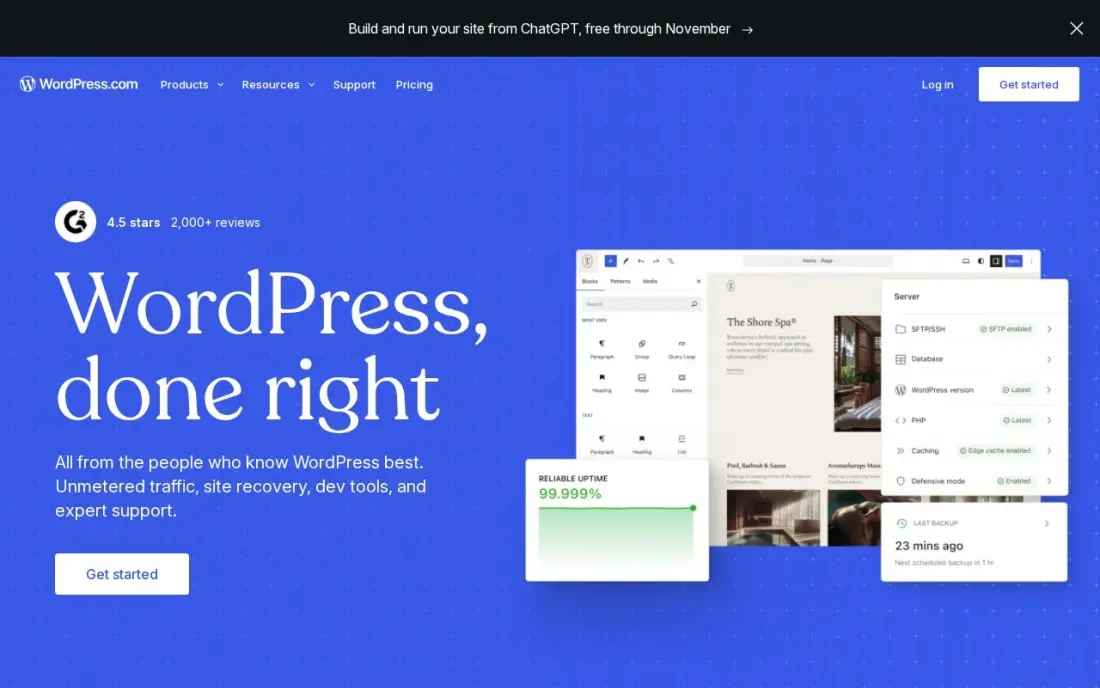
WordPress.com is the familiar workhorse in this list: a hosted WordPress site where hosting, security, updates and the CDN come with the plan, and more than 60,000 plugins cover product catalogues, quote forms, dealer locators and multilingual content. Business at $40 a month billed monthly adds staging, real-time backups, SFTP, WP-CLI and 24/7 priority support, and the first-year annual price is $25 a month.
The catch is the renewal: Business renews at $28 a month on annual billing, and every site needs its own plan, so a second brand site doubles the bill. Plugin installation no longer needs Business — Personal at $4 a month billed annually can install plugins now. Pick WordPress.com when the business wants a proven website fast and cheap.
What we like
- The lowest-friction way to run a manufacturing website: hosting, security, updates and CDN included
- Business adds staging, real-time backups, SFTP, WP-CLI and GitHub deployments for developer teams
- More than 60,000 plugins cover product catalogues, quote forms, dealer locators and multilingual sites
- A free plan exists, and Personal at $4 a month billed annually can now install plugins too
Watch out for
- The $25 a month annual figure is a first-year price; Business renews at $28 a month
- Each site needs its own plan, so a second brand site doubles the bill
- Plugin and theme choice is broad, but deep custom development still needs a developer

Strapi
Best for: Manufacturers with developers who want open-source control and managed hosting without a big contract
Strapi is the open-source option: the Community Edition is free to self-host with no seat or content limits, and Cloud Starter at $35 a project a month covers hosting, database, storage, CDN and SSL. Pricing is per project, not per seat, so a manufacturer can give the whole team editor access without the bill moving. REST and GraphQL APIs come out of the box, so product content feeds the website, the dealer portal or an app.
The catch is ownership: self-hosting means a developer runs hosting, backups and upgrades, and major-version upgrades carry breaking changes. Strapi Cloud also dropped its free plan in August 2026, so managed hosting starts at $35. Pick Strapi when the team has developers and wants control without an enterprise contract.
What we like
- Open-source Community Edition is free to self-host, with no seat or content limits
- Cloud Starter at $35 a project a month covers hosting, database, storage, CDN and SSL
- REST and GraphQL APIs come out of the box, so product content feeds any website or app
- Priced per project, not per seat, so adding editors never raises the Cloud bill
Watch out for
- Strapi Cloud dropped its free plan in August 2026, so managed hosting starts at $35 a month
- The self-hosted Community Edition needs a developer to run hosting, backups and upgrades
- Breaking changes between major versions make upgrades a real project, not a click

Hygraph
Best for: Manufacturers that need product data from ERP, PIM and CMS systems in one GraphQL API
Hygraph is the GraphQL-native headless CMS, and its Content Federation is the feature that matters most to manufacturers: it pulls product data from ERP, PIM and other systems into one API, so the website shows live stock, prices and specs without copying data into yet another system. Growth at $199 a month covers 10 seats, 3 locales, 10,000 entries and 1 million API operations, with transparent overage rates.
The catch is that federation is gated: Growth includes only one remote source, and real multi-system federation needs custom-priced Enterprise, which Hygraph quotes at about $32,000 to $300,000 a year. At $199 a month it also costs more than Sanity or Storyblok for the same team. Pick Hygraph when product data lives in several systems already.
What we like
- Content Federation pulls product data from ERP, PIM and other systems into one GraphQL API
- GraphQL-native from the start, so developers query exactly the product fields they need
- The free Hobby plan covers 3 seats, 1,000 entries and 500,000 API calls a month with no card
- Transparent overage rates: $0.20 per 10,000 API operations and per GB of asset traffic
Watch out for
- Growth includes only one remote source; real federation at scale needs custom-priced Enterprise
- At $199 a month, Growth costs more than Sanity and Storyblok for the same headcount
- Single sign-on, custom roles and an uptime SLA sit on Enterprise, not Growth

Bynder
Best for: Manufacturers with large photo, video and CAD asset libraries that need brand control
Bynder is the digital asset manager in this list, and it solves a different problem from the CMS tools: where the product photos, videos, CAD files and brand assets live, and who is allowed to use them. AI search and auto-tagging find the right file in seconds, and taxonomy, permissions and rights management keep dealers and distributors on approved assets only. Brand guidelines, templates and portals sit in the same system.
The catch is the price, or rather the absence of one: Bynder publishes no prices, so every package is a custom quote from sales, and implementation is quoted separately. Industry contract data puts entry-level packages around $450 a month, but that is third-party data, not a list price. Pick Bynder when the asset library, not the website, is the mess.
What we like
- AI-powered search and auto-tagging find the right product photo, video or CAD file in seconds
- Taxonomy, permissions and rights management keep dealers and distributors on approved assets only
- Brand guidelines, templates and portals come in the same system as the asset library
- Onboarding, 24/7 support, single sign-on and a custom URL come with every package
Watch out for
- No published prices at all: every package is a custom quote from sales
- Implementation and migration are quoted separately and can add 15–30% in year one
- The modular model means AI search, workflow and analytics may each be a paid add-on

Adobe Experience Manager
Best for: Enterprise manufacturers already on Adobe tools that need multi-site, multi-language delivery
Adobe Experience Manager is the enterprise suite in this list: Sites for content, Assets for digital asset management, plus forms and personalization, all in one platform with Adobe-managed cloud hosting. It governs many sites, brands and languages from a single system, and it integrates deeply with Adobe Analytics, Target and Commerce. The base package includes production, stage, development and rapid development environments.
The catch is cost and effort: Adobe publishes no prices, licences are tied to content requests per month, and analyst models put implementation at two to four times the first-year licence. There is no free tier and no trial, and AEM developers are scarce specialists. Pick AEM only when the business is already deep in Adobe and runs many sites.
What we like
- The most complete suite here: Sites CMS, Assets DAM, forms and personalization in one platform
- Multi-site, multi-brand and multi-language governance from a single system
- Adobe-managed cloud hosting with auto-scaling, CDN and continuous updates
- Deep integration with Adobe Analytics, Target and Commerce for manufacturers already on Adobe
Watch out for
- Adobe publishes no AEM prices; every licence is a custom quote tied to content requests
- Implementation commonly costs two to four times the first-year licence, per analyst models
- A steep learning curve and scarce specialist developers make the platform slow to adopt
The best platform for content for manufacturing is the one that keeps product pages, spec sheets and catalogues accurate without a developer in the loop — and the right one depends on whether the business needs a website, a product-data system, or both. The 9 tools below are ranked by fit for the most common buyer, a mid-size US manufacturer whose marketing team runs the website and the product catalogue, and every price was checked on the vendor's own pricing page or a fresh search-index copy of it on November 12, 2026.
How to choose the best platform for content for manufacturing
- Find where the product data lives first. If SKUs, attributes and spec sheets live in an ERP or a PIM, the CMS must pull from it — that is Hygraph's federation or a PIM connector, not a plain website builder.
- Check who will edit every day. A visual editor (Storyblok, HubSpot, WordPress.com) suits marketers; a code-shaped editor (Sanity, Strapi) suits developers and slows everyone else down.
- Check the pricing unit. Sanity and HubSpot charge per seat, Strapi and Storyblok per project or plan, Contentful per space. The unit decides what a growing team pays, not the headline price.
- Check the free-plan terms. Contentful's free plan bans commercial use, Strapi Cloud has no free plan at all, and Sanity's free plan covers 20 seats — three very different answers to the same question.
- Check locales and channels. A manufacturer selling in three languages needs locales on the entry plan, not an enterprise upgrade, and content that feeds the website, dealer portals and print from one source.
- Think about the next catalogue, not the next page. A thousand SKUs need structured content and a PIM; ten pages need a website. Buy for the catalogue the business will have in two years.
A content platform publishes the pages, but it does not bring buyers to them on its own. If the business is not showing up when engineers and procurement teams search, our AI search optimization service covers that side. And before publishing a new product page, the free SERP snippet preview shows how the title and description will look in search results.
Whatever you shortlist, try it with real product content before you pay. The free plans and trials in this list are long enough to publish a real product page, a spec sheet and a translated page, and to check that the catalogue feeds the website without manual copying. Check two things in the trial: that a marketer can publish a page without a developer, and that a price or spec change in one place reaches every channel.
Content platform pricing: what you will actually pay
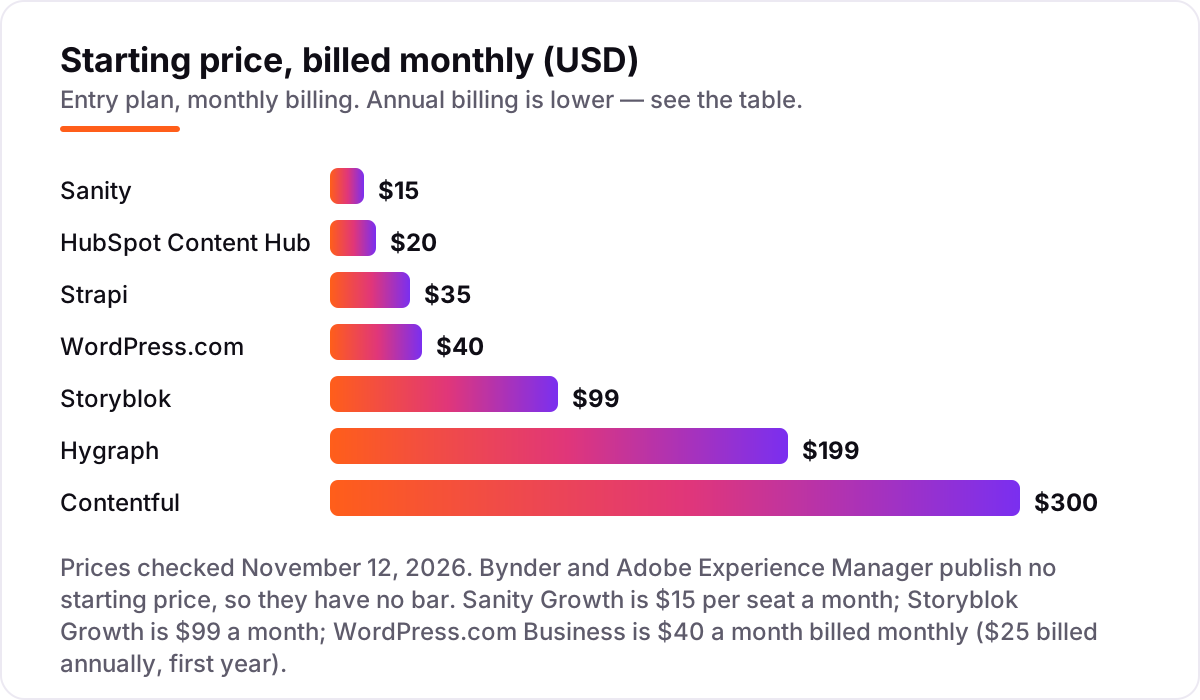
Take a manufacturer with five content editors and one website. On list prices billed monthly, the subscription costs $75 a month on Sanity Growth (5 seats at $15), $99 on Storyblok Growth (5 seats included), $300 on Contentful Lite, $100 on HubSpot Content Hub Starter (5 seats at $20), $40 on WordPress.com Business, $35 on Strapi Cloud Starter and $199 on Hygraph Growth (10 seats included). Bynder and Adobe Experience Manager publish no price, so they need a sales quote before any number exists.
Over a year on monthly billing, that is $420 on Strapi Cloud Starter, $480 on WordPress.com Business, $900 on Sanity Growth, $1,188 on Storyblok Growth, $1,200 on HubSpot Starter, $2,388 on Hygraph Growth and $3,600 on Contentful Lite. Annual billing cuts some of these: WordPress.com Business drops to $300 for the first year, HubSpot Starter to $420 a year on the new-customer $7 promo, and Strapi Cloud to about $349 with yearly billing saving up to 17%. Sanity's self-serve plans take monthly payments only, so there is no annual discount to take.
Three costs sit outside every number above. First, usage overages: Sanity charges per extra API request, GB of bandwidth and GB of assets, Contentful charges $5 per extra million API calls, and Hygraph charges $0.20 per 10,000 API operations — a busy catalogue site can add real money. Second, the bigger space: Contentful's Lite Space add-on costs $850 a month on top of Lite, and Hygraph's federation beyond one remote source needs Enterprise. Third, implementation: Adobe's own partners put AEM implementation at two to four times the first-year licence, and a PIM or DAM rollout needs data cleaning that no subscription covers.
Know the difference: headless CMS, DAM and PIM
The confusion in this category is that three different tools all call themselves a content platform. A headless CMS — Storyblok, Sanity, Contentful, Hygraph, Strapi — stores structured content and delivers it by API to any website, app or portal, with no front end of its own. A DAM — Bynder here — stores finished assets: photos, videos, CAD files and brand templates, with rights and permissions on who can use them. A PIM — Akeneo is the best-known example, and it is quote-only — stores structured product data: SKUs, attributes, variants and spec sheets, and pushes clean data to every sales channel.
Most manufacturers need two of the three. A CMS alone cannot fix dirty SKU data: if the same part has three names in three spreadsheets, no CMS will reconcile them — that is the PIM's job, or Hygraph's Content Federation pulling from the systems that already hold the data. A DAM alone cannot publish a product page. And a PIM alone has no website. The usual shape is a headless CMS for pages plus a PIM for product data, with a DAM added when the asset library grows past a few thousand files. Buy the system that matches the mess: wrong pages means a CMS, wrong product data means a PIM, lost files means a DAM.
Quick comparison: tool type by need
| Buyer | Best pick | Why |
|---|---|---|
| Marketing team that edits pages itself | Storyblok | Visual editor, Growth is $99/month |
| Developer-led team on a tight budget | Sanity | $15/seat/month, highest G2 score here |
| Many brands, sites and locales | Contentful | Mature headless CMS, Lite is $300/month |
| Already running HubSpot CRM | HubSpot Content Hub | Website plus CRM in one, $20/seat/month |
| Small manufacturer, familiar website | WordPress.com | Business is $40/month, plugins included |
| Product data spread across systems | Hygraph | Content Federation, Growth is $199/month |
Mistakes to avoid
- Budgeting on the subscription alone. Implementation, migration and data cleaning sit outside every price here, and AEM implementation commonly costs two to four times the first-year licence. The subscription is the smallest part of an enterprise bill.
- Treating a free plan as production-ready. Contentful's free plan bans commercial use, Strapi Cloud has had no free plan since August 2026, and Hygraph's free Hobby plan stops at 1,000 entries. A free plan that cannot legally or practically run the catalogue is not a free plan.
- Buying a CMS when the problem is product data. If SKUs, attributes and spec sheets are wrong, a new CMS publishes the same wrong data faster. Fix the product data with a PIM or federation first, then pick the CMS.
- Ignoring the pricing unit. A tool can be cheap for five people and dear for twenty: Sanity charges per seat, so 20 editors cost $300 a month, while Strapi Cloud charges per project and Contentful per space. Price the team the business will have next year, not the team it has today.
- Comparing monthly prices without checking billing. The annual price is usually lower — WordPress.com Business drops from $40 to $25 a month in year one, HubSpot Starter to $7 on promo — but Sanity takes monthly payments only, so there is no annual discount to take.
How we chose
We checked each vendor's own pricing page on November 12, 2026 and recorded the starting price exactly as shown, including the annual-billing figure where the page lists one, and we ranked the tools by fit for the most common buyer — a mid-size US manufacturer whose marketing team runs the website and the product catalogue — not by brand size. Two checks needed extra care. The browser's page reader and direct fetches from this machine both failed today, so prices were verified from fresh search-index copies of the vendors' own pricing pages, crawled within the last three days, plus independent October and November 2026 reads of the same pages. Sanity's old $99-a-month flat Growth price is stale: the current Growth plan is $15 per seat a month, confirmed by four independent October and November 2026 reads of sanity.io/pricing. Contentful's Basic plan was renamed Lite and still costs $300 a month, and Strapi Cloud's free plan ended in August 2026 while its Essential plan became Starter at $35 a month. One tool was left out: Akeneo PIM publishes no paid price on its own pages and its logo could not be fetched while outbound downloads were down, so Hygraph took its place and Akeneo is covered as the PIM example in the comparison above. Ratings come from G2 pages opened through fresh search-index copies crawled within three days: Sanity 4.7 from 967 reviews, Storyblok 4.5 from 633, HubSpot Content Hub 4.5 from 2,205, Strapi 4.5 from 207, Bynder 4.5 from 1,199, WordPress.com 4.4 from 2,720, Hygraph 4.4 from 733, Contentful 4.3 from 403 and Adobe Experience Manager 4.2 from 722. No vendor paid for a place in this list, and none of the links here are affiliate links.
What to do next
Start with the free plan or trial of your top pick and run one real product through it: a product page, a spec sheet and a translated version, published to every channel the business uses. Check that a marketer can publish without a developer and that a price change in one place reaches everywhere. If the platform is sorted but buyers are not finding the catalogue, our monthly SEO service handles the visibility side — or compare providers in our guide to content marketing software. Once your tools are in place, find out what's holding your rankings back.
Frequently asked questions
What is the best platform for content for manufacturing?
Storyblok is the best fit for most manufacturing marketing teams at $99 a month, because marketers can edit product pages themselves in the visual editor. Sanity is the cheapest paid start at $15 a seat a month with the highest G2 score here, and Contentful is the pick for larger manufacturers running many brands and locales.
How much does a content platform for manufacturing cost?
Published prices in this list run from $15 a seat a month on Sanity Growth to $300 a month on Contentful Lite, with Storyblok at $99, Hygraph at $199 and WordPress.com Business at $40 a month billed monthly. Bynder and Adobe Experience Manager publish no prices and sell by custom quote, and Akeneo PIM is also quote-only.
Do manufacturers need a PIM as well as a CMS?
Often, yes. A CMS manages pages, blog posts and landing pages, while a PIM manages structured product data: SKUs, attributes, variants and spec sheets. If the catalogue has thousands of SKUs, a PIM such as Akeneo keeps that data clean, and the CMS or a federation tool such as Hygraph publishes it. A small catalogue can live in a CMS alone.
Is there a free content platform for manufacturing?
Yes, with limits. Storyblok, Sanity, Hygraph and WordPress.com all have free plans, and Strapi's Community Edition is free to self-host. But Contentful's free plan bans commercial use, so a manufacturer cannot run production content on it, and Strapi Cloud has no free plan since August 2026.
What is the difference between a headless CMS and WordPress.com?
A headless CMS such as Storyblok, Sanity or Contentful stores content as structured data and delivers it by API to any website, app or portal, with no built-in front end. WordPress.com is a traditional hosted website: the content and the website come together, with hosting, themes and plugins included. Headless fits multi-channel publishing; WordPress.com fits one website fast.
Can I switch content platforms later?
Yes, but move in a quiet period and budget for migration. Export the content models, entries, media and URLs, then rebuild the front end against the new platform's API and set up redirects before going live. The hardest part is usually the content model, not the data, so pick a platform whose model matches the product catalogue from the start.
What should I check before paying for a content platform?
Check how the price grows with seats, locales and API usage, whether the free plan allows commercial use, and what the entry plan excludes — single sign-on and custom roles are enterprise-only on most tools here. Then run a trial with real product content: publish a product page, a spec sheet and a translated page before signing.
Sources we checked (18)
- Storyblok pricing — storyblok.com/pricing (checked November 12, 2026)
- Storyblok on G2 — 4.5/5, 633 reviews (checked November 12, 2026)
- Sanity pricing — sanity.io/pricing (checked November 12, 2026)
- Sanity on G2 — 4.7/5, 967 reviews (checked November 12, 2026)
- Contentful pricing — contentful.com/pricing (checked November 12, 2026)
- Contentful on G2 — 4.3/5, 403 reviews (checked November 12, 2026)
- HubSpot Content Hub pricing — hubspot.com/pricing/content (checked November 12, 2026)
- HubSpot Content Hub on G2 — 4.5/5, 2,205 reviews (checked November 12, 2026)
- WordPress.com pricing — wordpress.com/pricing (checked November 12, 2026)
- WordPress.com on G2 — 4.4/5, 2,720 reviews (checked November 12, 2026)
- Strapi Cloud pricing — strapi.io/pricing-cloud (checked November 12, 2026)
- Strapi on G2 — 4.5/5, 207 reviews (checked November 12, 2026)
- Hygraph pricing — hygraph.com/pricing (checked November 12, 2026)
- Hygraph on G2 — 4.4/5, 733 reviews (checked November 12, 2026)
- Bynder pricing — bynder.com/pricing (checked November 12, 2026)
- Bynder on G2 — 4.5/5, 1,199 reviews (checked November 12, 2026)
- Adobe Experience Manager — business.adobe.com/products/experience-manager.html (checked November 12, 2026)
- Adobe Experience Manager on G2 — 4.2/5, 722 reviews (checked November 12, 2026)
Make one of these tools?
We re-check this list every quarter. Send a correction, request a review, or ask about a clearly labeled sponsored spot.
Request a listingShamim
Founder of SerpAstra
A full-stack SEO and digital marketer who spends most days on Local SEO for dental practices, AI search visibility and lead generation.
Free SEO and AI visibility audit
Find out what is holding your rankings back
Send us your site. Within 2 business days you get a written audit, an AI visibility check and a short fix list ranked by impact. Free, with no contract attached.
Request my free audit→Related buying guides
 SEO & AI Search VisibilityBest CMS for SEO in 2026: 8 Options Ranked and Reviewed8 best CMS for SEO compared with real 2026 prices, free plans and SEO controls. WordPress, Webflow, Shopify and more, ranked by fit for a small business site.Read guide →
 Marketing10 Best Content Management Tools in 2026 (Free and Paid, Compared)Compare the 10 best content management tools on price, free plans and fit for blogs, teams and enterprises, with prices checked November 10, 2026.Read guide →
 Marketing10 Best Content Marketing Software in 2026, Compared10 best content marketing software tools compared on price, planning, optimization and publishing, with starting prices and the right pick for every team size.Read guide →