
9 Best Platforms to Advertise Developer Vacancies in 2026, Compared
Compare the 9 best platforms to advertise developer vacancies on price, reach and screening, with every price checked November 5, 2026, for hiring teams.
 Shamim Mia, Founder, SerpAstraLast verified November 5, 202614 min read
We compare pricing pages, documentation and public reviews. We never accept payment for rankings.

Key takeaways
- LinkedIn and Indeed are the volume plays: LinkedIn starts free for one opening with promoted posts from about $7 a day, and Indeed gives three free posts a month with sponsored budgets from $5 a day or $150 a month.
- Dice at $399 per 30-day slot and We Work Remotely at $299 per 30-day listing are the only flat per-post prices here — every other platform is free to start, auction-priced, or quoted.
- Stack Overflow, Hired and ZipRecruiter publish no starting price at all, so budget them as quotes, not rate cards, and confirm the number before you commit.
- The deciding factor is not price but audience: a tech-only board, a startup board and a remote-only board each filter out the wrong applicants before they ever reach your inbox.
On this page
Quick comparison
| Tool | Best for | Starting price | Free plan |
|---|---|---|---|
| Hiring managers who want the largest professional audience and precise targeting by skill, title and location | Free; promoted ~$7/day | Yes (free post) | |
| Indeed | Employers who want the biggest applicant volume and a free starting point for every role | Free; sponsored $5/day+ | Yes (3 free posts) |
| Dice | Teams hiring only technologists who want a tech-only audience and skill-based search | $399/post | No |
| Stack Overflow | Employers who want to reach developers where they already answer questions and show their work | Custom quote | No |
| Wellfound | Startups hiring developers who want startup experience and will accept salary and equity transparency | Free; $149/mo | Yes (free) |
| Hired | Employers who want pre-vetted developers with stated salary expectations and no upfront posting cost | Custom quote | Yes (free to join) |
| Glassdoor | Employers whose Glassdoor reviews and salary data already sell the company, and who want that story next to the vacancy | Free; sponsored $5/day+ | Yes (free profile) |
| ZipRecruiter | Employers who want one post distributed across 100+ job sites with AI matching and a flat slot model | Custom quote | No (4-day trial) |
| We Work Remotely | Teams hiring fully remote developers who want a remote-only audience and a single flat posting fee | $299/post | No |
Make one of these tools?
We re-check this list every quarter. Send a correction, request a review, or ask about a clearly labeled sponsored spot.
Request a listingThe best platforms to advertise developer vacancies

Best for: Hiring managers who want the largest professional audience and precise targeting by skill, title and location
LinkedIn is the default first post for most developer vacancies because it is where developers already keep their professional identity. A free post costs nothing and covers a single opening, but it pauses after 14 days and carries an application limit, so it suits one urgent role rather than a hiring pipeline. Promoted posts run on a pay-per-click auction with budgets from about $7 a day, and LinkedIn's own example puts a $10 daily budget at $300 or less for 30 days.
The targeting is what justifies the spend: skill, title, company and location filters reach developers who are not searching job boards at all. Screening questions and applicant summaries come with promoted posts, which cuts the first review round. Buy LinkedIn when reach matters most; buy Dice or Stack Overflow when the role needs a purely technical audience.
What we like
- The largest professional audience, with targeting by skill, title, company and location
- Free post costs nothing for a single opening, and promoted posts reach about 3x more qualified applicants than free listings, per LinkedIn
- Candidate profiles show work history, skills and endorsements before anyone applies
- Screening questions and applicant summaries are included on promoted posts
Watch out for
- No published rate card: promoted posts run on a pay-per-click auction, so the final cost is only known once the post is live
- Free post is capped at one active listing, pauses after 14 days and carries an application limit
- Recruiter seats and job slots are sold on annual contracts and quoted by sales, not self-serve

Indeed
Best for: Employers who want the biggest applicant volume and a free starting point for every role
Indeed is the volume play: the largest job-seeker audience in this list, with three free direct posts a month for employers posting directly. Each free post stays visible for up to 30 days, but organic visibility fades quickly, and jobs sent through feeds or an applicant tracking system may need sponsorship to appear at all. Sponsored Jobs start at $5 a day or $150 a month, billed per click on daily budgets or per started application on monthly budgets.
Standard sponsorship buys a visibility boost, email advertising and automated messages, and Indeed says it brings about 3x more applications than a free post. Premium adds first-page boosts, advanced matching, matched candidates and an urgency label, priced above Standard without a published rate. Buy Indeed when you need volume fast; buy Dice when you need that volume pre-filtered to technologists.
What we like
- The largest job-seeker audience, so a developer vacancy gets volume no niche board can match
- Free direct posts cost nothing, and Standard sponsored posts bring about 3x more applications than free, per Indeed
- Sponsored budgets are fully employer-controlled: daily or monthly caps, pause any time, no contract
- Indeed Apply raises completion rates by letting candidates apply without leaving Indeed
Watch out for
- Free posts are capped at three a month and organic visibility fades fast without sponsorship
- Sponsored spend is an auction: competitive developer titles cost far more per click than the $5/day floor
- Premium pricing is set above Standard but neither tier publishes a fixed rate

Dice
Best for: Teams hiring only technologists who want a tech-only audience and skill-based search
Dice is the specialist in this list: a job board only for technology and engineering roles, where candidates are searchable by stack, certification and clearance. A single job slot costs $399 for 30 days, with the post promoted across Dice and partner channels, and a slot frees up the moment the role is filled so it can be reused. Dice says 97% of companies posting receive an applicant in the first 24 hours.
Subscriptions step up from there: Starter and Standard add more slots, candidate views, branded jobs and a branded company profile. The cost to watch is TalentSearch, the resume database, which is billed separately from job posts and is where the real sourcing happens. Buy Dice when every applicant should already be a technologist; buy Indeed when the role could suit a wider pool.
What we like
- A tech-only audience: every candidate here is in technology, so non-technical applications nearly disappear
- Skill, certification and clearance filters match how developers actually describe themselves
- Single job slot is a flat $399 for 30 days with promotion across Dice and partner channels
- Dice says 97% of companies posting receive an applicant in the first 24 hours
Watch out for
- No free plan and no free trial: the first post costs $399
- Resume database access (TalentSearch) is a separate cost on top of job posts
- Audience is US-focused and tech-only, so it adds nothing for non-technical roles

Stack Overflow
Best for: Employers who want to reach developers where they already answer questions and show their work
Stack Overflow reaches developers in a place no general board can: the site where they already answer questions and build public reputation. Talent, its employer product, is branding and role promotion aimed at that community, priced by quote rather than a published rate card. Standalone job posting has been folded into Indeed, so a vacancy posted there is distributed on a pay-per-click basis rather than through a separate Stack Overflow checkout.
The value is the signal. Reputation scores, top tags and public answers tell you more about a developer than a resume summary, and tag targeting reaches people by the exact languages in the role. Buy Stack Overflow when you want to be seen by developers who are not job hunting; buy Dice when you want applications from developers who are.
What we like
- Developers judge employers by reputation scores and public answers, so strong engineers self-select in
- Stack Overflow says its public platform serves 100 million people a month, nearly all technical
- Employer branding puts open roles in front of developers while they research problems, not just while job hunting
- Tag-based targeting reaches people by the exact languages and frameworks in the role
Watch out for
- No published price: Talent employer branding is quoted, not listed
- Standalone job posting now routes through Indeed, so it is no longer a separate checkout
- Reaching passive developers takes outreach: the community does not apply like a job board audience

Wellfound
Best for: Startups hiring developers who want startup experience and will accept salary and equity transparency
Wellfound, formerly AngelList Talent, is the startup hiring board: free job posts, a built-in applicant tracking system and branded company profiles, in front of developers who actively want startup roles. Candidates state salary and equity expectations up front, which removes the late-stage compensation surprise that kills many developer hires. The catch on the free tier is transparency: a listing needs salary and/or equity information to post free, or promotion may be required.
Essentials costs $149 a month and adds screening questions, advanced filters, saved applications and quick accept/reject templates. Promoted jobs start at $200 a post for top placement, and the Reach and Autopilot tiers add AI sourcing and a dedicated recruiter. Buy Wellfound when the company is a startup and the pitch is equity; buy LinkedIn when the pitch is stability and scale.
What we like
- Free job posts with a built-in applicant tracking system and branded company profiles
- Candidates come pre-filtered for startup interest, including salary and equity expectations
- Essentials at $149/month adds screening questions, advanced filters and quick accept/reject templates
- Promoted jobs from $200 a post add top placement for hard-to-fill roles
Watch out for
- Free posts require salary and/or equity information, or promotion may be required
- Audience skews startup: weak for enterprise, agency or non-technical hiring
- Paid sourcing (Reach) and Autopilot add monthly cost quickly on top of free posts

Hired
Best for: Employers who want pre-vetted developers with stated salary expectations and no upfront posting cost
Hired flips the usual job board around: employers join and search free, and candidates arrive pre-vetted with stated salary expectations. You request interviews with people who have already said what they will accept, which removes the most common reason developer hiring stalls. Hired publishes no rate card; third-party comparisons report a success fee of 15% of first-year base salary, payable only when a hire is made.
That model changes the budget conversation. A $150,000 developer hire at a reported 15% fee costs $22,500, which dwarfs every per-post price in this list, but you pay nothing if nobody is hired. Buy Hired when vetting and salary clarity matter more than volume; buy Indeed when you want the widest funnel and will do the filtering yourself.
What we like
- Employers join and search free: money changes hands only when a hire is made
- Candidates arrive pre-vetted with stated salary expectations, cutting early screening time
- Salary-first matching means fewer conversations that collapse over compensation late in the process
- Covers software engineering, design, data and product roles in the US, Canada and the UK
Watch out for
- No published rate card: the success fee is quoted, not listed, and only confirmed in the employer agreement
- Success fee lands on hire, so a senior hire carries a five-figure fee even though posting was free
- Smaller and less diverse pool than the big boards: candidates must pass Hired's vetting first

Glassdoor
Best for: Employers whose Glassdoor reviews and salary data already sell the company, and who want that story next to the vacancy
Glassdoor is not a standalone posting channel anymore: job advertising runs through Indeed, and listings posted there surface on Glassdoor automatically. What Glassdoor adds is the research step every developer takes before applying — company reviews, salary data and interview reports sitting next to your vacancy. A free employer profile with review responses and culture content costs nothing, and it is the cheapest employer branding in this list.
Paid employer branding is quote-based and annual, with no published list price, and sponsored distribution is billed through Indeed's sponsored budgets from $5 a day. The risk is also the opportunity: a weak review profile deters developers here more than on any other platform. Buy Glassdoor when your reviews already sell the company; fix the reviews before you spend anywhere else if they do not.
What we like
- Candidates research employers here before applying, so a strong profile pre-sells the role
- Free employer profile with review responses, culture content and salary data at no cost
- Listings posted on Indeed surface on Glassdoor automatically, with no second posting step
- Sponsored distribution through Indeed adds priority visibility for urgent or competitive roles
Watch out for
- No standalone posting product: job advertising now runs through Indeed, so Glassdoor adds no separate checkout
- Employer branding packages are quote-based annual subscriptions with no published list price
- A weak review profile hurts here more than anywhere: candidates read reviews before applying

ZipRecruiter
Best for: Employers who want one post distributed across 100+ job sites with AI matching and a flat slot model
ZipRecruiter sells distribution: one post goes out to 100+ job sites, and an AI matching system pushes the listing to candidates it ranks as a fit. You pay per active job slot on a monthly subscription, not per click or per application, so the invoice stays flat no matter how many people apply. A slot is reusable the moment a role closes, which makes it closer to renting a desk than buying an advert.
The catch is pricing opacity. ZipRecruiter publishes no rate card and quotes every account individually, though third-party analyses of 2026 contracts report $299 to $399 a month for one Standard slot. New employers get a free trial that rolls into the chosen plan unless cancelled. Buy ZipRecruiter when you want maximum distribution from one listing; buy Dice when you want that listing seen only by technologists.
What we like
- One post distributes to 100+ job sites, including Google Jobs, from a single listing
- AI matching pushes the listing to candidates ranked as a fit, rather than waiting for search
- A filled slot can be reused immediately for the next role, so the subscription keeps working
- Clicks and applications are included in the rate, not billed one by one
Watch out for
- No published rate card: every account is quoted individually by sales
- Slot pricing means paying monthly whether or not a role is open, unless the slot is reused
- High applicant volume includes many unqualified candidates that still need screening

We Work Remotely
Best for: Teams hiring fully remote developers who want a remote-only audience and a single flat posting fee
We Work Remotely is the remote-only board: every visitor is looking for remote work, so a fully remote developer vacancy meets an audience with no on-site mismatch to filter out. A standard listing costs $299 for 30 days, with paid upgrades for visibility, and there is no subscription — you pay per post and stop when the role is filled. The fee itself does quiet quality work, discouraging the mass-produced listings that flood free boards.
What you do not get is tooling: no applicant tracking, no screening and no matching, so applications arrive by email or into your own ATS and every one needs manual review. Buy We Work Remotely when the role is fully remote and the budget is a single flat fee; buy ZipRecruiter when you want distribution plus matching and are willing to take a quoted subscription.
What we like
- A remote-only audience: every visitor is looking for remote work, so on-site mismatches disappear
- Flat $299 per 30-day listing with paid upgrades for extra visibility, no subscription required
- One of the largest remote boards, with We Work Remotely reporting millions of monthly visitors
- A posting fee filters out mass-produced listings, keeping the board cleaner than free boards
Watch out for
- Remote-only audience: useless for hybrid or on-site roles
- No free plan and no applicant tracking: applications arrive by email or your own ATS
- No screening, vetting or matching: every application still needs full manual review
The best platforms to advertise developer vacancies split into two kinds: boards that sell visibility, and marketplaces that sell matching. The first group charges per post, per click or per slot, and you do the screening. The second group vets candidates or states their salary expectations before you ever see them, and charges on hire instead. We ranked the nine platforms below by fit for the most common buyer — a hiring manager filling one developer role — starting with the biggest audiences and ending with the specialist boards, and every price was checked on the vendor's own pricing page or help page on November 5, 2026.
How to choose the best platforms to advertise developer vacancies
- Start with audience, not price. A free post on a general board brings hundreds of unqualified applications; a $399 post on a tech-only board brings fewer, better ones. The screening time you save is worth more than the posting fee.
- Match the board to the role's work pattern. Fully remote roles belong on a remote-only board, startup roles on a startup board, and senior or niche roles where developers already gather.
- Check the free tier's real limits. LinkedIn allows one free active post that pauses after 14 days, Indeed caps free posts at three a month, and Wellfound requires salary or equity disclosure for free posts.
- Price the whole hire, not the post. A free marketplace that charges 15% of first-year salary on hire costs far more than a $399 post if the hire lands — but nothing at all if it does not.
- Watch where the post actually goes. Stack Overflow and Glassdoor no longer sell standalone posting; both distribute through Indeed, so paying both would mean paying twice for the same listing.
Advertising is one system in your hiring stack, not the whole stack. If the business also needs to be found online, our guide to marketing platforms for small business SEO covers the visibility side. And before you publish the vacancy page itself, run its title and description through the free SERP snippet preview tool — it shows exactly how the posting will look in Google.
Whatever you shortlist, test it with one real vacancy before committing to a subscription. The free posts and trials in this list are long enough to run one genuine role — your job description, your salary band, your applicants — and that month tells you more than any review can. Check two things in the trial: that the applicants match the role's stack, and that the cost per qualified applicant beats your current channel. Every platform here lets you post or join free except Dice, ZipRecruiter and We Work Remotely, so there is little reason to buy before you have seen the applicants.
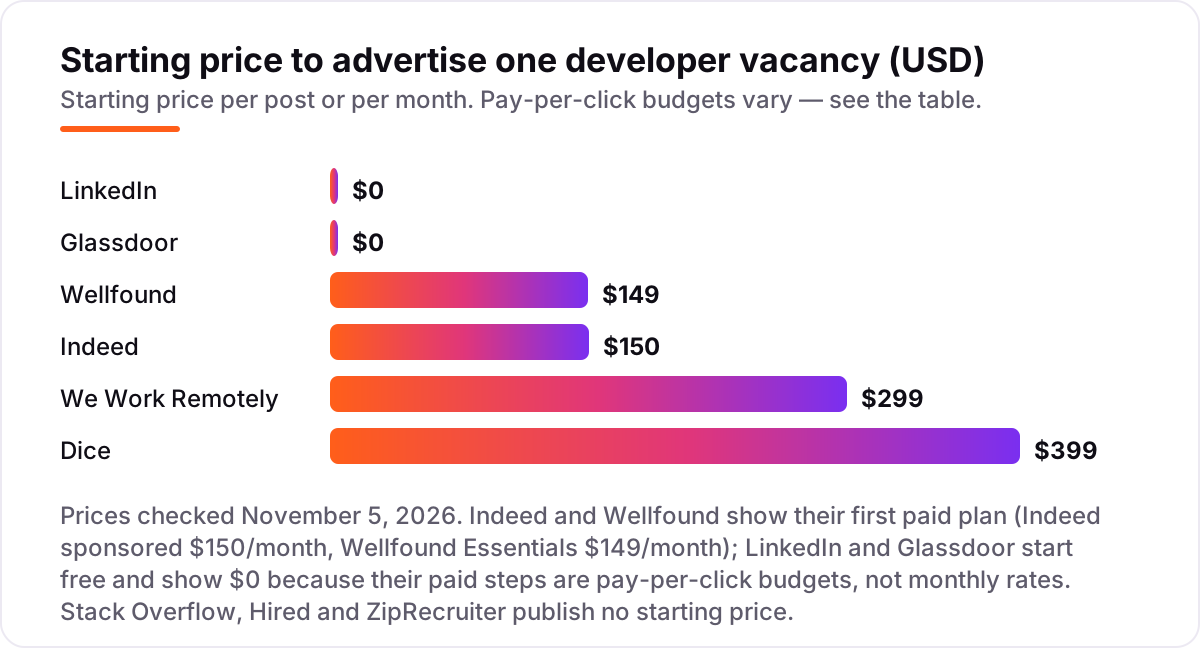
Developer job board pricing: what you will actually pay
Take one senior backend developer vacancy, advertised for 30 days. On list prices, the posting costs $0 on Wellfound, up to $300 on LinkedIn at a $10 daily promoted budget, $150 on Indeed at the sponsored monthly minimum, $399 on Dice for one job slot and $299 on We Work Remotely for one listing. Advertising the same role on all five costs $1,148 for the month, before any hire is made. Stack Overflow, Hired and ZipRecruiter are not in that total because they publish no rate card: Stack Overflow and ZipRecruiter are quoted, and Hired charges only on hire.
Over a year, the shape of the bill changes with volume. Four developer hires advertised one at a time cost $1,596 on Dice and $1,196 on We Work Remotely at flat per-post prices, while the same four roles on Indeed sponsored at the $150 monthly minimum cost $600 if each fills within a month — but far more if competitive titles push the auction above the floor. LinkedIn's cost is the hardest to forecast: a $10 daily budget caps at $300 a role, but the auction decides how many clicks that buys. Hired breaks the pattern entirely: four hires at a reported 15% of a $150,000 salary cost $90,000, which is why marketplaces only make sense when vetting time is worth more than the fee.
Three costs sit outside every number above. First, resume database access: Dice's TalentSearch is billed separately from job posts, and ZipRecruiter's resume search sits on higher tiers. Second, employer branding: Glassdoor's paid branding packages and Stack Overflow's Talent campaigns are quoted annually. Third, your own time: screening hundreds of general-board applications costs more than any posting fee, which is the real argument for the specialist boards.
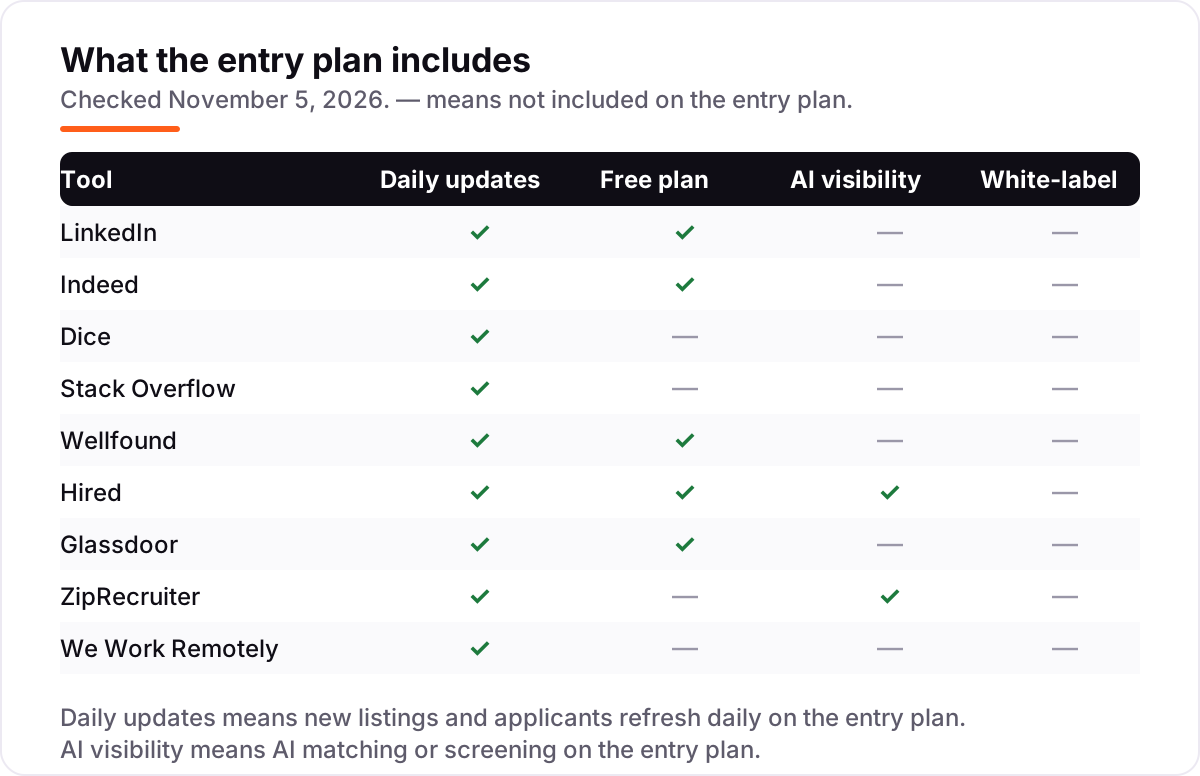
Know the difference: job boards, marketplaces and talent networks
The confusion in this category is between three models that look alike from the job seeker's side. A job board sells visibility: you write the post, pay for the slot or the clicks, and applicants come to you. LinkedIn, Indeed, Dice, ZipRecruiter and We Work Remotely are job boards, and the screening is your job. A marketplace adds matching or vetting before you see a candidate: Hired pre-vets developers and states their salary expectations, and Wellfound filters for startup interest and compensation transparency. A talent network is a community first and a hiring channel second: Stack Overflow's developers are there to answer questions, not to job hunt, so employer branding reaches them where they already spend time.
There is a second, quieter confusion: distribution is not audience. ZipRecruiter sends one post to 100+ sites, but those sites mostly carry the same general audience Indeed already reaches. Dice and We Work Remotely do the opposite: a smaller audience, filtered by technology or by remote-only intent, so fewer applications arrive and more of them fit. For a developer vacancy, the filtered audience usually beats the distributed one, because one qualified applicant is worth more than fifty unqualified ones.
A third distinction worth knowing is free versus free-to-start. LinkedIn, Indeed, Wellfound and Glassdoor all let you post free, but the free tier is capped, time-limited or visibility-limited on every one of them. The platforms that charge from the first post — Dice, We Work Remotely and ZipRecruiter's subscription — are at least honest about the price. Budget on the paid step, not the free tier, for any role you need filled quickly.
Quick comparison: tool type by need
| Buyer | Best pick | Why |
|---|---|---|
| Biggest audience, lowest start cost | Free for one opening, promoted from about $7/day, precise skill targeting | |
| Maximum applicant volume | Indeed | Largest job-seeker pool, 3 free posts a month, sponsored from $5/day |
| Tech-only applicants | Dice | Flat $399 per 30-day slot, skill and clearance search, no general applicants |
| Startup hiring with equity | Wellfound | Free posts with an ATS, candidates state salary and equity expectations |
| Pre-vetted developers, pay on hire | Hired | Free to join, salary-first matching, reported 15% success fee on hire |
| Fully remote role, flat fee | We Work Remotely | $299 per 30-day listing, remote-only audience, no subscription |
Mistakes to avoid
- Budgeting on the free tier. Free posts are capped, time-limited or visibility-limited everywhere here. Price the sponsored or paid step for any role that must be filled quickly.
- Paying twice for the same listing. Stack Overflow and Glassdoor distribute through Indeed now. If you already sponsor on Indeed, check where the listing surfaces before buying a second channel.
- Buying reach when you need filtering. A general board's volume looks impressive until screening eats the week. For a specialist developer role, a tech-only or remote-only board usually delivers fewer, better applicants.
- Treating a quoted price as a rate card. Stack Overflow, Hired and ZipRecruiter publish no starting price. Get the quote in writing before you plan a budget around any of them.
- Forgetting the success fee. A marketplace that is free to join can still be the most expensive option in this list once a senior hire lands. Multiply the reported fee by the role's salary before comparing it with a per-post price.
How we chose
We checked each vendor's own pricing or help page on November 5, 2026 and recorded the starting price exactly as shown, including the free tier where the vendor offers one, and we ranked the tools by fit for the most common buyer — a hiring manager filling one developer role — not by brand size. Three prices need a sourcing note. Hired's reported 15% success fee comes from third-party comparisons and the company's own earlier statements, not from a published Hired rate card, because Hired publishes none. ZipRecruiter's reported $299 to $399 a month per Standard slot comes from third-party analyses of 2026 contracts, because ZipRecruiter publishes no rate card. We Work Remotely's $299 per 30-day listing comes from fresh November 2026 reads of the vendor's own posting page, corroborated across several independent reads, after a direct fetch of the posting page failed. Ratings come from fresh search-index copies of the exact G2 review pages, crawled within the last few days. Four ratings are omitted deliberately: LinkedIn has no G2 employer listing, Stack Overflow's G2 listing covers its Teams knowledge product rather than Talent, Hired's G2 listing shows zero reviews, and We Work Remotely's G2 listing holds only five reviews, mostly from job seekers rather than employers. No vendor paid for a place in this list, and none of the links here are affiliate links.
What to do next
Start with the free post or trial of your top pick and run one real vacancy through it. Check that the applicants match the role's stack and that the cost per qualified applicant beats your current channel before you commit to a subscription or a quoted package. If the vacancy is filled but new customers are not finding you, our monthly SEO service handles the visibility side. Once your tools are in place, find out what's holding your rankings back.
Your stack only works if people find you
SerpAstra fixes what keeps your site off page one and makes it easy for AI assistants to recommend.
Get a free audit→Sources we checked (14)
- LinkedIn free vs promoted jobs — linkedin.com help (checked November 5, 2026)
- Indeed pricing — indeed.com/hire/pricing (checked November 5, 2026)
- Dice pricing — dice.com/hiring/pricing (checked November 5, 2026)
- Stack Overflow Talent — stackoverflow.co/talent (checked November 5, 2026)
- Wellfound — wellfound.com (checked November 5, 2026)
- Hired — hired.com (checked November 5, 2026)
- Glassdoor for employers — glassdoor.com/employers (checked November 5, 2026)
- ZipRecruiter pricing — ziprecruiter.com/pricing (checked November 5, 2026)
- We Work Remotely — weworkremotely.com (checked November 5, 2026)
- Indeed Hiring Platform reviews — g2.com (checked November 5, 2026)
- Dice reviews — g2.com (checked November 5, 2026)
- Wellfound Jobs reviews — g2.com (checked November 5, 2026)
- Glassdoor reviews — g2.com (checked November 5, 2026)
- ZipRecruiter reviews — g2.com (checked November 5, 2026)
Shamim
Founder of SerpAstra
A full-stack SEO and digital marketer who spends most days on Local SEO for dental practices, AI search visibility and lead generation.
Frequently asked questions
What is the best platform to advertise a developer vacancy?
LinkedIn is the best starting point for most developer vacancies: the largest professional audience, a free post for a single opening, and promoted posts from about $7 a day. Dice is better when every applicant must already be a technologist, and Wellfound is better for startup roles with equity on offer.
How much does it cost to advertise a developer vacancy?
It ranges from free to a five-figure success fee. LinkedIn, Indeed, Wellfound and Glassdoor all start free. Flat per-post prices are $399 for 30 days on Dice and $299 for 30 days on We Work Remotely. Hired charges only on hire, with a reported 15% of first-year base salary.
Can I advertise a developer vacancy for free?
Yes, with limits. LinkedIn allows one free active post that pauses after 14 days, Indeed allows three free direct posts a month, Wellfound posts free if you disclose salary or equity, and Glassdoor distribution runs through Indeed's free posts. Free posts get less visibility than sponsored ones on every platform.
Is Dice or Stack Overflow better for hiring developers?
Dice is better when you want applications from developers who are actively job hunting, with a flat $399 per 30-day slot and skill-based search. Stack Overflow is better for reaching developers who are not job hunting, through employer branding in the community where they already prove their skills.
Do I need to pay for screening, or is it included?
Screening is partly included almost everywhere: LinkedIn promoted posts, Indeed sponsored posts and Wellfound Essentials all include screening questions. Full vetting is different: only marketplaces like Hired pre-vet candidates, and that vetting is paid for through the success fee on hire, not upfront.
What is the difference between a job board and a hiring marketplace?
A job board sells visibility: you post a vacancy and applicants come to you, and you do the screening. A marketplace like Hired or Wellfound adds matching, salary transparency or vetting before you ever see a candidate. Boards are cheaper per post; marketplaces cost more per hire but save screening time.
Free SEO and AI visibility audit
Find out what is holding your rankings back
Send us your site. Within 2 business days you get a written audit, an AI visibility check and a short fix list ranked by impact. Free, with no contract attached.
Request my free audit→Related guides
 Digital Marketing & Ads7 Best Advertising Platforms for Small Businesses in 2026, Compared7 best advertising platforms for small businesses compared on minimum budgets, cost per click and who each one fits — minimums checked on each vendor's page.Read guide →
 Digital Marketing & AdsBest Advertising Platforms (2026): 12 Options Ranked for Every BudgetCompare the 12 best advertising platforms on minimum budgets, pricing and reach, with every minimum checked November 4, 2026, and sorted by use case.Read guide →
 Consumer Apps8 Best Local Job Listings Apps in 2026: Free and Paid Apps RankedCompare the 8 best local job listings app picks for 2026: free apps, real prices and local filters, with every price checked November 4, 2026.Read guide →