
11 Best Platforms to Start a Blog for 2026 (Pros, Cons and Pricing)
Compare the 11 best platforms to start a blog on price, free plans, SEO control and ownership, with every price checked November 5, 2026, before you commit.
 Shamim Mia, Founder, SerpAstraLast verified November 5, 202615 min read
We compare pricing pages, documentation and public reviews. We never accept payment for rankings.

Key takeaways
- WordPress.com is the best fit for most new bloggers at $4 a month billed yearly, with a free plan to start and plugins on every paid plan; Wix follows at $17 a month billed yearly for the easiest drag-and-drop editor.
- Blogger, Medium and Substack cost $0 to publish, but you rent the audience — Medium needs a $5-a-month membership before you can earn, and Substack keeps 10% of paid subscriptions.
- A blog needs a CMS plan on Webflow: Basic at $15 a month billed yearly has no CMS, so the real starting price for a blog is Premium at $25 a month billed yearly.
- The limit that decides your real cost is the one you hit first: member caps on Ghost, storage on WordPress.com Personal, and the 2% transaction fee on Squarespace Basic.
On this page
Quick comparison
| Tool | Best for | Starting price | Free plan |
|---|---|---|---|
| WordPress.com | New bloggers who want the biggest plugin and theme ecosystem, a free plan to start, and the cheapest honest paid step up | $9/mo | Yes (free plan) |
| Wix | Beginners who want the easiest drag-and-drop editor and a good-looking blog live in an afternoon | $24/mo | Yes (free plan) |
| Squarespace | Design-led bloggers who want polished templates, built-in SEO tools and analytics in one place | $25/mo | No (14-day trial) |
| Ghost | Writers who want a clean editor with newsletters and paid memberships built in, and zero revenue share | $18/mo | No (14-day trial) |
| Webflow | Design-led brands that want pixel-exact layouts with a real CMS behind the blog | $39/mo | Yes (Starter free) |
| Blogger | Hobby bloggers who want a genuinely free blog with hosting included and no platform ads | Free | Yes (free) |
| Medium | New writers who want to be read fast, with a built-in audience and the cleanest editor here | Free | Yes (free) |
| Substack | Writers whose blog is really a newsletter, and who want paid subscriptions with no monthly bill | Free | Yes (free) |
| Duda | Freelancers and agencies who build and manage blogs and sites for clients | $25/mo | No (14-day trial) |
| Weebly | Bloggers who want the cheapest paid plan with a custom domain, on the simplest editor here | $16/mo | Yes (free plan) |
| Shopify | Bloggers whose blog exists to sell products from a real online store | $39/mo | No (3-day trial) |
Make one of these tools?
We re-check this list every quarter. Send a correction, request a review, or ask about a clearly labeled sponsored spot.
Request a listingThe best platforms to start a blog

WordPress.com
Best for: New bloggers who want the biggest plugin and theme ecosystem, a free plan to start, and the cheapest honest paid step up
WordPress.com is the hosted version of the software behind a large share of the web, the safest default for a new blogger. Personal costs $9 a month, or $4 a month billed yearly, and adds a custom domain free for a year, 6 GB of storage and no ads. Since April 2026, plugins work on every paid plan, so Personal covers the SEO plugins most blogs need. The free plan is a genuine start, with a wordpress.com address.
Watch renewal pricing and the storage ceiling. Personal renews at $5 a month billed yearly, and 6 GB fills fast once photos pile up. Premium at $8 a month billed yearly doubles storage to 13 GB and adds WordAds. Pick WordPress.com for the biggest ecosystem and a cheap, honest start; pick Ghost or Webflow when design control matters more than plugins.
What we like
- The largest theme and plugin ecosystem of any platform here, so almost any feature has a ready-made answer
- Plugins and theme uploads now work on every paid plan, including Personal, since April 2026
- Cheapest paid start here: Personal is $4 a month billed yearly, with a custom domain free for the first year
- Free plan is a genuine way to start, with hosting, SSL and a wordpress.com address included
Watch out for
- Personal renews higher at $5 a month billed yearly, and the 6 GB storage ceiling fills up fast once photos pile up
- Free sites show WordPress.com ads and cannot use a custom domain as the primary address
- The block editor and settings take longer to learn than a drag-and-drop builder

Wix
Best for: Beginners who want the easiest drag-and-drop editor and a good-looking blog live in an afternoon
Wix is the easiest builder here to get a good-looking blog live in an afternoon. The free plan lets you publish on a wixsite.com address with Wix ads, and Light costs $17 a month billed yearly for your own domain, 2 GB of storage and no Wix ads. The drag-and-drop editor and AI website builder need no code, and the built-in blog has scheduling, categories, SEO settings and email subscriptions without plugins.
The trade-offs are price and lock-in. The $24 monthly-billed Light rate only appears at checkout — the pricing page shows the $17 annual figure — and 2 GB of storage is tight for a photo-heavy blog. Moving a Wix blog elsewhere means rebuilding it, since there is no clean export. Choose Wix when ease beats everything else; choose WordPress.com for a lower bill and an exit route.
What we like
- The easiest editor here: drag-and-drop plus an AI website builder, with no code at all
- Built-in blog covers scheduling, categories, SEO settings and email subscriptions without plugins
- Hundreds of templates, and the free plan lets you publish before you pay anything
- 24/7 support and a 14-day money-back guarantee on paid plans
Watch out for
- The $24 monthly rate only appears at checkout; the pricing page shows the $17 annual figure
- Light gives only 2 GB of storage, which is tight for a photo-heavy blog
- No clean export, so moving a Wix blog elsewhere later means rebuilding it

Squarespace
Best for: Design-led bloggers who want polished templates, built-in SEO tools and analytics in one place
Squarespace is the design-led pick: the most polished templates here, with blogging, SSL, SEO tools and Blueprint AI on every plan. Basic costs $25 a month, or $19 a month billed yearly, with a free domain for the first year, unlimited bandwidth and 2 contributors. The structured editor keeps a new blogger from wrecking the layout, and built-in analytics show what readers actually do.
The limits are the contributor cap and selling fees. Basic allows only 2 contributors, so a multi-author blog needs Core at $29 a month billed yearly, and Basic takes a 2% fee on store sales plus 7% on digital products and memberships. There is no free plan, only a 14-day trial. Pick Squarespace when the look matters as much as the words; pick Wix for a cheaper drag-and-drop start.
What we like
- The most polished templates in this list, with blogging, SSL, SEO tools and analytics on every plan
- Blueprint AI builder and structured editor keep a new blogger from making a mess of the layout
- Unlimited bandwidth and a free custom domain for the first year on annual plans
- Every plan can sell, so a blog can add a store later without moving platforms
Watch out for
- Basic allows only 2 contributors, so a multi-author blog needs Core at $29 a month billed yearly
- Basic takes a 2% fee on store sales and 7% on digital products and memberships
- No free plan, only a 14-day trial, and the editor allows less freedom than Wix or Webflow

Ghost
Best for: Writers who want a clean editor with newsletters and paid memberships built in, and zero revenue share
Ghost is the writer-first platform: a clean editor, built-in newsletters and paid memberships in one product, with no plugins to maintain. Ghost(Pro) Starter costs $18 a month, or $15 a month billed yearly, for one staff user, one newsletter and up to 1,000 members, with 0% taken from subscription revenue — Stripe's card fees still apply. The software itself is open source, so you can also self-host it free and pay only for a server.
The hard line is monetization: Starter does not support paid subscriptions at all, so a paid newsletter starts at Publisher, $29 a month billed yearly. Starter also allows no custom themes and one staff user only. Pick Ghost when the newsletter is the product and you want the cleanest writing experience; pick Substack when you want the same model with no monthly bill at all.
What we like
- The cleanest writing experience here, with newsletters and paid memberships built in, not bolted on
- Ghost takes 0% of subscription revenue; only Stripe's card fees apply on top
- Open-source software, so you can self-host it free and pay only for a server
- Fast by default: no plugin pile to slow the site down
Watch out for
- Starter does not support paid subscriptions at all — a paid newsletter starts at Publisher, $29 a month billed yearly
- Starter allows one staff user only and no custom themes
- No drag-and-drop page building and no e-commerce on any plan

Webflow
Best for: Design-led brands that want pixel-exact layouts with a real CMS behind the blog
Webflow is the design-control pick: a visual canvas with a real CMS underneath, so a blog looks exactly as you draw it. The catch: the blog needs the Premium Site plan, $39 a month or $25 a month billed yearly, because Basic at $15 a month billed yearly has no CMS. Premium includes 20,000 CMS items, 40 collections, site search and 50 GB of bandwidth, and the free Starter plan lets you build on a webflow.io address first.
It is the most expensive way to run a simple blog, with the steepest learning curve — the canvas assumes you understand layout. Workspace seats are billed separately, so a team pays twice. Pick Webflow when the blog fronts a design-led brand and the layout must be exact; pick Squarespace for strong design with a gentler editor.
What we like
- Pixel-exact design control with a real CMS underneath: 20,000 items and 40 collections on Premium
- Premium adds site search, code components and 50 GB of bandwidth
- Free Starter plan lets you build the whole site on a webflow.io address before paying
- Clean, fast output with no plugin maintenance
Watch out for
- A blog needs Premium: Basic at $15 a month billed yearly has no CMS at all
- The steepest learning curve here — the canvas assumes you understand layout
- Workspace seats are billed separately from the site plan, so a team pays twice

Blogger
Best for: Hobby bloggers who want a genuinely free blog with hosting included and no platform ads
Blogger is Google's free blogging service, and still the cheapest way to publish: hosting, a blogspot.com address, HTTPS and themes cost $0, with no storage limit stated and no platform ads. You can connect a domain you own at no charge — you pay only the registrar — and Blogger is the only free platform here that lets you run your own AdSense and keep the money. Setup takes minutes with a Google account.
The price is the platform: themes and design tools feel dated, there is no plugin ecosystem, and Google has not updated Blogger in years. You also build on rented ground — Google can change or close the service, as it has with others. Pick Blogger for a hobby blog or a first draft of a habit; pick WordPress.com when the blog might become a business.
What we like
- Completely free, including hosting, a blogspot.com address, HTTPS and themes, with no stated storage limit
- The only free platform here that lets you connect your own domain at no charge and keep your own AdSense money
- Setup takes minutes with a Google account, and there is nothing to update or patch
- No platform ads on your pages
Watch out for
- Themes and design tools feel dated, with no plugin ecosystem and no major update in years
- You build on rented ground: Google can change or close the service, as it has with other products
- Basic SEO controls only, with no built-in newsletter or membership features

Medium
Best for: New writers who want to be read fast, with a built-in audience and the cleanest editor here
Medium is the fastest way to be read: publishing is free, the editor is the cleanest here, and the recommendation feed puts new writers in front of readers they did not bring. You can publish unlimited public stories at $0, and the Partner Program pays writers from member reading time. A custom domain and the Partner Program need an active membership, $5 a month or $50 a year.
The trade is ownership. Your readers belong to Medium, the algorithm decides who sees a story, and earnings are a variable share of the pool — not a rate you control. You cannot run your own ads or sell directly from a story. Pick Medium to build a reputation and an audience fast; pick your own site when you want the readers, the list and the revenue to be yours.
What we like
- The fastest way to be read: the recommendation feed puts new writers in front of readers they did not bring
- Publishing is free with no story limit, and the editor is the cleanest here
- Partner Program pays writers from member reading time, with no hosting bill at all
- Built-in publications and curation can lift a good story far beyond your own following
Watch out for
- You need an active $5-a-month membership to put new stories behind the paywall and earn
- Your readers belong to Medium, and the algorithm decides who sees a story
- Earnings are a variable share of the membership pool, not a rate you control

Substack
Best for: Writers whose blog is really a newsletter, and who want paid subscriptions with no monthly bill
Substack is the email-first pick: a blog and a newsletter in one product, free to publish to any size list, with paid subscriptions when you are ready. Substack keeps 10% of paid subscription revenue, and Stripe adds card processing and recurring-billing fees on top; if you never charge readers, Substack costs $0 forever. A custom domain is a one-time $50 fee, and you can export your subscriber list with paying status.
The 10% never shrinks as you grow, so a big paid list pays more here than on a flat-fee platform — at $430 a month of subscription revenue the cut passes a flat-rate alternative. Discovery depends on recommendations between publications, and design options are minimal. Pick Substack when the newsletter is the blog; pick Ghost for the same model on a flat fee instead of a revenue share.
What we like
- Free to publish to any size list, with no subscriber cap and no send limit
- Paid subscriptions are a switch, not a project, and you set the price yourself
- You can export your subscriber list, paying status included
- Recommendations between publications bring new readers without ads
Watch out for
- The 10% cut never shrinks as you grow, and Stripe's card and billing fees sit on top of it
- Design options are minimal, and the blog is secondary to the email product
- Discovery depends on recommendations, so a new publication starts with no audience of its own

Duda
Best for: Freelancers and agencies who build and manage blogs and sites for clients
Duda is built for people who manage sites for others, and it shows: client billing, team permissions, reusable sections and a central dashboard come standard. Basic costs $25 a month, or $19 a month billed yearly, for one published site with unlimited storage and bandwidth, AWS hosting and 150 monthly AI credits. The editor is fast, the templates are clean, and a 14-day trial needs no credit card.
For a single personal blog, Duda is more tool than you need, and the price reflects it: Basic covers one site, so a second blog costs another $19 a month billed yearly. Blogging features are solid but secondary to the agency workflow, and white-label branding waits for the $149-a-month White Label plan. Pick Duda when you build blogs for clients; pick Wix or Squarespace for a blog of your own.
What we like
- Built for client work: client billing, team permissions, reusable sections and a central dashboard
- Fast editor with clean templates, unlimited storage and bandwidth, and AWS hosting
- Basic includes 150 monthly AI credits for text and site help
- 14-day trial needs no credit card, and there is a 30-day money-back guarantee
Watch out for
- Basic covers one published site, so a second blog costs another $19 a month billed yearly
- Blogging features are solid but secondary to the agency workflow
- White-label branding waits for the White Label plan at $149 a month billed yearly

Weebly
Best for: Bloggers who want the cheapest paid plan with a custom domain, on the simplest editor here
Weebly is the simplest builder here after Blogger: drag-and-drop, free hosting on a weebly.com address, and a cheap paid step up. Personal costs $16 a month, or $13 a month billed yearly, and connects a custom domain with free SSL. The free plan suits a personal blog, and Square payments are built in if the blog later sells anything.
Weebly is winding down in 67 countries, so check yours before you commit — the US is not on that list, and Weebly says it has no plans to discontinue the builder there, while recommending Square Online for new sites. Development has slowed, themes feel dated, and removing Square ads needs Professional at $15 a month billed yearly. Pick Weebly for the cheapest paid start with a custom domain; pick Wix when you want a builder still getting new features.
What we like
- The cheapest paid step up with a custom domain: Personal is $13 a month billed yearly
- The simplest drag-and-drop editor here after Blogger, with free hosting on the free plan
- Square payment processing is built in if the blog later sells anything
- Free SSL on paid plans, with a free plan that is genuinely usable for a personal blog
Watch out for
- Weebly is winding down in 67 countries, so check your country before you commit
- Development has slowed and themes feel dated next to Wix and Squarespace
- Removing Square ads needs Professional at $15 a month billed yearly

Shopify
Best for: Bloggers whose blog exists to sell products from a real online store
Shopify is the wrong tool for a pure blog and the right one for a blog that sells: the blogging engine is basic, but it sits inside the strongest store platform here. Basic costs $39 a month, or $29 a month billed yearly, with unlimited products, checkout, hosting and SSL, plus a 3-day trial and $1 a month for three months. Blog posts support the store with SEO content, and every post can link to a product.
As a blogging platform alone, Shopify is expensive and thin: no free plan, a basic editor, and features that trail every dedicated platform here. Card processing runs 2.9% plus 30 cents on Basic, with a 2% fee on outside payment gateways. Pick Shopify when the blog exists to sell products; pick any other tool here when the writing is the product.
What we like
- The strongest store platform here: unlimited products, checkout, hosting and SSL in the same login
- Blog posts support the store with SEO content, and every post can link straight to a product
- Huge app marketplace for anything the built-in blog does not do
- 3-day trial plus $1 a month for the first three months keeps the first quarter cheap
Watch out for
- As a blogging platform alone it is expensive and thin: a basic editor with no free plan
- Card processing runs 2.9% plus 30 cents on Basic, with a 2% fee on outside payment gateways
- Blog features trail every dedicated platform here, and themes and apps add up fast
The best platforms to start a blog do one job well: they let you publish, get found, and keep the audience you earn, without making you learn web development first. We ranked the 11 tools below by fit for the most common buyer — a new blogger who wants to publish weekly, be found on Google, and keep the option of earning later — starting with the cheapest hosted options and ending with the store-first pick, and every price was verified against the vendor's own pricing page on November 5, 2026.
How to choose the best platforms to start a blog
- Decide what the blog is for first. A hobby blog needs a free plan; a newsletter business needs memberships; a store blog needs checkout. The platform that fits a diary will not fit a paid newsletter, and buying the wrong one costs a rebuild later.
- Check the free plan's real limits. WordPress.com Free shows ads and blocks a custom domain, Wix Free shows Wix ads, and Medium's free publishing does not include earning — a $5-a-month membership unlocks the Partner Program and a custom domain.
- Count what the entry plan leaves out. Webflow Basic has no CMS, so a blog needs Premium; Ghost Starter has no paid subscriptions, so a paid newsletter needs Publisher; Squarespace Basic allows only 2 contributors.
- Ask who owns the audience. On Medium and Substack the readers belong to the platform, and the algorithm or the recommendation feed decides who sees a post. On WordPress.com, Ghost and Webflow the site and the list are yours.
- Check the exit before you enter. WordPress.com, Ghost, Medium and Substack export posts or subscriber lists; Wix has no clean export. A platform you cannot leave is a platform you are renting, not owning.
A blog is one part of being found online, not the whole job. If the blog is for a business, our guide to blogging platforms for SEO covers which of these setups search engines reward most. And before you publish a post, run its title through the free SERP snippet preview tool — it shows exactly how the title and description will look in Google.
Whatever you shortlist, publish on the free plan or trial first and run one genuine month — four real posts, your photos, your links — before you pay. That month tells you whether the editor suits you, whether the blog loads fast, and whether anyone actually reads it. Check two things in the trial: that your posts look right on a phone, and that you can export them. Every tool here except Wix lets you take your words with you, so there is no reason to buy before you have tried the exit.
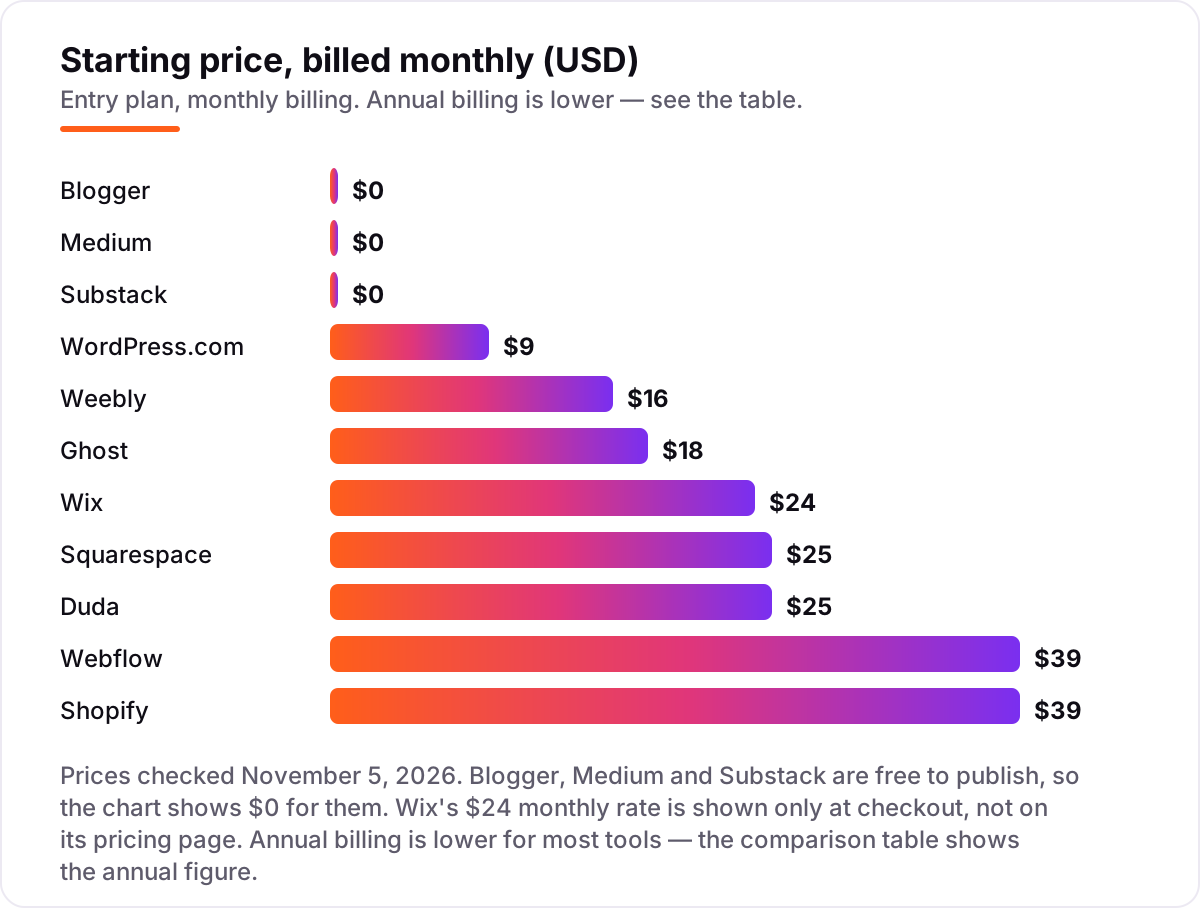
Platforms to start a blog pricing: what you will actually pay
Take a new blogger publishing once a week. On annual billing, the first year costs $0 on Blogger, Medium or Substack, $48 on WordPress.com Personal, $156 on Weebly Personal, $180 on Ghost Starter, $204 on Wix Light, $228 on Squarespace Basic or Duda Basic, $300 on Webflow Premium and $348 on Shopify Basic. Those are the list prices with no discounts applied, and the spread from $0 to $348 is the whole story: the cheapest blog here is free, and the dearest is a store that happens to have a blog.
Paying month to month instead of yearly adds up fast. The same year costs $108 on WordPress.com Personal, $192 on Weebly Personal, $216 on Ghost Starter, $288 on Wix Light, $300 on Squarespace Basic or Duda Basic, $468 on Webflow Premium and $468 on Shopify Basic. Annual billing saves $60 on WordPress.com, $72 on Ghost, $84 on Wix, $168 on Webflow and $120 on Shopify — real money for a blog that earns nothing yet. The one exception is the free trio, where the bill is $0 either way.
Three costs sit outside every number above. First, the renewal price: WordPress.com Personal renews at $5 a month billed yearly, not $4, so budget on the renewal from year two. Second, the domain: a custom domain is free for the first year on most annual plans, then roughly $10 to $15 a year from a registrar — except on Blogger, where connecting your own domain is free and you pay only the registrar. Third, the revenue share: Substack keeps 10% of paid subscriptions plus Stripe fees, and Medium needs a $5-a-month membership before you can earn at all, so a blog that starts earning pays the platform in a different currency. If the blog is meant to rank, not just to exist, compare the SEO side in our guide to the best SEO blog platform.
One more cost to check before you commit: the second site. Wix, Squarespace, Webflow, Duda and Shopify all price per site, so a second blog is a second subscription — Duda Basic covers one published site, and a second costs another $19 a month billed yearly. WordPress.com, Ghost and Weebly price per site too. Only the free platforms let you run a second blog for nothing, which is one more reason to start free and pay once the blog has proven it deserves a budget.
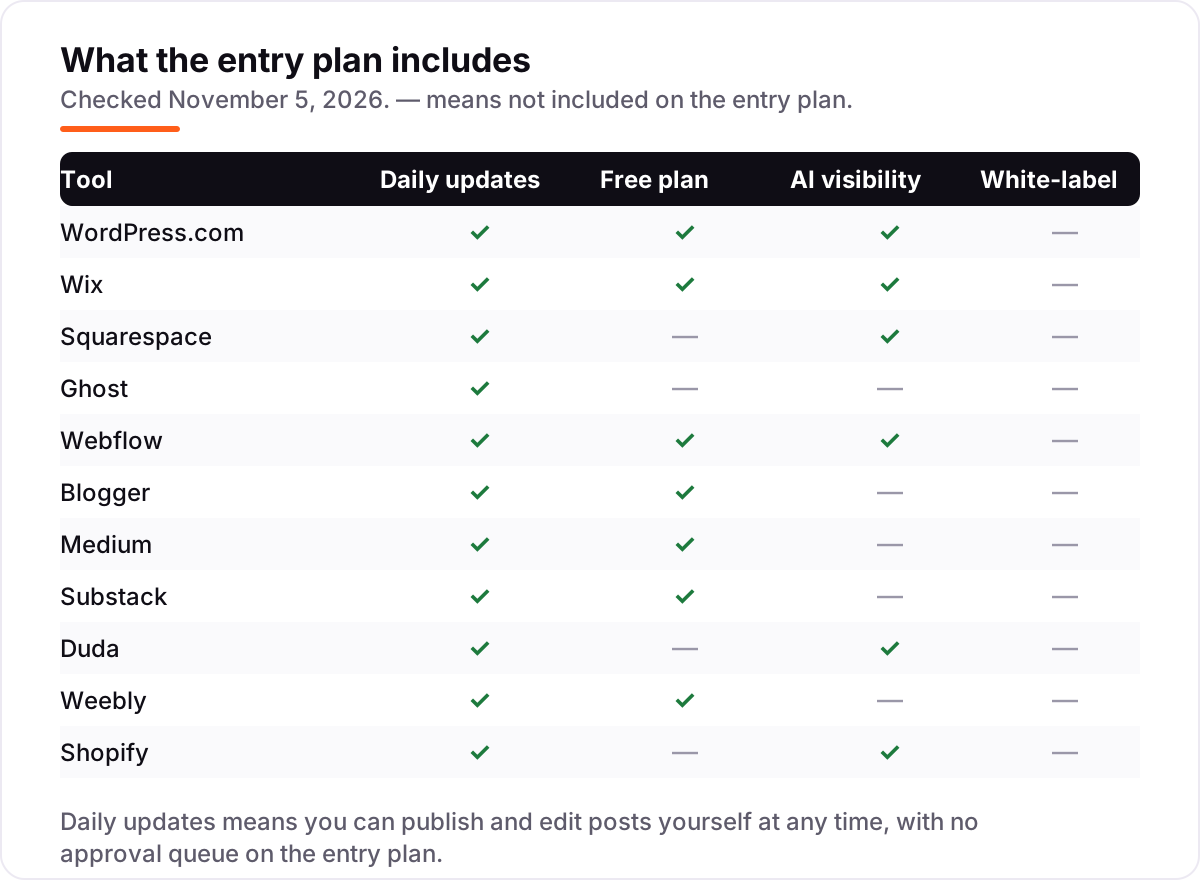
Know the difference: a hosted platform vs a site you own
The confusion in this category is between renting and owning. A hosted platform — WordPress.com, Wix, Squarespace, Ghost(Pro), Webflow, Duda, Weebly, Shopify — runs the servers, the security and the updates, and you pay a monthly fee for that. A site you own, in the full sense, is self-hosted WordPress or self-hosted Ghost: the software is free, you pick the host, and you are responsible for updates, backups and security. The hosted platforms in this list are the middle ground most new bloggers should start on.
There is a second, quieter distinction: an audience platform versus a site platform. Medium and Substack are audience platforms — they bring readers, but the readers belong to them, the algorithm decides who sees a post, and leaving means starting over with no list unless you exported it. WordPress.com, Ghost, Webflow and the other site platforms give you a site with an address you control, and the readers you earn are yours to email, retarget or move.
A third distinction worth knowing is free versus free to publish. Blogger, Medium and Substack are free to publish with no monthly bill, but the costs appear elsewhere: Medium charges $5 a month before you can earn, Substack takes 10% of what you earn, and Blogger costs you design freedom and momentum. WordPress.com, Wix and Weebly have free plans too, but the free plan is a trial of the paid product — ads, a subdomain and missing features are the price. Free is a starting point in every case, not a business model.
Quick comparison: tool type by need
| Buyer | Best pick | Why |
|---|---|---|
| Most new bloggers | WordPress.com | Free plan to start, Personal is $4/month billed yearly, plugins on every paid plan |
| Absolute beginner | Wix | Easiest drag-and-drop editor, Light is $17/month billed yearly |
| Design-led blog | Squarespace | Most polished templates, Basic is $19/month billed yearly |
| Newsletter-first writer | Ghost | Cleanest editor with memberships built in, Starter is $15/month billed yearly |
| Zero budget, just write | Blogger | Completely free, including hosting and your own AdSense |
| Blog that sells products | Shopify | Strongest store platform here, Basic is $29/month billed yearly |
Mistakes to avoid
- Buying on the annual price, then paying monthly. The monthly rate is always higher — $9 instead of $4 on WordPress.com Personal, $39 instead of $25 on Webflow Premium. If you are sure about the platform, pay yearly; if you are not, stay on the free plan instead.
- Starting on a platform you cannot leave. Wix has no clean export, so a blog that outgrows it has to be rebuilt by hand. Check the export before you publish your fiftieth post, not after.
- Picking Webflow Basic for a blog. Basic has no CMS, so there is no blog at all on the $15-a-month plan — the real starting price for a Webflow blog is Premium at $25 a month billed yearly.
- Counting Medium or Substack as free money. Medium needs a $5-a-month membership before you can earn, and Substack keeps 10% of paid subscriptions plus Stripe fees. Free to publish is not free to earn.
- Forgetting the second site. Every paid platform here prices per site. A second blog is a second subscription, so price the second blog before you commit to a platform for the first.
How we chose
We verified each price against the vendor's own pricing page on November 5, 2026, using fresh search-index copies of those pages crawled within the last few days and cross-checked against independent October 2026 reads of the same pages, because direct page loads were blocked that day. Wix's $24 monthly Light rate is shown only at checkout, not on its pricing page, so we disclose it as a checkout figure. Ratings come from fresh copies of each tool's G2 review page; Blogger, Medium and Weebly carry no rating here because G2 has no standalone listing for Google Blogger or Medium, and Weebly's listing has been folded into Square Online. We ranked the tools by fit for the most common buyer — a new blogger publishing weekly who wants to be found on Google and keep the option of earning later — not by brand size. No vendor paid for a place in this list, and none of the links here are affiliate links.
What to do next
Start on the free plan or trial of your top pick and publish four real posts before you pay anything. Check that the editor suits you, that the blog looks right on a phone, and that you can export your posts. If the blog is for a business and new customers are not finding you, our monthly SEO service handles the visibility side — or compare providers in our guide to SEO companies for small business. Once your tools are in place, find out what's holding your rankings back.
Your stack only works if people find you
SerpAstra fixes what keeps your site off page one and makes it easy for AI assistants to recommend.
Get a free audit→Sources we checked (19)
- WordPress.com pricing — wordpress.com/pricing (checked November 5, 2026)
- Wix pricing — wix.com/pricing (checked November 5, 2026)
- Squarespace pricing — squarespace.com/pricing (checked November 5, 2026)
- Ghost pricing — ghost.org/pricing (checked November 5, 2026)
- Webflow pricing — webflow.com/pricing (checked November 5, 2026)
- Blogger — blogger.com (free platform; no pricing page) (checked November 5, 2026)
- Medium membership — medium.com/plans (checked November 5, 2026)
- Substack pricing — substack.com/pricing (checked November 5, 2026)
- Duda pricing — duda.co/pricing (checked November 5, 2026)
- Weebly pricing — weebly.com/pricing (checked November 5, 2026)
- Shopify pricing — shopify.com/pricing (checked November 5, 2026)
- WordPress.com reviews — G2 (checked November 5, 2026)
- Wix reviews — G2 (checked November 5, 2026)
- Squarespace reviews — G2 (checked November 5, 2026)
- Ghost reviews — G2 (checked November 5, 2026)
- Webflow reviews — G2 (checked November 5, 2026)
- Substack reviews — G2 (checked November 5, 2026)
- Duda reviews — G2 (checked November 5, 2026)
- Shopify reviews — G2 (checked November 5, 2026)
Shamim
Founder of SerpAstra
A full-stack SEO and digital marketer who spends most days on Local SEO for dental practices, AI search visibility and lead generation.
Frequently asked questions
What is the best platform to start a blog?
WordPress.com is the best fit for most new bloggers: a free plan to start, Personal at $4 a month billed yearly, and plugins on every paid plan. Wix is the easiest editor if you want drag-and-drop, and Ghost is the best pick when the newsletter is the product. Start free, publish weekly for a month, and only then pay for a plan.
How much does it cost to start a blog?
From $0 to $39 a month. Blogger, Medium and Substack cost nothing to publish, and WordPress.com, Wix and Weebly all have free plans. The first paid plans run $4 to $39 a month billed yearly. Over a year on annual billing, a new blogger pays $0 on a free platform, $48 on WordPress.com Personal, or $348 on Shopify Basic.
Can I really start a blog for free?
Yes, with limits. Blogger is completely free with hosting included, Medium and Substack cost nothing to publish, and WordPress.com, Wix and Weebly all offer free plans. The trade is usually a platform subdomain, platform ads, or no custom domain. A custom domain costs roughly $10 to $15 a year from a registrar on the platforms that allow it free.
Which platform is best for making money from a blog?
It depends how you earn. Ghost Publisher at $29 a month billed yearly keeps 0% of subscription revenue, and Substack takes 10% but charges no monthly fee. Medium pays from member reading time but needs a $5-a-month membership to earn. Shopify fits blogs that sell products, and Blogger lets you keep your own AdSense money.
Can I move my blog to another platform later?
Usually, but the effort varies a lot. WordPress.com, Ghost, Medium and Substack all export posts or subscriber lists, so moving is a weekend job. Wix has no clean export, so moving a Wix blog means rebuilding it. Blogger exports too, but its themes and gadgets do not travel. Pick a platform with an export before the blog grows.
Do I need a custom domain to start a blog?
No. Every free plan here gives you a platform subdomain, such as yourname.wordpress.com or yourname.blogspot.com, and that is enough to start publishing. Buy a custom domain when the blog has a name worth keeping: it costs roughly $10 to $15 a year, it is free for the first year on most annual plans, and it makes a later move far easier.
Free SEO and AI visibility audit
Find out what is holding your rankings back
Send us your site. Within 2 business days you get a written audit, an AI visibility check and a short fix list ranked by impact. Free, with no contract attached.
Request my free audit→Related guides
 SEO & AI Search12 Best Blogging Platforms for SEO in 2026 (Pros, Cons and Pricing)Compare the best blogging platform for SEO for your budget: 12 platforms ranked on price, SEO controls and ownership, from free WordPress to Ghost and Webflow.Read guide →
 SEO & AI Search10 Best SEO Blog Platforms for 2026 (Pros, Cons and Pricing)10 best SEO blog platforms compared on price, SEO controls, ownership and audience reach. Prices checked on each vendor's pricing page, November 1, 2026.Read guide →
 SEO & AI Search9 Best WordPress SEO Plugins in 2026 (Free and Paid, Compared)The 9 best WordPress SEO plugins compared on price, free plans, AI help and schema, for bloggers and small businesses. Prices checked November 2, 2026.Read guide →