
7 Best Pricing Software in 2026, Compared
Compare the 7 best pricing software tools for competitor price tracking, repricing and price optimization, with published plans and quote-only tools marked.
 Shamim Mia, Founder, SerpAstraLast verified November 5, 20268 min read
We compare pricing pages, documentation and public reviews. We never accept payment for rankings.
Key takeaways
- Pricing software splits into two jobs: competitor price tracking with repricing rules for online sellers, and AI price optimization for retailers and B2B companies with pricing teams.
- Prisync, Price2Spy and Pricefy publish their prices — from $49 a month on Pricefy Starter, with a free plan for 50 SKUs — and suit small and mid-size stores.
- Competera, Pricefx, Wiser Solutions and Intelligence Node are quote-only platforms for large catalogues, B2B deal pricing or global retail data.
- Check which plan unlocks repricing: Pricefy starts it on Pro at $99 a month and Price2Spy sells it as a paid add-on, so the entry price is rarely the working price.
On this page
Quick comparison
| Tool | Best for | Starting price | Free plan |
|---|---|---|---|
| Prisync | Online stores that want competitor price tracking and repricing at a published price | $99/mo | No (14-day trial) |
| Price2Spy | Retailers that want frequent competitor checks and repricing on a modular budget | $78.95/mo | No (30-day trial) |
| Pricefy | Small stores that want to test price tracking free before paying for repricing | Free; $49/mo | Yes (free plan) |
| Competera | Large retailers that want AI price recommendations across big catalogues | Custom quote | No (demo) |
| Pricefx | B2B manufacturers and distributors managing list prices, deal quotes and rebates | Custom quote | No |
| Wiser Solutions | Mid-market and enterprise brands that want pricing data inside wider commerce intelligence | Custom quote | No (demo) |
| Intelligence Node | Global retailers and brands that want competitor pricing plus digital shelf data | Custom quote | No (demo) |
Make one of these tools?
We re-check this list every quarter. Send a correction, request a review, or ask about a clearly labeled sponsored spot.
Request a listingThe best pricing software

Prisync
Best for: Online stores that want competitor price tracking and repricing at a published price
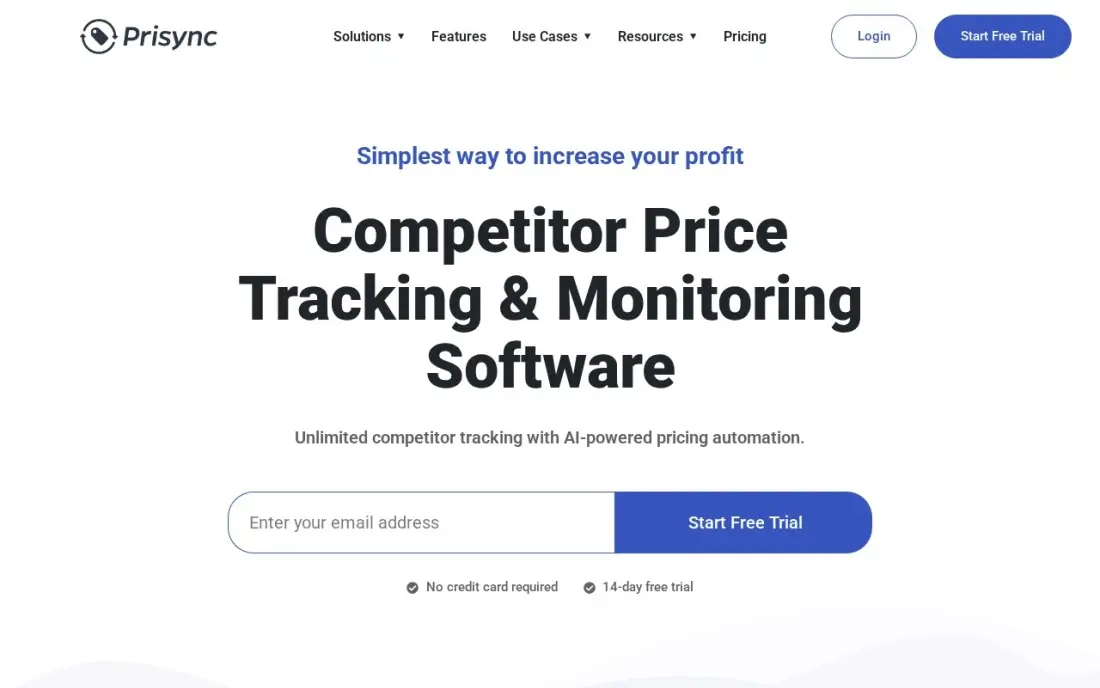
Prisync is the clearest starting point for an ecommerce store that prices against competitors. It tracks unlimited competitors per product, refreshes prices three times a day, and shows where each product sits against the market, with stock monitoring included from the entry plan. Higher tiers add a dynamic pricing engine that turns those comparisons into price rules.
Pricing is published and scales by catalogue: $99 a month for 100 products, $199 for 1,000 and $399 for 5,000, with a 14-day free trial. API access costs 20% extra on every plan, and URL-based plans mean adding competitor links by hand. It holds 4.7 out of 5 on G2 from 170 reviews.
What we like
- Published plans make budgeting simple: $99 for 100 products, $199 for 1,000, $399 for 5,000
- Prices refresh three times a day with unlimited competitors on every plan
- Stock monitoring and price-position comparison included from the entry plan
- Rated 4.7/5 on G2 from 170 reviews, with support reviewers praise most
Watch out for
- MAP monitoring waits for the Platinum plan at $399/month — the $99 entry plan does not include it
- API access costs 20% extra on every plan
- URL-based plans need you to add competitor links by hand
Price2Spy
Best for: Retailers that want frequent competitor checks and repricing on a modular budget
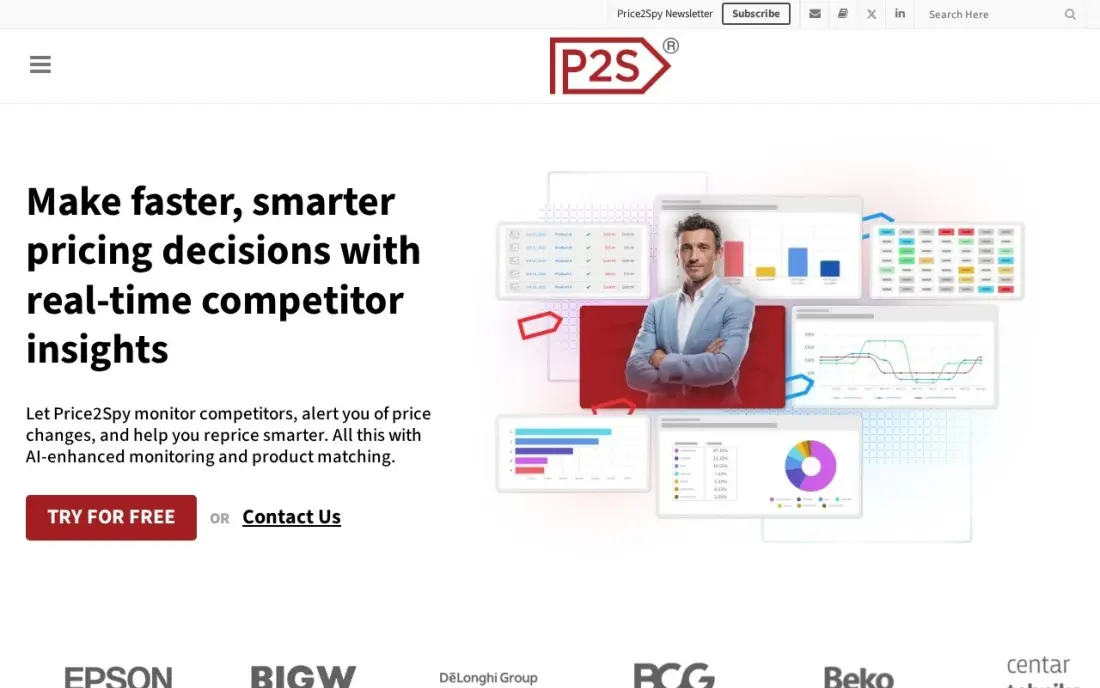
Price2Spy monitors competitor and marketplace prices across 40+ countries, checks up to eight times a day on higher plans, and includes repricing in the same platform, so a retailer can move from watching prices to changing them. Marketplace seller tracking shows which sellers undercut you. It has the highest G2 score in this list, 4.8 out of 5 from 110 reviews.
The base plan costs $78.95 a month billed monthly and scales with the number of product URLs, with a 30-day free trial. Automatch and repricing are paid add-ons, so the plan that matches a real repricing workflow costs more than the base price, and onboarding can take a week to a month.
What we like
- Monitors competitor and marketplace prices across 40+ countries, with repricing in the same platform
- Price checks up to eight times a day on higher plans
- Marketplace seller tracking shows exactly which sellers undercut your prices
- Rated 4.8/5 on G2 from 110 reviews, the highest score in this list
Watch out for
- Automatch and repricing are paid add-ons, so the $78.95 base price is not the full cost for most buyers
- Setup and onboarding can take a week to a month
- No free plan — only the 30-day trial

Pricefy
Best for: Small stores that want to test price tracking free before paying for repricing
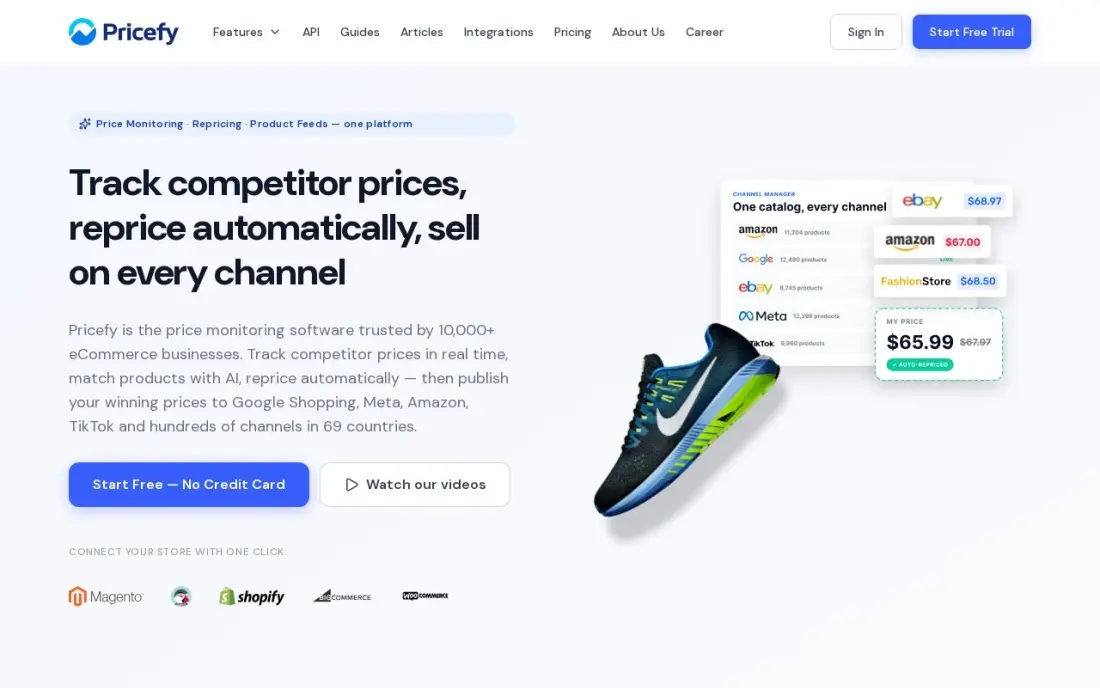
Pricefy is the cheapest way into pricing software. The free plan covers 50 SKUs with AI automatch, competitor discovery and daily price updates, and Starter costs $49 a month for 100 SKUs with prices refreshed every 12 hours and native Amazon, eBay and Google coverage. The full REST API comes with every paid plan at no extra charge.
Read the tiers before you count on repricing: dynamic repricing starts on Pro at $99 a month, not on Starter, and MAP monitoring on Business at $189. For a small store that wants to see competitor prices this week and automate later, it is the lowest-risk start.
What we like
- The only free forever plan in this list: 50 SKUs with AI automatch and daily updates at $0
- AI automatch claims 92–95% accuracy, so setup does not mean pasting URLs by hand
- Full REST API included on every paid plan, with no surcharge
- Paid plans refresh prices every 12 hours with native Amazon, eBay and Google coverage
Watch out for
- MAP and MSRP monitoring start on Business at $189/month — the $49 Starter plan does not include them
- Free plan covers only 50 SKUs, so a real catalog outgrows it fast
- Dynamic repricing starts on Pro at $99/month, not on Starter

Competera
Best for: Large retailers that want AI price recommendations across big catalogues
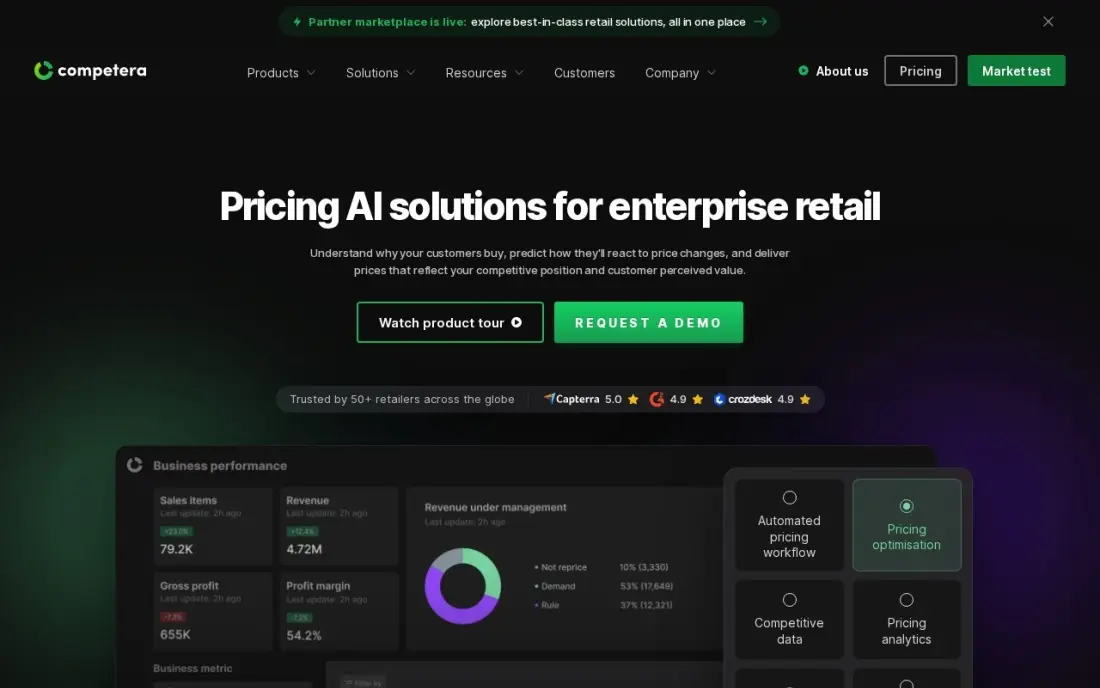
Competera is price optimization, not just price tracking. It combines competitor data with AI recommendations built on more than 20 pricing drivers, including demand elasticity, so a retailer can set prices that protect margin rather than simply match the cheapest rival. It is used by large grocery, electronics and apparel retailers.
It publishes no pricing and sells through demos and custom quotes, and the optimization scope needs careful scoping before you sign. Built for enterprises with dedicated pricing teams, it is too heavy for a store with a few hundred products, but it fits a retailer managing tens of thousands of prices every week.
What we like
- AI price recommendations built on 20+ pricing drivers, not just competitor matching
- Demand elasticity is among its pricing drivers, so prices protect margin instead of chasing rivals
- Built for retailers managing tens of thousands of prices every week
- Proven with large grocery, electronics and apparel retailers
Watch out for
- No published pricing — Competera sells by custom quote
- Built for enterprises with dedicated pricing teams, so it is overkill for a small brand
- Optimization scope needs careful scoping on a demo before you sign

Pricefx
Best for: B2B manufacturers and distributors managing list prices, deal quotes and rebates

Pricefx is pricing software for B2B companies, where prices are set through price lists, negotiated deals and rebates rather than a shelf tag. It handles price management, AI recommendations for list prices and deals, quoting, agreements, promotions and rebate accrual and payouts, and it connects to ERP, CRM and quoting systems. Pre-built AI agents flag margin risks in commercial data.
Pricefx publishes no prices; its pricing page leads to a demo request and a contracts hub. That fits its buyers: manufacturers and distributors with a pricing team and thousands of customer-specific prices. An online store that mainly needs competitor tracking will get more value from Prisync or Pricefy.
What we like
- Covers B2B price management, AI price optimization, quoting and rebates in one platform
- Integrates with ERP, CRM and quoting systems
- Pre-built AI agents flag margin risks and opportunities in commercial data
Watch out for
- No published pricing; every deal starts with a demo
- Built for B2B pricing teams, not online stores tracking competitor prices

Wiser Solutions
Best for: Mid-market and enterprise brands that want pricing data inside wider commerce intelligence
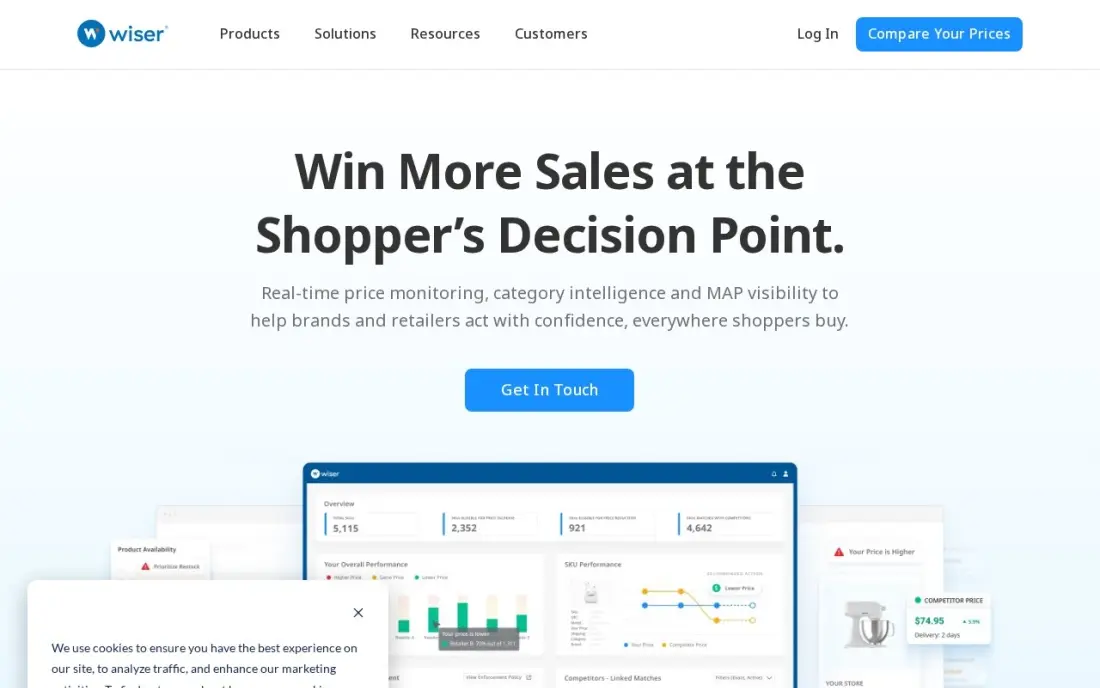
Wiser Solutions puts price monitoring inside a broader commerce intelligence platform, with assortment tracking, promotion analysis and review insights alongside competitor prices. Prices update as often as every 15 minutes across large catalogues, and automated discovery and AI matching reduce the manual work of mapping products to competitor listings.
Wiser publishes no pricing, so the quote depends on catalogue size and channels. G2 reviewers rate it 4.3 out of 5 from 63 reviews, praising support while noting the interface could be easier to navigate, and in-store data relies partly on crowdsourced collection. Choose it when pricing decisions need assortment and promotion context.
What we like
- Assortment tracking, promotion analysis and review insights sit beside competitor prices
- Price updates as often as every 15 minutes across large catalogs
- Automated product discovery and AI-driven matching reduce manual setup
- Used by large brands and retailers, so the data quality is proven at scale
Watch out for
- No published pricing — Wiser sells by custom quote
- Reviewers note the interface could be easier to navigate
- In-store data relies partly on crowdsourced collection, so coverage varies by category

Intelligence Node
Best for: Global retailers and brands that want competitor pricing plus digital shelf data
Intelligence Node pairs competitor price monitoring with digital shelf analytics, showing how products appear across retailers on price, availability and content quality. Its AI matching is built for very large catalogues across many countries, which matters when the same product sells under different titles and pack sizes in each market.
The vendor claims the world's largest pricing dataset, which is worth testing on a demo rather than taking on trust. It publishes no pricing and its onboarding suits large catalogues, so it is a fit for a global retailer or brand, not a single-country store.
What we like
- Pairs competitor price monitoring with digital shelf analytics — pricing, availability and content quality
- AI matching handles massive catalogs across global markets
- Matches the same product even when titles and pack sizes differ between markets
- Claims the world's largest pricing dataset, feeding over $600 billion in retail revenue
Watch out for
- No published pricing — Intelligence Node sells by custom quote
- Enterprise pricing and onboarding suit large catalogs, not small brands
- The world's-largest-dataset claim is the vendor's own, so test it on a demo
The best pricing software tells you what competitors charge, what your customers will pay and what each price does to your margin, then helps you change prices without a spreadsheet. We compared seven tools across two jobs — competitor price tracking with repricing for online sellers, and AI price optimization for large retailers and B2B companies — on data freshness, repricing, coverage and real cost. Every published price comes from the vendor's pricing page as checked in November 2026, and quote-only tools are marked as such.
How to choose the best pricing software
- Name the pricing decision first. Matching competitors on an online catalogue, optimizing margin across thousands of SKUs and setting B2B deal prices need different tools.
- Check how products are matched. URL-based matching means pasting competitor links by hand; AI automatch saves setup time but needs checking for accuracy.
- Confirm the refresh rate. Daily updates suit most stores; fast-moving marketplaces may need checks several times a day.
- Find the plan that actually reprices. On several tools, repricing sits on a higher tier or costs extra.
- Count SKUs honestly. Most published plans price by product count, so include variants and future range growth.
- Plan the integration. Recommended prices are only useful if they reach your store, ERP or quoting tool without manual copying.
Price is one lever; visibility is another. A product that ranks in search can hold a fair price instead of chasing the cheapest rival. If your store needs that side handled, our monthly SEO service covers it, and our guide to the best minimum advertised price software covers the MAP enforcement side of pricing for brands.
Pricing software pricing: what you will actually pay
Take a store with 900 products that wants competitor tracking now and repricing within a few months. On Prisync, 900 products need the $199-a-month plan for 1,000 products, or $2,388 a year, with API access 20% extra. Pricefy Starter costs $49 a month but covers only 100 SKUs and does not reprice; repricing starts on Pro at $99 a month. Price2Spy's base plan costs $78.95 a month billed monthly, or $947.40 a year, before the Automatch and repricing add-ons.
A smaller store with 50 products can start on Pricefy's free plan at $0 and stay there until it needs more SKUs or faster updates.
The enterprise platforms work differently. Competera, Pricefx, Wiser Solutions and Intelligence Node publish no prices and quote by catalogue size, channels and modules. Ask for the first-year cost including onboarding, and for the cost of each additional market or product category, before you compare them with a published-price tool.
Know the difference: competitor price tracking vs price optimization
Competitor price tracking answers what everyone else charges. Prisync, Price2Spy and Pricefy scan competitor sites and marketplaces, match your products to theirs and alert you to changes, and their repricing rules move your price relative to the market — for example, a set percentage below the cheapest in-stock rival. It is fast to set up and pays off quickly for stores that sell the same products as competitors.
Price optimization answers what you should charge. Competera and Pricefx model demand, elasticity, costs and margin targets and recommend prices that maximise profit, not just match the market. For B2B, Pricefx also manages customer-specific price lists, quotes and rebates. These platforms take longer to implement and need a pricing team, but they work on products no competitor sells identically.
Quick comparison: tool type by need
| Buyer | Best pick | Why |
|---|---|---|
| Growing online stores | Prisync | Published plans from $99/month for 100 products, unlimited competitors |
| Retailers wanting frequent checks | Price2Spy | Up to 8 checks a day, base plan $78.95/month billed monthly |
| Small stores testing the idea | Pricefy | Free plan for 50 SKUs, Starter $49/month |
| Large retail catalogues | Competera | AI price optimization on 20+ pricing drivers, custom quote |
| B2B manufacturers and distributors | Pricefx | Price lists, deal quotes and rebates in one platform, custom quote |
| Brands needing commerce context | Wiser Solutions | Pricing with assortment and promotion data, updates every 15 minutes |
| Global retailers and brands | Intelligence Node | Competitor pricing plus digital shelf analytics, custom quote |
Mistakes to avoid
- Racing to the bottom. Repricing rules that always undercut the cheapest rival destroy margin; set a floor price for every product.
- Trusting automatch blindly. A wrong product match leads to a wrong price; spot-check matches before switching on automatic repricing.
- Buying optimization without clean cost data. Margin-based recommendations are only as good as the cost and sales history you feed in.
- Ignoring MAP agreements. Brands may enforce minimum advertised prices; repricing below them can cost you supply.
- Changing prices with no test. Run a price change on one category first and compare sales and margin before rolling it out.
Related comparisons: AI Pricing Tools
How we chose
We checked each vendor's own pricing page in November 2026 and recorded published starting prices exactly as shown, including the billing period. We grouped tools by the pricing job they do — competitor tracking and repricing, retail optimization, B2B price management and market intelligence — and ranked them by fit for the most common buyer, an online store with a few hundred to a few thousand products. Quote-only vendors are listed as custom quote rather than with third-party estimates. Ratings come from G2 pages checked on the dates shown in the sources. No vendor paid for a place in this list, and none of the links here are affiliate links.
What to do next
Start a free plan or trial with your 50 best-selling products, track your top three competitors for two weeks and note how often prices move before you pay for repricing. If the products are priced right but still not found, book a free strategy call.
Frequently asked questions
What is the best pricing software?
For online stores, Prisync is the best all-round pick with published plans from $99 a month for 100 products, and Pricefy is the cheapest start with a free plan for 50 SKUs. For large retailers, Competera offers AI price optimization, and for B2B manufacturers and distributors, Pricefx covers price lists, quotes and rebates.
Is there free pricing software?
Pricefy has a free plan covering 50 SKUs with daily price updates. Prisync offers a 14-day free trial and Price2Spy a 30-day free trial. Competera, Pricefx, Wiser Solutions and Intelligence Node are sold through demos.
How much does pricing software cost?
Published prices run from $49 a month for Pricefy Starter to $78.95 a month billed monthly for Price2Spy's base plan and $99 a month for Prisync Professional. Enterprise optimization platforms such as Competera and Pricefx are quote-only.
What is the difference between repricing and price optimization?
Repricing changes prices by rules, such as staying a set amount below a competitor. Price optimization uses demand, elasticity and margin data to recommend the price that earns the most, which is what Competera and Pricefx are built for.
Does pricing software work for B2B companies?
Yes, but B2B needs different tools. Competitor trackers suit online catalogues; B2B companies with price lists, negotiated deals and rebates need a platform such as Pricefx that handles customer-specific prices and quoting.
How often should pricing software check competitor prices?
Daily is enough for most stores. Prisync refreshes three times a day, Pricefy every 12 hours on paid plans, Price2Spy up to eight times a day on higher plans and Wiser as often as every 15 minutes.
Sources we checked (10)
- Prisync — prisync.com/pricing (checked November 5, 2026)
- Prisync reviews on G2 (checked November 5, 2026)
- Price2Spy — www.price2spy.com/pricing (checked November 5, 2026)
- Price2Spy reviews on G2 (checked November 5, 2026)
- Pricefy — pricefy.io/pricing (checked November 5, 2026)
- Competera — competera.net (checked November 5, 2026)
- Pricefx — www.pricefx.com/pricing (checked November 16, 2026)
- Wiser Solutions — wiser.com (checked November 5, 2026)
- Wiser Solutions reviews on G2 (checked November 5, 2026)
- Intelligence Node — intelligencenode.com (checked November 5, 2026)
Make one of these tools?
We re-check this list every quarter. Send a correction, request a review, or ask about a clearly labeled sponsored spot.
Request a listingShamim
Founder of SerpAstra
A full-stack digital marketer and SEO strategist covering technical and local SEO, AI search visibility, paid ads and lead generation for local businesses, e-commerce brands and SaaS teams.
Free SEO and AI visibility audit
Find out what is holding your rankings back
Send us your site. Within 2 business days you get a written audit, an AI visibility check and a short fix list ranked by impact. Free, with no contract attached.
Request my free audit→Related buying guides
 Ecommerce12 Best Minimum Advertised Price Software in 2026, ComparedCompare the 12 best minimum advertised price software tools in detail on price, enforcement and evidence, with every price checked November 5, 2026.Read guide →
 Ecommerce7 Best B2B Ecommerce Platforms in 2026, ComparedCompare the 7 best B2B ecommerce platforms on company accounts, price lists, ERP links and real cost, with every price checked on the vendor's own pricing page.Read guide →
 Sales & CRM8 Best Sales Analytics Tools in 2026, ComparedCompare the 8 best sales analytics tools, from CRM reporting to call intelligence and KPI dashboards, on forecasting, data sources and real per-user price.Read guide →