
9 Best Programmatic Ad Platforms for 2026 (Pros, Cons and Pricing)
Compare the 9 best programmatic ad platforms for 2026 on price, minimum spend, free plans and channels, with every price checked November 5, 2026.
 Shamim Mia, Founder, SerpAstraLast verified November 5, 202613 min read
We compare pricing pages, documentation and public reviews. We never accept payment for rankings.
Key takeaways
- StackAdapt leads this list at 4.7/5 on G2 with no minimum spend; The Trade Desk follows as the leading independent DSP, and Choozle is the only tool with a published price, at $99/month.
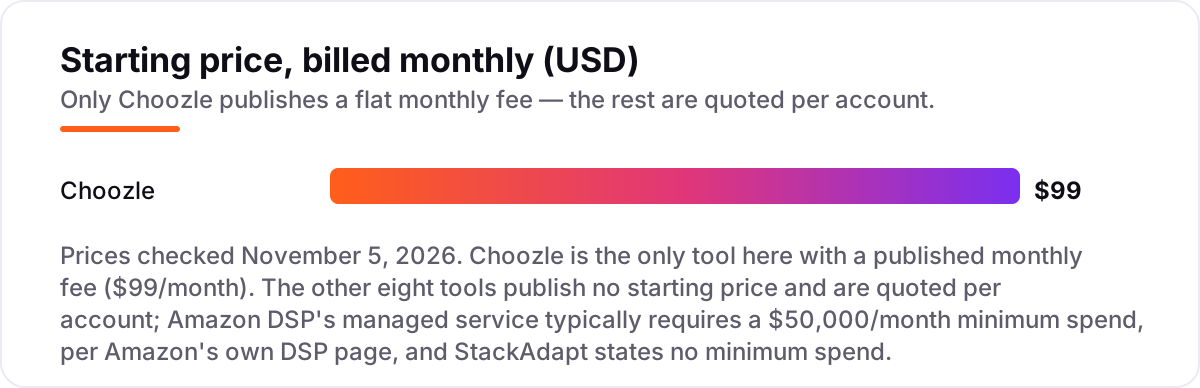
- Eight of the nine tools publish no starting price at all — they quote per account — so the real entry test is the minimum spend, not the subscription fee.
- The single most important buying factor is your monthly media budget: below about $5,000 a month, only the self-serve tools with no minimum are a sensible buy.
- Amazon DSP is the only platform here that publishes a minimum: managed service typically requires $50,000 a month, per Amazon's own DSP page, while self-service has no stated minimum.
On this page
Quick comparison
| Tool | Best for | Starting price | Free plan |
|---|---|---|---|
| StackAdapt | Mid-market agencies and in-house teams that want a self-serve DSP with no minimum spend | $0 platform fee | No |
| The Trade Desk | Enterprise brands and large agencies buying the open internet at scale | Custom quote | No |
| Google Display & Video 360 | Enterprise teams already deep in Google's stack who need YouTube inventory programmatically | Custom quote | No |
| Amazon DSP | Brands selling on Amazon, or any brand that wants Amazon's shopping signals behind its prospecting | Custom quote | No |
| Basis | Agencies that want planning, buying, billing and reporting in one system | Custom quote | No |
| Simpli.fi | Local and regional advertisers who need precise geo-fencing and hyperlocal targeting | Custom quote | No |
| AdRoll | Ecommerce and DTC brands that want retargeting and brand-awareness ads with no minimum spend | Free to start | Yes (free to start) |
| MNTN | DTC brands that want performance TV measured like digital | Custom quote | No |
| Choozle | Small agencies and in-house teams that want a simple self-serve DSP with a flat monthly fee | $99/mo | No |
Make one of these tools?
We re-check this list every quarter. Send a correction, request a review, or ask about a clearly labeled sponsored spot.
Request a listingThe best programmatic ad platforms

StackAdapt
Best for: Mid-market agencies and in-house teams that want a self-serve DSP with no minimum spend
StackAdapt is the most accessible full DSP in this list: a self-serve platform with no minimum spend, five plan tiers, and buying across native, display, video, connected TV, audio, digital out-of-home and in-game inventory from one interface. Its own plans page says most teams hit their stride around $5,000 a month in media, and fees are built into the CPM rather than charged as a separate platform fee.
The catch is access and transparency. Self-serve accounts go through an application and approval process, and StackAdapt publishes no rate card, so you cannot benchmark your CPMs against a list price. Managed support and the creative studio sit on the higher tiers. Pick StackAdapt when you want a real DSP without an enterprise contract; pick The Trade Desk or DV360 when your budget is large enough to justify their sales-led route.
What we like
- No minimum spend to get started, and fees are built into the CPM rather than charged separately
- Seven channels in one interface: native, display, video, connected TV, audio, digital out-of-home and in-game
- Highest G2 rating in this list at 4.7/5, with a 9.9/10 support score from reviewers
- Self-serve by credit card on the Basic tier, with managed options as spend grows
Watch out for
- Self-serve access goes through an application and approval process, not instant signup
- No published rate card, so you cannot benchmark your CPMs against a list price
- Managed support and the creative studio sit on the higher tiers

The Trade Desk
Best for: Enterprise brands and large agencies buying the open internet at scale
The Trade Desk is the independent DSP other DSPs are measured against: an omnichannel platform that buys display, video, connected TV, audio and digital out-of-home across the open web, with Kokai AI optimization and UID2 identity resolution built in. Because it owns no media of its own, it has no incentive to steer your budget toward its own inventory — the pitch that wins it enterprise accounts.
The price of that independence is access. There is no published price and no self-serve signup; terms are negotiated per account, and third-party guides report spend commitments far above what a mid-market buyer can reach. Reviewers also flag a steep learning curve. Buy The Trade Desk when your budget is enterprise-scale and you want the open internet without a walled garden; buy StackAdapt when you want a DSP you can start this week.
What we like
- The leading independent DSP, with no walled-garden conflict of interest
- Kokai AI optimization and UID2 identity resolution built into the platform
- Widest open-web reach in this list, across display, video, CTV, audio and digital out-of-home
- Real-time reporting and audience targeting reviewers praise most
Watch out for
- No published prices and no self-serve signup — access is sales-led, with spend commitments
- Steep learning curve: reviewers flag complexity for new users
- Platform, data and verification fees stack on top of media spend

Google Display & Video 360
Best for: Enterprise teams already deep in Google's stack who need YouTube inventory programmatically
Display & Video 360 is Google's enterprise DSP, and it earns its place on one fact alone: it is the only platform that buys YouTube programmatically, including premium YouTube Select inventory. It also covers display, video, audio, TV and digital out-of-home, with unified frequency control, deal buying and automated bidding, all inside Google Marketing Platform.
The trade-off is the walled garden. DV360 is built for Google's ecosystem — Campaign Manager 360, Floodlight, Google Analytics 360 — and its algorithms favor Google-owned supply. Access runs through a direct Google contract or a certified partner, and Google publishes no price. Choose DV360 when YouTube is non-negotiable; choose The Trade Desk when you want the same scale without favoring one company's inventory.
What we like
- The only DSP with programmatic access to YouTube, including YouTube Select
- Unified frequency control and deal buying across display, video, TV, audio and DOOH
- Campaign Manager 360 and Google Analytics 360 integration for measurement
- Automated bidding and inventory recommendations from Google's machine learning
Watch out for
- No published prices — access runs through a Google Marketing Platform contract or a certified partner
- Optimized for Google's ecosystem; its algorithms favor Google-owned supply
- Setup is heavy: Campaign Manager 360 and Floodlight tags are part of the deal

Amazon DSP
Best for: Brands selling on Amazon, or any brand that wants Amazon's shopping signals behind its prospecting
Amazon DSP buys display, video, audio and streaming TV ads using the one signal no other platform has: Amazon's shopping data. You can target people by what they bought, browsed and searched for, across Prime Video, Twitch, Fire TV and thousands of third-party sites — and you do not need to sell on Amazon to use it. Managed service typically requires a $50,000 monthly minimum, per Amazon's own DSP page.
One change to know: in September 2026 Amazon folded DSP into a new platform, Amazon Ads Agent, with a DVA+ campaign type, so the standalone DSP name is being retired while the programmatic capabilities continue. Self-service has no stated minimum, but each audience still needs enough budget to learn. Pick Amazon DSP when purchase intent is the targeting signal that matters most.
What we like
- Amazon's first-party shopping signals — targeting by what people actually bought
- Exclusive inventory: Prime Video, Twitch, Fire TV and Thursday Night Football
- Works for brands that do not sell on Amazon, not just Amazon sellers
- Amazon Marketing Cloud clean-room measurement for deeper attribution
Watch out for
- Managed service typically requires a $50,000/month minimum spend, per Amazon's own DSP page
- In September 2026 Amazon folded DSP into Amazon Ads Agent, so the standalone DSP name is being retired
- Reviewers report slow performance and heavy dependence on Amazon support

Basis
Best for: Agencies that want planning, buying, billing and reporting in one system
Basis, from Basis Technologies, is as much an operating system for media teams as a DSP. Media planning, buying, analytics, billing reconciliation and vendor messaging live in one place, and automation removes the manual busywork that eats agency margins. It buys programmatic, direct, search and social campaigns from a single login, and G2 reviewers give its support 9.5 out of 10.
That breadth is also the consideration. Pricing is entirely quote-based, there is no self-serve tier, and a solo advertiser will not use half of what Basis offers. It shines for agencies managing multiple clients and campaigns who want one system instead of five logins. Pick Basis when the agency's workflow is the bottleneck; pick StackAdapt when the buying itself is the job.
What we like
- Unifies media planning, buying, analytics and billing reconciliation in one place
- Workflow automation removes manual busywork for agencies running many clients
- Strongest support scores in this list after StackAdapt, at 9.5/10 on G2
- Buys programmatic, direct, search and social campaigns from a single login
Watch out for
- Entirely quote-based pricing — no published price or self-serve tier
- More platform than a solo advertiser or small team will use
- Heavy onboarding for teams that only need a buying seat, not an operating system

Simpli.fi
Best for: Local and regional advertisers who need precise geo-fencing and hyperlocal targeting
Simpli.fi is the local advertiser's DSP: geo-fencing, addressable targeting and structured-data audience segments built for campaigns that live or die by location — store visits, service areas, event audiences. It buys display, video, connected TV and audio, offers self-service for experienced marketers, and G2 reviewers report no campaign budget minimum.
The weakness is price transparency. Simpli.fi publishes no prices, every account is a custom quote, and reviewers flag extra fees that surface after signing. Reporting also feels complex to new users. Choose Simpli.fi when location is the targeting signal that matters most; choose StackAdapt when you want the same channels with a clearer path to a first campaign.
What we like
- Geo-fencing and addressable targeting built for local and regional campaigns
- No campaign budget minimum, according to G2 reviewer reports
- Self-service buying for experienced marketers, with managed options too
- Strongest small-business satisfaction in this list, with customer support reviewers praise
Watch out for
- No published prices — every account is a custom quote through sales
- Reviewers flag extra fees and a lack of pricing transparency
- Dashboard and reporting feel complex to new users

AdRoll
Best for: Ecommerce and DTC brands that want retargeting and brand-awareness ads with no minimum spend
AdRoll is the entry point for ecommerce brands: a self-service Ads plan that is free to start, with no platform fee and no fixed minimum — you pay only for the media you buy. It covers retargeting and brand-awareness campaigns across display, native, video and connected TV, with dynamic ads that pull products from your store and integrations for Shopify, WooCommerce and BigCommerce.
The limits are scope and transparency. AdRoll's own pricing page lists no dollar amounts, so paid tiers are quoted rather than published, and social ads and cross-channel attribution are paid add-ons. Managed services need qualifying ad spend. Pick AdRoll when you sell products online and want retargeting running this week; pick StackAdapt when you need a full DSP across seven channels.
What we like
- Free to start: the self-service Ads plan has no platform fee — you pay only for media
- Pay-as-you-go with no fixed minimum, so any DTC brand can start
- Deep ecommerce integrations: Shopify, WooCommerce, BigCommerce and Klaviyo
- Dynamic ads and AI Assistant for creative and audience work
Watch out for
- AdRoll's own pricing page lists no dollar amounts — paid tiers are quoted, not published
- Social ads and cross-channel attribution are paid add-ons, not included
- Managed services need qualifying ad spend, so small accounts stay self-serve

MNTN built the performance-TV category: streaming commercials bought and measured like digital ads, across more than 150 premium networks, with Verified Visits attribution that matches site visits to exposed households. Its own help center says there are no separate fees for services or technology — MNTN retains a portion of media spend as a margin — and QuickFrame AI can produce TV-ready creative without an agency.
The minimum is the filter. Third-party guides report a $5,000 monthly practical minimum, and because the platform fee is bundled into media, you cannot see exactly what the margin is. Attribution is view-through unless you set up more rigorous measurement. Pick MNTN when streaming TV is the channel and outcomes are the metric; pick StackAdapt when you want TV as one channel among seven.
What we like
- Highest G2 rating in this list at 4.8/5, from 61 reviews
- Verified Visits attribution ties TV exposure to site visits
- QuickFrame AI builds TV-ready creative without an agency
- No separate platform or technology fees — MNTN's margin sits inside the media cost
Watch out for
- No published prices — everything is a dynamic CPM quote through sales
- Third-party guides report a $5,000/month practical minimum, which prices out small testers
- Platform fee is bundled into media rather than broken out, so the margin is opaque

Choozle
Best for: Small agencies and in-house teams that want a simple self-serve DSP with a flat monthly fee
Choozle is the simplest DSP in this list: a self-serve platform with one flat subscription of $99 a month, stated on its own help center, and a clean interface a small team can run without a trader. It buys display, video, mobile and audio, with audience targeting and campaign reporting, and the first account balance starts at $500.
Read the fine print before the fee. Choozle expects about $15,000 in media spend per quarter, so the $99 is the smallest part of the bill, and reviewers say reporting and bulk editing lag the bigger DSPs. There is no free plan and no free trial. Pick Choozle when you want one predictable platform fee and a simple interface; pick StackAdapt when you want more channels and no quarterly media expectation.
What we like
- The only published monthly price in this list: a flat $99/month subscription
- Simple self-serve interface that small teams can run without a trader
- Audience targeting across display, video, mobile and audio from one login
- $500 minimum first account balance keeps the first test affordable
Watch out for
- Choozle expects about $15,000 in media spend per quarter, on top of the $99 fee
- Reporting and bulk editing lag the bigger DSPs, reviewers say
- No free plan and no free trial — the $99 fee starts in month one
The best programmatic ad platforms buy display, video and connected TV ads automatically, in real time, across thousands of sites and apps — and the nine below cover every budget, from a free-to-start self-serve plan to enterprise DSPs that only quote by sales call. We ranked them by fit for the most common buyer, a mid-market advertiser or agency, and every price was checked on the vendor's own page on November 5, 2026.
How to choose the best programmatic ad platforms
- Start with your monthly media budget. Below about $5,000 a month, only the self-serve tools with no minimum — StackAdapt, AdRoll and Simpli.fi — are a sensible buy. Above $50,000, the enterprise DSPs open up.
- Decide who runs it. Self-serve tools suit an in-house team; The Trade Desk, DV360 and Basis assume a trader or an agency. If nobody on your team has run programmatic before, managed service or a simpler platform is the honest choice.
- Match the platform to the inventory you need. Only DV360 buys YouTube programmatically. Only Amazon DSP has Amazon's shopping signals. Only MNTN is built around streaming TV. The rest compete on the open web.
- Ask what the fee covers. Some platforms charge a percentage of spend, some build the fee into the CPM, and some charge a flat subscription. Get the full fee stack in writing before you sign — platform, data, verification and management.
- Check the minimum behind the headline price. A $99 monthly fee means little next to a $15,000 quarterly media expectation, and a free-to-start plan still needs media budget to learn.
One practical note: programmatic buying rewards clean tracking. Before you launch, tag every landing page with UTM parameters so you can tell which platform drove the visit — our free UTM builder creates them in seconds. And if display is only one part of your plan, our guide to the best display advertising software covers the creative and testing side. Whatever you shortlist, run one real campaign before you commit to a contract: a month of live data tells you more about a DSP than any demo.
Programmatic ad platform pricing: what you will actually pay
Take a $5,000 monthly media budget. On Choozle you pay $99 a month in platform fees plus $5,000 in media, which is $5,099 a month — and $5,000 a month is exactly the $15,000 quarterly media level Choozle expects, so the budget fits but leaves no room to scale down. On StackAdapt there is no platform fee at all: fees are built into the CPM, so the $5,000 is all media, and StackAdapt itself says most teams hit their stride around $5,000 a month. On AdRoll the same applies — free to start, pay only for media — so the full $5,000 buys impressions.
MNTN is the same shape with a different catch: dynamic CPM with the margin inside the media cost, and third-party guides report a $5,000 monthly practical minimum, so your budget sits exactly on the floor. Amazon DSP's managed service is out of reach at this budget — its $50,000 monthly minimum is ten times what you have — although self-service has no stated minimum. The Trade Desk and DV360 publish no minimum at all; third-party guides report practical floors around $50,000 a month and up for DV360 and $100,000 and up for The Trade Desk, but those figures are reported, not vendor-published, so treat them as a warning, not a quote.
Over a year at $5,000 a month in media, Choozle costs $60,000 in media plus $1,188 in platform fees, while StackAdapt and AdRoll cost $60,000 in media with no separate platform fee — though the CPM you pay on each already contains their margin, so the real comparison is cost per result, not the fee line. One more cost to check before you commit: creative. MNTN's QuickFrame AI builds TV creative inside the platform, but on most DSPs you pay an agency or a designer for display and video assets on top of everything above.
Know the difference: DSPs, ad networks and walled gardens
The confusion in this category is between three different ways to buy ads. A DSP — a demand-side platform — is software you use to buy impressions across many exchanges and publishers, with your own targeting, budgets and frequency caps. An ad network sells you inventory from its own fixed set of publishers, with less control but a simpler buy. A walled garden — Google Ads, Meta, Amazon Sponsored Ads — sells you its own inventory through its own interface, with the best data about its own users and no access to anyone else's.
Programmatic ad platforms are DSPs, and the distinction that matters most is which inventory each one can reach. The Trade Desk, StackAdapt, Basis, Simpli.fi and Choozle buy the open web: thousands of sites and apps through exchanges. DV360 adds YouTube, which no other DSP can sell you. Amazon DSP adds Amazon's properties and shopping data. MNTN adds premium streaming TV. AdRoll sits between a DSP and a retargeting tool, strongest where a store's own visitors are the audience.
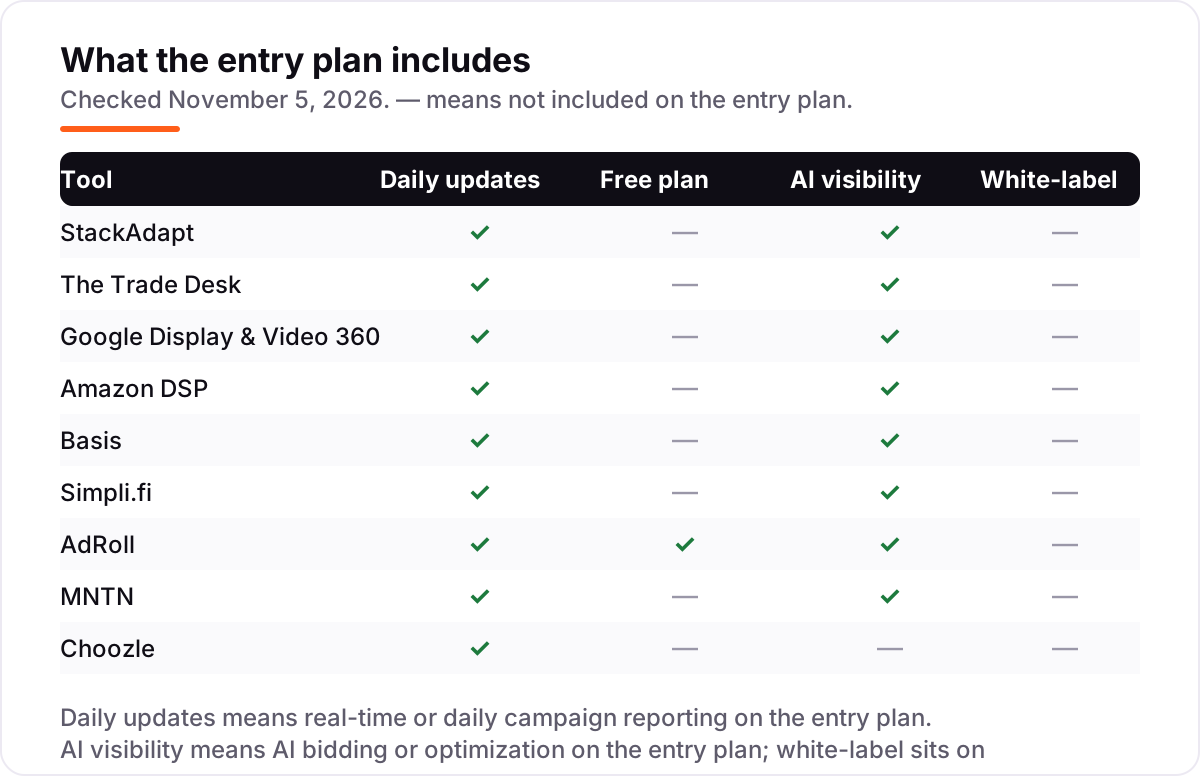
A second distinction is who sets the price. On a DSP, most impressions clear at auction, so your CPM moves with demand; on a walled garden, the platform sets the auction rules for its own inventory. Neither model publishes a rate card, which is why eight of the nine tools in this list are custom quote — the price is the negotiation, not a number on a page.
Quick comparison: tool type by need
| Buyer | Best pick | Why |
|---|---|---|
| Small budget, first DSP | AdRoll | Free to start, pay only for media, no minimum spend |
| Mid-market, no minimum | StackAdapt | No minimum spend, seven channels, 4.7/5 on G2 |
| Enterprise, open web | The Trade Desk | Leading independent DSP, custom quote |
| Need YouTube programmatically | Google Display & Video 360 | Only DSP with YouTube access, custom quote |
| Sell on Amazon | Amazon DSP | Shopping signals, managed service from $50,000/month |
| Agency, many clients | Basis | Planning, buying and billing in one system |
| Local targeting | Simpli.fi | Geo-fencing and hyperlocal targeting, no campaign minimum |
| Streaming TV only | MNTN | Performance TV, Verified Visits attribution, dynamic CPM |
| Flat monthly fee | Choozle | Single $99/month subscription, self-serve |
Mistakes to avoid
- Budgeting on the platform fee instead of the media. The fee is the small number. On a $5,000 monthly budget, a 15 percent platform fee is $750 — and the media is the other $5,000. Compare tools on total cost per result, not on the fee line.
- Buying an enterprise DSP below its practical floor. The Trade Desk and DV360 need enough volume for their algorithms to learn and their fees to stay a small share of spend. Below that floor you pay enterprise overhead for mid-market results.
- Ignoring the minimum behind a flat fee. Choozle's $99 a month looks cheap until you add the $15,000 quarterly media expectation. Read the media requirement, not just the subscription price.
- Assuming "no minimum" means cheap. StackAdapt and AdRoll charge no platform fee, but their margin sits inside the CPM. A low fee line and a high CPM can cost more than a quoted platform fee with cheap media.
- Forgetting creative. A DSP buys impressions; it does not make the ads. Budget for display and video creative — or pick a platform like MNTN whose AI creative is built in — before you judge the first month's results.
How we chose
We checked each vendor's own pricing or product page on November 5, 2026 and recorded the starting price exactly as shown — which, for eight of the nine tools, means no published price at all, only a custom quote. The one published figure, Choozle's $99 a month, comes from Choozle's own help center, and Amazon's $50,000 managed-service minimum is Amazon's own published figure. Ratings come from G2 pages verified by fresh search-index crawls on November 5, 2026, under the program's crawl-verified ratings ruling. DV360 carries no rating because G2 has no listing for DV360 itself — the Google Marketing Platform listing covers a different product, so we left it out rather than borrow a score. Minimum-spend figures for The Trade Desk and DV360 in the pricing section are third-party reported, not vendor-published, and are labeled as such. No vendor paid for a place in this list, and none of the links here are affiliate links.
What to do next
Shortlist two platforms that fit your budget — one self-serve, one quoted — and run the same $5,000 test campaign on both for a month. Compare cost per result, not CPM, and check that the reporting matches what your analytics shows before you sign a contract. If the ads are sorted but new customers are not finding you, our monthly SEO service handles the visibility side — or compare providers in our guide to marketing platforms for small business SEO. Once your tools are in place, find out what's holding your rankings back.
Your stack only works if people find you
SerpAstra fixes what keeps your site off page one and makes it easy for AI assistants to recommend.
Get a free audit→Sources we checked (17)
- StackAdapt plans and packages — stackadapt.com/plans-and-packages (checked November 5, 2026)
- The Trade Desk — thetradedesk.com (checked November 5, 2026)
- Google Display & Video 360 product overview — marketingplatform.google.com (checked November 5, 2026)
- Amazon DSP — advertising.amazon.com (managed-service $50,000/month minimum as stated on Amazon's DSP page, corroborated November 5, 2026)
- Basis — basis.com (checked November 5, 2026)
- Simpli.fi — simpli.fi (checked November 5, 2026)
- AdRoll pricing — adroll.com/pricing (checked November 5, 2026)
- MNTN pricing model — help.mountain.com (checked November 5, 2026)
- Choozle billing — help.choozle.com (checked November 5, 2026)
- StackAdapt reviews — g2.com/products/stackadapt/reviews (checked November 5, 2026)
- The Trade Desk reviews — g2.com/products/the-trade-desk/reviews (checked November 5, 2026)
- Amazon DSP reviews — g2.com/products/amazon-amazon-dsp/reviews (checked November 5, 2026)
- Basis reviews — g2.com/products/basis/reviews (checked November 5, 2026)
- Simpli.fi reviews — g2.com/products/simpli-fi/reviews (checked November 5, 2026)
- AdRoll reviews — g2.com/products/adroll/reviews (checked November 5, 2026)
- MNTN Performance TV reviews — g2.com/products/mntn-performance-tv/reviews (checked November 5, 2026)
- Choozle reviews — g2.com/products/choozle/reviews (checked November 5, 2026)
Shamim
Founder of SerpAstra
A full-stack SEO and digital marketer who spends most days on Local SEO for dental practices, AI search visibility and lead generation.
Frequently asked questions
What is the best programmatic ad platform?
StackAdapt is the best fit for most buyers: the highest G2 rating here at 4.7/5, no minimum spend, and seven channels in one interface. The Trade Desk is the best enterprise pick, and DV360 is the best pick when YouTube inventory is non-negotiable. AdRoll is the best free-to-start option for ecommerce brands.
How much does a programmatic ad platform cost?
Most DSPs publish no price and quote per account, so the real cost is your media budget plus a platform fee of roughly 10 to 20 percent of spend. The exceptions here are Choozle at a flat $99 a month and AdRoll, which is free to start. Amazon's managed service typically requires $50,000 a month.
Is there a free programmatic ad platform?
AdRoll is the only tool here that is free to start: its self-service Ads plan has no platform fee, and you pay only for the media you buy. StackAdapt has no minimum spend but no free tier, and every other platform in this list is a paid, quoted account with no free plan.
What is the difference between a DSP and an ad network?
A DSP is software you use to buy ads across many exchanges and publishers, with your own targeting, budgets and frequency caps. An ad network sells you its own inventory from a fixed set of publishers. DSPs give you control and reach; ad networks give you simplicity and a single invoice.
What is the minimum spend for programmatic advertising?
It depends on the platform. AdRoll and StackAdapt have no minimum spend, and Choozle expects about $15,000 in media per quarter. Amazon's managed service typically requires $50,000 a month. The Trade Desk and DV360 publish no minimum, but third-party guides report practical floors far above $5,000 a month.
Do I need an agency to run programmatic ads?
No, not for the self-serve tools: StackAdapt, AdRoll, Choozle and MNTN are built for in-house teams. An agency or managed service helps on The Trade Desk, DV360 and Basis, where contracts, setup and trading skill matter more, and on Amazon DSP's managed service, where Amazon's own team runs the account.
Free SEO and AI visibility audit
Find out what is holding your rankings back
Send us your site. Within 2 business days you get a written audit, an AI visibility check and a short fix list ranked by impact. Free, with no contract attached.
Request my free audit→Related guides
 Digital Marketing & Ads10 Best Display Advertising Software in 2026, ComparedThe 10 best display advertising software tools compared on price, reach and ease of use, from Google Ads to The Trade Desk. Checked November 4, 2026.Read guide →
 Digital Marketing & AdsBest Automated Ad Platforms (2026): 8 Options Ranked for Every Budget8 best automated ad platforms compared on price, automation and channels — from free Google and Meta tools to enterprise Smartly.io. Prices checked Nov 4, 2026.Read guide →
 SEO & AI Search12 Best Marketing Platforms for Small Business SEO in 2026, ComparedThe 12 best marketing platforms for small business SEO, compared on real prices, SEO tools and AI visibility. Every price checked November 1, 2026.Read guide →