
9 Best Programmatic Advertising Platforms in 2026, Compared
Compare the 9 best programmatic advertising platforms on access, minimum spend and fees, with prices checked November 5, 2026 — from $99/month to custom quotes.
 Shamim Mia, Founder, SerpAstraLast verified November 5, 202612 min read
We compare pricing pages, documentation and public reviews. We never accept payment for rankings.

Key takeaways
- Only two tools here publish an entry price: Choozle at $99 a month and StackAdapt with no monthly fee at all. The other seven are custom quote, so the sales conversation is the price.
- The Trade Desk, Google Display & Video 360 and Amazon DSP lead for scale, but each gates access behind contracts or spend commitments — they are not self-serve signups.
- The single most important buying factor is the access gate: the minimum spend, the contract and the fee on top of media decide what you actually pay, not any headline rate.
- Walled gardens sell you their own inventory with their own data; independent DSPs buy the open web. Pick the side that matches where your customers actually are.
On this page
Quick comparison
| Tool | Best for | Starting price | Free plan |
|---|---|---|---|
| The Trade Desk | Agencies and brands buying open-internet programmatic at scale, across display, video, audio and connected TV | Custom quote | No |
| Google Display & Video 360 | Teams already on Google Marketing Platform that want YouTube and open-web buying in one seat | Custom quote | No |
| Amazon DSP | Amazon sellers and ecommerce brands that want to target shoppers with Amazon purchase signals | Custom quote | No |
| StackAdapt | Mid-market teams and agencies that want self-serve programmatic without a contract | No monthly fee | No |
| Basis | Agencies that want media planning, buying, billing and reporting in one system | Custom quote | No |
| Choozle | Small agencies and in-house teams starting programmatic on a modest budget | $99/mo | No |
| Criteo | Ecommerce and retail brands that want retargeting and commerce audiences at scale | Custom quote | No |
| Adform | European brands and privacy-conscious advertisers that want an independent full-stack platform | Custom quote | No |
| Yahoo DSP | Brands that want premium Yahoo-owned inventory and cookieless identity in one DSP | Custom quote | No |
Make one of these tools?
We re-check this list every quarter. Send a correction, request a review, or ask about a clearly labeled sponsored spot.
Request a listingThe best programmatic advertising platforms

The Trade Desk
Best for: Agencies and brands buying open-internet programmatic at scale, across display, video, audio and connected TV
The Trade Desk is the largest independent demand-side platform, and independence is the pitch: because it owns no media, it has no reason to favor its own inventory in an auction. It buys across display, video, audio, connected TV and digital out-of-home from one seat, with Kokai AI optimization and UID2 and EUID identity tools for targeting as third-party cookies fade. Reviewers rate it 4.4 out of 5 on G2.
The catch is access. The Trade Desk publishes no price and no minimum spend, so every term is negotiated, and smaller advertisers reach it through an agency seat rather than directly. The interface is also complex for newcomers. Buy it when you run serious programmatic volume and want the open web without a walled garden's conflicts; buy StackAdapt or Choozle when the budget is smaller and the team is leaner.
What we like
- The largest independent DSP, with no owned media to favor in auctions
- Kokai AI optimization and UID2 and EUID identity tools for a cookieless world
- Omnichannel buying across display, video, audio, connected TV and digital out-of-home
- Transparent reporting that reviewers praise for control over spend
Watch out for
- No published price or minimum spend — every term is negotiated, so small budgets may not qualify for direct access
- Steep learning curve; reviewers consistently flag the complex interface for new users
- Platform, data and verification fees stack on top of media spend, so the headline rate is never the whole cost

Google Display & Video 360
Best for: Teams already on Google Marketing Platform that want YouTube and open-web buying in one seat
Display & Video 360 is Google's enterprise DSP, and its decisive advantage is inventory no other DSP can sell: YouTube, bought programmatically, next to dozens of open-web exchanges. It organizes buying into five modules — campaigns, audiences, creatives, inventory and insights — and ties into Campaign Manager 360, Analytics 360 and Google Ads data. Automated bidding and custom bidding algorithms run on Floodlight conversions, and private-marketplace and programmatic-guaranteed deals open premium publisher inventory.
The trade-offs are contractual. Google publishes no DV360 price; the platform fee is a percentage of media spend written into your contract or your sales partner's agreement, so two buyers can pay different rates for the same inventory without knowing it. Setup also demands Floodlight tagging and Campaign Manager 360. Buy DV360 when YouTube is central to the plan and the team already lives in Google's stack.
What we like
- The only DSP that buys YouTube programmatically, alongside open-web exchanges
- Native links to Campaign Manager 360, Analytics 360 and Google Ads data
- Automated bidding and custom bidding algorithms built on Floodlight conversions
- Programmatic guaranteed and private-marketplace deals with premium publishers
Watch out for
- No published price; access runs through a Google contract or a certified sales partner
- Platform fee is a percentage of media spend set in your contract, so you cannot benchmark it against other buyers
- Setup demands Campaign Manager 360 and Floodlight tagging, which adds implementation work

Amazon DSP
Best for: Amazon sellers and ecommerce brands that want to target shoppers with Amazon purchase signals
Amazon DSP turns shopping behavior into targeting: audiences built from what people browse, buy and stream on Amazon, activated as display, video, streaming TV and audio ads on Amazon properties and across the open web. Amazon Marketing Cloud adds clean-room measurement that ties ad exposure back to sales. For brands that already sell on Amazon, no other platform in this list knows the shopper this well.
The pricing split matters. Self-service lists no Amazon-imposed minimum spend, but in practice most teams enter through an agency seat with its own fee, and Amazon's managed service typically requires about $50,000 a month. That managed figure comes from Amazon's own documentation as reported by independent guides, not from a public rate card. Buy Amazon DSP when purchase intent is the targeting strategy; buy an independent DSP when the audience lives outside Amazon.
What we like
- Unique purchase-signal audiences built from Amazon shopping behavior
- Display, video, streaming TV and audio across Amazon properties and the open web
- Amazon Marketing Cloud clean-room measurement for closed-loop sales reporting
- Self-service lists no Amazon-imposed minimum spend, unlike the managed service
Watch out for
- Managed service typically requires about $50,000 a month, which rules out small budgets
- Self-service access usually comes through an agency seat, adding a management fee
- Reporting centers on Amazon outcomes, so open-web measurement needs extra work

StackAdapt
Best for: Mid-market teams and agencies that want self-serve programmatic without a contract
StackAdapt is the most accessible serious DSP in this list: its plans page states plainly that there is no minimum spend requirement to get started, and there is no separate platform fee — the cost is embedded in the CPM. The self-serve Basic tier takes credit-card payment, with managed and hybrid options, and buying covers connected TV, display, native, audio and digital out-of-home. Reviewers rate it 4.7 out of 5 on G2, the highest score here.
The caveat is opacity: because the fee lives inside the CPM, you cannot see the margin, and self-serve access still requires an application and approval. The vendor says most teams hit their stride around $5,000 a month in media. Buy StackAdapt when you want real programmatic reach without an enterprise contract; buy The Trade Desk when you need its scale and identity tools.
What we like
- No minimum spend requirement to get started, per the vendor's own plans page
- No separate platform fee — costs are embedded in the CPM rather than billed apart
- Self-serve Basic tier with credit-card payment, plus managed and hybrid options
- Omnichannel reach including connected TV, display, native, audio and digital out-of-home
Watch out for
- No published rate card — the fee is embedded in CPM, so you cannot see the margin
- Self-serve access is subject to an application and approval process
- Reporting customization is a common reviewer complaint at scale

Basis
Best for: Agencies that want media planning, buying, billing and reporting in one system
Basis, from Basis Technologies, is as much an operating system for media teams as a DSP. Media planning, programmatic buying, search and social, publisher-direct deals, billing reconciliation and client reporting all live in one platform, with an AI engine for automated optimization decisions. Agencies that run many clients through it replace several logins and a stack of spreadsheets with one workflow, and reviewers rate it 4.5 out of 5 on G2.
That breadth is also the limitation. Solo advertisers and small in-house teams will not use half of what Basis offers, and the price — a platform licence plus media fees — is quoted per agency with no public rate card. Buy Basis when the agency runs the business of advertising, not just the buying; buy Choozle or StackAdapt when the job is simply to launch campaigns.
What we like
- Planning, buying, billing reconciliation and reporting in a single platform
- Buys programmatic alongside search, social and publisher-direct in one workflow
- AI optimization engine for automated campaign decisions
- Strong reviewer praise for responsive support and agency workflow automation
Watch out for
- No published price — the platform licence plus media fees are quoted per agency
- Breadth is overkill for solo advertisers, who will not use half the workflow tools
- Learning the full planning-to-billing workflow takes time for new teams

Choozle
Best for: Small agencies and in-house teams starting programmatic on a modest budget
Choozle is the only tool in this list with a published subscription price: a flat $99 a month platform fee, confirmed on the vendor's own billing help pages, with media spend billed separately. The interface is built for teams without deep programmatic experience, and the platform opens access to more than 60 premium third-party data providers. White-label options let agencies deliver it under their own brand, and reviewers rate it 4.1 out of 5 on G2.
The fee is not the whole budget. Choozle expects a healthy media budget of $15,000 per quarter, the first account funding minimum is $500, and there is no free trial. Reporting and forecasting depth also lag the enterprise DSPs. Buy Choozle when the team is learning programmatic and wants a predictable platform fee; buy StackAdapt when the team wants no monthly fee at all.
What we like
- A published $99 a month platform fee — the only flat subscription price in this list
- Self-serve interface designed for teams without deep programmatic experience
- Access to more than 60 premium third-party data providers
- White-label options let agencies deliver the platform under their own brand
Watch out for
- Choozle expects a healthy media budget of $15,000 per quarter on top of the platform fee
- No free trial, and the first account funding minimum is $500
- Reporting and forecasting depth lag the enterprise DSPs, per reviewer feedback

Criteo
Best for: Ecommerce and retail brands that want retargeting and commerce audiences at scale
Criteo is the commerce specialist in this list. Instead of targeting browsing behavior alone, it builds audiences from product feeds, retail partnerships and transaction signals, then serves dynamic creative rebuilt automatically from your catalog. Commerce Growth serves direct-to-consumer brands, while Commerce Max is a retail media DSP spanning more than 200 global retailers, with closed-loop measurement tied to online and in-store sales.
The limits are clarity and control. Criteo publishes no price — costs run on a cost-per-click or cost-per-thousand-impressions basis set per campaign — and the overlap between Commerce Growth and Commerce Max confuses first-time buyers. Its G2 score, 3.8 out of 5 across 242 reviews on the Commerce Growth listing, is the second-lowest here. Buy Criteo when the catalog and the sale are the strategy; buy a general DSP when prospecting matters more than retargeting.
What we like
- Commerce data from product feeds and retail partnerships, not just browsing behavior
- Dynamic retargeting that rebuilds creative from your catalog automatically
- Commerce Max retail media DSP across more than 200 global retailers
- Closed-loop measurement tied to online and in-store sales data
Watch out for
- No published price — costs are CPC or CPM based and set per campaign
- Commerce Max and Commerce Growth overlap, so picking the right product takes guidance
- Reviewers ask for finer creative control and more detailed placement reporting

Adform
Best for: European brands and privacy-conscious advertisers that want an independent full-stack platform
Adform is the independent European option: Adform FLOW combines a DSP, a data management platform and an ad server in one integrated system, so planning, buying and measurement stay in one place. ID Fusion links emerging identity signals for targeting as third-party cookies disappear, and reviewers praise the platform's transparency and full placement-level reporting. Its G2 score is 4.3 out of 5, though from only 11 reviews.
The drawbacks are familiar for this category: no published price, terms quoted per advertiser with minimum commitments, and an interface reviewers call overwhelming for beginners. Buy Adform when the brand is European, privacy-first or wary of American walled gardens; buy The Trade Desk when the priority is the largest independent scale.
What we like
- DSP, data management and ad server in one integrated platform (Adform FLOW)
- ID Fusion identity solution built for targeting without third-party cookies
- Transparent reporting with full placement-level detail, per reviewers
- Strong European footprint and privacy-first positioning
Watch out for
- No published price — terms are quoted per advertiser with minimum commitments
- Interface feels overwhelming for beginners, per reviewer feedback
- Smaller G2 footprint (11 reviews) makes peer comparison harder than for the larger DSPs

Yahoo DSP
Best for: Brands that want premium Yahoo-owned inventory and cookieless identity in one DSP
Yahoo DSP pairs owned premium inventory with a cookieless identity story: Yahoo Mail, Finance, Sports and News supply consented first-party signals, while Yahoo ConnectID and Next-Gen Solutions match audiences across devices and households. The Yahoo Blueprint AI engine handles automated optimization, and buying spans connected TV, display, native, video and digital out-of-home, with TV partnerships across major publishers.
The watch-outs are price opacity and reporting speed. Yahoo publishes no price, minimum spend commitments are set per account, and reviewers report minimums around $10,000 a month — a reviewer-reported figure, not a vendor-published rate. Reporting delays also recur in reviews, and its G2 score of 3.6 out of 5 is the lowest here. Buy Yahoo DSP when premium Yahoo inventory and ConnectID matter; buy an independent DSP for the widest open-web reach.
What we like
- Exclusive premium inventory across Yahoo properties plus major TV partners
- Yahoo ConnectID and Next-Gen Solutions for cookieless audience matching
- Yahoo Blueprint AI buying engine for automated optimization
- Omnichannel buying across connected TV, display, native, video and digital out-of-home
Watch out for
- No published price — minimum spend commitments apply and are set per account
- Reporting delays are a recurring reviewer complaint
- Smaller open-web scale than The Trade Desk or DV360 for broad prospecting
The best programmatic advertising platforms buy ad space the way a stock exchange trades shares: software bids for each impression in real time, across websites, apps, streaming TV and audio, and the winning ad appears in milliseconds. We ranked the nine platforms below by fit for the most common buyer — a marketing team choosing its first or next demand-side platform — starting with the enterprise leaders and ending with the most accessible self-serve options, and every price was checked on November 5, 2026.
How to choose the best programmatic advertising platforms
- Start with the access gate, not the feature list. Ask for the minimum spend, the contract term and the platform fee in writing before you compare features — a platform you cannot afford to enter is not an option, however good it looks.
- Decide walled garden or open web first. Amazon DSP and DV360 sell unique inventory and data you cannot buy elsewhere; The Trade Desk, Basis and Adform buy the open web without favoring owned media.
- Separate media spend from everything else. Platform fees, data fees, verification fees and managed-service fees all sit on top of media, so ask for each line item rather than accepting one blended rate.
- Match the platform to the team's skill. Choozle and StackAdapt are built for self-serve teams; The Trade Desk and DV360 assume trained traders or an agency seat.
- Check the identity story. With third-party cookies fading, UID2 and EUID, ConnectID, ID Fusion and Amazon's purchase signals decide who you can still reach — ask how each platform targets without cookies.
If the goal is visibility rather than media buying itself, our monthly SEO service covers the search side of the same problem. And before you launch new landing pages for these campaigns, run your titles through the free SERP snippet preview tool — it shows exactly how the title and description will look in Google.
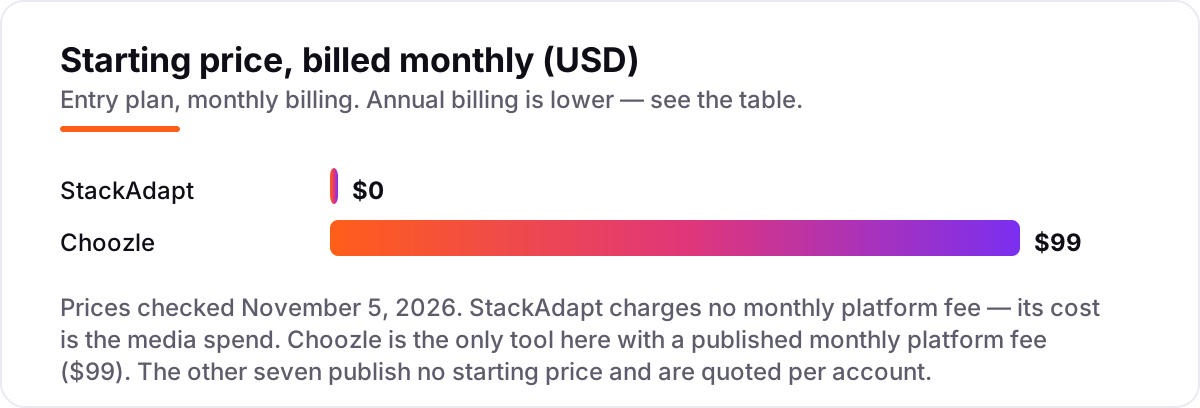
Programmatic advertising platforms pricing: what you will actually pay
Take an advertiser spending $10,000 a month on media — $120,000 over a year. On Choozle, the platform fee adds $99 a month, or $1,188 a year, for a total of $121,188 before data and verification costs; that media level also clears Choozle's expectation of $15,000 in media per quarter. On StackAdapt there is no separate monthly fee, so the same year costs $120,000 in media with the platform's margin embedded in the CPM rather than billed apart.
For the other seven platforms, the honest answer is that the number is negotiated. The Trade Desk, DV360, Basis, Criteo, Adform and Yahoo DSP all charge through a contract or a percentage of media spend, and Amazon's managed service typically requires about $50,000 a month — five times this example's whole media budget. A buyer at $10,000 a month in media should therefore shortlist StackAdapt and Choozle first, use Amazon DSP self-service or an agency seat for commerce audiences, and treat the enterprise DSPs as a later step once spend justifies the contract.
One more cost to check before you commit: data and verification. Third-party audience segments, brand-safety verification and viewability measurement are usually billed per thousand impressions on top of media, and they apply on every platform here. Ask each vendor to quote them at your planned volume, not at a generic rate.
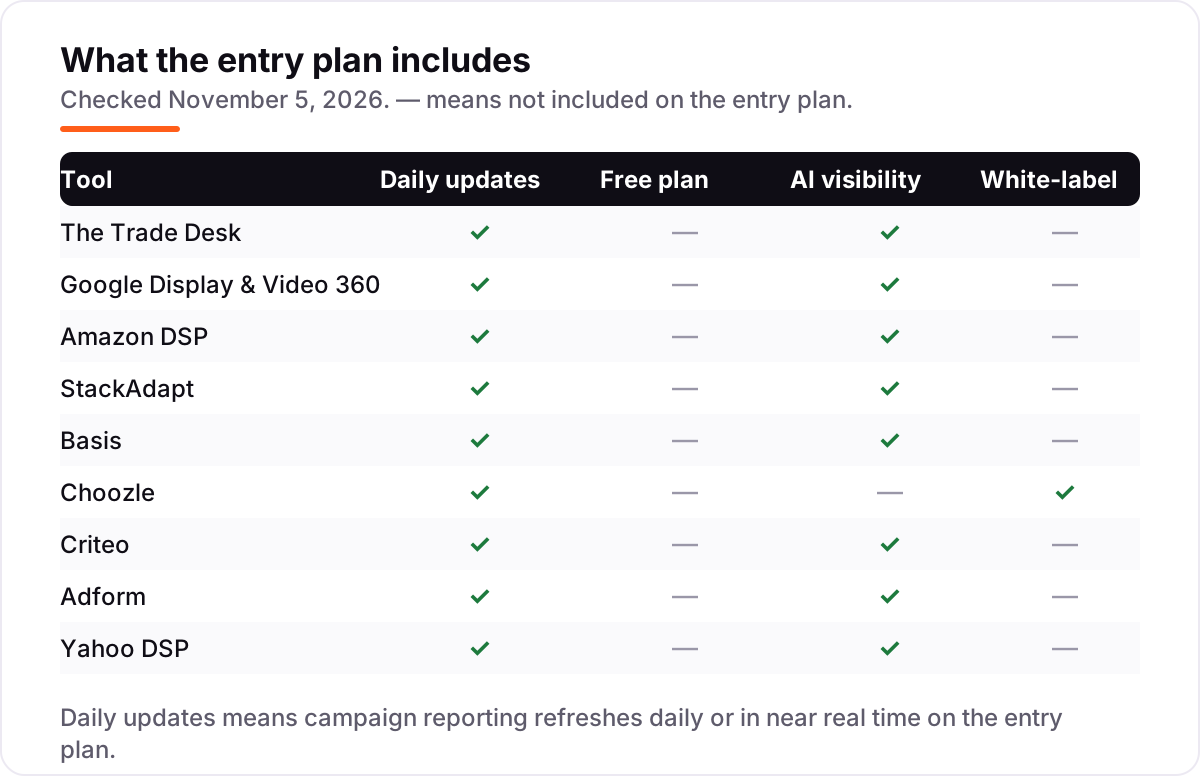
Know the difference: DSPs, walled gardens and ad networks
The confusion in this category is between three things that all sell ads but work differently. A demand-side platform buys impressions across many publishers through open auctions — The Trade Desk, Basis, StackAdapt, Choozle and Adform are DSPs. A walled garden sells mainly its own inventory with its own data — Amazon DSP and DV360 are the walled gardens here, though DV360 also buys open-web exchanges. An ad network, by contrast, bundles publisher inventory and resells it, often with less transparency about where each impression ran.
The practical difference is control versus exclusivity. On a DSP you choose the exchanges, the audiences and the bid for each impression, and you see where the ad ran. In a walled garden you get inventory and data nobody else can sell you — YouTube through DV360, purchase signals through Amazon DSP — but you accept their rules, their measurement and their fees. Neither model is wrong; the mistake is buying one while expecting the other.
A second distinction worth knowing is self-serve versus managed service. Self-serve means your team runs the platform; managed service means the vendor's team runs it for you, usually for a higher minimum spend. Amazon DSP offers both, and StackAdapt and Choozle offer self-serve with optional support — so ask which model any quoted price assumes before you compare two numbers.
Quick comparison: tool type by need
| Buyer | Best pick | Why |
|---|---|---|
| Largest independent scale | The Trade Desk | The biggest independent DSP, quoted per account |
| Google stack with YouTube | Google Display & Video 360 | Only DSP with programmatic YouTube, quoted per contract |
| Commerce and retail audiences | Amazon DSP | Purchase-signal targeting; managed service typically $50,000/month |
| Self-serve without a contract | StackAdapt | No minimum spend, no monthly fee |
| Agency planning plus buying | Basis | Planning, buying, billing and reporting in one system |
| Smallest published price | Choozle | Flat $99/month platform fee |
| Retargeting from a catalog | Criteo | Commerce audiences and dynamic creative, quoted per campaign |
| Premium Yahoo inventory | Yahoo DSP | Owned supply plus ConnectID, quoted per account |
Mistakes to avoid
- Comparing headline prices that do not exist. Seven of these nine platforms publish no price, so a comparison built on list prices is fiction — compare written quotes at your spend level instead.
- Budgeting media only. Platform fees, data fees, verification fees and managed-service fees all sit on top of media spend. A $10,000 media budget is not a $10,000 total budget.
- Buying an enterprise DSP for a test budget. The Trade Desk, DV360 and Yahoo DSP assume scale and trading skill; a small test learns more, faster, on StackAdapt or Choozle.
- Ignoring the identity question. If your targeting depends on third-party cookies, ask how the platform reaches audiences without them before you sign — UID2, ConnectID and ID Fusion are not interchangeable.
- Signing without an exit plan. Ask who owns the audience data and campaign history if you leave, and what happens to unspent commitments, before the contract starts.
How we chose
We checked each vendor's own pricing or product page on November 5, 2026 and recorded the starting price exactly as shown, or as custom quote where no price is published, and we ranked the tools by fit for the most common buyer — a marketing team choosing a demand-side platform — not by brand size. Two figures in this post are not vendor-published rates and are disclosed as such: Amazon's managed-service figure of about $50,000 a month comes from Amazon's own documentation as reported by independent guides, and Yahoo DSP's reported minimum of around $10,000 a month comes from reviewer reports, not from Yahoo's published pricing. Google Display & Video 360 carries no rating because it has no G2 profile of its own; the other ratings are G2 scores checked November 5, 2026. No vendor paid for a place in this list, and none of the links here are affiliate links.
What to do next
Shortlist two platforms — one accessible option and one enterprise option — and request written quotes at your real monthly media budget, including every fee line item. Run a small test on the accessible platform first to learn the workflow, then move budget to the enterprise seat only when the test proves the volume. If search visibility is the other half of the plan, our monthly SEO service handles it, or compare adjacent tools in our guide to display advertising software. Once your tools are in place, find out what's holding your rankings back.
Your stack only works if people find you
SerpAstra fixes what keeps your site off page one and makes it easy for AI assistants to recommend.
Get a free audit→Sources we checked (17)
- The Trade Desk — thetradedesk.com (checked November 5, 2026)
- The Trade Desk reviews — G2 (checked November 5, 2026)
- Google Display & Video 360 — marketingplatform.google.com (checked November 5, 2026)
- Amazon DSP — advertising.amazon.com (checked November 5, 2026)
- Amazon DSP reviews — G2 (checked November 5, 2026)
- StackAdapt plans and packages — stackadapt.com (checked November 5, 2026)
- StackAdapt reviews — G2 (checked November 5, 2026)
- Basis — basis.com (checked November 5, 2026)
- Basis reviews — G2 (checked November 5, 2026)
- Choozle billing settings — help.choozle.com (checked November 5, 2026)
- Choozle reviews — G2 (checked November 5, 2026)
- Criteo — criteo.com (checked November 5, 2026)
- Criteo reviews — G2 (checked November 5, 2026)
- Adform — adform.com (checked November 5, 2026)
- Adform reviews — G2 (checked November 5, 2026)
- Yahoo DSP — yahooinc.com (checked November 5, 2026)
- Yahoo DSP reviews — G2 (checked November 5, 2026)
Shamim
Founder of SerpAstra
A full-stack SEO and digital marketer who spends most days on Local SEO for dental practices, AI search visibility and lead generation.
Frequently asked questions
What is the best programmatic advertising platform?
The Trade Desk is the best fit for most large advertisers: the largest independent DSP with no owned media to favor. StackAdapt is the better pick for mid-market teams that want self-serve access with no minimum spend, and Choozle suits small teams that want a flat $99 a month fee.
How much does a programmatic advertising platform cost?
Most enterprise DSPs publish no price and charge a platform fee as a percentage of media spend, plus data and verification fees. The exceptions here are Choozle at $99 a month and StackAdapt with no monthly fee. Budget media spend first, then ask each vendor for the full fee breakdown in writing.
What is the difference between a DSP and a walled garden?
A DSP buys ad space across many publishers through open auctions, while a walled garden — Google, Amazon or Meta — sells mainly its own inventory with its own data. DSPs offer broader reach and independence; walled gardens offer unique data and inventory you cannot buy anywhere else.
Do I need a minimum spend for programmatic advertising?
It depends on the platform. StackAdapt states no minimum spend, and Amazon DSP self-service lists no Amazon-imposed minimum. Enterprise DSPs such as The Trade Desk, DV360 and Yahoo DSP set minimum spend commitments per account, and Amazon's managed service typically requires about $50,000 a month.
Can a small business use a programmatic advertising platform?
Yes, through the accessible end of this list. Choozle charges $99 a month plus media, though it expects $15,000 in media per quarter, and StackAdapt has no minimum spend or monthly fee. Start with one channel and one audience, and only move to an enterprise DSP when spend justifies the contract.
What should I check before signing a DSP contract?
Get the platform fee, data fees, verification fees and any minimum spend in writing, and ask what happens if you underspend. Confirm who owns the audience data and campaign history if you leave, how reporting handles viewability and fraud, and whether managed-service fees sit on top of platform fees.
Free SEO and AI visibility audit
Find out what is holding your rankings back
Send us your site. Within 2 business days you get a written audit, an AI visibility check and a short fix list ranked by impact. Free, with no contract attached.
Request my free audit→Related guides
 Digital Marketing & Ads10 Best Display Advertising Software in 2026, ComparedThe 10 best display advertising software tools compared on price, reach and ease of use, from Google Ads to The Trade Desk. Checked November 4, 2026.Read guide →
 Digital Marketing & Ads12 Best CTV Advertising Platforms for 2026 (Pros, Cons and Pricing)Compare the 12 best CTV advertising platforms on price, minimum budgets, targeting and measurement — every figure checked live on November 4, 2026.Read guide →
 Digital Marketing & Ads10 Best Digital Advertising Platforms in 2026, ComparedCompare the 10 best digital advertising platforms on price, minimum budgets, targeting and AI tools — every figure checked November 4, 2026.Read guide →