
7 Best Research Platforms in 2026, Compared
Compare the 7 best research platforms for user research, usability testing and market surveys, with free plans, seat limits and published prices checked.
 Shamim Mia, Founder, SerpAstraLast verified November 2, 20269 min read
We compare pricing pages, documentation and public reviews. We never accept payment for rankings.

Key takeaways
- Lyssna is the best research platform for most small product and marketing teams: a free plan with 3 seats and unlimited quick studies, and Growth at $166 a month.
- Dovetail is where interview notes, recordings and survey answers become a shared, searchable research repository; Silver and Gold are quote-only.
- Qualtrics is the research-grade choice for large organisations, with a published Strategic Research plan at $420 a month billed annually.
- SurveyMonkey, Alchemer and Typeform cover quantitative market research at lower prices, and Hotjar shows how people behave on your live site.
On this page
Quick comparison
| Tool | Best for | Starting price | Free plan |
|---|---|---|---|
| Lyssna | Product and marketing teams that want fast usability tests and surveys with a free start | Free; Growth $166/mo | Yes, 3 seats |
| Dovetail | Research teams that need one repository for interviews, recordings and insights | Custom quote | No, 30-day trial |
| Qualtrics | Large organisations running research-grade market and experience studies | $420/mo (Strategic Research) | No (30-day trial) |
| SurveyMonkey | Small teams running regular market research and customer surveys | Free; $30/user/mo | Yes (Basic plan) |
| Alchemer | Mid-size research teams that need advanced logic without enterprise pricing | $55/user/mo | No (7-day trial) |
| Typeform | Marketing teams that need high completion rates on research surveys | Free; $28/mo yearly | Yes (10 responses/mo) |
| Hotjar | Teams researching how real visitors behave on a live website | Free; Growth $39/mo yearly | Yes (free plan) |
Make one of these tools?
We re-check this list every quarter. Send a correction, request a review, or ask about a clearly labeled sponsored spot.
Request a listingThe best research platforms

Lyssna
Best for: Product and marketing teams that want fast usability tests and surveys with a free start
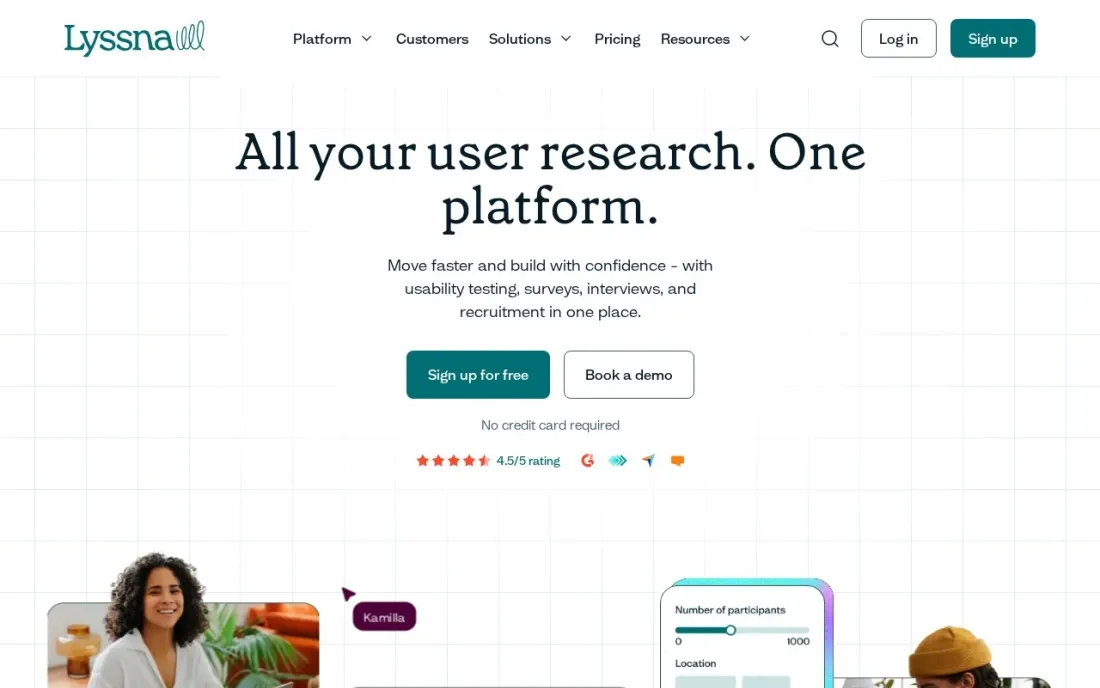
Lyssna, formerly UsabilityHub, is the quickest way for a small team to put a design, message or prototype in front of real people. The free plan includes 3 seats, unlimited quick studies, user interviews and access to its participant panel, with 15 self-recruited responses. That is enough to run first-click tests, preference tests and short surveys before a launch.
Growth costs $166 a month for 5 seats, unlimited self-recruited responses, 5 in-depth studies a month, conditional logic, custom branding and AI summaries. Panel responses are billed separately on every plan, so budget for credits if you cannot recruit your own users. Credits can be bought in bulk at a discount and do not expire.
What we like
- Free plan includes 3 seats, unlimited quick studies, user interviews and panel access
- Growth adds 5 seats, unlimited self-recruited responses and 5 in-depth studies a month
- Recruiting your own participants is free, and panel credits do not expire
- AI follow-up questions and AI summaries on Growth
Watch out for
- Panel responses are priced separately on every plan, and the pricing page gives no per-response rate
- Free plan caps self-recruited responses at 15
- SSO and a SOC 2 report need the custom-priced Enterprise plan

Dovetail
Best for: Research teams that need one repository for interviews, recordings and insights
Dovetail is a research repository rather than a testing tool. Teams bring in interview recordings, transcripts, survey answers and customer feedback, tag them, and turn them into insights that anyone in the company can search later. That solves the most common research problem in growing companies: findings that live in one person's slides and are forgotten by the next quarter.
Dovetail One's Silver plan starts at 25 users and Gold at 100, both priced through sales; a Bronze plan for up to 5 users is listed at $4,800 a year but marked coming soon. Credits cost 15 cents each, do not roll over and bill overages monthly unless an admin turns them off. A 30-day Gold trial lets a team test it on a real study.
What we like
- Central repository where interviews, recordings and feedback are tagged and searched across studies
- 30-day free trial of the Gold plan
- Credits are one shared workspace balance at 15 cents each, with admin control over overages
Watch out for
- Silver and Gold prices are not published; Bronze is listed as coming soon
- Credits do not roll over at renewal, and overages are on by default
- No free plan

Qualtrics
Best for: Large organisations running research-grade market and experience studies
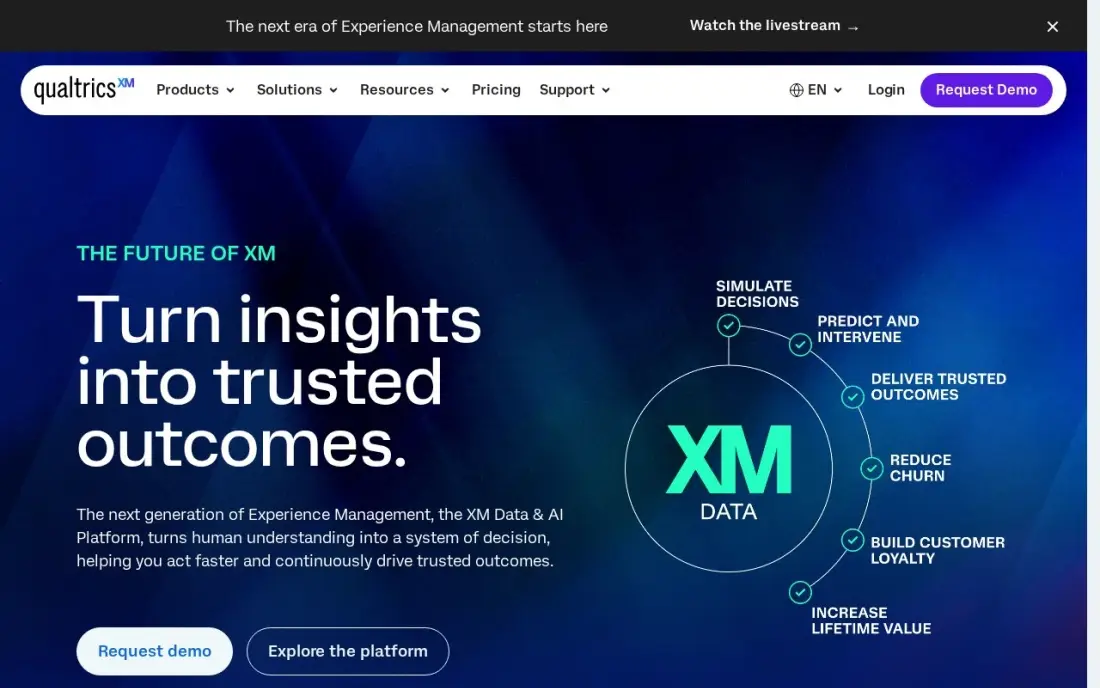
Qualtrics is the research platform large organisations standardise on. It handles complex survey design, panels and statistical analysis, and Text iQ reads open-text answers for the themes behind the scores. A self-serve Strategic Research plan is published at $420 a month billed annually and covers research surveys; the wider experience management platform is quote-only.
It is built for teams with dedicated researchers, so a small company will pay for depth it never uses. There is a 30-day free trial. Choose Qualtrics when studies feed board-level decisions and need research-grade rigour, and choose a lighter tool when the goal is a quick answer before next week's release.
What we like
- The most complete feedback toolkit here: surveys, reviews and support signals joined across the journey
- Text iQ reads open-text answers for the themes behind the scores, not just the numbers
- The enterprise standard for experience management, with the largest research-grade feature set
Watch out for
- No published price for the CX platform — CustomerXM is custom-quoted as an enterprise contract
- Built for teams with dedicated research staff; smaller teams will underuse it
- The published $420-a-month plan covers research surveys only, not the CX platform

SurveyMonkey
Best for: Small teams running regular market research and customer surveys
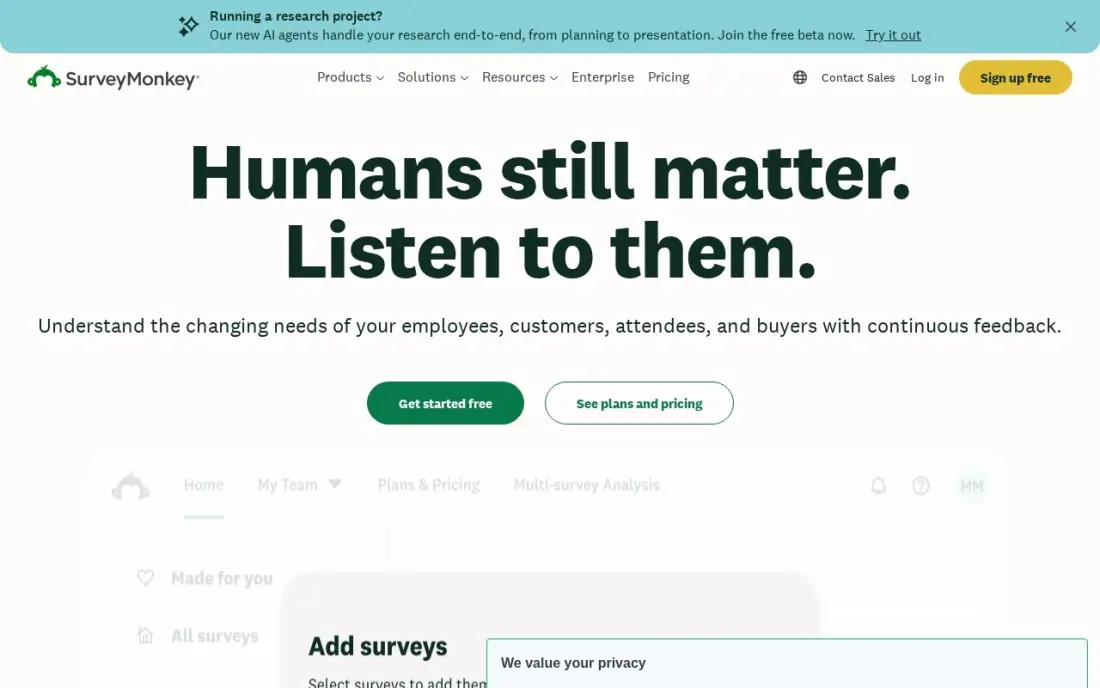
SurveyMonkey is the familiar choice for quantitative research. Expert-certified templates, skip logic, branching, A/B testing and real-time cross-tab analysis let a marketing team launch a market sizing or concept survey in an afternoon, and more than 200 integrations push results into Salesforce, Slack or Teams. It has a 4.4 G2 score from more than 23,000 reviews.
The free Basic plan caps surveys at 10 questions and 40 viewable responses, so it is a trial rather than a research tool. Team Advantage costs $30 a user a month billed annually with a three-user minimum, so $90 a month, and includes 50,000 responses a year. Extra responses cost 15 cents each.
What we like
- Team Advantage includes 50,000 responses a year shared across the team, with shared libraries and collaboration
- Expert-certified templates, skip logic, branching, A/B testing and real-time analysis with cross-tabs
- More than 200 integrations, including Salesforce, Slack and Microsoft Teams
Watch out for
- Individual plan prices are not shown on the public pricing page until you create an account
- Extra responses cost $0.15 each beyond the plan allowance, so a big launch can add up
- The free Basic plan caps surveys at 10 questions and only 40 viewable responses per survey

Alchemer
Best for: Mid-size research teams that need advanced logic without enterprise pricing
Alchemer sits between SurveyMonkey and Qualtrics. Collaborator includes 25 question types, advanced logic, piping and branching, with virtually unlimited responses and no per-response charges, so a research team can build the study it actually needs. 64 integrations, including Tableau, SPSS and Salesforce, carry data into analysis tools.
Pricing is per seat: Collaborator costs $55 a user a month billed monthly, or $315 a user a year billed annually, so a four-person team pays $220 a month. API access needs a Business Platform quote, and G2 reviewers report sharp price rises at renewal. Get renewal terms in writing, and there is a 7-day free trial to test it first.
What we like
- 25 question types with advanced logic, piping and branching on the entry plan
- Virtually unlimited responses with no per-response charges on any self-serve tier
- 64 integrations including Salesforce, Tableau, SPSS and Google Sheets, plus closed-loop workflows
Watch out for
- Per-seat pricing: a 4-person team pays $220/month on Collaborator before any add-on
- API access needs a Business Platform quote, not a self-serve plan
- G2 reviewers report steep price rises at renewal once you outgrow the self-serve tiers

Typeform
Best for: Marketing teams that need high completion rates on research surveys
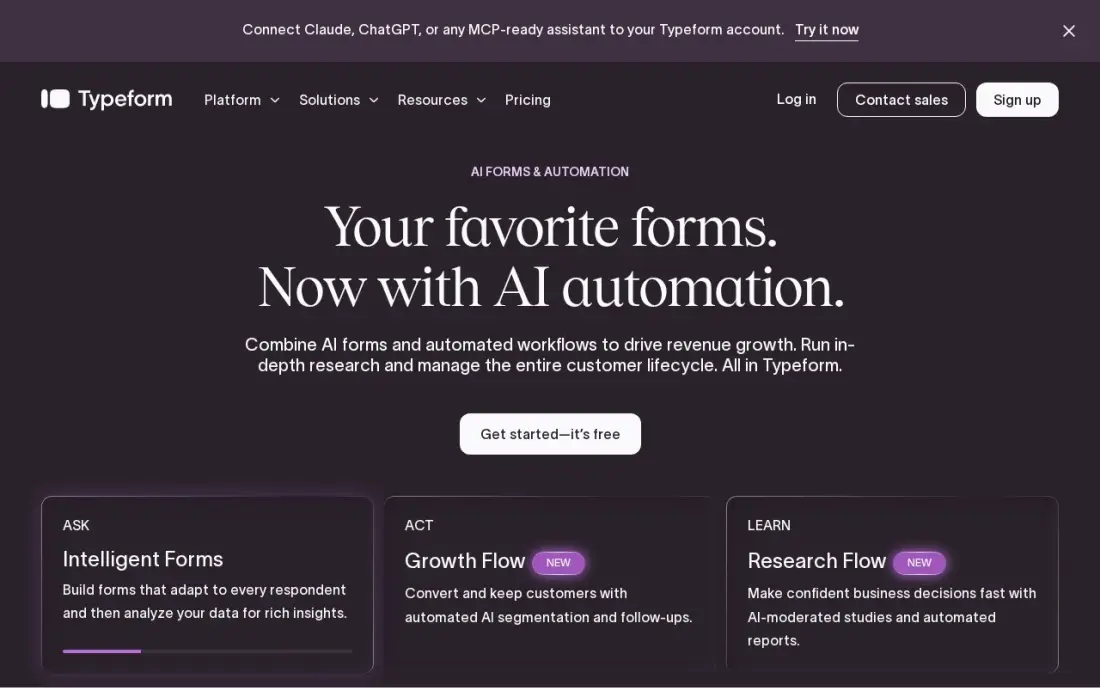
Typeform shows one question at a time in a conversational format, which keeps respondents moving through longer research surveys that would stall as a grid. Logic, branching, file uploads and webhooks are included from Basic, and the free plan allows 10 responses a month for testing.
Volume is the constraint. Basic costs $28 a month billed annually, or $39 monthly, and caps responses at 100 a month with Typeform branding. Plus at $56 a month billed annually allows 1,000 responses and removes the logo, and drop-off analysis needs Business at $91. Budget by the number of responses your study needs.
What we like
- One-question-at-a-time conversational format that keeps respondents moving through long surveys
- Basic includes logic and branching, payments, file uploads and webhooks for $28/month billed annually
- Plus ($56/month billed annually) removes Typeform branding and adds 1,000 responses a month
Watch out for
- Basic caps at 100 responses a month and keeps the Typeform logo on every form
- Monthly billing costs about 40% more than annual billing on every plan
- Drop-off analysis and conversion tracking need the Business plan ($91/month billed annually)

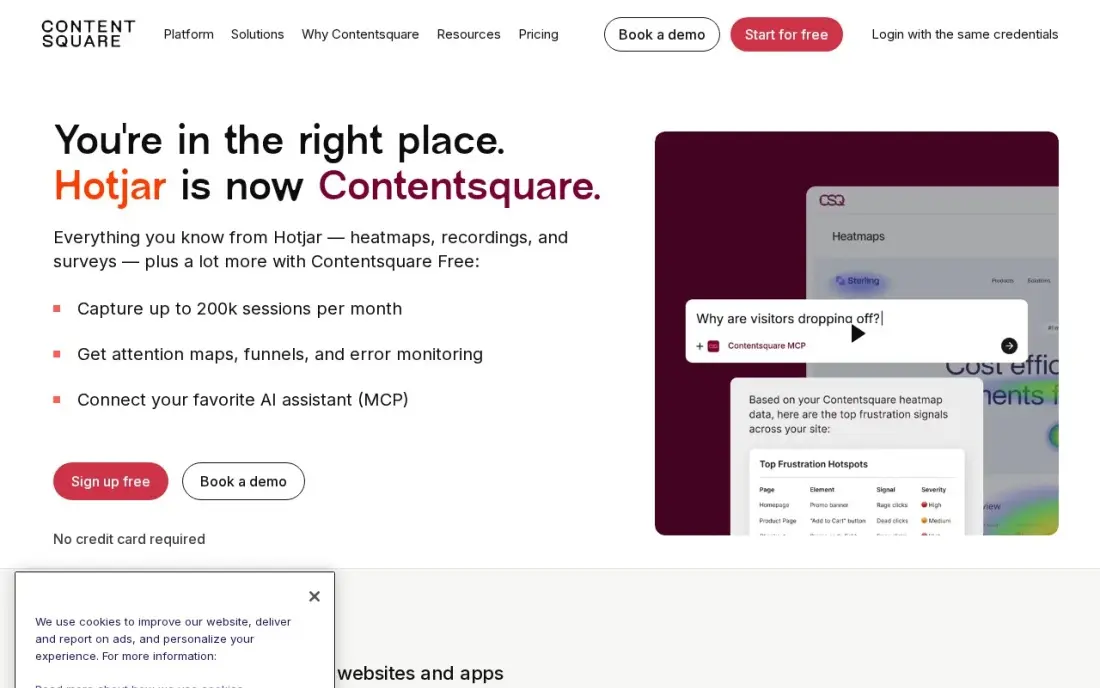
Hotjar gives behavioural research that surveys cannot: heatmaps show where visitors click and scroll, and session recordings show the moment someone hesitates or leaves. The free plan covers up to 200,000 sessions a month, which is plenty for most small sites, and Growth costs $49 a month, or $39 billed annually, adding AI summaries and longer data access.
New accounts now sign up through Contentsquare, and surveys are a separate product from $79 a month. Reviewing recordings takes real time, and filtering feels thin at high volume. Use Hotjar to find where a page fails, then run a Lyssna test or a short survey to learn why.
What we like
- Heatmaps and session recordings show exactly where visitors click, scroll and drop off
- The free plan covers up to 200,000 sessions a month — far more than most small sites need
- Surveys and feedback widgets sit in the same tool, so the why sits next to the what
Watch out for
- Hotjar no longer sells standalone accounts — new sign-ups go through Contentsquare, and surveys are now a separate product from $79 a month
- The vendor's own pricing page shows euros in the EU view, so US buyers should confirm the dollar price at checkout
- Filtering and segmentation feel thin on large session volumes, and reviewing recordings takes real time
The best research platforms help a team find out what customers think and do before it spends money on the wrong design, message or product. We compared seven platforms across user research, usability testing, research repositories and market surveys on what each one does best, seats and response limits, participant costs and published pricing. Every price below was checked on vendor pricing pages and our verified tool records in November 2026.
How to choose the best research platforms
- Name the research method first. Usability tests, interviews, surveys and behaviour analytics need different tools.
- Count participant costs. Recruiting your own users is often free; panel participants are billed on top on most platforms.
- Check seat limits. Lyssna's Growth plan covers 5 seats; SurveyMonkey and Alchemer charge per user.
- Plan where findings live. A repository such as Dovetail keeps insights searchable after the study ends.
- Match rigour to the decision. A quick preference test suits a button colour; a pricing study needs a proper sample.
- Look at response caps. Typeform Basic stops at 100 responses a month, and SurveyMonkey charges 15 cents per extra response.
Research tells you what buyers want; search shows you what they ask. Our AI search optimization service turns those questions into pages that AI assistants cite, and our survey software guide covers more survey-first tools.
Which research platform fits your situation
A small product team testing designs before each release. Lyssna is the natural start: the free plan covers 3 seats, unlimited quick studies, user interviews and panel access, with 15 self-recruited responses. Move to Growth at $166 a month when you need 5 seats, unlimited self-recruited responses and in-depth studies. Budget separately for panel responses if you cannot recruit your own users.
A research team drowning in interview notes and recordings. Dovetail solves the storage problem rather than the testing problem: interviews, transcripts, survey answers and feedback are tagged and searchable across studies. Silver starts at 25 users and Gold at 100, both quote-only, so use the 30-day Gold trial on a real study and ask an admin to turn off credit overages, which are on by default.
A marketing team sizing a market or testing a concept. SurveyMonkey Team Advantage gives three people 50,000 responses a year for $90 a month billed annually, with templates and cross-tab analysis. If the survey needs heavier logic and you expect a large sample, Alchemer Collaborator includes 25 question types and no per-response charges, at $55 a user a month; get renewal terms in writing. Typeform suits shorter surveys where completion rate matters, but Basic stops at 100 responses a month.
A large organisation whose studies feed board-level decisions. Qualtrics is built for dedicated research staff, with complex survey design, panels, statistical analysis and Text iQ for open-text answers. Strategic Research costs $420 a month billed annually and covers research surveys only; the wider CX platform is a custom quote.
A team that wants to know why a web page underperforms. Start with Hotjar's free plan, which covers up to 200,000 sessions a month, and use heatmaps and recordings to find where visitors drop off. New accounts now sign up through Contentsquare, and surveys cost extra from $79 a month, so pair it with a Lyssna test to learn the reason behind the drop-off.
Research platforms pricing: what you will actually pay
A three-person product team can start at $0 on Lyssna's free plan. Moving to Growth costs $166 a month, or $1,992 over twelve months, for 5 seats and unlimited self-recruited responses, plus panel credits if needed. A three-seat SurveyMonkey Team Advantage plan costs $90 a month billed annually, or $1,080 a year, with 50,000 responses.
Alchemer Collaborator for three people costs $945 a year billed annually ($315 per user) or $165 a month billed monthly. Typeform Basic costs $336 a year billed annually. At the top, Qualtrics Strategic Research costs $420 a month billed annually, or $5,040 a year, and Dovetail's listed Bronze plan is $4,800 a year plus credits.
Know the difference: qualitative vs quantitative research platforms
Qualitative platforms answer why. Lyssna runs usability tests and interviews, Dovetail organises recordings and notes into themes, and Hotjar shows real sessions. They work with small samples, often five to fifteen people, and the output is understanding rather than percentages.
Quantitative platforms answer how many. SurveyMonkey, Alchemer, Typeform and Qualtrics collect structured answers from hundreds or thousands of respondents and turn them into numbers you can segment. Most teams need both: qualitative work to find the right questions and quantitative work to size the answer.
Quick comparison: tool type by need
| Team | Best pick | Why |
|---|---|---|
| Small product team | Lyssna | Free plan with 3 seats; Growth $166/month |
| Research repository | Dovetail | Tag and search interviews and feedback across studies |
| Enterprise research | Qualtrics | Research-grade surveys from $420/month yearly |
| Market surveys | SurveyMonkey | Templates and 50,000 responses a year from $90/month |
| Advanced survey logic | Alchemer | 25 question types, unlimited responses, $55/user/month |
| High completion rates | Typeform | One question at a time, from $28/month yearly |
| Website behaviour | Hotjar | Heatmaps and recordings, free up to 200,000 sessions |
Mistakes to avoid
- Asking customers to predict their behaviour. Watch what they do in a test before trusting what they say in a survey.
- Forgetting panel costs. Budget for participants as well as the subscription.
- Running studies nobody can find later. Store findings in one shared place, tagged by topic.
- Leading questions. Ask what people did last time, not whether they would like your idea.
- Testing too late. A five-person test on a rough prototype is cheaper than a redesign after launch.
Related comparisons: AI Tools for Research · Keyword Research Software · Keyword Research Tool API · Keyword Research Tools under 50 Month
How we chose
We read Lyssna's and Dovetail's pricing pages on 16 November 2026 and took the other tools from our verified records, checked in November 2026, recording prices exactly as published. We ranked platforms by fit for a small to mid-size product or marketing team, weighting research methods covered, free plans, seat and response limits and participant costs. Ratings come from G2 pages on the dates shown in the sources, and tools without a verified rating show none. No vendor paid for a place in this list, and none of the links here are affiliate links.
What to do next
Pick one decision your team will make this month, write the single question that would change it, and run a free Lyssna study or a short survey to answer it. To learn which questions your buyers ask search engines and AI tools, book a free SEO audit.
Frequently asked questions
What is the best research platform?
Lyssna is the best fit for most small product and marketing teams, with a free plan and Growth at $166 a month. Dovetail suits teams that need a research repository, and Qualtrics suits large organisations running research-grade studies.
What is the difference between a research platform and a survey tool?
A survey tool collects answers to questions. A research platform also runs usability tests, interviews and prototype studies, recruits participants and stores findings so teams can reuse them.
Is there a free research platform?
Lyssna's free plan includes 3 seats, unlimited quick studies and 15 self-recruited responses. SurveyMonkey, Typeform and Hotjar also have free plans with tighter limits.
How much does Qualtrics cost?
Qualtrics publishes a Strategic Research plan at $420 a month billed annually for research surveys. Its wider experience management platform is quote-only, and there is a 30-day free trial.
How much does Dovetail cost?
Dovetail One's Silver and Gold plans are priced through sales. A Bronze plan for up to 5 users is listed at $4,800 a year but marked coming soon, and credits cost 15 cents each.
Do I need to pay for research participants?
Recruiting your own users is free on Lyssna, but panel responses are priced separately on every plan. Most platforms charge for panel participants on top of the subscription.
What is the best user research platform?
Lyssna is the best start for most product and marketing teams: its free plan includes 3 seats, unlimited quick studies, user interviews and panel access, and Growth costs $166 a month for 5 seats. Dovetail suits teams that run many interviews and need a repository for recordings and insights. Hotjar covers behaviour research on a live website, free for up to 200,000 sessions a month.
Which research platforms are best for team collaboration?
Dovetail is built for it: interviews, recordings and feedback are tagged and searched in one shared repository across studies, with a 30-day free trial. SurveyMonkey Team Advantage shares 50,000 responses a year across the team with shared libraries, at $30 a user a month billed annually and a 3-user minimum. Lyssna's free plan includes 3 seats.
Sources we checked (10)
- Lyssna — www.lyssna.com/pricing (checked November 16, 2026)
- Dovetail — dovetail.com/pricing (checked November 16, 2026)
- Qualtrics — www.qualtrics.com/pricing (checked November 12, 2026)
- SurveyMonkey — www.surveymonkey.com/pricing (checked November 2, 2026)
- SurveyMonkey reviews on G2 (checked November 2, 2026)
- Alchemer — www.alchemer.com/plans-pricing (checked November 2, 2026)
- Alchemer reviews on G2 (checked November 2, 2026)
- Typeform — www.typeform.com/pricing (checked November 2, 2026)
- Typeform reviews on G2 (checked November 2, 2026)
- Hotjar — hotjar.com/pricing (checked November 12, 2026)
Make one of these tools?
We re-check this list every quarter. Send a correction, request a review, or ask about a clearly labeled sponsored spot.
Request a listingShamim
Founder of SerpAstra
A full-stack digital marketer and SEO strategist covering technical and local SEO, AI search visibility, paid ads and lead generation for local businesses, e-commerce brands and SaaS teams.
Free SEO and AI visibility audit
Find out what is holding your rankings back
Send us your site. Within 2 business days you get a written audit, an AI visibility check and a short fix list ranked by impact. Free, with no contract attached.
Request my free audit→Related buying guides
 Marketing8 Best Survey Software Tools in 2026, ComparedCompare the 8 best survey software tools on free plans, response limits, logic, AI analysis and real monthly cost, with every price checked on vendor pages.Read guide →
 Data, Analytics & AI10 Best Feedback Analytics Software in 2026, ComparedThe 10 best feedback analytics software tools for 2026, compared on real prices, free plans, and NPS, CSAT and CES tracking. Prices checked November 2, 2026.Read guide →
 Marketing11 Best Software for Voice of Customer Analytics in 2026, Compared11 best software for voice of customer analytics compared on price, surveys, text analysis and AI. Prices checked November 2, 2026, free plans noted.Read guide →