
Best Restaurant POS Systems for 2026: 8 Options Compared by Use Case
Compare the 8 best restaurant pos systems on price, hardware, processing fees and offline mode, with every price checked today, November 8, 2026.
 Shamim Mia, Founder, SerpAstraLast verified November 8, 202613 min read
We compare pricing pages, documentation and public reviews. We never accept payment for rankings.

Key takeaways
- Toast at $69/month is the best fit for most independent restaurants; Square starts free with Plus at $49/month, and SpotOn bundles hardware into an All-In plan at $0 per station.
- The processing rate decides your real bill, not the software fee: at $40,000 a month in card sales, processing runs $1,120–$1,300 a month while software costs $79–$198.
- Three tools in this list have a $0 way to start — Square Free, the Toast Starter Kit and SpotOn All-In — but all three trade the free software for higher processing rates or a two-year term.
- The single most important buying factor is the contract: Toast, Clover, Revel and SpotOn All-In all lock you in for two to three years, so get the term and the exit fee in writing.
On this page
Quick comparison
| Tool | Best for | Starting price | Free plan |
|---|---|---|---|
| Toast | Independent full-service restaurants that want a restaurant-only platform with the kitchen, ordering and payroll in one place | $69/mo | Yes (Starter Kit $0) |
| Square for Restaurants | Small counters, cafes and food trucks that want to start at $0 with no contract and no hardware commitment | Free; Plus $49/mo | Yes (Free plan) |
| SpotOn | Independent restaurants comparing bundled hardware deals and wanting reservations and marketing in the same system | $55/mo per station | Yes (All-In $0) |
| Lightspeed Restaurant | Multi-location restaurant groups that manage menus, inventory and reporting from one back office | $69/mo | No (demo only) |
| TouchBistro | Full-service dining rooms that need reliable offline mode and tableside ordering on iPads | $69/mo | No (demo only) |
| Clover | Quick-service and full-service restaurants that want Fiserv hardware bundles and a large app market | $89.95/mo | No |
| Revel Systems | Restaurant chains and high-volume venues that need enterprise controls and will sign a 3-year contract | $99/mo per terminal | No (demo only) |
| Oracle Simphony | Hotels, stadiums and multi-property groups that need one POS across many revenue centers | Custom quote | No (demo only) |
Make one of these tools?
We re-check this list every quarter. Send a correction, request a review, or ask about a clearly labeled sponsored spot.
Request a listingThe best restaurant pos systems

Toast
Best for: Independent full-service restaurants that want a restaurant-only platform with the kitchen, ordering and payroll in one place
Toast is the restaurant-only default: every part, from the kitchen display to payroll, is built around how a dining room works. Point of Sale costs $69 a month and covers core POS, cloud reporting and 24/7 support; the Starter Kit puts software at $0 a month for one or two terminals. Online ordering, loyalty, gift cards and payroll are add-ons, so the bill grows with the modules you switch on.
The trade-off is commitment: contracts typically run one to three years, most commonly two, hardware is Toast-only, and the kitchen display costs $25 per screen a month. The Starter Kit's free software is paid for in processing at 3.09% to 3.69% plus 15 cents, against 2.49% plus 15 cents with hardware bought upfront. Buy Toast for one restaurant-only system; buy Square to start with no contract.
What we like
- Built only for restaurants, so table service, kitchen display, online ordering and payroll fit together
- Point of Sale at $69 a month covers core POS, cloud reporting and 24/7 support
- Starter Kit software is $0 a month for one or two terminals, with no upfront hardware cost
- The largest restaurant-only install base here, with about 180,000 locations reported in Q2 2026
Watch out for
- Two-year contracts are typical, with early termination fees reported in the four figures
- Hardware is Toast-only, and add-ons like the kitchen display run $25 per screen per month
- The $0 Starter Kit trades its free software for higher processing rates of 3.09% to 3.69% plus 15 cents

Square for Restaurants
Best for: Small counters, cafes and food trucks that want to start at $0 with no contract and no hardware commitment
Square is the lowest-commitment way to start selling food: the Free plan costs $0 a month per location and covers the POS app, menu management, pickup and local delivery and a branded ordering page, and you pay only processing at 2.6% plus 15 cents in person. Plus costs $49 a month per location, drops the in-person rate to 2.5% plus 15 cents, and adds loyalty, marketing and advanced reporting.
The catch is volume. At low card sales the free plan is unbeatable, but once you process tens of thousands a month, the flat 2.6% rate costs more than a cheaper rate elsewhere — Clover's 2.3% beats it at the $40,000 a month in our worked example below. There is no contract and no annual discount, so Square is the easiest to leave. Start here when the budget is $0.
What we like
- Free plan at $0 a month per location, with no contract and no monthly software fee
- Plus at $49 a month per location adds lower processing, loyalty, marketing and advanced reporting
- Hardware is bought outright from Square, so there is no hardware financing contract
- The highest G2 rating here at 4.6 out of 5 across 1,211 reviews
Watch out for
- Processing is the whole business model, so high card volume makes the free plan expensive
- KDS costs $30 a month per device on Plus, and the kiosk app is a paid add-on
- No annual billing discount, and the old $60 restaurant Plus price still circulates in older reviews

SpotOn
Best for: Independent restaurants comparing bundled hardware deals and wanting reservations and marketing in the same system
SpotOn is unusually transparent about the trade-off, because it prints both prices side by side. All-In costs $0 per station with hardware included and processing at 2.79% plus 20 cents, on a two-year minimum term. POS Essentials costs $55 per station a month at 2.45% plus 15 cents, month-to-month, with the hardware bought outright — a Station 15 at $750 on promotion, a handheld at $297.
The maths decides the plan. At $60,000 a month in card sales, the All-In rate premium costs hundreds more a month than Essentials plus its subscription, so high-volume rooms should take Essentials and buy the hardware. Low-volume rooms that need hardware now should take All-In. Either way, get the conversion terms in writing: leaving the processing later is the expensive part, not leaving the software.
What we like
- All-In is $0 per station with hardware included, the only bundled deal in this list
- G2's top-rated restaurant POS for eight straight seasons, at 4.4 out of 5 across 249 reviews
- POS Essentials is month-to-month at $55 per station, with the lower 2.45% plus 15 cents rate
- Reservations, online ordering and marketing are sold by the same vendor, not bolted on
Watch out for
- All-In needs a two-year minimum term with processing minimums, and leaving early is expensive
- POS Essentials hardware is bought outright, with a Station 15 at $750 on promotion
- The Core Bundle add-on grows with card volume, reaching $250 a month at $100,000 in sales

Lightspeed Restaurant
Best for: Multi-location restaurant groups that manage menus, inventory and reporting from one back office
Lightspeed Restaurant suits operators who think in groups rather than single rooms. Menus, reporting and inventory are managed across locations from one back office, and the system handles bars with tab management and hotels with multiple revenue centers. The Starter plan costs $69 a month and already includes the core POS, menu and floor management, online ordering, contactless payments, loyalty and the Pulse remote-monitoring app.
The limits are contractual and hardware-related. Expect a one-year commitment, iPad-only deployment where you buy the iPads, and the kitchen display at $30 a screen extra. Essential costs $189 a month and Premium $399, with custom processing rates from Essential up. Choose Lightspeed when a second location is already in the plan; a single room gets the same core POS cheaper from Toast or Square.
What we like
- Lightspeed AI, online ordering, loyalty and the Pulse remote-monitoring app are on every plan
- Menus, reporting and inventory run across locations from one back office
- Handles bars with tab management and hotels with multiple revenue centers
- Starter at $69 a month is unusually complete for the entry tier
Watch out for
- A one-year contract is typically required, and the terms are not published on the pricing page
- iPad-only deployment, so Android hardware is not an option and you buy the iPads
- Kitchen display costs $30 per screen a month on every plan, and restaurant processing is quoted from Essential up

TouchBistro
Best for: Full-service dining rooms that need reliable offline mode and tableside ordering on iPads
TouchBistro has served full-service restaurants since 2010, and its standout trait is resilience: the system runs on a local network, so orders keep flowing when the internet dies. The Point of Sale package starts at $69 a month per license and covers tableside ordering, floor plans, menu management, staff management and reporting, with unlimited users and 24/7 support included on every plan.
The Essentials Bundle costs $119 a month and adds integrated payments and restaurant-grade hardware with no upfront cost, which suits a new restaurant buying everything at once. Everything beyond core POS — online ordering at about $50 a month, reservations, loyalty, the kitchen display — is an add-on, so quote the complete setup. Pick TouchBistro when the dining room is the business and the wifi is not to be trusted.
What we like
- Runs on a local network, so orders keep flowing when the internet goes down
- Unlimited users, advanced reporting and 24/7 support are included on every plan
- Table management, floor plans and bill splitting are built for full-service dining
- Essentials Bundle at $119 a month adds integrated payments and restaurant-grade hardware
Watch out for
- Annual contracts are required on every plan, and the processing rate is quoted, not published
- Online ordering, reservations, loyalty and the kitchen display are all paid add-ons
- iPad-only, so the whole room runs on Apple hardware and TouchBistro says it is not a fit for food trucks or retail

Clover
Best for: Quick-service and full-service restaurants that want Fiserv hardware bundles and a large app market
Clover is the hardware-first option here, and its price depends on how you buy it. Bought directly from Clover with the hardware paid for upfront, the Restaurant Growth software costs $89.95 a month with card-present processing at 2.3% plus 10 cents — the lowest published rate here. Financed as a bundle, quick-service Starter runs $135 a month and full-service Starter $179, both on 36-month contracts.
That rate is what makes Clover win at volume: on $40,000 a month in card sales it saves about $180 a month against Square Plus, repaying the higher software fee. The catches are the 36-month term, proprietary hardware you cannot reuse elsewhere, and reseller quotes that differ from Clover's own. Get a dealer quote before taking the website number, and buy Clover when card volume is high enough for the rate to matter.
What we like
- Restaurant Growth software at $89.95 a month covers online ordering, floor plans and reporting
- The lowest published card-present rate here at 2.3% plus 10 cents on restaurant plans
- More than 150 apps in the Clover App Market extend the register without switching systems
- Hardware bundles put a Station Duo, Flex handheld and cash drawer on one monthly bill
Watch out for
- The 36-month contract on hardware bundles is the longest commitment in this list
- Restaurant pricing depends on who sells it to you: direct, bank and reseller quotes differ
- The $89.95 software fee excludes hardware, so the financed bundles run $135 to $354 a month

Revel Systems
Best for: Restaurant chains and high-volume venues that need enterprise controls and will sign a 3-year contract
Revel is the chain operator's POS in this list: a cloud-based iPad system built to run many terminals across many sites from one back office, with deep inventory, CRM, reporting and kitchen management included. The published starting price is $99 a month per terminal, billed annually, with a flat 2.49% plus 15 cents processing rate under the Revel Advantage bundled-payments program.
The $99 rate has strings attached: a three-year agreement, a minimum of two terminals, and onboarding from $674, so a two-terminal setup costs at least $198 a month before hardware and processing. Revel's own website now redirects to Shift4's food and beverage pages, which is why the price here is reported by 2026 reviews and G2 rather than read from the vendor. Buy Revel when you run a chain; a single room gets the same job done cheaper elsewhere.
What we like
- Deep inventory, CRM and reporting built for chains running many terminals from one back office
- Flat 2.49% plus 15 cents processing across card brands under Revel Advantage
- iPad interface that staff learn fast, with kitchen management and mobile order taking included
- Rated 4.1 out of 5 on G2 across 146 reviews, with POS integration the top-cited strength
Watch out for
- Three-year Revel Advantage agreement and a minimum of two terminals are required for the $99 rate
- Software is billed annually, not monthly, and onboarding starts at $674
- Revel's own site now redirects to Shift4, so the price is reported by reviewers rather than published by the vendor

Oracle Simphony
Best for: Hotels, stadiums and multi-property groups that need one POS across many revenue centers
Oracle Simphony is the enterprise end of this list: the cloud POS running restaurants, bars, hotels, stadiums and other venues in the same group from one back office. It succeeds MICROS, which Oracle bought in 2014, and its strongest card is the OPERA property-management integration hotels already run. Pricing is custom quote only, billed per revenue center plus transaction fees.
Everything about Simphony is scaled for groups: central menu and price control, kitchen management, inventory, digital menus and guest profiling, with 24/7 support and dedicated account managers. Hotel Tech Report's 201 recent hotel reviews rate it 4.39 out of 5, with ease of use at 4.56. For a single independent restaurant it is overkill in price, process and setup — but for a hotel or stadium group, it is the only tool here built for the job.
What we like
- One cloud POS across restaurants, bars, hotels, stadiums and other venues in the same group
- Deep OPERA property-management integration for hotels, with central menu and price control
- Proven at high volume, with 201 recent hotel reviews and a 4.39 out of 5 rating on Hotel Tech Report
- Modular design covers kitchen management, inventory, digital menus and guest profiling
Watch out for
- No published price: everything is quoted, and hardware, installation and support are quoted separately
- Heavy setup that reviewers say gets expensive to fix later if the configuration is wrong
- Overkill for a single independent restaurant, with enterprise sales and support processes to match
The best restaurant pos systems do more than ring up orders: they run the floor, the kitchen and the online orders from one screen, and the wrong one costs far more than its monthly fee. We ranked the eight tools below by fit for the most common buyer — a single-location independent restaurant — starting with the cheapest ways to get selling and ending with the enterprise option, and every price was checked on the vendor's own pricing page on November 8, 2026.
How to choose the best restaurant pos systems
- Count your stations first. Toast, SpotOn, Clover and Revel all price per station or per terminal, so a two-terminal room pays double the headline price. Square, Lightspeed and TouchBistro price per location or per license instead.
- Compare the processing rate, not just the software fee. Card-present rates here run from 2.3% plus 10 cents on Clover to 2.6% plus 15 cents on Square Free, and at real volumes that gap is worth more than the software subscription.
- Check offline mode before you buy. TouchBistro keeps taking orders on its local network when the internet dies; most cloud systems stop. If your wifi is unreliable, this one feature decides the shortlist.
- Read the contract term. Toast, Clover, Revel and SpotOn All-In lock you in for two to three years. Square and SpotOn Essentials are month-to-month, so the exit cost is zero.
- Count the add-ons. Kitchen display, online ordering, loyalty and reservations are separate paid modules on most tools here. Price the stack you will actually run, not the entry tier.
A POS runs the dining room, but customers still have to find the room first — and for a restaurant that means local search. Our guide to local SEO for restaurants covers the Maps and review side. Before you ask regulars for reviews, make it one tap with the free Google review link generator — it builds a short link customers can open straight from the receipt or the table tent.
Whatever you shortlist, run it on a real service before you sign. The demos and $0 plans in this list are long enough to run one genuine weekend — your menu, your floor plan, your rush — and that weekend tells you more than any review can. Check two things in the trial: that orders reach the kitchen without a second look, and that the close-of-day report matches the till. Every tool here offers a demo or a $0 start, so there is no reason to sign a three-year contract before the staff have used it.
Restaurant POS systems pricing: what you will actually pay
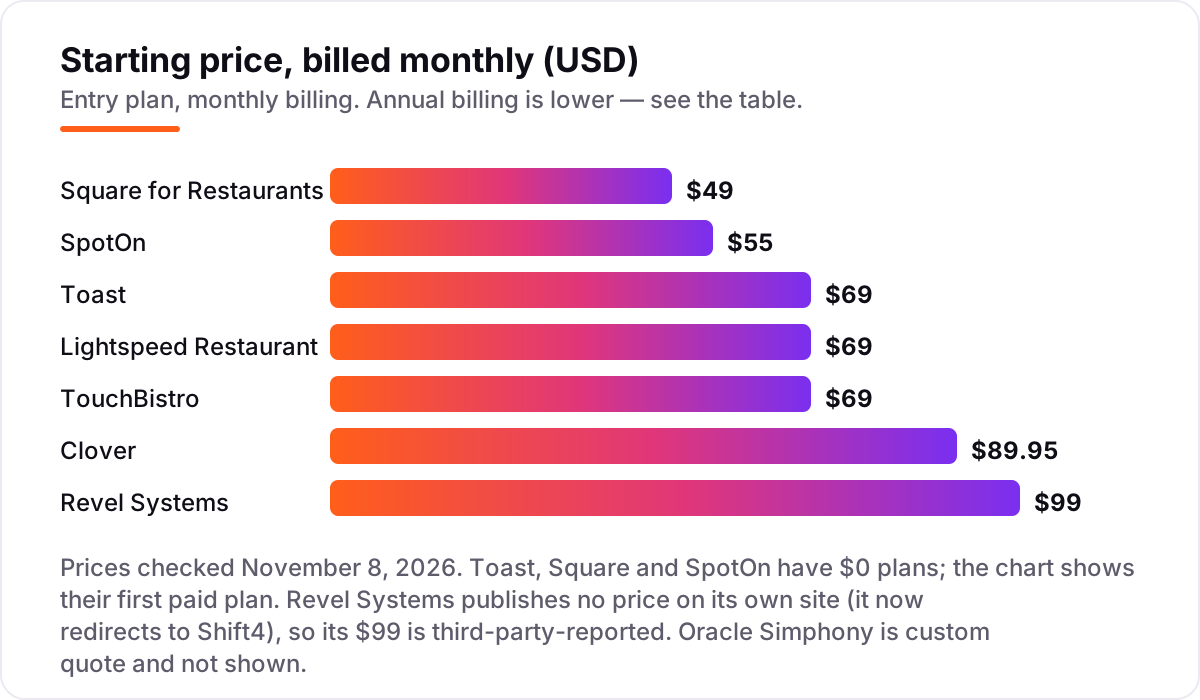
Take a single-location restaurant with two terminals, one kitchen display screen, and $40,000 a month in card sales across 2,000 tickets at $20 each. The software alone costs $79 a month on Square Plus ($49 plus a $30 kitchen display), $94 on Toast ($69 plus a $25 display), $99 on Lightspeed Starter ($69 plus a $30 display), $110 on SpotOn Essentials ($55 per station for two stations), $69 on TouchBistro for one license (a second license and the display are quoted), $89.95 on Clover (hardware separate), and $198 on Revel ($99 per terminal for two terminals, plus $674 onboarding once). Oracle Simphony is custom quote.
Over a year, that software costs $948 on Square Plus, $1,128 on Toast, $1,188 on Lightspeed, $1,320 on SpotOn Essentials, $1,080 on Clover, and $2,376 on Revel. Now add processing on the same $40,000: Toast at 2.49% plus 15 cents comes to $1,296 a month, Square Plus at 2.5% plus 15 cents to $1,300, SpotOn Essentials at 2.45% plus 15 cents to $1,280, Clover at 2.3% plus 10 cents to $1,120, and Revel at 2.49% plus 15 cents to $1,296.
The processing dwarfs the software, and it flips the ranking. The cheapest all-in month is Clover at about $1,210 ($89.95 plus $1,120 in processing), ahead of Square Plus at $1,379 and Toast at $1,390 — because Clover's 2.3% rate saves about $180 a month against Square Plus at this volume. Below about $15,000 a month in card sales the order reverses and Square's cheap software wins. The lesson holds at every volume: work out the processing on your own sales first, then compare software prices. If the room is found through search rather than walk-ins, our local SEO service covers the visibility side — the POS cannot sell to customers who never find the door.
Know the difference: software price vs the full monthly bill
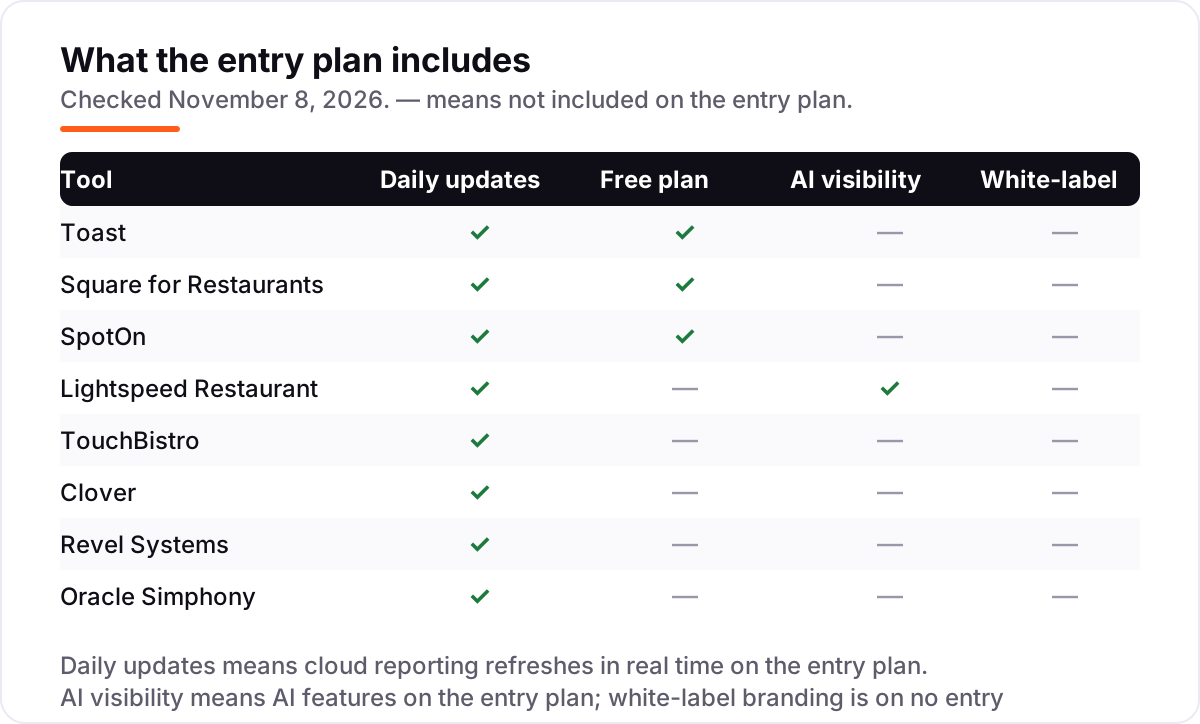
The confusion in this category is between the price on the pricing page and the price on the bank statement. The software subscription is the smallest part of a restaurant POS bill. Processing fees run 2.3% to 2.79% of every card sale, hardware is bought outright or financed over 24 to 36 months, and the kitchen display, online ordering, loyalty and reservations are paid modules on most tools here. A $69-a-month plan easily becomes a $1,400-a-month bill once processing is counted.
There is a second, quieter confusion: per-location pricing versus per-station pricing. Square, Lightspeed and TouchBistro charge per location or per license, so a second terminal costs little or nothing extra. Toast, SpotOn, Clover and Revel charge per station or per terminal, so a two-terminal room pays double the headline price and a four-terminal room pays four times it. Always multiply the headline price by your station count before comparing.
A third distinction worth knowing is the $0 plan versus a free plan. Square Free is a real free plan with no term and no hardware cost. The Toast Starter Kit and SpotOn All-In cost $0 a month but trade that for higher processing rates or a two-year term — the cost is still there, it is just collected per transaction instead of per month. Judge a $0 plan by its processing rate, not by its monthly fee.
Quick comparison: tool type by need
| Buyer | Best pick | Why |
|---|---|---|
| New restaurant on a tight budget | Square for Restaurants | Free plan at $0, no contract, Plus is $49/month when you want more |
| Most independent restaurants | Toast | Restaurant-only platform from $69/month, kitchen to payroll in one place |
| Bundled hardware deal | SpotOn | All-In is $0 per station with hardware included |
| Multi-location group | Lightspeed Restaurant | One back office for menus, inventory and reporting, from $69/month |
| Full-service dining room | TouchBistro | Offline mode and tableside ordering on iPads, from $69/month |
| Hotel or stadium group | Oracle Simphony | One POS across many revenue centers, custom quote |
Mistakes to avoid
- Budgeting on the software price alone. Processing runs $1,120–$1,300 a month at $40,000 in card sales, against $79–$198 in software. Compare the processing rate first and the subscription second.
- Buying hardware before reading the contract. Toast, Clover, Revel and SpotOn All-In lock you in for two to three years, and the early exit fee can run into four figures. Get the term and the exit fee in writing.
- Paying for the same add-on twice. Online ordering, loyalty and the kitchen display are separate modules on most tools here. List the modules you need and price them once, before you sign.
- Forgetting the second station. Per-station pricing doubles the headline price in a two-terminal room and quadruples it in a four-terminal room. Multiply before you compare.
- Ignoring offline mode. A cloud POS that stops when the wifi drops stops the whole dining room. If your connection is unreliable, test the offline behaviour during the trial weekend.
How we chose
We checked each vendor's own pricing page on November 8, 2026 and recorded the starting price exactly as shown, including the per-station or per-terminal basis, and we ranked the tools by fit for the most common buyer — a single-location independent restaurant — not by brand size. Two prices carry a caveat: Revel Systems publishes no price on its own site, which now redirects to Shift4, so its $99 a month per terminal is reported by 2026 reviews and G2's pricing page, and Oracle Simphony is custom quote with no published price. Ratings come from fresh search-index copies of the exact G2 pages; Oracle Simphony carries no rating because its G2 listing has only 9 reviews. No vendor paid for a place in this list, and none of the links here are affiliate links.
What to do next
Start with the $0 plan or demo of your top pick and run one real weekend of service through it. Check that orders reach the kitchen without a second look, that the close-of-day report matches the till, and that the processing rate on your own sales beats the plan you are leaving. If the dining room is sorted but new customers are not finding you, our monthly SEO service handles the visibility side — or compare providers in our guide to retail analytics software. Once your tools are in place, find out what's holding your rankings back.
Your stack only works if people find you
SerpAstra fixes what keeps your site off page one and makes it easy for AI assistants to recommend.
Get a free audit→Sources we checked (15)
- Toast pricing — pos.toasttab.com/pricing (checked November 8, 2026)
- Square for Restaurants pricing — squareup.com/us/en/point-of-sale/restaurants/pricing (checked November 8, 2026)
- SpotOn pricing — spoton.com/pricing (checked November 8, 2026)
- Lightspeed Restaurant pricing — lightspeedhq.com/pos/restaurant/pricing (checked November 8, 2026)
- TouchBistro pricing — touchbistro.com/pricing (checked November 8, 2026)
- Clover restaurant pricing — clover.com/pricing/restaurant (checked November 8, 2026)
- Revel Systems pricing — revelsystems.com (checked November 8, 2026; vendor site now redirects to Shift4, $99 reported by 2026 reviews and G2)
- Oracle Simphony — oracle.com/hospitality/simphony (checked November 8, 2026; custom quote, no published price)
- Toast G2 reviews — g2.com (checked November 8, 2026)
- Square Point of Sale G2 reviews — g2.com (checked November 8, 2026)
- SpotOn G2 reviews — g2.com (checked November 8, 2026)
- Lightspeed Restaurant G2 reviews — g2.com (checked November 8, 2026)
- TouchBistro G2 reviews — g2.com (checked November 8, 2026)
- Clover G2 reviews — g2.com (checked November 8, 2026)
- Revel Systems G2 reviews — g2.com (checked November 8, 2026)
Shamim
Founder of SerpAstra
A full-stack SEO and digital marketer who spends most days on Local SEO for dental practices, AI search visibility and lead generation.
Frequently asked questions
What is the best restaurant POS system?
Toast is the best fit for most independent restaurants: a restaurant-only platform with the kitchen, ordering and payroll in one place, from $69 a month. Square is the best cheap start with a free plan, and SpotOn is the best bundled hardware deal. Multi-location groups should look at Lightspeed Restaurant instead.
How much does a restaurant POS system cost per month?
Software runs from $0 to $99 a month per location or terminal, with Oracle Simphony priced by quote. But software is the small part: at $40,000 a month in card sales, processing adds $1,120–$1,300 a month, and hardware, kitchen displays and add-ons sit on top. Budget the full bill, not the headline price.
Is there a free restaurant POS system?
Yes, with trade-offs. Square Free costs $0 a month per location, the Toast Starter Kit is $0 for one or two terminals, and SpotOn All-In is $0 per station with hardware included. All three charge higher processing rates or need a two-year term, so compare the processing bill before calling any of them free.
Toast vs Square: which is better for a restaurant?
Toast is better for a full-service restaurant that wants one restaurant-only system with kitchen display, online ordering and payroll together, from $69 a month. Square is better for a small counter, cafe or food truck that wants to start at $0 with no contract. Toast locks you into a two-year term; Square lets you leave any time.
Do restaurant POS systems require a contract?
Most do. Toast typically needs one to three years, Clover hardware bundles run 36 months, Revel needs three years, and SpotOn All-In needs two. Square and SpotOn Essentials are month-to-month. Always get the term, the early termination fee and the processing rate in writing before you sign anything.
Can I switch restaurant POS systems later?
Yes, but plan the move for a slow week, not a busy season. Export your menu, modifiers, prices, customer list and sales history from the old system, rebuild the menu in the new one, and run both systems in parallel for a few days. Switching also means new hardware on Toast, Clover and TouchBistro, so price that before you commit.
Free SEO and AI visibility audit
Find out what is holding your rankings back
Send us your site. Within 2 business days you get a written audit, an AI visibility check and a short fix list ranked by impact. Free, with no contract attached.
Request my free audit→Related guides
 Local SEOLocal SEO for restaurants: menus, reservations and reviewsLocal SEO for restaurants: menus, reservations and reviews that win the map pack, plus the pages and profiles that turn nearby searches into bookings.Read guide →
 SEO & AI Search11 Best Retail Analytics Software in 2026, Compared11 best retail analytics software tools compared on price, from free POS analytics to enterprise in-store tracking. Prices checked November 2, 2026.Read guide →
 SEO & AI SearchBest Tools for SEO for Retail in 2026: 8 Picks Ranked by What You Need8 best tools for SEO for retail compared on price, local listings, rank tracking and AI visibility. Real prices checked on vendor pages, November 2, 2026.Read guide →