
10 Best Retail Advertising Platforms for 2026 (Pros, Cons and Pricing)
Compare the 10 best retail advertising platforms for brands selling online, on minimum spend, fees and reach, with every price checked November 5, 2026.
 Shamim Mia, Founder, SerpAstraLast verified November 5, 202614 min read
We compare pricing pages, documentation and public reviews. We never accept payment for rankings.

Key takeaways
- Amazon Ads leads for most retail brands at no monthly fee and a $1 daily budget; Walmart Connect follows with no setup or monthly fees, and AdRoll's self-serve plan is free.
- Only three platforms here are quote-only: Criteo, Target Roundel and The Trade Desk. The other seven publish a floor you can start from, from $0 to about $1 a day.
- The single most important buying factor is where your products already sell: a platform only converts shoppers on its own shelves, so pick the network that matches your distribution first.
- Retail media is not one price: you pay per click or per thousand impressions, and the real cost is your daily budget times 30 days, not the headline minimum.
On this page
Quick comparison
| Tool | Best for | Starting price | Free plan |
|---|---|---|---|
| Amazon Ads | Brands and sellers that want their products in front of Amazon shoppers at the moment of purchase | $1/day min | Yes (no fee) |
| Walmart Connect | Brands already selling on Walmart.com that want a second retail media network beside Amazon | No fees | Yes (no fees) |
| Criteo | Brands that want one platform running retail media across many retailers plus open-web retargeting | Custom quote | No (quote-only) |
| Google Ads | Retailers that want to catch shoppers searching for a product on Google before they pick a store | No minimum | Yes (no minimum) |
| Meta Ads | Retail brands that sell on discovery and impulse, especially in visual categories like home, fashion and beauty | $1/day floor | Yes (no minimum) |
| Target Roundel | Brands already carried in Target stores that want premium, brand-safe placement with Target's shopper data | Custom quote | No (quote-only) |
| Instacart Ads | Grocery and consumer-goods brands that want ads at the digital shelf where baskets are built | No minimum | Yes (no minimum) |
| Pinterest Ads | Retail brands in visual categories that want shoppers to discover products while planning purchases | No minimum | Yes (no minimum) |
| The Trade Desk | Larger retail brands that want programmatic buying across the open web with full control over inventory | Custom quote | No (quote-only) |
| AdRoll | Small retailers that want easy retargeting across the web and social without a subscription | Free; Plus $36/mo | Yes (free plan) |
Make one of these tools?
We re-check this list every quarter. Send a correction, request a review, or ask about a clearly labeled sponsored spot.
Request a listingThe best retail advertising platforms

Amazon Ads
Best for: Brands and sellers that want their products in front of Amazon shoppers at the moment of purchase
Amazon Ads is where most retail advertising starts, because it puts products in front of shoppers at the moment they are ready to buy. Sponsored Products promote individual listings in search results and on product pages, and you pay only when a shopper clicks. The minimum daily budget is $1, there is no monthly fee, and Sponsored Brands and Sponsored Display add brand and retargeting formats once a product proves itself.
The catch is competition. Click costs rise fast in crowded categories, and an unmanaged campaign can spend its budget before lunch. Sponsored Brands need Brand Registry, so sellers without a registered trademark are limited to Sponsored Products. Managed-service display is a different tier entirely, typically requiring a $50,000 minimum spend. Start on Amazon Ads when you sell on Amazon; add a second network only after this one is profitable.
What we like
- The largest retail media audience: ads appear where shoppers are already buying
- Sponsored Products start at a $1 daily budget with no monthly fee
- Sponsored Brands and Sponsored Display add brand and retargeting formats in the same console
- Closed-loop reporting ties ad spend directly to Amazon sales
Watch out for
- Click costs climb fast in crowded categories, and unmanaged campaigns burn budget quickly
- Sponsored Brands need Brand Registry, so unregistered sellers are limited to Sponsored Products
- Managed-service display typically requires a $50,000 minimum spend, per Amazon's own FAQ

Walmart Connect
Best for: Brands already selling on Walmart.com that want a second retail media network beside Amazon
Walmart Connect is the natural second retail network for brands that already sell on Walmart.com. Sponsored Search has no setup or monthly fees: you choose a budget and pay only when a shopper clicks, and the self-serve Ad Center covers Sponsored Products, Sponsored Brands and Sponsored Videos. Closed-loop measurement tracks the impact on Walmart site, app and store sales, so the return is measured in receipts rather than clicks.
The limits are eligibility and scale. Sponsored Products only serve items that are in stock and winning the Buy Box, so a listing problem stops delivery outright. Onsite Display is a different budget tier: Walmart recommends $4,500 per campaign per month, though it sets no minimum requirement. The audience is also smaller than Amazon's. Choose Walmart Connect when you already sell on Walmart.com and want cheaper clicks beside Amazon.
What we like
- Sponsored Search has no setup or monthly fees — you choose a budget and pay per click
- Self-serve Sponsored Products, Sponsored Brands and Sponsored Videos in one Ad Center
- Closed-loop measurement tracks impact on Walmart site, app and store sales
- Less crowded auctions than Amazon, so click costs often run lower
Watch out for
- Sponsored Products only serve items winning the Buy Box, so listing problems stop delivery
- Onsite Display carries a $4,500-per-campaign monthly recommendation, which is a different budget tier
- Smaller audience than Amazon, so reach in niche categories can be thin

Criteo
Best for: Brands that want one platform running retail media across many retailers plus open-web retargeting
Criteo is the platform for brands that sell through many retailers and do not want a separate campaign on each one. Its Commerce Growth product runs sponsored products across more than 200 retailer partners and adds open-web retargeting from the same feed, with AI targeting built for product data rather than generic display audiences. Dynamic creative keeps prices and availability current without rebuilding ads by hand.
The price is the problem for smaller brands: Criteo publishes no rate card, so every deal is negotiated, and a platform fee sits on top of media cost as a percentage. That makes budget comparisons with pure CPC platforms awkward. Reviewers also note limited creative control and reporting that is thinner than they want. Choose Criteo when your products sit on many retailers and one feed should power them all.
What we like
- Runs sponsored products across 200+ retailer partners plus open-web retargeting from one platform
- Commerce data and AI targeting built for product feeds, not generic display audiences
- Closed-loop measurement attributes sales back to ad exposure inside retailer data
- Dynamic creative updates product ads automatically as prices and availability change
Watch out for
- No published price — every deal is negotiated, so small brands cannot self-serve at a known rate
- Platform fees sit on top of media cost as a percentage, which complicates budget comparisons
- Reviewers note limited creative control and reporting that is less detailed than they want

Google Ads
Best for: Retailers that want to catch shoppers searching for a product on Google before they pick a store
Google Ads catches demand one step earlier than a marketplace: the shopper searching for a product before picking a store. There is no minimum spend — you set your own daily budget and pay per click or per viewable impression — and Shopping and Performance Max campaigns promote a whole catalog from one product feed across Search, YouTube, Maps and the Display Network. The free Keyword Planner shows estimated bids before anything is spent.
The absence of a minimum is not the same as cheap. Competitive keywords can cost several dollars a click, and Performance Max automates placements, so control over where ads appear is limited. Feed quality decides results: a messy feed produces weak Shopping ads that no budget can rescue. Choose Google Ads when shoppers search for your category before they know which store to buy from.
What we like
- No minimum spend: you set your own daily budget and pay per click or per viewable impression
- Shopping and Performance Max campaigns promote your whole catalog from one product feed
- Reaches shoppers across Search, YouTube, Maps and the Display Network from one account
- Free Keyword Planner shows estimated bids before you spend anything
Watch out for
- No minimum spend sounds free, but competitive product keywords can cost several dollars a click
- Performance Max automates placements, so control over where ads appear is limited
- Feed quality decides results — a messy product feed produces weak Shopping ads no budget can fix

Meta Ads
Best for: Retail brands that sell on discovery and impulse, especially in visual categories like home, fashion and beauty
Meta Ads sells on discovery rather than search: products appear in Facebook and Instagram feeds while people browse, which suits visual categories like home, fashion and beauty. The published floors are low — $1 a day for impression-based ad sets and $5 a day for conversion-optimized ones — and Advantage+ automation plus Shops put the catalog into the feed. Catalog ads update prices and availability automatically from your product feed.
The floor is not the working budget. Conversion campaigns need roughly 50 optimization events a week per ad set to leave the learning phase, which takes spend. Creative fatigue is fast, so feeds need fresh images and video constantly. Account restrictions and ad rejections are also a recurring reviewer complaint, with slow support. Choose Meta Ads when your products sell on looks and impulse rather than on a search.
What we like
- Published floors are low: $1 a day for impression-based ad sets, $5 a day for conversion-optimized ones
- Advantage+ automation and Shops put the product catalog directly into Facebook and Instagram feeds
- Interest, behavior and custom-audience targeting built for product discovery
- Catalog ads update prices and availability automatically from your product feed
Watch out for
- Conversion-optimized ad sets need at least $5 a day, and learning needs roughly 50 events a week per ad set
- Creative fatigue is fast — feeds need fresh images and video constantly
- Account restrictions and ad rejections are a recurring reviewer complaint, with slow support

Target Roundel
Best for: Brands already carried in Target stores that want premium, brand-safe placement with Target's shopper data
Target Roundel is Target's in-house retail media network, and it trades on premium placement rather than scale. Self-serve Product Ads in Media Studio carry no minimum spend and no DSP or access fee — you pay for the clicks you buy — and Target Circle loyalty data from over 100 million members powers the targeting. Placements run on Target.com, in the app and in stores, which suits lifestyle, home and beauty brands.
The gate is distribution: if your products are not carried in Target stores, Roundel is unavailable at any budget. Managed programmatic and connected-TV campaigns are a different tier, with minimum commitments that sometimes reach five figures. Scale is also smaller than Amazon or Walmart. Choose Roundel when Target already stocks your products and you want its shoppers, not the whole internet.
What we like
- Self-serve Product Ads in Media Studio carry no minimum spend and no DSP or access fee
- Target Circle loyalty data from over 100 million members powers targeting
- Premium, brand-safe placements on Target.com, in the app and in stores
- CPC pricing for sponsored products keeps entry costs tied to clicks, not commitments
Watch out for
- No distribution in Target stores means no Roundel access at any budget
- Managed programmatic and CTV campaigns carry minimum commitments, sometimes five figures
- Smaller scale than Amazon or Walmart, so it works as a complement, not a replacement

Instacart Ads
Best for: Grocery and consumer-goods brands that want ads at the digital shelf where baskets are built
Instacart Ads puts grocery and consumer-goods brands at the digital shelf, where baskets are actually built. Featured product ads are the self-serve format: there is no minimum spend, you set a lifetime budget, and the second-price auction means a winning click costs $0.01 more than the next-highest bid. Ads appear in search results and across the marketplace, close to the add-to-cart decision rather than far up the funnel.
The reach is bounded by the marketplace itself — Instacart Ads never reaches shoppers on the open web. Featured product ads are also the only self-serve format; display, coupons and delivery promotions still need the Instacart team. And a brand's products must already be listed with Instacart retailers before any ad can run. Choose Instacart Ads when your products already sell through its grocery retailers.
What we like
- No minimum spend on self-serve featured product ads — you set a lifetime budget and pay per click
- Second-price auction keeps the winning click $0.01 above the next-highest bid
- Ads appear at the digital shelf, close to the add-to-cart decision
- Fewer advertisers than Amazon, so click costs often run lower for grocery brands
Watch out for
- Only reaches shoppers inside the Instacart marketplace, not the open web
- Featured product ads are the only self-serve format; display and coupons need the Instacart team
- A brand's products must already be listed with Instacart retailers before ads can run

Pinterest Ads
Best for: Retail brands in visual categories that want shoppers to discover products while planning purchases
Pinterest Ads reaches shoppers while they plan purchases — saving ideas for a home project, a wedding or a seasonal refresh — which suits visual categories like home, fashion, beauty and food. There is no minimum budget: you set any daily or lifetime budget during setup, and Performance+ automation handles targeting, bidding and budgets for sales campaigns. Catalog and shopping ads sync products automatically from your feed.
No minimum does not mean no floor in practice. Bid floors and thin conversion volume starve very small budgets, and conversion campaigns need roughly 50 events a week to optimize, so small catalogs learn slowly. Advertiser-side reporting history is also shorter than on other platforms, so year-on-year comparison needs your own records. Choose Pinterest Ads when your products are planned, not impulse-bought.
What we like
- No minimum budget: you set any daily or lifetime budget during setup
- Performance+ automation handles targeting, bidding and budgets for sales campaigns
- Shoppers arrive in planning mode, which suits home, fashion, beauty and food products
- Catalog and shopping ads sync products automatically from your feed
Watch out for
- No minimum budget, but bid floors and thin conversion volume starve tiny budgets
- Conversion campaigns need roughly 50 events a week, so small catalogs learn slowly
- Advertiser-side reporting history is shorter than on other platforms, so year-on-year comparison needs your own records

The Trade Desk
Best for: Larger retail brands that want programmatic buying across the open web with full control over inventory
The Trade Desk is the independent demand-side platform for retail brands that want programmatic buying across the open web rather than inside one retailer's walls. It offers transparent pricing and control over inventory, bids and fees, Kokai AI optimization that suggests targeting and bidding adjustments, and reach across display, video, audio and connected TV, including retail audiences off-site. Real-time reporting supports scaled campaigns.
The barriers are price and complexity. There is no published price and minimums are negotiated, which puts it out of reach for small advertisers. Reviewers consistently flag a steep learning curve, especially for new users facing the complex interface. And the DSP is only the buying layer — creative, feeds and measurement tooling still sit with you. Choose The Trade Desk when retail media budgets are large enough to need open-web reach.
What we like
- Independent DSP with transparent pricing and control over inventory, bids and fees
- Kokai AI optimization suggests targeting and bidding adjustments across campaigns
- Reaches retail audiences off-site, including connected TV and premium publishers
- Real-time reporting and audience tools built for scaled retail campaigns
Watch out for
- No published price and negotiated minimums put it out of reach for small advertisers
- Steep learning curve — reviewers consistently flag the complex interface for new users
- You still need creative, feeds and measurement tooling; the DSP is the buying layer, not the whole stack

AdRoll
Best for: Small retailers that want easy retargeting across the web and social without a subscription
AdRoll is the retargeting pick for small retailers: the self-serve Ads plan is free, with no subscription and no minimum spend, and you pay only for the media you buy. It runs cross-channel retargeting across web, social and email from one dashboard, and reviewers praise its ease of use and easy setup more than any other strength. Integrations with Shopify and other store platforms keep product feeds in sync automatically.
The trade-offs are pricing opacity and support. AdRoll's own pricing page lists package names but no dollar amounts, so the $36-a-month Marketing & Ads Plus figure comes from third-party reporting rather than the vendor. Support quality is a recurring reviewer complaint, including slow resolution of integration issues. And media margins sit inside CPM pricing, so the true cost per click is harder to compare with pure CPC platforms.
What we like
- Self-serve Ads plan is free — you pay only for media, with no minimum spend
- Cross-channel retargeting across web, social and email from one dashboard
- Reviewers praise ease of use and easy setup more than any other strength
- Integrations with Shopify and other store platforms keep product feeds in sync
Watch out for
- Paid plans publish no prices on AdRoll's own pricing page, so the $36/month Plus figure is third-party sourced
- Support quality is a recurring reviewer complaint, including slow resolution of integration issues
- Media margins sit inside CPM pricing, so the true cost per click is harder to compare with pure CPC platforms
The best retail advertising platforms put your products in front of shoppers who are already looking to buy, and they charge for that attention by the click or the thousand impressions rather than by subscription. We ranked the ten platforms below by fit for the most common buyer — a retail brand deciding where its next ad dollar goes — starting with the biggest shopper audiences and ending with the free retargeting option, and every price was checked on November 5, 2026.
How to choose the best retail advertising platforms
- Start with your distribution. A retail network only converts shoppers on its own shelves: Amazon Ads needs Amazon listings, Roundel needs Target distribution, Instacart Ads needs products in its grocery retailers. Pick the network that matches where you already sell.
- Read the floor, then ignore it. Published minimums run from $0 to about $1 a day, but a $1-a-day campaign buys one or two clicks. Budget for learning: roughly 50 optimization events a week per ad set on Meta and Pinterest.
- Separate subscription from media. Seven platforms here charge no monthly fee, so the real comparison is click cost and conversion rate, not the price of admission. Quote-only platforms are a different purchase — a negotiated deal, not a signup.
- Check the attribution window and the receipt. Retail media measures sales inside the retailer's own data; open-web platforms measure clicks and modeled conversions. Decide which receipt you trust before you compare returns.
- Mind the feed. Shopping, catalog and sponsored-product ads all run on your product feed. A feed with bad titles, missing attributes or stale prices caps results on every platform at once.
Retail advertising is one side of getting found. If the store itself needs more search visibility, our guide to retail SEO tools covers the organic side. And before you publish new product pages, run your titles through the free SERP snippet preview tool — it shows exactly how the title and description will look in Google.
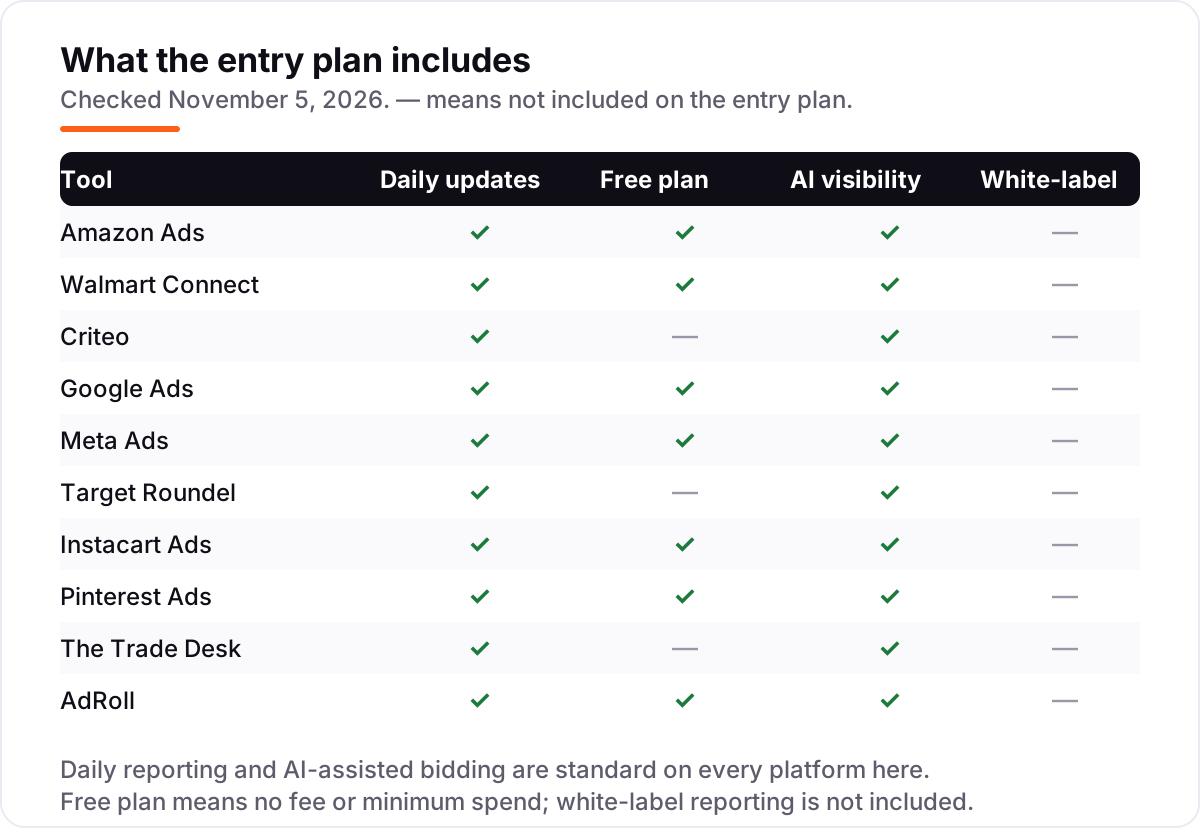
Whatever you shortlist, test with one product before you fund the catalog. The no-fee platforms in this list let you run a genuine trial — one product, one budget, one week — and that week tells you more than any benchmark. Check two things in the trial: that the clicks turn into add-to-carts at a cost your margin survives, and that the reporting shows sales rather than vanity metrics. Every platform here reports daily, so there is no reason to buy blind.
Retail advertising platforms pricing: what you will actually pay
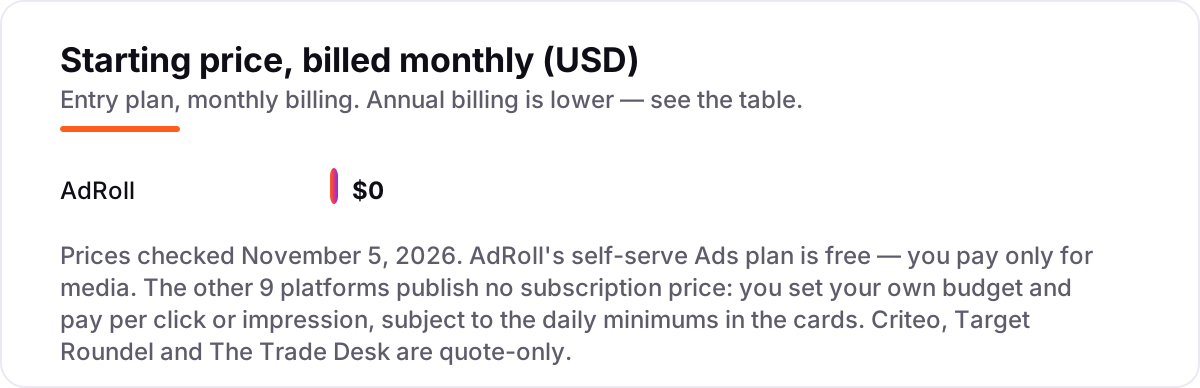
Take a retail brand with $2,000 a month to test three platforms. On published floors, the subscription cost is $0 on all three: Amazon Sponsored Products at $1 a day, Meta Ads at $1 a day per ad set, and AdRoll's free plan. The money goes to media instead. Split as $800 on Amazon, $700 on Meta and $500 on AdRoll retargeting, the monthly bill is exactly $2,000 — no platform fee on top, because none of the three charges one.
That changes the moment a quote-only platform enters the mix. Criteo, Target Roundel and The Trade Desk negotiate budgets rather than publishing rates, and managed tiers carry commitments: Amazon's own FAQ puts managed-service display at a typical $50,000 minimum spend, and Walmart recommends $4,500 per campaign per month for Onsite Display. A brand that adds a managed campaign at those levels is no longer comparing $1-a-day floors — it is comparing negotiated deals.
Three costs sit outside every number above. First, the floor is not the working budget: a $1-a-day campaign buys almost no data, so plan on $30 to $50 a day per platform for a real test. Second, creative: product feeds need clean titles, images and attributes, and social feeds need fresh creative constantly. Third, management time or an agency fee — the platforms are self-serve, but nobody optimizes them for free. If the brand also sells through Walmart.com, the second network costs nothing extra to enter; see our guide to advertising platforms for small businesses for the wider field.
Know the difference: retail media vs open-web advertising
The confusion in this category is between two kinds of inventory. Retail media runs inside a retailer's own property: Amazon search results, Walmart.com shelves, Target.com pages, Instacart search. The retailer owns the audience, the surface and the transaction, so measurement ends in a receipt. Open-web advertising — The Trade Desk, Criteo's retargeting, AdRoll — buys audiences across publishers and the open internet, and measures clicks, modeled conversions and attributed sales that never touch a single retailer's ledger.
That distinction decides the budget split. Retail media converts shoppers who are already buying, so it usually shows the strongest return on ad spend and the weakest reach: it cannot find a customer who never visits that retailer. Open-web advertising finds customers earlier and wider, but its measurement is softer and its click costs are set by auctions you do not control. Most mature retail brands run both: retail media for the shelf, open-web for the prospecting that fills the shelf's funnel.
A second distinction worth knowing is self-serve versus managed. Self-serve platforms — Amazon Sponsored Products, Walmart Sponsored Search, Instacart featured products, Google, Meta, Pinterest, AdRoll — let anyone open an account and set a budget. Managed platforms — Criteo's enterprise deals, Roundel's programmatic and connected-TV campaigns, The Trade Desk's negotiated accounts — come with minimums, insertion orders and account teams. The same company can appear on both sides: Roundel's self-serve Product Ads carry no minimum while its managed campaigns carry five-figure commitments.
Quick comparison: tool type by need
| Buyer | Best pick | Why |
|---|---|---|
| Brand selling on Amazon | Amazon Ads | Biggest shopper audience, Sponsored Products from $1/day, no monthly fee |
| Brand selling on Walmart.com | Walmart Connect | No setup or monthly fees on Sponsored Search, closed-loop sales measurement |
| Brand on many retailers at once | Criteo | One feed across 200+ retailer partners, quote-only |
| Retailer catching product searches | Google Ads | No minimum spend, Shopping and Performance Max from one feed |
| Brand selling on discovery | Meta Ads | Catalog ads in Facebook and Instagram feeds from $1/day per ad set |
| Brand stocked at Target | Target Roundel | Self-serve Product Ads with no minimum, Target Circle shopper data |
| Grocery or consumer-goods brand | Instacart Ads | Featured product ads at the digital shelf, no minimum spend |
| Small retailer needing retargeting | AdRoll | Free self-serve plan, pay only for media |
Mistakes to avoid
- Budgeting on the floor. A $1-a-day campaign buys one or two clicks and teaches you nothing. Fund the learning phase — roughly 50 optimization events a week per ad set — or the platform never optimizes.
- Buying retail media where you do not sell. Roundel needs Target distribution, Walmart Connect needs Walmart.com listings, Instacart Ads needs products in its retailers. A platform you cannot list on is a platform you cannot advertise on.
- Comparing a subscription price with a media budget. Seven platforms here charge $0 in fees, so the comparison is click cost and conversion rate, not admission. Quote-only platforms are negotiated deals — compare them on total cost, including platform fees.
- Feeding every platform a dirty catalog. Shopping, catalog and sponsored-product ads all run on your product feed. Bad titles, missing attributes and stale prices cap results everywhere at once — fix the feed before raising the budget.
- Judging retail media and open-web ads by the same receipt. Retail media reports sales inside one retailer's data; open-web platforms report modeled attribution. Compare each against its own baseline, not against the other's numbers.
How we chose
We checked each vendor's own pricing or advertising page on November 5, 2026 and recorded the starting price exactly as shown, or as "Custom quote" where the vendor publishes no price. Two figures in this post are third-party sourced and are labeled as such: AdRoll's Marketing & Ads Plus price of $36 a month, because AdRoll's own pricing page lists package names but no dollar amounts, and Instacart's $0.15 minimum bid, which comes from third-party advertising guides rather than Instacart's own pages. Ratings come only from G2 pages opened on November 5, 2026; Walmart Connect, Target Roundel and Instacart Ads carry no rating because G2 has no listing for those advertising products, and Pinterest Ads carries none because G2's Pinterest listing rates the consumer product rather than the ads platform. We ranked the tools by fit for the most common buyer — a retail brand deciding where its next ad dollar goes — not by brand size. No vendor paid for a place in this list, and none of the links here are affiliate links.
What to do next
Start with the platform that matches where you already sell, fund one product for one real week, and check that clicks turn into add-to-carts at a cost your margin survives. Add a second network only after the first is profitable, and fix the product feed before raising any budget. If the ads are sorted but new customers are not finding the store itself, our monthly SEO service handles the visibility side — or compare providers in our guide to retail analytics software. Once your tools are in place, find out what's holding your rankings back.
Your stack only works if people find you
SerpAstra fixes what keeps your site off page one and makes it easy for AI assistants to recommend.
Get a free audit→Sources we checked (16)
- Amazon Ads FAQ — advertising.amazon.com/en-gb/resources/faq (checked November 5, 2026)
- Walmart Connect — walmartconnect.com (checked November 5, 2026)
- Criteo — criteo.com (checked November 5, 2026)
- Google Ads — ads.google.com (checked November 5, 2026)
- Meta Ads — facebook.com/business/ads (checked November 5, 2026)
- Target Roundel — roundel.com (checked November 5, 2026)
- Instacart Ads — ads.instacart.com (checked November 5, 2026)
- Pinterest Performance+ — business.pinterest.com (checked November 5, 2026)
- The Trade Desk — thetradedesk.com (checked November 5, 2026)
- AdRoll pricing — adroll.com/pricing (checked November 5, 2026)
- Amazon Sponsored Ads on G2 — g2.com (checked November 5, 2026)
- Criteo Commerce Growth on G2 — g2.com (checked November 5, 2026)
- Google Ads on G2 — g2.com (checked November 5, 2026)
- Facebook for Business on G2 — g2.com (checked November 5, 2026)
- The Trade Desk on G2 — g2.com (checked November 5, 2026)
- AdRoll on G2 — g2.com (checked November 5, 2026)
Shamim
Founder of SerpAstra
A full-stack SEO and digital marketer who spends most days on Local SEO for dental practices, AI search visibility and lead generation.
Frequently asked questions
What is the best retail advertising platform?
Amazon Ads is the best fit for most retail brands: the largest shopper audience, no monthly fee and a $1 daily budget on Sponsored Products. Walmart Connect is the best second network for brands already selling on Walmart.com. Google Ads is the better pick when shoppers search for the product before choosing a store.
How much does retail advertising cost?
There is no single price. Seven platforms here charge no subscription: you pay per click or per thousand impressions against a budget you set, from $0 to about $1 a day at the floor. Criteo, Target Roundel and The Trade Desk are quote-only. A realistic test budget is $30 to $50 a day per platform, not the published minimum.
Is there a free retail advertising platform?
AdRoll's self-serve Ads plan is genuinely free — you pay only for media, with no subscription and no minimum spend. Amazon Ads, Walmart Connect, Google Ads, Meta Ads, Instacart Ads and Pinterest Ads charge no monthly fee either, but you still pay for every click or impression your ads earn.
What is the difference between retail media and open-web advertising?
Retail media runs inside a retailer's own property — Amazon, Walmart.com, Target.com or Instacart — and measures sales in that retailer's receipts. Open-web advertising, like The Trade Desk or Criteo's retargeting, buys audiences across publishers and the open internet. Retail media converts shoppers already buying; open-web advertising finds them earlier.
Do I need to sell on Amazon to run retail ads?
No, but each retail network only serves brands it already carries. Amazon Ads needs a seller or vendor account, Walmart Connect needs Walmart.com listings, Roundel needs Target distribution, and Instacart Ads needs products listed with its retailers. Google Ads, Meta Ads, Pinterest Ads and AdRoll work for any retailer with a website and a product feed.
Can I run the same product feed on every platform?
Mostly yes. Amazon, Walmart, Google, Meta, Pinterest and Criteo all accept product feeds, and tools like Shopify sync them automatically. Each platform still has its own feed specification, image rules and category mapping, so expect a setup pass per platform rather than a single upload that works everywhere.
How do I choose between Amazon Ads and Walmart Connect?
Start with where your sales already come from. If Amazon drives most of your revenue, Amazon Ads comes first and Walmart Connect second. If Walmart.com is your main channel, reverse the order. Both charge no monthly fee, so the deciding factor is distribution and click cost, not the subscription price.
Free SEO and AI visibility audit
Find out what is holding your rankings back
Send us your site. Within 2 business days you get a written audit, an AI visibility check and a short fix list ranked by impact. Free, with no contract attached.
Request my free audit→Related guides
 Digital Marketing & Ads7 Best Advertising Platforms for Small Businesses in 2026, Compared7 best advertising platforms for small businesses compared on minimum budgets, cost per click and who each one fits — minimums checked on each vendor's page.Read guide →
 SEO & AI Search11 Best Retail Analytics Software in 2026, Compared11 best retail analytics software tools compared on price, from free POS analytics to enterprise in-store tracking. Prices checked November 2, 2026.Read guide →
 SEO & AI SearchBest Tools for SEO for Retail in 2026: 8 Picks Ranked by What You Need8 best tools for SEO for retail compared on price, local listings, rank tracking and AI visibility. Real prices checked on vendor pages, November 2, 2026.Read guide →