
12 Best Security Software for Small Business in 2026, Compared
Compare the 12 best security software for small business options on price, endpoint protection and passwords, with prices checked November 7, 2026.
 Shamim Mia, Founder, SerpAstraLast verified November 7, 202615 min read
We compare pricing pages, documentation and public reviews. We never accept payment for rankings.

Key takeaways
- Microsoft Defender for Business is the best fit for most small businesses at $3 per user per month; Bitdefender GravityZone follows at $118.99 a year for 5 devices, and Keeper Business covers team passwords from $2 per user per month.
- The single most important buying factor is the billing unit: per-user, per-device and per-pack prices do not compare directly, so price the whole team before you choose.
- Only Sophos publishes no price at all — every other tool here has a published starting price, though five come from reseller or review listings rather than the vendor's own page.
- Endpoint protection stops malware; it does not replace backups or a password manager, so budget for all three layers, not one.
On this page
Quick comparison
| Tool | Best for | Starting price | Free plan |
|---|---|---|---|
| Microsoft Defender for Business | Small businesses already on Microsoft 365 that want EDR protection for up to 300 users without a second console | $3/mo | No (30-day trial) |
| Bitdefender GravityZone | Small businesses that want top-rated endpoint protection with a cloud console and no IT team | $118.99/yr | No (30-day trial) |
| Norton Small Business | Small businesses that want an all-in-one suite — antivirus, VPN, backup and monitoring — in one subscription | $179.99/yr | No (60-day guarantee) |
| Malwarebytes for Teams | Micro-businesses with 1–20 devices that want simple centrally managed antivirus without an IT hire | $119.99/yr | No (14-day trial) |
| McAfee Small Business Security | Small offices with five PCs or Macs that want one flat price and 24/7 phone support | $94.99/yr | No (30-day trial) |
| ESET Small Office Protection | Small businesses that want a light, low-impact agent with strong independent test scores | $179.99/yr | No (30-day trial) |
| Avast Business Security | Small businesses that want the cheapest per-device managed antivirus with a cloud console | $36.99/yr | No (30-day trial) |
| AVG AntiVirus Business Edition | Small Windows offices that want centrally managed antivirus with patch management as an add-on | $46.99/yr | No (30-day trial) |
| Trend Micro Worry-Free Business Security | Small businesses that want cloud-managed endpoint and email protection in one per-user price | $37.75/yr | No (30-day trial) |
| Sophos Endpoint | Small businesses that want enterprise-grade endpoint protection with deep-learning malware detection | Custom quote | No (30-day trial) |
| Keeper Business | Small teams that need shared logins, passkeys and vaults under admin control from $2 a user | $2/mo | No (free trial) |
| Backblaze Business Backup | Small businesses that want set-and-forget offsite backup so ransomware cannot destroy the only copy | $9/mo | No (15-day trial) |
Make one of these tools?
We re-check this list every quarter. Send a correction, request a review, or ask about a clearly labeled sponsored spot.
Request a listingThe best security software for small business

Microsoft Defender for Business
Best for: Small businesses already on Microsoft 365 that want EDR protection for up to 300 users without a second console
Microsoft Defender for Business is the cheapest way into real endpoint detection and response: $3 per user per month on annual billing, covering up to 5 devices per user, for businesses with up to 300 users. Next-generation antivirus, automated investigation and remediation, and threat and vulnerability management come in one console. If the business already pays for Microsoft 365 Business Premium at $22 per user per month, Defender for Business is already included.
It works best on Windows, covers macOS less deeply, and does not support Linux at all. It is endpoint protection only — no VPN, no password manager and no backup — so it is one layer, not the whole stack. Buy it when the business already lives in Microsoft 365; buy Bitdefender or Norton for a mixed Windows and Mac fleet.
What we like
- Cheapest real EDR here at $3 per user per month, covering up to 5 devices per user
- Included in Microsoft 365 Business Premium, so many businesses already pay for it
- Automated investigation and remediation contain attacks without a security team
- Threat and vulnerability management is included, not an add-on
Watch out for
- No Linux endpoint support and weaker macOS coverage than Windows
- No VPN, password manager or cloud backup included — endpoint protection only
- Needs a Microsoft 365 subscription to buy the standalone licence

Bitdefender GravityZone
Best for: Small businesses that want top-rated endpoint protection with a cloud console and no IT team
Bitdefender GravityZone is the value pick for endpoint protection: Small Business Security costs $118.99 a year for 5 devices on a one-year term, bought online with no partner, and a 10-device licence lists at $324.99 a year. One cloud console manages Windows, macOS, Linux and mobile, and the product scores near the top of independent business protection tests. Patch management and web access control are add-ons rather than bundled.
The limits are the tiers. EDR — the ability to investigate an incident after it happens — sits in Business Security Premium, not the entry plan, so a business that needs investigation pays more. First-term promotions of about 30% also end at renewal, so budget on the list price. Choose GravityZone when detection quality per dollar matters most; choose Defender for Business when the business is already on Microsoft 365.
What we like
- Consistently among the highest-rated business endpoint products in independent tests
- One cloud console covers Windows, macOS, Linux and mobile from the same licence
- Lightweight agent with patch management available as an add-on
- Self-service online purchase up to 100 devices, no partner required
Watch out for
- Per-device price falls with volume, so the 5-device pack is the most expensive per device
- EDR sits one tier up in Business Security Premium, not the entry plan
- First-term promotions of about 30% do not carry into renewal pricing

Norton Small Business
Best for: Small businesses that want an all-in-one suite — antivirus, VPN, backup and monitoring — in one subscription
Norton Small Business is the all-in-one option: one subscription covers antivirus, a password vault, dark web monitoring, a secure browser, a software updater and 250 GB of cloud backup. The 5-employee pack lists at $179.99 a year and costs $89.99 for the first year; the 3-employee pack lists at $119.99. Each employee covers 2 devices across Windows, Mac, Android and iOS, and the 60-day money-back guarantee is the longest in this list.
The trade-off is control. Norton says the product needs no business dashboard, which is good for a hands-off owner and bad for anyone who wants to manage employee devices centrally. VPN, financial monitoring and 24/7 tech support all wait for the Premium tier at $299.99 a year for 5 employees. Pick Norton when one subscription for everything beats best-of-breed tools; pick Defender for Business when central management matters.
What we like
- One subscription covers antivirus, password manager, dark web monitoring and 250 GB cloud backup
- Covers 2 devices per user across Windows, Mac, Android and iOS
- 60-day money-back guarantee, the longest here
- Business financial monitoring flags suspicious transactions on company accounts (Premium)
Watch out for
- No central business dashboard for managing employee devices remotely
- The 5-employee list price is $179.99 a year; the $89.99 figure is first-year only
- VPN, financial monitoring and 24/7 tech support wait for the Premium tier

Malwarebytes for Teams
Best for: Micro-businesses with 1–20 devices that want simple centrally managed antivirus without an IT hire
Malwarebytes for Teams is built for micro-businesses: a central cloud dashboard, real-time protection, web filtering and brute-force protection, sold in fixed packs of 3, 10 or 20 devices. The 3-device pack costs $119.99 a year, the 10-device pack $399.99, and the 20-device pack $519.99 against a $799.99 list price. The agent is light, the console needs no IT background, and the upgrade path to ThreatDown EDR is clear past 20 devices.
The pack sizes are the catch. A 7-device office buys the 10-device pack and pays for 3 empty seats, and the per-device price barely moves until the 20-device pack. There is no EDR on Teams, so incident investigation means stepping up to ThreatDown Core at $69 per device per year. Choose Teams when simplicity beats everything; choose Bitdefender when the device count is awkward and per-device pricing fits better.
What we like
- Simplest setup here: a central cloud dashboard a non-technical owner can run
- Real-time protection with web filtering and brute-force protection on every plan
- Light agent that reviewers praise for low system impact
- Clear upgrade path to ThreatDown EDR when the business outgrows Teams
Watch out for
- Sold in fixed 3-, 10- and 20-device packs, so odd device counts overpay
- No EDR on Teams — that starts with ThreatDown Core at $69 per device per year
- The 20-device pack is the only one with a meaningful per-device discount

McAfee Small Business Security
Best for: Small offices with five PCs or Macs that want one flat price and 24/7 phone support
McAfee Small Business Security keeps the maths simple: $94.99 a year covers 5 PCs or Macs, plus unlimited iOS and Android devices, with 24/7 technical support included in the base price. There is no console to learn and no per-device arithmetic — one flat price, one renewal date. That suits a small office where the owner wants a support number rather than a dashboard.
The ceiling is the 5-desktop cap. A sixth PC means buying a second pack or switching products, and there is no Linux support and no central console for managing a growing fleet. There is also no EDR tier, so this is antivirus plus support rather than incident investigation. Pick McAfee for a small, stable office; pick Avast or AVG when the device count will grow past five desktops.
What we like
- Flat $94.99 a year covers 5 PCs or Macs plus unlimited iOS and Android devices
- 24/7 technical support included in the base price
- Simple to install and manage with no console to learn
- Unlimited mobile cover suits teams that work from phones and tablets
Watch out for
- Covers 5 PCs or Macs; a sixth desktop means another pack or a different plan
- No Linux support and no central console for managing many devices
- No EDR tier — this is antivirus plus support, not incident investigation

ESET Small Office Protection
Best for: Small businesses that want a light, low-impact agent with strong independent test scores
ESET Small Office Protection is the lightweight pick: a small, fast agent built for older hardware, with strong independent test results for protection and few false positives. The 5-device pack costs $179.99 a year, 10 devices cost $204.99, and 25 devices cost $512.50. One licence covers Windows, macOS and Linux, including file servers, and everything is bought online and managed through ESET PROTECT Hub.
The pack structure is the weakness. There is no single-device option, and the 5-device pack is the most expensive per device in this list. EDR and full-disk encryption wait for the higher PROTECT tiers, so incident investigation costs more. Choose ESET when the office runs older machines that heavier agents slow down; choose Bitdefender when the per-device price matters more than the footprint.
What we like
- Lightest agent here — built for older hardware and small offices
- Strong independent test results for protection and low false positives
- Covers Windows, macOS and Linux, including file servers, from one licence
- Simple online purchase and management through ESET PROTECT Hub
Watch out for
- Sold in fixed 5-, 10- and 25-device packs with no single-device option
- EDR and full-disk encryption wait for the higher PROTECT tiers
- Per-device price is near the top of this list at the 5-device pack

Avast Business Security
Best for: Small businesses that want the cheapest per-device managed antivirus with a cloud console
Avast Business Security is the cheapest per-device managed antivirus in this list: Essential costs $36.99 a device a year, Premium $46.99 and the top tier $56.99, all managed from the Cloud Management Console. CyberCapture sends unknown files for cloud analysis before they run, and the entry tier covers malware and ransomware protection, data protection and IT support. Staff who used Avast Free at home will already know the product.
The entry tier is Windows-focused, so Mac and server cover costs more, and patch management and password protection wait for the top tier. Support on the entry plan is ticket-based rather than phone. Pick Avast when the fleet is mostly Windows and the per-device price is the deciding factor; pick ESET when the office runs Macs and Linux machines too.
What we like
- Cheapest per-device price here at $36.99 a device a year
- Cloud Management Console covers every device from one dashboard
- CyberCapture quarantines unknown files for cloud analysis before they run
- Free antivirus exists for personal use, so staff already know the product
Watch out for
- Entry tier is Windows-focused; Mac and server cover costs more
- Patch management and password protection wait for the $56.99 top tier
- Support is ticket-based on the entry plan, not phone

AVG AntiVirus Business Edition
Best for: Small Windows offices that want centrally managed antivirus with patch management as an add-on
AVG AntiVirus Business Edition costs $46.99 a device a year with a 3-device minimum, managed from the Cloud Management Console, with volume discounts from 10 devices. CyberCapture and cloud-based real-time outbreak detection are included, and patch management is a $16.42 per device per year add-on for offices that want Windows and third-party updates handled automatically. Internet Security Business Edition, at $56.99 a device a year, adds server and browser controls.
AVG and Avast share a parent company, an engine and a console, so the choice between them is mostly price and packaging rather than protection. The 3-device minimum rules out the smallest offices, and renewal pricing can rise above the first-year figure. Pick AVG when patch management matters and the office is all Windows; pick Avast when the per-device price is lower for the same job.
What we like
- Flat per-device annual price with volume discounts from 10 devices
- CyberCapture and cloud-based real-time outbreak detection included
- Patch management available as a $16.42 per device per year add-on
- Cloud Management Console manages Windows endpoints and servers from one place
Watch out for
- 3-device minimum, so a one- or two-PC business cannot buy the entry plan
- Same parent company as Avast, with a near-identical engine and console
- Renewal pricing can rise above the first-year figure shown at checkout

Trend Micro Worry-Free Business Security
Best for: Small businesses that want cloud-managed endpoint and email protection in one per-user price
Trend Micro Worry-Free Business Security is a cloud-managed suite for up to 250 devices: no server to install, one console, and a per-user licence that covers a workstation, a server or a mobile device. Standard costs $37.75 per user per year for 2–25 seats, Advanced costs $62.02 with email security added, and Worry-Free XDR costs $90 when incident investigation is needed. AI-powered threat defence, device control and web filtering are included from Standard.
The buying experience is the weak point: Trend Micro publishes no price on its own site, so the figure comes from reseller listings and orders go through a partner. Per-user licensing also punishes shared PCs — three staff on one machine need three licences. Choose Worry-Free when a cloud console with no server appeals; choose Bitdefender when you want to buy online at a published price.
What we like
- Cloud-managed console with no server to install or maintain
- AI-powered threat defence with device control and web filtering
- Covers Windows, Mac and mobile from one per-user licence
- Clear step up to Worry-Free XDR at $90 per user per year when investigation is needed
Watch out for
- No published price on Trend Micro's own site — buy through a reseller or partner
- Advanced tier with email security costs $62.02 per user per year, nearly double Standard
- Licences are per user, so a shared PC used by three staff needs three licences

Sophos Endpoint
Best for: Small businesses that want enterprise-grade endpoint protection with deep-learning malware detection
Sophos Endpoint — sold as Intercept X until the October 2025 rename — is the enterprise-grade pick: deep-learning malware detection, CryptoGuard anti-ransomware and exploit prevention in one agent, managed from Sophos Central. It carries the highest G2 reviewer scores among the endpoint tools here, and the fixed-price Endpoint 100 bundle suits businesses with up to 100 employees. The same console can later cover a Sophos firewall and email security.
The price is the problem: Sophos publishes none, and every quote comes from a partner, so a straight comparison with the published prices in this list takes a phone call. Third-party estimates put the endpoint tiers at roughly $28–$70 per user per year. Choose Sophos when detection quality and a single console for endpoint, firewall and email matter more than a published price.
What we like
- Deep-learning malware detection and CryptoGuard anti-ransomware in one agent
- Highest G2 reviewer scores among the endpoint tools in this list
- One Sophos Central console for endpoint, firewall and email if you buy more
- Fixed-price Endpoint 100 bundle suits businesses up to 100 employees
Watch out for
- No published price — every quote comes from a partner, so comparing takes longer
- Intercept X was renamed Sophos Endpoint in October 2025, so older reviews use the old name
- MDR, the 24/7 managed option, costs roughly $80–$200+ per user per year on top

Keeper Business
Best for: Small teams that need shared logins, passkeys and vaults under admin control from $2 a user
Keeper Business is the password layer every endpoint tool in this list lacks: shared vaults, passkeys, autofill and two-factor codes under an admin console, with zero-knowledge encryption so Keeper itself cannot read your vaults. Business Starter costs $2 per user per month billed annually for 5–10 seats, Business costs $4 with shared team folders and delegated administration, and every Business user gets a free Family plan for personal use.
The add-ons are the catch. BreachWatch dark web monitoring costs $2 per user per month extra, and SSO with SCIM provisioning waits for Enterprise at $6 per user per month. Business Starter also caps at 10 seats, so an 11-person team moves to Business at $4. Buy Keeper alongside any endpoint tool here — it solves the shared-password problem antivirus cannot touch.
What we like
- Cheapest team password manager here at $2 per user per month on Business Starter
- Zero-knowledge architecture: Keeper cannot read your vaults
- Every Business user gets a free Family plan for personal use
- Strong compliance record: SOC 2 Type II, ISO 27001, FedRAMP High
Watch out for
- Dark web monitoring (BreachWatch) is a $2 per user per month add-on, not included
- SSO and SCIM provisioning wait for Enterprise at $6 per user per month
- Business Starter caps at 10 seats, so growing teams must move to Business at $4

Backblaze Business Backup
Best for: Small businesses that want set-and-forget offsite backup so ransomware cannot destroy the only copy
Backblaze Business Backup is the recovery layer: unlimited offsite backup for one Mac or Windows computer, including attached drives, for $9 a month or $99 a year, with one year of version history included free. Backup runs continuously in the background with nothing to schedule, and the Business plan adds central admin for managing many computers. When ransomware encrypts files, the one-year version history lets you roll back to the clean copy.
The per-computer price is the catch: ten machines cost $990 a year, which can exceed the endpoint protection itself. Backblaze also cannot back up Windows Server, Linux or NAS devices, and a restore by mailed drive costs extra and takes days. Buy it with any endpoint tool here — antivirus stops most attacks, but backup is what saves the business when one gets through.
What we like
- Unlimited storage per computer for a flat $99 a year — no storage maths
- One year of version history included free, so ransomware-encrypted files can be rolled back
- Continuous backup runs in the background with nothing to schedule
- Business plan adds central admin for managing many computers
Watch out for
- One licence covers one computer, so ten machines cost $990 a year
- Cannot back up Windows Server, Linux or NAS devices
- Restore by mailed drive costs extra and takes days, not minutes
The best security software for small business buyers is rarely one product: most small businesses need endpoint protection for every computer, a password manager for shared logins, and offsite backup for the day ransomware or a failed drive strikes. We ranked the 12 tools below by fit for the most common buyer — a US business with about 10 people and no dedicated security staff — starting with the cheapest real EDR and ending with backup, and every price was checked on November 7, 2026.
How to choose the best security software for small business
- Start with the billing unit, not the headline price. A $3 per user per month tool and a $179.99 per year pack are not comparable until you price the whole team — 10 users on Defender for Business is $360 a year, while a 5-device pack that covers half the office is not the bargain it looks like.
- Check what the entry plan leaves out. EDR, VPN, password management and backup are often one tier up or a separate product. If the entry plan lacks the feature you need, the step-up price is your real price.
- Count devices per person, not people. Per-user licences like Defender for Business cover up to 5 devices each, while per-device licences like Avast Business Security charge for the laptop and the phone separately.
- Ask who manages it. A cloud console you can run yourself suits a business with no IT staff; a partner-only product like Sophos suits one with an IT provider already in place.
- Check the renewal price. Norton, Bitdefender and AVG all discount the first year, so the second-year bill is the number to budget on.
Security is one system in your stack, not the whole stack. If the business also needs to be found online, our monthly SEO service handles the visibility side, and our guide to the best antivirus software covers the consumer products staff use at home. Before you publish new pages for the services you sell, run your titles through the free SERP snippet preview tool — it shows exactly how the title and description will look in Google.
Whatever you shortlist, trial it on two or three real machines before you buy for the whole office. Every tool here offers a free trial or a money-back guarantee, and a week on real machines tells you more than any review: whether the agent slows old PCs, whether the console makes sense to a non-technical owner, and whether alerts arrive in a form anyone actually reads.
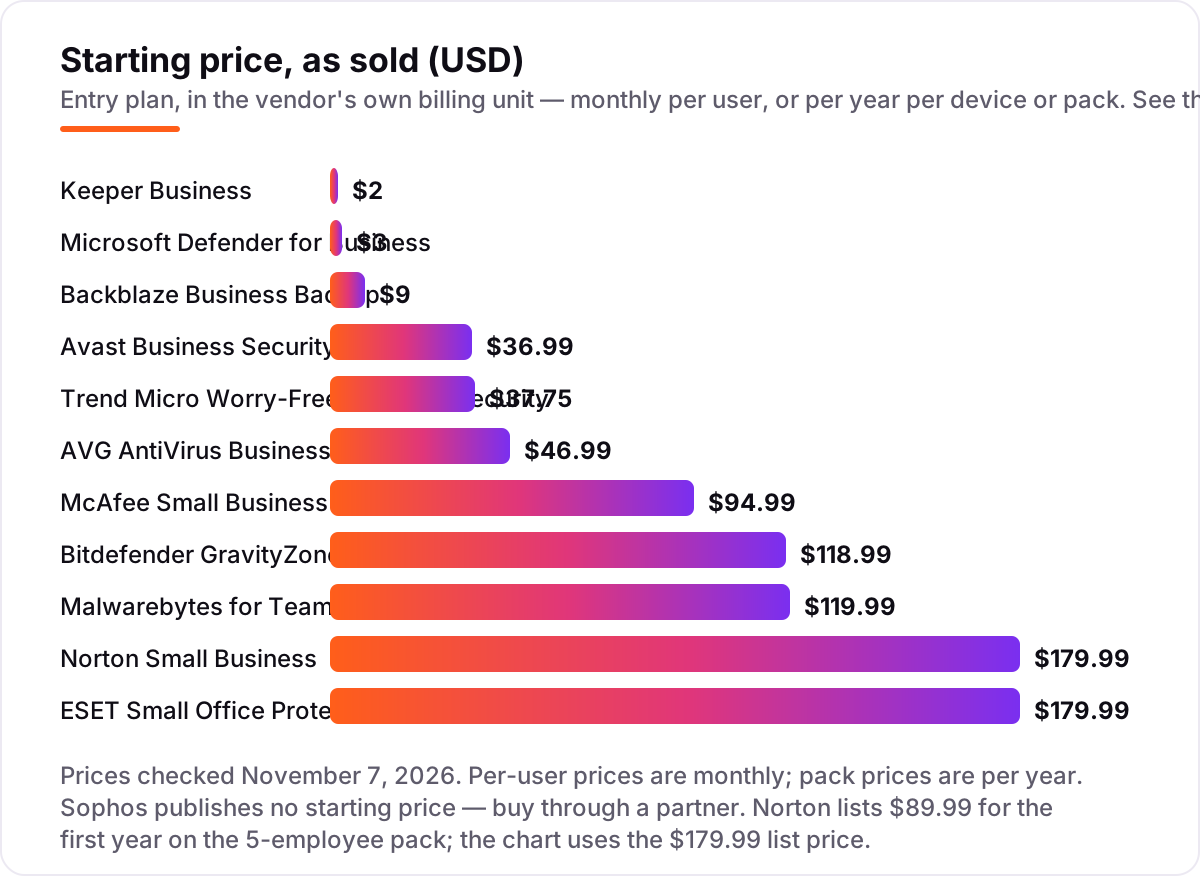
Security software for small business pricing: what you will actually pay
Take a 10-person business with 10 computers. On list prices, endpoint protection costs $360 a year on Microsoft Defender for Business (10 users at $3 a month), $324.99 on Bitdefender GravityZone (10 devices), $249.99 on Norton Small Business (10 employees), $399.99 on Malwarebytes for Teams (10 devices), $189.98 on McAfee Small Business Security (two 5-PC packs at $94.99), $204.99 on ESET Small Office Protection (10 devices), $369.90 on Avast Business Security (10 devices at $36.99), $469.90 on AVG AntiVirus Business Edition (10 devices at $46.99), and $377.50 on Trend Micro Worry-Free (10 users at $37.75). Sophos is a quote, so it has no number here.
Two of those numbers need adjusting before they are real. Norton lists $249.99 for 10 employees but charges $149.99 for the first year, and Bitdefender lists $324.99 for 10 devices but runs first-term promotions of about 30%, bringing it to roughly $227.49. Both revert to list price at renewal, so budget on the list figure.
Then add the other two layers. Keeper Business Starter covers 10 seats at $2 per user per month, or $240 a year, and Backblaze Business Backup covers 10 computers at $99 each, or $990 a year. A full stack for 10 people — Defender for Business, Keeper and Backblaze — costs $360 plus $240 plus $990, or $1,590 a year. That is the honest number: endpoint protection alone is the cheap part, and backup is the expensive part because it is priced per computer with no volume discount.
Know the difference: endpoint protection vs a password manager vs backup
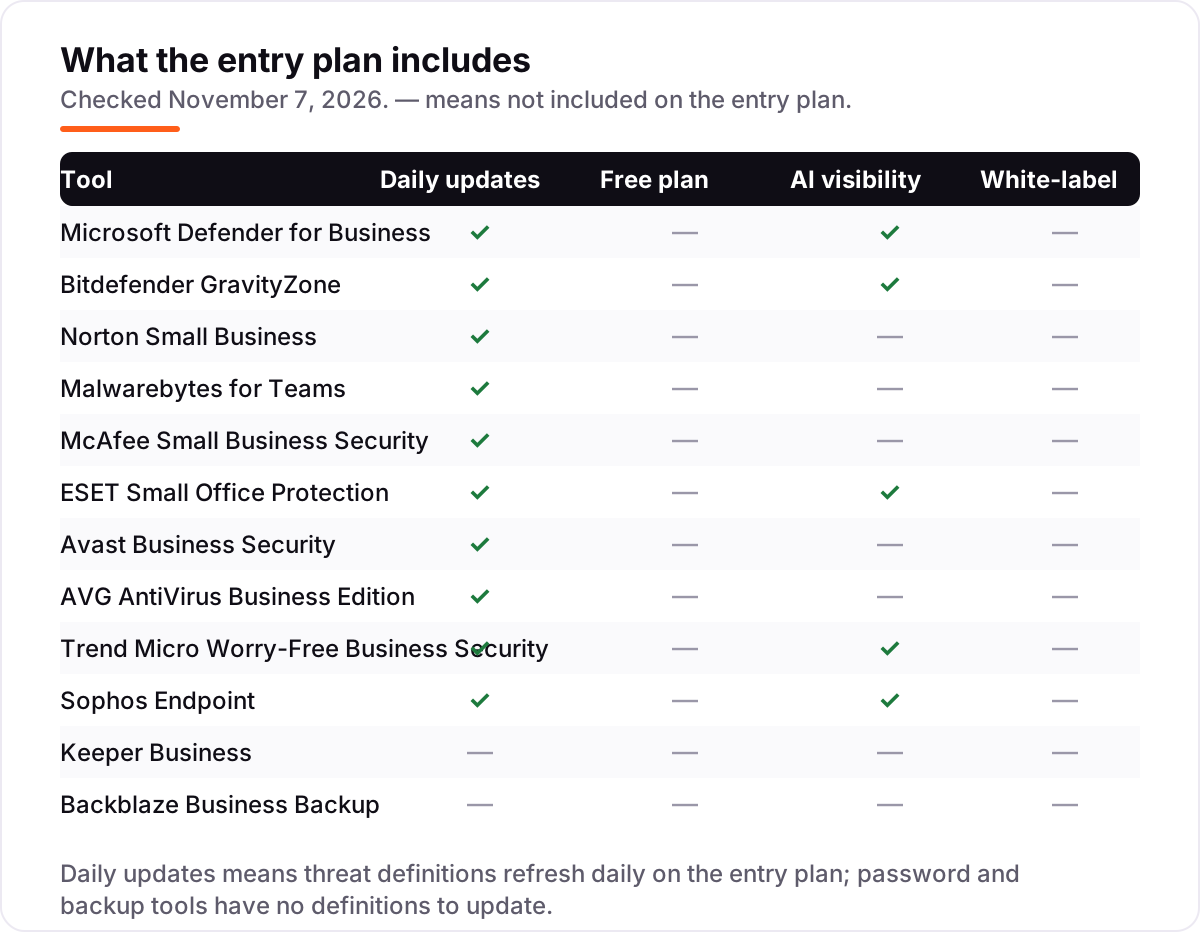
The confusion in this category is that three different jobs share one name. Endpoint protection — Defender for Business, Bitdefender, Norton, Malwarebytes and the rest — stops malware on a computer. A password manager — Keeper Business here — stops credential theft, which is how most small-business breaches actually start: one reused password, not one virus. Backup — Backblaze here — does not stop anything at all; it is the recovery plan for the day the other two fail.
A small business needs all three because they fail independently. Antivirus cannot help when an employee reuses a password that leaked in another company's breach. A password manager cannot help when ransomware encrypts the only copy of the accounts file. Backup cannot help when the attacker is already inside reading email. The cheapest stack in this list — Defender for Business, Keeper Business Starter and Backblaze — costs $1,590 a year for 10 people, and each layer covers a failure the other two cannot see.
There is a second confusion worth clearing up: antivirus and EDR are not the same thing. Antivirus blocks known malware before it runs. EDR records what happens after something gets in, isolates the device and investigates the cause. Defender for Business includes EDR at $3 per user per month; Bitdefender, ESET and Sophos charge more for it on higher tiers; Norton, McAfee, Avast and AVG do not offer it on their entry plans at all.
Quick comparison: tool type by need
| Buyer | Best pick | Why |
|---|---|---|
| Microsoft 365 business | Microsoft Defender for Business | Full EDR at $3 per user per month, often already included in Business Premium |
| Best-value endpoint protection | Bitdefender GravityZone | Top test scores from $118.99 a year for 5 devices, bought online |
| One subscription for everything | Norton Small Business | Antivirus, backup, VPN and monitoring from $179.99 a year for 5 employees |
| Micro-team, no IT staff | Malwarebytes for Teams | Simple cloud dashboard from $119.99 a year for 3 devices |
| Team passwords and passkeys | Keeper Business | Shared vaults from $2 per user per month, with a free Family plan per user |
| Offsite backup against ransomware | Backblaze Business Backup | Unlimited storage per computer for $99 a year, with one year of version history |
Mistakes to avoid
- Comparing a monthly price with an annual pack price. A $3 per user per month tool costs $360 a year for 10 users; a $179.99 per year pack covers 5 employees. Price the whole team, in the same unit, before you rank anything.
- Budgeting on the first-year price. Norton, Bitdefender and AVG all discount year one. The renewal price is what you pay in year two, so compare tools on that number.
- Buying endpoint protection and calling the job done. Antivirus does not fix reused passwords or a missing backup. Price the password manager and the backup in the same budget, or the first breach will cost more than both.
- Running two real-time antivirus products together. They slow each other down and can miss threats. When you switch, install the new tool, confirm it reports to its console, then remove the old one.
- Ignoring the device count. Per-device licences charge for the laptop and the phone separately; per-user licences like Defender for Business cover up to 5 devices each. A phone-heavy team pays very different totals on the two models.
How we chose
We checked each vendor's own pricing page on November 7, 2026 and recorded the starting price exactly as shown, including the billing unit and the renewal figure where the page lists one, and we ranked the tools by fit for the most common buyer — a US small business with about 10 people and no dedicated security staff — not by brand size. Two prices come from the vendor's own page opened today (Microsoft Defender for Business and Norton Small Business); the rest come from fresh search-index copies of the vendors' own pages and from reseller and review listings that quote the vendor's store, and we say which is which in the sources list. This list carries only two review ratings, both from G2 pages crawled within the last three days, because the other G2 pages we could open were older copies and we would rather show no rating than a stale one. No vendor paid for a place in this list, and none of the links here are affiliate links.
What to do next
Start with the free trial of your top pick and run it on two or three real machines for a week. Check that the agent does not slow older PCs, that the console makes sense to whoever will actually run it, and that alerts arrive where someone reads them. Then price the whole stack — endpoint, password manager and backup — for the full team before you commit to a year. If the tools are sorted but new customers are not finding you, our monthly SEO service handles the visibility side — or compare providers in our guide to email security software. Once your tools are in place, find out what's holding your rankings back.
Your stack only works if people find you
SerpAstra fixes what keeps your site off page one and makes it easy for AI assistants to recommend.
Get a free audit→Sources we checked (19)
- Microsoft 365 business pricing — microsoft.com (checked November 7, 2026)
- Norton Small Business pricing — us.norton.com (checked November 7, 2026)
- Bitdefender business — bitdefender.com (checked November 7, 2026)
- Malwarebytes business — malwarebytes.com (checked November 7, 2026)
- McAfee — mcafee.com (checked November 7, 2026)
- ESET — eset.com (checked November 7, 2026)
- Avast Business — avast.com/business (checked November 7, 2026)
- AVG — avg.com (checked November 7, 2026)
- Trend Micro — trendmicro.com (checked November 7, 2026)
- Sophos — sophos.com (checked November 7, 2026)
- Keeper Security — keepersecurity.com (checked November 7, 2026)
- Backblaze Computer Backup pricing — backblaze.com/cloud-backup/pricing.html (checked November 7, 2026)
- G2 — Microsoft Defender for Business reviews (checked November 7, 2026)
- G2 — Keeper Business Password Manager reviews (checked November 7, 2026)
- SMB Endpoint Security Price Index — endpointindex.com (checked November 7, 2026; ESET, AVG and Bitdefender store prices)
- Malwarebytes Business review — ifeeltech.com (checked November 7, 2026; Teams pack prices from the vendor page)
- AVG Antivirus pricing — security.org (checked November 7, 2026; AVG business prices)
- McAfee Small Business Security pricing — security.org (checked November 7, 2026)
- Trend Micro Worry-Free pricing — NeweggBusiness listing (checked November 7, 2026; $37.75 per user per year)
Shamim
Founder of SerpAstra
A full-stack SEO and digital marketer who spends most days on Local SEO for dental practices, AI search visibility and lead generation.
Frequently asked questions
What is the best security software for a small business?
Microsoft Defender for Business is the best fit for most small businesses at $3 per user per month, because it adds EDR to the Microsoft 365 many already pay for. Bitdefender GravityZone is the best-value endpoint alternative at $118.99 a year for 5 devices. Add Keeper Business for passwords and Backblaze for backup.
How much does security software for a small business cost?
For a 10-person business, endpoint protection alone costs $360 a year on Defender for Business or $324.99 on Bitdefender for 10 devices. A full stack — endpoint, password manager and backup — runs about $1,590 a year for 10 people. Per-device antivirus starts at $36.99 a year on Avast.
Is the Windows Defender built into Windows enough for a small business?
No, not on its own. The free Defender built into Windows protects one PC but has no central management, no reporting and no vulnerability management. Defender for Business, at $3 per user per month, adds EDR, automated investigation and a console that manages up to 300 users and 5 devices each.
Do I need a password manager if I already have antivirus?
Yes. Antivirus stops malware; it does nothing about staff reusing one password across every account. A password manager like Keeper Business, from $2 per user per month, gives every employee unique logins and lets an admin revoke access when someone leaves. It is a different layer, not a duplicate.
What is the difference between antivirus and EDR?
Antivirus blocks known malware before it runs. EDR watches what happens after something gets in — it records suspicious behaviour, isolates the device and investigates the cause. Defender for Business, Bitdefender Premium and Sophos Endpoint all add EDR above their entry antivirus tiers, which is why they cost more.
Can I switch security software later?
Yes, but do it one machine at a time. Install the new tool, confirm it reports to its console, then remove the old one — never run two real-time antivirus products together, because they slow each other down and can miss threats. Plan the switch for a quiet week and keep the old licence until every machine reports clean.
Does security software include backup?
Usually not. Norton Small Business is the exception here, with 250 GB of cloud backup in the base plan. The rest protect the device, not the data. Backblaze Business Backup covers the gap at $9 per computer per month with unlimited storage, which matters because ransomware targets backups first.
Free SEO and AI visibility audit
Find out what is holding your rankings back
Send us your site. Within 2 business days you get a written audit, an AI visibility check and a short fix list ranked by impact. Free, with no contract attached.
Request my free audit→Related guides
 IT, Security & DevOpsBest Antivirus Software Review for 2026: 10 Options Compared by Use CaseCompare the best antivirus software review picks for 2026: 10 suites with prices, renewal costs, free plans and device limits, checked November 6, 2026.Read guide →
 Email, SMS & Social MediaBest Email Security Software for 2026: 11 Options Compared by Use CaseCompare the 11 best email security software options for 2026 on price, phishing defense and BEC protection, with every price checked November 6, 2026.Read guide →
 Digital Marketing & AdsBest Email Backup Software for 2026: 9 Options Compared by Use CaseCompare the 9 best email backup software options for Microsoft 365 and Google Workspace on price and storage, with every price checked November 5, 2026.Read guide →