
10 Best Series a Investors for SAAS Companies in 2026
Compare the 10 best series a investors for saas companies by SaaS focus, stage fit and portfolio strength — every firm's record checked November 4, 2026.
 Shamim Mia, Founder, SerpAstraLast verified November 4, 202614 min read
We compare pricing pages, documentation and public reviews. We never accept payment for rankings.

Key takeaways
- Andreessen Horowitz is the best fit for most SaaS founders raising a Series A, with Sequoia Capital the strongest alternative for founders who want a partner that stays to IPO, and Emergence Capital the best pure-play SaaS specialist.
- The single most important buying factor is the lead investor's SaaS track record: a firm that has taken SaaS companies from Series A to IPO knows the metrics your next round will be judged on.
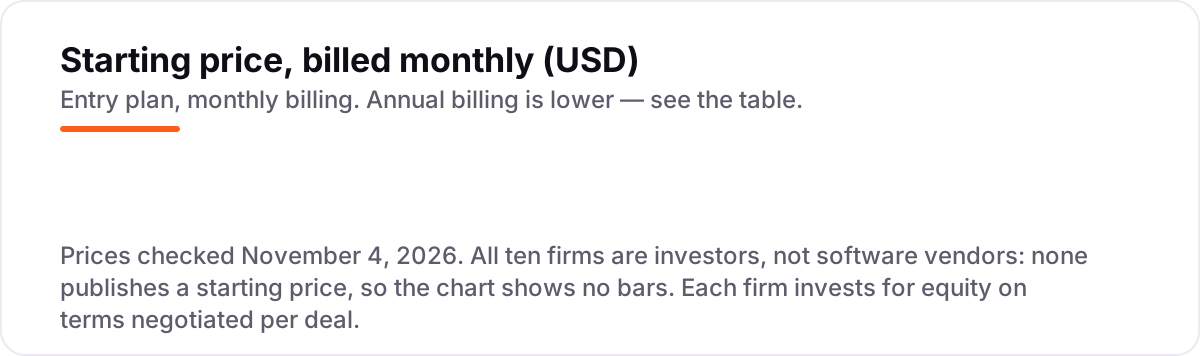
- No investor here publishes a price. Series A terms are negotiated per deal — the cost is equity, a meaningful minority stake, so the partner matters more than the valuation.
- A lead investor writes the largest check, sets the terms and usually takes a board seat; participants follow. Choose the lead first, then fill the round.
On this page
Quick comparison
| Tool | Best for | Starting price | Free plan |
|---|---|---|---|
| Andreessen Horowitz | SaaS founders who want the largest operating platform in venture behind their Series A | Custom quote | No |
| Sequoia Capital | Founders who want the deepest SaaS track record and a partner that can stay from Series A to IPO | Custom quote | No |
| Accel | B2B SaaS founders who want a partner with a long record of backing category-defining software | Custom quote | No |
| Bessemer Venture Partners | Cloud and SaaS founders who want thesis-driven partners and public benchmarks for their metrics | Custom quote | No |
| Lightspeed Venture Partners | Enterprise and AI SaaS founders who want a global multi-stage partner | Custom quote | No |
| General Catalyst | SaaS founders building for global scale who want a long-hold, multi-stage partner | Custom quote | No |
| Index Ventures | SaaS founders with a transatlantic plan who want a partner strong in both the US and Europe | Custom quote | No |
| Founders Fund | Founders with an ambitious, contrarian product who want a concentrated, conviction-led partner | Custom quote | No |
| Khosla Ventures | Technical founders building deep-tech or AI-native SaaS who want a risk-tolerant early backer | Custom quote | No |
| Emergence Capital | Pure-play enterprise SaaS founders who want a specialist that invests almost only in early-stage B2B software | Custom quote | No |
Make one of these tools?
We re-check this list every quarter. Send a correction, request a review, or ask about a clearly labeled sponsored spot.
Request a listingThe best series a investors for saas companies

Andreessen Horowitz
Best for: SaaS founders who want the largest operating platform in venture behind their Series A
Andreessen Horowitz, known as a16z, is the largest venture firm in this list, and it has backed SaaS companies including Slack, GitHub and Okta since its founding in 2009. Its Series A teams sit inside sector groups, so a SaaS founder works with partners who spend their time on enterprise software. The firm's operating teams cover hiring, go-to-market and marketing, which is the main reason founders pick a16z over a smaller fund.
The trade-off is attention. a16z backs many companies, so a Series A founder is one of a large portfolio and has to work to stay visible. The brand also raises expectations: the next round will be judged against the firm's reputation. Choose a16z when you want the deepest operating bench in venture and a partner that can keep funding you from Series A to IPO.
What we like
- Founded in 2009 and has backed SaaS companies including Slack, GitHub and Okta
- Sector-focused teams, so a SaaS founder works with partners who spend their time on enterprise software
- Operating teams cover hiring, go-to-market, marketing and technical talent
- Multi-stage funds can keep backing a company from Series A through IPO
Watch out for
- A large portfolio means a founder has to work to stay visible inside the firm
- The brand raises expectations: the next round is judged against the firm's reputation
- Fit depends on the individual partner, not the logo — sector teams vary in SaaS depth

Sequoia Capital
Best for: Founders who want the deepest SaaS track record and a partner that can stay from Series A to IPO
Sequoia Capital has been backing companies since 1972, and its SaaS record runs from Stripe and Zoom to Airbnb, ServiceNow and Snowflake. It invests from seed through growth, so the same firm that leads your Series A can fund your Series B and C, and its partners have seen SaaS companies through every market cycle. A Sequoia partner knows what the metrics for your next round need to look like.
The cost of that record is selectivity. Most Series A pitches to Sequoia are turned down, and the firm's size means it may already back a company in your category. Pick Sequoia when you want the deepest SaaS track record in venture and a partner that plans to stay on the cap table until IPO — and when your numbers are strong enough to win a partner's conviction.
What we like
- Founded in 1972 and has backed Stripe, Zoom, Airbnb, ServiceNow and Snowflake
- More than five decades of backing companies from early rounds through IPO
- Invests from seed to growth, so the same firm can fund every later round
- US and European funds give a SaaS company a route into both markets
Watch out for
- Highly selective — most Series A pitches are turned down
- Fit depends on the individual partner, not the brand
- Its size means it may already back a competitor in your SaaS category

Accel
Best for: B2B SaaS founders who want a partner with a long record of backing category-defining software
Accel has backed software companies since 1983, and its portfolio runs from Slack and Atlassian to Dropbox, Facebook and Spotify. It is an early-stage firm first, with dedicated early-stage funds, so a Series A founder is the core customer rather than a small bet inside a growth fund. Its offices across the US, Europe and India also give a SaaS company a route abroad without changing firms.
The trade-off is breadth. Accel invests across sectors, so SaaS is one of several focuses, and follow-on support varies by fund and by partner. Pick Accel when you want a partner with a long record of backing category-defining software and an early-stage team that treats Series A as its main job.
What we like
- Founded in 1983 and has backed Slack, Atlassian, Dropbox, Facebook and Spotify
- Early-stage focus with dedicated early-stage funds, not only growth capital
- Global offices across the US, Europe and India for companies that expand abroad
- A long record of backing software companies that defined their categories
Watch out for
- A generalist across sectors, so SaaS is one of several focuses
- A competitive process — entry is selective at Series A
- Follow-on support varies by fund and by partner

Bessemer Venture Partners
Best for: Cloud and SaaS founders who want thesis-driven partners and public benchmarks for their metrics
Bessemer Venture Partners traces its roots to 1911, making it the oldest firm in this list, and it has backed Shopify, Twilio, LinkedIn and DocuSign. It is the most openly thesis-driven firm here: its published roadmaps and the Cloud 100 list spell out what it looks for in cloud and SaaS companies, so a founder can check the fit before pitching. That openness extends to its benchmarks, which many SaaS founders use to judge their own metrics.
The catch is breadth. Bessemer invests across AI, healthcare, fintech and more, so a SaaS company competes with other sectors for capital, and there is no SaaS-only fund. Pick Bessemer when you want a partner that publishes its thinking and will hold you to public SaaS benchmarks.
What we like
- Founded in 1911, the oldest firm in this list, and has backed Shopify and Twilio
- Publishes public SaaS research, including the Cloud 100 and its cloud benchmarks
- Thesis-driven roadmaps tell a founder exactly what the firm is looking for
- Invests from seed through growth, so it can fund a company for years
Watch out for
- A broad sector spread means SaaS competes with AI, healthcare and fintech for capital
- There is no SaaS-only fund — the SaaS bet sits inside a generalist portfolio
- A large global team, so partner selection matters more than the brand

Lightspeed Venture Partners
Best for: Enterprise and AI SaaS founders who want a global multi-stage partner
Lightspeed Venture Partners has invested since 2000, backing Snap, Affirm, Rubrik, Wiz and Anthropic, and it runs eleven offices across the US, Europe, Israel and India. It is a multi-stage firm, so the same team that leads a Series A can fund later rounds, and its recent bets skew toward enterprise software and AI-native companies — the two categories most SaaS founders now build in.
The trade-off is spread. Lightspeed invests across consumer, health and fintech as well as enterprise, so SaaS is one of several bets, and a large portfolio spreads partner attention. Pick Lightspeed when you want a global, multi-stage partner with a strong recent record in enterprise and AI software.
What we like
- Founded in 2000 and has backed Snap, Affirm, Rubrik, Wiz and Anthropic
- Eleven offices globally, across the US, Europe, Israel and India
- Multi-stage investing from seed through growth in one firm
- Early backer of both enterprise software and AI-native companies
Watch out for
- Multi-sector, so enterprise SaaS is one of several bets alongside consumer, health and fintech
- A large portfolio spreads partner attention across many companies
- Brand strength varies by region — strongest in the US, newer in some other markets

General Catalyst
Best for: SaaS founders building for global scale who want a long-hold, multi-stage partner
General Catalyst has backed Stripe, Airbnb and HubSpot since its founding in 2000, and it invests from seed through growth with funds sized to follow on for years. It runs offices across the US, Europe and India, and its creation strategy means it sometimes builds companies alongside founders rather than only funding them. For a SaaS founder, the appeal is a partner that thinks in decades, not fund cycles.
The trade-off is breadth. General Catalyst invests across many sectors, so a SaaS founder should check the individual partner's SaaS record rather than the firm's logo, and a Series A is a small line next to much bigger bets. Pick it when you want a global, long-hold partner for a company built to scale.
What we like
- Founded in 2000 and has backed Stripe, Airbnb and HubSpot
- Invests from seed through growth, with funds sized to follow on for years
- Global presence across the US, Europe and India
- A creation strategy that also builds companies alongside founders, not only funds them
Watch out for
- A broad mandate across sectors, so SaaS founders should check the partner's own SaaS record
- Large funds mean a Series A is a small line next to much bigger bets
- Follow-on decisions depend on the individual partner's conviction

Index Ventures
Best for: SaaS founders with a transatlantic plan who want a partner strong in both the US and Europe
Index Ventures was founded in Geneva in 1996 and has backed Figma, Notion, Datadog and Adyen, with offices in London, San Francisco, New York and Tel Aviv. It raised $2.3 billion in new funds in 2024 — an $800 million venture fund and a $1.5 billion growth fund — so it can fund a SaaS company from Series A through to IPO. For a founder with customers on both sides of the Atlantic, it is the most natural fit in this list.
The trade-off is split attention. A transatlantic model means partner time is divided across regions, and the growth fund can pull focus toward later stages. Pick Index when your plan is genuinely cross-border and you want a partner that is strong in both the US and Europe.
What we like
- Founded in Geneva in 1996 and has backed Figma, Notion, Datadog and Adyen
- Raised $2.3 billion in new funds in 2024, across an $800 million venture fund and a $1.5 billion growth fund
- Offices in London, San Francisco, New York and Tel Aviv for cross-border companies
- Backs founders from seed and Series A through to IPO
Watch out for
- A transatlantic model means partner time is split across regions
- Entry is competitive — the firm backs a small number of Series A companies a year
- The growth fund can pull attention toward later stages

Founders Fund
Best for: Founders with an ambitious, contrarian product who want a concentrated, conviction-led partner
Founders Fund was founded in 2005 by entrepreneurs, and it has backed SpaceX, Palantir, Stripe and Airbnb. It makes concentrated bets and holds them for a long time, which suits a founder with an ambitious product that other firms find too early or too strange. The firm is known for backing ideas others passed on, and for letting founders run their companies without heavy-handed direction.
The trade-off is fit. A concentrated portfolio means fewer SaaS bets per year, and a conventional SaaS pitch may not match a contrarian thesis. Pick Founders Fund when your product is ambitious enough that most firms say no — and you want a partner that says yes with conviction.
What we like
- Founded in 2005 and has backed SpaceX, Palantir, Stripe and Airbnb
- Known for concentrated bets and holding them for a long time
- Founded by entrepreneurs, with a founder-first view of company building
- A track record of backing ideas other firms passed on
Watch out for
- A concentrated portfolio means fewer SaaS bets per year
- A contrarian thesis means a conventional SaaS pitch may not fit
- A small team, so partner access is limited
Khosla Ventures
Best for: Technical founders building deep-tech or AI-native SaaS who want a risk-tolerant early backer
Khosla Ventures was founded in 2004 by Vinod Khosla and has backed Square, DoorDash and OpenAI. It is known for backing technical risk — science-led ideas that other firms find too early or too uncertain — which makes it a strong fit for AI-native SaaS and deep-tech founders. It invests from seed through growth, so the same firm can fund a company for years.
The trade-off is focus. A pure-play SaaS company with modest technical depth may not stand out in a portfolio that spans health, energy and climate, and the firm's outspoken style is not for every founder. Pick Khosla when your edge is technical and you want a backer that is comfortable with real risk.
What we like
- Founded in 2004 by Vinod Khosla and has backed Square, DoorDash and OpenAI
- Known for backing technical risk and science-led ideas other firms avoid
- Invests from seed through growth, so it can fund a company for years
- A long record of early bets on companies that later defined their markets
Watch out for
- An appetite for technical risk means a pure-play SaaS company with modest tech depth may not stand out
- A broad mandate across health, energy and climate competes with SaaS for attention
- An outspoken style that is not for every founder

Emergence Capital
Best for: Pure-play enterprise SaaS founders who want a specialist that invests almost only in early-stage B2B software
Emergence Capital is the only pure-play SaaS specialist in this list: founded in 2003, it invests almost only in early-stage enterprise software, and it backed Salesforce, Zoom, Box and Veeva. It makes only five to seven investments a year, so each company gets deep partner attention, and it closed a $1 billion seventh fund in March 2025 to keep backing B2B companies. No other firm here knows SaaS metrics as narrowly or as deeply.
The trade-off is the narrow door. A company outside enterprise SaaS will not fit, and five to seven new investments a year makes Emergence one of the most selective firms here. Pick Emergence when your company is pure enterprise SaaS and you want a specialist partner that lives and breathes your metrics.
What we like
- Founded in 2003 with a SaaS-only focus from day one, and has backed Salesforce, Zoom, Box and Veeva
- Makes only five to seven investments a year, so each company gets deep attention
- Closed a $1 billion seventh fund in March 2025 to back B2B companies
- Every partner focuses on enterprise software — there is no consumer or healthcare book
Watch out for
- A narrow focus means a company outside enterprise SaaS will not fit
- A small portfolio means fewer founder peers inside the firm
- Highly selective — only five to seven new investments a year
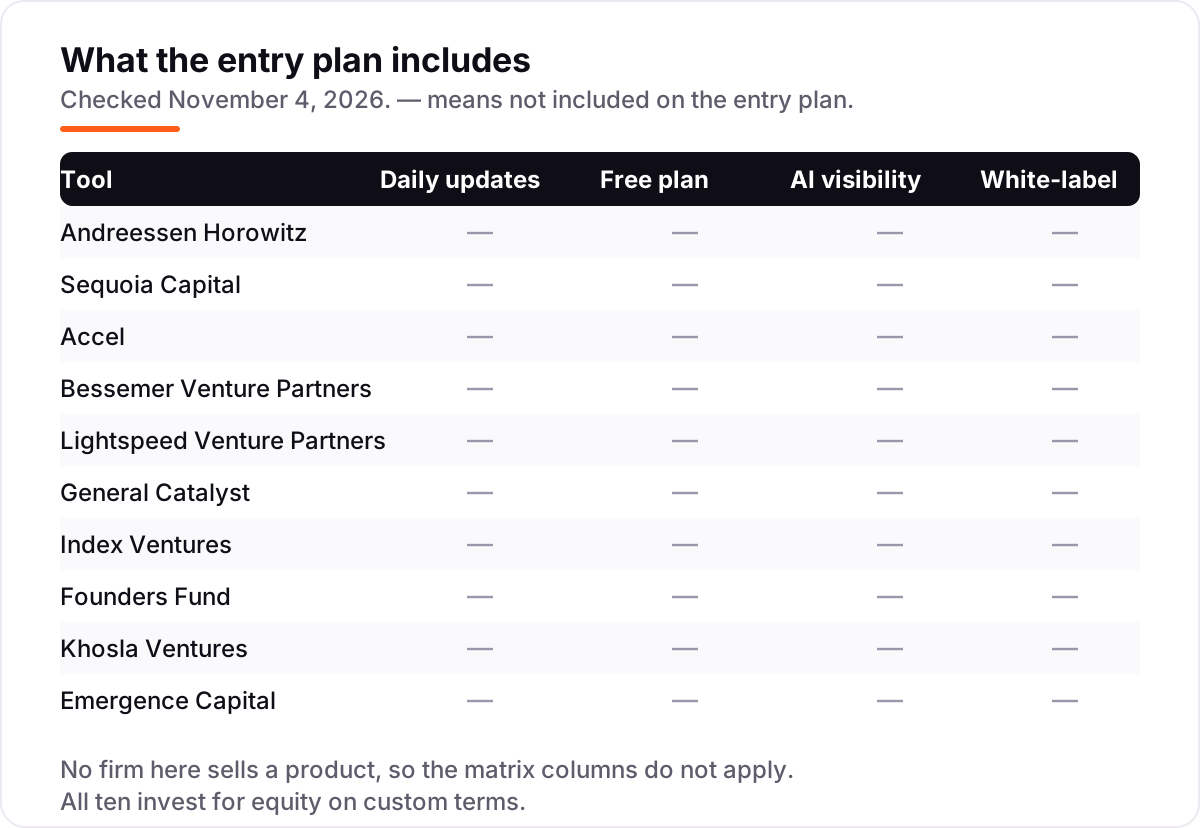
The best series a investors for saas companies are the firms that do more than write a check: they lead the round, set the terms, take a board seat and help a SaaS company hire, sell and raise the next round. We ranked the ten firms below by fit for the most common founder — a SaaS company with early revenue raising its first institutional round — and every firm's focus was checked on November 4, 2026. None of these firms publishes a price, because investors do not sell a product: they buy equity, and the terms are negotiated per deal.
How to choose the best series a investors for saas companies
- Lead or follow? A lead investor writes the largest check, sets the price and terms, and usually takes a board seat. Participants follow the lead's terms. Your first job is finding a lead, not filling a list of names.
- Check the partner's own SaaS record, not the firm's logo. Ask which SaaS companies the partner personally backed, at what stage, and how those companies did. A firm's famous portfolio means little if your partner has never led a SaaS Series A.
- Match the check to your round. A lead usually takes a large share of the round, so a firm whose typical Series A check is far bigger or smaller than your round is a poor fit — ask early what size of check the partner writes.
- Weigh the operating help. Hiring, go-to-market, customer introductions and pricing advice are where firms differ most. Andreessen Horowitz has the largest operating team; Emergence Capital has the narrowest, deepest SaaS bench.
- Check follow-on capacity. A firm that can fund your Series B and C is worth more than one that can only do the A. Ask how many of the firm's Series A companies it backed again in later rounds.
- Mind the geography. Index Ventures and Lightspeed Venture Partners run offices on both sides of the Atlantic; most others are US-first. If your customers are in Europe, a partner with a team there shortens every later fundraise.
Raising money is one job; being found by customers is another. If the business also needs to be found online, our guide to marketing platforms for small business SEO covers the visibility side. And before you publish new pages for the services you sell, run your titles through the free SERP snippet preview tool — it shows exactly how the title and description will look in Google.
Whatever you shortlist, talk to the firm's portfolio founders before you sign. Ask them how the partner behaved when the numbers missed, not when they beat plan — that is when you learn what the firm is really like. Check two things in those calls: whether the partner answers the phone in a bad quarter, and whether the firm followed on in the next round. Every firm in this list will connect you to founders; if one will not, treat that as an answer.
Series A investors for SaaS companies pricing: what you will actually pay
Take a SaaS company raising a $12 million Series A at a $48 million post-money valuation, as an illustration. The new investors take 25% of the company — $12 million divided by $48 million — and the founders keep the other 75%. If the lead investor writes $7 million of the round, the lead holds about 14.6% of the company, and the remaining $5 million is split among the participating investors. Those percentages are the price: there is no monthly fee, no annual subscription and no per-seat charge on any firm in this list.
Three costs sit outside those percentages. First, the option pool: investors often ask for the employee option pool to be increased before the valuation is set, which dilutes the founders a little further. Second, your own lawyers: the company pays its own legal costs for the round, and the investors pay theirs. Third, the next round: a high valuation now means a higher bar later, so a valuation that looks like a win can become a down round if growth slows.
Valuation is the number founders argue about most, and it matters least. A partner who helps you hire the right head of sales and opens the right customer doors is worth more than a few points of valuation, and a bad partner at a great valuation is still a bad partner. If you run a finance firm rather than a SaaS company, the visibility tools differ too — see our guide to the best SEO platform for finance.
One more thing to check before you commit: the firm's follow-on record. Ask how many of its Series A companies it backed again at Series B. A firm that leads the A and then disappears at the B leaves you fundraising from scratch a year later, and that is the most expensive surprise in this list.
Know the difference: a lead investor vs a participating investor
The confusion in this category is between two roles that sound similar and behave very differently. A lead investor writes the largest check, sets the price and the terms, does the deep diligence and usually takes a board seat. A participating investor writes a smaller check, accepts the lead's terms and does lighter diligence. Both put money in, but only the lead prices the round.
A round without a lead rarely closes. Other investors wait for someone else to set the terms, and the founder ends up negotiating with five firms at once instead of one. The practical rule is simple: find the lead first, agree terms with them, and then fill the rest of the round with participants who trust the lead's judgment.
There is a second, quieter confusion: a venture investor is not a lender. Venture debt and revenue-based financing lend money that must be repaid, with interest, whether the company grows or not. A Series A investor buys equity: if the company fails, the investor loses the money, and if it succeeds, the investor owns a share of it. That is why the partner matters more than the valuation — you are choosing a co-owner, not a vendor.
A third distinction worth knowing is an accelerator versus a Series A firm. An accelerator takes a small stake early, usually at the idea stage, in exchange for a program and a small check. A Series A firm invests after the company has revenue and a working product, writes a much larger check and takes a board seat. If your company already has revenue, an accelerator is the wrong room.
Quick comparison: tool type by need
| Buyer | Best pick | Why |
|---|---|---|
| Founder who wants the biggest platform | Andreessen Horowitz | Largest operating team in venture, with sector-focused Series A partners |
| Founder who wants the deepest track record | Sequoia Capital | Backing SaaS winners since 1972, from Series A through IPO |
| Founder who wants a SaaS-only specialist | Emergence Capital | Only enterprise SaaS, five to seven bets a year, Salesforce and Zoom in the portfolio |
| Founder with a US and Europe plan | Index Ventures | Strong in London and San Francisco, with Figma and Notion backed |
| Founder with an ambitious, contrarian product | Founders Fund | Concentrated bets on ideas other firms passed on, from SpaceX to Palantir |
| Founder building AI-native SaaS | Khosla Ventures | Comfortable with technical risk, early backer of OpenAI |
Mistakes to avoid
- Chasing the logo instead of the partner. The firm does not sit on your board — the partner does. A great firm with the wrong partner is a worse outcome than a smaller firm with the right one.
- Raising without a lead. A round with five participants and no lead has no price, no terms and no one doing deep diligence. Find the lead first, then fill the round.
- Optimizing the valuation over the partner. A few points of valuation are worth less than a partner who helps you hire and opens customer doors. A bad partner at a great valuation is still a bad partner.
- Skipping the reference calls. Talk to the firm's portfolio founders, and ask how the partner behaved when the numbers missed. If a firm will not connect you to founders, treat that as an answer.
- Ignoring follow-on capacity. A firm that leads your Series A and then disappears at Series B leaves you fundraising from scratch a year later. Ask how many of its Series A companies it backed again.
How we chose
We checked each firm's own website on November 4, 2026 and recorded what it publishes about its focus, stage and portfolio, and we ranked the firms by fit for the most common founder — a SaaS company with early revenue raising its first institutional round — not by brand size. No firm here publishes a price, because investors take equity rather than charging a fee, so every starting price in this list is honestly shown as a custom quote. This list carries no review ratings because G2, Capterra and Trustpilot carry no review pages for venture capital firms, and we would rather show no rating than a stale or estimated one. No firm paid for a place in this list, and none of the links here are affiliate links.
What to do next
Start with the three firms that fit your company best and ask for a warm introduction — a portfolio founder or a founder they backed before is the fastest route in. Come to the first meeting with your metrics ready: revenue, growth, retention and burn, in one page. If the raise is sorted but new customers are not finding you, our monthly SEO service handles the visibility side — or compare providers in our guide to SEO companies for small business. Once your tools are in place, find out what's holding your rankings back.
Your stack only works if people find you
SerpAstra fixes what keeps your site off page one and makes it easy for AI assistants to recommend.
Get a free audit→Sources we checked (12)
- Andreessen Horowitz — a16z.com (checked November 4, 2026)
- Sequoia Capital — sequoiacap.com (checked November 4, 2026)
- Sequoia Capital history — sequoiacap.com/our-history (checked November 4, 2026)
- Accel — accel.com (checked November 4, 2026)
- Bessemer Venture Partners — bvp.com (checked November 4, 2026)
- Lightspeed Venture Partners — lsvp.com (checked November 4, 2026)
- General Catalyst — generalcatalyst.com (checked November 4, 2026)
- Index Ventures — indexventures.com (checked November 4, 2026)
- Founders Fund — foundersfund.com (checked November 4, 2026)
- Khosla Ventures — khosla.com (checked November 4, 2026)
- Emergence Capital — emergencecap.com (checked November 4, 2026)
- Emergence Capital closes on $1B fund — TechCrunch, March 25, 2025 (checked November 4, 2026)
Shamim
Founder of SerpAstra
A full-stack SEO and digital marketer who spends most days on Local SEO for dental practices, AI search visibility and lead generation.
Frequently asked questions
What is the best Series A investor for a SaaS company?
Andreessen Horowitz is the best fit for most SaaS founders: the largest operating platform in venture, with sector teams and hiring and go-to-market help. Sequoia Capital is the strongest alternative for founders who want a partner that stays to IPO, and Emergence Capital is the best pure-play SaaS specialist.
How much equity does a Series A investor take?
It depends on the round size and the valuation, and the terms are negotiated per deal. As an illustration, a $12 million round at a $48 million post-money valuation sells 25% of the company. The lead investor usually takes the largest share of the round and a board seat.
Do Series A investors charge founders any fees?
No. Venture firms charge management fees to their own investors, called limited partners, not to the companies they back. The cost to a founder is equity, plus the founder's own legal costs for the round. There is no monthly price or subscription to pay.
What metrics do Series A investors look for in a SaaS company?
They look for annual recurring revenue with strong growth, net revenue retention above 100%, and a clear path to efficient growth. The exact bar varies by firm and by market, but every firm in this list wants to see real revenue, not just a pipeline, before leading a Series A.
Should a SaaS founder pick a specialist or a generalist investor?
Pick a specialist like Emergence Capital when your company is pure enterprise SaaS and you want a partner that knows your metrics cold. Pick a generalist like Sequoia or Accel when you want a broader network, multi-stage funding and help beyond one category.
How long does a Series A raise take?
Most Series A raises take two to four months from first meetings to money in the bank, with the longest stretch usually spent finding a lead investor. A warm introduction to the right partner shortens it; a cold process with no lead can run much longer.
Can a SaaS company raise a Series A without a lead investor?
It is possible but hard. Without a lead, no one sets the price or the terms, and other investors wait for someone else to commit first. Most successful Series A rounds have one lead writing the largest check and taking a board seat.
Free SEO and AI visibility audit
Find out what is holding your rankings back
Send us your site. Within 2 business days you get a written audit, an AI visibility check and a short fix list ranked by impact. Free, with no contract attached.
Request my free audit→Related guides
 SEO & AI Search8 Best SEO Platforms for Finance in 2026 (Pros, Cons and Pricing)8 best SEO platform for finance options compared on price, YMYL content tools, branch tracking and AI visibility. All prices checked November 1, 2026.Read guide →
 SEO & AI Search12 Best Accounting Software for SAAS in 2026, Compared12 best accounting software for saas tools compared with real 2026 prices, from $0 billing layers to full ledgers and ERP, sorted by what your SaaS needs.Read guide →
 SEO & AI Search12 Best Marketing Platforms for Small Business SEO in 2026, ComparedThe 12 best marketing platforms for small business SEO, compared on real prices, SEO tools and AI visibility. Every price checked November 1, 2026.Read guide →