
7 Best Shopify Apps for Inventory Management in 2026, Compared
Compare the 7 best Shopify apps for inventory management on stock sync, order caps, multichannel selling and real cost, prices from vendor pages.
 Shamim Mia, Founder, SerpAstraLast verified November 10, 20268 min read
We compare pricing pages, documentation and public reviews. We never accept payment for rankings.
Key takeaways
- Zoho Inventory is the best Shopify inventory app for most small stores: a free plan for 50 orders a month and Standard at $29 a month billed annually for 500 orders.
- Cin7 Core is the pick for sellers on Shopify plus Amazon who need one accurate stock number, from $349 a month with unlimited locations.
- Katana suits Shopify brands that make their own products, with bills of materials and manufacturing orders on Core at $299 a month.
- If your stock problem is really a shipping problem, ShipStation from $14.99 a month syncs stock as orders ship; Shopify POS Pro covers stores that also sell in person.
On this page
Quick comparison
| Tool | Best for | Starting price | Free plan |
|---|---|---|---|
| Zoho Inventory | Small Shopify stores that want a real free plan and per-organisation pricing | $29/mo (annual) | Yes (50 orders) |
| Cin7 Core | Multichannel sellers on Shopify and Amazon who need one stock number everywhere | $349/mo | No |
| Katana | Shopify brands that make, assemble or batch-produce what they sell | $299/mo | Yes (30 SKUs) |
| Shopify POS | Shopify stores with a physical shop that want one inventory pool for online and in-person sales | $39/mo | No (3-day trial) |
| ShipStation | Shopify stores whose stock problem is really a fulfilment problem | $14.99/mo | No (30-day trial) |
| Ordoro | High-volume Shopify sellers who want inventory, kitting and labels in one workflow | $499/mo | No (15-day trial) |
| inFlow Inventory | Shopify stores that also sell wholesale and need B2B ordering | $99/mo (annual) | No (14-day trial) |
Make one of these tools?
We re-check this list every quarter. Send a correction, request a review, or ask about a clearly labeled sponsored spot.
Request a listingThe best Shopify inventory management apps

Zoho Inventory
Best for: Small Shopify stores that want a real free plan and per-organisation pricing
Zoho Inventory is the best starting point for most Shopify stores because the free plan is a working plan: 50 orders a month with item tracking, barcoding and vendor management for $0. Paid plans charge per organisation rather than per user, so adding a warehouse helper costs nothing. Standard costs $29 a month billed annually, or $39 monthly, for 500 orders, 3 users and 2 locations, with composite items, dropshipping and backorders.
The meter is orders. A busy month can push you into the next tier, and serial and batch tracking wait for Premium at $79 a month. For a Shopify store doing a steady few hundred orders a month across a small catalog, it covers stock, purchasing and bundles at the lowest price here.
What we like
- Free plan covers 50 orders a month with item tracking, barcoding and vendor management
- Per-organization pricing, not per-user: adding team members costs nothing extra on any plan
- Standard at $29/month billed annually covers 500 orders, 3 users and 2 locations with composite items and dropshipping
Watch out for
- Order caps force an upgrade at every growth step: 500 orders a month on Standard, 3,000 on Premium
- Serial and batch tracking, barcode generation and stock counting sit on Premium ($79/month) or above
- No free trial of the paid plans beyond the 14-day trial; the free plan is the only way to test long-term

Cin7 Core
Best for: Multichannel sellers on Shopify and Amazon who need one stock number everywhere
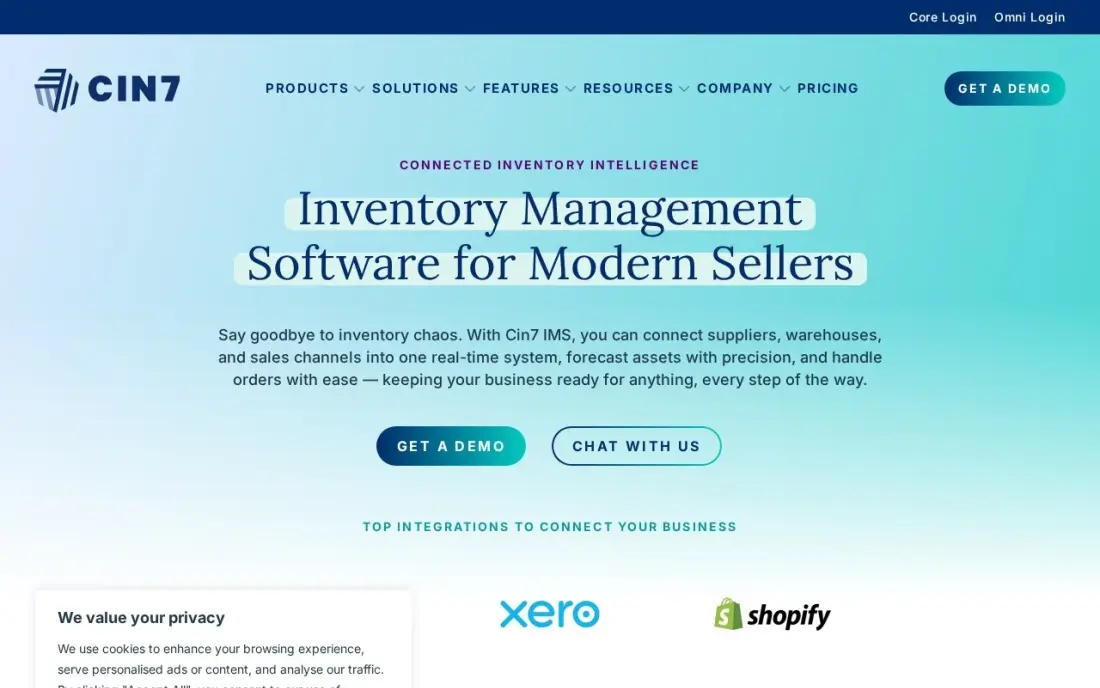
Cin7 Core is built for the moment a Shopify store adds Amazon, wholesale or a second warehouse and stock numbers start disagreeing. Native Shopify and Amazon sync keeps one figure across channels, and every plan includes unlimited inventory locations. It also publishes a price list: Standard costs $349 a month, Pro $599 and Advanced $1,199.
Standard covers 5 users, 2 integrations and 6,000 sale orders a year, so high-volume, low-ticket sellers outgrow it quickly. Forecasting, the B2B portal and POS are paid add-ons. Pro adds material requirements planning for sellers who assemble kits. Choose Cin7 when overselling across channels is costing you money.
What we like
- One published price list for a serious system: Standard $349, Pro $599 and Advanced $1,199 a month
- Unlimited inventory locations on every plan, with native Shopify and Amazon stock sync
- Pro adds material requirements planning for sellers who assemble or make what they sell
Watch out for
- Standard at $349/month covers only 5 users, 2 integrations and 6,000 sale orders a year; volume above that costs more
- ForesightAI forecasting, the B2B portal and POS are paid add-ons, not part of the base plans
- Cin7 Omni, the enterprise product, is quote-only, so larger sellers lose the published-price certainty

Katana
Best for: Shopify brands that make, assemble or batch-produce what they sell
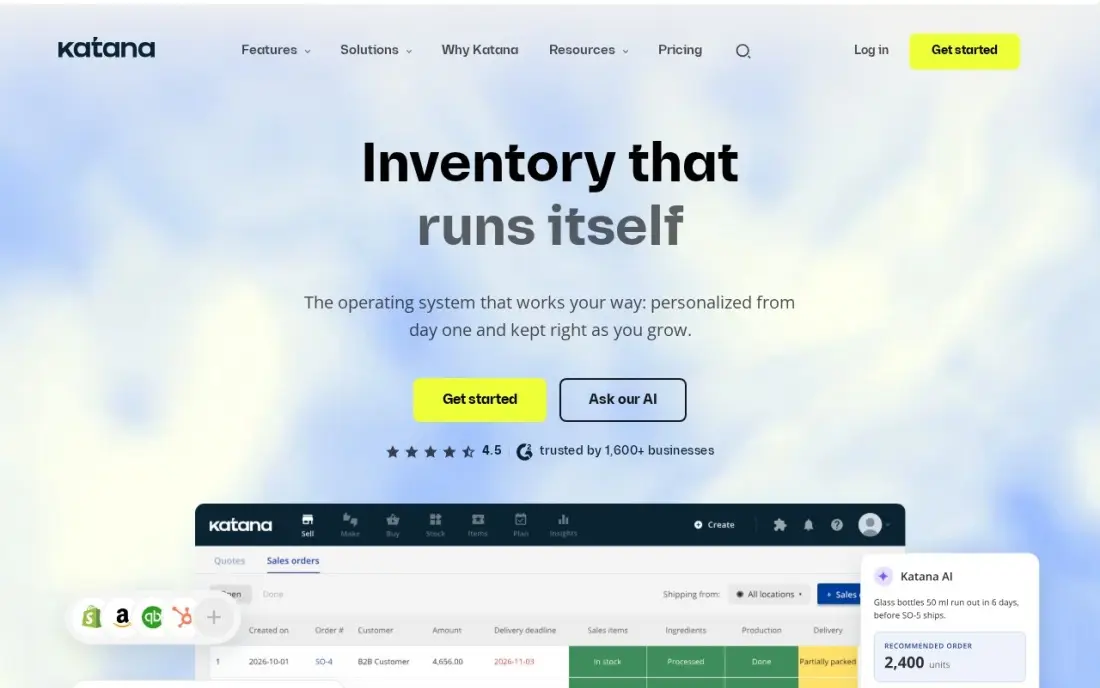
Katana is the Shopify inventory app for makers. Core includes multi-level bills of materials, manufacturing orders and forecasting, so selling a candle or a skincare product automatically consumes wax, jars and labels from stock. Real-time stock syncs across sales channels, with QuickBooks and Xero integrations, and a free plan for 30 SKUs and 3 locations works with Shopify only.
Core costs $299 a month with unlimited users, but lot tracking costs $249 a month extra and production routings $199, and order volume and extra locations add usage charges. A maker needing full traceability should budget around $498 a month before usage. Choose Katana when you build what you sell.
What we like
- Multi-level bills of materials and manufacturing orders included in Core
- Real-time stock across sales channels with QuickBooks and Xero integrations
- Unlimited users and integrations on the paid Core plan
Watch out for
- Lot tracking and production routings are paid add-ons ($249 and $199/month), not in Core
- Sales-order volume and extra locations add usage charges on top of the $299 base

Shopify POS
Best for: Shopify stores with a physical shop that want one inventory pool for online and in-person sales

Shopify's own inventory is the place to start if you also sell in person. One catalog and one stock pool cover the store, the website, social and AI chats, so a sale anywhere updates stock everywhere without another app. POS Pro at $89 a month per location adds staff roles, smart inventory management, low-stock reports and unlimited registers.
The maths needs care: Shopify Basic costs $39 a month, or $29 billed annually, so one location on POS Pro costs $128 a month on monthly billing before processing, and each extra location adds $89. It has no bills of materials for makers. Use it when your problem is keeping shop and site in sync.
What we like
- One inventory pool for the store, the website, social and AI chats — a sale anywhere updates stock everywhere
- POS Pro adds staff roles, smart inventory management, low-stock reports and unlimited registers
- One back office scales to 1,000+ locations with central reporting
- Shopify Magic AI features are included on Shopify plans
Watch out for
- POS Pro at $89 a month per location sits on top of the plan, so one location with Pro costs $128 a month before processing
- A physical-only shop pays for an online plan it barely uses
- Published card rates require Shopify Payments

ShipStation
Best for: Shopify stores whose stock problem is really a fulfilment problem
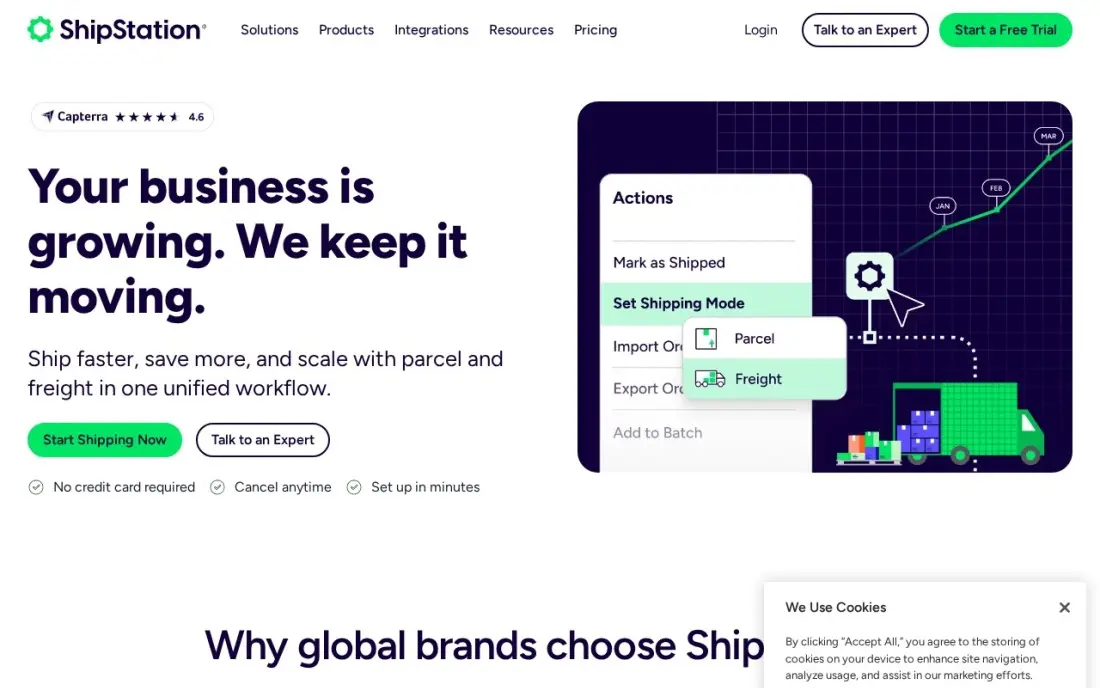
ShipStation is a shipping tool first, but for many Shopify stores that is where inventory goes wrong. As orders ship, stock levels sync back to every connected channel, so listings do not oversell, and automation rules, branded labels and discounted carrier rates cut the time each order takes. Starter costs $14.99 a month for 50 shipments, with 300-plus integrations.
Price rises with shipment volume — Starter is $79.99 a month at 1,000 shipments — and the inventory tools are lighter than a dedicated system, with no bills of materials or warehouse management. Choose ShipStation when labels and stock sync are the job, and add a dedicated inventory app later if purchasing becomes the bottleneck.
What we like
- Starter at $14.99/month covers 50 shipments with 300+ integrations across carts and marketplaces
- Automation rules, branded labels and discounted carrier rates cut the time each order takes to leave the shelf
- Stock levels sync back to every connected channel as orders ship, so listings do not oversell
Watch out for
- ShipStation is shipping-first: its inventory tools are lighter than the dedicated systems in this list
- The price rises with shipment volume — Starter is $79.99 a month at 1,000 shipments, not $14.99
- Older directories still show the retired $9.99 Starter tier and the old Bronze/Silver ladder; the current plans are Starter, Standard and Premium

Ordoro
Best for: High-volume Shopify sellers who want inventory, kitting and labels in one workflow
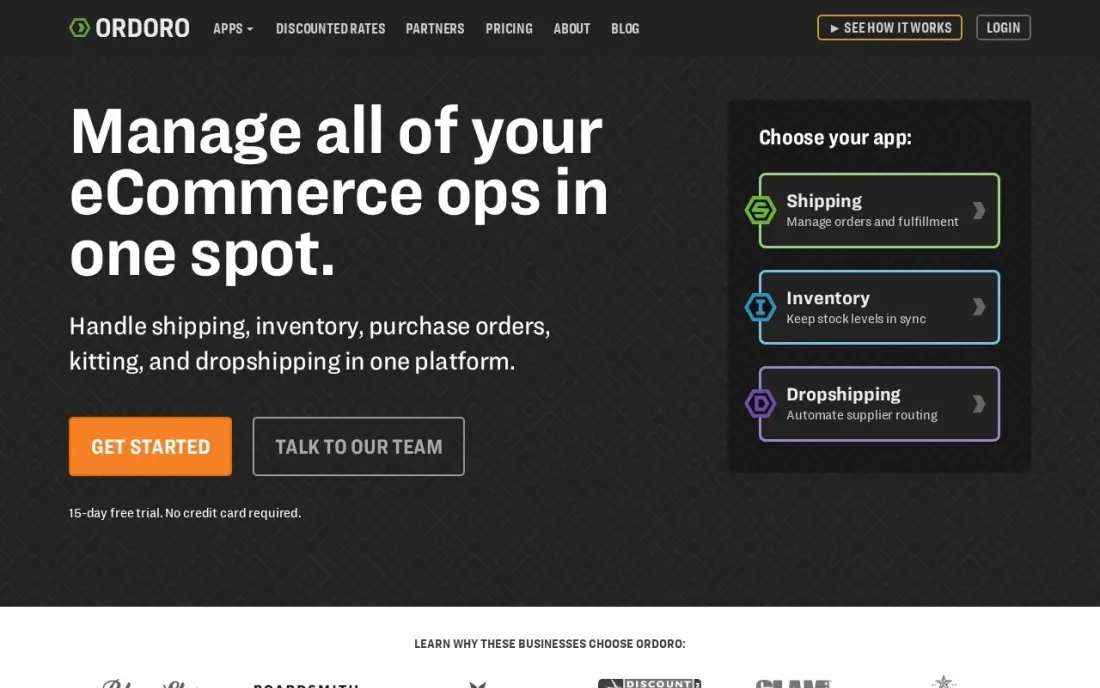
Ordoro sits between a label printer and a full inventory system. Pro bundles inventory management, kitting, purchase orders and multi-warehouse tracking with discounted USPS rates and batch label printing, so a store shipping hundreds of orders a day manages stock and fulfilment from the same screen. Automation rules and presets cut manual work.
Pro costs $499 a month, and the plan names matter: Express at $59 is shipping only, with no inventory, and dropshipping automation is a separate $299 module. There is a 15-day trial. Choose Ordoro when bundles and kits ship from your own shelves every day and you want one tool for both jobs.
What we like
- Pro bundles inventory, kitting, purchase orders and multi-warehouse tracking
- Discounted USPS rates and batch label printing in the same workflow
- Automation rules and shipping presets cut manual label work
Watch out for
- Inventory management only starts on Pro at $499/month; Express ($59) is shipping only
- Dropshipping automation is a separate $299/month module

inFlow Inventory
Best for: Shopify stores that also sell wholesale and need B2B ordering
inFlow Inventory suits a Shopify brand that also sells to shops and distributors. Every plan includes unlimited products, sales orders and purchase orders, and the B2B Showroom add-on at $39 a month gives each wholesale customer a portal with their own products and prices. G2 reviewers cite ease of use most, and support is in-house on every plan.
Lite costs $99 a month billed annually, or $129 monthly, for 2 team members and 1 location. A third person or second site means Core at $299 a month with a $499 onboarding package, and serial and lot tracking are $39 add-ons below the top tier. Choose inFlow when wholesale orders and Shopify orders draw from the same stock.
What we like
- Unlimited products, sales and purchase orders on every plan, with 2 team members and 1 location on Lite
- B2B Showroom add-on ($39/month) gives customers their own portal with per-customer products and prices
- G2 reviewers cite ease of use most, and in-house support is included on every plan
Watch out for
- Lite at $99/month billed annually covers only 2 team members and 1 location; a third person or second site means Core ($299/month)
- Serial and lot tracking are $39/month add-ons each below the top tier, and Core and above require a $499 one-time onboarding package
- Manufacturing (bills of materials, work orders) is a separate product line starting at $169/month billed annually
The best Shopify app for inventory management keeps one accurate stock number across your store, marketplaces and warehouse, tells you what to reorder before you run out, and stops you selling what you do not have. We compared seven options — simple inventory apps, multichannel systems, a manufacturing tool, Shopify's own POS inventory and two shipping-first tools — on stock sync, order caps, purchasing features and real monthly cost, with every price taken from the vendor's own page as checked in November 2026.
How to choose the best Shopify app for inventory management
- Name the real problem. Overselling across channels, running out of stock, tracking raw materials and slow fulfilment each point to a different tool.
- Check what the plan meters. Zoho meters orders, Cin7 meters sale orders and integrations, ShipStation meters shipments and inFlow meters users and locations.
- Count channels and locations. Selling on Shopify plus Amazon or from two warehouses needs multichannel sync and multi-location stock.
- Look for purchasing tools. Purchase orders, reorder points and supplier records turn stock tracking into stock planning.
- Decide if you make products. Bills of materials and manufacturing orders are essential for makers and irrelevant for resellers.
- Price the add-ons. Lot tracking, forecasting and B2B portals are often extra on top of the base plan.
Accurate stock also protects your search traffic: product pages that flip between in stock and sold out, or that sell items you cannot ship, lose trust with shoppers and search engines. Our ecommerce SEO guide covers how to handle out-of-stock pages without losing rankings.
Shopify inventory app pricing: what you will actually pay
Take a Shopify store doing 400 orders a month from one warehouse. Zoho Inventory Standard covers up to 500 orders for $29 a month billed annually, or $348 a year. ShipStation's price depends on shipments: Starter is $14.99 a month at 50 shipments and $79.99 a month at 1,000, so 400 shipments falls between those bands. inFlow Lite costs $99 a month billed annually, or $1,188 a year, for 2 team members.
The multichannel and manufacturing tools cost more. Katana Core costs $299 a month, or $3,588 a year, before lot tracking at $249 and usage charges. Cin7 Core Standard costs $349 a month, or $4,188 a year, for 6,000 sale orders a year — and 400 orders a month is 4,800, so it fits with room to spare. Ordoro Pro costs $499 a month, or $5,988 a year.
Know the difference: inventory app vs shipping app with stock sync
An inventory app such as Zoho Inventory, Cin7 Core, Katana or inFlow is the master record for stock. It handles purchase orders, suppliers, reorder points, bundles and, for Katana, raw materials, and pushes the right number to Shopify and other channels.
A shipping app such as ShipStation or Ordoro Express focuses on getting orders out the door, and adjusts stock as each order ships. That fixes overselling for many stores, but it does not plan purchasing or track components. Ordoro Pro bridges the two, with inventory and kitting alongside labels.
Quick comparison: tool type by need
| Buyer | Best pick | Why |
|---|---|---|
| Most small Shopify stores | Zoho Inventory | Free for 50 orders/month, Standard $29/month billed annually |
| Shopify plus Amazon | Cin7 Core | Native multichannel sync, unlimited locations, from $349/month |
| Makers and manufacturers | Katana | Bills of materials and manufacturing orders, Core $299/month |
| Online plus physical shop | Shopify POS | One inventory pool, POS Pro $89/month per location |
| Fulfilment-led stores | ShipStation | Stock sync as orders ship, from $14.99/month |
| Kits and high volume | Ordoro | Inventory, kitting and labels on Pro at $499/month |
| Shopify plus wholesale | inFlow Inventory | B2B portal add-on, Lite $99/month billed annually |
Mistakes to avoid
- Running two stock masters. If Shopify and an app both edit stock freely, numbers drift; choose one source of truth.
- Ignoring order caps. A sale or holiday peak can push an order-metered plan into the next tier for the month.
- Skipping a stock count before go-live. Importing wrong numbers into a new app just moves the problem.
- Forgetting bundles and variants. Set up kits and variants properly, or the app will undercount components.
- Buying manufacturing features you do not need. Resellers pay for bills of materials they never use; makers cannot live without them.
How we chose
We checked each vendor's pricing page in November 2026 and recorded the starting price, the meter each plan uses and the main add-ons. We ranked tools for a small to mid-size Shopify store, weighting stock accuracy across channels, purchasing features, ease of setup and real monthly cost at typical order volumes. Ratings come from G2 pages checked on the dates shown in the sources; tools without one show none. No vendor paid for a place in this list, and none of the links here are affiliate links.
What to do next
Count your monthly orders, sales channels and locations, then connect your Shopify store to the free plan or trial of your top two apps and run one week of real orders through each. If your product pages need to rank as well as stay in stock, book a free call.
Frequently asked questions
What is the best Shopify app for inventory management?
Zoho Inventory is the best for most small Shopify stores, with a free plan for 50 orders a month and Standard at $29 a month billed annually. Cin7 Core is best for Shopify plus Amazon, Katana for makers, and Shopify POS Pro for stores with a physical shop.
Does Shopify have built-in inventory management?
Yes, Shopify tracks stock per product and location, and POS Pro at $89 a month per location adds smart inventory management and low-stock reports. Dedicated apps add purchase orders, bundles, bills of materials and multi-channel sync.
Is there a free Shopify inventory app?
Zoho Inventory's free plan covers 50 orders a month for 1 user and 1 location, and Katana's free plan covers 30 SKUs and 3 locations for Shopify stores. Both are useful for testing before you pay.
How do I stop overselling on Shopify and Amazon?
Use one system as the stock master and sync both channels from it. Cin7 Core has native Shopify and Amazon sync with unlimited locations, and ShipStation syncs stock back to every connected channel as orders ship.
What inventory app is best for Shopify manufacturers?
Katana, because Core includes multi-level bills of materials and manufacturing orders that consume raw materials when products sell. Cin7 Core Pro at $599 a month adds material requirements planning for sellers who assemble kits.
How much does Shopify inventory software cost?
On published prices, Zoho Inventory Standard costs $29 a month billed annually, ShipStation Starter $14.99 a month for 50 shipments, inFlow Lite $99 a month billed annually, Katana Core $299, Cin7 Core $349 and Ordoro Pro $499 a month.
Sources we checked (13)
- Zoho Inventory — www.zoho.com/us/inventory/pricing (checked November 10, 2026)
- Zoho Inventory reviews on G2 (checked November 10, 2026)
- Cin7 Core — www.cin7.com/pricing (checked November 10, 2026)
- Cin7 Core reviews on G2 (checked November 10, 2026)
- Katana — katanamrp.com/pricing (checked November 10, 2026)
- Katana reviews on G2 (checked November 10, 2026)
- Shopify POS — www.shopify.com/pos/pricing (checked November 10, 2026)
- Shopify POS reviews on G2 (checked November 10, 2026)
- ShipStation — www.shipstation.com/pricing (checked November 10, 2026)
- ShipStation reviews on G2 (checked November 10, 2026)
- Ordoro — www.ordoro.com/pricing (checked November 10, 2026)
- inFlow Inventory — www.inflowinventory.com/software-pricing (checked November 10, 2026)
- inFlow Inventory reviews on G2 (checked November 10, 2026)
Make one of these tools?
We re-check this list every quarter. Send a correction, request a review, or ask about a clearly labeled sponsored spot.
Request a listingShamim
Founder of SerpAstra
A full-stack SEO and digital marketer who spends most days on Local SEO for dental practices, AI search visibility and lead generation.
Free SEO and AI visibility audit
Find out what is holding your rankings back
Send us your site. Within 2 business days you get a written audit, an AI visibility check and a short fix list ranked by impact. Free, with no contract attached.
Request my free audit→Related buying guides
 Logistics, Supply Chain & Procurement10 Best Inventory Management Software Small Business in 2026, Compared10 best inventory management software small business picks compared with real 2026 prices, free plans and order limits, so you can choose by volume.Read guide →
 Logistics, Supply Chain & Procurement12 Best Inventory Tracking Software for Small Business in 2026, ComparedThe 12 best inventory tracking software for small business, compared on real prices, free plans and stock features. Prices checked November 10, 2026.Read guide →
 SEO & AI Search Visibility12 Best Shopify SEO Apps in 2026: Free and Paid Apps Ranked12 best shopify seo apps compared on price, free plans and AI search features. Every price checked on the Shopify App Store listing, November 2, 2026.Read guide →