
10 Best Small Business ERP Software in 2026, Compared
Compare the 10 best small business ERP software options on price, inventory, manufacturing and free plans, with every price checked November 10, 2026.
 Shamim Mia, Founder, SerpAstraLast verified November 10, 202616 min read
We compare pricing pages, documentation and public reviews. We never accept payment for rankings.
Key takeaways
- Odoo is the best value for most small businesses at $31.10/user/month billed annually; Business Central follows at $80/user/month with Copilot included, and ERPNext is free to self-host with managed hosting from $5/month.
- Four of the ten tools — SAP Business One, NetSuite, Sage Intacct and Acumatica — publish no price at all, so budget for a quoted subscription plus a separate implementation project.
- The single most important buying factor is the pricing model: per-user, per-month, resource-based and quote-only ERPs scale in completely different ways as headcount grows.
- Every price below was checked on the vendor's own pricing page on November 10, 2026, or marked as a custom quote where the vendor publishes no price. Ratings are G2, with review counts shown.
On this page
Quick comparison
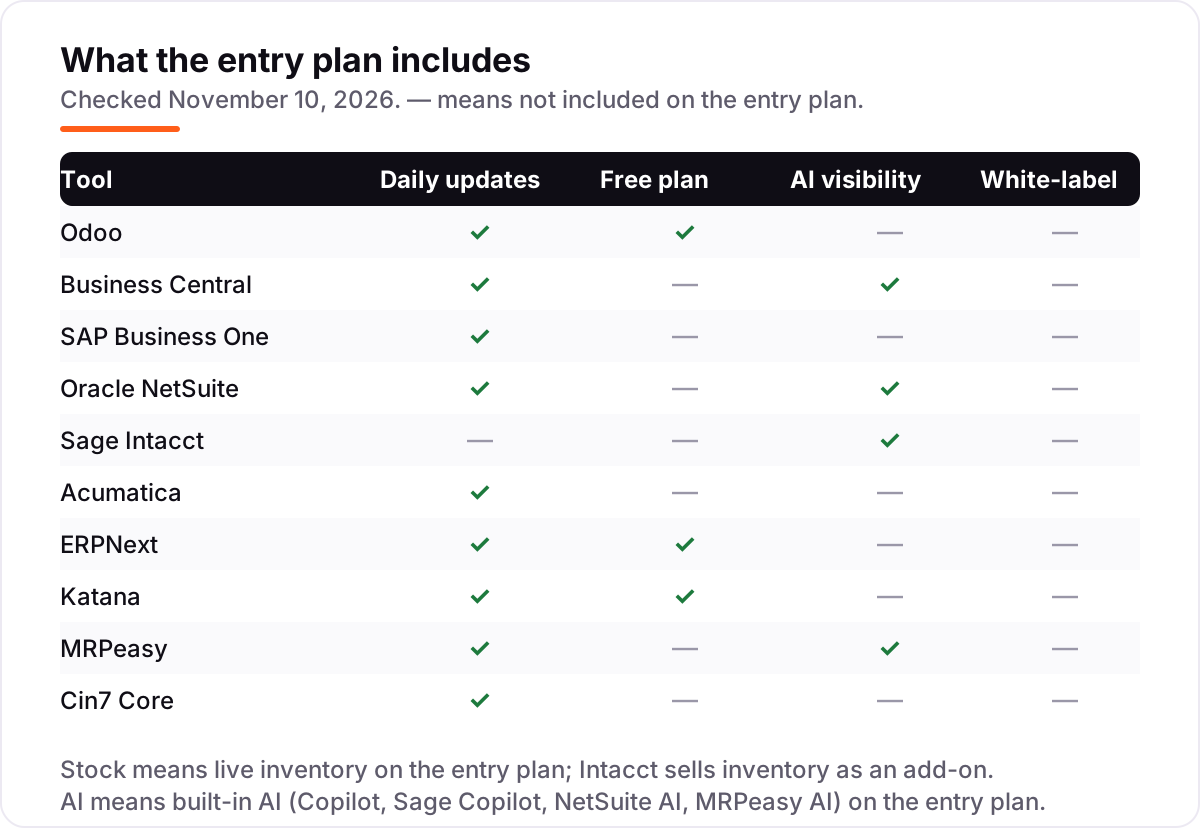
| Tool | Best for | Starting price | Free plan |
|---|---|---|---|
| Odoo | Small businesses that want every app — accounting, inventory, CRM, manufacturing — for one flat per-user price | $31.10/user/mo (annual) | Yes (One App Free) |
| Business Central | Small and midsize businesses already running Microsoft 365 that want finance, sales, inventory and projects in one Microsoft system | $80/user/mo | No (trial available) |
| SAP Business One | Growing distributors and manufacturers that want SAP depth — strong inventory and production — without moving to S/4HANA | Custom quote | No (demo only) |
| Oracle NetSuite | Scaling businesses with multiple entities or subsidiaries that need one cloud system for finance, inventory, CRM and reporting | Custom quote | No (demo only) |
| Sage Intacct | Finance-led businesses that have outgrown QuickBooks and need multi-entity accounting, dimensional reporting and strong controls | Custom quote | No (demo only) |
| Acumatica | Businesses with many light or occasional users — shop floor, field service, seasonal staff — that refuse to pay per seat | Custom quote | No (demo only) |
| ERPNext | Small businesses with technical resources that want full ERP scope with zero per-user licence fees | Free; hosted from $5/mo | Yes (open source) |
| Katana | Small makers and multichannel brands that manufacture or assemble products and sell on Shopify, Amazon and their own store | $299/mo | Yes (30 SKUs) |
| MRPeasy | Small manufacturers with 10 to 200 employees that need real MRP — bills of material, scheduling and purchasing — on a budget | $49/user/mo | No (30-day trial) |
| Cin7 Core | Multichannel sellers with real inventory complexity — thousands of orders across Shopify, Amazon and eBay — who need purchasing and warehousing in one system | $349/mo | No (14-day trial) |
Make one of these tools?
We re-check this list every quarter. Send a correction, request a review, or ask about a clearly labeled sponsored spot.
Request a listingThe best small business ERP software

Odoo
Best for: Small businesses that want every app — accounting, inventory, CRM, manufacturing — for one flat per-user price
Odoo is the value pick because one flat price buys the whole suite: accounting, inventory, CRM, sales, purchasing, manufacturing and projects all sit in the same system, and every app is included in Standard. At $31.10 per user per month billed annually, a 10-person team pays $311 a month for software that would cost several subscriptions elsewhere.
The trade-off is that the headline price is a first-year discount. Standard costs $24.90 per user per month for the first 12 months, then $31.10, and monthly billing runs higher again at $38.90 after year one. Custom, at $61.00 after year one, is the only way to get Studio, the external API, multi-company support or Odoo.sh hosting.
What we like
- One flat per-user price covers all apps — accounting, inventory, CRM, sales, purchasing, manufacturing and projects
- One App Free is a real free plan: one app, unlimited users, hosted on Odoo Online
- Hosting, maintenance, upgrades and unlimited support are included in every paid plan
- No per-module fees, so adding a department never adds a second subscription
Watch out for
- The $24.90 first-year price rises to $31.10/user/month from year two, and monthly billing costs $38.90 after the first year
- Studio, the external API, multi-company and Odoo.sh hosting need the Custom plan at $61.00/user/month after year one
- Odoo's own implementation help (Success Packs) is billed separately, and setup takes real configuration effort

Business Central
Best for: Small and midsize businesses already running Microsoft 365 that want finance, sales, inventory and projects in one Microsoft system
Business Central is the natural ERP for a business that already lives in Microsoft 365. Essentials costs $80 per user per month on annual billing and covers finance, sales, purchasing, inventory, projects and basic warehousing, with Microsoft Copilot included and native links into Outlook, Excel, Teams and Power BI.
The price to watch is the per-user maths. Ten full users cost $800 a month, and manufacturing or service management moves the team to Premium at $110 per user per month. Implementation is a separate partner quote on top of the licence, and the $80 figure is the November 2025 list price — older guides still showing $70 are out of date.
What we like
- Microsoft Copilot is included, and the system plugs straight into Outlook, Excel, Teams and Power BI
- Essentials covers finance, sales, purchasing, inventory, projects and basic warehousing in one licence
- Team Member licences at $8/user/month cover staff who only approve, view reports or raise requisitions
- Per-named-user licensing with unlimited transactions inside each seat, so volume never raises the licence bill
Watch out for
- At $80/user/month, a 10-user team pays $800 a month before implementation or add-ons
- Manufacturing and service management need Premium at $110/user/month, not Essentials
- Implementation is quoted separately by a Microsoft partner — the licence is only the start of the bill

SAP Business One
Best for: Growing distributors and manufacturers that want SAP depth — strong inventory and production — without moving to S/4HANA
SAP Business One is the ERP for a product business that has outgrown its accounting software and wants SAP-grade inventory and production without stepping up to S/4HANA. The core covers serial and batch tracking, bills of material and MRP, and it is sold as a perpetual licence or a cloud subscription through SAP's large partner network.
The honest difficulty is price transparency: SAP publishes no price list, so every deal is a partner quote built from licence type, user count, deployment and add-ons. Partner estimates put cloud subscriptions roughly at $100–$219 per Professional user per month, with implementation on top, and customisation is a known cost driver.
What we like
- Deep inventory and production control — serial and batch tracking, bills of material, MRP — in the core product
- Perpetual licences or cloud subscription, on-premise or hosted, through SAP's large partner network
- Separate Professional and Limited user types, so light users cost less than full users
- A Starter Package covers up to five users for the smallest deployments
Watch out for
- SAP publishes no price list; every deal is quoted by an SAP partner, so budgeting needs a sales conversation
- Partner estimates put cloud subscriptions roughly at $100–$219 per Professional user per month, with implementation on top
- Customisation and add-ons are a known cost driver, per G2 reviewers

Oracle NetSuite
Best for: Scaling businesses with multiple entities or subsidiaries that need one cloud system for finance, inventory, CRM and reporting
NetSuite is the scale pick. It is a single cloud system for finance, inventory, CRM, order management and reporting, with multi-entity and multi-currency consolidation built in rather than bolted on, and SuiteScript and SuiteFlow let a team reshape almost any workflow, and real-time dashboards give leadership one source of truth.
The cost is the thing to go in with eyes open. Oracle publishes no price list, so the subscription is quoted by users and modules, and third-party guides commonly cite around $999 a month plus $99–$199 per user — treat that as a planning range, not a price. G2 puts typical implementation at 6 months, and reviewers warn about the learning curve.
What we like
- The most customisable system here: SuiteScript and SuiteFlow let teams reshape almost any workflow
- Multi-entity, multi-currency and multi-subsidiary consolidation (OneWorld) in the same platform
- Real-time dashboards and saved searches give leadership one source of truth across finance and inventory
- The largest review base in this list — 5,235 G2 reviews — and the widest partner ecosystem
Watch out for
- Oracle publishes no price list; third-party guides commonly cite around $999 a month plus $99–$199 per user, but that is not a vendor price
- G2 puts typical implementation at 6 months, and implementations are usually a five-figure partner project
- Reviewers consistently cite a steep learning curve and a dated-feeling interface for new users

Sage Intacct
Best for: Finance-led businesses that have outgrown QuickBooks and need multi-entity accounting, dimensional reporting and strong controls
Sage Intacct is the finance team's ERP. It is a cloud financial platform built around the general ledger, with dimensional reporting, multi-entity consolidation and inter-entity transactions in the core product. Sage Copilot AI is included at no extra charge, and the audit trails and approval workflows are the kind a controller asks for by name.
It is also the most quote-bound tool here. Sage publishes no price list, so every subscription is a custom annual quote built from modules, users and entities, and there is no free plan or self-service trial — evaluation runs through a demo. Inventory and order management are paid add-ons, not core financials.
What we like
- The strongest reporting in this list — G2 reviewers mention reporting in over 500 reviews, with dimensional reporting built in
- Multi-entity consolidation and inter-entity transactions without spreadsheets or a separate consolidation tool
- Sage Copilot AI is included at no extra charge on the platform
- AICPA-preferred financial management with audit trails and approval workflows finance teams trust
Watch out for
- Sage publishes no price list; every subscription is a custom annual quote from Sage or a partner
- No free plan and no self-service trial — evaluation runs through a demo with Sage or a partner
- Implementation is a separate partner project that partners typically price at roughly one to one-and-a-half times the annual subscription

Acumatica
Best for: Businesses with many light or occasional users — shop floor, field service, seasonal staff — that refuse to pay per seat
Acumatica is the only tool here that does not charge per user. The licence is priced by edition and resource use — transaction volume, data and compute — so adding shop-floor, field-service or seasonal users costs nothing extra, and Select, Prime and Enterprise editions include unlimited users. Industry editions cover manufacturing, construction, distribution, retail and field service.
The catch is the same as the other quote-only tools: Acumatica publishes no list prices, so the number comes from a partner after scoping. Partner-reported starting points cluster around $6,396 a year for the Essentials edition, which is capped at 10 named users, and most mid-market deployments land well above that.
What we like
- No per-user pricing: the licence is priced by edition and resource use, so adding users does not raise the bill
- Unlimited users on Select, Prime and Enterprise editions — the only unlimited-user model in this list
- Industry editions for manufacturing, construction, distribution, retail and field service
- Cloud, on-premise or hybrid deployment, with a modern low-code customisation toolkit
Watch out for
- Acumatica publishes no list prices; quotes come through partners and depend on edition, transactions and resources
- The entry Essentials edition is capped at 10 named users, so larger teams need a higher edition
- Transaction-volume tiers mean a busy month can push the business into a higher resource band

ERPNext
Best for: Small businesses with technical resources that want full ERP scope with zero per-user licence fees
ERPNext is the most complete free ERP a small business can actually run. The software is open source under GPLv3, so the licence costs $0 and every module ships in the same system: multi-currency accounting, warehouse management, multi-level bills of material, production planning, CRM, HR and payroll, projects and a helpdesk. Frappe Cloud hosts it from $5 a month for a site.
Free licences do not mean a free ERP. Frappe does no implementation directly, so someone has to install it, configure it, migrate the data and keep it updated — a partner or an in-house developer. The $5 site plan is shared hosting with CPU limits, so a production site usually needs the $40 a month server plan.
What we like
- The software is free under GPLv3 — every module included, with no per-user, per-module or annual licence fees
- Full ERP scope: accounting, stock, manufacturing, CRM, HR, projects, assets and support in one system
- No per-user meter at any scale, so adding staff never raises the licence bill
- Frappe Cloud hosting starts at $5 a month for a site, with managed upgrades and backups
Watch out for
- Frappe does no implementation directly, so setup, migration and customisation all need a partner or in-house skill
- The $5/month site plan is shared hosting with CPU limits — a production site usually needs the $40/month server plan
- The implementation partner pool is smaller than Odoo's or Microsoft's, so local help can be harder to find

Katana
Best for: Small makers and multichannel brands that manufacture or assemble products and sell on Shopify, Amazon and their own store
Katana is built for brands that make what they sell. The free plan covers up to 30 SKUs with unlimited users, locations and integrations, and Core costs $299 a month with unlimited SKUs and users, multi-channel sales orders, purchasing, inventory planning and barcode scanning. The visual production scheduler is the feature reviewers praise most.
The price to model carefully is the add-on stack. Manufacturing routings, traceability and warehouse management are paid add-ons on top of Core — independent pricing reviews put them at $199, $249 and $149 a month — and sales-order volume and extra locations are billed by usage. A maker that needs all three add-ons pays far more than $299.
What we like
- A real free plan: up to 30 SKUs with unlimited users, locations and integrations
- Unlimited users and unlimited SKUs on Core, with a visual drag-and-drop production scheduler
- Multi-channel sales orders, purchasing, inventory planning and barcode scanning in the Core plan
- Rated 4.4/5 on G2 with the highest ease-of-use scores among the manufacturing tools here
Watch out for
- Core at $299 a month is a floor: manufacturing routings, traceability and warehouse management are paid add-ons
- Sales-order volume and extra inventory locations are billed by usage on top of the platform fee
- The free plan stops at 30 SKUs, so a growing catalogue jumps straight to $299 a month with no middle tier

MRPeasy
Best for: Small manufacturers with 10 to 200 employees that need real MRP — bills of material, scheduling and purchasing — on a budget
MRPeasy is the most honestly small-manufacturer-focused MRP in this list, built for companies with 10 to 200 employees. Every plan includes production planning, multi-level bills of material, lot and serial traceability, inventory and purchasing, and Starter costs $49 per user per month with a 30-day trial and no card required.
The honest weakness is the per-user model. Ten users on Enterprise cost $990 a month, and the bill grows with every hire, while Katana's flat $299 platform fee does not move with headcount at all. Built-in accounting is basic, so most businesses pair MRPeasy with QuickBooks or Xero rather than replacing them.
What we like
- Production planning, multi-level bills of material and finite-capacity scheduling on every plan from $49/user/month
- The highest G2 score in this list at 4.6/5, with reviewers praising ease of use most
- Lot and serial traceability, shop-floor control and purchasing included on Starter — not held for higher tiers
- Standard integrations with Shopify, WooCommerce, QuickBooks and Xero, plus a 30-day trial with no card required
Watch out for
- Per-user pricing compounds: 10 users on Enterprise costs $990 a month, and the bill grows with every hire
- Built-in accounting is basic — most businesses pair MRPeasy with QuickBooks or Xero rather than replacing them
- Beyond 10 users, extra users are charged at $79 per block of 10, which softens the per-user maths but complicates budgeting

Cin7 Core
Best for: Multichannel sellers with real inventory complexity — thousands of orders across Shopify, Amazon and eBay — who need purchasing and warehousing in one system
Cin7 Core is the step up when a business outgrows simple stock tracking. Standard costs $349 a month for 5 users and 6,000 orders a year, with multi-location inventory, purchasing workflows, light manufacturing and warehouse operations in one system, plus more than 700 integrations covering Shopify, Amazon, eBay, QuickBooks and Xero. It is the only inventory-led tool here with a published fixed price.
The price is also the filter. At $349 a month with no free plan, it is for businesses whose inventory complexity already costs more than that in errors and stockouts, and real manufacturing depth needs Pro at $599 a month — MRP and multi-level bills of material are not in Standard. Pick Cin7 Core when multichannel inventory is the bottleneck; pick Katana or MRPeasy when production planning is the job.
What we like
- Multi-location inventory, purchasing workflows, light manufacturing and warehouse operations in one system
- More than 700 integrations, including Shopify, Amazon, eBay, QuickBooks and Xero
- Standard covers 5 users and 6,000 orders a year, so the entry plan fits a genuinely busy seller
- The only inventory-led tool here with a published fixed price — no quote, no usage surprise at the entry tier
Watch out for
- At $349 a month with no free plan, it is the dearest inventory-led option here for a small team
- MRP and multi-level bills of material need the Pro plan at $599 a month, not Standard
- The B2B portal and extra users beyond the plan allowance cost extra on top of the subscription
The best small business ERP software does one job well: it keeps the money, the stock and the orders in the same system, so the accounts, the warehouse and the sales team stop disagreeing. We ranked the ten tools below by fit for the most common buyer — a small business outgrowing its accounting software — starting with the cheapest published prices and ending with the inventory-led options, and every price was checked on the vendor's own pricing page on November 10, 2026, or marked as a custom quote where the vendor publishes no price.
How to choose the best small business ERP software
- Count your users first, then check how the vendor charges for them. Odoo and Business Central charge per user, so the bill grows with headcount; Acumatica charges by resources, so it does not; ERPNext charges nothing per user at all.
- List the modules you actually need. Inventory is core in Odoo, Business Central, SAP Business One and NetSuite, a paid add-on in Sage Intacct, and the whole product in Katana, MRPeasy and Cin7 Core.
- Check what the entry price leaves out. Manufacturing needs Premium in Business Central, add-ons in Katana, and the Pro plan in Cin7 Core — the headline price is rarely the whole price.
- Ask who implements it. Odoo, MRPeasy and Katana are built for self-service setup; NetSuite, SAP Business One, Sage Intacct and Acumatica are sold through partners, and implementation is a separate quoted project.
- Think about who else touches the system. If the accountant already lives in QuickBooks, an ERP that integrates with it — MRPeasy, Katana and Cin7 Core all do — is an easier move than one that replaces it. Our guide to payroll software for small business covers the other system most small businesses buy alongside an ERP.
ERP software is one system in your stack, not the whole stack. If the business also needs to be found online, our monthly SEO service handles the visibility side. And before you publish new pages for the products you sell, run your titles through the free SERP snippet preview tool — it shows exactly how the title and description will look in Google.
Whatever you shortlist, try it with real data before you pay. The free plans and trials in this list are long enough to run one genuine month — your products, your stock levels, your orders — and that month tells you more than any review can. Check two things in the trial: that the stock count matches the warehouse on the first day, and that an order flows from sale to invoice without retyping. Every tool here that offers a trial gives you at least 14 days, so there is no reason to buy before the warehouse team has used it.
ERP pricing: what you will actually pay
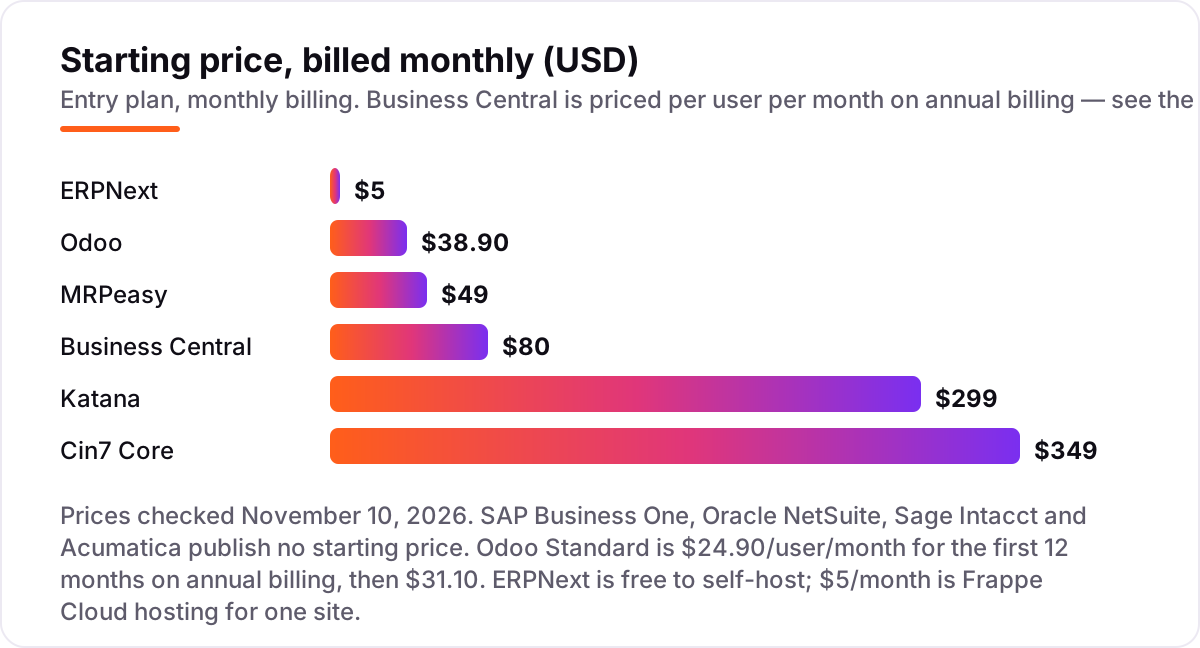
Take a 10-person business that sells physical products from one warehouse. On list prices, the subscription costs $5 a month on ERPNext hosted on Frappe Cloud, $311 a month on Odoo Standard billed annually, $490 a month on MRPeasy Starter, $800 a month on Business Central Essentials, $299 a month on Katana Core and $349 a month on Cin7 Core Standard. Over a year, that is $60 on ERPNext hosting, $3,732 on Odoo, $5,880 on MRPeasy, $9,600 on Business Central, $3,588 on Katana and $4,188 on Cin7 Core — before any of the extras below.
Three costs sit outside every number above. First, the introductory discount: Odoo Standard costs $24.90 per user per month for the first 12 months, then $31.10, so a 10-user team saves $744 in year one and pays the full $311 a month from year two. Second, the add-ons: Katana's manufacturing, traceability and warehouse add-ons cost extra, and Cin7 Core needs the $599 Pro plan for MRP — the $299 and $349 figures are floors, not totals. Third, implementation: NetSuite, SAP Business One, Sage Intacct and Acumatica are quoted without it, and the partner project is a separate bill. If the business also needs accounting depth alongside inventory, compare the ledger side in our guide to accounting software for small businesses with inventory.
The quote-only tools deserve a different kind of budgeting. With no published price, the honest move is to get three written quotes — one from the vendor and two from partners — each separating licence, implementation, training and support onto different lines. Third-party guides commonly cite around $999 a month plus $99–$199 per user for NetSuite, but that is a planning estimate, not a vendor price, and partner estimates for SAP Business One span roughly $100–$219 per Professional user per month. A quote that bundles everything into one number cannot be compared with anything.
Know the difference: ERP software vs accounting software
The confusion in this category is between a ledger and an operating system. Accounting software records the money: invoices, bills, bank feeds and tax-ready reports. ERP software adds the operations around the money — inventory, purchasing, sales orders, manufacturing and warehousing — in the same system, so the stock count, the order status and the accounts always agree. A business that only needs the books should buy accounting software; a business that also tracks stock and production needs ERP, and buying a second accounting tool on top of an ERP is paying twice for the same ledger.
There is a second, quieter confusion: inventory tools are not ERPs. An inventory tool tracks stock and orders; it does not keep a general ledger, run payroll or produce a balance sheet. Katana, MRPeasy and Cin7 Core sit on this border — they are inventory-led systems that cover operations deeply and integrate with QuickBooks or Xero for the ledger, rather than replacing it. All ten tools in this list cover the operations side; the first seven also carry the ledger, and the last three pair with one. If the books are the priority and stock is simple, start with our guide to the best accounting software for small businesses instead.
A third distinction worth knowing is the pricing model, because it decides what the system costs in year three. Per-user pricing (Odoo, Business Central, MRPeasy) grows with headcount; flat platform pricing (Katana, Cin7 Core) grows with order volume and locations instead; resource pricing (Acumatica) grows with transaction volume; and quote-only pricing (NetSuite, SAP Business One, Sage Intacct) grows with whatever the contract says. None of these is wrong — but a business hiring five people a year should not buy per-user pricing without doing the three-year maths first.
Quick comparison: tool type by need
| Buyer | Best pick | Why |
|---|---|---|
| Most small businesses, best value | Odoo | Every app for one per-user price, from $31.10/user/month billed annually |
| Microsoft 365 shop | Business Central | Copilot included and native Microsoft integration, $80/user/month |
| Growing distributor or manufacturer | SAP Business One | Deep inventory and production, quoted per deal |
| Scaling across entities | Oracle NetSuite | Multi-entity consolidation and the deepest customisation, quoted per deal |
| Finance-led, reporting first | Sage Intacct | Strongest reporting and multi-entity accounting, quoted per deal |
| Many light users, no per-seat bill | Acumatica | Priced by resources, not seats, with unlimited users on most editions |
| Technical team, tightest budget | ERPNext | Free to self-host, hosted from $5/month, no per-user fees |
| Small maker selling multichannel | Katana | Free plan to 30 SKUs, Core from $299/month |
| Small manufacturer on a budget | MRPeasy | Real MRP from $49/user/month, rated 4.6/5 on G2 |
| High-volume multichannel seller | Cin7 Core | Deep inventory and 700+ integrations from $349/month |
Mistakes to avoid
- Budgeting on the first-year price. Odoo's $24.90 rate lasts 12 months, then rises to $31.10. The list price is what you pay in year two, so compare tools on that number.
- Comparing a per-user price with a flat price. Ten users on Business Central cost $800 a month; Katana costs $299 whatever the headcount. Count your users before you compare prices.
- Buying on the free plan, then finding manufacturing costs extra. Katana's routings and Cin7 Core's MRP are paid upgrades. If production is the job, price the upgrade from day one.
- Treating a quote as a price. The four quote-only vendors will each give a different number for the same business. Get the licence, implementation, training and support on separate lines, and get three quotes.
- Forgetting the implementation. A licence is not a working system. Budget for migration, configuration and training — and for the weeks the team spends learning it — before you sign.
How we chose
We checked each vendor's own pricing page on November 10, 2026 and recorded the starting price exactly as shown, including the annual-billing figure where the page lists one. Four vendors — SAP Business One, Oracle NetSuite, Sage Intacct and Acumatica — publish no price at all, so they are listed as custom quote, and the dollar ranges mentioned for them come from third-party pricing guides, not from the vendors, and are labelled as such wherever they appear. Katana's add-on prices come from an independent pricing review of Katana's pricing page, and ERPNext's hosted price is the $5/month Frappe Cloud site plan — some roundups still show $14, an older tier. We ranked the tools by fit for the most common buyer — a small business outgrowing its accounting software — not by brand size. No vendor paid for a place in this list, and none of the links here are affiliate links.
What to do next
Start with the shortlist that matches your pricing model: Odoo or ERPNext if the budget is tight, Business Central if the office runs on Microsoft 365, and one quote-only vendor if the business is scaling across entities. Then take the free plan or trial of your top pick and run one real month — your products, your stock, your orders — through it. If the stock count matches the warehouse and an order flows from sale to invoice without retyping, you have your system. Once your tools are in place, find out what's holding your rankings back.
Your stack only works if people find you
SerpAstra fixes what keeps your site off page one and makes it easy for AI assistants to recommend.
Get a free audit→Sources we checked (21)
- Odoo pricing — odoo.com/pricing (checked November 10, 2026)
- Odoo ERP on G2 — 4.2/5, 355 reviews (checked November 10, 2026)
- Microsoft Dynamics 365 Business Central pricing — microsoft.com (checked November 10, 2026)
- Business Central on G2 — 4.0/5, 918 reviews (checked November 10, 2026)
- SAP Business One on G2 — 4.3/5, 542 reviews (checked November 10, 2026)
- Oracle NetSuite on G2 — 4.1/5, 5,235 reviews (checked November 10, 2026)
- Sage Intacct on G2 — 4.3/5, 4,433 reviews (checked November 10, 2026)
- Acumatica on G2 — 4.4/5, 2,021 reviews (checked November 10, 2026)
- ERPNext on G2 — 4.3/5, 51 reviews (checked November 10, 2026)
- Frappe Cloud pricing — frappecloud.com/pricing (checked November 10, 2026)
- Katana pricing — katanamrp.com/pricing (checked November 10, 2026)
- Katana on G2 — 4.4/5, 122 reviews (checked November 10, 2026)
- Katana add-on prices — productionplanning.ai, Katana MRP pricing (third-party read of Katana's pricing page, October 2026)
- MRPeasy pricing — mrpeasy.com/pricing (checked November 10, 2026)
- MRPeasy on G2 — 4.6/5, 62 reviews (checked November 10, 2026)
- Cin7 Core pricing — cin7.com/pricing (checked November 10, 2026)
- Cin7 Core on G2 — 4.2/5, 345 reviews (checked November 10, 2026)
- NetSuite pricing estimates — erppeers.com, NetSuite pricing guide (third-party estimates; Oracle publishes no price list)
- SAP Business One pricing — purchaseorders.io (third-party partner estimates; SAP publishes no US price list)
- Sage Intacct pricing — itqlick.com (third-party estimate; Sage publishes no price list)
- Acumatica pricing — erpresearch.com (partner-reported ranges; Acumatica publishes no list prices)
Shamim
Founder of SerpAstra
A full-stack SEO and digital marketer who spends most days on Local SEO for dental practices, AI search visibility and lead generation.
Frequently asked questions
What is the best small business ERP software in 2026?
Odoo is the best fit for most small businesses: every app for one per-user price, from $31.10/user/month billed annually. Businesses already on Microsoft 365 should look at Business Central at $80/user/month, and teams with technical skill should consider ERPNext, which is free to self-host. The quote-only tools — NetSuite, SAP Business One, Sage Intacct and Acumatica — suit larger or more complex operations.
How much does small business ERP software cost?
Published prices run from $0 to $349 a month at the entry level. ERPNext is free to self-host, Odoo starts at $31.10/user/month billed annually, MRPeasy at $49/user/month, Business Central at $80/user/month, Katana at $299/month and Cin7 Core at $349/month. The four quote-only vendors publish no price, and implementation — usually a separate partner project — often costs as much as a year of subscription.
Is there a free ERP software for small business?
Yes, with limits. ERPNext is free to self-host under an open-source licence, Odoo has a One App Free plan for a single app with unlimited users, and Katana has a free plan up to 30 SKUs. None of the four quote-only vendors offers a free plan. Free plans cover the software only — someone still has to configure it, migrate the data and keep it updated.
What is the difference between ERP software and accounting software?
Accounting software keeps the ledger: invoices, bills, bank feeds and tax-ready reports. ERP software adds the operations around the ledger — inventory, purchasing, sales orders, manufacturing and warehousing — in the same system, so stock levels, orders and the accounts always agree. A business that only needs the books should buy accounting software; a business that also tracks stock and production needs ERP.
Do I need an ERP, or is QuickBooks enough?
QuickBooks is enough while the business sells a simple catalogue from one location and the books are the only system. It stops being enough when inventory, purchasing and production live in spreadsheets, when stock counts disagree with the accounts, or when several people need different views of the same order. That is the point where an ERP pays for itself.
Why do some ERP vendors not publish prices?
NetSuite, SAP Business One, Sage Intacct and Acumatica sell through quotes because the price depends on users, modules, entities, transaction volume and contract length — numbers a flat list cannot represent. Third-party guides commonly cite around $999 a month plus $99–$199 per user for NetSuite, but those are planning estimates, not vendor prices. Always get a written quote that separates licence, implementation and support.
How long does it take to implement a small business ERP?
It depends on the tool and the scope. Lightweight tools like MRPeasy and Katana are built for self-service setup and can go live in weeks, while G2 puts typical NetSuite implementation at 6 months. The quote-only tools usually need a partner-led project of several months. Budget for data migration and training on top of the subscription, and plan the move for a quiet period, not year-end.
Free SEO and AI visibility audit
Find out what is holding your rankings back
Send us your site. Within 2 business days you get a written audit, an AI visibility check and a short fix list ranked by impact. Free, with no contract attached.
Request my free audit→Related guides
 Accounting, Tax & Finance7 Best Accounting Software for Small Businesses in 2026, ComparedCompare the 7 best accounting software for small businesses on price, free plans, bank feeds and AI features, with every price checked November 2, 2026.Read guide →
 SEO & AI Search10 Best Accounting Software for Small Business with Inventory in 2026, Compared10 best accounting software for small business with inventory, compared on price, stock depth and free plans. Prices checked November 2, 2026.Read guide →
 Accounting, Tax & Finance10 Best Payroll Software for Small Business in 2026, ComparedCompare the 10 best payroll software for small business on base price, tax filing and free trials, with every price checked November 4, 2026.Read guide →