
8 Best Software for Distributors in 2026, Compared
Compare the 8 best software for distributors on inventory, purchasing, B2B ordering, accounting links and real cost, with prices checked on vendor pages.
 Shamim Mia, Founder, SerpAstraLast verified November 10, 20269 min read
We compare pricing pages, documentation and public reviews. We never accept payment for rankings.
Key takeaways
- Small distributors rarely need a full ERP on day one: inFlow Inventory starts at $99 a month billed annually with unlimited products, sales and purchase orders and a B2B customer portal add-on.
- Odoo Inventory is the only free full warehouse system here, free for unlimited users while Inventory is the only Odoo app you use.
- Cin7 Core suits distributors that also sell on Shopify and Amazon, from $349 a month with unlimited locations.
- NetSuite, Acumatica and SAP Business One are the ERP step-up for multi-warehouse distributors, and all three are sold by quote with separate implementation costs.
On this page
Quick comparison
| Tool | Best for | Starting price | Free plan |
|---|---|---|---|
| inFlow Inventory | Small wholesale distributors that want unlimited orders and a B2B customer portal | $99/mo (annual) | No (14-day trial) |
| Odoo Inventory | Distributors that want a free warehouse system now and a full ERP on the same platform later | Free (one app); $31.10/user/mo | Yes (1 app free) |
| Cin7 Core | Distributors that also sell direct on Shopify and Amazon and need one stock figure | $349/mo | No |
| Fishbowl Inventory | QuickBooks-based distributors that need pick, pack and ship workflows in the warehouse | $229/mo (annual) | No |
| Zoho Inventory | Very small distributors and start-ups that want a free plan and per-organization pricing | Free; $29/mo (annual) | Yes (50 orders) |
| Oracle NetSuite | Growing multi-warehouse distributors that want ERP, CRM and ecommerce on one cloud platform | Custom quote | No (tour only) |
| Acumatica | Distributors with many warehouse and field users who want to avoid per-seat pricing | Custom quote | No (demo only) |
| SAP Business One | Established distributors of 10 to 250 staff that want inventory, purchasing and CRM in one ERP | Custom quote (via partners) | No (demo only) |
Make one of these tools?
We re-check this list every quarter. Send a correction, request a review, or ask about a clearly labeled sponsored spot.
Request a listingThe best software for distributors

inFlow Inventory
Best for: Small wholesale distributors that want unlimited orders and a B2B customer portal
inFlow is built the way a small wholesaler works. Every plan includes unlimited products, sales orders and purchase orders, so the meter is people and locations rather than order volume, and the B2B Showroom add-on at $39 a month gives each customer a portal showing their own products and prices. G2 reviewers most often praise ease of use, and support is in-house.
Lite costs $99 a month billed annually, or $129 monthly, for 2 team members and 1 location. A third person or a second warehouse means Core at $299 a month, which also requires a $499 one-time onboarding package, and serial and lot tracking cost $39 a month each below the top tier.
What we like
- Unlimited products, sales and purchase orders on every plan, with 2 team members and 1 location on Lite
- B2B Showroom add-on ($39/month) gives customers their own portal with per-customer products and prices
- G2 reviewers cite ease of use most, and in-house support is included on every plan
Watch out for
- Lite at $99/month billed annually covers only 2 team members and 1 location; a third person or second site means Core ($299/month)
- Serial and lot tracking are $39/month add-ons each below the top tier, and Core and above require a $499 one-time onboarding package
- Distributors that assemble kits need the separate Manufacturing product, starting at $169/month billed annually

Odoo Inventory
Best for: Distributors that want a free warehouse system now and a full ERP on the same platform later
Odoo Inventory gives a distributor a proper warehouse system for nothing: multi-location stock, lots and serial numbers, barcode receiving and picking, reordering rules, landed costs and FEFO picking, free for unlimited users on the One App Free plan. Landed costs matter for importers, because freight and duty end up in the true unit cost.
The free plan lasts only while Inventory is your sole Odoo app. Add Sales, Purchase or Accounting and every internal user moves to Standard at $31.10 a month for the first 12 months, then $38.90. Advanced settings take real setup work, and reviewers mention a steep learning curve.
What we like
- One App Free gives the full Inventory app — multi-location stock, lots and serials, barcode picking — for unlimited users at $0
- Standard includes every Odoo app, so sales, purchasing and accounting share one stock figure with no sync step
- Reordering rules, landed costs and FEFO picking cover warehouse workflows the simpler trackers cannot
Watch out for
- The $31.10/user/month figure is a 12-month introductory rate; the list price is $38.90/user/month
- Every internal user is charged once a second app is installed, so costs scale with headcount, not stock
- Setup and customization take real work; reviewers note a steep learning curve on advanced settings

Cin7 Core
Best for: Distributors that also sell direct on Shopify and Amazon and need one stock figure
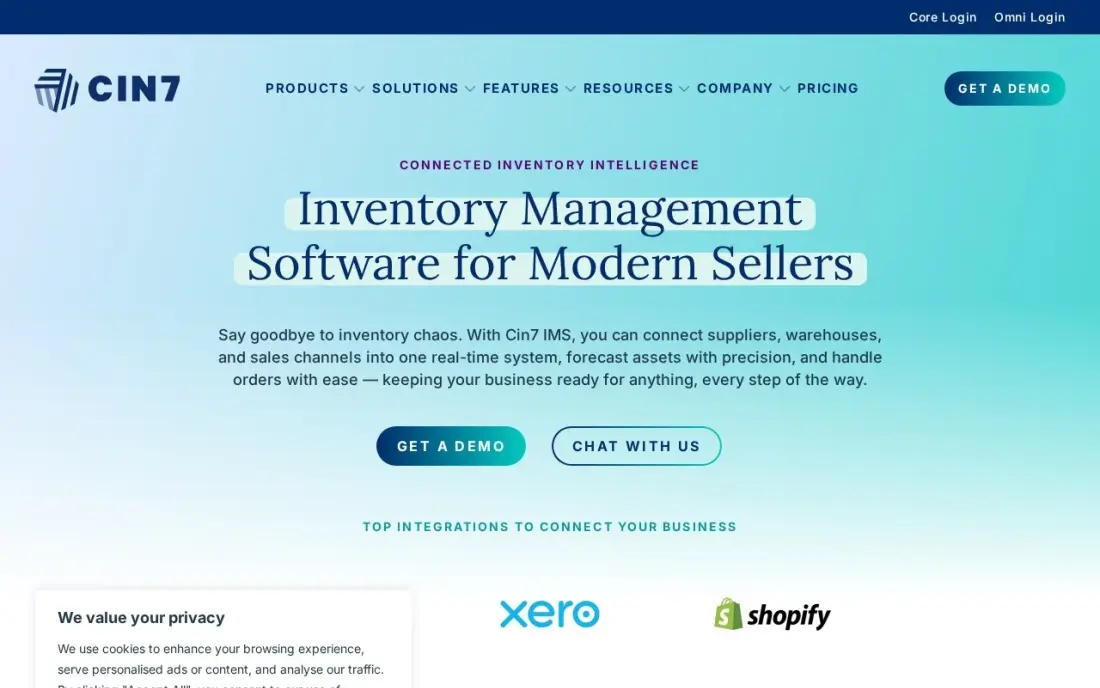
Cin7 Core suits the distributor that has started selling online too. Wholesale orders, Shopify and Amazon all draw on one stock figure, every plan includes unlimited inventory locations, and Pro adds material requirements planning for products you assemble or kit. The price list is published, which is rare at this level.
Standard costs $349 a month for 5 users, 2 integrations and 6,000 sale orders a year; Pro is $599 and Advanced $1,199. Order volume is the real meter, so a distributor with many small orders can outgrow Standard quickly, and forecasting, the B2B portal and POS are paid add-ons.
What we like
- One published price list for a serious system: Standard $349, Pro $599 and Advanced $1,199 a month
- Unlimited inventory locations on every plan, with native Shopify and Amazon stock sync
- Pro adds material requirements planning for sellers who assemble or make what they sell
Watch out for
- Standard at $349/month covers only 5 users, 2 integrations and 6,000 sale orders a year; volume above that costs more
- ForesightAI forecasting, the B2B portal and POS are paid add-ons, not part of the base plans
- Cin7 Omni, the enterprise product, is quote-only, so larger sellers lose the published-price certainty

Fishbowl Inventory
Best for: QuickBooks-based distributors that need pick, pack and ship workflows in the warehouse
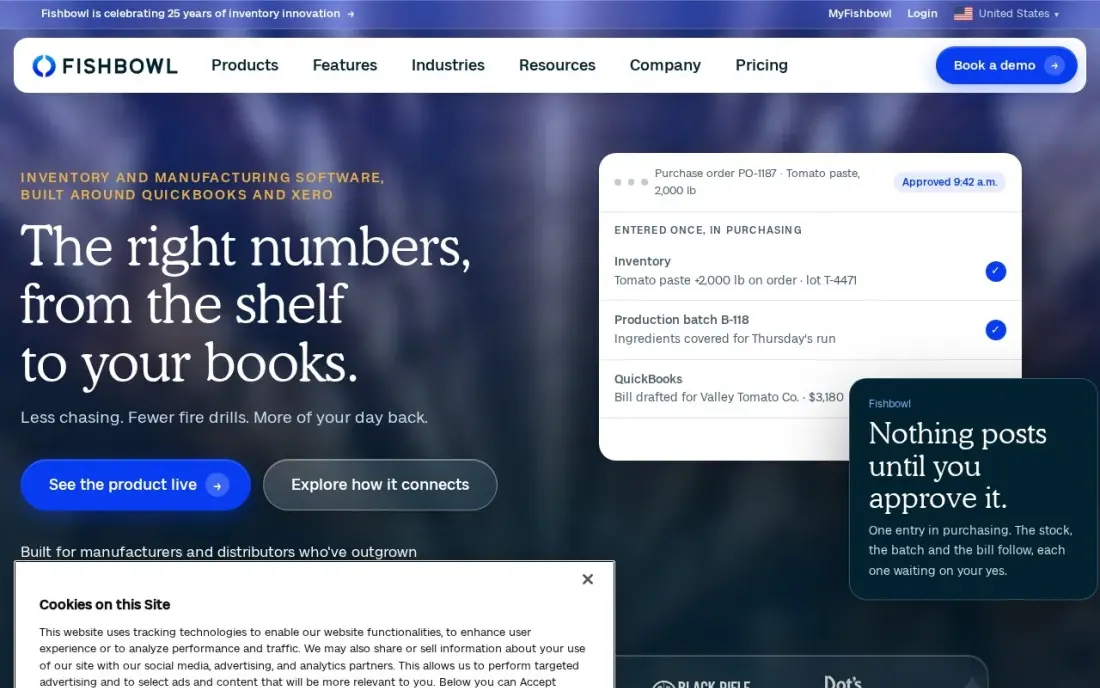
Fishbowl is the long-standing warehouse add-on for businesses whose books stay in QuickBooks. Essentials covers real-time inventory, SKU tracking, reorder points and mobile barcode scanning, with two-way QuickBooks Online sync included, and Growth at $429 a month adds pick, receive and ship workflows, automated reordering and multichannel selling.
Essentials costs $229 a month billed annually and covers only 2 users, with no monthly-billing price published. Every purchase requires an implementation package quoted separately, so ask for that number before comparing. Distributors that also assemble kits need Fishbowl Advanced Manufacturing, which starts at $675 a month.
What we like
- Essentials covers real-time inventory, SKU tracking, reorder points and mobile barcode scanning for 2 users
- Two-way QuickBooks Online sync is included, so stock and the books stay in step without a third tool
- Growth ($429/month) adds pick, receive and ship workflows, automated reordering and multichannel selling
Watch out for
- Essentials at $229/month billed annually covers only 2 users, with no monthly-billing price published
- Distributors that also assemble kits need Fishbowl Advanced Manufacturing from $675/month
- Every purchase requires an implementation package, quoted separately and not included in the subscription price

Zoho Inventory
Best for: Very small distributors and start-ups that want a free plan and per-organization pricing
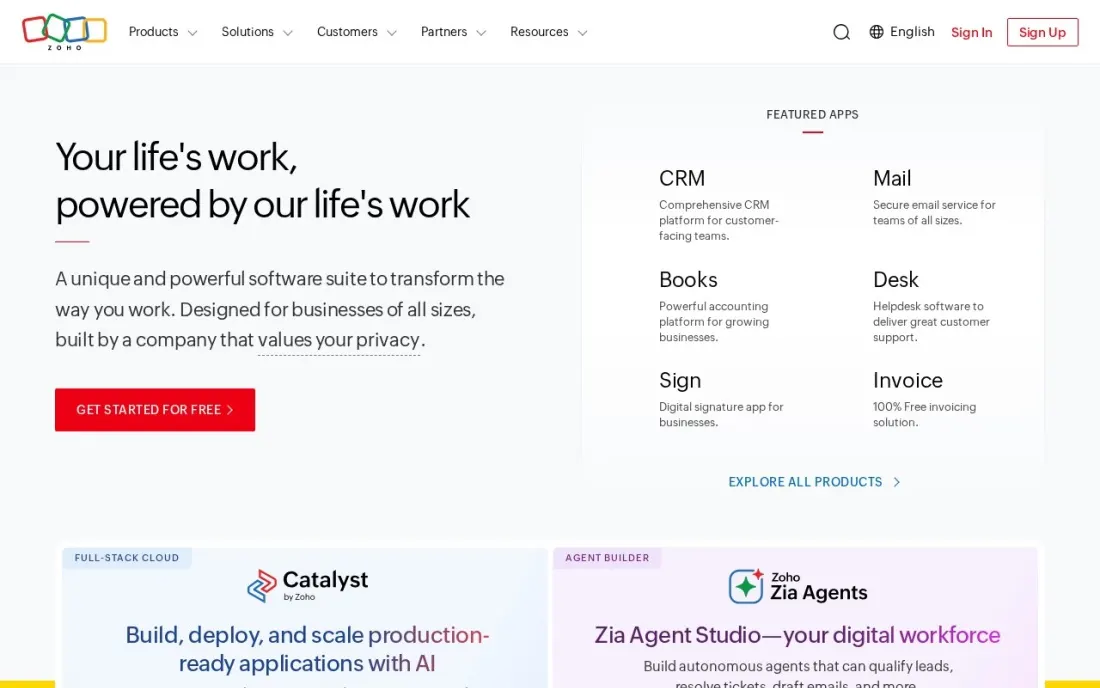
Zoho Inventory is the cheapest proper start in this list. The free plan covers 50 orders a month with item tracking, barcoding and vendor management, and paid plans charge per organization rather than per user, so adding a warehouse hand costs nothing. Standard includes composite items, dropshipping and backorders, which cover most small wholesale workflows.
Standard costs $29 a month billed annually, or $39 monthly, for 500 orders, 3 users and 2 locations. Order caps force each upgrade, and serial and batch tracking, which food and electrical distributors usually need, start on Premium at $79 a month. It pairs naturally with Zoho Books for accounting.
What we like
- Free plan covers 50 orders a month with item tracking, barcoding and vendor management
- Per-organization pricing, not per-user: adding team members costs nothing extra on any plan
- Standard at $29/month billed annually covers 500 orders, 3 users and 2 locations with composite items and dropshipping
Watch out for
- Order caps force an upgrade at every growth step: 500 orders a month on Standard, 3,000 on Premium
- Serial and batch tracking, barcode generation and stock counting sit on Premium ($79/month) or above
- No free trial of the paid plans beyond the 14-day trial; the free plan is the only way to test long-term

Oracle NetSuite
Best for: Growing multi-warehouse distributors that want ERP, CRM and ecommerce on one cloud platform
NetSuite is the cloud ERP many distributors move to when spreadsheets and add-ons stop scaling. The general ledger, inventory, purchasing, order management, CRM and ecommerce run on one database, and SuiteSuccess templates give wholesale and distribution businesses a standard starting configuration. It is the most reviewed ERP here, at 4.1 out of 5 from 5,256 G2 reviews.
Oracle publishes no price list, so every deal is negotiated. Third-party guides put small-business implementation at $25,000 to $50,000 and report renewal increases of 15 to 50 percent a year, so put a renewal cap in the contract before signing.
What we like
- True cloud ERP with CRM included in the base platform, no separate module fee
- One system for general ledger, inventory, orders, CRM and ecommerce
- SuiteSuccess templates shorten implementation for standard business models
- The most reviewed ERP here, with 5,256 G2 reviews at 4.1 out of 5
Watch out for
- Oracle publishes no price list, so every deal is negotiated and quotes vary widely
- Implementation typically runs $25,000 to $50,000 for a small business, per third-party guides
- Renewal increases of 15 to 50 percent a year are reported by third-party guides

Acumatica
Best for: Distributors with many warehouse and field users who want to avoid per-seat pricing
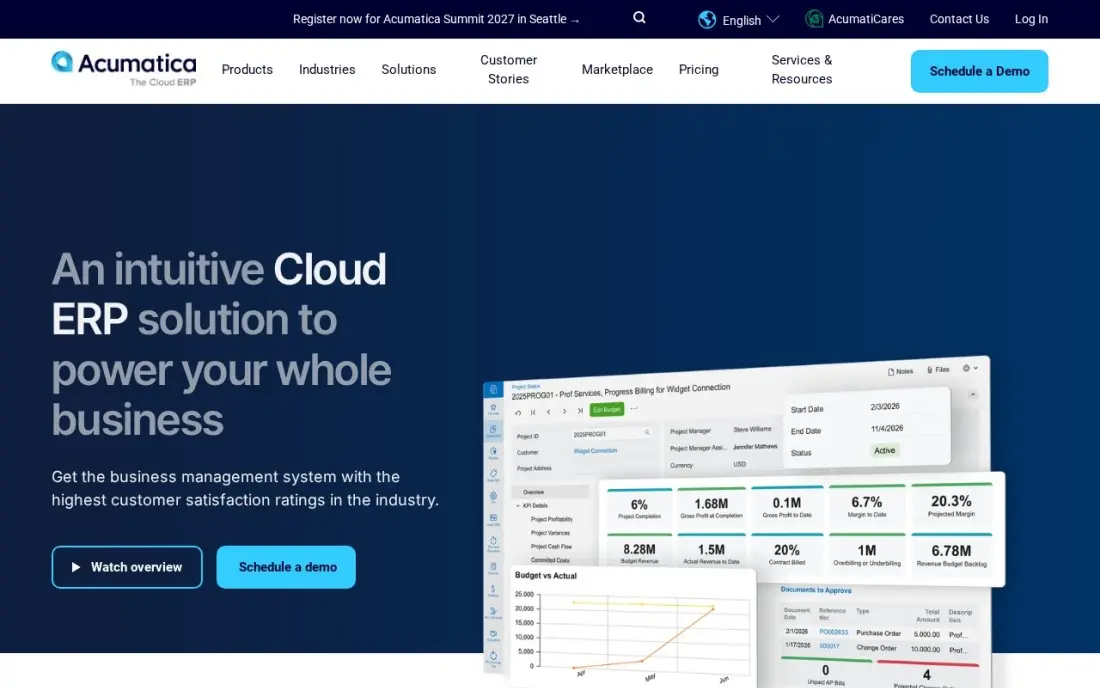
Acumatica's pricing model is the reason distributors shortlist it: the subscription follows the applications you use and your transaction volume, and mid-market and enterprise editions include unlimited users. A warehouse team, drivers and sales reps can all log in without a per-seat bill, and distribution, production and project accounting are part of the product.
There is no published list price, so every figure comes from a partner quote, and consumption pricing is harder to budget than seats. Implementation and training are quoted separately and add materially to year one. The fully open API makes connections to ecommerce and warehouse tools straightforward.
What we like
- Unlimited users: pricing follows transaction volume and computing resources, not seat count
- Genuine manufacturing depth, including production, distribution and project accounting
- Fully open API, so integrations with CRM, ecommerce and warehouse tools are straightforward
- Rated 4.4 out of 5 on G2, though the freshest indexed copy is months old, so we show no rating here
Watch out for
- Acumatica publishes no list price, so every figure comes from partners and varies by deal
- Consumption pricing is hard to budget: the bill follows transaction volume, not headcount
- Implementation and training are quoted separately and add materially to year one

SAP Business One
Best for: Established distributors of 10 to 250 staff that want inventory, purchasing and CRM in one ERP
SAP Business One is SAP's ERP for small and mid-sized firms, and distribution is one of its strongest fits: sales, purchasing, inventory, CRM and production run in one system, with a perpetual licence option for companies that would rather own than rent. It is rated 4.3 out of 5 on G2 from 542 reviews.
SAP sells it only through certified partners and publishes no US list price, so quotes and support quality depend on the partner you choose. Third-party guides report a basic five-user implementation from about $15,000. Collect at least two partner quotes for the same scope and compare three-year totals.
What we like
- Purpose-built ERP for companies with 10 to 250 employees, with CRM, sales and inventory in one system
- Strong inventory and production handling for manufacturers and distributors
- Rated 4.3 out of 5 on G2 from 542 reviews, with ease of use the most cited strength
- Perpetual licence option suits companies that prefer to own the software rather than rent it
Watch out for
- SAP publishes no US list price, so every figure comes from partner quotes that vary widely
- Sold only through certified partners, never directly, so support quality depends on the partner
- Implementation for a basic five-user deployment is reported from about $15,000 by third-party guides
The best software for distributors keeps one honest stock figure across warehouses, turns customer orders into picks and purchase orders into received stock, and hands clean numbers to accounting. We compared eight tools — five inventory systems that suit small and growing wholesalers and three ERPs for larger distributors — on stock control, purchasing, B2B ordering and real cost, and every price below comes from the vendor's own pricing page as checked in November 2026.
How to choose the best software for distributors
- Count orders, users and locations first. Each tool meters a different one: Zoho and Cin7 cap orders, inFlow and Fishbowl charge by user, and Acumatica follows transaction volume.
- Check customer-specific pricing. Wholesale lives on price lists and contract prices, so test that a customer sees their price on orders and in any portal.
- Insist on purchasing and reorder points. A distributor's margin is lost in overstock and stockouts, so automated reorder suggestions matter more than pretty dashboards.
- Confirm lot, serial and expiry tracking if your products need it. Several tools put batch tracking on a higher tier or charge for it separately.
- Price landed costs for imports. Freight and duty belong in unit cost; without them, your margin reports are wrong.
- Get the implementation quote in writing. Fishbowl, inFlow Core and every ERP here add onboarding or partner fees to the subscription.
Good stock control wins nothing if buyers cannot find you. If you want more trade accounts from search, our monthly SEO service works on that side, and our guide to the best ecommerce platform for wholesale covers B2B ordering sites in depth.
Software for distributors pricing: what you will actually pay
Take a distributor with 4 staff using the system, one warehouse and about 400 orders a month. Zoho Inventory Standard covers 3 users and 500 orders for $29 a month billed annually, so a fourth user means checking Premium at $79 a month. inFlow Lite covers only 2 team members, so this business needs Core at $299 a month plus the $499 one-time onboarding package. Fishbowl Essentials at $229 a month billed annually also stops at 2 users, so it would need Growth at $429 a month plus an implementation package.
Odoo looks different: Inventory alone is free for all 4 users, but adding Sales and Purchase moves them to Standard at $31.10 each a month for the first year, about $124 a month, then $38.90 each, about $156 a month. Cin7 Core Standard at $349 a month covers 5 users but caps sale orders at 6,000 a year, roughly the volume this business already does.
Over a year that is $348 to $948 on Zoho, about $1,493 on Odoo in the first year, $4,087 on inFlow Core including onboarding and $4,188 on Cin7 Core. The ERPs start well above that, and their implementation alone is usually five figures.
Know the difference: inventory software vs distribution ERP
Inventory software runs stock, orders and purchasing and hands invoices and costs to separate accounting software. inFlow, Fishbowl, Zoho Inventory and Cin7 Core work this way, and they suit distributors with one or two warehouses and a bookkeeper on QuickBooks or Xero. They are quick to set up and cost hundreds, not thousands, a month.
A distribution ERP puts the ledger, inventory, purchasing, CRM and often ecommerce in one database, so there is nothing to reconcile. NetSuite, Acumatica, SAP Business One and Odoo's full suite sit here. The trade is a real implementation project, partner fees and a contract, which makes sense once the cost of errors and double entry exceeds the cost of the project.
Quick comparison: tool type by need
| Buyer | Best pick | Why |
|---|---|---|
| Small wholesaler | inFlow Inventory | Unlimited orders, B2B portal add-on, $99/month (annual) |
| Free start with ERP path | Odoo Inventory | Free for unlimited users as a single app |
| Wholesale plus Shopify and Amazon | Cin7 Core | One stock figure across channels, $349/month |
| QuickBooks shops | Fishbowl Inventory | Two-way QuickBooks sync, $229/month (annual) |
| Very small or start-up | Zoho Inventory | Free for 50 orders/month, $29/month (annual) after |
| Multi-warehouse growth | Oracle NetSuite | ERP, CRM and ecommerce on one platform, custom quote |
| Many users, no seat fees | Acumatica | Consumption pricing with unlimited users, custom quote |
| Established 10–250 staff firms | SAP Business One | Full ERP via partners, perpetual licence option |
Mistakes to avoid
- Buying an ERP to fix a process problem. If nobody counts stock or follows a receiving routine, a bigger system just records the mess faster.
- Ignoring order caps. A busy season can push Zoho or Cin7 into the next tier, so price your peak month, not your average.
- Skipping a stock count before go-live. Migrated quantities that are wrong on day one destroy trust in the new system within a week.
- Leaving out landed costs. Distributors that import and ignore freight and duty overstate their margins on every order.
- Signing without a renewal cap. Quote-only vendors can raise renewal prices sharply; agree the uplift limit in the first contract.
Related comparisons: Warehouse Software Tools · Routing Software · Fulfillment Software · Route Planner Apps
How we chose
We checked each vendor's own pricing page in November 2026 and recorded the starting price as shown, including annual and monthly figures where both are listed. We ranked the tools for the most common buyer, a wholesale distributor with one to three warehouses and under 50 staff, and gave credit for published prices, purchasing tools and accounting links. NetSuite, Acumatica and SAP Business One publish no prices, so we describe their pricing models and cite third-party guides only where we say so. Ratings come from G2 pages checked on the dates shown in the sources. No vendor paid for a place in this list, and none of the links here are affiliate links.
What to do next
Pull last quarter's order count, user count and number of stock locations, then shortlist the two tools whose limits fit those numbers and run a trial with real SKUs and one week of real orders. If you want more trade buyers finding you in search while you sort the warehouse, book a free SEO review.
Frequently asked questions
What is the best software for distributors?
For small wholesalers, inFlow Inventory is the best fit at $99 a month billed annually with unlimited orders and a B2B portal add-on. Odoo is the best free start, Cin7 Core suits distributors that also sell online, and NetSuite, Acumatica or SAP Business One suit larger multi-warehouse operations.
Do distributors need an ERP?
Not at first. Inventory software plus QuickBooks or Xero covers most distributors under a few million in sales. An ERP becomes worth its implementation cost once you run several warehouses, need landed costs and lot tracking across entities, or spend hours reconciling systems.
Is there free software for distributors?
Yes. Odoo Inventory is free for unlimited users while it is the only Odoo app you use, and Zoho Inventory has a free plan for 50 orders a month with one user and one location.
How much does distribution software cost?
Published starting prices run from $29 a month billed annually on Zoho Inventory to $99 on inFlow, $229 on Fishbowl and $349 on Cin7 Core. NetSuite, Acumatica and SAP Business One are custom quotes with separate implementation projects.
What features matter most for a wholesale distributor?
Multi-location stock, purchase orders with reorder points, customer-specific pricing, barcode picking, lot or serial tracking where your products need it, landed costs for imports and a clean link to your accounting system.
Can distributor software handle B2B online ordering?
Several can. inFlow's B2B Showroom add-on costs $39 a month, Cin7 Core offers a B2B portal as a paid add-on, and NetSuite includes ecommerce on its platform. Otherwise, a B2B ecommerce platform can connect to your inventory system.
What is the best software for food and FMCG distributors?
Food and fast-moving goods need lot and expiry tracking, so check that first. Odoo Inventory includes lots and serial numbers, barcode picking and FEFO picking, which ships the earliest-expiring stock first, free for unlimited users on the One App Free plan. On Zoho Inventory, serial and batch tracking start on Premium at $79 a month. Larger multi-warehouse distributors usually move to an ERP such as NetSuite.
Sources we checked (15)
- inFlow Inventory — www.inflowinventory.com/software-pricing (checked November 10, 2026)
- inFlow Inventory reviews on G2 (checked November 10, 2026)
- Odoo Inventory — www.odoo.com (checked November 10, 2026)
- Odoo Inventory reviews on G2 (checked November 10, 2026)
- Cin7 Core — www.cin7.com/pricing (checked November 10, 2026)
- Cin7 Core reviews on G2 (checked November 10, 2026)
- Fishbowl Inventory — www.fishbowlinventory.com/pricing (checked November 10, 2026)
- Fishbowl Inventory reviews on G2 (checked November 10, 2026)
- Zoho Inventory — www.zoho.com/us/inventory/pricing (checked November 10, 2026)
- Zoho Inventory reviews on G2 (checked November 10, 2026)
- Oracle NetSuite — www.netsuite.com/portal/products/pricing.shtml (checked November 12, 2026)
- Oracle NetSuite reviews on G2 (checked November 12, 2026)
- Acumatica — www.acumatica.com/pricing (checked November 12, 2026)
- SAP Business One — www.sap.com/products/erp/business-one.html (checked November 12, 2026)
- SAP Business One reviews on G2 (checked November 12, 2026)
Make one of these tools?
We re-check this list every quarter. Send a correction, request a review, or ask about a clearly labeled sponsored spot.
Request a listingShamim
Founder of SerpAstra
A full-stack digital marketer and SEO strategist covering technical and local SEO, AI search visibility, paid ads and lead generation for local businesses, e-commerce brands and SaaS teams.
Free SEO and AI visibility audit
Find out what is holding your rankings back
Send us your site. Within 2 business days you get a written audit, an AI visibility check and a short fix list ranked by impact. Free, with no contract attached.
Request my free audit→Related buying guides
 Manufacturing, Maintenance & ERP10 Best Small Business ERP Software in 2026, ComparedCompare the 10 best small business ERP software options on price, inventory, manufacturing and free plans, with every price checked November 10, 2026.Read guide →
 Logistics, Supply Chain & Procurement10 Best Inventory Management Software Small Business in 2026, Compared10 best inventory management software small business picks compared with real 2026 prices, free plans and order limits, so you can choose by volume.Read guide →
 Ecommerce7 Best Ecommerce Platforms for Wholesale in 2026, ComparedCompare the 7 best ecommerce platforms for wholesale on price lists, trade ordering, marketplace reach and real cost, with every price checked on vendor pages.Read guide →