
7 Best Stock Apps in 2026, Compared
Compare the 7 best stock apps on commissions, options fees, account minimums, research and paid upgrades, with every fee checked on broker pages, November 2026.
 Shamim Mia, Founder, SerpAstraLast verified November 5, 20268 min read
We compare pricing pages, documentation and public reviews. We never accept payment for rankings.

Key takeaways
- Every app in this list charges $0 commission on online US stock and ETF trades, so compare options fees, account types, research and paid upgrades instead.
- Fidelity and Charles Schwab are the full-service picks: no account minimums, $0 online stock trades and $0.65 per options contract, with mutual funds and retirement accounts under one login.
- Webull charges no commission on US-listed stocks, ETFs and options, with a $0.50 per-contract fee only on certain index options, which suits active traders.
- Robinhood and Public are free to use, with optional upgrades at $5 and $20 a month; Cash App Investing is the simplest, and M1 Finance suits investors who think in target allocations.
On this page
Quick comparison
| Tool | Best for | Starting price | Free plan |
|---|---|---|---|
| Fidelity | Long-term investors who want stocks, funds and retirement accounts with one full-service broker | $0 trades | $0 account |
| Charles Schwab | Investors who want a full-service broker with no account fees and phone help when they need it | $0 trades | $0 account |
| Webull | Active traders who want commission-free stocks, ETFs and options with detailed charts | $0 trades | $0 account |
| Robinhood | Beginners who want commission-free stocks and options with an optional low-cost upgrade | Free; Gold $5/mo | Yes (free) |
| Public | Investors who want stocks plus bonds, Treasuries and AI research tools in one app | Free; Reserve $20/mo | Yes (free) |
| Cash App Investing | First-time investors who already use Cash App and want to buy a stock with a few dollars | Free | Yes (free) |
| M1 Finance | Hands-off investors who want deposits spread across a target mix of stocks automatically | $3/mo under $10k | No ($3/mo under $10k) |
Make one of these tools?
We re-check this list every quarter. Send a correction, request a review, or ask about a clearly labeled sponsored spot.
Request a listingThe best stock apps

Fidelity
Best for: Long-term investors who want stocks, funds and retirement accounts with one full-service broker
Fidelity is the stock app for people who want one broker for life. Online US stock and ETF trades cost $0 for any number of shares, there is no minimum to open an account, and there is no annual low-balance fee. Fidelity's own mutual funds also trade for $0, which makes it easy to hold a simple index-fund core next to individual stocks.
The fees that remain are clear but worth knowing. Options cost $0.65 per contract, non-Fidelity transaction-fee funds cost $49.95 per purchase, and a small number of ETFs carry a $100 service fee. For a buy-and-hold investor building retirement savings, none of these get in the way.
What we like
- $0 commission on online US stock and ETF trades, for any number of shares
- No minimums to open an account and a $0 annual low-balance fee
- Fidelity mutual funds trade for $0, alongside non-Fidelity no-transaction-fee funds
- Buy-to-close options orders of $0.65 or less carry no per-contract fee
Watch out for
- Options cost $0.65 per contract, which adds up for frequent options traders
- Non-Fidelity transaction-fee funds cost $49.95 per purchase
- A limited number of ETFs carry a $100 transaction-based service fee

Charles Schwab
Best for: Investors who want a full-service broker with no account fees and phone help when they need it
Charles Schwab matches Fidelity on the basics: $0 online commission on listed stocks and ETFs, no fee to open or maintain an account and no minimum investment for a brokerage account. Its trading platform is now powered by the Ameritrade technology Schwab acquired, so active traders get a more advanced tool than most beginner apps offer.
Options cost $0.65 per contract, unlisted ETFs carry a commission, and a broker-assisted trade adds a $25 service charge. That last option is the reason some investors choose Schwab: when a large or unusual order makes you nervous, you can still ask a person to place it.
What we like
- $0 online commission on listed stocks and ETFs
- No fees to open or maintain an account and no minimum investment for a brokerage account
- Broker-assisted trades are available for a $25 service charge when you want a person to place the order
Watch out for
- Options cost $0.65 per contract on top of the $0 base commission
- Unlisted ETFs carry a commission, unlike US exchange-listed ones
- Broker-assisted orders add a $25 service charge each

Webull
Best for: Active traders who want commission-free stocks, ETFs and options with detailed charts
Webull is built for people who watch the market during the day. It charges no commission on stocks, ETFs and options listed on US exchanges, which makes it cheaper than Fidelity or Schwab for anyone who trades equity options often, and it has no deposit minimum. The app leans on detailed charts, screeners and market data rather than hand-holding.
Certain index options carry a $0.50 per-contract fee, and regulatory fees on sells are passed through as the pricing page sets out. A Premium membership exists, but its price is not on the pricing page, so check it in the app before upgrading. Long-term investors will find the screens busier than they need.
What we like
- No commission on stocks, ETFs and options listed on US exchanges
- No deposit minimums to open an account
- Regulatory fees on sells are itemised on the pricing page, so costs are easy to check
Watch out for
- Certain index option trades carry a $0.50 per-contract fee
- The pricing page does not list the Webull Premium membership price
- Charts and data-heavy screens are more than a long-term investor needs

Robinhood
Best for: Beginners who want commission-free stocks and options with an optional low-cost upgrade
Robinhood made the free stock app mainstream and still offers one of the broadest free tiers: commission-free stocks, ETFs and options, fractional shares, recurring investments, crypto and traditional and Roth IRAs. The free tier pays a 1% match on IRA contributions, and Gold at $5 a month or $50 a year lifts it to 3%.
Gold also adds yield on eligible uninvested cash plus margin and extended-hours trading, perks that matter more as you trade more. Support is in-app only, and past outages have frustrated traders at busy moments. For a beginner who wants stocks and options in a clean app, the free tier does the job.
What we like
- Commission-free stocks, ETFs and options on the free tier, with fractional shares
- Gold at $5/month adds a 3% IRA match (vs 1% free) and 3.60% APY on eligible cash
- Recurring investments automate a weekly or monthly buy without thinking about it
- One of the widest free offerings: stocks, ETFs, options, crypto and retirement accounts
Watch out for
- No spare-change Round-Ups and no managed portfolio option on the free tier
- Gold's margin and extended-hours perks only matter once you trade actively
- Customer support is in-app only, and past outages have frustrated traders at busy moments

Public
Best for: Investors who want stocks plus bonds, Treasuries and AI research tools in one app
Public is the stock app with the widest free shelf: commission-free stocks and ETFs in regular and extended hours, plus options, corporate bonds, Treasuries and crypto. AI Agents, earnings summaries and a research assistant are built in, and Investment Plans automate recurring buys.
The extras sit behind Public Reserve at $20 a month or $200 a year, including options rebates and the lowest margin rates. The social feed and AI tools are useful but can encourage trading more often than a long-term plan needs. Choose Public when you want research and more asset types than a basic app offers.
What we like
- Commission-free stocks and ETFs in regular and extended hours, plus options, bonds and crypto
- AI Agents, earnings summaries and research assistance are built into the app
- High-Yield Cash Account pays 3.75% APY and margin starts at a 5.15% base rate
- Investment Plans automate recurring buys, and direct indexing starts at $1,000
Watch out for
- No spare-change Round-Ups and no managed portfolio for hands-off beginners
- The interesting extras — options rebates, IRA match funding — sit behind Reserve at $20/month
- Social feed and AI tools can nudge toward trading more often than a long-term plan needs

Cash App Investing
Best for: First-time investors who already use Cash App and want to buy a stock with a few dollars
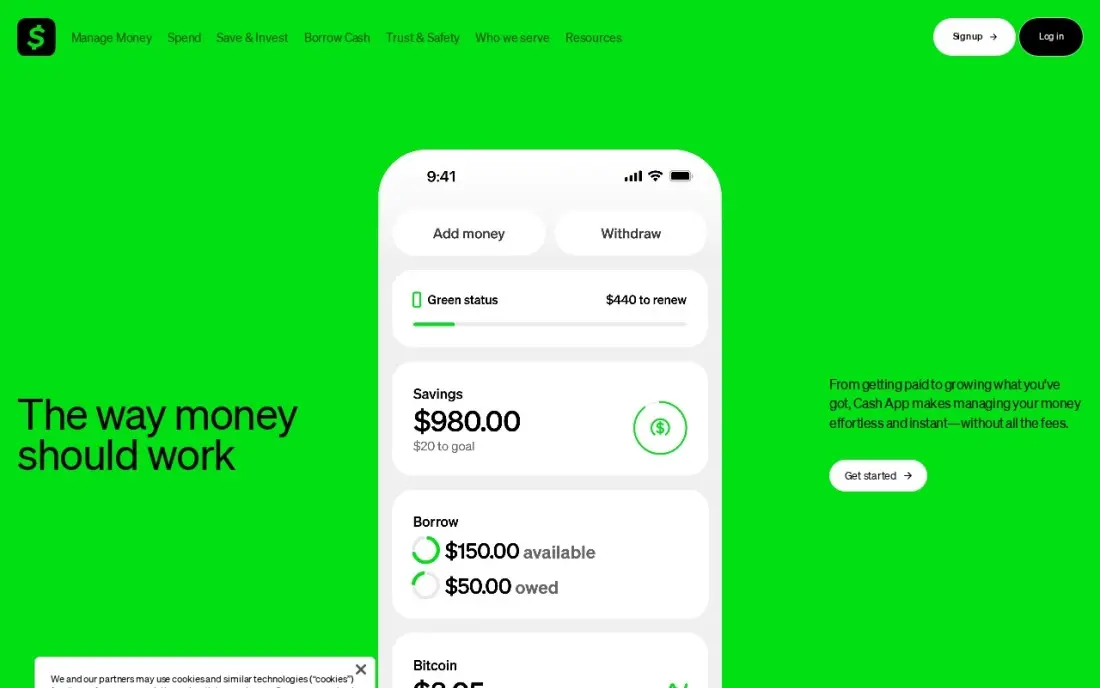
Cash App Investing is the simplest stock app here. If you already use Cash App to send money, investing is one tab away: no commission, no monthly fee and no account minimum on stocks and ETFs, with fractional shares from $1 and Round Ups that turn card purchases into stock.
The limits are firm. It offers stocks and ETFs only, with no options, mutual funds or retirement accounts, no research tools, and fractional shares cannot be transferred to another broker, so leaving means selling. It is a good place to buy a first share, not a home for serious savings.
What we like
- Truly free: no commissions, no monthly fee and no account minimum on stocks and ETFs
- Start with $1 through fractional shares, and Round Ups turn card purchases into stock
- Investing sits inside the app you already use for payments, direct deposit and tax filing
- No commission fees on stock and ETF trades, with only small regulatory fees on sales
Watch out for
- Stocks and ETFs only — no options, bonds, mutual funds or retirement accounts
- No research tools or portfolio guidance; you pick every stock yourself
- Fractional shares cannot transfer to another brokerage, so switching brokers means selling

M1 Finance
Best for: Hands-off investors who want deposits spread across a target mix of stocks automatically

M1 Finance is a stock app for people who would rather set a plan than pick trades. You build a Pie, a target mix of stocks and ETFs, and every deposit flows into the slices that are underweight. Trading and management cost $0 on self-directed accounts, and fractional shares start at $1 per slice.
A $3 monthly platform fee applies while total assets stay under $10,000, which is $36 a year. Brokerage accounts need $100 to start and IRAs need $500, and smaller accounts get one trade window a day rather than instant orders. That suits a patient investor and frustrates anyone who wants to time a trade.
What we like
- Pies let you set a target allocation once, then auto-invest and rebalance with one tap
- Zero commissions and zero management fees on self-directed brokerage accounts
- Fractional shares from $1 per slice, so every deposit is fully invested
- High-Yield Cash Account for uninvested cash, plus margin borrowing from $2,000 invested
Watch out for
- A $3 monthly platform fee applies below $10,000 in assets — $36 a year on a small account
- Brokerage accounts need a $100 minimum to start, and IRAs need $500
- One scheduled trade window a day for smaller accounts, so no instant buying at a price you pick
The best stock app lets you buy shares cheaply, hold them in the right type of account and understand what you own, without fees you did not expect. We compared seven apps across the three kinds buyers usually weigh up — full-service brokers, trading-focused apps and simple starter apps — on commissions, options fees, account minimums, research and paid upgrades. Every fee below comes from the broker's own pricing page or from our checked database, reviewed in November 2026. This guide is general information, not investment advice.
How to choose the best stock app
- Look past the $0 commission. Every app here charges nothing for online US stock and ETF trades, so the differences are in options fees, account fees and upgrades.
- Check the account types. If you want an IRA, rule out Cash App Investing; Fidelity, Schwab, Robinhood and M1 all offer retirement accounts.
- Match the app to how often you trade. A buy-and-hold investor needs a reliable broker and good funds; an options trader needs low per-contract fees and fast charts.
- Count the paid upgrades. Robinhood Gold at $5 a month and Public Reserve at $20 a month are optional, but their best perks sit behind the paywall.
- Read the minimums. Most apps have none, but M1 Finance needs $100 for a brokerage account and charges $3 a month under $10,000.
- Think about leaving. Fractional shares on some apps cannot transfer to another broker, so switching later can mean selling and paying tax.
If you are investing only small amounts each week, our guide to the best micro-investing apps covers round-up and automatic investing apps such as Acorns and Stash, which sit one step before a full stock app.
Stock app pricing: what you will actually pay
Take an investor who buys $500 of stocks and ETFs each month and trades 10 options contracts a month. On Fidelity or Schwab the stock buys cost $0 and the options cost 10 × $0.65 = $6.50 a month, or $78 a year. On Webull, standard equity options carry no commission, so the same activity costs $0 before regulatory fees; index options would add $0.50 per contract.
Robinhood is $0 on the free tier, and Gold costs $5 a month or $50 a year if you want the 3% IRA match and margin access. Public is free, with Reserve at $20 a month or $200 a year for options rebates and lower margin rates. Cash App Investing costs $0 but cannot trade options at all.
M1 Finance works differently: $0 per trade, but a $3 monthly platform fee while your assets stay under $10,000. On a $2,000 account that is $36 a year, or 1.8% of the balance, which is more than most index funds charge. Above $10,000 the fee disappears.
Know the difference: full-service broker vs trading app
A full-service broker such as Fidelity or Schwab is built for the long haul. You get taxable and retirement accounts, mutual funds and bonds alongside stocks, research reports, cash management and customer service you can phone. The apps are less flashy, but nothing about your finances outgrows them.
A trading app such as Webull, Robinhood or Public is built around the act of trading. Charts, options chains, extended-hours trading and social or AI features take centre stage, and the free tier is generous because the business earns from active customers and paid upgrades. Many investors hold both: a full-service account for retirement and a trading app for a smaller pot they manage more actively.
Quick comparison: tool type by need
| Buyer | Best pick | Why |
|---|---|---|
| Long-term investors | Fidelity | $0 stock trades, $0 Fidelity funds, no minimum |
| Investors who want phone help | Charles Schwab | $0 account fees, broker-assisted trades for $25 |
| Active options traders | Webull | No commission on US-listed options |
| Beginners | Robinhood | Free stocks and options, Gold $5/month optional |
| Bonds, Treasuries and research | Public | Wide free shelf, Reserve $20/month optional |
| Cash App users | Cash App Investing | Free stocks from $1, no minimum |
| Hands-off allocators | M1 Finance | Auto-invest Pies, $3/month under $10,000 |
Mistakes to avoid
- Choosing on sign-up bonuses. A free share is worth a few dollars; options fees, account types and support matter for years.
- Trading more because the app makes it easy. Notifications and social feeds encourage frequent trading, which rarely helps long-term returns.
- Ignoring retirement accounts. Investing in a taxable account when an IRA was available can cost more in tax than any app fee.
- Paying for an upgrade you do not use. Robinhood Gold and Public Reserve only pay off if you use their specific perks every month.
- Forgetting about transfers. Check whether fractional shares can move to another broker before building a large position in them.
Related comparisons: Options Trading Platforms · Crypto Apps · Software for Financial Advisors · Money Tracking Apps
How we chose
We checked Fidelity's, Schwab's and Webull's own pricing pages in November 2026 and recorded fees exactly as shown, and we used our verified database entries for Robinhood, Public, Cash App Investing and M1 Finance, checked earlier the same month. We ranked the apps for the most common buyer, a US investor starting or consolidating a self-directed account, and weighed commissions, options fees, account types, minimums and upgrade costs. Rates on cash and margin change often, so confirm them in the app before you rely on them. This is general information, not investment advice. No vendor paid for a place in this list, and none of the links here are affiliate links.
What to do next
Decide whether you need a retirement account, then open one free account at a full-service broker and, if you trade options, compare its per-contract fee with Webull's. If you run a financial business and want investors to find it in search, book a free SEO consultation.
Frequently asked questions
What is the best stock app?
Fidelity is the best all-round stock app for long-term investors, with $0 online stock and ETF trades, no account minimum and $0 Fidelity mutual funds. Webull is the pick for active options traders because it charges no commission on US-listed options, and Robinhood is the easiest free app for beginners.
Are stock apps really free?
For online US stock and ETF trades, yes: every app here charges $0 commission. Costs show up elsewhere, such as $0.65 per options contract at Fidelity and Schwab, M1 Finance's $3 monthly fee under $10,000, optional upgrades like Robinhood Gold at $5 a month, and small regulatory fees on sales.
Which stock app is best for beginners?
Robinhood and Cash App Investing are the simplest to start with, and both let you buy fractional shares. Beginners who want a broker they will not outgrow should look at Fidelity or Schwab, which add retirement accounts, mutual funds and customer service.
Which stock app has the lowest options fees?
Webull charges no commission on options listed on US exchanges, with a $0.50 per-contract fee only on certain index options. Robinhood also offers commission-free options. Fidelity and Schwab charge $0.65 per contract.
Do I need a minimum to open a stock app account?
Mostly not. Fidelity, Schwab, Webull and Cash App Investing have no account minimum. M1 Finance needs $100 to open a brokerage account and $500 for an IRA.
Is my money safe in a stock app?
US brokers are regulated, and most are SIPC members, which protects customer securities if the broker fails, but not against market losses. Check each app's disclosures for its SIPC membership and any cash sweep protection before you deposit.
Sources we checked (7)
- Fidelity — www.fidelity.com/trading/commissions-margin-rates (checked November 16, 2026)
- Charles Schwab — www.schwab.com/pricing (checked November 16, 2026)
- Webull — www.webull.com/pricing (checked November 16, 2026)
- Robinhood — robinhood.com/us/en/support/articles/gold-overview (checked November 5, 2026)
- Public — public.com/disclosures/fee-schedule (checked November 5, 2026)
- Cash App Investing — cash.app (checked November 5, 2026)
- M1 Finance — www.m1.com (checked November 5, 2026)
Make one of these tools?
We re-check this list every quarter. Send a correction, request a review, or ask about a clearly labeled sponsored spot.
Request a listingShamim
Founder of SerpAstra
A full-stack digital marketer and SEO strategist covering technical and local SEO, AI search visibility, paid ads and lead generation for local businesses, e-commerce brands and SaaS teams.
Free SEO and AI visibility audit
Find out what is holding your rankings back
Send us your site. Within 2 business days you get a written audit, an AI visibility check and a short fix list ranked by impact. Free, with no contract attached.
Request my free audit→Related buying guides
 Personal Finance & InvestingBest Micro Investing Apps (2026): 7 Apps Worth DownloadingCompare the 7 best micro investing apps on price, minimums and automation, with every price checked November 5, 2026 — from free trading to $12 a month.Read guide →
 Real Estate & Property ManagementBest Real Estate Apps for Investors (2026): 10 Apps Worth DownloadingCompare the 10 best real estate apps for investors on price, free plans, deal analysis and rent collection, with every price checked November 8, 2026.Read guide →
 Tax Software12 Best Tax Software Reviews in 2026: Pricing, Features and Pros & ConsCompare the 12 best tax software reviews on price, free filing, state fees and expert help, with every price checked November 4, 2026 before you file.Read guide →