
9 Best Web Scraping Tools for E-commerce in 2026, Compared
Compare the 9 best web scraping tools for e-commerce for competitor prices, product data and reviews, from Octoparse to Bright Data, with prices checked.
 Shamim Mia, Founder, SerpAstraLast verified November 7, 20269 min read
We compare pricing pages, documentation and public reviews. We never accept payment for rankings.
Key takeaways
- Octoparse is the best web scraping tool for e-commerce teams without developers: point-and-click scrapers, preset templates and scheduled cloud runs, with Standard at $69 a month billed annually.
- Apify is the most flexible pick, with ready-made marketplace scrapers and a free plan that includes $5 of usage a month; Starter costs $19 a month.
- For large catalogues and protected marketplaces, Bright Data and Oxylabs bring the proxy networks that keep price monitoring running when lighter tools get blocked.
- Developer teams should compare credit costs per marketplace page: ScraperAPI charges 5 credits for an Amazon request, and ScrapingBee and Zyte bill only successful requests.
On this page
Quick comparison
| Tool | Best for | Starting price | Free plan |
|---|---|---|---|
| Octoparse | E-commerce teams without developers who want scheduled competitor price scraping | $83/mo | Yes (free plan) |
| Apify | Stores that want ready-made marketplace scrapers plus the option to run custom code | $19/mo | Yes (free plan) |
| Bright Data | Large retailers monitoring prices on protected marketplaces at high volume | From $1.50/1K records | Yes (free tier) |
| Oxylabs | Enterprise retail teams that need compliance sign-off and country-level price data | $30/mo | No (trial) |
| ScrapingBee | Developers who want dedicated Amazon and Walmart endpoints with clear credit costs | $19/mo | No (1,000-credit trial) |
| ScraperAPI | Developers who want one simple endpoint for product pages with no proxy management | $49/mo | No (7-day trial) |
| Zyte | Developers running Scrapy crawlers on retail sites who want pay-per-success billing | From $0.13/1K responses | No ($5 credit trial) |
| WebScraper.io | Small store owners who want a free browser extension for one-off product exports | Free; Cloud $50/mo | Yes (free extension) |
| Diffbot | Teams that want product data extracted by AI from any store without writing selectors | $299/mo | Yes (free plan) |
Make one of these tools?
We re-check this list every quarter. Send a correction, request a review, or ask about a clearly labeled sponsored spot.
Request a listingThe best web scraping tools for e-commerce

Octoparse
Best for: E-commerce teams without developers who want scheduled competitor price scraping
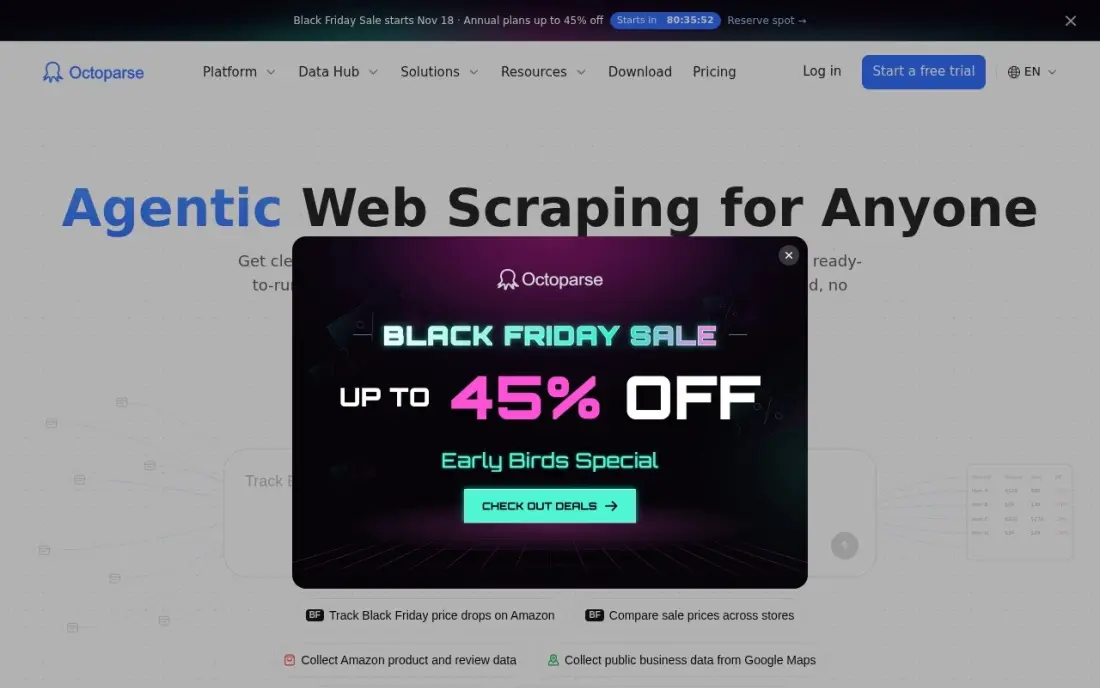
Octoparse lets a merchandiser build a scraper by clicking product names, prices, stock status and ratings on a category page, then add pagination and run it on a schedule in the cloud. More than 500 preset templates cover common jobs, and AI-assisted field detection speeds up new stores. The free plan covers 10 tasks with local extraction, enough to test a competitor price sheet.
Standard costs $83 a month billed monthly, or $69 billed annually, and adds scheduling, IP rotation, CAPTCHA solving and the Data Export API. Residential proxy bandwidth and CAPTCHA solving bill separately, and Trustpilot reviews mention billing and cancellation complaints, so read the plan table before you pay.
What we like
- Point-and-click workflow builder with more than 500 preset scraping templates
- Free plan covers 10 tasks with local extraction, so you can learn the tool at $0
- Standard adds scheduling, IP rotation, CAPTCHA solving and the Data Export API
- AI-assisted task creation and automatic field detection speed up new scrapers
Watch out for
- The $69 headline is the annual figure; month-to-month Standard is $83
- Residential proxy bandwidth and CAPTCHA solving bill separately on top of the plan
- Trustpilot reviews are polarized at 4.1/5, with billing and cancellation complaints prominent

Apify
Best for: Stores that want ready-made marketplace scrapers plus the option to run custom code
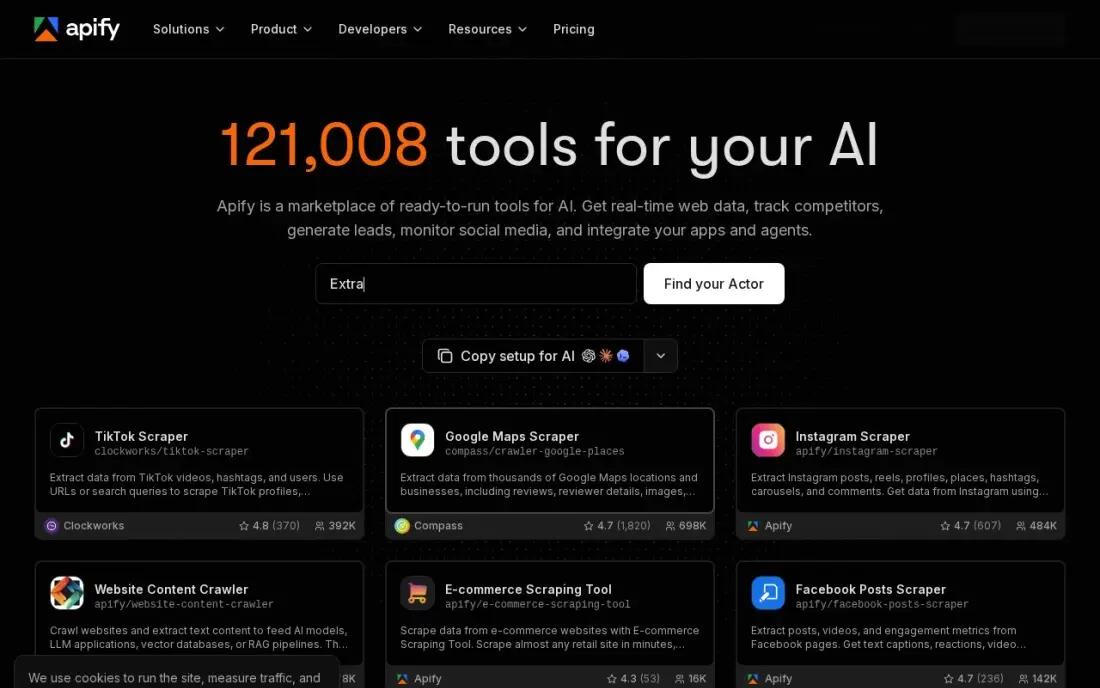
Apify's marketplace holds thousands of ready-made scrapers, called Actors, so common e-commerce jobs such as pulling product listings, prices or reviews often need no building at all. A developer can also write a custom Actor in Python or JavaScript and run it on the same platform, which suits stores that start simple and grow into custom monitoring.
The free plan includes $5 of platform usage a month, and Starter costs $19 a month, or $17 billed annually, returning $19 as prepaid usage. The meter is the risk: compute units, proxies and storage all bill by use, so set spending limits before running a full-catalogue job.
What we like
- Free plan includes $5 of platform usage every month, with no card required
- Starter is $19 a month and includes $19 of prepaid usage, with 10% off billed annually
- Marketplace of thousands of ready-made Actors for Google Maps, Instagram, TikTok and more
- Pay-as-you-go overage beyond the included credit, so light months stay cheap
Watch out for
- Usage billing can spike if an Actor is misconfigured or a target triggers heavy proxy use
- Starter buys the same $0.20 compute-unit rate as the free plan, so the $19 mainly buys overage rights, concurrency and a Store discount
- Building your own Actors has a learning curve for non-developers

Bright Data
Best for: Large retailers monitoring prices on protected marketplaces at high volume
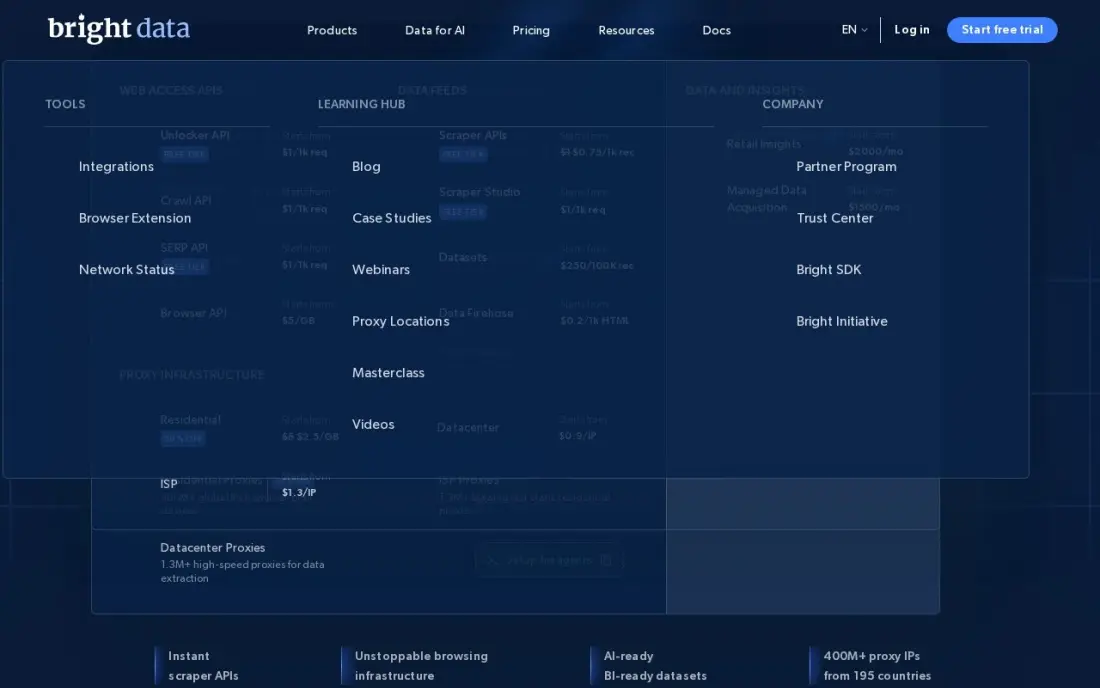
Bright Data is built for e-commerce data at scale. It has one of the largest residential proxy networks, built-in anti-bot bypass and more than 1,000 pre-built scrapers that return structured records, which matters when you track thousands of products on marketplaces that block ordinary scrapers. You pay only for delivered records, not blocked attempts.
The Web Scraper API costs $1.50 per 1,000 records pay as you go, with a free tier of 5,000 records a month, and the Scale plan starts at $499 a month. Identity checks can take up to three business days, and there is no flat plan, so a large daily price sweep shows up directly on the bill.
What we like
- One of the largest residential proxy networks, with built-in anti-bot bypass
- More than 1,000 pre-built scrapers return structured data without writing selectors
- You pay only for successful requests or delivered records, not for blocked attempts
- Free tier covers 5,000 records or requests a month with no card required
Watch out for
- No flat monthly plan for the scraping APIs, so costs scale directly with record volume
- Identity (KYC) approval can take up to three business days before you can start
- Proxy bandwidth is premium-priced next to budget providers

Oxylabs
Best for: Enterprise retail teams that need compliance sign-off and country-level price data
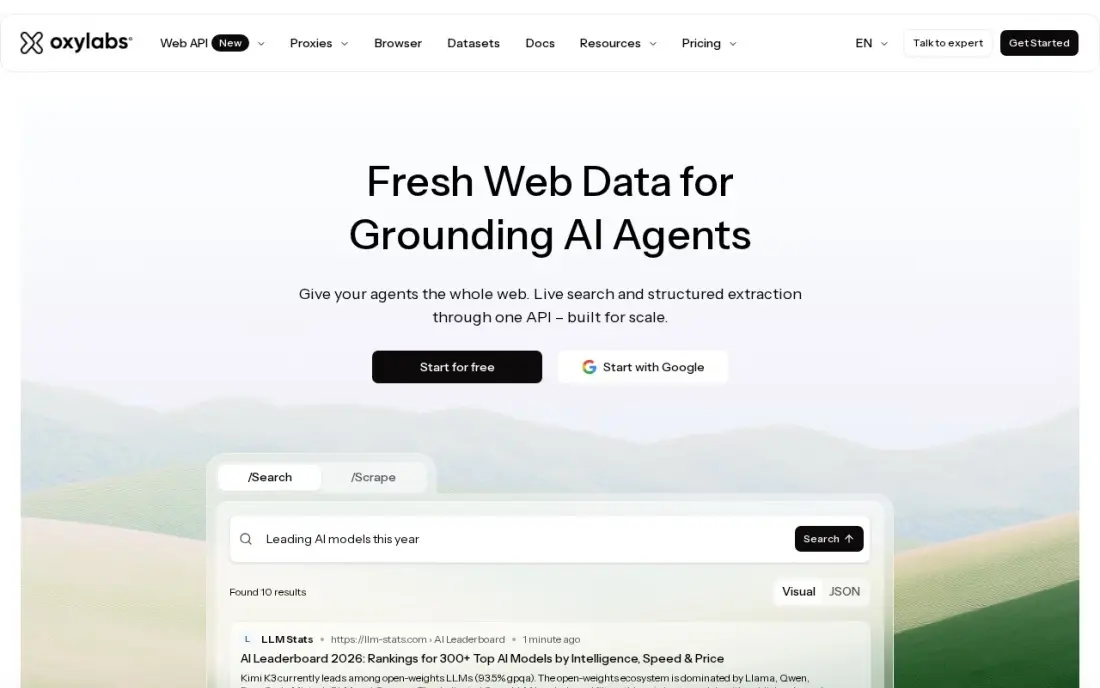
Oxylabs suits retailers that check prices and availability across many countries. Its residential network covers more than 175 million IPs in 195 countries with coordinate-level targeting, so you can see the price a shopper in a given city sees, and its compliance documentation is the kind legal teams accept.
Since October 2026 a single Starter subscription at $30 a month covers proxies, the Web API and unblocking, and Web API scraping starts from $0.50 per 1,000 results, with rendering and AI parsing priced higher. There is no visual builder, so it needs a developer, and premium per-gigabyte rates make small jobs relatively expensive.
What we like
- More than 175 million residential IPs across 195 countries, with coordinate-level targeting
- One $30 Starter subscription now covers proxies, Web API and unblocking together
- Web API scraping starts from $0.50 per 1,000 results, with AI parsing as an add-on
- Strong compliance posture that enterprise legal and procurement teams accept
Watch out for
- Pricing changed in October 2026 to one unified subscription, so older $49 Web Scraper API figures are stale
- Premium per-gigabyte rates make small jobs expensive next to credit-based APIs
- API-first design with no visual scraper builder for non-developers

ScrapingBee
Best for: Developers who want dedicated Amazon and Walmart endpoints with clear credit costs
ScrapingBee offers dedicated endpoints for Amazon, Walmart and Google Search, which saves a developer from writing and maintaining selectors for the most common e-commerce sources. Its credit table is published — 1 credit for a plain request, 5 with rendering, up to 75 for stealth — and auto mode tries cheaper setups first and bills only the one that worked.
Hobby costs $19 a month for 75,000 credits, prices exclude VAT, and the trial gives 1,000 credits with no card. JavaScript rendering is on by default at 5 credits, so turn it off for pages that do not need it. You are charged only for successful requests.
What we like
- Published credit table: 1 credit plain, 5 with rendering, 10 or 25 premium, 75 stealth
- Auto mode tries progressively heavier setups and bills only the cheapest one that worked
- You are charged only for successful requests, not for failed attempts
- Dedicated endpoints for Google Search, Amazon, Walmart, YouTube and more
Watch out for
- JavaScript rendering is on by default at 5 credits, and stealth proxies cost 75, so Hobby's 75,000 credits can mean 1,000 stealth requests
- No monthly free tier, only a one-off 1,000-credit trial with no card
- No visual builder, so non-developers need another tool for point-and-click work

ScraperAPI
Best for: Developers who want one simple endpoint for product pages with no proxy management
ScraperAPI keeps scraping simple: send a product URL to one endpoint and get the page back, with proxy rotation, rendering and geotargeting handled for you. Output comes as HTML, Markdown or text, and the 7-day trial includes 5,000 credits with no card, which is enough to test a competitor's product pages.
Hobby costs $49 a month, or $44.10 billed annually, for 100,000 credits — but credits per request vary by target. An Amazon request costs 5 credits and rendering adds 10, so 100,000 credits are not 100,000 product pages. Set a spending cap on day one, because overages auto-upgrade you to the next tier.
What we like
- A single endpoint handles proxy rotation, headless rendering and geotargeting automatically
- Hobby is $49 a month for 100,000 credits with 20 concurrent threads
- 7-day trial with 5,000 credits and no card, plus a 7-day refund window
- 10% off with annual billing, and structured output in HTML, Markdown or text
Watch out for
- Credits per request vary by target, so 100,000 credits are not 100,000 pages: Amazon costs 5, Google 25, LinkedIn 30
- JavaScript rendering adds 10 credits per request, which makes rendered pages cost $4.90 per 1,000 on Hobby
- Auto-upgrade billing bumps you to the next tier unless you set a monthly spending cap

Zyte
Best for: Developers running Scrapy crawlers on retail sites who want pay-per-success billing
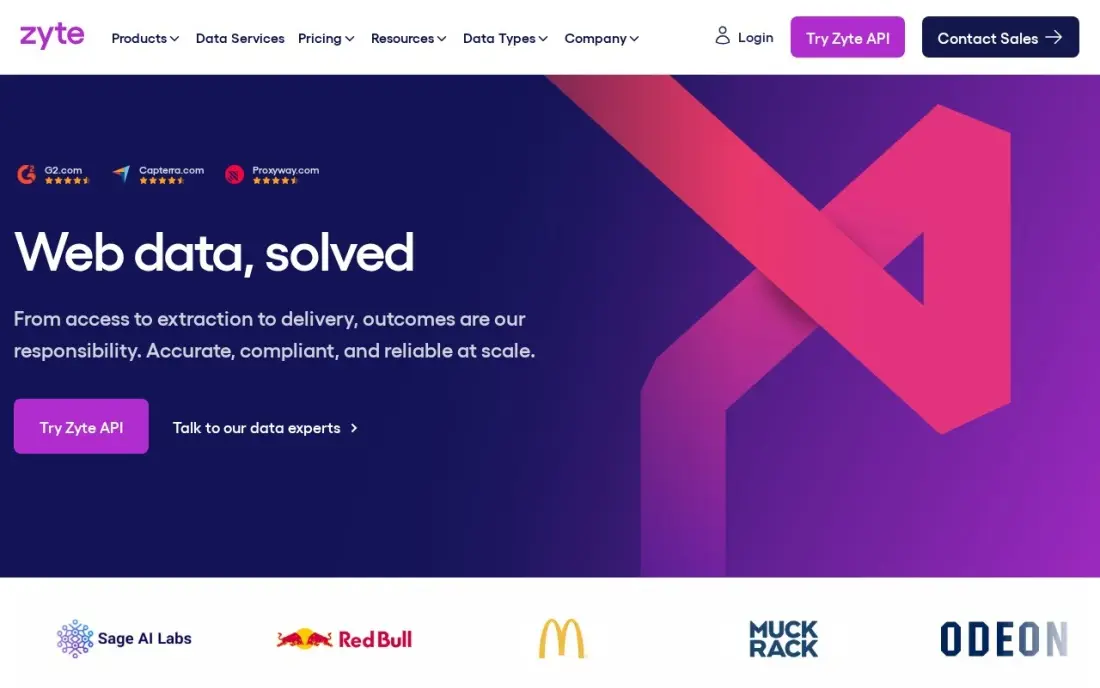
Zyte, the company behind the open-source Scrapy framework, sells one API that picks the right access method for each site — plain requests, residential IPs or a headless browser — and bills only successful responses. For an e-commerce team already running Scrapy spiders on competitor catalogues, Scrapy Cloud hosting keeps the whole job in one place.
Prices start from $0.13 per 1,000 successful HTTP responses on easy sites, but Zyte assigns each site a difficulty tier, and browser rendering on the hardest tier costs up to $16.08 per 1,000 pay as you go. Monthly commitments from $100 cut rates by up to half. New accounts get $5 of credit for 30 days.
What we like
- You pay only for successful responses, which is the fairest billing model in this list
- One API picks the access method each site needs: plain requests, residential IPs or a headless browser
- Monthly commitments of $100, $200 or $500 cut the per-request rates by up to half
- Built by the team behind Scrapy, with Scrapy Cloud hosting for your own crawlers
Watch out for
- No monthly plan: your cost depends on the difficulty tier Zyte assigns each site
- Browser rendering on hard sites runs up to $16.08 per 1,000 responses pay as you go
- No free plan, only $5 of credit for the first 30 days

WebScraper.io
Best for: Small store owners who want a free browser extension for one-off product exports
WebScraper.io is the free way to start. The Chrome and Firefox extension lets you click product names, prices and links on a category page, follow pagination and export the result to CSV or XLSX, with no account and no cap on local runs. For a small store checking a few competitors once a month, that may be all that is needed.
The extension stops when you close the browser and has no scheduling. Web Scraper Cloud adds scheduling, an API, proxies and stored results from $50 a month billed annually, but covers only 5,000 URL credits a month, which pagination on a big catalogue uses quickly. Selectors break when a site changes layout.
What we like
- Free Chrome and Firefox extension with unlimited local scraping and no signup
- Visual sitemap builder lets you define extraction by clicking, with no code
- Cloud adds scheduling, an API, proxies and stored results from $50 a month
- Exports to CSV, XLSX and JSON, plus Dropbox, Google Sheets and Amazon S3
Watch out for
- The extension stops when you close the browser, and scheduling needs Cloud
- Cloud Project covers only 5,000 URL credits a month, which pagination eats quickly
- No AI adaptation: selectors break when a site changes its layout, so you fix them by hand

Diffbot
Best for: Teams that want product data extracted by AI from any store without writing selectors
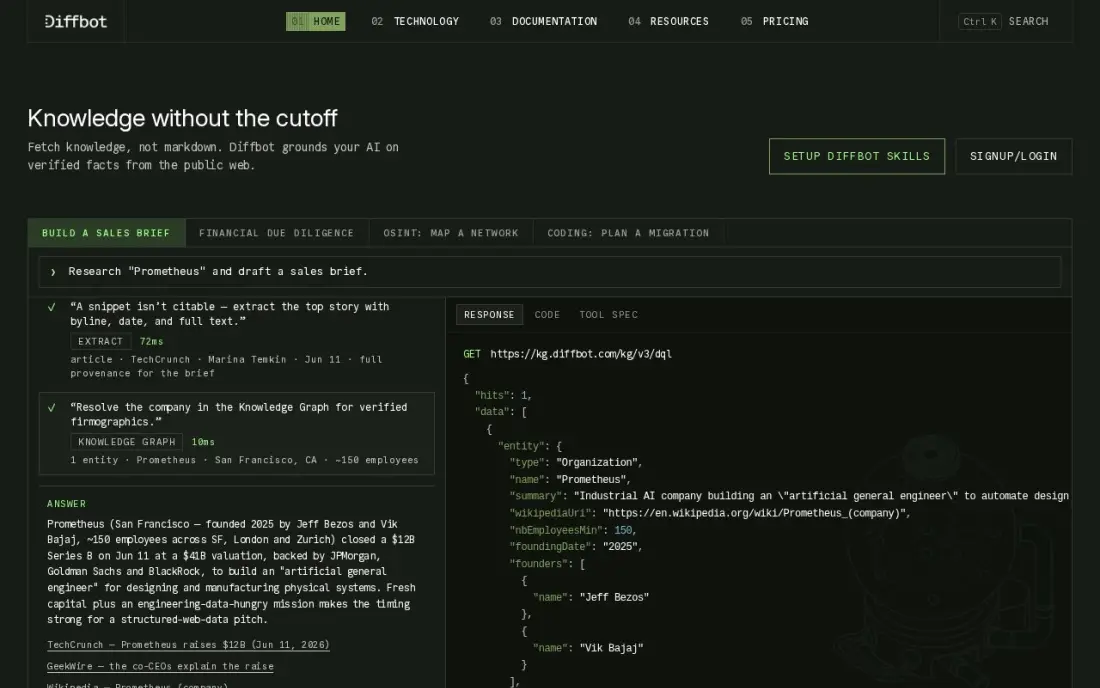
Diffbot's AI reads a page and returns structured data directly, so a product page from any store comes back as name, price, images and specifications without selectors to write or fix when the layout changes. That suits teams pulling product data from hundreds of small retailers, where maintaining a scraper per site is not realistic.
The free plan includes 10,000 credits a month, and Startup costs $299 a month for 250,000 credits. Extracting a page costs 1 credit, while Knowledge Graph entity exports cost 25 or more, so the plan covers far more page extractions than enrichment queries. The G2 score of 4.9 rests on only 29 reviews.
What we like
- AI reads any page and returns structured data directly, with no selectors to maintain
- Knowledge Graph holds more than 10 billion entities and 1 trillion facts, per Diffbot
- Free plan includes 10,000 credits a month across all four APIs, with no card
- Crawlbot spiders whole sites for links and pages at 0 credits per crawl call
Watch out for
- At $299 a month, the entry plan excludes small teams and casual users
- Knowledge Graph queries cost 25 to 100 credits each, so 250,000 credits buy only 10,000 entity exports
- Only 29 reviews on G2, so the 4.9/5 score rests on a small sample
The best web scraping tool for e-commerce pulls competitor prices, stock levels, product details and reviews into a spreadsheet or database on a schedule, without getting blocked. We compared nine tools across the three ways stores scrape — point-and-click tools for non-developers, scraping APIs for developers and proxy-backed platforms for large catalogues — and checked every price on the vendor's pricing page in November 2026.
How to choose the best web scraping tool for e-commerce
- Decide who will build the scrapers. Octoparse and WebScraper.io work by clicking; ScrapingBee, ScraperAPI, Zyte and Oxylabs expect a developer.
- List your target sites. Small competitor stores are easy; Amazon and other large marketplaces block basic scrapers and need proxy rotation.
- Work out the cost per product page. Credits per request vary — ScraperAPI charges 5 for Amazon, rendering adds more — so price your real targets.
- Check scheduling. Price monitoring is only useful if it runs daily without someone pressing start.
- Plan where the data goes. CSV exports suit a monthly check; an API or Google Sheets export suits automated repricing.
- Watch for layout changes. Selector-based scrapers break when stores redesign; AI extraction such as Diffbot breaks less.
Competitor data is most useful when it shapes your own product pages. Our SEO for e-commerce guide covers category and product page optimisation, and our monthly SEO service turns what you learn about competitors into rankings.
E-commerce web scraping pricing: what you will actually pay
Take a store tracking 2,000 competitor product pages once a day, about 60,000 pages a month. On Octoparse Standard, that is $69 a month billed annually or $83 billed monthly, plus any residential proxy and CAPTCHA charges. On ScrapingBee Hobby at $19 a month for 75,000 credits, plain pages at 1 credit fit easily, but rendered pages at 5 credits would need 300,000 credits and a bigger plan. On ScraperAPI Hobby at $49 a month for 100,000 credits, Amazon pages at 5 credits each cover only 20,000 requests.
Bright Data's Web Scraper API at $1.50 per 1,000 records would cost about $82.50 a month for the 55,000 records above the 5,000 free each month. Zyte starts at $0.13 per 1,000 successful responses on easy sites, under $10 a month here, but hard sites with rendering cost up to $16.08 per 1,000. Apify Starter at $19 a month includes $19 of usage, and heavier runs bill extra. WebScraper.io is free if someone runs the extension by hand.
Know the difference: no-code scraper vs scraping API
A no-code scraper such as Octoparse or WebScraper.io gives you a visual builder: open the store page, click the price, click the product name, tell it to follow the next-page link, and it writes the extraction rules for you. It suits marketing and merchandising teams, but someone must fix the scraper when a competitor redesigns.
A scraping API such as ScrapingBee, ScraperAPI, Zyte or Oxylabs fetches pages for your developer's code and handles the hard part — proxies, rendering and anti-bot measures. Your developer writes the parsing and the storage. It scales further and integrates with repricing or BI tools, but it needs code and someone to maintain it.
Quick comparison: tool type by need
| Buyer | Best pick | Why |
|---|---|---|
| Non-technical e-commerce teams | Octoparse | Point-and-click and templates, Standard $69/month billed annually |
| Ready-made marketplace scrapers | Apify | Actor marketplace, free plan with $5 usage a month |
| Large-scale price monitoring | Bright Data | Big proxy network, $1.50 per 1,000 records |
| Multi-country enterprise retail | Oxylabs | 195-country coverage, Starter $30/month |
| Amazon and Walmart endpoints | ScrapingBee | Dedicated endpoints, Hobby $19/month |
| Simple single endpoint | ScraperAPI | Proxies and rendering handled, Hobby $49/month |
| Scrapy users | Zyte | Pay per success from $0.13 per 1,000 responses |
| One-off exports on a budget | WebScraper.io | Free browser extension |
| Product data from many small stores | Diffbot | AI extraction with no selectors, free 10,000 credits |
Mistakes to avoid
- Pricing on plain-page credits. Marketplaces and rendered pages cost several times more per request; test real URLs first.
- Scraping too aggressively. High request rates get you blocked and can breach a site's terms; schedule sensibly.
- Collecting personal data. Reviewer names and profiles raise privacy issues; keep to product and price data.
- Skipping data checks. A broken selector can quietly return empty prices for weeks; alert on missing fields.
- Leaving auto-upgrade on. Usage plans can jump a tier during a big run; set spending caps.
How we chose
We checked each vendor's pricing page in November 2026 and recorded the starting price exactly as shown, including whether it is billed monthly or annually and how credits are counted. We grouped the tools by who builds the scrapers and ranked them by fit for the most common buyer, an online store monitoring competitor prices and products. Ratings come from G2 pages on the dates shown in the sources; where no rating was verified, we left it out. No vendor paid for a place in this list, and none of the links here are affiliate links.
What to do next
Pick your five most important competitor products, scrape them daily for two weeks on a free plan or trial, and check whether the data changes your pricing decisions. If competitors are also beating you in search, book a free e-commerce SEO review.
Frequently asked questions
What is the best web scraping tool for e-commerce?
Octoparse is the best web scraping tool for e-commerce teams without developers, with point-and-click scrapers, templates and scheduled cloud runs, and Standard at $69 a month billed annually. Apify is the most flexible, and Bright Data is the strongest for large-scale monitoring of protected marketplaces.
Is it legal to scrape competitor prices?
Scraping publicly visible prices is common, but the rules depend on your country, the site's terms of service and what data you collect. Avoid personal data, do not bypass logins, keep request rates reasonable and get legal advice for large or commercial projects.
Can I scrape Amazon product data?
Yes, with the right tool. ScrapingBee has a dedicated Amazon endpoint, ScraperAPI charges 5 credits per Amazon request, and Bright Data offers pre-built scrapers for major marketplaces. Amazon actively blocks basic scrapers, so proxy rotation matters.
Is there a free web scraping tool for e-commerce?
Yes. WebScraper.io's browser extension is free for local use, Octoparse has a free plan for 10 tasks, Apify's free plan includes $5 of usage a month, Bright Data's free tier covers 5,000 records a month and Diffbot's covers 10,000 credits.
How often should I scrape competitor prices?
Daily is enough for most stores; fast-moving categories such as electronics may need several checks a day during sales. More frequent scraping costs more credits and is more likely to be blocked, so match frequency to how often prices actually change.
What data can e-commerce scraping collect?
Product names, prices, discounts, stock status, ratings, review counts, images, descriptions and category rankings are the common fields. Many teams also scrape search result positions on marketplaces to see where their products rank.
Sources we checked (17)
- Octoparse — www.octoparse.com/pricing (checked November 7, 2026)
- Octoparse reviews on G2 (checked November 7, 2026)
- Apify — apify.com/pricing (checked November 7, 2026)
- Apify reviews on G2 (checked November 7, 2026)
- Bright Data — brightdata.com/pricing (checked November 7, 2026)
- Bright Data reviews on G2 (checked November 7, 2026)
- Oxylabs — oxylabs.io/pricing (checked November 7, 2026)
- Oxylabs reviews on G2 (checked November 7, 2026)
- ScrapingBee — www.scrapingbee.com/pricing (checked November 7, 2026)
- ScraperAPI — www.scraperapi.com/pricing (checked November 7, 2026)
- ScraperAPI reviews on G2 (checked November 7, 2026)
- Zyte — www.zyte.com/pricing (checked November 7, 2026)
- Zyte reviews on G2 (checked November 7, 2026)
- WebScraper.io — www.webscraper.io/pricing (checked November 7, 2026)
- WebScraper.io reviews on G2 (checked November 7, 2026)
- Diffbot — www.diffbot.com/pricing (checked November 7, 2026)
- Diffbot reviews on G2 (checked November 7, 2026)
Make one of these tools?
We re-check this list every quarter. Send a correction, request a review, or ask about a clearly labeled sponsored spot.
Request a listingShamim
Founder of SerpAstra
A full-stack SEO and digital marketer who spends most days on Local SEO for dental practices, AI search visibility and lead generation.
Free SEO and AI visibility audit
Find out what is holding your rankings back
Send us your site. Within 2 business days you get a written audit, an AI visibility check and a short fix list ranked by impact. Free, with no contract attached.
Request my free audit→Related buying guides
 Data, Analytics & AIBest Web Scraping Software Reviews for 2026: 10 Options Compared by Use CaseCompare the 10 best web scraping software reviews by price, free plan and use case, from $19 APIs to enterprise tools, with prices checked November 7, 2026.Read guide →
 Retail, Restaurants & Hospitality11 Best Retail Analytics Software in 2026, Compared11 best retail analytics software tools compared on price, from free POS analytics to enterprise in-store tracking. Prices checked November 2, 2026.Read guide →
 StrategySEO for ecommerce: product and category pages that rankSEO for ecommerce: product and category pages that rank, with the structure, schema and internal links that turn search traffic into paying customers.Read guide →