
10 Best Website Platforms for Affiliate Marketing in 2026, Compared
Compare the 10 best website platform for affiliate marketing options on price, blogging, SEO and stores, with every price checked November 5, 2026.
 Shamim Mia, Founder, SerpAstraLast verified November 5, 202612 min read
We compare pricing pages, documentation and public reviews. We never accept payment for rankings.

Key takeaways
- WordPress.com is the cheapest branded-domain start at $4/month billed annually, while Hostinger undercuts it only as a 48-month prepaid promotion that renews at $10.99/month.
- For content-led affiliate sites, blogging and SEO tools matter more than store features — Ghost and WordPress.com fit that job, while Shopify and BigCommerce fit review stores that also sell.
- The limit that forces your next upgrade is usually the CMS, the storage cap or the missing plugin support — check those three before the headline price.
- No platform here charges for affiliate links themselves; the real costs are the plan, the domain renewal and any apps or themes you add.
On this page
Quick comparison
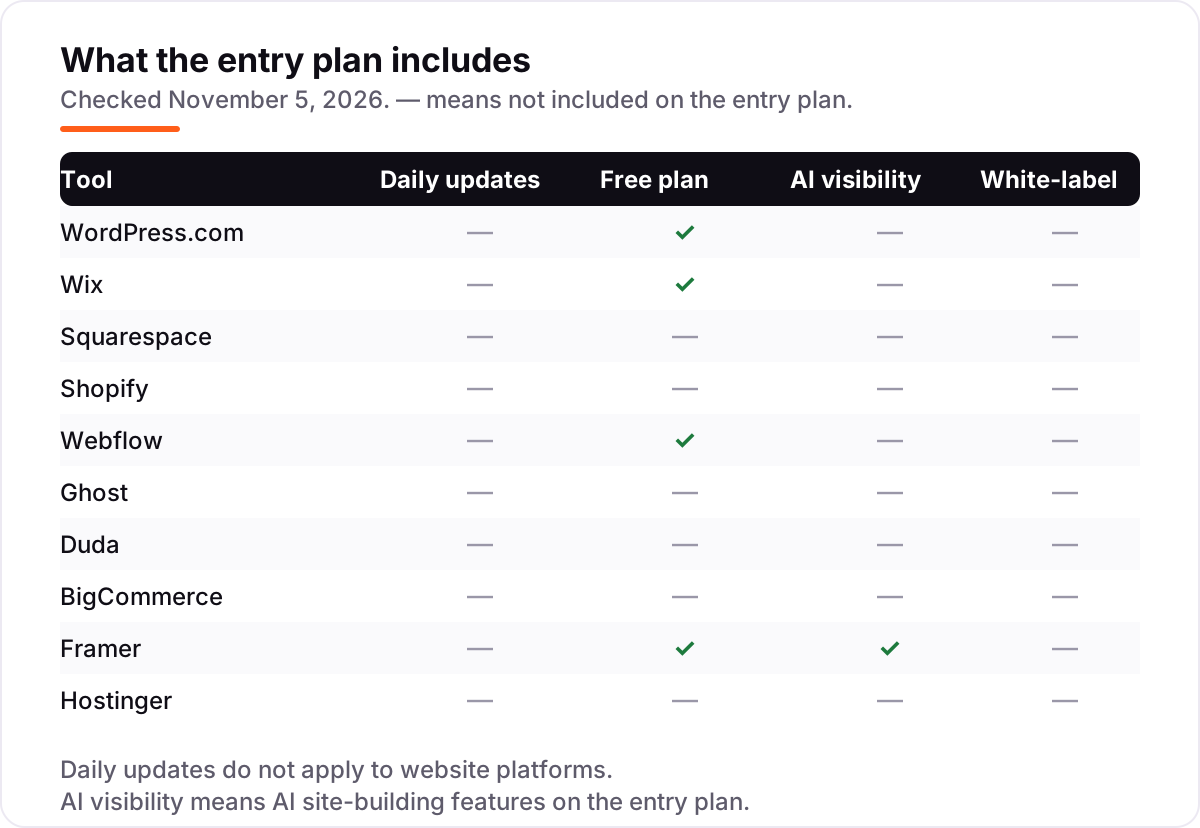
| Tool | Best for | Starting price | Free plan |
|---|---|---|---|
| WordPress.com | Bloggers who want WordPress without setting up hosting, starting on a tight budget | $4/mo (annual) | Yes (free plan) |
| Wix | Beginners who want a drag-and-drop builder with blogging and SEO tools in one place | $17/mo (annual) | Yes (free plan) |
| Squarespace | Affiliates who want polished design and built-in blogging without managing plugins | $19/mo (annual) | No (14-day trial) |
| Shopify | Affiliates who run product-review stores and want checkout for their own products too | $29/mo (annual) | No (3-day trial) |
| Webflow | Design-led affiliates who want full visual control and fast, clean pages | $15/mo (annual) | Yes (free plan) |
| Ghost | Newsletter-first affiliates who monetize an audience with memberships and paid posts | $15/mo (annual) | No (14-day trial) |
| Duda | Affiliates and small agencies who build several client or niche sites from one account | $19/mo (annual) | No (14-day trial) |
| BigCommerce | Review stores with large catalogs that want no platform transaction fees | $29/mo (annual) | No (15-day trial) |
| Framer | Solo affiliates who want an AI-generated modern site live in an afternoon | $10/mo (annual) | Yes (free plan) |
| Hostinger | Budget affiliates who want hosting, a domain and an AI builder for the lowest first-term price | $2.49/mo (48-mo term) | No (money-back guarantee) |
Make one of these tools?
We re-check this list every quarter. Send a correction, request a review, or ask about a clearly labeled sponsored spot.
Request a listingThe best website platform for affiliate marketing

WordPress.com
Best for: Bloggers who want WordPress without setting up hosting, starting on a tight budget
WordPress.com Personal is the lowest-friction way to start an affiliate blog: $9 a month billed monthly, or $4 a month billed annually, buys a custom domain free for the first year, no WordPress.com ads, 6 GB of storage and built-in stats. You write posts, drop in affiliate links by hand and publish, with no hosting, updates or security patching to manage yourself.
The ceiling is plugin support. Personal does not allow plugin installs, so link cloaking, advanced schema and redirect tools wait for the Creator plan, and 6 GB of storage limits image-heavy review sites. Start here when the budget is tight and the content is mostly text; move to Creator or self-hosted WordPress the month plugins become the bottleneck.
What we like
- The cheapest branded-domain start here at $4/month billed annually
- Built-in blogging, stats and social sharing with no setup work
- A huge theme library and a clear upgrade path to plugin support
- WordPress familiarity transfers if you later move to self-hosted WordPress
Watch out for
- No plugin installs on Personal — link cloaking and advanced SEO tools need the Creator plan
- Storage is 6 GB and the design options are narrower than self-hosted WordPress
- The free plan carries WordPress.com ads and a wordpress.com subdomain

Wix
Best for: Beginners who want a drag-and-drop builder with blogging and SEO tools in one place
Wix Light suits a first affiliate site because everything is in one place: drag-and-drop pages, a blog, SEO settings and analytics for $24 a month billed monthly, or $17 a month billed annually, with a custom domain and no Wix ads. More than 900 templates mean a review site can look finished in a weekend, and the free plan lets you test the editor before paying.
The trade-offs are portability and scale. Changing templates means rebuilding rather than restyling, affiliate links are managed by hand with no cloaking tool, and 2 GB of storage runs out fast on photo-heavy reviews. Pick Wix when ease matters more than flexibility; pick WordPress.com or Ghost when the content library is the long-term asset.
What we like
- Drag-and-drop editing with more than 900 templates, no code required
- Blogging, SEO settings and site analytics included on Light
- Custom domain with Wix ads removed once you pay
- A gentle learning curve for a first affiliate site
Watch out for
- Template switching means rebuilding the site rather than restyling it
- Affiliate link management is manual — there is no built-in link cloaking
- Light caps storage at 2 GB, so image-heavy review sites outgrow it

Squarespace
Best for: Affiliates who want polished design and built-in blogging without managing plugins
Squarespace Basic is the design-first choice: $25 a month billed monthly, or $19 a month billed annually, with a custom domain free for the first year, blogging, newsletters, SEO tools and analytics in one subscription. Review posts, comparison tables and email capture all work without plugins, and the templates make a new site look established from the first post.
The limits are flexibility and price. There is no free plan, only a 14-day trial, third-party integrations are narrower than WordPress or Shopify, and design changes stay inside one template family. Choose Squarespace when presentation and low maintenance matter most; choose a builder with an app marketplace when you need specialized affiliate tools.
What we like
- Award-style templates that make review content look professional fast
- Blogging, newsletters and analytics built in, no plugins to maintain
- SEO controls and social sharing included on every plan
- Reliable hosting and support in the same subscription
Watch out for
- No free plan — only a 14-day trial before paying
- Third-party integrations are narrower than WordPress or Shopify
- Design changes stay inside one template family, not a free-form canvas

Shopify
Best for: Affiliates who run product-review stores and want checkout for their own products too
Shopify Basic is the right pick when the affiliate site is really a store: $39 a month billed monthly, or $29 a month billed annually, buys unlimited products, a blog, discount codes, abandoned-checkout recovery and analytics. Product-review pages can sit next to real checkout, and buy buttons let the same offers earn on other sites too.
Content is the weak spot. The blog is serviceable but thinner than WordPress or Ghost, and the apps that close the gap — SEO, reviews, email capture — each add a monthly fee, while transaction fees apply unless you use Shopify Payments. Pick Shopify when selling is part of the plan; pick a blogging platform when content alone does the earning.
What we like
- The strongest store platform here for review sites that also sell
- A huge app store for SEO, reviews, email capture and analytics
- Buy buttons let you monetize content on other sites as well
- Checkout, payments and hosting handled in one subscription
Watch out for
- Blogging and content tools are weaker than WordPress or Ghost
- Apps for SEO, reviews and link tools add monthly cost on top of Basic
- Transaction fees apply unless you use Shopify Payments

Webflow
Best for: Design-led affiliates who want full visual control and fast, clean pages
Webflow gives a design-led affiliate full visual control: $15 a month billed yearly buys the Basic Site plan with a custom domain, 150 static pages and strong SEO controls, and the free Starter plan lets you build on a webflow.io subdomain first. Pages load fast and the code is clean, which helps both readers and search rankings.
The catch for affiliates is the CMS. Basic has no CMS collections, so a blog with dozens of reviews needs the CMS plan at $25 a month billed yearly, and the editor takes longer to learn than Wix or Squarespace. Choose Webflow when design and page speed are the edge; choose Ghost or WordPress.com when publishing volume matters more.
What we like
- Full visual design control with clean, fast-loading code
- Strong SEO controls: meta tags, redirects, sitemaps and schema
- Free Starter plan for staging before you pay
- Hosting, SSL and backups included in the site plan
Watch out for
- Basic has no CMS — affiliate blogs need the CMS plan at $25/month billed yearly
- Steeper learning curve than Wix or Squarespace
- Editor seats and higher limits are paid add-ons

Ghost
Best for: Newsletter-first affiliates who monetize an audience with memberships and paid posts
Ghost Starter fits the newsletter-first affiliate: $18 a month billed monthly, or $15 a month billed annually, with memberships and newsletters built in, a clean long-form editor and very fast pages. Readers can join free or paid tiers, and affiliate offers can go out by email as well as on the site, with no plugin stack to maintain.
The trade-offs are design and ecosystem. There is no drag-and-drop page builder — design comes from themes — integrations are fewer than WordPress, and there is no free plan, only a 14-day trial. Pick Ghost when the audience list is the asset; pick Squarespace when visual design matters more than memberships.
What we like
- Memberships and newsletters built in — no plugin stack to maintain
- Very fast pages, which helps both readers and search rankings
- A clean editor built for long-form review content
- SEO basics and analytics included on Starter
Watch out for
- No drag-and-drop page builder — design comes from themes
- Fewer integrations than WordPress, and no free plan
- The self-hosted free version needs technical setup and your own hosting

Duda
Best for: Affiliates and small agencies who build several client or niche sites from one account
Duda Basic suits affiliates who run several niche sites: $25 a month billed monthly, or $19 a month billed annually, buys one website with blogging, membership tools, SEO settings and a widget library, plus client-management features that keep multiple sites organized. Pages load fast and the responsive controls work without code.
The ecosystem is the limit. Templates and apps are fewer than on Wix or WordPress, there is no free plan beyond the 14-day trial, and white-label plus team permissions wait for higher tiers. Choose Duda when you manage a small portfolio of sites; choose Wix or WordPress.com for a single site with the widest template choice.
What we like
- Fast-loading sites with built-in SEO and widget library
- Client management tools suit affiliates running several niche sites
- Blogging and membership tools included on Basic
- Responsive design controls without touching code
Watch out for
- Smaller template and app ecosystem than Wix or WordPress
- No free plan — only a 14-day trial
- White-label and team permissions sit on higher tiers

BigCommerce
Best for: Review stores with large catalogs that want no platform transaction fees
BigCommerce Core is the store pick for large review catalogs: $39 a month billed monthly, or $29 a month billed annually, with no platform transaction fees, unlimited products and staff accounts, clean SEO-friendly URLs and built-in blogging and discount tools. A catalog of hundreds of reviewed products fits without per-seat charges.
The costs beyond the plan are themes, which are paid extras, and time: the admin takes longer to learn than Shopify's, and the blog is basic next to WordPress or Ghost. Pick BigCommerce when catalog size and zero platform fees matter; pick Shopify when the app ecosystem and ease of use matter more.
What we like
- No platform transaction fees on any plan
- Clean SEO-friendly URLs and strong product catalog tools
- Unlimited staff accounts on Core, unlike per-seat rivals
- Built-in blogging and discount tools for review stores
Watch out for
- Themes cost extra on top of the subscription
- Blogging tools are basic compared with WordPress or Ghost
- The admin takes longer to learn than Shopify's

Framer
Best for: Solo affiliates who want an AI-generated modern site live in an afternoon
Framer Basic is the fastest launch here: $10 a month billed yearly buys a custom domain, your own branding, 2 CMS collections with 1,000 items, 50 GB of bandwidth and 1,000 monthly AI credits, and the AI builder can turn a prompt into a publishable modern site. The free plan lets you build on a framer.website subdomain first.
Scale is the constraint. Two CMS collections and 1,000 items cover a focused niche site but not a large review library, extra editors cost $20 a month each, and there is no plugin marketplace to extend it. Choose Framer for one sharp niche site launched fast; choose WordPress.com or Ghost for a growing content library.
What we like
- AI generation turns a prompt into a publishable modern site
- Modern templates and smooth interactions with no code
- Custom domain and your own branding on Basic
- Fast managed hosting with SEO controls included
Watch out for
- Basic allows only 2 CMS collections and 1,000 items
- Extra editors cost $20/month each, on top of the site plan
- A smaller ecosystem than WordPress — no plugin marketplace

Hostinger
Best for: Budget affiliates who want hosting, a domain and an AI builder for the lowest first-term price
Hostinger Premium is the cheapest way in: $2.49 a month on a 48-month term paid upfront — $119.52 in one payment — buys hosting, an AI website builder, a free domain for a year and up to 3 websites, so one account can cover several niches. There is no free plan, but a 30-day money-back guarantee covers a change of mind.
Read the renewal line before buying. Premium renews at $10.99 a month, more than four times the intro rate, it has no ecommerce — selling needs the Unlimited plan — and its 5 AI credits run out fast. Pick Hostinger when the first-term budget is the deciding factor; pick WordPress.com when you want one stable price year after year.
What we like
- The lowest first-term price here: $119.52 for 48 months
- AI builder, free domain for a year and hosting in one plan
- Up to 3 websites on Premium, so one account covers several niches
- A 30-day money-back guarantee instead of a trial
Watch out for
- The $2.49 rate needs 48 months paid upfront and renews at $10.99/month
- Premium has no ecommerce — selling needs the Unlimited plan
- Only 5 AI credits on Premium, so AI building runs out fast
The best website platform for affiliate marketing is the one that fits how you earn: content sites live on blogging and search traffic, while review stores live on catalogs and checkout. We ranked the ten platforms below by fit for the most common buyer — a solo affiliate building a content site first — starting with the cheapest branded-domain options and ending with the budget host, and every price was checked on November 5, 2026.
How to choose the best website platform for affiliate marketing
- Decide content-first or store-first. Content-first affiliates need blogging, SEO controls and fast pages; store-first affiliates need catalogs, checkout and discount tools. That one choice eliminates half this list.
- Check the CMS limit before the price. Webflow Basic has no CMS and Framer Basic allows only 2 collections — a review library outgrows both fast, and the upgrade is the real price.
- Count the plugin gap. WordPress.com Personal blocks plugins, Wix and Squarespace have no plugin marketplace at all, and Framer has none either — if you need link cloaking or advanced schema, budget for the plan that allows it.
- Read the renewal line. Hostinger's $2.49 rate renews at $10.99, and every annual price here assumes a year paid upfront — the monthly-billed price is higher on most plans.
- Test the free plan or trial with real content. Publish five real posts, add affiliate links and check the site on a phone before paying — the editor you enjoy is the one you will actually publish on.
A platform is one part of the stack, not the whole business. If the site also needs to be found, our guide to SEO tools for affiliate marketing covers the visibility side, and our monthly SEO service handles it done-for-you. And before you publish new review pages, run your titles through the free SERP snippet preview tool — it shows exactly how the title and description will look in Google.
Whatever you shortlist, start with the free plan or trial and publish real content before committing to a year. Five genuine posts tell you more than any feature table: whether the editor suits you, whether the pages load fast on mobile, and whether affiliate links and disclosures sit naturally in the layout. Check one more thing in the trial — that the plan allows a custom domain without a forced upgrade, since a branded domain is what merchants and readers trust.
Website platform pricing: what you will actually pay
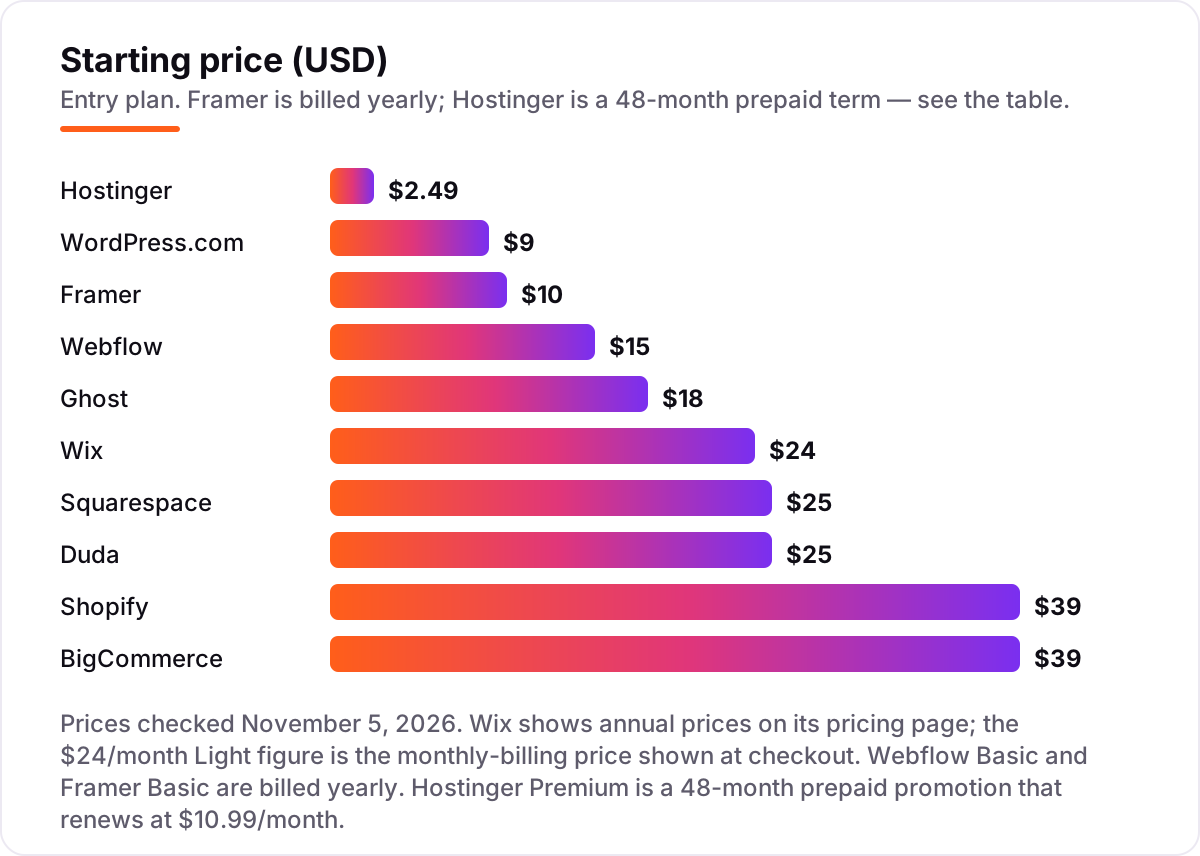
Take a solo affiliate publishing two review posts a week for a year. On annual billing, the subscription costs $48 on WordPress.com Personal, $120 on Framer Basic, $180 on Webflow Basic or Ghost Starter, $204 on Wix Light, $228 on Squarespace Basic or Duda Basic, and $348 on Shopify Basic or BigCommerce Core. Hostinger Premium costs $119.52 for the first 48 months, which works out to about $30 a year — but only until the term ends, when it renews at $10.99 a month.
Two of those numbers need adjusting before they are real. Webflow Basic has no CMS, so a blogging affiliate actually pays $300 a year for the CMS plan, and WordPress.com Personal blocks plugins, so link cloaking waits for the Creator plan. Add a domain renewal after the free first year — typically $10–$20 a year — and any paid theme or app, and the honest first-year range for a content site is roughly $60 to $330, before email tools.
The gap between the cheapest and dearest content setup is about $270 a year, and it buys design control and store features, not traffic. Traffic comes from the content itself: consistent reviews, honest disclosures and pages that load fast. Spend the saving on an email tool or better images before spending it on a higher platform tier.
Know the difference: a content site vs a store
The confusion in this category is between a site that earns from links and a site that earns from checkout. A content site — reviews, comparisons, tutorials — earns when readers click an affiliate link and buy elsewhere; the merchant pays the commission, and the platform takes nothing. A store earns when readers buy from you directly, and then checkout fees, transaction fees and catalog tools all matter.
There is a second, quieter confusion: a free plan is not a free business. Free plans carry a platform subdomain and platform branding, and most affiliate programs judge your site before approving you — a branded domain on a paid plan clears that review far more easily. Start free to learn the editor, but budget for the cheapest paid plan before applying to programs.
A third distinction worth knowing is hosted versus self-hosted. Every platform here is hosted: updates, security and backups are handled for you, and the trade-off is the platform's limits — plugin rules, CMS caps, template families. Self-hosted WordPress removes those limits but hands you the maintenance. For a first affiliate site, hosted wins; the maintenance bill arrives later, when the income justifies it.
Quick comparison: tool type by need
| Buyer | Best pick | Why |
|---|---|---|
| Cheapest branded-domain start | WordPress.com | Personal is $4/month billed annually, with blogging built in |
| First site, easiest editor | Wix | Drag-and-drop with 900+ templates, Light is $17/month billed annually |
| Design-first review site | Squarespace | Polished templates and built-in newsletters, from $19/month billed annually |
| Newsletter-first affiliate | Ghost | Memberships and newsletters built in, from $15/month billed annually |
| Review store that also sells | Shopify | Checkout plus a huge app store, Basic is $29/month billed annually |
| Lowest first-term budget | Hostinger | Premium is $2.49/month on a 48-month prepaid term, renewing at $10.99 |
Mistakes to avoid
- Buying on the intro price. Hostinger's $2.49 rate renews at $10.99, and every annual price here assumes a year paid upfront. Compare tools on the renewal price, not the first-term price.
- Picking a plan without a CMS. Webflow Basic has no CMS collections and Framer Basic allows only 2 — a review library outgrows both, and the upgrade is the real starting price.
- Assuming plugins will fix it. WordPress.com Personal, Wix, Squarespace and Framer all limit or block plugins — if link cloaking or advanced SEO tools are essential, buy the plan that allows them from day one.
- Publishing without disclosures. Affiliate links must be disclosed on the page, not buried in a footer — regulators and readers both check, and a clear disclosure builds the trust that earns clicks.
- Waiting for traffic before building a list. Search rankings can fall without warning. Collect email addresses from the first post, so the audience survives any single traffic source.
How we chose
We checked each vendor's own pricing page and recorded the starting price exactly as shown, including the annual-billing figure where the page lists one, and we ranked the platforms by fit for the most common buyer — a solo affiliate building a content site first — not by brand size. Three figures need a note. The Wix $24/month Light figure is the monthly-billing price shown at checkout, not on the pricing page, which lists annual prices. Framer's $10/month Basic figure comes from Framer's own pricing-update and comparison pages in fresh search-index crawls dated within the last day, since direct page loads were degraded on November 5, 2026. Hostinger's $2.49/month Premium figure is third-party-sourced from October 2026 reads of Hostinger's own pricing page, not verified on the vendor page today, and it renews at $10.99/month. This list carries no review ratings because the G2 review pages could not be opened on November 5, 2026, and we would rather show no rating than a stale or estimated one. No vendor paid for a place in this list, and none of the links here are affiliate links.
What to do next
Start with the free plan or trial of your top pick and publish five real posts before committing to a year. Check that the editor suits you, that pages load fast on a phone, and that affiliate links and disclosures sit naturally in the layout. If the site is built but new readers are not finding it, our monthly SEO service handles the visibility side — or compare providers in our guide to affiliate marketing software. Once your tools are in place, find out what's holding your rankings back.
Your stack only works if people find you
SerpAstra fixes what keeps your site off page one and makes it easy for AI assistants to recommend.
Get a free audit→Sources we checked (10)
- WordPress.com pricing — wordpress.com/pricing (checked November 5, 2026)
- Wix pricing — wix.com/pricing (checked November 5, 2026)
- Squarespace pricing — squarespace.com/pricing (checked November 5, 2026)
- Shopify pricing — shopify.com/pricing (checked November 5, 2026)
- Webflow pricing — webflow.com/pricing (checked November 5, 2026)
- Ghost pricing — ghost.org/pricing (checked November 5, 2026)
- Duda pricing — duda.co/pricing (checked November 5, 2026)
- BigCommerce pricing — bigcommerce.com/pricing (checked November 5, 2026)
- Framer pricing — framer.com/pricing (checked November 5, 2026)
- Hostinger Website Builder — hostinger.com/website-builder (checked November 5, 2026)
Shamim
Founder of SerpAstra
A full-stack SEO and digital marketer who spends most days on Local SEO for dental practices, AI search visibility and lead generation.
Frequently asked questions
What is the best website platform for affiliate marketing?
WordPress.com is the best fit for most affiliate beginners: a branded domain from $4/month billed annually, built-in blogging and a clear upgrade path. Ghost is better for newsletter-first affiliates, and Shopify or BigCommerce are better when the site also sells products directly.
Can I do affiliate marketing on a free website plan?
Yes, with limits. WordPress.com, Wix, Webflow and Framer all have free plans, but they use a platform subdomain and show platform branding or ads. A custom domain on a paid plan looks more trustworthy to readers and merchants, and it is usually required by affiliate programs that review your site.
Do I need a store platform for affiliate marketing?
No, not unless you also sell your own products. Most affiliate income comes from content — reviews, comparisons and tutorials — so a blogging platform like WordPress.com or Ghost is enough. A store platform like Shopify or BigCommerce only earns its higher price when checkout, catalogs and discounts are part of the business.
How much does an affiliate website cost per year?
On annual billing, the entry plans here run from about $30 a year on Hostinger's first 48-month term to about $348 a year on Shopify or BigCommerce Basic. Budget on top for domain renewal after the free first year, and for any themes or apps you add — those extras, not the plan, are where most affiliate sites overspend.
Do affiliate platforms charge fees on my commissions?
No. None of the platforms in this list take a cut of affiliate commissions — those are paid by the merchant or network, not the website platform. What platforms do charge is the subscription, plus payment-processing or transaction fees only when you sell your own products through their checkout.
Can I switch website platforms later?
Yes, but plan the move carefully. Export your posts, pages and images, redirect every old URL to its new address, and re-check affiliate links after the move — a broken redirect can silently kill commissions. Switching is easiest early, before the site has hundreds of posts and backlinks pointing at its URLs.
Does my affiliate site need an email list?
Yes, if you want income that survives algorithm changes. Search traffic can fall without warning, but an email list stays yours. Ghost builds the list in, Squarespace includes newsletters, and every other platform here connects to an email tool — start collecting addresses from the first post, not after the traffic arrives.
Free SEO and AI visibility audit
Find out what is holding your rankings back
Send us your site. Within 2 business days you get a written audit, an AI visibility check and a short fix list ranked by impact. Free, with no contract attached.
Request my free audit→Related guides
 Digital Marketing & Ads12 Best Affiliate Marketing Software in 2026, ComparedThe 12 best affiliate marketing software options for 2026, compared with real prices, free plans and G2 ratings — from free tools to enterprise networks.Read guide →
 SEO & AI Search8 Best SEO Tools for Affiliate Marketing in 2026, Compared8 best seo tools for affiliate marketing compared on price, keyword research, content scoring and outreach, with real starting prices checked on vendor pages.Read guide →
 SEO & AI Search8 Best Website Platforms for SEO in 2026 (Pros, Cons and Pricing)The 8 best website platform for SEO options compared on price, controls, speed and ease of use, with real prices checked November 2, 2026, and pros and cons.Read guide →