6 Best Apps for Kids to Learn Science in 2026, Compared
Compare the 6 best apps for kids to learn science, from free Khan Academy to BrainPOP and Tinybop, on ages, subjects and real cost, checked November 2026.
 Shamim Mia, Founder, SerpAstraLast verified November 21, 20267 min read
We compare pricing pages, documentation and public reviews. We never accept payment for rankings.
Key takeaways
- Khan Academy is free and covers middle school, high school and AP science, with simulations and hands-on activity guides.
- BrainPOP Family costs $119 to $159 a year and teaches science through animated movies, quizzes and games for grades K-8.
- Tinybop's The Human Body ($3.99) lets kids 4+ explore eight body systems in an interactive model, with no third-party ads.
- Thinkrolls Space and Inventioneers ($5.99 each) teach physics through puzzles and invention building for a one-time price.
On this page
Quick comparison
| Tool | Best for | Starting price | Free plan |
|---|---|---|---|
 Khan Academy | Middle and high schoolers who need free, structured science courses | Free | Yes |
 BrainPOP Family | Families with kids in grades K-8 who learn best from short animated movies | From $119/yr | Free trial |
 Generation Genius | Homeschool families who want science video lessons with DIY experiments | £185/yr | No |
 Tinybop: The Human Body | Kids 4 and up who learn by exploring an interactive model | $3.99 | No |
 Thinkrolls Space | Kids 5 to 8+ who like puzzles and learn physics by trial and error | $5.99 | No |
 Inventioneers | Young builders who want to invent machines and test real-time physics | $5.99 | No |
Make one of these tools?
We re-check this list every quarter. Send a correction, request a review, or ask about a clearly labeled sponsored spot.
Request a listingThe best science learning apps for kids
Khan Academy
Best for: Middle and high schoolers who need free, structured science courses
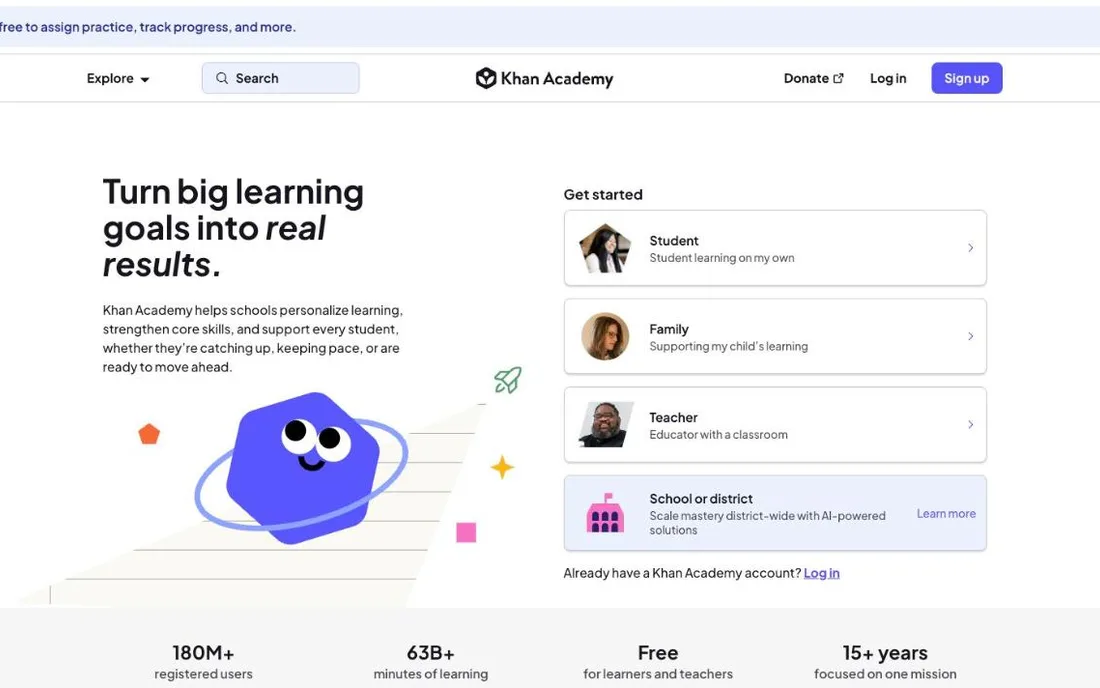
Khan Academy is the best free choice for older kids. Its science section has full courses in middle school biology, Earth and space science, chemistry and physics, then high school and AP courses, each with lessons, practice and teacher resources. The middle school courses also include simulations to explore, and there are hands-on activity guides for 3rd and 5th grade through high school.
It is run by a nonprofit and costs nothing, with no subscription. The format is closer to school than to a game, so it suits a child who needs help with a science class or wants to work ahead. Younger children will get more from a playful app below.
What we like
- Full courses in biology, chemistry, physics and Earth and space science
- Interactive simulations in each middle school science course
- Hands-on activity guides from 3rd grade through high school
Watch out for
- Courses start at middle school; little for preschoolers
- Video-and-practice format is less playful than game apps
BrainPOP Family
Best for: Families with kids in grades K-8 who learn best from short animated movies
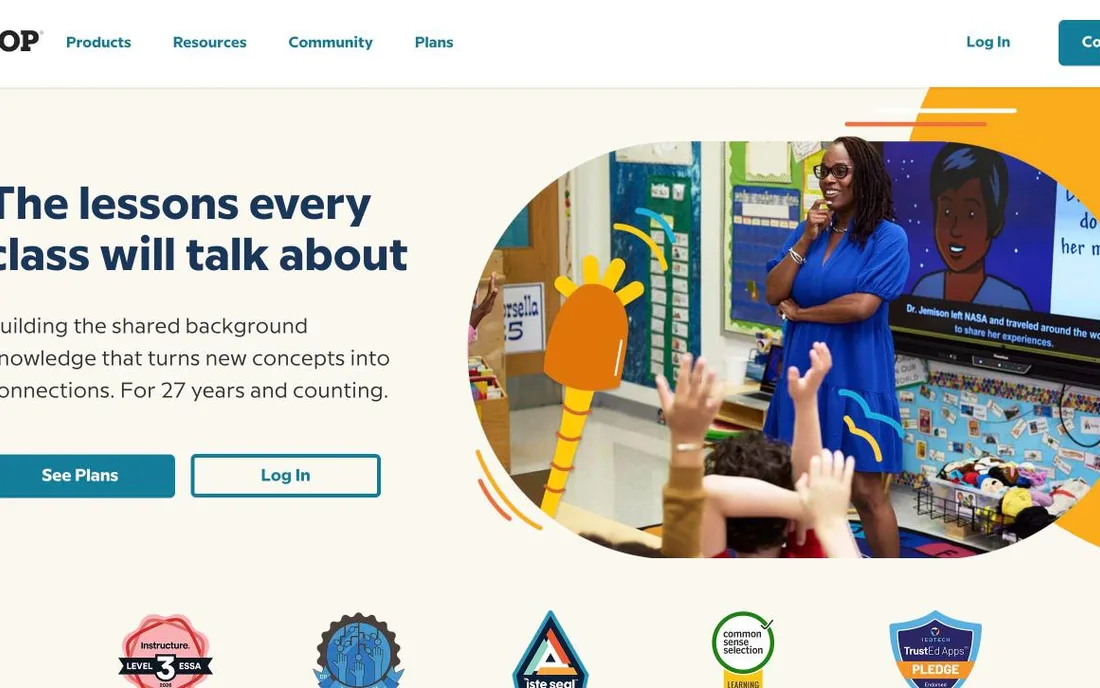
BrainPOP turns science topics into short animated movies with recurring characters, then backs each one with quizzes and games. BrainPOP Jr. covers 300+ topics for kindergarten to 3rd grade, and BrainPOP covers 800+ topics for grades 3 to 8, from electric circuits to the rainforest. Many schools already use it, so the format may be familiar.
BrainPOP Jr. Family is $119 a year, BrainPOP Family is $129 a year, and the plan with both libraries is $159 a year. Each includes two child profiles, and you get a two-week free trial before you are charged. Science is one subject among several.
What we like
- 1,200+ animated movies and topics across BrainPOP and BrainPOP Jr.
- Quizzes, vocabulary and games built for each age group
- Two child profiles on every family plan
Watch out for
- Covers all subjects, so you pay for more than science
- Only two child profiles per plan
Generation Genius
Best for: Homeschool families who want science video lessons with DIY experiments
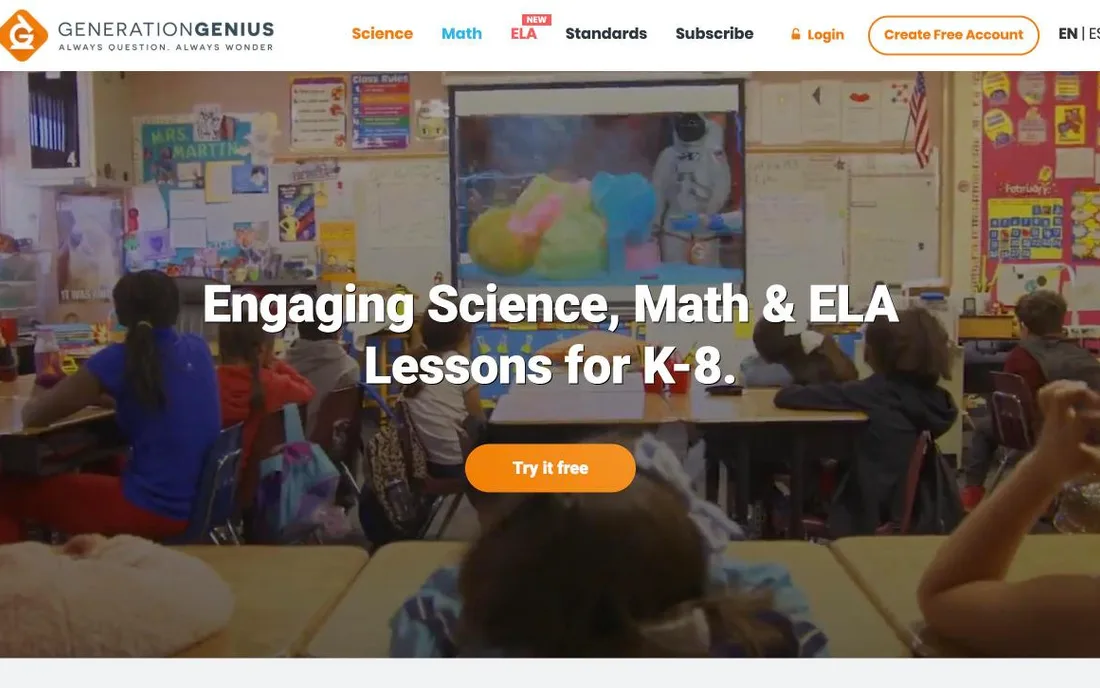
Generation Genius is built around science video lessons for K-8, each paired with a DIY activity using low-cost materials, printable worksheets, lesson plans and quiz games. That makes it a good fit for homeschool families who want to run a real science lesson at the kitchen table rather than hand over a game.
When we checked, the homeschool Science Only plan showed as £185 a year and the Science + Math + ELA plan as £241 a year; the page displayed prices in GBP for our location, so confirm your local price. You can cancel any time, and there is a 30-day money-back guarantee.
What we like
- 100+ science video lessons for K-8
- Hands-on DIY activities, worksheets and quiz games with each lesson
- Approved vendor for Education Savings Accounts in several states
Watch out for
- Price showed only in GBP from our location
- Homeschool plans have no student links
Tinybop: The Human Body
Best for: Kids 4 and up who learn by exploring an interactive model
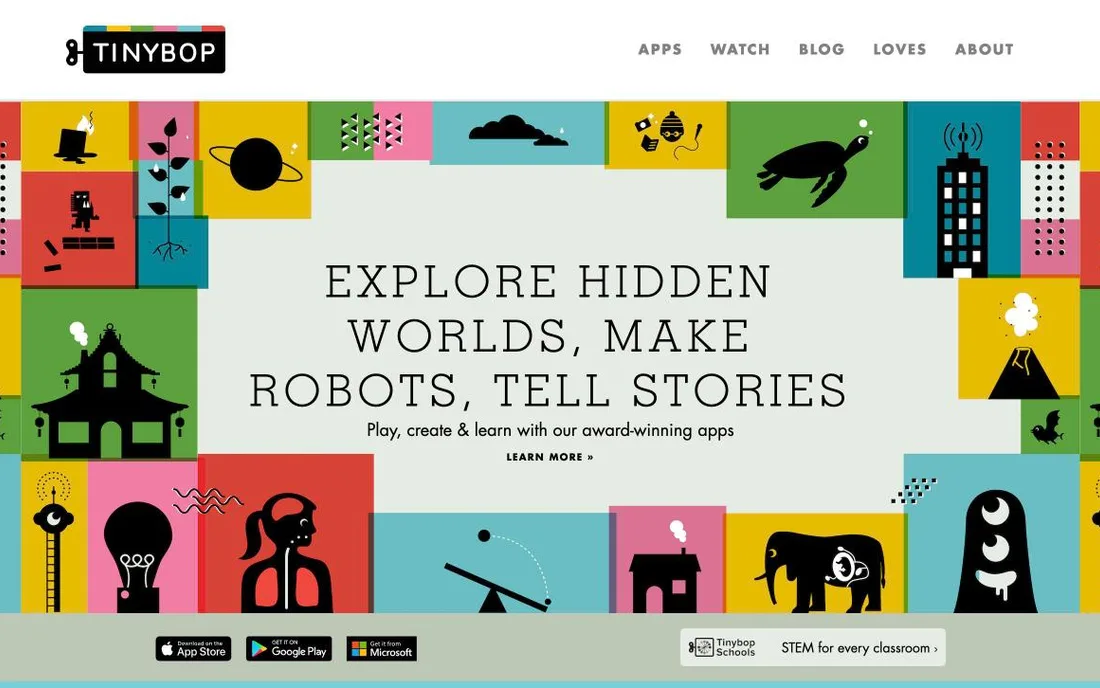
Tinybop's The Human Body is an interactive model rather than a lesson. Kids 4 and up explore eight systems, including the skeletal, muscular, nervous, circulatory, digestive and immune systems: the heart beats, lungs breathe and the eye uses the device camera to show how sight works. Labels come in 50+ languages.
It costs $3.99 on the US App Store, with one in-app purchase for an extra system, and has no third-party ads. It rates 4.2 out of 5 from 403 ratings. Tinybop's Explorer's Library has other science apps too, including Plants, The Earth, Weather, Space and Simple Machines.
What we like
- Interactive model of eight body systems, from skeleton to skin
- Labels in 50+ languages and a free parent handbook
- No third-party advertising
Watch out for
- Designed for iPad; small phone screens feel cramped
- Explore-only, with no quizzes or levels
Thinkrolls Space
Best for: Kids 5 to 8+ who like puzzles and learn physics by trial and error
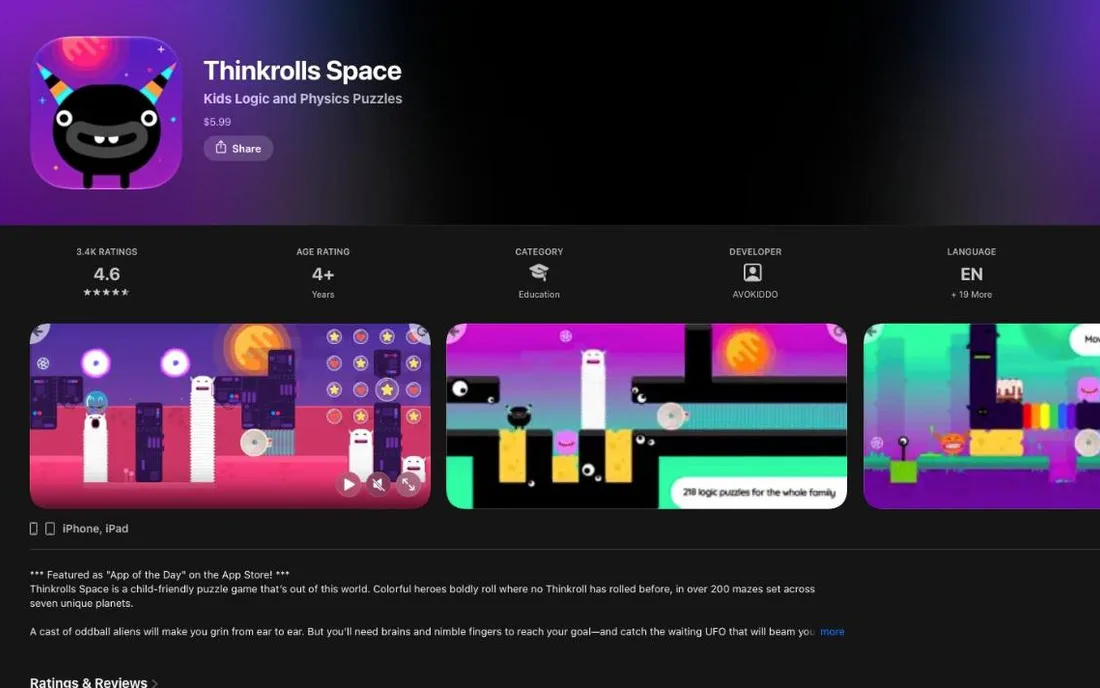
Thinkrolls Space teaches physics the way kids like best: by playing. Players roll characters through 200+ mazes across seven planets, moving and combining objects to clear a path, with 110 easy levels for ages 5 and up and 108 harder levels for 8 and up. Unlimited retries keep frustration low.
It costs $5.99 on the US App Store with no in-app purchases or third-party ads, works without internet and stores up to six player profiles. It rates 4.6 out of 5 from about 3,400 ratings. Pair it with a lesson-based app if you want facts as well as reasoning.
What we like
- 200+ physics and logic levels in easy and hard modes
- No ads, no in-app purchases and no internet needed
- Up to six player profiles and Family Sharing
Watch out for
- Puzzle game, not a science course
- Space theme is fun but does not teach astronomy facts
Inventioneers
Best for: Young builders who want to invent machines and test real-time physics
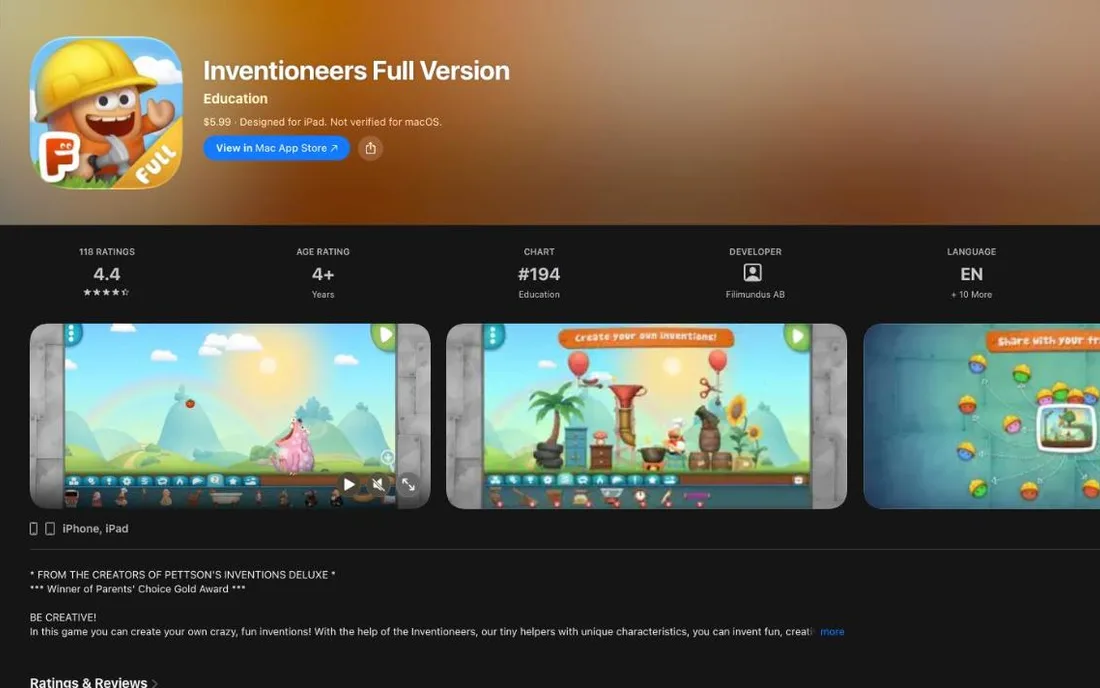
Inventioneers is a contraption-building game that teaches real-time physics. Kids solve 120 invention puzzles across eight chapters with the help of helpers that blow air, light fires, use magnets or freeze things, then use a create tool to build and share their own machines. It won a Parents' Choice Gold Award.
The full version costs $5.99 on the US App Store and is designed for iPad. It rates 4.5 out of 5 from 117 ratings, with parents noting that adults enjoy the harder levels too. It suits a child who likes building more than watching.
What we like
- 120 invention puzzles across eight chapters
- Create mode to design and share your own inventions
- Covers air, fire, magnetism and other forces
Watch out for
- Designed for iPad
- Fewer recent updates and ratings than larger apps
The best apps for kids to learn science make a child curious first and teach facts second: they let kids poke at a beating heart, build a machine that fails, or watch a short story about electric circuits, then check what stuck. We compared six options, from a free nonprofit course library to subscription video lessons and one-time-purchase iPad apps, on age range, subjects, how kids learn and real cost. Every price below comes from the vendor's own page or the US App Store listing as checked in November 2026.
How to choose the best apps for kids to learn science
- Match the app to the age. Explore-and-play apps suit ages 4 to 8; structured courses suit middle and high school.
- Decide between lessons and play. Video lessons teach facts and vocabulary; puzzle apps build reasoning about forces.
- Check for ads and in-app purchases. Tinybop and Thinkrolls Space say they carry no third-party ads; check any app you add.
- Compare one-time and yearly prices. A $3.99 app is a one-off cost; a subscription repeats every year.
- Look for off-screen activities. DIY experiments turn screen time into real investigation.
- Count the profiles. Some family plans cover two children, others up to six.
For more ideas across subjects, see our guide to the best free learning apps for kids, and pair science with our picks of the best apps for kids to learn math.
Science app pricing: what you will actually pay
Over two years, Khan Academy costs nothing. The paid apps are cheap one-off buys: Tinybop's The Human Body is $3.99, and Thinkrolls Space and Inventioneers are $5.99 each, so all three together cost $15.97 once with no renewals.
Subscriptions add up faster. BrainPOP Family is $129 a year for grades 3-8, so $258 over two years; the plan with both BrainPOP and BrainPOP Jr. is $159 a year, or $318 over two years. Generation Genius's homeschool Science Only plan showed as £185 a year when we checked, priced in GBP for our location. Use BrainPOP's two-week free trial and Generation Genius's 30-day money-back guarantee before committing to a year.
Know the difference: lesson apps vs exploration apps
Lesson apps like Khan Academy, BrainPOP and Generation Genius follow a curriculum. A child watches or reads, then answers questions, so you can see progress and cover topics a school expects. They work best for older kids, homeschoolers and anyone filling gaps from class.
Exploration apps like Tinybop's The Human Body, Thinkrolls Space and Inventioneers have no syllabus. Kids learn by touching, testing and failing, which builds curiosity and intuition about how things work. They are ideal for younger kids, but add a lesson app when you want facts and vocabulary.
Quick comparison: tool type by need
| Buyer | Best pick | Why |
|---|---|---|
| Free, middle and high school | Khan Academy | Full science courses, simulations, no cost |
| Animated lessons, K-8 | BrainPOP Family | 1,200+ movies and topics; from $119/year |
| Homeschool with experiments | Generation Genius | K-8 science videos with DIY activities |
| Ages 4+, hands-on exploring | Tinybop: The Human Body | Interactive body model; $3.99 once |
| Physics puzzles | Thinkrolls Space | 200+ levels, no ads; $5.99 once |
| Builders and tinkerers | Inventioneers | 120 invention puzzles plus create mode; $5.99 |
Mistakes to avoid
- Buying a course for a preschooler. Young kids learn science through play; save structured courses for later.
- Paying for a yearly plan before a trial. Use free trials and refund windows first.
- Letting the app replace experiments. Use the DIY activities or try one simple experiment a week.
- Ignoring the device. Several apps are designed for iPad and feel cramped on a phone.
- Not sitting in. Ten minutes of talking about what a child discovered doubles the value of any app.
How we chose
We read each vendor's own site and the US App Store listings in November 2026 and recorded prices exactly as shown, including one plan shown only in GBP from our location. We compared age range, science topics, learning style, ads, in-app purchases and cost for a family with one or two children. App Store ratings are quoted as shown on the listings on the day we checked. No developer paid for a place in this list, and none of the links here are affiliate links.
What to do next
Pick one lesson app and one exploration app for your child's age, try them for two weeks, and keep the one your child returns to without being asked. If you run a tutoring center or kids' STEM program and want more parents to find you online, that is where we can help. Book a free SEO review.
Frequently asked questions
What are the best apps for kids to learn science?
Khan Academy is the best free option for middle and high school, BrainPOP Family is best for animated lessons across K-8, and Tinybop's The Human Body is a strong pick for kids 4 and up.
Is there a free science app for kids?
Yes. Khan Academy is free from a nonprofit and covers biology, chemistry, physics and Earth and space science from middle school up.
What is the best science app for preschoolers?
Tinybop's The Human Body is rated for ages 4+ and lets young kids explore body systems by touch. Thinkrolls Space has easy physics puzzles for ages 5 and up.
How much does BrainPOP cost for families?
BrainPOP Jr. Family is $119 a year for K-3, BrainPOP Family is $129 a year for grades 3-8, and both together are $159 a year, each with two child profiles and a two-week free trial.
Which science app is best for homeschool?
Generation Genius pairs K-8 science videos with DIY activities, worksheets and quizzes, and is an approved Education Savings Account vendor in several states. Khan Academy is a free alternative for older kids.
Do science game apps really teach science?
Puzzle apps like Thinkrolls Space and Inventioneers build reasoning about forces and cause and effect. For facts and vocabulary, add a lesson app such as BrainPOP or Khan Academy.
Sources we checked (9)
- Khan Academy — www.khanacademy.org/science (checked November 21, 2026)
- BrainPOP Family — www.brainpop.com/at-home/family (checked November 21, 2026)
- Generation Genius — www.generationgenius.com/subscribe (checked November 21, 2026)
- Tinybop: The Human Body — apps.apple.com/us/app/the-human-body-by-tinybop/id682046579 (checked November 21, 2026)
- Tinybop: The Human Body reviews on App Store (checked November 21, 2026)
- Thinkrolls Space — apps.apple.com/us/app/thinkrolls-space/id1458751834 (checked November 21, 2026)
- Thinkrolls Space reviews on App Store (checked November 21, 2026)
- Inventioneers — apps.apple.com/us/app/inventioneers-full-version/id947381696 (checked November 21, 2026)
- Inventioneers reviews on App Store (checked November 21, 2026)
Make one of these tools?
We re-check this list every quarter. Send a correction, request a review, or ask about a clearly labeled sponsored spot.
Request a listingShamim
Founder of SerpAstra
A full-stack digital marketer and SEO strategist covering technical and local SEO, AI search visibility, paid ads and lead generation for local businesses, e-commerce brands and SaaS teams.
Free SEO and AI visibility audit
Find out what is holding your rankings back
Send us your site. Within 2 business days you get a written audit, an AI visibility check and a short fix list ranked by impact. Free, with no contract attached.
Request my free audit→Related buying guides
 Education & E-Learning6 Best Apps for Kids to Learn Math in 2026, ComparedCompare the 6 best apps for kids to learn math on grade range, game style, free versions and real yearly cost, with every price checked on official pages.Read guide →
 Education & E-Learning10 Best Learning Apps for Kids: Free Picks for 2026, ComparedCompare the 10 best learning apps for kids: free picks rated on ads, age range and subjects, with free tiers and paid upgrades checked on official pages.Read guide →
 Education & E-Learning9 Best Apps for Kids in 2026, ComparedCompare the 9 best apps for kids aged 2 to 8 on learning value, free plans, ads and real yearly cost, with every price checked on the vendor's own pages.Read guide →