
9 Best Apps for Kids in 2026, Compared
Compare the 9 best apps for kids aged 2 to 8 on learning value, free plans, ads and real yearly cost, with every price checked on the vendor's own pages.
 Shamim Mia, Founder, SerpAstraLast verified November 4, 202610 min read
We compare pricing pages, documentation and public reviews. We never accept payment for rankings.
Key takeaways
- Khan Academy Kids is the best place to start: reading, math and social-emotional skills for ages 2 to 8, completely free with no ads or in-app purchases.
- Three more strong apps cost nothing: Duolingo ABC for phonics, ScratchJr for first coding projects and the web version of Teach Your Monster to Read.
- If you pay, pay yearly: Homer is $59.99 a year against $9.99 a month, and Starfall's $35 web membership beats its $5.99 monthly in-app price.
- ABCmouse and Lingokids are the broadest paid curriculum apps, but both cost $13.49 to $14.99 a month when billed monthly.
On this page
Quick comparison
| Tool | Best for | Starting price | Free plan |
|---|---|---|---|
| Khan Academy Kids | Families who want one free, ad-free learning app that covers the basics for ages 2 to 8 | Free | Yes (free) |
| ABCmouse | Parents who want a big step-by-step curriculum across reading, math, science and art | $14.99/mo; $79.99/yr | Yes (Basic tier) |
| Lingokids | Younger children who learn through songs and games, with screen-time controls for parents | $13.49/mo | Yes (Basic tier) |
| Epic | Children who can read a little and need a large library of books to practise on | Free Basic; $9.99/mo | Yes (Basic) |
| Duolingo ABC | Preschoolers and first graders who need a free, ad-free phonics app that works offline | Free | Yes (free) |
| ScratchJr | Children aged 5 to 7 who are ready to make their own stories and games, not just play them | Free | Yes |
| Starfall | Families on a budget who want classroom-tested phonics for the whole household | $35/yr (web) | Yes (free tier) |
| Teach Your Monster to Read | Children aged 3 to 6 who will practise phonics happily if it feels like a game | Free web; $8.99 app | Yes (free on web) |
| Homer | Parents who want a reading plan shaped around one child's level and interests | $59.99/yr | No (30-day trial) |
Make one of these tools?
We re-check this list every quarter. Send a correction, request a review, or ask about a clearly labeled sponsored spot.
Request a listingThe best apps for kids

Khan Academy Kids
Best for: Families who want one free, ad-free learning app that covers the basics for ages 2 to 8
Khan Academy Kids is the first app to install on a young child's tablet. It covers reading, phonics, math and social-emotional skills in more than 4,000 activities, videos and books, built with the Stanford Graduate School of Education, and it costs nothing: no ads, no subscription and no in-app purchases. A parent section shows what the child practised and which skills need another pass.
Its breadth is also its limit. Because reading sits beside math, stories and songs, a child who only needs phonics gets a gentler, slower path than a dedicated reading app gives. Use it for the first months; add a focused app only if one skill is clearly lagging.
What we like
- Completely free for families: 4,000+ activities, videos and books with no ads, no subscriptions and no in-app purchases
- Built with the Stanford Graduate School of Education and aligned to Head Start and Common Core standards
- Covers reading, phonics, math and social-emotional skills in one app for ages 2 to 8
- Parent dashboard shows what the child practiced and which skills need more work
Watch out for
- Reading is one subject among several, so it is less focused than a phonics-only app
- No offline mode for the full library on every device
- School reporting costs $5 per student a year for districts, not for families

ABCmouse
Best for: Parents who want a big step-by-step curriculum across reading, math, science and art
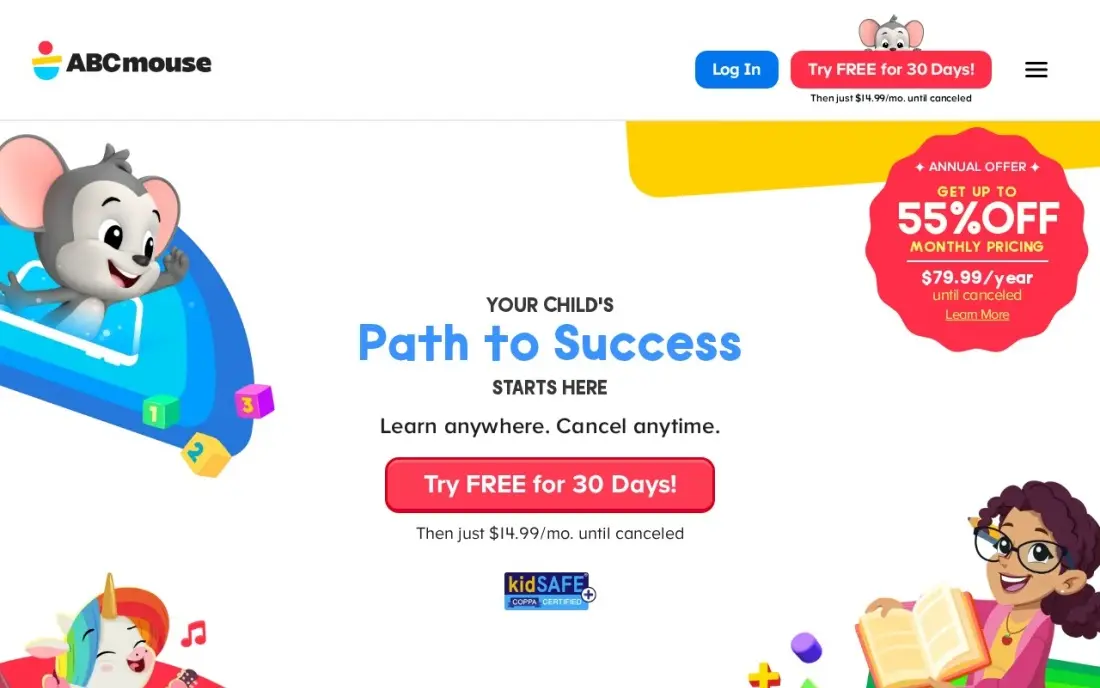
ABCmouse is the largest structured curriculum here, with more than 13,000 activities across reading, math, science, art and music for ages 2 to 8. Reading and Math Learning Paths adjust to the child's level, one subscription covers up to 3 child profiles, and the app is KidSAFE and COPPA certified with no third-party ads.
It is also the dearest monthly subscription in this list at $14.99 a month. The annual plan is $45 for the first year and then renews at $79.99 a year, so budget for the second-year price. The free Basic tier allows 10 activities a day, enough to see whether your child takes to it.
What we like
- 13,000+ activities across reading, math, science, art and music for ages 2 to 8
- Personalized Reading and Math Learning Paths that adjust to the child's level
- Up to 3 child profiles on one subscription, with progress tracking for parents
- KidSAFE and COPPA certified, with no third-party ads in the paid app
Watch out for
- Monthly billing at $14.99 is the most expensive monthly rate in this list
- The $45 first-year annual price renews at $79.99 a year, so the second year costs more
- Reading sits inside a broad curriculum, so a child who only needs phonics pays for subjects they will not use

Lingokids
Best for: Younger children who learn through songs and games, with screen-time controls for parents
Lingokids is a play-first app: more than 4,000 games, songs and videos across 18 subjects for ages 2 to 8, with early English and reading woven through them. Plus adds up to 4 child profiles, offline mode, screen-time limits and a Progress Center, and the whole app is ad-free. The free Basic tier gives 10 games a day without asking for payment details.
Where you subscribe changes the price. Plus is $13.49 a month on the Lingokids website, or $161.88 a year, while the App Store lists $14.99 to $15.99 a month. Buy on the website, and pair it with a phonics app once your child is ready to read.
What we like
- 4,000+ games, songs and videos for ages 2 to 8, with reading among 18 subjects
- Plus adds up to 4 child profiles, offline mode, screen-time limits and a Progress Center
- Free Basic tier gives 10 games a day with no payment details needed
- Ad-free throughout, with content reviewed for young children
Watch out for
- Plus costs $13.49 a month on the website, but App Store prices differ ($14.99 to $15.99 a month)
- Reading is one of 18 subjects, so it is broader and less reading-focused than the phonics apps
- The free Basic tier allows only 10 games a day, which runs out fast on a long car ride

Epic
Best for: Children who can read a little and need a large library of books to practise on
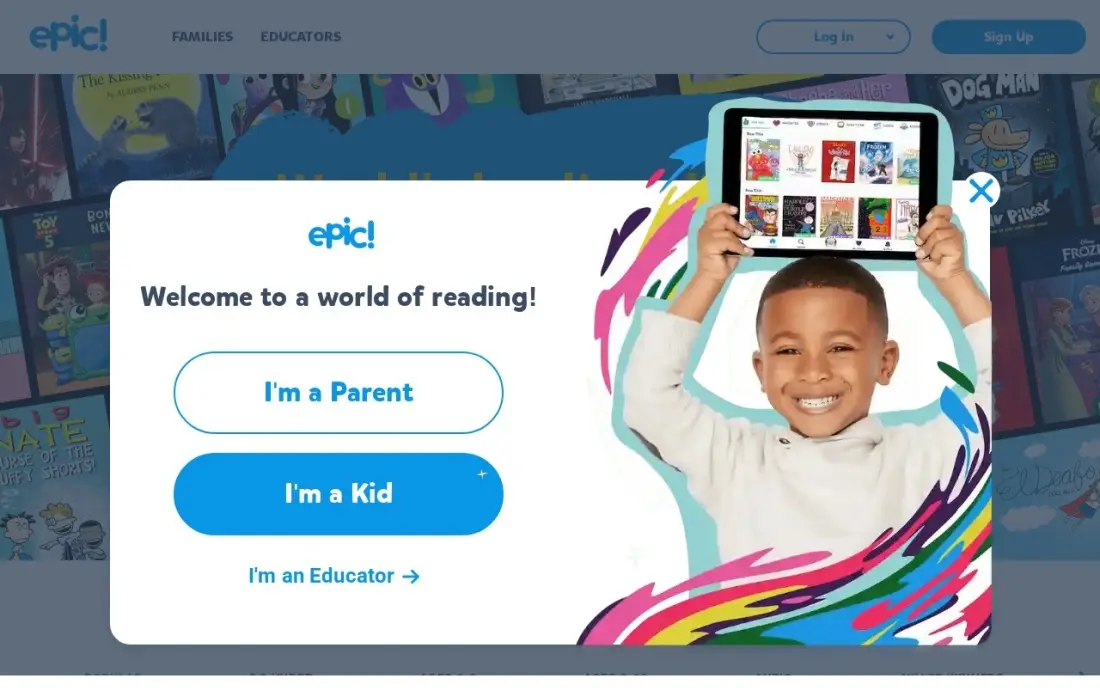
Epic is a digital library rather than a lesson plan. It holds more than 40,000 books, audiobooks and learning videos for children up to 12, with Read-To-Me books, quizzes and reading badges, and up to 4 child profiles share one account with a parent dashboard. Epic Basic lets a family sample a limited library free.
Epic Unlimited costs $9.99 a month with a 7-day free trial, though the App Store shows several monthly prices, so check the plan offered to you. Do not buy it for a child who cannot decode words yet: there is no phonics course, and a beginner needs one of the reading apps here first.
What we like
- 40,000+ books, audiobooks and learning videos — the largest library in this list
- Read-To-Me books, audiobooks and quizzes that build fluency and comprehension
- Up to 4 child profiles, with reading badges and a parent dashboard
- Free for educators, and the Basic tier lets a family sample the library at no cost
Watch out for
- It is a library, not a reading teacher: there is no phonics curriculum for a true beginner
- The App Store lists several monthly prices ($7.99 to $13.99), so what you pay depends on the plan shown to you
- Free for educators, but families pay — there is no free full tier for home use
Duolingo ABC
Best for: Preschoolers and first graders who need a free, ad-free phonics app that works offline
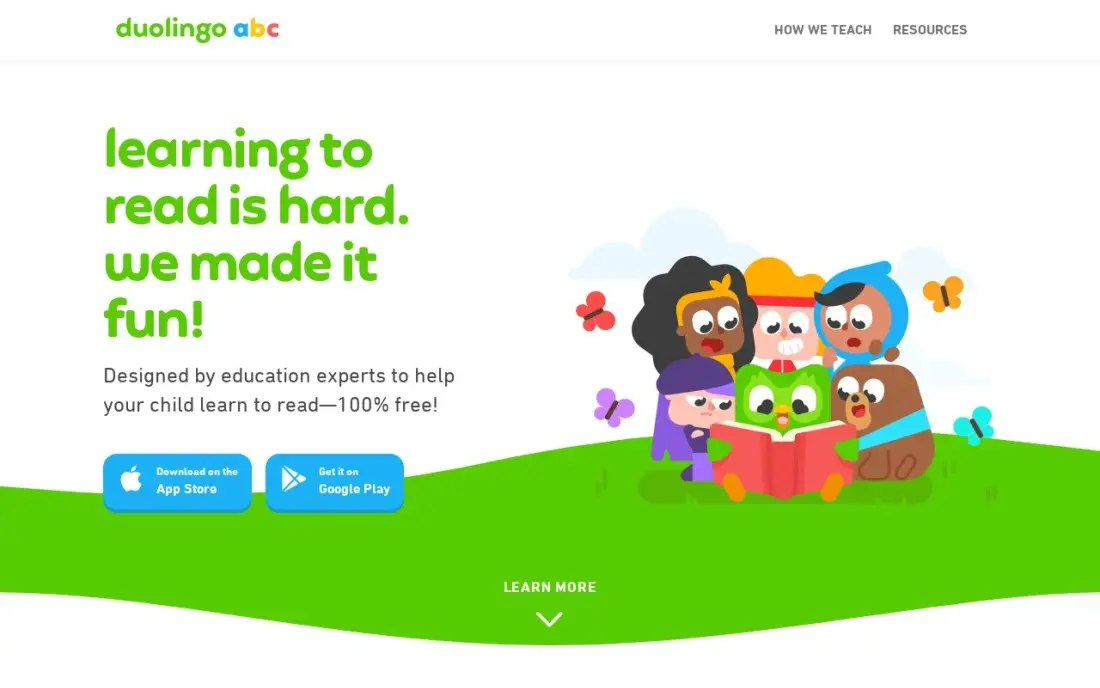
Duolingo ABC is free in the full sense: no ads, no in-app purchases and no locked lessons. More than 700 short lessons teach the alphabet, phonics, sight words and early writing with the same game-style rewards as the adult Duolingo app, and lessons work offline, which helps on trips.
It covers preschool to first grade only, so a confident reader will outgrow it within a year, and there is no parent dashboard. That is a fair trade for a free app. Use it as the phonics starter, then move to a library app such as Epic when your child starts reading whole books.
What we like
- Completely free with no ads and no in-app purchases — the whole app is the free tier
- 700+ bite-sized lessons covering the alphabet, phonics, sight words and early writing
- Works offline, so lessons travel without a connection
- Made by the Duolingo team, with the same game-like rewards that keep children practicing
Watch out for
- Covers only preschool to first grade, so children outgrow it fast
- No parent dashboard or detailed progress reports
- No desktop version; it runs on phones and tablets only
ScratchJr
Best for: Children aged 5 to 7 who are ready to make their own stories and games, not just play them
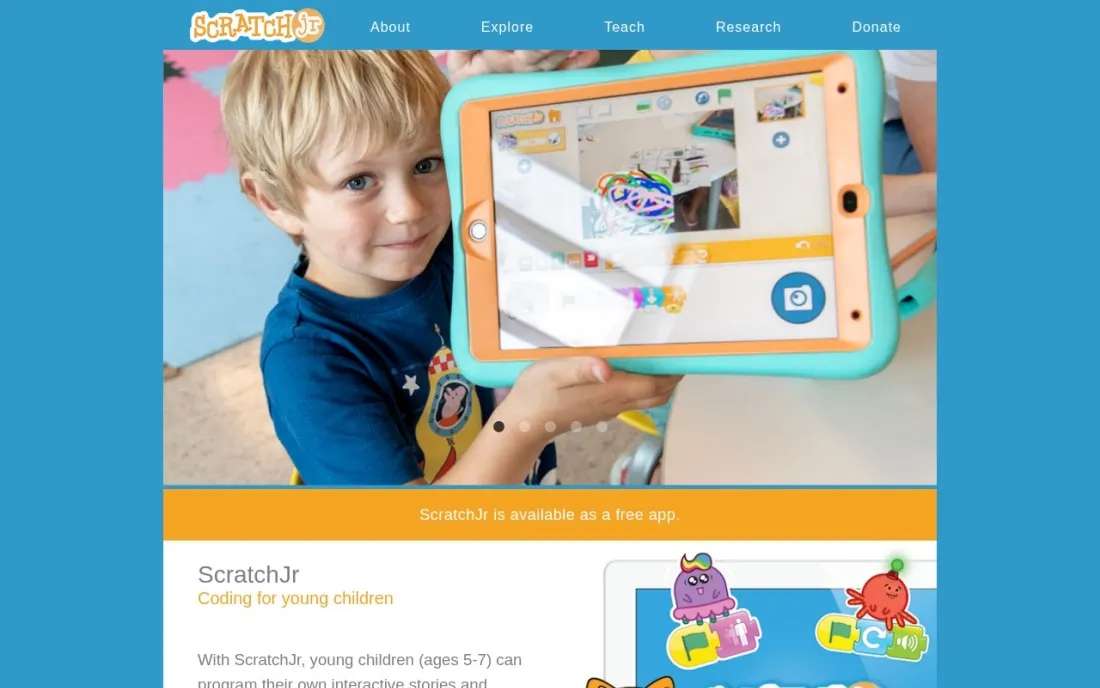
ScratchJr is the one app in this list where the child makes something. Children snap together picture blocks to make characters move, talk and react, building their own interactive stories, games and animations. It was made for ages 5 to 7, started as a project of the MIT Media Lab, Tufts University and Playful Invention Company, and is now maintained by the Scratch Foundation.
It is a free app for iPads, Android tablets and Chromebooks. The trade-off is structure: there are no levels, rewards or progress reports, so it works best when a parent suggests a small project, such as a cat that walks across a park. Once your child is reading well, the next step is Scratch on the web.
What we like
- Free coding app made for ages 5 to 7, with picture blocks that need no reading
- Children create interactive stories, games and animations rather than following set lessons
- Started at the MIT Media Lab and Tufts University; now maintained by the Scratch Foundation
- Runs on iPads, Android tablets and Chromebooks
Watch out for
- No guided curriculum or progress tracking, so a parent or teacher needs to set small challenges
- Covers coding and storytelling only, not reading or math practice

Starfall
Best for: Families on a budget who want classroom-tested phonics for the whole household
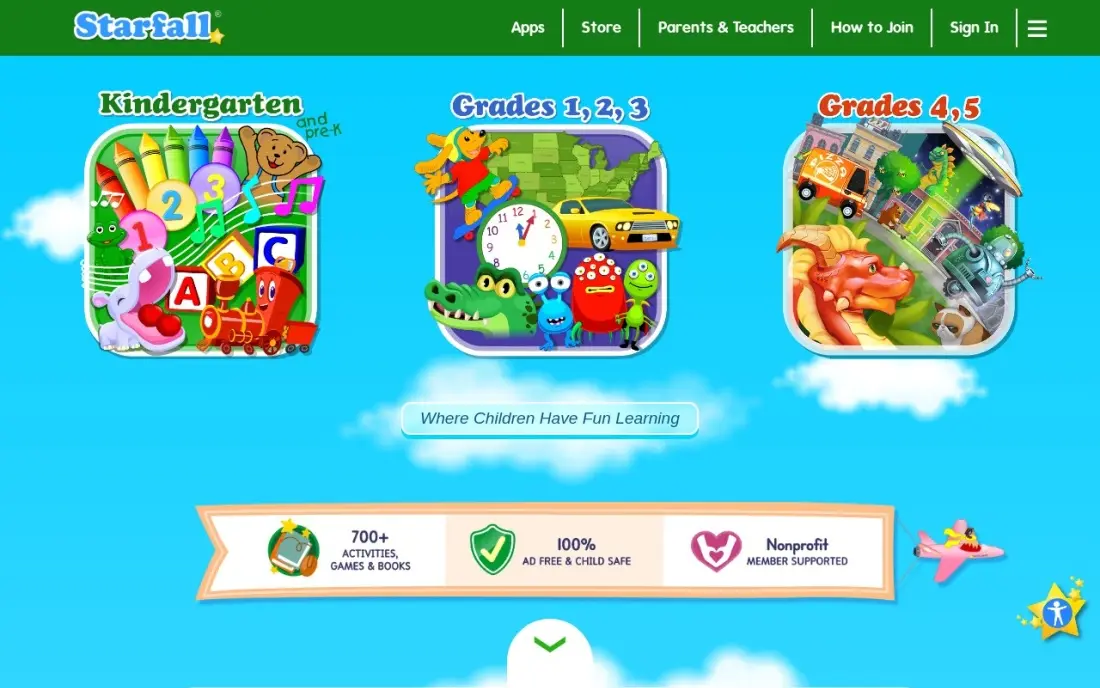
Starfall is the cheapest paid app here and one of the most trusted in classrooms. A nonprofit since 2002, it teaches phonics through songs, games and stories, and a Home Membership unlocks more than 700 activities for the whole household on any computer, tablet or phone. The free tier covers the alphabet and basic reading games.
Buy it the right way. The Home Membership costs $35 a year on the Starfall website, while the in-app subscription is $5.99 a month, or about $72 a year, more than twice as much. The design looks older than newer apps and the math section is thin, but the phonics is sound.
What we like
- The cheapest paid option here: a $35 a year Home Membership unlocks 700+ activities
- Nonprofit phonics program used in classrooms since 2002, trusted by teachers
- Free tier covers the alphabet and basic reading games, so you can try before paying
- Membership covers the whole household on any computer, tablet or phone
Watch out for
- The $35 a year Home Membership must be bought on the website, not in the app
- The app subscription costs $5.99 a month, which is more than twice the membership's monthly equivalent
- Design and games feel older than newer apps, and the math section is thin
Teach Your Monster to Read
Best for: Children aged 3 to 6 who will practise phonics happily if it feels like a game
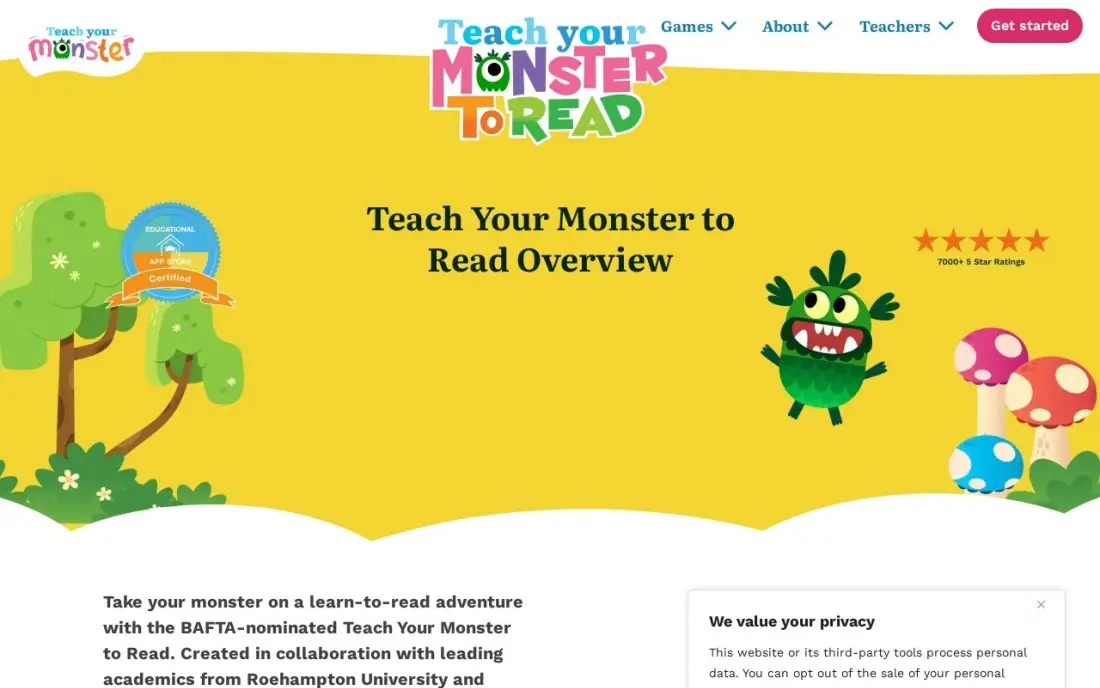
Teach Your Monster to Read wraps phonics in a game: the child designs a monster and guides it through three games, First Steps, Fun With Words and Champion Reader, that teach letter sounds, blending and early reading. It was built with academics from Roehampton University by the Usborne Foundation, a charity, and it is free to play in full on a computer.
The mobile app costs $8.99 once, with no ads and no in-app purchases, but the makers say the app moves to a subscription model in early 2027, so the one-time price will not last. It ends where fluent reading starts, so plan the next app before your child finishes it.
What we like
- Three phonics games (First Steps, Fun With Words, Champion Reader) built with Roehampton University academics
- Free to play in full on a computer, with no ads and no in-app purchases anywhere
- A single one-time app purchase covers all three games, with no subscription on the current version
- Made by a charity, the Usborne Foundation, and used by more than 50 million children
Watch out for
- The app moves to a subscription model in early 2027, so the one-time price will not last
- The game covers phonics and early reading only; there is no library for fluent readers
- No parent dashboard with detailed progress reports on the current version
Homer
Best for: Parents who want a reading plan shaped around one child's level and interests
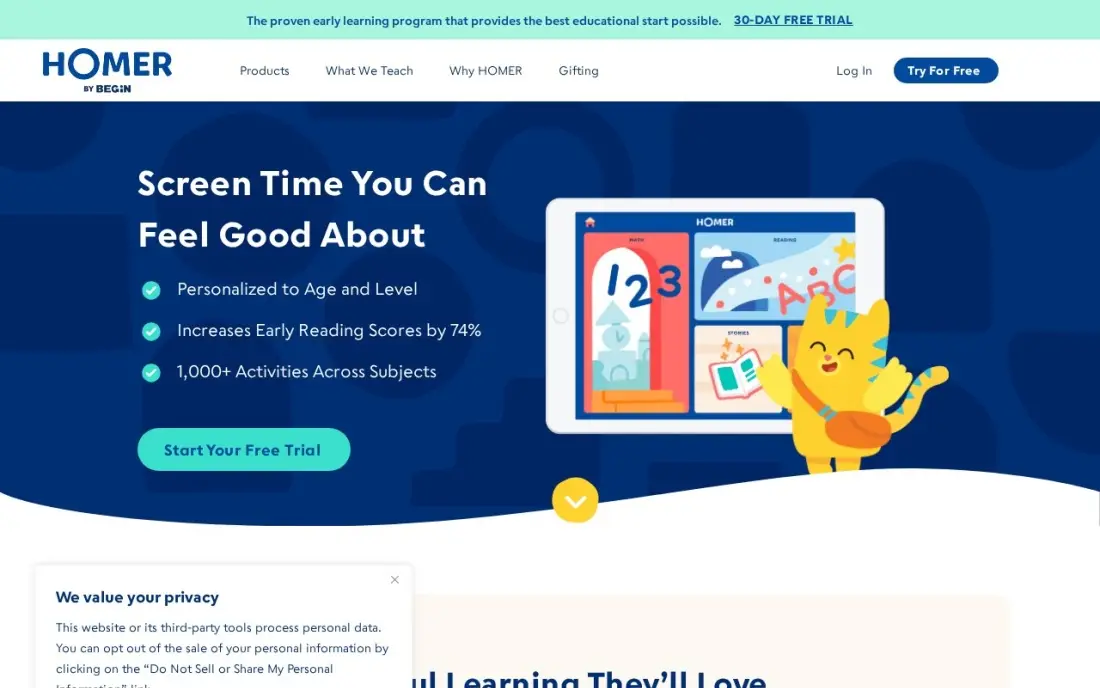
Homer starts with a short quiz about your child's age and interests, then serves a personalised plan from more than 1,000 lessons in phonics, sight words and the alphabet. Up to 4 children can have profiles, the app works offline, and the parent dashboard tracks progress and prints practice sheets.
There is no free plan, but the 30-day free trial is the longest here. Billing choice matters more than with any other app: $9.99 a month adds up to $119.88 a year, while the annual plan is $59.99, half the price. Some parents report glitches and slow support in public reviews, so test it on your own device during the trial.
What we like
- 1,000+ lessons built around phonics, sight words and the alphabet, personalized to the child
- Up to 4 child profiles, with a parent dashboard and printable practice sheets
- Works offline, so reading practice does not need a connection
- 30-day free trial, longer than most apps in this list
Watch out for
- Monthly billing at $9.99 is double the annual equivalent of $4.99 a month
- The library is smaller than Epic's or ABCmouse's, and it leans on its own stories
- Some parents report app glitches and slow customer support in public reviews
The best apps for kids teach something real, keep a young child interested for ten to twenty minutes, and do it without ads or tricks that push parents to spend. We compared nine learning apps for ages 2 to 8 across reading, math, play-based learning and first coding, judging each on what a child actually learns, how much of it is free and what a family pays over a year. Every price below was checked on the vendor's own pages in November 2026.
How to choose the best apps for kids
- Match the app to the age, not the marketing. Most apps here start at 2 and stop around 8, but Duolingo ABC tops out at first grade and ScratchJr is built for 5 to 7.
- Check for ads and in-app purchases. Khan Academy Kids and Duolingo ABC have neither; free tiers on other apps are often a preview that nudges toward a subscription.
- Decide between one broad app and a few focused ones. ABCmouse, Lingokids and Khan Academy Kids cover many subjects; Starfall, Homer and Teach Your Monster to Read go deeper on reading.
- Look at what parents can see. A progress dashboard tells you whether the app is teaching or just entertaining; Duolingo ABC and ScratchJr have none.
- Count child profiles. ABCmouse covers up to 3 children, while Epic, Lingokids Plus and Homer allow up to 4 on one subscription.
- Buy where it is cheapest. Lingokids and Starfall both cost less on their own websites than through the app store.
Choosing apps for a family is a small version of the comparison work we do for businesses every week. If you run an education brand and want parents to find it when they search, our SEO audit shows what is holding the site back, and our guide to the best learn-to-read apps for kids goes deeper on phonics.
Kids app pricing: what you will actually pay
Take a family with one 5-year-old who wants a reading app and a broad learning app for a year. The free route costs $0: Khan Academy Kids for the broad curriculum, Duolingo ABC for phonics and ScratchJr for making things.
The cheapest paid route is Starfall at $35 a year on its website, plus Homer at $59.99 a year: $94.99 in total. The same two apps bought monthly in the app would cost about $72 for Starfall at $5.99 a month and $119.88 for Homer at $9.99 a month, roughly $192, or about twice as much. A big all-in-one app sits higher: ABCmouse is $14.99 a month, which is $179.88 a year on monthly billing, while its annual plan is $45 for the first year and $79.99 after that. Lingokids Plus is $161.88 a year when bought on its website. Epic Unlimited adds $9.99 a month if your child needs a library of books on top.
Know the difference: curriculum apps vs creative apps
Curriculum apps lead the child through lessons someone else designed. Khan Academy Kids, ABCmouse, Lingokids, Homer and Starfall decide what comes next, adjust the level, and report progress to parents. They are the right choice when you want steady practice in reading or math and a way to check it is working.
Creative apps hand the child tools instead of lessons. ScratchJr gives no levels or rewards at all; the child decides what to build and learns sequencing and problem solving along the way. Epic sits between the two, a library the child explores freely. Most families do best with one of each: a curriculum app for daily practice and an open-ended app for weekend projects.
Quick comparison: tool type by need
| Need | Best pick | Why |
|---|---|---|
| One free app for everything | Khan Academy Kids | Reading, math and more for ages 2 to 8, no ads or purchases |
| Big paid curriculum | ABCmouse | 13,000+ activities, up to 3 children, $79.99/year after year one |
| Play-based learning for toddlers | Lingokids | 4,000+ games and songs, screen-time limits on Plus |
| Books for new readers | Epic | 40,000+ books and audiobooks, Unlimited $9.99/month |
| Free phonics | Duolingo ABC | 700+ lessons, offline, no ads |
| First coding | ScratchJr | Free picture-block coding for ages 5 to 7 |
| Cheapest paid reading app | Starfall | $35/year on the website for the household |
| Phonics as a game | Teach Your Monster to Read | Free on a computer, $8.99 one-time app |
| Personalised reading plan | Homer | Adapts to one child, $59.99/year |
Mistakes to avoid
- Paying before trying the free options. Khan Academy Kids and Duolingo ABC cost nothing and cover more than many paid apps.
- Subscribing inside the app by default. Starfall's in-app price is more than double its website membership, and Lingokids is cheaper on its own site too.
- Forgetting the renewal price. ABCmouse's $45 first year renews at $79.99, so put a reminder in your calendar before the second year starts.
- Buying a library for a child who cannot read yet. Epic is excellent once a child can decode words, and frustrating before that.
- Leaving the child alone with the app. Ten minutes of play followed by a chat about what they learned does more than an hour of tapping.
Related comparisons: Learning Apps for Kids · Language Apps for Kids · Apps for Kids to Learn English · Apps for Kids to Learn Math
How we chose
We started from apps aimed at ages 2 to 8 that teach a clear skill, then checked each one's pricing on its own website or official listing in November 2026, recording monthly and yearly prices exactly as shown and noting where app-store prices differ. We weighted free access, the absence of ads and in-app purchases, parent visibility and value over a year. We did not add review scores, because the store ratings for children's apps mix parent and child opinions and change daily. No vendor paid for a place in this list, and none of the links here are affiliate links.
What to do next
Install Khan Academy Kids this week and sit with your child for the first three sessions. If one skill, usually reading, needs more help after a month, add one focused app from this list on a free trial before paying. If you build apps or courses for children and want more families to find them, book a free SEO call.
Frequently asked questions
What are the best apps for kids?
Khan Academy Kids is the best all-round app for ages 2 to 8 and it is completely free. Add Duolingo ABC for phonics and ScratchJr for first coding projects, both free. If you want a paid curriculum, ABCmouse and Lingokids are the broadest, and Starfall is the cheapest at $35 a year on its website.
Are there good free apps for kids with no ads?
Yes. Khan Academy Kids and Duolingo ABC have no ads, no subscriptions and no in-app purchases. ScratchJr is a free app, and Teach Your Monster to Read is free to play in full on a computer. Epic, ABCmouse, Lingokids and Starfall also have limited free tiers.
How much do paid kids learning apps cost?
On the prices we checked, Starfall is $35 a year on its website, Homer is $59.99 a year or $9.99 a month, Epic Unlimited is $9.99 a month, Lingokids Plus is $13.49 a month on its website and ABCmouse is $14.99 a month or $79.99 a year after a $45 first year.
What is the best app for a 3-year-old?
Khan Academy Kids, ABCmouse and Lingokids all start at age 2, and Teach Your Monster to Read starts at 3. For a 3-year-old, a free app such as Khan Academy Kids is the sensible first try, with short sessions and a parent nearby.
What is the best coding app for young kids?
ScratchJr is the best starting point for ages 5 to 7. It is free on iPads, Android tablets and Chromebooks, uses picture blocks that need no reading, and lets children build their own stories and games.
Should I pay monthly or yearly for a kids app?
Yearly, once you know your child uses the app. Homer costs $59.99 a year against $119.88 on monthly billing, and Starfall's $35 web membership compares with about $72 a year for its $5.99 monthly in-app plan. Use the free tier or trial for a few weeks first.
Which kids apps work without Wi-Fi?
Duolingo ABC is the best free choice: its 700+ phonics and reading lessons work offline, with no ads and no in-app purchases. Homer also works offline, with up to 4 child profiles, at $9.99 a month after a 30-day free trial. Lingokids adds offline mode on its Plus plan, along with screen-time limits. Epic does not offer offline mode for the full library on every device.
Sources we checked (9)
- Khan Academy Kids — www.khanacademy.org/kids/pricing (checked November 4, 2026)
- ABCmouse — www.abcmouse.com/learn/abcmouse/abcmouse-vs-homer/11387 (checked November 4, 2026)
- Lingokids — help.lingokids.com/hc/en-us/articles/115005120505-What-is-the-Price-and-currency-for-Lingokids-Plus (checked November 4, 2026)
- Epic — www.getepic.com/pricing (checked November 4, 2026)
- Duolingo ABC — www.duolingo.com/abc (checked November 4, 2026)
- ScratchJr — www.media.mit.edu/projects/scratchjr/overview (checked November 16, 2026)
- Starfall — store.starfall.com/membership (checked November 4, 2026)
- Teach Your Monster to Read — www.teachyourmonster.org/teach-your-monster-to-read-overview (checked November 4, 2026)
- Homer — www.learnwithhomer.com (checked November 4, 2026)
Make one of these tools?
We re-check this list every quarter. Send a correction, request a review, or ask about a clearly labeled sponsored spot.
Request a listingShamim
Founder of SerpAstra
A full-stack digital marketer and SEO strategist covering technical and local SEO, AI search visibility, paid ads and lead generation for local businesses, e-commerce brands and SaaS teams.
Free SEO and AI visibility audit
Find out what is holding your rankings back
Send us your site. Within 2 business days you get a written audit, an AI visibility check and a short fix list ranked by impact. Free, with no contract attached.
Request my free audit→Related buying guides
 Education & E-Learning10 Best Learn to Read Apps for Kids in 2026: Free and Paid Apps RankedCompare the 10 best learn to read apps for kids for ages 2 to 8 on price, free plans and phonics teaching, with every price checked November 4, 2026.Read guide →
 Business SoftwareBest Spanish Learning Apps for Kids (2026): 9 Apps Worth DownloadingCompare the 9 best spanish learning app for kids on price, free tiers, ages and speaking practice, with every price checked November 4, 2026.Read guide →
 IT Security11 Best Cross-Platform Parental Control Apps in 2026, ComparedCompare the 11 best cross-platform parental control apps on price, device coverage and monitoring, with every price checked November 7, 2026.Read guide →