
9 Best Computer Aided Dispatch Software in 2026, Compared
Compare the 9 best computer aided dispatch software options for 2026, with real contract costs, cloud vs on-premise choices and no published prices explained.
 Shamim Mia, Founder, SerpAstraLast verified November 7, 202613 min read
We compare pricing pages, documentation and public reviews. We never accept payment for rankings.

Key takeaways
- Motorola CommandCentral leads for large agencies on Motorola radios, Hexagon follows for multi-agency regional centers, and Mark43 is the cloud-native pick — all three sell on custom quote only.
- No vendor in this list publishes a starting price and none offers a free plan, so every purchase starts with a demo, a bid and a quoted contract.
- The single most important buying factor is agency size: a platform built for a metro PSAP will swamp a 20-person department, and a small-agency tool will stall under metro call volume.
- Budget for five years, not year one: implementation, interfaces, training and annual maintenance add substantially to the licence cost.
On this page
Quick comparison
| Tool | Best for | Starting price | Free plan |
|---|---|---|---|
| Motorola CommandCentral | Large agencies and regional centers already on Motorola radios that want one vendor from call to field | Custom quote | No (demo only) |
| Hexagon | Multi-agency and regional centers that need GIS-first dispatch and NG9-1-1 readiness | Custom quote | No (demo only) |
| Tyler Technologies | Cities and counties standardizing on the Tyler public safety suite | Custom quote | No (demo only) |
| Mark43 | Agencies moving from legacy on-premise CAD to a cloud-native platform | Custom quote | No (demo only) |
| CentralSquare | Mid-size agencies that want the largest US installed base and cloud or on-premise choice | Custom quote | No (demo only) |
| Zetron | Control rooms that need radio dispatch, call handling and CAD from one vendor | Custom quote | No (demo only) |
| Caliber Public Safety | Law enforcement agencies that want CAD plus RMS and jail management from one vendor | Custom quote | No (demo only) |
| Southern Software | Small and rural agencies that need real CAD at a price a town council can approve | Custom quote | No (demo only) |
| Omnigo | Agencies that need dispatch alongside incident reporting and records | Custom quote | No (demo only) |
Make one of these tools?
We re-check this list every quarter. Send a correction, request a review, or ask about a clearly labeled sponsored spot.
Request a listingThe best computer aided dispatch software

Motorola CommandCentral
Best for: Large agencies and regional centers already on Motorola radios that want one vendor from call to field
Motorola's CommandCentral suite is the closest thing public safety has to a default choice, with PremierOne CAD at its center. Call handling, CAD, radio, records and analytics come from one vendor, so a large agency deals with a single supplier from the first 911 call to the final report. Motorola counts more than 130 PremierOne systems and over 142 million calls for service.
The price is enterprise: no published starting price, no free tier, and implementations run for months. A Chula Vista council record put the initial PremierOne CAD and mobile system at $1,305,270. Buy it when the operation is large and the radio fleet is Motorola; smaller agencies will find what they need in CentralSquare or Southern Software for far less.
What we like
- PremierOne CAD proven at metro scale, with more than 130 systems and 142 million calls, per Motorola
- One vendor from VESTA 9-1-1 call handling to radios, records and analytics
- Esri ArcGIS mapping with automated unit recommendation and real-time tracking
- Cloud and on-premise deployment, including PremierOne Cloud CAD on Azure Government
Watch out for
- Quote-only enterprise pricing, with six-figure contracts and long implementations
- Strongest for agencies already invested in Motorola radios and CommandCentral
- Configuration and training take months, not weeks, for a large center

Hexagon
Best for: Multi-agency and regional centers that need GIS-first dispatch and NG9-1-1 readiness
Hexagon's HxGN OnCall Dispatch is built for centers where police, fire and EMS from several jurisdictions share one queue. Its GIS heritage shows in the mapping: incident locations, unit positions and hazard layers sit on one screen. Kitsap 911 chose it for 13 agencies handling over 300,000 calls a year, and Hamburg runs it for police and fire across 1.8 million residents.
The platform is NG9-1-1-ready with accurate mobile caller location, and cloud deployment is now available alongside on-premise. Pricing is quote-only with no published starting price and no free tier. Buy Hexagon when the dispatch problem is genuinely complicated — many agencies, many disciplines, one screen. A single-county center will find the cost and complexity hard to justify.
What we like
- GIS-first design with strong mapping, location intelligence and multi-jurisdiction workflows
- Chosen by Hamburg for 1.8 million residents and Kitsap 911 for 13 agencies
- NG9-1-1-ready with accurate mobile caller location
- Cloud and on-premise deployment, with OnCall Analytics for performance reporting
Watch out for
- Enterprise pricing and long sales cycles with no published starting price
- Configuration needs experienced implementers and a multi-month project
- Interface can feel dated next to cloud-native rivals

Tyler Technologies
Best for: Cities and counties standardizing on the Tyler public safety suite
Tyler's Enterprise CAD and New World CAD make the most sense inside a Tyler shop. When CAD, records, mobile and jail management share one data model, officers stop retyping the same incident three times. The Missouri State Highway Patrol runs it across nine dispatch centers for 1,300 troopers, and Michigan's Upper Peninsula 911 Authority deployed it across eight counties on AWS GovCloud.
Pricing is quote-only, with no published starting price and no free tier. A Moore, Oklahoma, proposal put the Tyler Enterprise product alone at about $952,000. Buy Tyler when the city wants the suite, not just the CAD: the integration dividend is real, but leaving the suite later is expensive, so press on the roadmap before signing.
What we like
- CAD integrates tightly with Tyler RMS, mobile, corrections and analytics products
- Esri ArcGIS mapping with proximity dispatching and automatic vehicle location
- Deployed for the Missouri State Highway Patrol and across eight Michigan counties
- Fire Prevention Mobile shares pre-plan data such as hazards and suppression systems
Watch out for
- Quote-only pricing with no published starting price
- Suite lock-in makes future switching expensive
- Some agencies report slow feature delivery; implementation commonly takes 12 to 18 months

Mark43
Best for: Agencies moving from legacy on-premise CAD to a cloud-native platform
Mark43 is the cloud-native challenger in this list. Dispatch, records and analytics share one real-time platform that updates itself, so the IT department stops babysitting CAD servers and implementations are measured in weeks rather than months. More than 300 agencies use it, including Dallas and Boston, and AI features include call transcription and analytics.
Pricing is quote-only with no published starting price and no free tier, and the platform is cloud-only. Buy Mark43 when speed and usability matter most and the agency can host dispatch in the cloud. Agencies that must keep data on their own servers, or with strict data-sovereignty rules, should confirm the architecture satisfies their policies before shortlisting.
What we like
- True cloud-native platform with automatic updates and deployments measured in weeks
- AI features include call transcription and analytics on the entry platform
- More than 300 agencies on the platform, including Dallas and Boston
- Dispatch, records and analytics share one real-time data foundation
Watch out for
- Quote-only pricing with no published starting price
- Cloud-only: agencies needing on-premise deployment will not find it here
- Less proven than the incumbents at the very largest metro scale

CentralSquare
Best for: Mid-size agencies that want the largest US installed base and cloud or on-premise choice
CentralSquare claims the largest footprint in US public safety software, and its CAD covers the full incident lifecycle from the 911 call to the final report. Cloud-hosted or on-premise deployment comes from the same platform, with advanced GIS mapping, automated unit recommendation and CAD-to-CAD links for shared situational awareness across jurisdictions.
Pricing is quote-only with no published starting price and no free tier. The portfolio grew through acquisitions, so buyers should confirm exactly which CAD product a bid covers — Enterprise CAD is the current flagship — and ask for references running that exact product. For a mid-size agency, the installed base means peer references are easy to find.
What we like
- Massive installed base with deep public safety domain knowledge
- Cloud-hosted or on-premise deployment from the same platform
- CAD-to-CAD integration and cross-jurisdiction coordination for mutual aid
- NG9-1-1-ready with advanced unit recommendation and real-time performance metrics
Watch out for
- Quote-only pricing with no published starting price
- Several CAD product lines live under one roof after years of acquisitions
- Less proven than Motorola or Hexagon at mega-PSAP scale

Zetron
Best for: Control rooms that need radio dispatch, call handling and CAD from one vendor
Zetron approaches dispatch from the communications side. Its MAX platform combines IP-based radio dispatch, NG9-1-1 call taking, voice logging, fire station alerting and MAX CAD in one system, so a control room buys the whole chain from one supplier. The company has served mission-critical communications since 1980, with thousands of installations across public safety, transportation and utilities.
MAX CAD scales from two to more than 22 console positions and supports multi-jurisdiction and multi-agency workflows, with an open REST API and CAD-to-CAD links. Pricing is quote-only with no published starting price and no free tier. Buy Zetron when dispatch is a communications problem first; CAD-only buyers should confirm the CAD module gets the development attention it needs.
What we like
- Integrated radio dispatch, call handling, alerting and CAD from one vendor
- MAX CAD scales from two to more than 22 console positions
- Long track record since 1980, with thousands of installations worldwide
- Open REST API with CAD-to-CAD interoperability and NCIC links
Watch out for
- Quote-only pricing with no published starting price
- Product breadth can mean CAD is not the star of the portfolio
- Smaller marketing presence than the big CAD-first vendors

Caliber Public Safety
Best for: Law enforcement agencies that want CAD plus RMS and jail management from one vendor
Caliber has served US law enforcement since the 1970s, and its platform covers the core chain: CAD for dispatch, mobile for the field, RMS for records and JailTracker for corrections. The latest CAD release adds next-generation ESRI ArcPro mapping with live weather and wildfire layers, direct NCIC queries inside the dispatcher workspace, and hosted deployment at Nlets.
Pricing is quote-only with no published starting price and no free tier. The company is now part of the Harris Operating Group, so buyers should ask how the roadmap and support have changed under new ownership. For a sheriff's office or municipal police department, Caliber's law-enforcement focus shows in the details — and its Insight LS tool scores calls against NENA and APCO standards.
What we like
- Integrated CAD, mobile, RMS and jail management built for law enforcement
- ESRI ArcPro mapping with live weather and wildfire layers, plus direct NCIC queries
- Trusted by more than 300 agencies nationwide, per Caliber
- Hosted deployment at Nlets, meeting FBI CJIS security requirements
Watch out for
- Quote-only pricing with no published starting price
- Product modernization pace is worth probing in a live demo
- Strongest in law enforcement, thinner for fire and EMS workflows

Southern Software
Best for: Small and rural agencies that need real CAD at a price a town council can approve
Southern Software has served smaller public safety agencies since 1988, with CAD, records, mapping, mobile and jail management in one suite. The CAD handles multi-jurisdictional dispatch with standardized call handling, E-911 with Phase II wireless compliance, integrated mapping with location verification, and NCIC inquiries. In April 2026 Wythe County, Virginia, launched it for a six-county regional standardization.
Pricing is quote-based, but public bids show the entry point: one full CAD position was priced at $18,894, including software, project management and first-year support. That is the lowest documented entry in this list by a wide margin. Buy Southern Software when the agency is small and the budget is real; a 500-seat regional center should look at the enterprise vendors instead.
What we like
- CAD, RMS, mapping, mobile and jail in one affordable suite, in service since 1988
- A public bid priced one full CAD position at $18,894 including first-year support
- Integrated E-911 with Phase II wireless compliance and NCIC inquiries
- Responsive support reputation among small agencies
Watch out for
- Pricing is not public, though public bids show the lowest entry in this list
- Less suited to very large or multi-state operations
- Interface reflects its long history in places

Omnigo
Best for: Agencies that need dispatch alongside incident reporting and records
Omnigo sits at the intersection of dispatch and incident management. Its web-based Dispatch software helps public safety and security teams coordinate responses in real time, and incident data flows straight into Report Exec and records without re-entry. More than 2,700 organizations use Omnigo, including over 800 public safety and courts customers, and Warr Acres Police Department has run it for over 20 years.
Pricing is quote-only with no published starting price and no free tier, and deployment is cloud or on-premise. On G2 it scores 4.2 out of 5 from 59 reviews, checked November 7, 2026 — the only usable CAD-relevant rating in this list. Buy Omnigo when dispatch must blend with wider incident management; pure 911 centers should verify its CAD depth against a dispatch-first workflow.
What we like
- Combines dispatch with incident reporting, records and case management
- Web-based dispatch with real-time updates and quick data access for officers
- Cloud and on-premises deployment options
- Rated 4.2 out of 5 on G2 from 59 reviews, checked November 7, 2026
Watch out for
- Quote-only pricing with no published starting price
- Serves several markets beyond public safety, so CAD depth needs verifying
- Some reviewers report the dispatch module can be slow or crash
The best computer aided dispatch software is the system a 911 center can run at 3 a.m. without thinking about it: the call comes in, the right units are recommended, the rigs roll, and every unit shows on the map until the incident closes. We ranked the nine tools below by fit for the most common buyer — a 911 center, police department, fire district or EMS agency buying CAD for emergency response — starting with the large metro platforms and ending with the small-agency and incident-management options, and we checked every vendor's own product page on November 7, 2026.
How to choose the best computer aided dispatch software
- Start with agency size and call volume. Large metro PSAPs should evaluate Motorola, Hexagon and Mark43. Mid-size agencies should look at CentralSquare, Tyler and Caliber. Small and rural agencies should talk to Southern Software and Omnigo. Buying a six-figure enterprise platform for a 20-person department wastes money; buying a small-agency tool for a metro PSAP wastes the implementation.
- Require a live pilot with your own data. CAD demos always look good; the test is your call types, your map data, your station alerting and your mutual-aid agreements. Ask for a sandbox or guided pilot with real agency data before signing. Every vendor here offers demos for verified agencies, so there is no excuse to buy blind.
- Check the deployment model before you fall in love. Mark43 is cloud-only, Motorola, Hexagon, Tyler, CentralSquare, Caliber and Omnigo offer cloud or on-premise, and Zetron's MAX platform covers both. An agency that must keep dispatch on its own servers should shortlist accordingly.
- Plan for the total cost, not the licence. Implementation, training, hardware, interfaces to records and alerting systems, and annual maintenance add substantially to the base price. Ask each vendor for a five-year total cost of ownership including interfaces, and talk to reference agencies of similar size about what the project really cost.
- Check the workflows for your discipline, not just generic dispatch. Police CAD needs priors, BOLOs and NCIC queries in the call window; fire CAD needs station alerting and apparatus recommendations; EMS CAD needs medical priority dispatch. A platform built for one discipline can technically handle the others, but the daily friction shows.
CAD is one system in the emergency stack, not the whole stack. If the agency also needs to be found by the public it serves, our local SEO service covers how a municipal department shows up on Google Maps and in AI answers. And before the department publishes new public pages, run the titles through the free SERP snippet preview tool — it shows exactly how the title and description will look in Google.
Whatever you shortlist, run it with real data before you sign. The demos in this list are long enough to dispatch your genuine call types through the system — your stations, your apparatus, your mutual-aid partners — and that trial tells you more than any brochure can. Check three things in the pilot: that unit recommendations match what your captains would send, that station alerting fires correctly on every tone-out, and that the map carries your hydrant and pre-plan data without manual fixes.
Computer aided dispatch software pricing: what you will actually pay
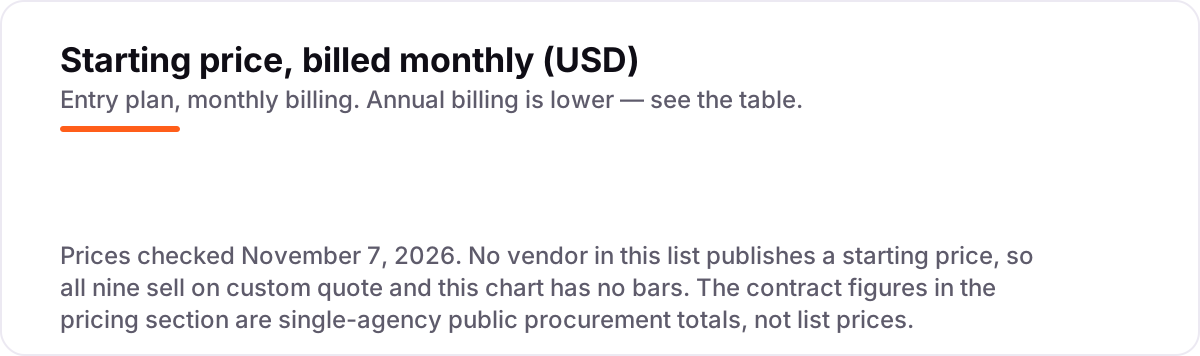
No vendor in this list publishes a starting price, so the honest way to price a purchase is from public contracts, where the numbers are on the record. At the small end, a public bid priced one Southern Software CAD position at $18,894, including the software, project management and first-year support — a single position for a small agency, not a whole center. At the mid-market end, Moore, Oklahoma, was quoted about $952,000 for the Tyler Enterprise product alone, with hardware of $125,000 to $130,000 on top and a near-term total of roughly $700,000 to $800,000 depending on scope.
At the metro end, the numbers jump again. Chula Vista, California, approved an initial PremierOne CAD and mobile system from Motorola at $1,305,270, with a 10-year lease paying about $170,238 a year, and Little Rock, Arkansas, renewed PremierOne CAD maintenance and support for a five-year term totaling $2,854,306. That spread — $18,894 for one small-agency position against more than $1.3 million for a metro rollout, plus nearly $2.9 million in five-year maintenance — is the whole pricing story: the licence is only the entry ticket.
Three costs sit outside every number above. First, interfaces: CAD-to-CAD links, records interfaces, station alerting and radio integrations are usually priced separately. Second, data work: map data, hydrant and pre-plan imports, and call-type configuration are billed as professional services. Third, the annual tail: maintenance and subscription renewals run every year, so a five-year total is the number the council should approve, not the year-one figure. For the dispatch-adjacent side of the operation, our guide to taxi dispatch software shows how a different dispatch market prices the same problems.
Know the difference: CAD vs RMS vs station alerting
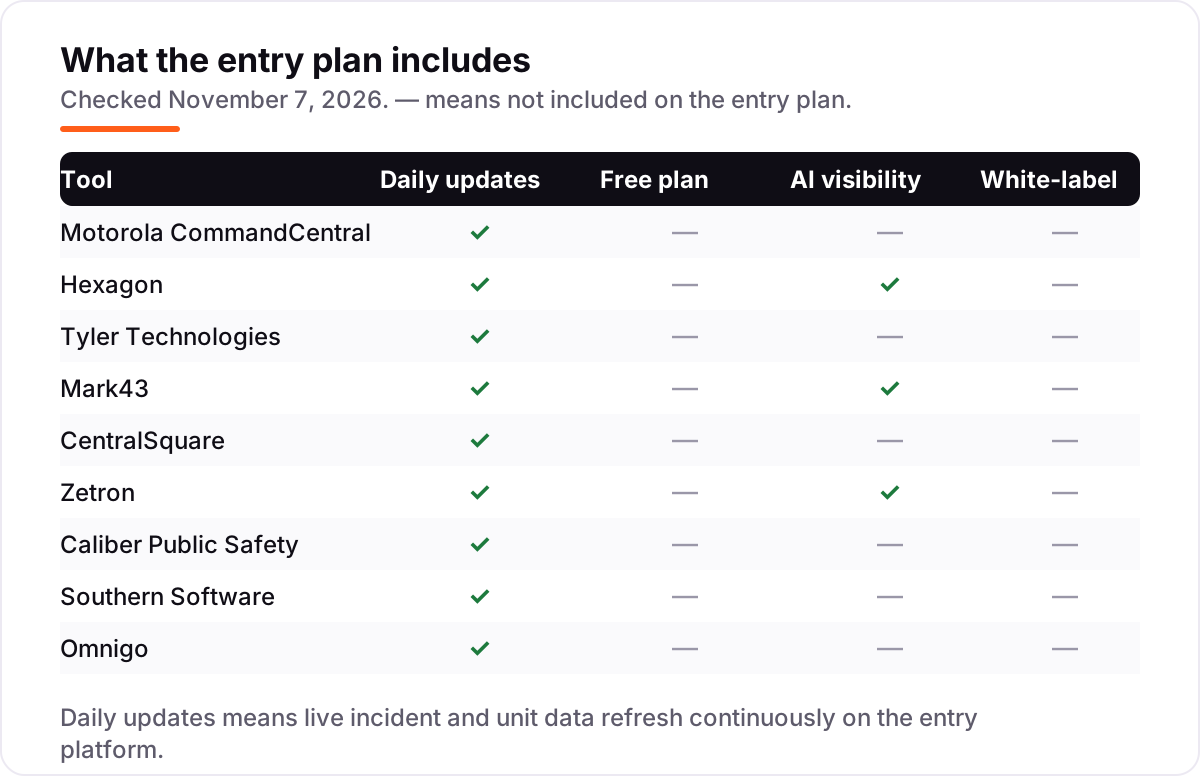
The confusion in this category is between three systems that work together but do different jobs. CAD manages live incidents: taking the call, recommending units, dispatching them, tracking responders on a map and logging everything until the incident closes. RMS, records management, stores the permanent record: reports, investigations, NFIRS statistics and the history the department keeps for years. Station alerting is the third piece: the tones, lights and voice announcements that wake a station and send a crew to the apparatus.
An agency can buy all three from one vendor — Motorola, Tyler, CentralSquare, Mark43, Caliber, Southern Software and Omnigo all sell CAD with records — or mix vendors and connect them with interfaces. The mixed route works, but every interface is a cost, a delay and a failure point, which is why the integration between live dispatch data and the permanent record is a key buying criterion. If a vendor's CAD cannot push incident data into the agency's RMS without re-entry, the dispatcher pays for that gap on every call.
There is a second, quieter confusion: mapping add-ons are not CAD. A mapping tool shows where units are; it does not take calls, recommend units, alert stations or keep the incident log. Hexagon's OnCall mapping is strong, but it is the mapping layer around OnCall Dispatch, not a replacement for it. If a tool only maps, it belongs in a different list.
Quick comparison: tool type by need
| Buyer | Best pick | Why |
|---|---|---|
| Large metro PSAP on Motorola radios | Motorola CommandCentral | Deepest radio integration, custom quote, proven at metro scale |
| Multi-agency center needing strong GIS | Hexagon | GIS-first enterprise CAD, custom quote, NG9-1-1-ready |
| Municipality standardizing on Tyler | Tyler Technologies | Dispatch inside the Tyler suite, custom quote, Esri mapping |
| Agency modernizing to the cloud | Mark43 | Cloud-native with AI features, custom quote, 300+ agencies |
| Mid-size agency wanting flexibility | CentralSquare | Cloud or on-premise, custom quote, mutual-aid interoperability |
| Control room needing radio plus CAD | Zetron | Radio dispatch, call handling and CAD in one, custom quote |
| Small or rural agency | Southern Software | Lowest documented entry, custom quote, in service since 1988 |
Mistakes to avoid
- Budgeting on the licence price alone. The licence is the smallest part of a five-year CAD cost. Implementation, interfaces, training, hardware and annual maintenance are where the money goes, so get a five-year total in writing before the council votes.
- Buying on the demo, then finding the discipline workflows cost extra. A CAD demo shows generic dispatch; the discipline-specific pieces — station alerting, apparatus recommendations, NCIC queries, medical priority dispatch — are where the gaps hide. Demo those workflows with your own call types.
- Ignoring the deployment model. A cloud-only platform is the wrong buy for an agency that must keep dispatch on its own servers, and a client-server platform is the wrong buy for an agency with no IT staff. Decide the model before the shortlist, not after it.
- Skipping the reference calls. Every vendor can name a happy customer. Call three agencies your size that have run the system for two years, and ask what the implementation really cost and what broke in year one.
- Forgetting the interfaces. CAD that cannot talk to the records system, the alerting system and the neighboring county's CAD creates manual work on every shift. Price every interface in the bid, and confirm who maintains it when one side upgrades.
How we chose
We checked each vendor's own product page on November 7, 2026 and recorded the starting price exactly as shown — in every case, no price is published, so every tool here is listed as a custom quote, and the contract figures in the pricing section come from public procurement records, not from vendor price lists. We ranked the tools by fit for the most common buyer — a 911 center, police department, fire district or EMS agency buying CAD for emergency response — not by brand size. This list carries one review rating: Omnigo scores 4.2 out of 5 on G2 from 59 reviews, checked November 7, 2026. The other ratings were omitted because the G2 and Capterra listings for these products are either for a whole vendor suite rather than the CAD product, or based on a single stale review, and we would rather show no rating than a misleading one. No vendor paid for a place in this list, and none of the links here are affiliate links.
What to do next
Shortlist three vendors by agency size — one enterprise platform, one mid-market option and one small-agency tool — then book a guided demo with each and run your own call types through it. Ask for a five-year total cost in writing, call three reference agencies your size, and confirm the deployment model and every interface before the bid goes to the council. If the agency's public pages also need work, our monthly SEO service handles the visibility side — or compare dispatch options in our guide to fleet dispatch software. Once your tools are in place, find out what's holding your rankings back.
Your stack only works if people find you
SerpAstra fixes what keeps your site off page one and makes it easy for AI assistants to recommend.
Get a free audit→Sources we checked (14)
- Motorola CAD — motorolasolutions.com (checked November 7, 2026)
- Hexagon public safety — hexagon.com (checked November 7, 2026)
- Tyler Technologies Enterprise CAD — tylertech.com (checked November 7, 2026)
- Mark43 — mark43.com (checked November 7, 2026)
- CentralSquare CAD — centralsquare.com (checked November 7, 2026)
- Zetron MAX Systems, MAX CAD — zetron.com (checked November 7, 2026)
- Caliber Public Safety CAD — caliberpublicsafety.com (checked November 7, 2026)
- Southern Software CAD — southernsoftware.com (checked November 7, 2026)
- Omnigo — omnigo.com (checked November 7, 2026)
- Omnigo G2 reviews, 4.2/5 from 59 reviews — g2.com (checked November 7, 2026; rating used)
- Mark43 Capterra listing, 4.0/5 from 1 review — capterra.com (checked November 7, 2026; rating omitted, single 2023 review)
- Southern Software CAD bid, $18,894 for one CAD position — myvendorlink.com (checked November 7, 2026)
- Moore, Oklahoma Tyler Enterprise CAD proposal, about $952,000 — citizenportal.ai (checked November 7, 2026)
- Chula Vista Motorola PremierOne CAD and mobile, $1,305,270 initial system cost — legistar.com (checked November 7, 2026)
Shamim
Founder of SerpAstra
A full-stack SEO and digital marketer who spends most days on Local SEO for dental practices, AI search visibility and lead generation.
Frequently asked questions
What is the best computer aided dispatch software?
Motorola CommandCentral is the best fit for large agencies, especially those already on Motorola radios. Hexagon suits multi-agency centers that need deep GIS, Tyler suits municipalities standardizing on Tyler, Mark43 suits agencies moving to the cloud, and Southern Software is the best value for small departments.
How much does computer aided dispatch software cost?
No vendor publishes a starting price, so every purchase is a custom quote. Public contracts show the range: one Southern Software CAD position was bid at $18,894, a Moore proposal put Tyler Enterprise at about $952,000, and a Chula Vista record put Motorola PremierOne CAD and mobile at $1,305,270.
Is there free computer aided dispatch software?
No. There are no free tiers in this category; every vendor prices by quote and offers guided demos for verified agencies. Open-source options exist, but they lack the certification, support and interfaces that public safety procurement requires, so they do not appear in this list.
What is the difference between CAD and RMS?
CAD manages live incidents: taking calls, recommending and dispatching units, and tracking responders in real time. RMS, records management, stores the permanent record: reports, investigations and statistics. Most vendors sell them together, and the link between live dispatch data and the permanent record is a key buying criterion.
Which CAD is best for a small agency?
Southern Software CAD targets smaller agencies with affordable pricing and an integrated suite, and Caliber's hosted CAD suits small counties too. CentralSquare's cloud tiers also suit mid-size departments. The mega-vendor platforms are built and priced for large PSAPs and will be overkill, and over budget, for a small department.
Should we choose cloud or on-premise CAD?
Cloud CAD removes servers, backups and updates, which suits agencies with little IT staff — Mark43 and Omnigo offer cloud, and Motorola, Hexagon, Tyler and CentralSquare offer both. An agency that must keep dispatch on its own servers should shortlist on-premise options only, and confirm the uptime SLA and offline fallback.
How long does CAD implementation take?
Enterprise CAD implementations commonly take 12 to 24 months from contract to go-live, including data migration, interface building, training and parallel operations. Cloud-native deployments can go faster — Mark43 measures implementations in weeks. Ask each vendor for reference timelines from agencies your size before signing the contract.
Free SEO and AI visibility audit
Find out what is holding your rankings back
Send us your site. Within 2 business days you get a written audit, an AI visibility check and a short fix list ranked by impact. Free, with no contract attached.
Request my free audit→Related guides
 IT, Security & DevOps7 Best Dispatch Software in 2026: Pricing, Features and Pros & ConsCompare the 7 best dispatch software options on price, per-user and per-task billing, and dispatch features, with every price checked November 7, 2026.Read guide →
 IT, Security & DevOpsBest Fleet Dispatch Software for 2026: 10 Options Compared by Use CaseCompare the 10 best fleet dispatch software options for 2026, with real prices, free plans and G2 ratings, sorted by telematics, delivery and field service use.Read guide →
 Accounting, Tax & FinanceBest Taxi Dispatch Software for 2026: 7 Options Compared by Use CaseCompare the 7 best taxi dispatch software options on price, free plans, white-label apps and AI dispatch, with every price checked November 4, 2026.Read guide →