
12 Best Content Discovery Platforms for 2026 (Pros, Cons and Pricing)
12 best content discovery platforms compared on price and free plans, with every price checked November 10, 2026. Find trending content and distribute yours.
 Shamim Mia, Founder, SerpAstraLast verified November 10, 202613 min read
We compare pricing pages, documentation and public reviews. We never accept payment for rankings.

Key takeaways
- BuzzSumo leads at $199 a month, Feedly is the daily reader at $8 a month, and Taboola distributes content from $10 a day — the top three cover research, reading and reach.
- The single most important buying factor is the job: discovery tools find content to share, distribution networks pay to place yours — buying the wrong side wastes the budget.
- Taboola, Outbrain and MGID charge per click with no subscription, from $10 a day, $20 a day and a $100 deposit respectively; Curata is custom quote only.
- Every price below was checked on November 10, 2026, with third-party-sourced prices disclosed in How we chose; ratings are G2, with review counts shown.
On this page
Quick comparison
| Tool | Best for | Starting price | Free plan |
|---|---|---|---|
| BuzzSumo | Content and PR teams that need to find the most-shared articles and the journalists behind them | $199/mo (annual) | No (free trial) |
| Feedly | Solo marketers and small teams that read dozens of sources every day and want them in one feed | $8/mo | Yes (100 feeds) |
| Taboola | Advertisers with a content budget who want their articles in front of readers on thousands of publisher sites | CPC (from $10/day) | No |
| Outbrain | Performance advertisers who want premium publisher placements and brand-safe inventory | CPC (from $20/day) | No |
| Scoop.it | Bloggers and small teams that publish a curated topic page and share it to social channels | $14.99/mo | Yes (1 topic page) |
| Marketers who want a free, magazine-style feed of trending stories to read and share | Free | Yes (free) | |
| UpContent | Small marketing teams that need topic-based article discovery with shareability scoring | $15/mo | No (free trial) |
| ContentStudio | Small teams that want content discovery plus scheduling and publishing in one subscription | $29/mo | No (7-day trial) |
| Quuu | Solo marketers who want hand-reviewed content suggestions queued to their social profiles | $19.79/mo per profile | No (7-day trial) |
| DrumUp | Small businesses that want keyword-based content suggestions plus scheduling on a tight budget | $15/mo | Yes (free plan) |
| MGID | Small-budget advertisers learning native ads who can filter placements aggressively | CPC ($100 deposit) | No |
| Curata | Mid-market marketing teams that need machine-learning curation with marketing automation integrations | Custom quote | No (demo only) |
Make one of these tools?
We re-check this list every quarter. Send a correction, request a review, or ask about a clearly labeled sponsored spot.
Request a listingThe best content discovery platforms

BuzzSumo
Best for: Content and PR teams that need to find the most-shared articles and the journalists behind them
BuzzSumo is the research end of this list. Its Content Analyzer finds the most-shared articles for any topic, with engagement broken down by network and backlinks attached, and its alerts watch brands, keywords and competitors as mentions happen. The Question Analyzer shows what audiences actually ask, which turns a blank brief into a list of angles that already have demand.
The price is the honest barrier: $199 a month buys one user, two alerts and two years of history, and a team needs PR & Comms at $299. Share counts also skew toward English-language content, so niche topics get thinner coverage. Buy BuzzSumo when finding what already works is the job; buy Feedly when you only need to keep up with sources you already trust.
What we like
- Content Analyzer shows the most-shared articles for any topic, with engagement by network and backlinks
- Trending Feeds and alerts surface rising stories and brand mentions as they happen
- Question Analyzer shows the questions audiences actually ask, which makes briefs faster to write
- Journalist and influencer search on PR & Comms and above turns discovery into outreach lists
Watch out for
- No free plan — the $199/month entry price is the highest subscription here
- Only 1 user and 2 alerts on Content Creation, so a team needs the $299/month plan
- Reviewers note coverage skews toward English-language content, so niche topics get thinner results

Feedly
Best for: Solo marketers and small teams that read dozens of sources every day and want them in one feed
Feedly is the daily habit in this list: a clean reader that pulls your chosen sources into one feed, with search, notes and highlights on the $8 Pro plan. It covers up to 1,000 feeds, updates them quickly, and hides sponsored ads, so the morning read stays short. The free plan covers 100 feeds in three folders, which is enough to test whether an RSS habit sticks.
Feedly does not publish or schedule, so discovered articles still need a second tool to reach your audience, and the AI features — AI feeds, mute filters and deduplication — sit on Pro+, not the $8 plan. Prices also vary by country on the same page, so check your own screen before paying. Pick Feedly when reading widely every day is the work; pick BuzzSumo when you need to know what already performs.
What we like
- Free plan covers 100 feeds in 3 folders, so trying it costs nothing
- Pro raises the cap to 1,000 feeds and adds search, notes and highlights
- Pro+ adds Feedly AI, mute filters and deduplication, at $99 for the first year then $144 a year
Watch out for
- AI features sit on Pro+, not the $8 Pro plan
- No built-in publishing or scheduling — discovered articles still need another tool to go out
- Newsletter following needs Pro+, not the $8 Pro plan

Taboola
Best for: Advertisers with a content budget who want their articles in front of readers on thousands of publisher sites
Taboola, now sold as Realize, is the scale play: its network reaches 600 million daily active users across publisher sites, homepages and apps, and its performance AI adjusts bids toward conversions as data arrives. There is no subscription or platform fee — you set bids and budgets, pay per click or per thousand impressions, and start from a $10 daily minimum.
The catch is the learning budget. Taboola recommends $50 a day per campaign, so a serious test runs about $1,500 for a month, and G2 reviewers report slow and inconsistent ad approvals. There is also no published rate card, so your real cost per click emerges from spending, not from a price list. Buy Taboola when you have proven content and a test budget; buy MGID when the budget is smaller and you can filter placements yourself.
What we like
- Realize reaches 600 million daily active users across publisher sites, homepages and apps
- Performance AI and SmartBid bidding adjust spend toward conversions automatically
- No platform fee — you pay only for clicks or impressions, with budgets you set yourself
Watch out for
- No published rate card, so click costs vary by niche and you learn them by spending
- Taboola recommends $50 a day per campaign, so a real test is a four-figure monthly commitment
- Ad approvals can be slow and inconsistent, per G2 reviewers

Outbrain
Best for: Performance advertisers who want premium publisher placements and brand-safe inventory
Outbrain is the premium end of native distribution: its widgets sit on publishers such as CNN, BBC and Le Monde, and the inventory is known for brand safety rather than sheer volume. Campaigns run on cost per click with a $20-a-day minimum budget, the lowest daily floor among the networks here, and Conversion Bid Strategy can optimise toward a target cost per action.
The brand has changed underneath the name. Outbrain bought Teads in February 2025 and the combined company rebranded as Teads, with the brand business moving there — the Outbrain name now covers the performance side. Click costs also tend to run higher than Taboola's for comparable US inventory, and there is no rate card. Pick Outbrain when premium placements matter more than the lowest click price.
What we like
- Premium publisher inventory — CNN, BBC and Le Monde among them — with strong brand safety
- CPC billing with a $20-a-day campaign minimum, the lowest daily floor among the native networks here
- Conversion Bid Strategy optimises toward a target cost per action automatically
Watch out for
- The Outbrain advertiser platform is now Teads after the 2025 merger, so the brand business has moved
- Typical CPCs run higher than Taboola's for comparable US inventory
- No rate card, so you bid in an auction and learn your real CPC by spending

Scoop.it
Best for: Bloggers and small teams that publish a curated topic page and share it to social channels
Scoop.it is the classic curation tool: pick a topic, and it suggests relevant articles you can publish to a topic page, your blog and your social channels from one place. The $14.99 Pro plan adds analytics and up to five social accounts, and the free plan covers one topic page, so the format can be tested before any money changes hands.
It shows its age in places. G2 reviewers praise the ease of use and curation, but note the search could be better and the pricing structure is not as clear as it could be. The bigger features — WordPress integration and newsletters on Plus at $67 a month, white-label on Enterprise — sit well above the entry price. Choose Scoop.it when a public curated page is the goal; choose UpContent when scoring and filtering matter more.
What we like
- Suggests relevant articles per topic, so curation starts from a shortlist, not a blank search
- Publishes to a topic page, blog and social channels from one place
- Free plan covers one topic page, so the format can be tested before paying
Watch out for
- G2 reviewers say the pricing structure is not as clear as it could be
- Search could be better, per G2 reviewers
- White-label and API sit on the Enterprise tier, which needs a custom annual contract

Best for: Marketers who want a free, magazine-style feed of trending stories to read and share
Flipboard is the free option that asks for nothing: no subscription, no trial clock, just a magazine-style reader that turns topics and publishers into a personalised feed of trending stories. It is the easiest way to keep up with a niche and to find articles worth sharing, and publishers can reach its readers by having their content distributed into Flipboard magazines.
Free has limits. Flipboard is a reader, not a marketing suite: there is no analytics, no scheduling and no curation scoring, and publisher paywalls still apply to linked stories. Flipboard-served ads cannot be hidden completely either. Use Flipboard as the free daily read alongside a paid tool, not as the whole discovery stack — at $0, it costs nothing to keep.
What we like
- Completely free for readers — no subscription, no trial clock
- Magazine-style curation makes trending stories easy to scan and share
- Follow topics and publishers to build a personalised magazine of what matters in your niche
Watch out for
- No analytics or scheduling — it is a reader, not a marketing suite
- Publisher paywalls still apply to linked stories, so some content stops at the paywall
- Flipboard-served ads cannot be hidden completely, even in Reader Mode

UpContent
Best for: Small marketing teams that need topic-based article discovery with shareability scoring
UpContent is built around a simple idea: rank every article before you read it. Its four filters — recency, relevance, shareability and influence — sort each topic's feed, and the best pieces flow into Buffer, Hootsuite or Constant Contact for publishing and newsletters. Most users get started in under a day, according to G2, and the $15 Sharer plan is the cheapest paid start in this list.
The limits are the topic count and the integrations. Sharer covers only a handful of topics, so serious coverage needs Curator at $49 or Engager at $95 a month, and there are only four integrations in total. There is no free plan either, only a trial. Pick UpContent when scored, filtered discovery is the bottleneck; pick Feedly when you already know your sources and just need to read them.
What we like
- Four filters — recency, relevance, shareability and influence — rank every article before you read it
- Integrates with Buffer, Hootsuite and Constant Contact, so curated articles flow into publishing and newsletters
- Most users get started in under a day, per G2
Watch out for
- Only 4 integrations, so teams outside Buffer, Hootsuite and Constant Contact need workarounds
- Starting plan covers few topics — serious coverage needs Curator at $49 or Engager at $95
- No free plan, only a trial

ContentStudio
Best for: Small teams that want content discovery plus scheduling and publishing in one subscription
ContentStudio is the all-in-one of this list: content discovery, scheduling, publishing, analytics and a social inbox in a single dashboard, with AI credits bundled into every plan. Standard costs $29 a month, or $19 on annual billing, and includes five social accounts, 25,000 AI text credits and 1,500 API requests — a lot of tool for a small team that wants discovery and publishing together.
The extras add up. Social listening is $150 a month on top, white-label is $50 a month, and Standard covers one user and one workspace, so a second teammate means moving to Advanced. There is no free plan, only a seven-day trial. Choose ContentStudio when one subscription should cover discovery through publishing; choose Quuu when you only need the curated queue.
What we like
- Discovery, publishing, analytics and a social inbox live in one dashboard
- Standard includes 5 social accounts, 25,000 AI text credits and 1,500 API requests
- Annual billing cuts Standard from $29 to $19 a month
Watch out for
- No free plan — only a 7-day trial
- Social listening costs $150 a month extra, and white-label $50 a month extra
- Standard covers 1 user and 1 workspace, so a second teammate means Advanced

Quuu
Best for: Solo marketers who want hand-reviewed content suggestions queued to their social profiles
Quuu does one thing: hand-reviewed content suggestions, matched to your tone, queued to your social profiles. There are no tiers and no feature gates — one plan at $19.79 per profile a month, or $16.49 on annual billing, with unlimited AI-generated posts and smart auto-scheduling included. Every account starts with a seven-day free trial and no credit card is required.
The price is per profile, so three profiles cost $59.37 a month, not $19.79, and that is the number to budget on. Quuu's own guidance calls it a complement to a full social media management platform rather than a replacement, so analytics depth is not the point. Pick Quuu when a steady queue of good shares is the gap; pick ContentStudio when the team also needs the inbox and approvals.
What we like
- Human-reviewed suggestions matched to your tone, not raw RSS dumps
- One plan with everything included — no tiers or feature gates
- 7-day free trial with no credit card required
Watch out for
- Priced per profile, so three profiles cost $59.37 a month, not $19.79
- No free plan, only a 7-day trial
- Quuu's own guidance calls it a complement to a full management platform, not a replacement

DrumUp
Best for: Small businesses that want keyword-based content suggestions plus scheduling on a tight budget
DrumUp is the budget pick: a free plan at $0, Starter at $15 a month, and keyword plus RSS streams that surface fresh content daily into a library you can schedule from. Repeat scheduling cycles evergreen posts automatically, so a small business can keep its feeds moving without a daily curation chore — and the 4.1 G2 rating comes from only 15 reviews, so treat it as a hint, not a verdict.
Support is the weak spot. G2 reviewers report slow answers from chat support and occasional glitches when posting images, and the platform covers fewer social networks than larger schedulers. The free plan also limits how much you can do before paying. Choose DrumUp when $15 a month is the budget and the job is simply finding and scheduling good content.
What we like
- Free plan covers the basics at $0, and Starter is $15 a month
- Keyword and RSS streams surface fresh content daily, with a library of saved posts
- Repeat scheduling cycles evergreen posts automatically
Watch out for
- Only 15 G2 reviews, so the 4.1 rating rests on a thin base
- G2 reviewers report patchy support and occasional posting glitches
- Fewer social platforms than larger schedulers, per G2 reviewers

MGID
Best for: Small-budget advertisers learning native ads who can filter placements aggressively
MGID is where small budgets learn native advertising. The $100 minimum deposit is the lowest entry among the established networks, and CPC bids from about a cent in cheaper regions keep tests cheap to run. One account covers native, push, display and video formats, with selective bidding and rule-based optimisation once conversion data starts flowing.
Cheap clicks are not automatically good clicks. Traffic quality is mixed, so building placement whitelists and blacklists is mandatory work, and MGID's own account managers advise $500 to $1,500 for a first budget — the $100 deposit opens the door but does not fund a real test. There is no rate card either. Pick MGID when you can filter placements yourself; pick Taboola when you want premium inventory from day one.
What we like
- Lowest entry point among the established native networks at a $100 deposit
- CPC bids from about a cent in cheaper regions, so tests are cheap to run
- Covers native, push, display and video formats in one account
Watch out for
- Traffic quality is mixed, so whitelists and blacklists are mandatory work
- MGID's own managers advise $500 to $1,500 for a first budget, so $100 is a door, not a test
- No published rate card — CPCs vary by geo and competition

Curata
Best for: Mid-market marketing teams that need machine-learning curation with marketing automation integrations
Curata is the enterprise end of curation: machine learning scores and organises content from across the web, and the platform is built to plug into Marketo, Eloqua or Pardot workflows. G2 reviewers praise a hands-on sales team and an interface that non-technical marketers can use, and the 4.5 rating from 42 reviews is one of the highest here.
There is no published price at all — every quote comes from a sales call — and one G2 reviewer reports a $12,000 annual contract that went largely unused because the marketing-automation integrations it needed were never connected. Without those integrations, Curata delivers far less than it promises. Buy it only when the automation stack is already in place; everyone else should start with UpContent or Scoop.it.
What we like
- Machine-learning curation scores and organises content from across the web
- Built for teams that plug curation into Marketo, Eloqua or Pardot workflows
- G2 reviewers praise a hands-on sales team and an interface non-technical marketers can use
Watch out for
- No published prices at all — every quote comes from a sales call
- A G2 reviewer reports a $12,000 annual contract that went largely unused without the right integrations
- Needs marketing-automation accounts to deliver its full value, per the same review
The best content discovery platforms do two different jobs, and this list covers both: finding the articles, trends and stories worth sharing, and putting your own content in front of new readers. The 12 tools below are ranked by fit for the most common buyer, a small marketing team that needs a steady flow of good content without hiring a full-time curator, and every price was checked on November 10, 2026.
How to choose the best content discovery platforms
- Discovery or distribution first. If the job is finding articles to share, shortlist Feedly, BuzzSumo, Scoop.it, Flipboard, UpContent, Quuu, DrumUp, ContentStudio or Curata. If the job is paying to place your own content, shortlist Taboola, Outbrain or MGID — and do not expect a reading feed from them.
- Check the pricing unit before the price. Quuu charges per profile, UpContent per topic, the native networks per click, and the rest per month. A $19.79 plan that triples with three profiles is not cheaper than a $29 flat plan.
- Check what the entry plan actually includes. AI features sit on higher tiers at Feedly and BuzzSumo, social listening is a $150 add-on at ContentStudio, and white-label is an enterprise feature almost everywhere here.
- Check the free tier's real limits. Flipboard is genuinely free; Feedly's free plan stops at 100 feeds; DrumUp's free plan is the only free route to scheduling here.
- Check where the content comes from. BuzzSumo ranks by shares, UpContent scores by shareability, Feedly shows only sources you pick. A tool that ranks by shares will keep showing you the same popular angles.
- Think about the step after discovery. A feed is only useful if the article gets shared, so check the path to Buffer, Hootsuite, WordPress or your newsletter before you buy.
Discovery only helps if people find your own content too. Our local SEO service covers the search side, and before you publish the articles you write from what you discover, the free SERP snippet preview tool shows how the title and description will look in Google.
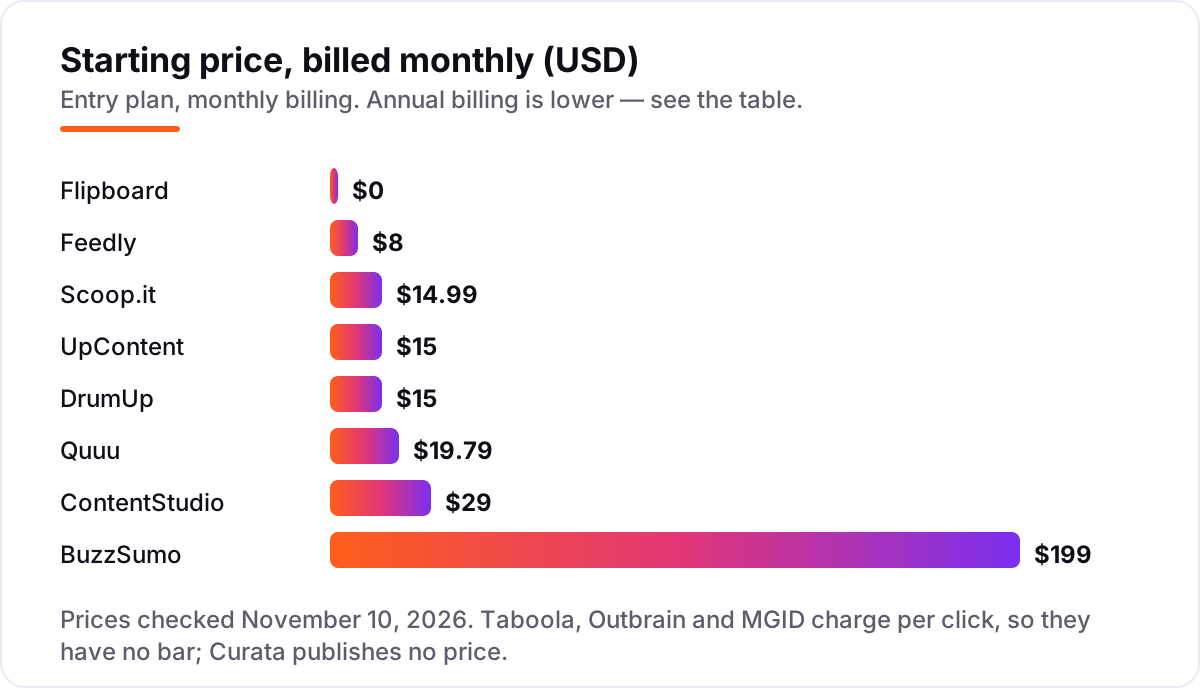
Content discovery platform pricing: what you will actually pay
Take a small team that reads widely, shares daily and promotes its best articles. The cheapest stack costs nothing: Flipboard for reading, Feedly's free plan for 100 feeds and DrumUp's free plan for scheduling — $0 a month, with the only cost being the time to curate. The working stack costs $42.79 a month: Feedly Pro at $8, Quuu for one profile at $19.79 and UpContent Sharer at $15. Over a year that is $513.48, or $449.88 if you pay yearly where the option is published — Feedly Pro at $72 a year and Quuu at $16.49 a month — with UpContent still billed monthly.
For research, add BuzzSumo: $199 a month billed annually is $2,388 a year, so the research stack — BuzzSumo plus Feedly Pro — costs $2,460 a year. For distribution, the numbers change shape entirely: Taboola recommends $50 a day, which is $1,500 for a 30-day test; Outbrain's $20-a-day minimum is $600 for the same 30 days; MGID opens with a $100 deposit but recommends $650 or more to learn anything. Curata publishes no price, so budget for a sales conversation, not a checkout page — one G2 reviewer reports a $12,000 annual contract.
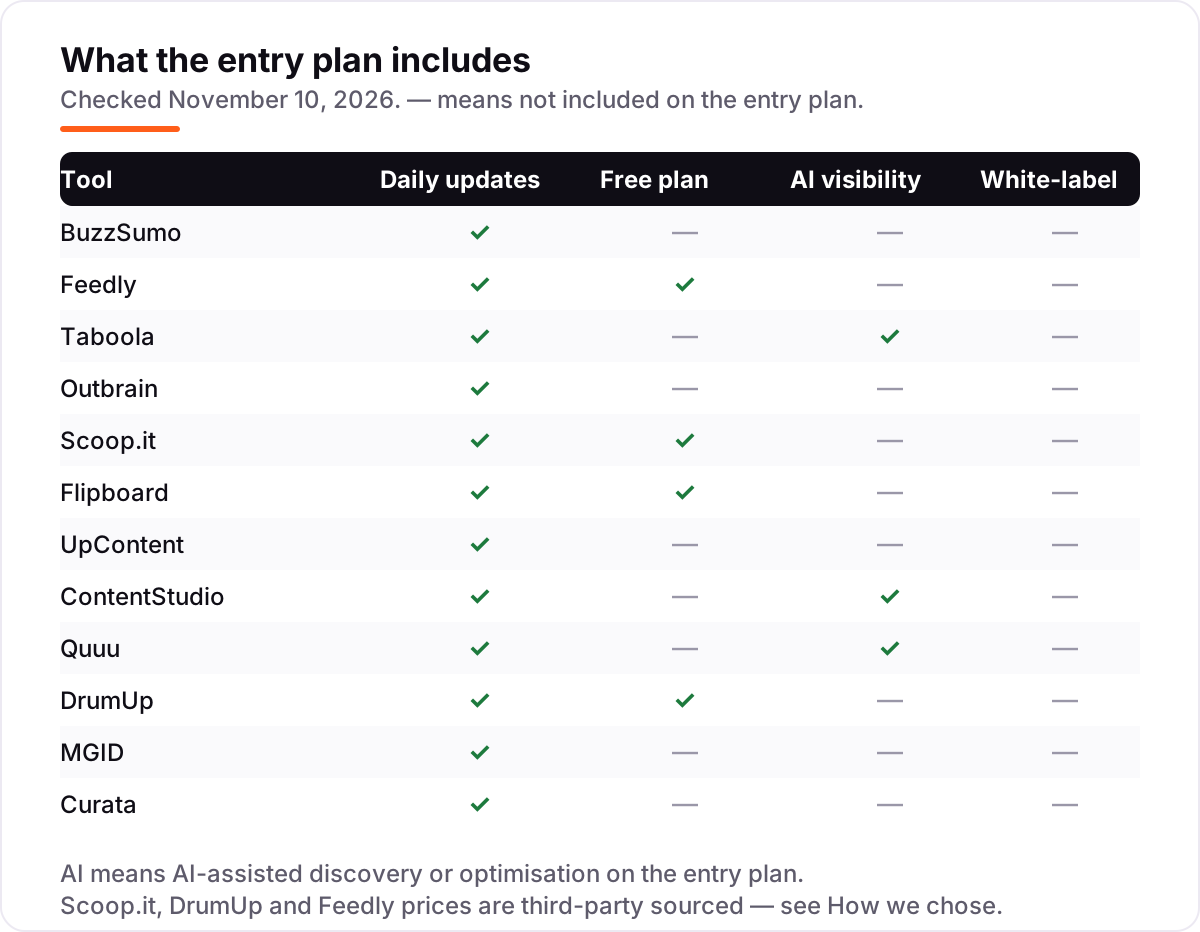
Know the difference: content discovery vs content distribution
The confusion in this category is the word discovery itself. Content discovery means finding content — the articles, trends and stories already out there that your audience would value. Feedly, Flipboard, BuzzSumo, Scoop.it, UpContent, Quuu, DrumUp, ContentStudio and Curata all do this, in different ways: readers, rankers, curators and scorers. Content distribution means placing your content where new readers will find it — Taboola, Outbrain and MGID do this, and they charge per click, not per month.
The two jobs need different budgets: discovery costs a subscription, distribution costs media spend, and a $15 discovery subscription will never buy reach. A team that buys Taboola expecting a reading feed, or buys Feedly expecting traffic, has bought the wrong side of this list. There is a second confusion inside distribution itself: Outbrain bought Teads in February 2025 and the combined company rebranded as Teads, so the Outbrain name now covers the performance side while brand advertising runs as Teads — the buying model, CPC with a $20-a-day minimum, is unchanged.
Quick comparison: tool type by need
| Buyer | Best pick | Why |
|---|---|---|
| Solo marketer on a $0 budget | Free reader, no trial clock | |
| Small team with a daily reading habit | Feedly | 1,000 feeds and search from $8/month |
| Deepest trending-content research | BuzzSumo | Most-shared articles plus journalist search, $199/month |
| Paying to reach new readers | Taboola | Largest native network, CPC from $10/day |
| Premium placements, brand safety | Outbrain | $20/day minimum, premium publishers |
| Curated social queue on a budget | DrumUp or Quuu | Free plan, or $19.79 per profile |
Mistakes to avoid
- Buying distribution when you need discovery. Taboola will not give you a reading feed, and Feedly will not send you traffic. Decide the job first — the two sides of this list do not substitute for each other.
- Comparing monthly prices without checking the unit. Quuu at $19.79 per profile costs $59.37 for three profiles; UpContent's $15 covers only a handful of topics. Price the profiles and topics you will actually use.
- Trusting a directory price. Scoop.it's $14.99 and DrumUp's $15 come from vendor-supplied directory listings, and Feedly shows different prices by country. Check the vendor's own page before paying.
- Paying for BuzzSumo for one user when the team needs more. Content Creation covers one user and two alerts; a three-person team needs PR & Comms at $299 a month, not $199.
- Treating MGID's $100 deposit as a test budget. MGID's own managers advise $500 to $1,500 for a first budget, and Taboola recommends $50 a day. A deposit that opens the account does not buy enough data to judge the channel.
How we chose
We checked each vendor's own pricing page on November 10, 2026 and recorded the starting price exactly as shown, including the annual-billing figure where the page lists one, and we ranked the tools by fit for the most common buyer — a small marketing team that needs a steady flow of content to share and promote — not by brand size. BuzzSumo and ContentStudio prices come from live reads of their pricing pages today. Outbrain's $20-a-day minimum is from its help documentation as cited in October 2026 reads; the help page we opened today confirms CPC billing and the 3% card fee but does not restate the minimum. Taboola publishes no rate card: the $10-a-day minimum and $50-a-day recommendation are third-party reported. MGID's $100 deposit comes from MGID's own cost guide, updated August 2026. Scoop.it's $14.99 and DrumUp's $15 are vendor-supplied listings on G2, not the vendors' own pages, and Scoop.it's own pricing page would not load for us. Feedly's $8 is from an October 6, 2026 read of its pricing page, because the page failed to load on November 10 and shows different prices by country. Ratings come from G2 pages we opened on November 10, 2026; tools without a rating line have none because G2 blocked the page, as with Feedly, or the review base was not one we could verify today. Two suggested tools are not in this list: Pocket is gone — Mozilla shut it down in July 2025 — and zest.is is now an enterprise search tool, not the content-discovery extension it once was. No vendor paid for a place in this list, and none of the links here are affiliate links.
What to do next
Start with the free tier of your top pick — Flipboard, Feedly or DrumUp cost nothing to try — and run it for two weeks on your real topics. If the feed stays useful after the novelty wears off, pay for the plan that removes the limit you actually hit. If distribution is the goal instead, put $100 into MGID or a $20-a-day Outbrain test before committing to a bigger daily budget. Once your tools are in place, find out what's holding your rankings back.
Your stack only works if people find you
SerpAstra fixes what keeps your site off page one and makes it easy for AI assistants to recommend.
Get a free audit→Sources we checked (17)
- BuzzSumo pricing — buzzsumo.com/pricing (checked November 10, 2026)
- BuzzSumo on G2 — 4.5/5, 107 reviews (checked November 10, 2026)
- Feedly pricing — feedly.com/pricing, read October 6, 2026 (page would not load November 10, 2026)
- Taboola advertiser page — taboola.com/advertise (checked November 10, 2026)
- Taboola cost guide — nativeyukti.com (September 2026; Taboola publishes no rate card)
- Taboola on G2 (as Realize) — 3.7/5, 70 reviews (checked November 10, 2026)
- Outbrain pricing and billing — outbrain.com/help/advertisers/pricing-billing-model (checked November 10, 2026)
- Outbrain $20/day minimum — openadlibrary.com (October 2026 read of Outbrain help docs)
- Scoop.it pricing and reviews on G2 — $14.99/month Pro, 4.6/5, 28 reviews (checked November 10, 2026)
- Flipboard is free — gadgetsranked.com (checked November 10, 2026)
- UpContent pricing — upcontent.com/capabilities (checked November 10, 2026)
- UpContent on G2 — 4.4/5, 293 reviews (checked November 10, 2026)
- ContentStudio pricing — contentstudio.io/pricing (checked November 10, 2026)
- Quuu pricing — quuu.co/pricing (checked November 10, 2026)
- DrumUp pricing and reviews on G2 — $15/month Starter, 4.1/5, 15 reviews (checked November 10, 2026)
- MGID native advertising cost guide — mgid.com/blog (updated August 2026)
- Curata on G2 — 4.5/5, 42 reviews (checked November 10, 2026)
Shamim
Founder of SerpAstra
A full-stack SEO and digital marketer who spends most days on Local SEO for dental practices, AI search visibility and lead generation.
Frequently asked questions
What is the best content discovery platform in 2026?
BuzzSumo is the best fit for most teams: the deepest research into what already performs, from $199 a month billed annually. Feedly is the best daily reader at $8 a month, and Taboola is the best way to pay for reach, from $10 a day. Pick by the job — research, reading or distribution — because no single tool does all three well.
How much does a content discovery platform cost?
Subscriptions run from $0 to $199 a month: Flipboard is free, Feedly Pro is $8, Scoop.it is $14.99, UpContent and DrumUp are $15, Quuu is $19.79 per profile and ContentStudio is $29. BuzzSumo is the dearest at $199. The native networks charge per click instead: Taboola from $10 a day, Outbrain from $20 a day, MGID from a $100 deposit.
Is there a free content discovery platform?
Yes. Flipboard is completely free for readers, Feedly has a free plan covering 100 feeds, and DrumUp has a free plan at $0. Scoop.it also has a free plan for one topic page. Free plans work for reading and light curation; once you need analytics, scoring or more accounts, a paid plan from $8 to $15 a month is the next step.
What is the difference between content discovery and content distribution?
Discovery finds other people's content worth sharing — Feedly, BuzzSumo and Scoop.it do this. Distribution pays to place your content in front of new readers — Taboola, Outbrain and MGID do that, charging per click. Buying a distribution network when you need a reading feed, or the reverse, is the most common mistake in this category.
Is Outbrain still called Outbrain?
Partly. Outbrain bought Teads in February 2025 and the combined company rebranded as Teads in June 2025, with the brand advertising business moving under the Teads name. The Outbrain name still covers the performance and recommendation side, and the CPC model and $20-a-day minimum are unchanged. Expect the Teads name on sales and brand materials.
Can a content discovery platform replace creating content?
No. Discovery and curation fill the gaps between your own articles, but a feed of other people's work does not build authority or rank. Use curated content for roughly a third of your social output, and spend the time you save writing the pieces only you can write. The tools here find the raw material; they do not replace the writing.
Free SEO and AI visibility audit
Find out what is holding your rankings back
Send us your site. Within 2 business days you get a written audit, an AI visibility check and a short fix list ranked by impact. Free, with no contract attached.
Request my free audit→Related guides
 Digital Marketing & Ads10 Best Content Marketing Software in 2026, Compared10 best content marketing software tools compared on price, planning, optimization and publishing, with starting prices and the right pick for every team size.Read guide →
 AI, Data & Analytics12 Best Content Analytics Software in 2026, ComparedCompare the 12 best content analytics software options for 2026, with real starting prices, free plans and G2 ratings — from free GA4 to Parse.ly.Read guide →
 Email, SMS & Social Media9 Best Tools for Content Creation and Social Media Management in 2026, ComparedCompare the 9 best tools for content creation and social media management on price, free plans and AI features, with every price checked November 6, 2026.Read guide →