
11 Best Email Platforms for Nonprofits in 2026, Compared
Compare the best email platform for nonprofits: 11 tools ranked on price, free plans and nonprofit discounts, with every price checked November 6, 2026.
 Shamim Mia, Founder, SerpAstraLast verified November 6, 202614 min read
We compare pricing pages, documentation and public reviews. We never accept payment for rankings.

Key takeaways
- Mailchimp is the best fit for most nonprofits at $13/month; Constant Contact follows at $12/month for events, and Brevo is cheapest at $9/month for large lists mailed rarely.
- Nonprofit discounts change the ranking: GetResponse offers 50% off, MailerLite 30% for life, Constant Contact up to 30% on prepay, and HubSpot 40% on Pro and Enterprise only.
- The single most important buying factor is the pricing model: contact-based pricing punishes list growth, while Brevo charges for emails sent — so model your list at 12 months out.
- Free plans shrank in 2026: Mailchimp allows 250 contacts and MailerLite 250 subscribers, while Kit still covers 10,000 subscribers free and Brevo stores 100,000 contacts.
On this page
Quick comparison
| Tool | Best for | Starting price | Free plan |
|---|---|---|---|
| Mailchimp | Nonprofits that want the email platform most donor tools already integrate with | $13/mo | Yes (free plan) |
| Constant Contact | Nonprofits that run fundraisers and events and want a person on the phone | $12/mo | No (30-day trial) |
| Brevo | Nonprofits with a large list they mail rarely, who want to pay for sends, not contacts | $9/mo | Yes (free plan) |
| MailerLite | Small nonprofits that want real automation at the lowest paid price | $12/mo | Yes (free plan) |
| GetResponse | Nonprofits that run webinars, donor courses or virtual fundraisers alongside email | $19/mo | Yes (free plan) |
| ActiveCampaign | Nonprofits with a dedicated marketer running sophisticated donor journeys | $19/mo | No (14-day trial) |
| HubSpot | Nonprofits building a real donor database, not just a mailing list | $20/mo | Yes (free tools) |
| Kit | Nonprofits whose newsletter is the main channel and whose list is still growing | $39/mo | Yes (free plan) |
| AWeber | Small teams that want phone support and three seats included at the entry price | $15/mo | No (14-day trial) |
| Moosend | Budget-first nonprofits that want full automation for $9 a month | $9/mo | No (30-day trial) |
| EmailOctopus | Tiny nonprofits that send one monthly newsletter and want the cheapest honest setup | $10/mo | Yes (free plan) |
Make one of these tools?
We re-check this list every quarter. Send a correction, request a review, or ask about a clearly labeled sponsored spot.
Request a listingThe best email platform for nonprofits

Mailchimp
Best for: Nonprofits that want the email platform most donor tools already integrate with
Mailchimp is the safe default for a nonprofit that wants every other tool to just work with its email list. Donor CRMs, event platforms, fundraising pages and website builders integrate with Mailchimp first, so the list stays in sync without custom work. Essentials costs $13 a month for 500 contacts and covers scheduling, A/B testing and basic automations; Standard at $20 adds multi-step journeys and dynamic content.
The catch is how the bill grows. The free plan now covers only 250 contacts and 500 sends a month, and the price climbs steeply with list size — Essentials is about $75 a month at 5,000 contacts. Unsubscribed contacts still count until you archive them. Pick Mailchimp when integrations matter most; pick Brevo or MailerLite when the budget matters more.
What we like
- The largest integration ecosystem — donor CRMs, event tools and fundraising platforms connect to it first
- Multi-step automation and A/B testing from the Standard plan at $20/month
- Free plan covers a small list getting started, with landing pages included
- Templates and the drag-and-drop editor are easy enough for a rotating volunteer team
Watch out for
- Free plan shrank in January 2026 to 250 contacts and 500 sends a month
- Contact-based pricing counts unsubscribed contacts until you archive them
- Nonprofit discount terms have changed more than once — verify the current offer before budgeting

Constant Contact
Best for: Nonprofits that run fundraisers and events and want a person on the phone
Constant Contact is the nonprofit specialist among the generalists, and the reason is events. Invitations, registrations, reminders and follow-up surveys for a gala or fundraiser live in the same account as the email list, and the templates include nonprofit designs. Lite costs $12 a month for 500 contacts, and verified nonprofits get 20% off a six-month prepay or 30% off a twelve-month prepay.
The trade-offs are the prepayment the discount demands and the thin entry plan. Lite is broadcast email only — automation and A/B testing wait for Standard at $35 a month — and there is no permanent free plan, only a 30-day trial. Pick Constant Contact when your calendar is full of events and you want a human on the phone; pick MailerLite when you want automation at half the price.
What we like
- Built-in event marketing handles invitations, registrations and follow-up surveys in one place
- Nonprofits get 20% off a 6-month prepay or 30% off a 12-month prepay
- Live phone and chat support on every plan, which matters when the email volunteer changes yearly
- 600+ templates include nonprofit-specific designs
Watch out for
- No permanent free plan — only a 30-day trial
- Lite is broadcast email only; automation and A/B testing need Standard at $35/month
- The 30% nonprofit discount needs a 12-month prepayment, which strains tight cash flow

Brevo
Best for: Nonprofits with a large list they mail rarely, who want to pay for sends, not contacts
Brevo is the cheapest honest structure in this list for a nonprofit with a big list and a quiet calendar. It charges by emails sent rather than contacts stored, so 40,000 supporters mailed once a month cost far less than on any contact-based platform. Starter costs $9 a month for 5,000 emails, and the free plan stores up to 100,000 contacts while sending 300 emails a day.
The catch is the contact cap on paid plans: Starter stores only 500 contacts at the $9 tier, so a list over 500 needs a higher volume tier, and Starter has no automation at all — that starts on Standard at $18 a month. Pick Brevo when your list is large and your sends are few; pick Mailchimp or MailerLite when you mail weekly and need automation on the entry plan.
What we like
- Charges by emails sent, not contacts stored — a 40,000-person list mailed monthly costs little
- Email, SMS and a basic CRM in one account, so donor reminders and event follow-ups share a list
- The most generous free plan here: 300 emails a day with up to 100,000 contacts stored
- Standard at $18/month adds unlimited automation, A/B testing and send-time optimization
Watch out for
- Starter has no automation at all — automation starts on Standard at $18/month
- Paid plans cap stored contacts (500 at the $9 tier), while the free plan stores up to 100,000
- Free plan sends only 300 emails a day, so a big appeal goes out over several days

MailerLite
Best for: Small nonprofits that want real automation at the lowest paid price
MailerLite is the value pick for a nonprofit that wants real automation without enterprise pricing. The interface is clean enough for a volunteer to run, the automation builder handles welcome sequences and donor anniversaries, and a 30% nonprofit discount on paid plans lasts for the life of the account. Comfort costs $12 a month for 500 subscribers, or $10.80 billed annually.
The limits are the smaller free plan and the send cap. Free now covers only 250 subscribers and 2,500 emails a month, and Comfort caps sends at ten times your subscriber tier, so a frequent mailer needs Power at $25 a month. Pick MailerLite when the budget is tight and automation matters; pick Brevo when the list is huge and the sends are rare.
What we like
- A 30% nonprofit discount on paid plans for the life of the account
- Automation, landing pages and signup forms included on the free plan
- Clean interface a non-technical volunteer can run without training
- Only active subscribers count toward billing — unsubscribed and bounced contacts are free
Watch out for
- Free plan shrank in June 2026 to 250 subscribers and 2,500 emails a month
- Comfort caps sends at 10x your subscriber tier, so frequent mailers need Power at $25/month
- Fewer native integrations than Mailchimp, so some donor tools need Zapier

GetResponse
Best for: Nonprofits that run webinars, donor courses or virtual fundraisers alongside email
GetResponse is the pick for a nonprofit whose calendar includes webinars: donor education sessions, volunteer training and virtual fundraisers run on the same platform as the email list, with landing pages and forms included. Starter costs $19 a month for 1,000 contacts with unlimited sends, and verified nonprofits get 50% off through TechSoup — the largest discount in this list.
The discount has strings attached: it lasts 24 months, needs a logo on your website, and cannot combine with annual billing. Starter also includes only one custom automation workflow; unlimited workflows need Marketer at $59 a month. Pick GetResponse when webinars are a real part of your program; pick MailerLite when email alone is the job.
What we like
- Webinars, landing pages, forms and courses run on the same platform as the email list
- 50% nonprofit discount — the largest in this list — via TechSoup verification
- Starter includes unlimited monthly sends and 3 user seats
- Free plan covers 500 contacts with no time limit
Watch out for
- Starter includes only one custom automation workflow — unlimited workflows need Marketer at $59/month
- The 50% nonprofit discount runs through TechSoup, needs a logo on your site, and lasts 24 months
- The same contact on two lists can count twice toward your contact limit

ActiveCampaign
Best for: Nonprofits with a dedicated marketer running sophisticated donor journeys
ActiveCampaign is the power tool in this list. Its automation reacts to donor behavior across email, site visits and pipeline stages, with lead scoring and conditional journeys the simpler tools cannot express. Starter costs $19 a month for 1,000 contacts billed monthly, or $15 billed annually, and a 20% nonprofit discount is reported for eligible organizations.
It is overkill for the monthly-newsletter nonprofit, and the entry plan is tighter than it looks: each automation caps at five actions, there is one seat, and accounts created after November 3, 2025 are billed for every contact including unsubscribed ones. Pick ActiveCampaign when a dedicated marketer runs donor cultivation; pick MailerLite when one volunteer sends the newsletter.
What we like
- The deepest automation here: journeys that react to donations, site visits and pipeline stages
- A built-in CRM tracks donors through cultivation stages without a second tool
- A 20% nonprofit discount is reported for eligible organizations
- Lead scoring and conditional content the simpler tools cannot express
Watch out for
- No free plan — only a 14-day trial, and the trial caps sends at 100 emails
- Starter caps automations at 5 actions each and 1 seat, so teams pay for Plus at $59/month
- Accounts created after November 3, 2025 are billed for all contacts, including unsubscribed ones

HubSpot
Best for: Nonprofits building a real donor database, not just a mailing list
HubSpot's nonprofit case starts with the free CRM: donor records, pipelines, activity tracking and reporting at no cost, which no other free plan here matches. Marketing Hub Starter layers email automation, landing pages and ad management on top for $20 a month at 1,000 marketing contacts, and the platform connects to Donorbox, Fundraise Up and Eventbrite.
The 40% nonprofit discount is real but narrow: it covers Professional and Enterprise tiers only, and Starter is excluded. Paid tiers escalate fast — Professional is $890 a month plus a mandatory onboarding fee. Pick HubSpot when you are building a donor database, not just a mailing list; pick a cheaper tool when email alone is the job.
What we like
- Free CRM holds donor records, pipelines and activity tracking at $0 with no expiry
- Marketing Hub Starter adds email automation, landing pages and ad management for $20/month
- More than 2,000 integrations, including Donorbox, Fundraise Up and Eventbrite
- Nonprofits get 40% off Professional and Enterprise tiers through the HubSpot for Nonprofits program
Watch out for
- The 40% nonprofit discount covers Pro and Enterprise only — Starter is excluded
- Paid tiers escalate steeply: Professional is $890/month, plus a mandatory onboarding fee
- Starter mostly removes HubSpot branding; the free tools already cover the basics

Kit
Best for: Nonprofits whose newsletter is the main channel and whose list is still growing
Kit is the free-plan champion in this list: the free Newsletter plan covers up to 10,000 subscribers with unlimited broadcasts, landing pages and forms, so a growing nonprofit can run for years without paying anything. Creator costs $39 a month for 1,000 subscribers and adds unlimited visual automations, sequences and A/B testing, plus built-in commerce for selling digital products.
The catch is the price jump. The free plan has no sequences or visual automations, so the first welcome series forces the $39 upgrade — the dearest entry price here — and selling costs 3.5% plus 30¢ per transaction on every plan. Pick Kit when your list is growing fast and you want the longest free runway; pick MailerLite when you need automation from day one.
What we like
- The most generous free plan here: 10,000 subscribers with unlimited broadcasts
- Unlimited sends on every plan, including free — no send caps to watch
- Built-in commerce sells digital products and paid newsletters without a checkout tool
- Tag-based segmentation fits donor interests without a CRM
Watch out for
- Creator costs $39/month at 1,000 subscribers — the dearest entry price here
- The free plan has no sequences or visual automations, so the first welcome series forces the upgrade
- No nonprofit discount we could verify, and selling donations costs 3.5% + 30¢ per transaction

AWeber
Best for: Small teams that want phone support and three seats included at the entry price
AWeber is the steady veteran in this list, and its entry plan is generous with people: Lite includes three team seats at $15 a month for 500 subscribers, where most rivals charge extra for a second user. Support runs 24/7 by phone, chat and email even on Lite, and eligible nonprofits get a 25% discount on paid plans.
The limits are scope, not price. Lite caps you at three automations, three landing pages and one list, and unlimited everything needs Plus at $30 a month. There is no free plan on the pricing page, only a 14-day trial, though a free tier still appears in some help articles. Pick AWeber when three people share the email job; pick MailerLite when automation depth matters more.
What we like
- A 25% nonprofit discount on paid plans for eligible organizations
- Lite includes 3 team seats — most rivals charge extra for a second user
- 24/7 support by phone, chat and email, even on the entry plan
- One-click integrations with WordPress, PayPal and the main donor tools
Watch out for
- No free plan on the pricing page — only a 14-day trial (a free tier still appears in some help articles)
- Lite caps you at 3 automations, 3 landing pages and 1 list; unlimited needs Plus at $30/month
- Prices rise steeply with list size: Lite is $60/month at 5,000 subscribers

Moosend
Best for: Budget-first nonprofits that want full automation for $9 a month
Moosend is the budget automation tool: one paid plan, priced only by contact count, with automation workflows, landing pages and unlimited sends included from the start. Pro costs $9 a month for 500 contacts billed monthly, or $7 billed annually, and nonprofits get a further 25% off that stacks with the annual discount.
The simplicity has edges. There is no permanent free plan, only a 30-day trial, and the single plan means there is no cheaper tier to drop to in a quiet quarter. Transactional email, custom reports and single sign-on are paid add-ons. Pick Moosend when you want full automation for $9 a month; pick EmailOctopus when a free plan matters more than automation.
What we like
- Full automation, landing pages and unlimited sends on the single Pro plan
- A 25% nonprofit discount that stacks with the 20% annual-billing discount
- The joint-cheapest entry price here at $9/month for 500 contacts
- Simple pricing: one plan, priced only by contact count
Watch out for
- No permanent free plan — only a 30-day trial, capped at 1,000 contacts
- One paid plan only, so there is no cheaper tier to drop to in a quiet quarter
- Transactional email, custom reports and SSO are paid add-ons even on Pro

EmailOctopus
Best for: Tiny nonprofits that send one monthly newsletter and want the cheapest honest setup
EmailOctopus is the minimalist's choice: email campaigns, simple automation and landing pages at the lowest prices in this list, with a free plan covering 2,500 subscribers and 10,000 emails a month. Pro starts at $10 a month billed monthly, or $9 billed annually, for 500 subscribers, and adds unlimited automations, landing pages and users.
The ceiling is capability. Automation is basic, the template library is thinner than the big suites, and free-plan reports expire after 30 days while emails carry EmailOctopus branding. Pick EmailOctopus when the nonprofit is small, the budget is near zero and the job is one monthly newsletter; pick MailerLite when the list needs real automation.
What we like
- Free plan covers 2,500 subscribers and 10,000 emails a month — the biggest free list here after Kit
- Pro starts at $10/month billed monthly ($9 billed annually) for 500 subscribers
- Simple and fast to learn: one monthly newsletter takes minutes, not an afternoon
- Unlimited landing pages, forms and users on Pro, with reports kept forever
Watch out for
- Automation is basic and the template library is thinner than the big suites
- Free-plan reports expire after 30 days and emails carry EmailOctopus branding
- No phone support — help is by email, and the integration list leans on Zapier
The best email platform for nonprofits is the one that fits a tight budget, a rotating cast of volunteers and a list that grows every time you run an event. We ranked the eleven tools below by fit for the most common buyer — a small US nonprofit sending a monthly newsletter and a few fundraising appeals a year — starting with the widest integrations and ending with the cheapest honest setups, and every price was checked on the vendor's own pricing page on November 6, 2026.
How to choose the best email platform for nonprofits
- Count contacts at 12 months out, not today. A gala or a viral appeal can double a list in a weekend, and contact-based pricing charges for every name — Mailchimp Essentials is $13 a month at 500 contacts and about $75 at 5,000.
- Check what the free plan really covers. Kit covers 10,000 subscribers free but no automations, Brevo stores 100,000 contacts but sends 300 emails a day, and MailerLite's free plan now stops at 250 subscribers.
- Ask about the nonprofit discount before you buy. Most discounts need proof of 501(c)(3) status first and cannot be applied retroactively — GetResponse offers 50%, MailerLite 30% for life, Constant Contact up to 30% on prepay.
- Match automation to whoever runs it. A volunteer sending one newsletter a month needs EmailOctopus or MailerLite; a dedicated marketer running donor journeys needs ActiveCampaign or HubSpot.
- Check the donor tools connect. Your fundraising platform, event tool and CRM should sync with the email list — Mailchimp and HubSpot have the widest integration lists here.
A nonprofit's email tool is one system in its stack, not the whole stack. If the organization also needs to be found online, our monthly SEO service handles the visibility side. And before you publish new pages for the programs you run, run your titles through the free SERP snippet preview tool — it shows exactly how the title and description will look in Google.
Whatever you shortlist, try it with a real appeal before you pay. The free plans and trials in this list are long enough to send one genuine campaign — your list, your templates, your donation links — and that campaign tells you more than any review can. Check two things in the trial: that the emails land in inboxes rather than spam, and that the nonprofit discount you expect is actually applied to your account. Every discount here needs proof of status, so have the determination letter ready before you start the trial.
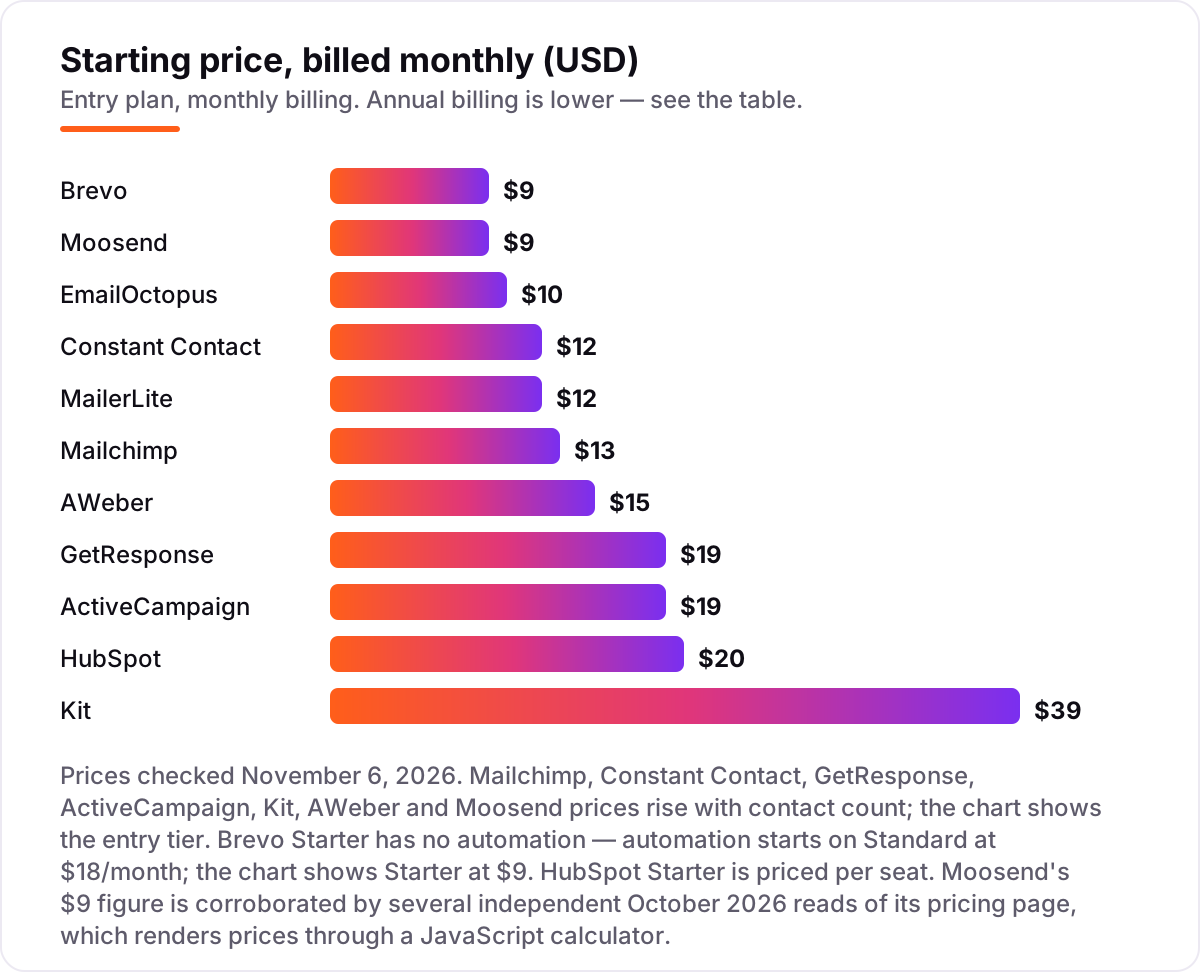
Email platform for nonprofits pricing: what you will actually pay
Take a nonprofit with 5,000 contacts that mails four times a month — a newsletter plus three appeals or updates, or 20,000 emails in total. On list prices, the subscription costs $32 a month on Brevo Starter, $48 on Moosend Pro, $49 on MailerLite Comfort, $54 on GetResponse Starter, $60 on AWeber Lite, $75 on Mailchimp Essentials, $80 on Constant Contact Lite, $89 on Kit Creator and $99 on ActiveCampaign Starter. EmailOctopus Pro is $28 a month billed annually at this size. HubSpot Starter starts at $20 a month for 1,000 marketing contacts and rises with the contact count, so it is not in the same comparison at 5,000.
Over a year, that is $336 on EmailOctopus billed annually, $384 on Brevo, $576 on Moosend, $588 on MailerLite, $648 on GetResponse, $720 on AWeber, $900 on Mailchimp, $960 on Constant Contact, $1,068 on Kit and $1,188 on ActiveCampaign. The same 5,000 contacts and the same 20,000 emails cost $336 a year at the cheap end and $1,188 at the dear end — an $852 gap that comes entirely from the pricing model and the automation depth, not from the size of the list.
Nonprofit discounts narrow the gap a lot. GetResponse at 50% off falls from $648 to about $324 a year, MailerLite at 30% off from $588 to about $412, Moosend at 25% off from $576 to about $432, AWeber at 25% off from $720 to about $540, and Constant Contact at 30% off a 12-month prepay from $960 to about $672. Two of those discounts need care: GetResponse's 50% runs through TechSoup, lasts 24 months and needs a logo on your site, while Constant Contact's 30% needs the full year paid up front. If the organization cannot prepay, compare on list prices instead — see our guide to email marketing software for small business for how the same tools price without a nonprofit discount.
Annual billing cuts the bill on most tools here: MailerLite Comfort drops from $144 to about $130 a year, Brevo Starter from $108 to about $97, GetResponse Starter from $228 to about $187, ActiveCampaign Starter from $228 to $180, and Kit Creator from $468 to $390. One more cost to check before you commit: a second list is not always a second subscription, but a second organization is — every tool here charges per account, so a nonprofit running two brands pays twice whatever the chart shows.
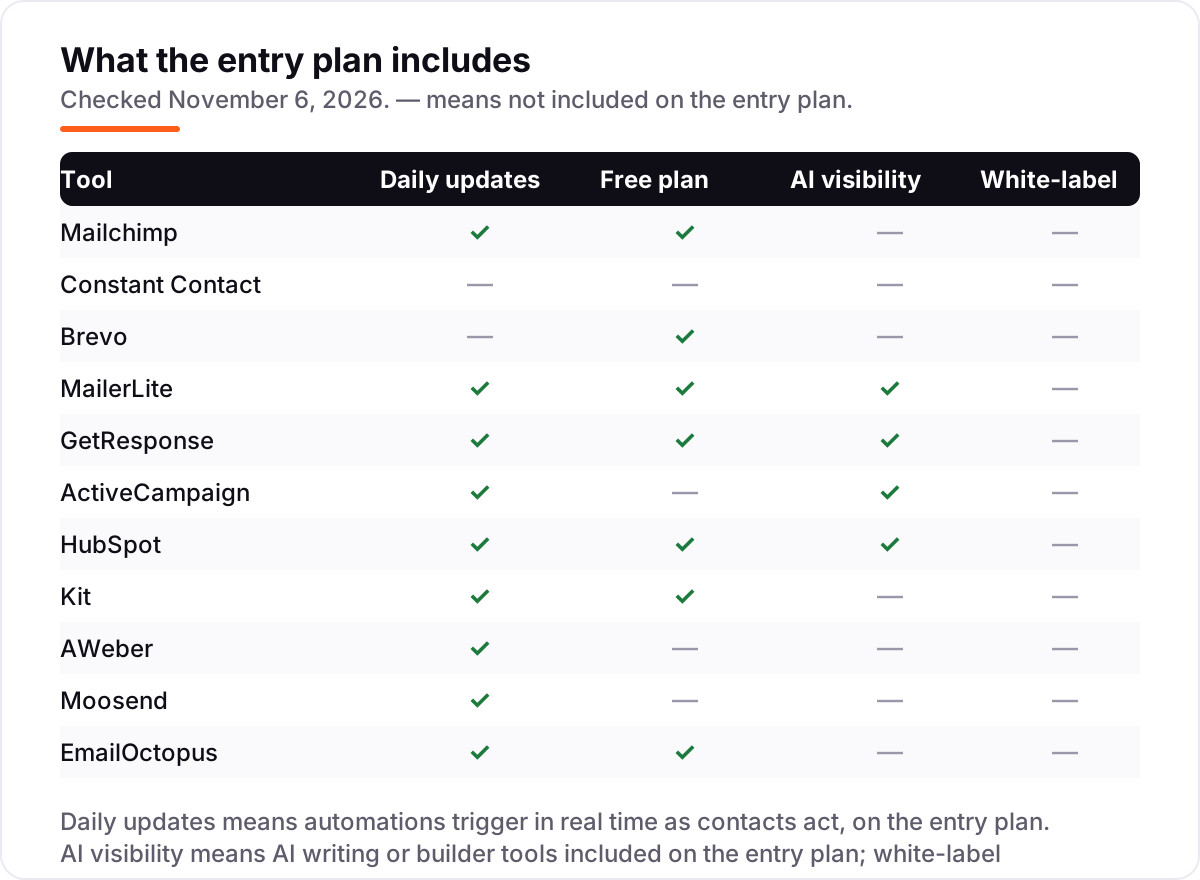
Know the difference: contact-based vs volume-based pricing
The confusion in this category is between two ways of charging for the same emails. Contact-based pricing — Mailchimp, MailerLite, Constant Contact, GetResponse, ActiveCampaign, Kit, AWeber, Moosend and EmailOctopus — charges by the size of the list: every subscriber costs money whether you mail them or not, which punishes list growth and rewards list hygiene. Volume-based pricing — Brevo, the only one here — charges by emails sent: a huge list mailed rarely costs little.
Match the model to your mailing pattern. The nonprofit with 40,000 contacts and a monthly newsletter is cheaper on volume-based pricing: Brevo Starter covers 20,000 emails a month for $32, while the same list on Mailchimp Essentials would cost several hundred dollars a month. The nonprofit with 3,000 engaged donors mailed weekly may be cheaper contact-based, since the volume bill grows with every send. And on contact-based platforms, archive unsubscribed contacts promptly: several platforms charge for them until you do.
There is a second, quieter confusion: a nonprofit discount and a low price are not the same thing. A 30% discount on an expensive platform can cost more than full price on a cheap one — at 5,000 contacts, Constant Contact after its 30% prepay discount is about $56 a month, while Brevo at full price is $32. Model your list size at twelve months, apply the discount you actually qualify for, then compare. And check the fine print: HubSpot's 40% discount excludes Starter entirely, and GetResponse's 50% lasts 24 months and needs a logo on your site.
Quick comparison: tool type by need
| Buyer | Best pick | Why |
|---|---|---|
| Small list, tight budget | EmailOctopus | Free to 2,500 subscribers, Pro is $10/month when you outgrow it |
| Most nonprofits | Mailchimp | The widest integrations, Essentials from $13/month |
| Events and fundraisers | Constant Contact | Event tools plus phone support, Lite from $12/month |
| Large list, rare sends | Brevo | Pay per email sent, Starter from $9/month |
| Real automation, low price | MailerLite | 30% nonprofit discount for life, Comfort from $12/month |
| Donor journeys and CRM | ActiveCampaign | Deepest automation with a built-in CRM, Starter from $19/month |
Mistakes to avoid
- Budgeting on the discount price before you qualify. Most nonprofit discounts need proof of 501(c)(3) status first and cannot be applied retroactively. Apply and get the discount confirmed before you compare prices.
- Buying on the free plan, then finding automation costs extra. Kit's free plan has no sequences, Brevo Starter has no automation at all, and Constant Contact Lite is broadcast only. If you need a welcome series, count the paid plan in the price from day one.
- Ignoring the cap that bites first. A tool can be cheap and still be the wrong buy: Mailchimp's free plan stops at 250 contacts, Brevo's free plan sends 300 emails a day, and AWeber Lite stops at 3 automations.
- Forgetting unsubscribed contacts still count. Several contact-based platforms charge for unsubscribed contacts until you archive them. Clean the list before you migrate, and archive unsubscribes every month.
- Picking on the discount percentage alone. GetResponse at 50% off is about $27 a month at 5,000 contacts, but Brevo at full price is $32 — and HubSpot's 40% discount does not apply to Starter at all. Compare the price after the discount, not the percentage.
How we chose
We checked each vendor's own pricing page on November 6, 2026 and recorded the starting price exactly as shown, including the annual-billing figure where the page lists one, and we ranked the tools by fit for the most common buyer — a small US nonprofit sending a monthly newsletter and a few fundraising appeals a year — not by brand size. Ratings come from fresh crawls of each tool's G2 review page, checked November 6, 2026. One price needs a note: Moosend renders its prices through a JavaScript calculator, so its $9 figure is corroborated by several independent October 2026 reads of its pricing page rather than a single direct read. AWeber's pricing page shows a 14-day trial with no free plan, though a free tier still appears in some of its help articles — we list it as no free plan, following the pricing page. No vendor paid for a place in this list, and none of the links here are affiliate links.
What to do next
Start with the free plan or trial of your top pick and send one real appeal through it. Check that the emails land in inboxes, that the donation links track, and that the nonprofit discount you expect is applied to your account before the trial ends. If the appeal works but new donors are not finding you, our monthly SEO service handles the visibility side — or compare providers in our guide to email marketing platforms for creators. Once your tools are in place, find out what's holding your rankings back.
Your stack only works if people find you
SerpAstra fixes what keeps your site off page one and makes it easy for AI assistants to recommend.
Get a free audit→Sources we checked (22)
- Mailchimp pricing — mailchimp.com/pricing (checked November 6, 2026)
- Constant Contact pricing — constantcontact.com/pricing (checked November 6, 2026)
- Brevo pricing — brevo.com/pricing (checked November 6, 2026)
- MailerLite pricing — mailerlite.com/pricing (checked November 6, 2026)
- GetResponse pricing — getresponse.com/pricing (checked November 6, 2026)
- ActiveCampaign pricing — activecampaign.com/pricing (checked November 6, 2026)
- HubSpot Marketing Hub pricing — hubspot.com/pricing/marketing (checked November 6, 2026)
- Kit pricing — kit.com/pricing (checked November 6, 2026)
- AWeber pricing — aweber.com/pricing.htm (checked November 6, 2026)
- Moosend pricing — moosend.com/pricing (checked November 6, 2026)
- EmailOctopus pricing — emailoctopus.com/pricing (checked November 6, 2026)
- Mailchimp on G2 — g2.com (checked November 6, 2026)
- Constant Contact on G2 — g2.com (checked November 6, 2026)
- Brevo on G2 — g2.com (checked November 6, 2026)
- MailerLite on G2 — g2.com (checked November 6, 2026)
- GetResponse on G2 — g2.com (checked November 6, 2026)
- ActiveCampaign on G2 — g2.com (checked November 6, 2026)
- HubSpot Marketing Hub on G2 — g2.com (checked November 6, 2026)
- Kit on G2 — g2.com (checked November 6, 2026)
- AWeber on G2 — g2.com (checked November 6, 2026)
- Moosend on G2 — g2.com (checked November 6, 2026)
- EmailOctopus on G2 — g2.com (checked November 6, 2026)
Shamim
Founder of SerpAstra
A full-stack SEO and digital marketer who spends most days on Local SEO for dental practices, AI search visibility and lead generation.
Frequently asked questions
What is the best email platform for nonprofits?
Mailchimp is the best fit for most nonprofits: the widest integrations, a free plan for small lists, and Essentials from $13/month. Constant Contact is better for event-heavy organizations, Brevo is cheapest for large lists mailed rarely, and MailerLite is the best value when automation matters on a tight budget.
What is the best free email platform for nonprofits?
Kit has the most generous free plan, covering up to 10,000 subscribers with unlimited broadcasts. EmailOctopus is next at 2,500 subscribers and 10,000 emails a month. Brevo stores up to 100,000 contacts free but sends only 300 emails a day, and MailerLite's free plan covers 250 subscribers with automation included.
How do nonprofit discounts work on email platforms?
Most vendors ask for proof of nonprofit status, usually a 501(c)(3) determination letter, before the discount applies, and it cannot be added retroactively. GetResponse offers 50% via TechSoup, MailerLite 30% for life, Constant Contact up to 30% on prepay, and HubSpot 40% on Pro and Enterprise only — always verify the current terms first.
How much does email marketing cost a nonprofit?
Entry prices run from $9 to $39 a month. At 5,000 contacts mailing four times a month, Brevo costs about $32 a month, MailerLite $49, GetResponse $54, Mailchimp $75 and ActiveCampaign $99 — before nonprofit discounts, which cut GetResponse to about $27 and MailerLite to about $34 a month.
Should a nonprofit choose contact-based or volume-based pricing?
Choose volume-based pricing, like Brevo, when the list is large and you mail rarely — you pay for emails sent, not names stored. Choose contact-based pricing, like Mailchimp or MailerLite, when the list is small and you mail weekly. Either way, archive unsubscribed contacts promptly, since several platforms charge for them until you do.
Can a nonprofit switch email platforms later?
Yes, but plan the move between campaigns, not during an appeal. Export your contacts, tags and suppression lists from the old tool, import them into the new one, and warm up the new sending setup with small sends first. Expect the migration itself to take a few days, and keep the old account live until the first campaign lands cleanly.
Does a nonprofit need a CRM as well as an email platform?
Not always. A small nonprofit can run on email alone with tags and segments. A CRM earns its keep once you track donations, grants and volunteer hours per person — HubSpot's free CRM covers that at $0, and ActiveCampaign bundles a CRM with its email automation. Buy the CRM when donor history matters, not before.
Free SEO and AI visibility audit
Find out what is holding your rankings back
Send us your site. Within 2 business days you get a written audit, an AI visibility check and a short fix list ranked by impact. Free, with no contract attached.
Request my free audit→Related guides
 Digital Marketing & Ads11 Best Email Marketing Software for Small Business in 2026, ComparedThe 11 best email marketing software for small business, compared on real 2026 prices, free plans and automation — Brevo starts at $9/month.Read guide →
 Digital Marketing & Ads7 Best Email Marketing Platforms for Creators in 2026, Compared7 best email marketing platforms for creators compared on price, free plans and monetization. Real prices checked November 4, 2026, sorted by creator need.Read guide →
 Digital Marketing & Ads12 Best CRM Email Marketing Software in 2026, Compared12 best crm email marketing software tools compared on price, CRM depth and automation, with real starting prices checked on November 4, 2026.Read guide →