
10 Best Marketing Project Management Tools in 2026, Compared
Compare the 10 best marketing project management tools on price, free plans, proofing and AI features, with every price checked November 5, 2026.
 Shamim Mia, Founder, SerpAstraLast verified November 5, 202613 min read
We compare pricing pages, documentation and public reviews. We never accept payment for rankings.

Key takeaways
- Asana is the best fit for most marketing teams at $13.49/user/month; monday.com follows at $9/seat/month billed annually, and ClickUp at $9/user/month with docs, whiteboards and chat included.
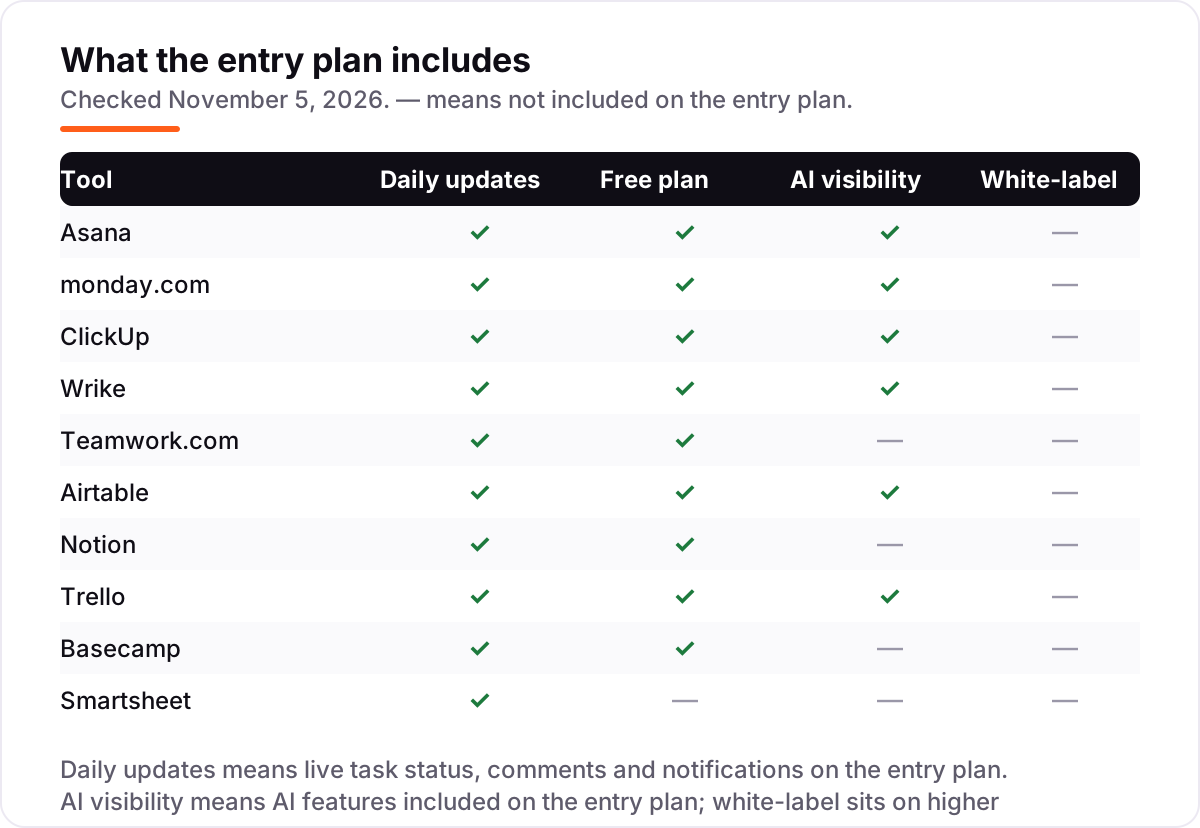
- Trello, ClickUp, Notion, Asana and monday.com all offer genuinely free plans — Smartsheet is the only tool here with no free plan for new signups.
- The single most important buying factor is the seat rule, not the headline price: seat minimums, fixed buckets and commenter billing decide what you actually pay.
- Proofing and approvals are the marketing-specific feature to check: Wrike builds them in from Team, while Asana and monday.com hold the deeper workflow features for higher tiers.
On this page
Quick comparison
| Tool | Best for | Starting price | Free plan |
|---|---|---|---|
| Asana | Marketing teams that run multi-channel campaigns and want timelines, portfolios and ready-made marketing templates | $13.49/mo | Yes (Personal) |
| monday.com | Visual marketing teams that want colorful boards, fast onboarding and one dashboard per campaign | $9/seat/mo | Yes (Individual) |
| ClickUp | Small marketing teams that want docs, whiteboards, chat and tasks in one subscription instead of four | $9/mo | Yes (Free Forever) |
| Wrike | Marketing teams that need proofing, approvals and request forms built into the project workflow | $10/mo | Yes (free plan) |
| Teamwork.com | Marketing agencies that bill clients by the hour and need time tracking and invoicing in the same tool | $9.99/mo | Yes (free plan) |
| Airtable | Marketing teams that run campaigns as structured data — content calendars, asset libraries and launch trackers | $20/seat/mo | Yes (free plan) |
| Notion | Content-led marketing teams that want briefs, docs and tasks in one flexible workspace | $10/mo | Yes (free plan) |
| Trello | Small teams that want the simplest possible board for a content calendar or launch checklist | $5/mo | Yes (free plan) |
| Basecamp | Small marketing teams that want projects, messages and files in one calm place without per-seat surprises | $15/mo | Yes (Personal) |
| Smartsheet | Marketing operations teams that think in spreadsheets and need Gantt charts and automated reports | $9/mo | No (30-day trial) |
Make one of these tools?
We re-check this list every quarter. Send a correction, request a review, or ask about a clearly labeled sponsored spot.
Request a listingThe best marketing project management tools

Asana
Best for: Marketing teams that run multi-channel campaigns and want timelines, portfolios and ready-made marketing templates
Asana is the default choice for marketing teams because it ships with the campaign machinery other tools make you build: launch, content calendar, creative request and event templates are ready to use, and Timeline and Gantt views show the whole quarter at a glance. Starter costs $13.49 per user a month billed monthly, or $10.99 on annual billing, and adds dashboards, forms, custom fields and unlimited automations.
The trade-off is the ceiling on the entry plan. Portfolios, goals and workload views wait for Advanced at $24.99 per user a month billed annually, and the free Personal plan caps at two users, so a third person forces a paid seat. Buy Asana when the team runs multi-channel campaigns and wants the templates and timelines ready on day one; buy monday.com when the board itself is the priority.
What we like
- The strongest marketing template library here: campaign, launch, content calendar and creative-request templates ready to use
- Timeline and Gantt views, dashboards and unlimited automations from the Starter plan
- AI Studio Basic included on Starter, with 50,000 AI credits per billing account a month
- Unlimited free guests, so freelancers and clients join projects without a paid seat
Watch out for
- Portfolios, goals and workload views wait for Advanced at $24.99/user/month billed annually
- Free Personal plan caps at 2 users, so a third person forces a paid seat
- Notifications get noisy on busy campaigns unless each person tunes them

monday.com
Best for: Visual marketing teams that want colorful boards, fast onboarding and one dashboard per campaign
monday.com is the fastest board in this list to set up: pick a campaign template, invite the team and the work is visible the same afternoon. Basic costs $9 a seat a month on annual billing, or $12 billed monthly, and includes unlimited boards, 5 GB of storage per seat and 1,000 AI credits a month.
The catch is what Basic leaves out. There are no automations and no integrations on Basic, so the features that make the platform worth using start on Standard at $12 a seat a month billed annually. Paid plans also have a three-seat minimum, and seats are sold in fixed buckets, so a seven-person team pays for ten. Pick monday.com when the team wants visual boards with almost no setup; pick Asana when timelines and portfolios matter more.
What we like
- The most visual boards here — a new team can run a campaign board in an afternoon
- 1,000 AI credits a month included on Basic, with three AI tools
- Unlimited boards and 5 GB storage per seat from the entry plan
- The highest G2 rating in this list at 4.7/5 from 17,932 reviews
Watch out for
- Basic has no automations or integrations — the features that make the platform worth using start on Standard at $12/seat/month
- Every paid plan has a 3-seat minimum, so a two-person team pays for three seats
- Seats are sold in fixed buckets, so a 7-person team pays for 10 seats

ClickUp
Best for: Small marketing teams that want docs, whiteboards, chat and tasks in one subscription instead of four
ClickUp is the all-in-one bet: one subscription covers tasks, docs, whiteboards, goals, chat and Gantt charts, where other tools need two or three products to do the same job. Core costs $9 per user a month billed annually, or $12 billed monthly, and includes 1,000 automation actions a month, 1,000 pooled AI credits per user a month, custom fields and unlimited storage.
The price of that breadth is setup time. ClickUp takes longer to configure than Asana or monday.com, and the interface can feel cluttered until the views are tuned. Performance can also feel slow in very large workspaces. Pick ClickUp when the team wants to replace several tools with one; pick Asana when the team wants marketing templates and timelines with no configuration.
What we like
- The most in one subscription: tasks, docs, whiteboards, goals, chat and Gantt charts from Core
- 1,000 automation actions a month and 1,000 pooled AI credits per user a month on Core
- Free Forever plan allows unlimited members, so a team can trial it properly
- Custom fields, task types and unlimited storage included at the entry price
Watch out for
- The flexibility is also the learning curve — setup takes longer than Asana or monday.com
- Performance can feel slow in very large workspaces
- Guests with permission controls arrive on Core, but private views and docs wait for Business at $17/user/month

Wrike
Best for: Marketing teams that need proofing, approvals and request forms built into the project workflow
Wrike is the pick for teams whose work ends in a review: proofing, approvals and request forms are built into the workflow rather than bolted on. Team costs $10 per user a month billed annually, for 2 to 15 users, and includes interactive Gantt charts, shareable dashboards, custom fields, AI Essentials and 50 automation actions a month.
The limits are the ones that push teams up a tier. Team has no resource management, time tracking or workload charts — those start on Business at $25 per user a month billed annually — and Wrike publishes no month-to-month rate, so the $10 figure needs a year-long commitment. Pick Wrike when creative review is the daily job; pick Asana when the team needs portfolios and goals more than proofing.
What we like
- The best proofing and approvals in this list, built for creative review cycles
- Interactive Gantt charts, shareable dashboards and custom fields from the Team plan
- AI Essentials included on Team, plus request forms for intake
- Free plan covers unlimited users, so a whole department can try it
Watch out for
- Team caps at 15 users and 50 automation actions a month — growing teams move to Business at $25/user/month
- Resource management, time tracking and workload charts do not exist on Team at all
- No month-to-month billing published, so the $10 rate needs a year-long commitment

Teamwork.com
Best for: Marketing agencies that bill clients by the hour and need time tracking and invoicing in the same tool
Teamwork.com is built for agencies: time tracking and billing live in the same workspace as the projects, so billable hours flow straight into client invoices instead of through a separate tool. Basics costs $9.99 per user a month billed annually, or $13.99 billed monthly, with a three-seat minimum, and includes project templates, time tracking, automations and a workload planner.
The catches are the gates on the entry plan. Basics has no client users, advanced reporting waits for Accelerate at $24.99 per user a month billed annually, and the AI credit allowance only arrives on November 10, 2026. Pick Teamwork.com when the agency bills by the hour; pick ClickUp or Asana when the team does in-house marketing with no client billing.
What we like
- Time tracking and billing built in — the only tool here that invoices clients from the same workspace
- Workload planner and project templates from the entry paid plan
- Free plan is a working plan: 5 users, 5 projects, Gantt views and time logging
- Strong agency fit: client work, retainers and billable hours are first-class, not add-ons
Watch out for
- Basics has no client users and no AI credit allowance until November 10, 2026
- Advanced reporting and workload management wait for Accelerate at $24.99/user/month
- The old plan names (Deliver, Grow, Scale) still appear in reviews — the current names are Basics, Accelerate and Optimize

Airtable
Best for: Marketing teams that run campaigns as structured data — content calendars, asset libraries and launch trackers
Airtable treats a campaign as data, not a board: content calendars, asset libraries and launch trackers become linked records with views, filters and forms, which suits teams that slice the same work many ways. Team costs $20 a seat a month billed annually, or $24 billed monthly, and includes 50,000 records per base, Interface Designer, Gantt views and 15,000 AI credits per paid user a month.
The seat rule is the trap. On Team, anyone with Commenter access or higher is a paid seat, so ten people who only comment cost the same as ten editors. The record cap also bites once an asset library grows past 50,000 records. Pick Airtable when the campaign is a database; pick monday.com or Trello when the team just needs a board to move cards across.
What we like
- The best content-calendar database here: linked records, views and filters beat a flat board
- Interface Designer turns a base into a clean client-facing dashboard
- 15,000 AI credits per paid user a month and 25,000 automation runs a month on Team
- Gantt and timeline views, extensions and a 1-year revision history included
Watch out for
- On Team, anyone with Commenter access or higher is a paid seat, so the bill grows faster than headcount
- Record limits bite: 50,000 records per base on Team, and large asset libraries outgrow it
- At $20/seat/month it is the priciest entry plan here, before any add-ons
Notion
Best for: Content-led marketing teams that want briefs, docs and tasks in one flexible workspace
Notion is the docs-first choice: briefs, brand guidelines, editorial calendars and task lists live in one workspace, so the plan and the writing never drift apart. Plus costs $10 per member a month billed annually, or $12 billed monthly, and includes unlimited blocks for the team, unlimited file uploads, 30-day page history and unlimited guests.
The trade-off is that project management is assembled, not built in. Timelines and boards come from databases and templates, so a team that wants Asana-style portfolios will keep building them by hand. Full Notion AI also waits for Business at $20 a member a month. Pick Notion when content and docs are the work; pick Asana or Wrike when the project structure itself is the work.
What we like
- The most flexible workspace here: briefs, brand docs, content calendars and tasks in one place
- Unlimited file uploads, 30-day page history and unlimited guests on Plus
- Huge template gallery for editorial calendars, campaign trackers and launch plans
- Guests are never billed, so clients and freelancers join free
Watch out for
- Full Notion AI lives on Business at $20/member/month — Plus gets only a limited trial
- Project management is built from databases and templates, not purpose-built views like Asana's
- The free plan caps at 1,000 blocks once a second member joins, so teams outgrow it fast

Trello
Best for: Small teams that want the simplest possible board for a content calendar or launch checklist
Trello is the purest board in this list: lists and cards, drag and drop, nothing to configure. A small team can run a content calendar or a launch checklist the same afternoon it signs up. Standard costs $5 per user a month billed annually, or $6 billed monthly, and adds unlimited boards, custom fields, advanced checklists, 1,000 Butler automation runs a month and AI features.
The simplicity has a ceiling. There is no Gantt, workload or reporting view on Standard — those wait for Premium at $10 per user a month billed annually — and the free plan caps at ten boards and ten collaborators per workspace. Pick Trello when the work is a simple board; pick monday.com when the board needs dashboards, or Asana when it needs timelines.
What we like
- The easiest tool here to learn — a team can be running a content calendar in an afternoon
- Cheapest paid seat in this list at $5/user/month billed annually
- AI features now included on Standard, including AI-assisted card capture
- Unlimited Power-Ups per board even on the free plan
Watch out for
- No Gantt, workload or reporting views on Standard — those wait for Premium at $10/user/month
- The free plan caps at 10 boards and 10 collaborators per workspace
- Needs Power-Ups for basics like WIP limits, which other tools include natively

Basecamp
Best for: Small marketing teams that want projects, messages and files in one calm place without per-seat surprises
Basecamp is the calm option: one price, every feature, no tiers and nothing held back. Plus costs $15 per user a month billed monthly and includes unlimited projects, message boards, to-do lists, schedules, file storage and Campfire chat. Clients and contractors are always free to add, so only employees count toward the bill, and Pro Unlimited costs $299 a month flat for unlimited users.
The price of that calm is capability. There are no Kanban, Gantt or timeline views, no time tracking, no proofing and almost no automation — projects are flat lists and message boards. At $15 a user a month it also costs more than Asana Starter for far fewer project features. Pick Basecamp when the team wants one quiet place for projects and messages; pick Asana or Wrike when the work needs timelines, proofing or automations.
What we like
- Every feature included at one price — no tiers, no feature gates, nothing held back
- Clients and contractors are always free to add; only employees count as paid seats
- Message boards, Campfire chat, schedules and files in one calm workspace
- Pro Unlimited at $299/month flat beats per-seat pricing once the team passes 20 people
Watch out for
- No Kanban, Gantt or timeline views — projects are flat to-do lists, boards and schedules
- No time tracking, proofing or automation to speak of
- At $15/user/month it costs more than Asana Starter for far fewer project features

Smartsheet
Best for: Marketing operations teams that think in spreadsheets and need Gantt charts and automated reports
Smartsheet is project management in a spreadsheet: rows, columns and formulas, with Gantt, board and calendar views layered on top. Pro costs $9 per member a month billed annually, or $12 billed monthly, for 1 to 10 members, and includes unlimited sheets and dashboards, 250 automation runs a month and 20 GB of attachment storage per member.
The limits are the member cap and the missing free plan. Pro stops at ten members, so an eleventh person forces Business at $19 a member a month billed annually, and there has been no free plan for new signups since August 2024 — only a 30-day trial. Pick Smartsheet when the team thinks in spreadsheets and wants Gantt charts cheap; pick monday.com when the team wants a visual board instead.
What we like
- Gantt charts, 250 automations a month and reports included on the $9 entry plan
- The familiar spreadsheet grid means Excel users need almost no training
- Unlimited free Contributors can view, comment and attach files without a paid seat
- The largest review base here: 4.4/5 from 22,959 G2 reviews
Watch out for
- No free plan for new signups since August 2024 — only a 30-day trial
- Pro caps at 10 members and 250 automations a month; an 11th member forces Business at $19/member/month
- The spreadsheet grid feels plain next to visual boards, and advanced features have a learning curve
The best marketing project management tools do one job well: they turn a campaign from a scattered chat thread into a plan with owners, dates and approvals, without making the team learn a new system. We ranked the ten tools below by fit for the most common buyer — a marketing team of three to ten people running content, social and email campaigns — starting with the most complete marketing tool and ending with the spreadsheet-style option, and every price was checked on the vendor's own pricing page on November 5, 2026.
How to choose the best marketing project management tools
- Count the seats first. monday.com has a 3-seat minimum and sells seats in fixed buckets, Wrike Team caps at 15 users, Smartsheet Pro caps at 10 members, and Airtable bills commenters as paid seats on Team. The seat rule decides the bill, not the headline price.
- Check proofing and approvals. If the team produces creative work, Wrike builds proofing into the workflow; Asana and monday.com handle review through tasks and comments, which is fine for small teams and messy for large ones.
- Check automations on the entry plan. monday.com Basic has none at all, Wrike Team allows 50 actions a month and Smartsheet Pro allows 250 — a team that automates handoffs will outgrow the cheapest tier fast.
- Check the free plan's real limits. Trello caps at 10 boards, Notion caps at 1,000 blocks with two or more members, and Smartsheet has no free plan at all for new signups.
- Think about who else touches the work. Asana and monday.com offer unlimited free guests, Airtable charges for commenters on Team, and Basecamp never charges for clients or contractors.
Marketing is one system in your stack, not the whole stack. If the team also needs to be found online, our guide to marketing platforms for small business SEO covers the visibility side. And before you publish new campaign pages, run your titles through the free SERP snippet preview tool — it shows exactly how the title and description will look in Google.
Whatever you shortlist, try it with real campaign data before you pay. The free plans and trials in this list are long enough to run one genuine campaign — your briefs, your assets, your approvals — and that campaign tells you more than any review can. Check two things in the trial: that the approval flow works the way your stakeholders actually work, and that the seat count on the invoice matches the people who will use it every day.
Marketing project management tools pricing: what you will actually pay
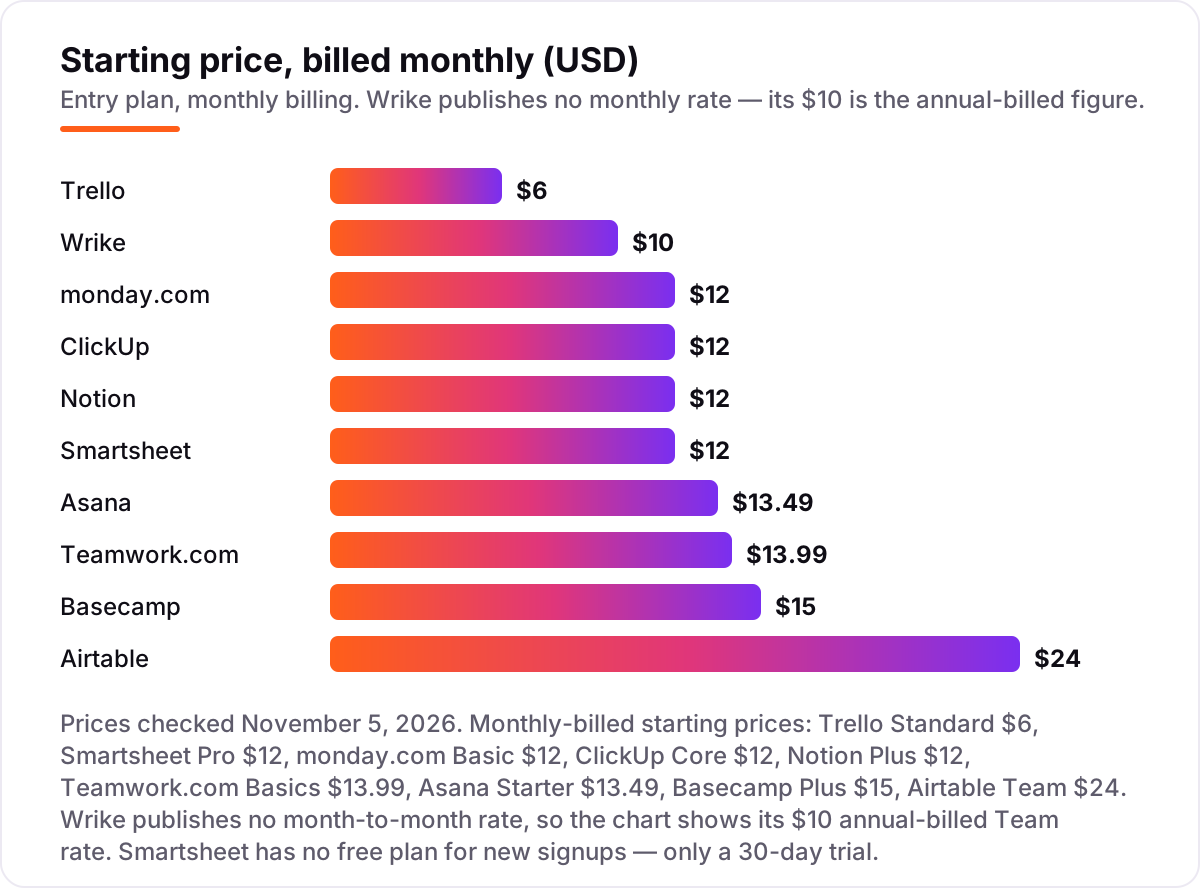
Take a ten-person marketing team running three campaigns at once. On annual billing, the subscription costs $600 a year on Trello Standard, $1,080 on monday.com Basic, ClickUp Core or Smartsheet Pro, $1,199 on Teamwork.com Basics, $1,200 on Wrike Team or Notion Plus, $1,319 on Asana Starter, $1,800 on Basecamp Plus and $2,400 on Airtable Team. The same ten people and the same three campaigns cost $600 a year at the cheap end and $2,400 at the dear end — a $1,800 gap that comes entirely from per-seat prices and seat rules, not from features.
Paying month to month instead lifts the bill: Asana rises to $1,619 a year, Airtable to $2,880, Teamwork.com to $1,679 and Trello to $720. Wrike publishes no monthly rate at all, so its $10 is annual-only. Basecamp's flat Pro Unlimited plan costs $299 a month, or $3,588 a year — more than the per-seat plan until the team passes 20 people, so a ten-person team should stay on Plus.
Three costs sit outside every number above. First, the seat traps: a seven-person team on monday.com pays for ten seats, an eleventh member on Smartsheet Pro forces Business at $19 a member a month, and Airtable Team bills commenters as paid seats. Second, the tier jumps: monday.com Basic has no automations, so the real entry point is Standard at $12 a seat a month; Asana's portfolios wait for Advanced at $24.99. Third, the AI add-ons: several tools here meter AI credits, and heavy AI use is billed on top. If the team runs content marketing rather than campaigns, the visibility tools differ too — see our guide to the best content marketing software.
Know the difference: marketing project management vs marketing automation
The confusion in this category is between planning the work and sending the work. A marketing project management tool plans it: who makes the asset, when it ships, who approves it and where the campaign stands. A marketing automation tool sends it: email sequences, social scheduling and lead nurturing. Most teams need both, and the two connect — a campaign planned in Asana can trigger sends in an automation tool, which is why our guide to AI marketing automation tools sits next to this one.
There is a second, quieter confusion: general project management tools are not marketing tools. A general tool tracks any work; a marketing tool adds campaign templates, content calendars, proofing and approvals, and asset review. Asana, Wrike and monday.com all ship marketing templates for exactly this reason, while Trello and Basecamp stay deliberately general. If the team only ever runs one kind of work, a general tool is fine; if campaigns are the work, the marketing features earn their price.
A third distinction worth knowing is the seat you pay for versus the seat you use. Several tools here charge for people who only comment or view: Airtable Team bills commenters as paid seats, while Asana, monday.com and Smartsheet let guests and Contributors in free. Before you compare headline prices, count who will actually touch the work — the cheapest per-seat price can be the dearest bill once the commenters are counted.
Quick comparison: tool type by need
| Buyer | Best pick | Why |
|---|---|---|
| Small team on a budget | Trello | Free plan, Standard is $5/user/month billed annually |
| Most marketing teams | Asana | Campaign templates and timelines, from $13.49/user/month |
| Visual team that hates setup | monday.com | Boards in an afternoon, Basic is $9/seat/month billed annually |
| Agency billing clients | Teamwork.com | Time tracking and invoicing built in, Basics is $9.99/user/month billed annually |
| Campaigns as structured data | Airtable | Content-calendar database, Team is $20/seat/month billed annually |
| Spreadsheet thinkers | Smartsheet | Gantt charts in a familiar grid, Pro is $9/member/month billed annually |
Mistakes to avoid
- Budgeting on the headline price. The seat rule decides the bill: monday.com sells seats in fixed buckets, Wrike Team caps at 15 users, Smartsheet Pro caps at 10 members, and Airtable bills commenters as paid seats.
- Buying Basic, then finding automations cost extra. monday.com Basic has no automations or integrations at all — the real entry point is Standard at $12 a seat a month. Check the automation allowance before you buy, not after.
- Ignoring the cap that bites first. A tool can be cheap and still be the wrong buy: Trello Standard has no Gantt or reporting views, and Wrike Team has no time tracking or resource management.
- Paying per seat for commenters. On Airtable Team, anyone with Commenter access or higher is a paid seat. If ten people only comment, that is ten seats — count the commenters before you commit.
- Forgetting the AI meter. Several tools here include AI credits on the entry plan and charge for more. If the team leans on AI for briefs and summaries, check the credit allowance and the overage price.
How we chose
We checked each vendor's own pricing page on November 5, 2026 and recorded the starting price exactly as shown, including the annual-billing figure where the page lists one, and we ranked the tools by fit for the most common buyer — a marketing team of three to ten people running content, social and email campaigns — not by brand size. One price in this list is not vendor-verified as a monthly rate: Wrike publishes no month-to-month price, so its $10 is the annual-billed Team rate, shown as such in the chart. Ratings come from each tool's G2 review page, checked November 5, 2026. No vendor paid for a place in this list, and none of the links here are affiliate links.
What to do next
Start with the free plan or trial of your top pick and run one real campaign through it. Check that the approval flow matches how your stakeholders actually work and that the seat count on the invoice matches the people who will use it every day. If the campaign plan is sorted but new customers are not finding you, our monthly SEO service handles the visibility side — or compare providers in our guide to SEO companies for small business. Once your tools are in place, find out what's holding your rankings back.
Your stack only works if people find you
SerpAstra fixes what keeps your site off page one and makes it easy for AI assistants to recommend.
Get a free audit→Sources we checked (20)
- Asana pricing — asana.com/pricing (checked November 5, 2026)
- monday.com pricing — monday.com/pricing (checked November 5, 2026)
- ClickUp pricing — clickup.com/pricing (checked November 5, 2026)
- Wrike pricing — wrike.com/price (checked November 5, 2026)
- Teamwork.com pricing — teamwork.com/pricing (checked November 5, 2026)
- Airtable pricing — airtable.com/pricing (checked November 5, 2026)
- Notion pricing — notion.com/pricing (checked November 5, 2026)
- Trello pricing — trello.com/pricing (checked November 5, 2026)
- Basecamp pricing — basecamp.com/pricing (checked November 5, 2026)
- Smartsheet pricing — smartsheet.com/pricing (checked November 5, 2026)
- Asana reviews — g2.com/products/asana/reviews (checked November 5, 2026)
- monday.com reviews — g2.com/products/monday-com/reviews (checked November 5, 2026)
- ClickUp reviews — g2.com/products/clickup/reviews (checked November 5, 2026)
- Wrike reviews — g2.com/products/wrike/reviews (checked November 5, 2026)
- Teamwork.com reviews — g2.com/products/teamwork-com/reviews (checked November 5, 2026)
- Airtable reviews — g2.com/products/airtable/reviews (checked November 5, 2026)
- Notion reviews — g2.com/products/notion/reviews (checked November 5, 2026)
- Trello reviews — g2.com/products/trello/reviews (checked November 5, 2026)
- Basecamp reviews — g2.com/products/basecamp/reviews (checked November 5, 2026)
- Smartsheet reviews — g2.com/products/smartsheet/reviews (checked November 5, 2026)
Shamim
Founder of SerpAstra
A full-stack SEO and digital marketer who spends most days on Local SEO for dental practices, AI search visibility and lead generation.
Frequently asked questions
What is the best marketing project management tool?
Asana is the best fit for most marketing teams: campaign templates, timelines, dashboards and unlimited automations from $13.49/user/month. monday.com is the better pick for teams that want the most visual board with almost no setup, and ClickUp is the better pick when one subscription should also cover docs, whiteboards and chat.
How much does marketing project management software cost?
Entry prices run from $0 to $24 a user a month. Trello Standard is the cheapest paid seat at $5/user/month billed annually, while Airtable Team is the priciest at $20/seat/month. A ten-person team pays $600 to $2,400 a year on annual billing, before any add-ons or higher tiers.
Is there a free marketing project management tool?
Yes, with limits. Trello, ClickUp, Notion, Asana, monday.com, Wrike, Teamwork.com, Airtable and Basecamp all have free plans, though most cap users, boards or projects. Smartsheet is the exception: its free plan closed to new signups in August 2024, so new teams get only a 30-day trial.
What is the difference between Asana and monday.com for marketing teams?
Asana leads on marketing structure: campaign templates, timelines, portfolios and unlimited automations from Starter. monday.com leads on visual boards and fast onboarding, but Basic has no automations or integrations, so the real entry point is Standard at $12/seat/month. Pick Asana for campaigns, monday.com for boards.
Do marketing teams need proofing and approval features?
Yes, if the team produces creative work. Wrike builds proofing and approvals into its Team plan, which is why it ranks high here. Asana and monday.com handle review through tasks and comments, which works for small teams but gets messy once several stakeholders approve the same asset.
What is the difference between marketing project management and marketing automation?
Project management plans the work: who makes the asset, when it ships and who approves it. Marketing automation sends the work: email sequences, social scheduling and lead nurturing. Most teams need both, and the two connect — a campaign planned in Asana can trigger sends in an automation tool.
Which marketing project management tool is best for an agency?
Teamwork.com, because time tracking and client billing are built in — billable hours flow straight into invoices, and the workload planner shows who has capacity. Asana is the better agency pick when clients mostly need visibility rather than billing, since unlimited free guests join projects at no cost.
Free SEO and AI visibility audit
Find out what is holding your rankings back
Send us your site. Within 2 business days you get a written audit, an AI visibility check and a short fix list ranked by impact. Free, with no contract attached.
Request my free audit→Related guides
 SEO & AI Search12 Best Marketing Platforms for Small Business SEO in 2026, ComparedThe 12 best marketing platforms for small business SEO, compared on real prices, SEO tools and AI visibility. Every price checked November 1, 2026.Read guide →
 Digital Marketing & Ads10 Best Content Marketing Software in 2026, Compared10 best content marketing software tools compared on price, planning, optimization and publishing, with starting prices and the right pick for every team size.Read guide →
 Digital Marketing & Ads10 Best AI Marketing Automation Tools in 2026, Compared10 best AI marketing automation tools compared on price, AI features and free plans — real starting prices checked November 4, 2026, sorted by use case.Read guide →