
12 Best Multi-Platform Email Client for 2026 (Pros, Cons and Pricing)
Compare the 12 best multi-platform email client apps for Windows, Mac, iOS and Android on price, free plans and AI, with prices checked November 6, 2026.
 Shamim Mia, Founder, SerpAstraLast verified November 6, 202614 min read
We compare pricing pages, documentation and public reviews. We never accept payment for rankings.

Key takeaways
- Microsoft Outlook is the best fit for most people — the app is free and Microsoft 365 Personal costs $9.99/month; Thunderbird is free and open source, and Spark Plus starts at $10/month.
- The single most important buying factor is whether the client works with the accounts you already have: Outlook, Thunderbird, Spark and most others connect to any provider, while Proton Mail and HEY lock you into their own mailbox.
- Nine of the twelve tools have genuinely free plans, so most buyers can try the real app for a month before paying anything.
- Watch the billing shape, not just the monthly number: eM Client, Canary Mail and HEY sell yearly only, and Superhuman at $30 a month is the most expensive client here by a wide margin.
On this page
Quick comparison
| Tool | Best for | Starting price | Free plan |
|---|---|---|---|
| Microsoft Outlook | Most people who live in Microsoft 365 and want email, calendar and contacts in one place | Free; M365 $9.99/mo | Yes (free app) |
| Mozilla Thunderbird | Anyone who wants a free, private, open-source client that works with any provider | Free | Yes (free) |
| Spark | People who want a smart, good-looking inbox on Mac, Windows, iOS and Android without paying much | $10/mo | Yes (free plan) |
| Proton Mail | Privacy-minded users who want encrypted mail on their own domain across every device | $4.99/mo | Yes (free plan) |
| eM Client | Windows and Mac users who want a desktop client with calendar, tasks and chat in one window | $49.95/yr | Yes (free plan) |
| Mailbird | Windows and Mac users who want a fast unified inbox with app integrations on the side | $4.03/mo (annual) | Yes (free plan) |
| Superhuman | Gmail and Outlook power users who will pay a premium to clear email faster | $30/mo | No |
| Spike | People who want chat-style email with team chat, notes and calls in one app | $8/mo | Yes (free plan) |
| Shortwave | Gmail users who want an AI assistant that searches, drafts and schedules from the inbox | $18/mo | Yes (free plan) |
| Canary Mail | Mac, Windows, iPhone and Android users who want AI sorting and real encryption | $36/yr | Yes (free plan) |
| Missive | Small teams that share inboxes and want email, chat and tasks in one workspace | $18/mo | No |
| HEY | People happy to move to a new @hey.com address for a calmer, screened inbox | $99/yr | No |
Make one of these tools?
We re-check this list every quarter. Send a correction, request a review, or ask about a clearly labeled sponsored spot.
Request a listingThe best multi-platform email client

Microsoft Outlook
Best for: Most people who live in Microsoft 365 and want email, calendar and contacts in one place
Outlook is the safe default because it is already everywhere: the free app runs on Windows, Mac, iOS, Android and the web, and it handles Gmail, Yahoo and IMAP accounts alongside Microsoft ones, so most people can switch without moving a single message. The free app covers mail, calendar and contacts, and Focused Inbox plus sweep rules keep a busy inbox under control.
The catch is the split between the free app and the classic desktop apps. The new Outlook for Windows is free but still misses features long-time users expect, and the full desktop Outlook, Word, Excel and Copilot come only with Microsoft 365 Personal at $9.99 a month or $99.99 a year. Buy Outlook when you live in Microsoft 365; buy Thunderbird or Spark when you want a free client without the subscription.
What we like
- The Outlook app and Outlook.com cost nothing, and the same inbox works on Windows, Mac, iOS, Android and the web
- Deep Microsoft 365 integration: calendar, Teams, OneDrive and Office files in one window
- Focused Inbox, sweep rules and solid search handle high-volume mail well
- The client most workplaces already standardize on, so help and migration guides are everywhere
Watch out for
- The classic desktop apps need a Microsoft 365 subscription; the free app is a cut-down version
- The new Outlook for Windows still lacks some classic Outlook features, and its interface divides long-time users
- Search and rules feel slower than desktop rivals on very large mailboxes

Mozilla Thunderbird
Best for: Anyone who wants a free, private, open-source client that works with any provider
Thunderbird is the only tool here that asks for nothing: no account, no subscription, no ads and no tracking, just a free open-source client that runs on Windows, macOS, Linux, Android and iOS and works with any provider. It handles unlimited accounts, local folders, offline mail, calendars and tasks, and OpenPGP encryption is built in rather than bolted on.
The trade-off is polish. The interface looks dated next to Spark or Superhuman, setup takes more clicks, and there is no AI writing or summarising — add-ons fill some gaps but vary in quality. A paid Thunderbird Pro bundle with its own mailbox and scheduling tools is in beta, but the core client stays free. Choose Thunderbird when privacy and price matter more than a modern face.
What we like
- Completely free and open source, with no ads, no tracking and no account lock-in
- Runs on Windows, macOS, Linux, Android and iOS, and works with Gmail, Outlook, Yahoo and any IMAP account
- Built-in OpenPGP encryption, phishing protection and a huge add-on library
- Local folders and offline mail keep your archive on your own machine, not in a vendor cloud
Watch out for
- The interface looks dated next to Spark or Superhuman, and setup takes more clicks
- No built-in AI writing or summarising; add-ons fill the gap but vary in quality
- Large mailboxes can feel slow, and the Android app is newer than the desktop client

Spark
Best for: People who want a smart, good-looking inbox on Mac, Windows, iOS and Android without paying much
Spark earns its place with the Smart Inbox: it sorts real people from newsletters automatically, and snooze, send later and reminders all work on the free plan, which covers unlimited accounts. The design is clean and fast on Mac, Windows, iOS and Android, and one subscription syncs settings across every device you own.
The paid plans are where the interesting tools live. Plus costs $10 a month, or $8.25 billed annually, and adds the AI assistant, Gatekeeper, a priority inbox and shared templates; Pro costs $20 a month and adds unlimited meeting notes and shared inboxes. There is no web or Linux version. Pick Spark when you want a smart inbox that looks good and costs little.
What we like
- Smart Inbox sorts people from newsletters automatically, and snooze, send later and reminders are on the free plan
- One subscription covers Mac, Windows, iOS and Android, with settings synced across devices
- Plus adds the AI assistant, Gatekeeper and shared templates for $10 a month
- Clean, modern design that feels fast on both desktop and phone
Watch out for
- The AI assistant, Gatekeeper and priority inbox all need Plus; the free plan is a limited preview
- No web or Linux version, so Chromebook and Linux users are left out
- Spark 3 drew complaints about slowness from users who loved the older version

Proton Mail
Best for: Privacy-minded users who want encrypted mail on their own domain across every device
Proton Mail is the privacy-first choice: end-to-end encryption, Swiss privacy law and tracker blocking are built in, and the apps cover Windows, macOS, Linux, iOS, Android and the web. Mail Plus costs $4.99 a month, or $3.99 billed annually, and adds 15 GB of storage, 10 addresses, a custom domain and Bridge for other desktop clients.
The catch is that Proton is a mailbox, not just an app: you get a @proton.me address, and moving your existing mail in takes effort. Search is slower than Gmail's, the free plan caps storage at 1 GB with no custom domain, and the Lumo AI assistant sits in the Unlimited bundle, not Mail Plus. Choose Proton when encryption matters more than speed.
What we like
- End-to-end encryption and Swiss privacy law, with tracker blocking built in
- Apps for Windows, macOS, Linux, iOS, Android and web, plus Bridge for other desktop clients
- Mail Plus adds 15 GB, 10 addresses, a custom domain and hide-my-email aliases
- A real free plan with no ads and no data selling, funded by paying users
Watch out for
- Mail Plus is $4.99 a month, and the free plan caps storage at 1 GB with no custom domain
- Search is slower than Gmail's, and Proton's own Bridge is needed for desktop IMAP clients
- No AI drafting or summarising on Mail Plus; the Lumo assistant sits in the Unlimited bundle

eM Client
Best for: Windows and Mac users who want a desktop client with calendar, tasks and chat in one window
eM Client is the desktop all-rounder: one window holds mail, calendar, tasks, contacts and chat, with a clean modern interface and strong support for Exchange and Gmail. The Personal subscription costs $49.95 a year and covers unlimited accounts on three devices, and a one-time licence is sold for buyers who would rather not subscribe.
The free plan is the tightest here after Mailbird's: two accounts on one device for personal use, with snooze and Send Later held back. There is no Linux or web version, and the AI add-on costs $2 a month extra instead of being included. Pick eM Client when you want everything in one desktop window and you work on Windows or Mac.
What we like
- One window holds mail, calendar, tasks, contacts and chat, with a clean modern interface
- Personal subscription covers unlimited accounts on 3 devices for $49.95 a year
- A one-time licence is also sold for buyers who would rather not subscribe
- Strong Exchange and Gmail support, with snooze, Send Later, mass mail and translation on paid plans
Watch out for
- The free plan stops at 2 accounts on 1 device and leaves out snooze and Send Later
- No Linux or web version, so the client only covers Windows, macOS and the mobile apps
- The AI add-on costs $2 a month extra instead of being included in the subscription

Mailbird
Best for: Windows and Mac users who want a fast unified inbox with app integrations on the side
Mailbird is the fast, light Windows-first client: a unified inbox merges every account while keeping reply context intact, and WhatsApp, Slack, Google Calendar and dozens of other apps sit in the sidebar. Premium costs $4.03 a month billed annually and adds unlimited accounts, email tracking, snooze and AI tools, or $99.75 buys a pay-once licence.
The limits are the platform and the free plan. Mailbird runs on Windows and Mac only — there is no mobile or web app, so your phone keeps a different inbox — and the free plan covers a single account. Recent G2 reviews also complain about the pay-once licence terms changing after purchase. Choose Mailbird when your email life happens on a Windows desktop.
What we like
- Unified Inbox merges every account while keeping reply context intact
- Fast and light on Windows and Mac, with WhatsApp, Slack, Google Calendar and dozens of app integrations
- Premium adds unlimited accounts, email tracking, snooze and AI tools for $4.03 a month billed annually
- A $99.75 pay-once licence suits buyers who would rather not subscribe
Watch out for
- The free plan covers only 1 account, so multi-inbox users must pay
- No mobile or web app: Mailbird is desktop-only, which breaks the multi-platform promise on phones
- Recent G2 reviews complain about the pay-once licence terms changing after purchase

Superhuman
Best for: Gmail and Outlook power users who will pay a premium to clear email faster
Superhuman is the fastest way through email in this list: a keyboard-first client with a split inbox, snippets, read statuses and an AI that writes replies, labels mail and answers questions across the inbox. It runs on Mac, Windows, iOS, Android and the web, and reviewers rate it 4.8 out of 5 on G2 — the highest score here.
The price is the whole story. There is no free plan and no published trial, so the cheapest way in is Mail Starter at $30 a month, or $25 billed annually, and it works only on top of Gmail or Outlook accounts you still pay for separately. Pick Superhuman when email is your job and thirty dollars a month is cheaper than the hours it saves.
What we like
- The fastest client here: keyboard-first triage, split inbox, snippets and read statuses
- AI writes replies, labels mail automatically and answers questions across the inbox
- The highest G2 rating in this list, 4.8 out of 5 from 1,284 reviews
- Runs on Mac, Windows, iOS, Android and web, with calendar and scheduling built in
Watch out for
- No free plan and no published free trial, so the cheapest way in is $30 a month
- Works only on top of Gmail or Outlook accounts; you still pay Google or Microsoft separately
- The $12 suite Pro tier does not include the Mail app, which confuses buyers

Spike
Best for: People who want chat-style email with team chat, notes and calls in one app
Spike turns email into chat: long threads become readable conversations, and the same app holds team chat, notes, tasks and video calls, so a small team can live in one window. It runs on Windows, Mac, iOS, Android and the web, and Pro costs $8 a month, or $6 billed annually, with unlimited search history and unlimited Spike AI.
The free plan is restrictive — a single address — and the cheapest paid plan covers only three, so heavy multi-account users need the top tier at $12 a month billed annually. There is no Linux app, reviewers note the mobile app can feel laggy, and the two plan families, Email App and Teamspace, share confusingly similar names. Choose Spike when you want email to feel like messaging.
What we like
- Chat-style threads turn long email chains into readable conversations
- One app covers mail, team chat, notes, tasks and video calls on Windows, Mac, iOS, Android and web
- Pro adds unlimited search history, 5 GB of storage and unlimited Spike AI for $6 a month billed annually
- Shared Inbox and custom domains on the Teamspace Team plan suit small teams
Watch out for
- The free plan is restrictive, and the cheapest paid plan covers only 3 addresses
- No Linux app, and reviewers note the mobile app can feel laggy
- Two plan families (Email App and Teamspace) with overlapping names make pricing confusing

Shortwave
Best for: Gmail users who want an AI assistant that searches, drafts and schedules from the inbox
Shortwave is the AI-native client: an assistant built by ex-Google engineers that searches years of Gmail, drafts replies, summarises threads and books meetings from a prompt. Pro costs $18 a month with monthly billing only, and it includes three years of AI search history, 50 threads per AI search and personalised AI writing.
The catch is the audience: Shortwave works with Gmail and Google Workspace only, so Outlook, Yahoo and IMAP accounts are out. Every plan caps AI use with a daily quota, the free plan keeps only 90 days of search history and adds a Shortwave signature, and there is no annual discount. Pick Shortwave when your mail lives in Gmail and you want the AI to do the reading.
What we like
- An AI assistant that searches years of mail, drafts replies and books meetings from a prompt
- Built by ex-Google engineers as a modern successor to Inbox by Gmail, with bundles and snooze built in
- Runs on Mac, Windows, iOS, Android and web, with a free plan to try the AI first
- Pro includes 3 years of AI search history, 50 threads per AI search and personalised AI writing
Watch out for
- Works only with Gmail and Google Workspace accounts; Outlook and IMAP users are locked out
- Every plan caps AI use with a daily quota, and the free plan keeps only 90 days of search history
- Pro is $18 a month with no annual discount, and AI filters wait for Business at $30

Canary Mail
Best for: Mac, Windows, iPhone and Android users who want AI sorting and real encryption
Canary Mail pairs AI with real security: the free plan sorts your inbox with AI, blocks tracking pixels by default and warns about phishing, and it works with Gmail, Outlook, iCloud, Yahoo, Exchange and any IMAP account on Mac, iPhone, iPad, Windows and Android. Growth costs $36 a year and adds AI writing, summaries and read receipts.
The billing shape is the thing to notice: there is no monthly option, so Growth is $36 a year or $100 once, and PGP encryption with SecureSend waits for Pro+ at $100 a year or $300 once. The free plan also covers only two devices. Choose Canary when you want AI sorting and encryption for the accounts you already have.
What we like
- AI sorts the inbox on the free plan, and Growth adds AI writing and summaries for $36 a year
- Blocks tracking pixels by default and warns about phishing and impersonation
- Pro+ adds PGP encryption and SecureSend for password-protected mail to anyone
- Runs on Mac, iPhone, iPad, Windows and Android with settings synced across devices
Watch out for
- No monthly billing: Growth is $36 a year or $100 once, and there is no way to pay month to month
- PGP encryption and SecureSend wait for Pro+ at $100 a year
- The free plan covers only 2 devices, so a third device needs a paid plan

Missive
Best for: Small teams that share inboxes and want email, chat and tasks in one workspace
Missive is the team inbox: shared mailboxes with assignments, internal comments and tasks, so a support or sales team can answer mail together without forwarding or cc'ing. It works with Gmail, Outlook, IMAP, SMS, WhatsApp and Instagram in one unified inbox, on Mac, Windows, iOS, Android and the web.
The price is per seat and the caps matter. Starter costs $18 a user a month, or $14 billed annually, and stops at five users; Productive costs $24 billed annually and is the first plan with AI features and rules. There is no free plan, only a 30-day trial. Pick Missive when several people answer the same inbox and you need to see who is handling what.
What we like
- Shared inboxes with assignments, internal comments and tasks, built for teams that answer mail together
- Works with Gmail, Outlook, IMAP, SMS, WhatsApp and Instagram in one unified inbox
- The second-highest G2 rating here, 4.7 out of 5 from 838 reviews
- Runs on Mac, Windows, iOS, Android and web, with a 30-day trial and no credit card required
Watch out for
- No free plan: the cheapest way in is Starter at $14 a user a month billed annually
- AI features wait for Productive at $24 a user a month, and AI runs on credits or your own API key
- Starter caps at 5 users, so a sixth seat forces the jump to Productive

HEY
Best for: People happy to move to a new @hey.com address for a calmer, screened inbox
HEY rebuilds email around the Screener: first-time senders land in a holding pen and only reach your inbox if you approve them, while approved mail splits into the Imbox, newsletters go to the Feed and receipts to the Paper Trail. It costs $99 a year, includes 100 GB, HEY Calendar and a personal blog, and runs on web, Mac, Windows, Linux, iOS and Android.
The commitment is total. You must take a new @hey.com address — HEY cannot read your existing Gmail or Outlook inbox — and there is no IMAP or POP, so no other mail app can open HEY mail. There is no free plan and no monthly option. Choose HEY when you are ready to move house for a calmer inbox, not when you want a better view of the one you have.
What we like
- The Screener means first-time senders only reach you if you approve them
- Imbox, Feed and Paper Trail split real mail, newsletters and receipts automatically
- Spy-pixel blocking and a clean, opinionated design with apps for web, Mac, Windows, Linux, iOS and Android
- 100 GB of storage, HEY Calendar and a personal HEY World blog included
Watch out for
- You must take a new @hey.com address; HEY cannot read your existing Gmail or Outlook inbox
- No IMAP or POP support, so no other mail app can open HEY mail
- No monthly option and no free plan: the minimum spend is $99 a year after the trial
A best multi-platform email client earns its place by doing one thing well: it shows the same inbox, with the same rules and folders, on your Windows PC, your Mac, your iPhone and your Android phone, so email follows you instead of trapping you on one device. We ranked the twelve tools below by fit for the most common buyer — someone with two or three accounts who wants one inbox everywhere — and every price was checked on the vendor's own pricing page on November 6, 2026.
How to choose the best multi-platform email client
- Check your accounts first. Thunderbird, Spark, Outlook, eM Client, Mailbird, Spike, Canary Mail and Missive connect to Gmail, Outlook, Yahoo and any IMAP account. Shortwave works with Gmail only, Superhuman with Gmail and Outlook only, and Proton Mail and HEY give you a new mailbox instead.
- Count your accounts against the free plan. eM Client's free plan stops at 2 accounts, Mailbird's at 1, Canary Mail's free plan covers 2 devices, and Spike's free plan covers 1 address. The cap you hit first is your real starting price.
- Decide whether you need a client or a service. A client reads the mailbox you have; a service replaces it. Proton Mail and HEY mean a new address and a migration; the rest mean installing an app.
- Weigh AI against price. Spark, Superhuman, Shortwave, Canary Mail, Spike and Mailbird all put AI features on paid plans, while Thunderbird and HEY have none. Our guide to AI email management tools covers the AI side in more depth.
- Test the phone app, not just the desktop. A client is only multi-platform if the mobile app is good: Mailbird has no phone app at all, and Spike's mobile app draws complaints about lag. Try the free plan on your phone for a week before you pay.
If the inbox is sorted but your business still needs to be found online, our monthly SEO service handles the visibility side. And before you publish new pages for the services you sell, run your titles through the free SERP snippet preview tool — it shows exactly how the title and description will look in Google.
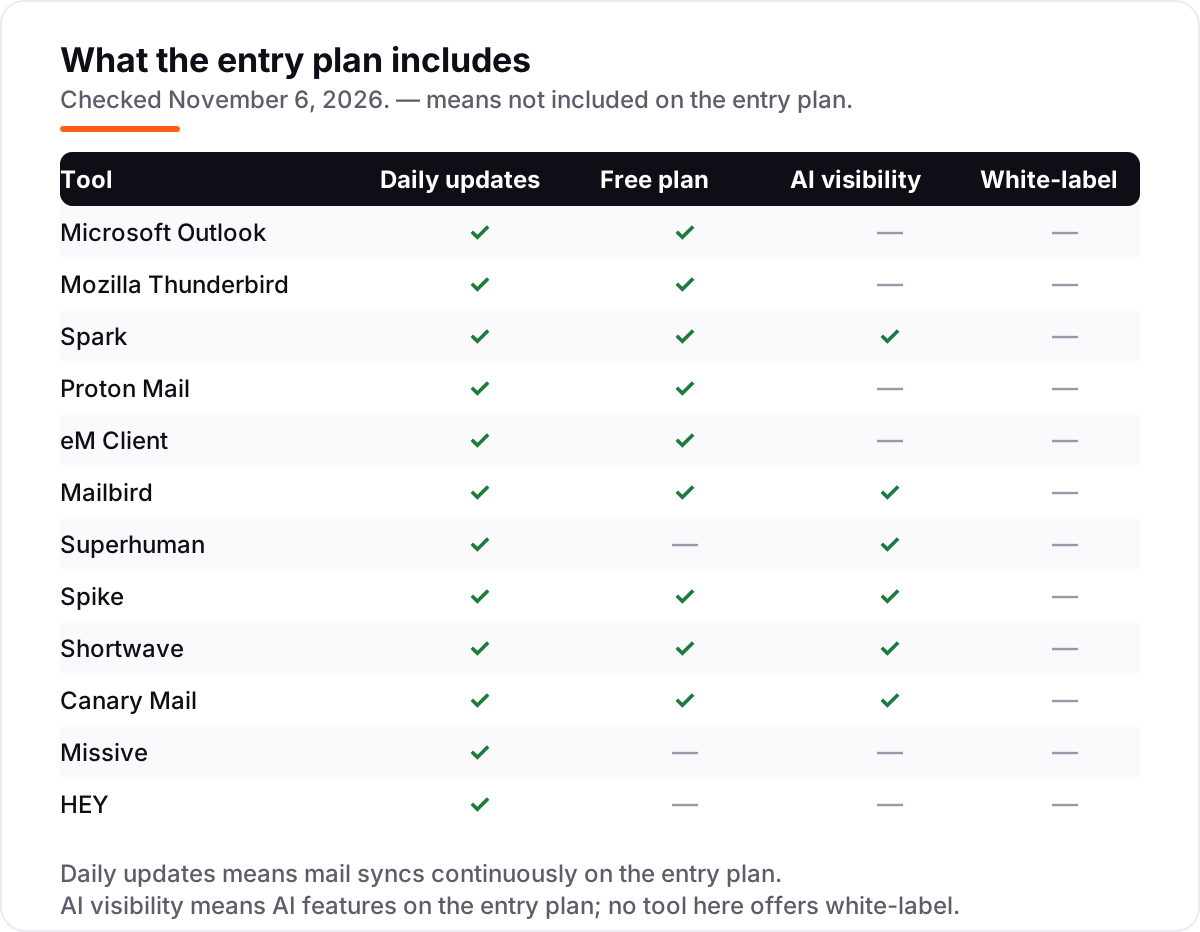
Whatever you shortlist, try it with real mail before you pay. The free plans and trials in this list are long enough to run one genuine week — your accounts, your rules, your phone — and that week tells you more than any review can. Check two things in the trial: that mail syncs instantly on every device, and that the search finds an old message in seconds. Every tool here except Superhuman, Missive and HEY has a free plan, so there is no reason to buy before you have tried it.
Multi-platform email client pricing: what you will actually pay
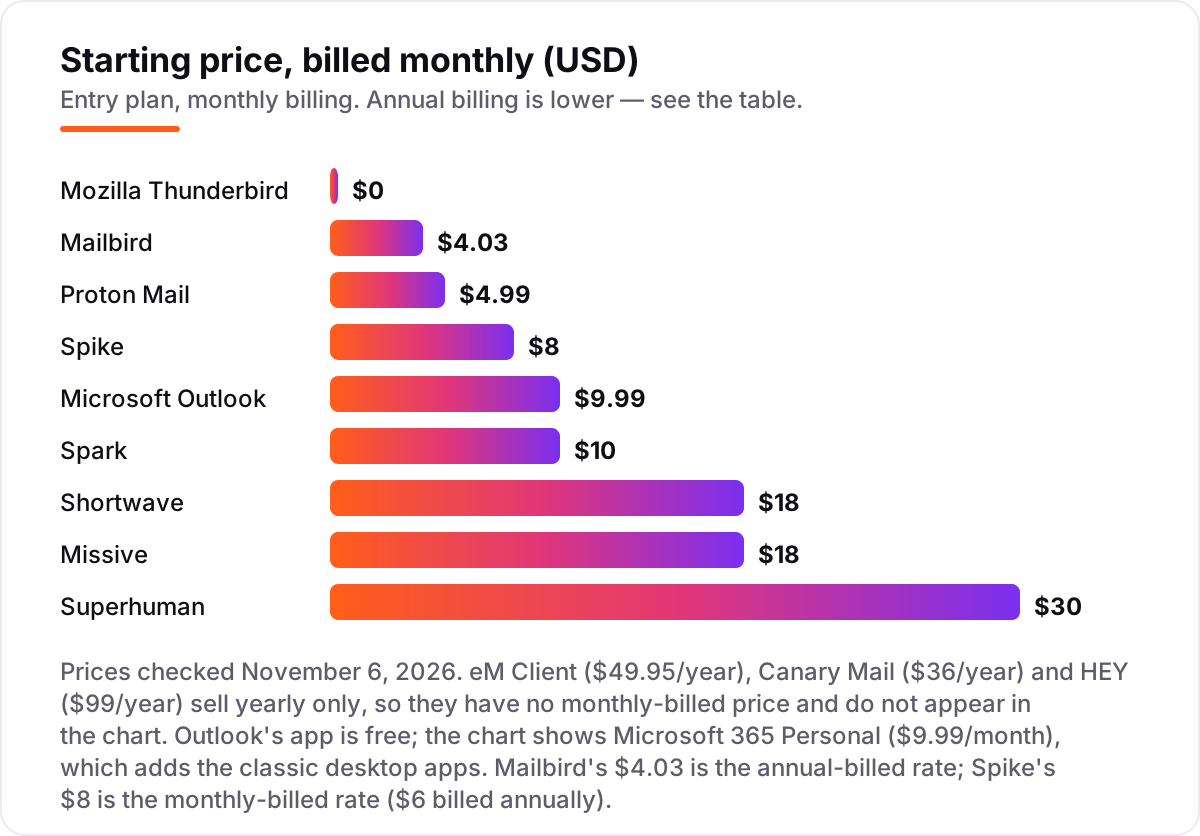
For one person, the honest starting point is $0: Thunderbird, the free Outlook app, Spark, Proton Mail, eM Client, Mailbird, Canary Mail, Shortwave and Spike all have free plans, so a single user with two or three accounts can run a good inbox without paying anything. The first paid step is small: Mailbird Premium at $4.03 a month billed annually, Proton Mail Plus at $4.99 a month ($3.99 billed annually), Spike Pro at $8 a month ($6 billed annually), Spark Plus at $10 a month ($8.25 billed annually), Shortwave Pro at $18 a month, and Superhuman Starter at $30 a month ($25 billed annually).
The yearly-only tools need a different comparison. Canary Mail Growth costs $36 a year, eM Client Personal costs $49.95 a year, and HEY for You costs $99 a year — each is one annual payment with no monthly option. At those prices, a year of Canary Mail costs less than four months of Superhuman Starter billed monthly, and a year of HEY costs about what three months of Superhuman costs. If you only need one device family, our guide to email client software compares desktop-first options too.
For a five-person team sharing one inbox, the numbers change. Missive Starter costs $70 a month billed annually ($14 times 5), Spark Plus costs $41.25 a month billed annually ($8.25 times 5), and Superhuman Starter costs $125 a month billed annually ($25 times 5). Over a year, that is $495 on Spark Plus, $840 on Missive Starter and $1,500 on Superhuman Starter. Remember that Superhuman sits on top of Gmail or Outlook accounts you still pay for separately, so its $1,500 is on top of your mailbox bill, not instead of it.
Know the difference: email client vs email service
The confusion in this category is between an app and a mailbox. An email client is an app that reads the accounts you already have: Thunderbird, Spark, Outlook, eM Client, Mailbird, Spike, Canary Mail, Shortwave, Superhuman and Missive all work this way, connecting to Gmail, Outlook, Yahoo or any IMAP account. Your mail stays with your provider, so switching clients takes minutes and your address never changes.
An email service gives you the mailbox itself. Proton Mail gives you a @proton.me address with encrypted storage, and HEY gives you a @hey.com address with its Screener and Imbox system. That is a bigger commitment: switching means exporting your mail, telling everyone your new address, and paying every year to keep it. The upside is privacy and a rethought inbox; the downside is lock-in. Outlook straddles both sides — Outlook.com is a service with a free mailbox, and the Outlook app is a client that reads any account.
A second distinction worth knowing is the client that only works with one provider. Shortwave reads Gmail and nothing else; Superhuman reads Gmail and Outlook and nothing else. If your work mail is on Yahoo or a custom IMAP server, neither tool can help you, however good their AI is. Check the provider list before you check the price.
Quick comparison: tool type by need
| Buyer | Best pick | Why |
|---|---|---|
| Most people | Microsoft Outlook | Free app on every platform, full desktop apps with Microsoft 365 at $9.99/month |
| Free and private | Thunderbird | $0, open source, works with any provider on Windows, Mac, Linux and mobile |
| Smart inbox on a budget | Spark | Free plan with Smart Inbox, Plus is $10/month with AI and Gatekeeper |
| Privacy first | Proton Mail | Encrypted mail on your own domain, Mail Plus is $4.99/month |
| Fastest inbox | Superhuman | Keyboard-first triage and AI, $30/month, rated 4.8/5 on G2 |
| Team sharing one inbox | Missive | Shared inboxes with assignments, Starter is $14/user/month billed annually |
Mistakes to avoid
- Buying a client that cannot read your accounts. Shortwave is Gmail-only, Superhuman is Gmail and Outlook only, and HEY cannot read your existing inbox at all. Check the provider list before the price.
- Budgeting on the annual rate when you will pay monthly. Spark Plus is $10 a month, not $8.25, and Superhuman Starter is $30, not $25, unless you commit to a year. Compare tools on the billing you will actually use.
- Assuming the free plan covers your account count. eM Client's free plan stops at 2 accounts, Mailbird's at 1, Canary Mail's free plan covers 2 devices and Spike's covers 1 address. Count your accounts before you count on free.
- Paying for a service when you only need a client. Proton Mail and HEY replace your mailbox; Thunderbird, Spark and the rest use the one you have. Do not pay for a new address when a free app would do the job.
- Forgetting the mailbox still costs money. Superhuman and Shortwave sit on Gmail or Outlook accounts you pay for separately, and Proton Mail Plus and HEY are the mailbox bill itself. Price the whole stack, not just the app.
How we chose
We checked each vendor's own pricing page on November 6, 2026 and recorded the starting price exactly as shown, including the annual-billing figure where the page lists one, and we ranked the tools by fit for the most common buyer — someone with two or three accounts who wants one inbox on every device — not by brand size. Two prices come from fresh third-party reads of the vendor's own pages because the vendor pages would not load directly on November 6: eM Client's $49.95 a year (two independent October 2026 reads of the vendor page agree) and Mailbird's $4.03 a month billed annually (the vendor's own blog, September 2026). This list carries no rating for Spark, because G2's main "Spark" listing is a different product (a Java framework), and none for Shortwave, because no fresh G2 figure could be located; Proton Mail's rating is from G2's "Proton Mail For Business" listing, and HEY's is from a G2 comparison page. No vendor paid for a place in this list, and none of the links here are affiliate links.
What to do next
Start with the free plan of your top pick and run one real week of mail through it on every device you own. Check that mail syncs instantly, that search finds an old message in seconds, and that the phone app is one you actually enjoy opening. If the inbox is sorted but new customers are not finding you, our monthly SEO service handles the visibility side — or compare alternatives in our guide to email apps like Superhuman. Once your tools are in place, find out what's holding your rankings back.
Your stack only works if people find you
SerpAstra fixes what keeps your site off page one and makes it easy for AI assistants to recommend.
Get a free audit→Sources we checked (22)
- Microsoft 365 pricing — microsoft.com (checked November 6, 2026)
- Thunderbird — thunderbird.net (checked November 6, 2026)
- Spark pricing — sparkmailapp.com/pricing (checked November 6, 2026)
- Proton Mail pricing — proton.me/mail/pricing (checked November 6, 2026)
- eM Client pricing — emclient.com/pricing (checked November 6, 2026)
- Mailbird pricing — getmailbird.com/pricing (checked November 6, 2026)
- Superhuman Mail pricing — superhuman.com/mail/pricing (checked November 6, 2026)
- Spike pricing — spikenow.com (checked November 6, 2026)
- Shortwave pricing — shortwave.com/pricing (checked November 6, 2026)
- Canary Mail pricing — canarymail.io (checked November 6, 2026)
- Missive pricing — missiveapp.com/pricing (checked November 6, 2026)
- HEY pricing — hey.com/pricing (checked November 6, 2026)
- Microsoft Outlook reviews — g2.com (checked November 6, 2026)
- Thunderbird reviews — g2.com (checked November 6, 2026)
- eM Client reviews — g2.com (checked November 6, 2026)
- Mailbird reviews — g2.com (checked November 6, 2026)
- Proton Mail For Business reviews — g2.com (checked November 6, 2026)
- Superhuman Mail reviews — g2.com (checked November 6, 2026)
- Spike reviews — g2.com (checked November 6, 2026)
- Canary Mail reviews — g2.com (checked November 6, 2026)
- Missive reviews — g2.com (checked November 6, 2026)
- HEY reviews — g2.com (checked November 6, 2026)
Shamim
Founder of SerpAstra
A full-stack SEO and digital marketer who spends most days on Local SEO for dental practices, AI search visibility and lead generation.
Frequently asked questions
What is the best multi-platform email client?
Microsoft Outlook is the best fit for most people: the app is free on every platform and the full desktop apps come with Microsoft 365 Personal at $9.99 a month. Thunderbird is the best free option at $0, Spark is the best smart inbox at $10 a month, and Superhuman is the fastest at $30 a month.
Is there a free multi-platform email client?
Yes. Thunderbird is completely free and open source, the Outlook app is free, and Spark, Proton Mail, Spike, Canary Mail and Shortwave all have free plans. Nine of the twelve tools in this list cost nothing to start with, so try the free plan with your real accounts before paying for any upgrade.
What is the difference between an email client and an email service?
A client is an app that reads the accounts you already have — Thunderbird, Spark, Outlook, eM Client and most tools here work that way. A service gives you the mailbox itself: Proton Mail gives you a @proton.me address and HEY gives you a @hey.com address, so switching means moving your mail and telling people your new address.
Can I use the same email client on Windows, Mac, iPhone and Android?
Yes, with most tools here: Outlook, Thunderbird, Spark, Proton Mail, Spike, Shortwave, Canary Mail, Missive and HEY all run on Windows, Mac, iOS and Android. Mailbird is desktop-only with no phone app, eM Client has no Linux or web version, and Shortwave works only with Gmail accounts.
How much does a good multi-platform email client cost?
Most buyers pay $0 to $10 a month. Thunderbird and the Outlook app are free, Mailbird Premium is $4.03 a month billed annually, Proton Mail Plus is $4.99 a month and Spark Plus is $10 a month. Superhuman is the outlier at $30 a month, while Canary Mail, eM Client and HEY sell yearly only at $36, $49.95 and $99 a year.
Do I still need Gmail or Outlook if I use one of these clients?
It depends on the tool. Superhuman and Shortwave sit on top of Gmail or Outlook accounts, so you keep paying Google or Microsoft separately. Proton Mail and HEY replace your mailbox entirely. Thunderbird, Spark, eM Client, Mailbird, Spike, Canary Mail and Missive work with the accounts you already have.
Can I switch email clients later?
Yes, if your mail lives with a provider rather than inside the client. Your messages stay in Gmail, Outlook or your IMAP account when you switch apps, so moving from Thunderbird to Spark takes minutes. The exception is Proton Mail and HEY: your mail lives in their mailbox, so leaving means exporting it and changing your address.
Free SEO and AI visibility audit
Find out what is holding your rankings back
Send us your site. Within 2 business days you get a written audit, an AI visibility check and a short fix list ranked by impact. Free, with no contract attached.
Request my free audit→Related guides
 Digital Marketing & AdsBest Email Client Software for 2026: 9 Options Compared by Use CaseCompare the 9 best email client software options for 2026 on price, free plans, AI features and privacy, with every price checked November 5, 2026.Read guide →
 Email, SMS & Social Media10 Best AI Email Management Tools in 2026 (Free and Paid, Compared)Compare the 10 best ai email management tools on price, AI triage, drafting and shared inboxes, with every starting price checked November 5, 2026.Read guide →
 Digital Marketing & Ads12 Best Email Apps Alternatives to Superhuman in 2026Compare the 12 best email apps alternatives to Superhuman on price, free plans, AI features and speed, with every price checked November 5, 2026.Read guide →