
Best SAAS Billing Software for 2026: 10 Options Compared by Use Case
Compare the 10 best saas billing software options for 2026 by use case, with real prices checked November 4, 2026 — from Stripe Billing to Billsby.
 Shamim Mia, Founder, SerpAstraLast verified November 4, 202614 min read
We compare pricing pages, documentation and public reviews. We never accept payment for rankings.

Key takeaways
- Stripe Billing is the best fit for most SaaS companies at 0.7% of billing volume; Chargebee follows at 0.80%, and Recurly at $249 a month plus 0.9% above $40,000 in monthly billings.
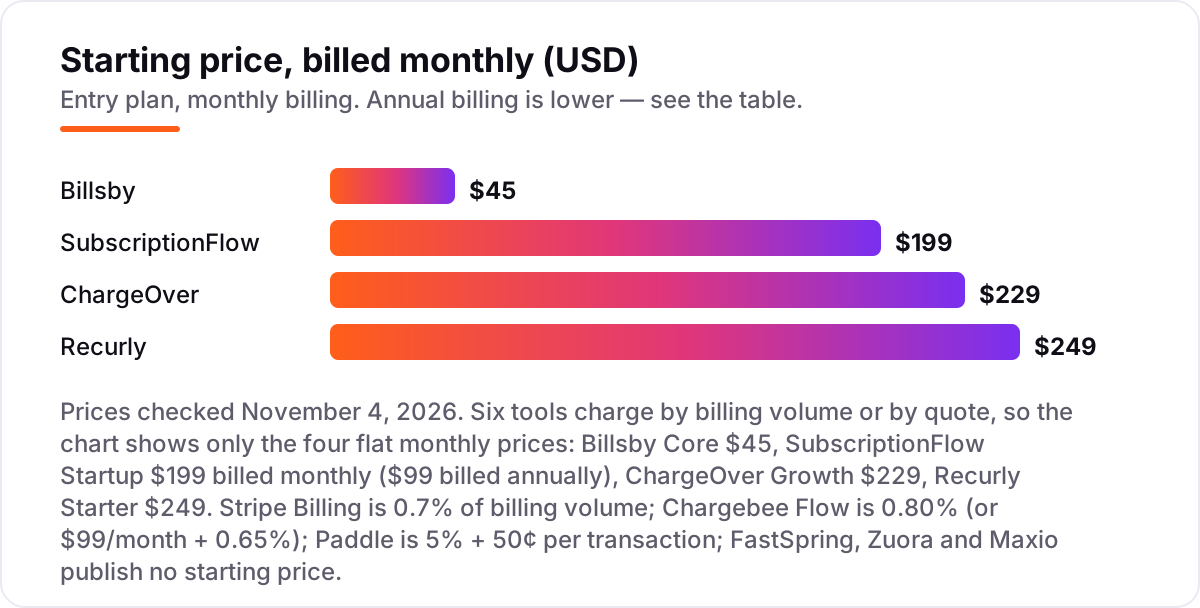
- Billsby is the only tool here with a free plan, and its first paid plan is $45 a month — the cheapest flat price in this list.
- The single most important buying factor is who the seller of record is: Stripe Billing, Chargebee and Recurly bill on top of your payment processor, while Paddle and FastSpring sell as the merchant of record and handle global tax for you.
- Six of the ten tools charge by billing volume or by quote, so compare them at your own monthly volume — the worked example below does the math at $50,000 a month.
On this page
Quick comparison
| Tool | Best for | Starting price | Free plan |
|---|---|---|---|
| Stripe Billing | SaaS companies already processing payments through Stripe that want billing inside the same stack | 0.7% of volume | No (pay-as-you-go) |
| Chargebee | SaaS and subscription businesses that want a dedicated billing platform separate from their payment processor | 0.80% of volume | No (pay-as-you-go) |
| Recurly | Consumer and e-commerce subscription businesses where failed payments and churn are the biggest leaks | $249/mo + 0.9% | No (90-day trial) |
| Paddle | SaaS companies selling software worldwide that want tax, VAT and chargebacks handled for them | 5% + 50¢ | No (pay per transaction) |
| FastSpring | Software and digital-goods sellers that want one vendor for storefront, billing and global tax | Custom quote | No (free demo) |
| Maxio | B2B SaaS companies whose finance team wants billing, revenue recognition and collections in one system | Custom quote | No (free trial) |
| Zuora | Large enterprises with complex subscription models, multi-currency catalogs and revenue recognition needs | Custom quote | No |
| ChargeOver | Mid-market subscription businesses that want a predictable flat monthly bill priced by customers, not revenue | $229/mo | No (free sandbox) |
| SubscriptionFlow | Small subscription businesses that want every feature included for one low flat monthly fee | $99/mo (annual) | No (free demo) |
| Billsby | Founders launching a subscription product who want to set everything up free before going live | Free; Core $45/mo | Yes (free plan) |
Make one of these tools?
We re-check this list every quarter. Send a correction, request a review, or ask about a clearly labeled sponsored spot.
Request a listingThe best saas billing software

Stripe Billing
Best for: SaaS companies already processing payments through Stripe that want billing inside the same stack
Stripe Billing is the billing layer on top of Stripe Payments, so it fits SaaS companies that already process cards through Stripe and want subscriptions, invoices and dunning in the same dashboard. Pay-as-you-go costs 0.7% of billing volume, on top of the standard 2.9% plus 30 cents per successful card charge. Annual plans start at $620 a month for up to $100,000 in monthly billing volume.
The depth is the draw: flexible pricing models, metered usage up to 100 million events a month, Smart Retries for failed payments, proration, trials and coupons, all through an API developers rate highly. The bill grows with volume, and tax, revenue recognition and advanced fraud tools are paid add-ons. Pick Stripe Billing when Stripe already moves your money; pick Chargebee or Recurly when you want a billing platform that works with any gateway.
What we like
- No monthly fee on pay-as-you-go — 0.7% of billing volume, with annual plans from $620/month
- Metered usage up to 100 million events a month, Smart Retries, proration, trials and coupons
- The API and documentation developers rate most highly in this list
- Customer portal, invoices and checkout all live in the same Stripe dashboard
Watch out for
- The bill grows with volume — 0.7% of billing volume sits on top of the 2.9% + 30¢ processing fee
- Tax, revenue recognition and advanced fraud tools are paid add-ons, not part of Billing
- No way to use Stripe Billing with a different payment processor

Chargebee
Best for: SaaS and subscription businesses that want a dedicated billing platform separate from their payment processor
Chargebee is the dedicated billing platform, built for SaaS and subscription businesses that want billing separated from their payment processor. Flow is priced by volume: pay-as-you-go is 0.80% of monthly billing value with no platform fee, or $99 a month plus 0.65% with a monthly commitment. Both include 100 million usage events a month, 40-plus gateway integrations and smart dunning.
The platform covers the full subscription job — product catalog, pricing experiments, invoicing, coupons, trials, revenue recognition add-ons and a customer portal — and reviewers praise its breadth. The cost scales with revenue, so a fast-growing company can pay far more than a flat-fee tool, and the interface takes time to learn. Pick Chargebee when billing is a core system you want to run properly; pick Stripe Billing when you want billing inside the processor you already use.
What we like
- Pay-as-you-go Flow is 0.80% of monthly billing value with no platform fee, or $99/month + 0.65%
- 100 million usage events a month, 40+ gateway integrations and smart dunning on Flow
- Full subscription job: product catalog, pricing experiments, invoicing, coupons and trials
- Startup program bills free until $1 million in cumulative billing for qualifying startups
Watch out for
- The cost scales with revenue, so a fast-growing company pays far more than on a flat-fee tool
- Dense interface with a real learning curve in the first month
- CPQ, revenue recognition and retention tools are separate products with separate prices

Recurly
Best for: Consumer and e-commerce subscription businesses where failed payments and churn are the biggest leaks
Recurly is a subscription management platform built for consumer and e-commerce subscriptions, and its reputation rests on payment recovery: Smart Retries, dunning campaigns and churn tools sit at the center. Starter costs $249 a month plus 0.9% of billing volume, with the first $40,000 of billings each month included free, and a 90-day free trial. All-Access is quoted for companies billing over $1 million a year.
Starter covers automated global billing, flexible plans and pricing, one dunning campaign, 10-plus payment methods and 20-plus gateways. The catch is that the strongest recovery tooling — machine-learning retries and multiple dunning campaigns — waits for All-Access, and Recurly moves no money itself, so gateway fees sit on top. Pick Recurly when failed payments and churn are your biggest leaks; pick Chargebee when you need deeper B2B billing and revenue recognition.
What we like
- Starter is $249/month plus 0.9% of billing volume, with the first $40,000 of billings each month free
- Strongest churn-recovery reputation here: dunning campaigns, gift subscriptions, coupons and trials
- 140+ currencies and multi-language dunning for global consumer subscriptions
- 90-day free trial on Starter with no volume minimum
Watch out for
- The strongest recovery tooling — machine-learning retries and multiple dunning campaigns — waits for All-Access
- Recurly moves no money itself, so gateway processing fees sit on top of the platform fee
- All-Access needs at least $1 million in billing volume and a quoted annual contract

Paddle
Best for: SaaS companies selling software worldwide that want tax, VAT and chargebacks handled for them
Paddle is a merchant of record, which means Paddle — not you — is the legal seller, and it handles checkout, billing, global sales tax and VAT, fraud and chargebacks in one fee: 5% plus 50 cents per checkout transaction, with no monthly fee. That single fee replaces a billing platform, a tax tool and a fraud tool, and there is no lock-in period.
The trade is control for convenience: Paddle owns the checkout and the customer payment relationship, so your brand sits inside Paddle's flow and you cannot bring your own gateway. At 5% plus 50 cents it is also the most expensive per transaction here for high-volume sellers. Pick Paddle when you sell software worldwide and want tax compliance handled for you; pick Stripe Billing when you want to keep the payment relationship and pay less per transaction.
What we like
- One fee covers checkout, billing, global sales tax and VAT, fraud protection and chargebacks
- No monthly fee, no lock-in, and your data stays yours if you leave
- Handles tax registration, filing and remittance in 75+ countries as the merchant of record
- Dedicated customer success and migration support for larger sellers
Watch out for
- Paddle owns the checkout and the payment relationship, so you cannot bring your own gateway
- At 5% + 50¢ per transaction it is the most expensive per-transaction option here for high-volume sellers
- Your brand sits inside Paddle's checkout flow rather than a fully owned one

FastSpring
Best for: Software and digital-goods sellers that want one vendor for storefront, billing and global tax
FastSpring is also a merchant of record, aimed at software and digital-goods sellers. Its flat-rate pricing bundles checkout, payment processing, subscription management, global tax collection and remittance, fraud prevention and B2B invoicing into one revenue share — the exact percentage is quoted for your volume and mix, and discounted rates are available for ACH and wire transfer transactions.
The appeal is the single contract: one vendor handles the storefront, the billing and the tax filings, so there is no stack of add-ons to manage. The downside is the same as Paddle's — FastSpring is the seller of record, so you give up checkout control, and there is no published price to compare before you talk to sales. Pick FastSpring when you sell downloadable software worldwide; pick Paddle when you want a published 5% rate you can model before signing.
What we like
- Flat-rate pricing bundles checkout, processing, subscriptions, tax and fraud into one revenue share
- Collects and remits VAT and sales tax on your behalf in every market it serves
- B2B invoicing and interactive quotes included, not sold as add-ons
- Discounted rates available for ACH and wire transfer transactions
Watch out for
- No published price — the revenue-share percentage is quoted for your volume and mix
- FastSpring is the seller of record, so you give up checkout control
- Smaller integration list than Stripe Billing or Chargebee

Maxio
Best for: B2B SaaS companies whose finance team wants billing, revenue recognition and collections in one system
Maxio is the B2B SaaS pick in this list, built from the merger of Chargify and SaaSOptics. It pairs subscription billing with revenue recognition, A/R management and SaaS metrics, so finance teams can run billing, collections and the monthly close in one system. Pricing is by quote, based on billing volume and the modules you need, with no per-seat charges and annual contracts as the default.
The strength is the finance depth: automated revenue recognition under ASC 606, dunning, metering, multi-entity support and integrations with QuickBooks, Xero, NetSuite, Salesforce and HubSpot. The cost is the catch — reviewers report high prices and a learning curve, and setup is a project, not an afternoon. Pick Maxio when finance needs billing and revenue recognition together; pick Chargebee when you want a lighter billing-only platform.
What we like
- Billing plus automated revenue recognition under ASC 606, A/R management and SaaS metrics
- No per-seat charges — unlimited users on every plan
- 20+ payment gateways and integrations with QuickBooks, Xero, NetSuite, Salesforce and HubSpot
- Usage-based, fixed, milestone and event-based billing in one catalog
Watch out for
- Pricing is by quote, and reviewers report high prices with a learning curve
- Setup is a project with onboarding calls, not an afternoon's work
- Advanced revenue management and A/R are modules, so the base price is only part of the bill

Zuora
Best for: Large enterprises with complex subscription models, multi-currency catalogs and revenue recognition needs
Zuora is the enterprise pick, built for companies with complex subscription models — multi-currency catalogs, ramp deals, usage rating, CPQ and revenue recognition across channels. It is the oldest platform here and the one most large subscription businesses standardize on, with deep Salesforce and ERP integrations. Pricing is entirely by quote, and G2 reviewers report implementation taking around six months.
The platform handles billing complexity other tools cannot: any pricing model, contract terms, entitlements and multi-entity billing in one catalog. The price is the platform's weight — high cost, a steep learning curve and a long implementation make it a poor fit for a small team. Pick Zuora when your pricing model is genuinely complex and you have a billing team; pick Maxio or Chargebee when a mid-market platform will do the job.
What we like
- Handles any pricing model — flat fee, tiered, volume, overage — from one dynamic catalog
- CPQ, e-commerce, self-service and partner portals all draw on the same price book
- Revenue recognition and accounting rules embedded in the catalog, not bolted on
- Deep Salesforce and ERP integrations for enterprise finance stacks
Watch out for
- High cost and a steep learning curve — G2 reviewers report about six months to implement
- Renewal pricing draws complaints from reviewers, including large increases at renewal
- Overkill for a small team: the platform needs dedicated billing or RevOps expertise to run

ChargeOver
Best for: Mid-market subscription businesses that want a predictable flat monthly bill priced by customers, not revenue
ChargeOver is the flat-rate pick: plans start at $229 a month for the Growth plan, which covers 200 active customers, and the price scales with customer count, not with a percentage of your revenue. There are no per-transaction fees from ChargeOver itself — you still pay your gateway — and there are no annual contracts. A free sandbox lets you test features before going live.
The platform covers recurring billing, invoicing, dunning, a self-service billing portal, 40-plus reports and integrations with QuickBooks, Xero, HubSpot and Salesforce. Reviewers rate it 4.7 out of 5 on G2, the second-highest score here, and praise the support team. The trade is scope: it is a billing tool, not a full revenue platform, with no revenue recognition module. Pick ChargeOver when you want a predictable flat bill; pick Recurly when recovery tooling matters more.
What we like
- Flat $229/month for the Growth plan, covering 200 active customers a month — no percentage of revenue
- No annual contracts and no per-transaction fees from ChargeOver itself
- 40+ reports, self-service billing portal and integrations with QuickBooks, Xero, HubSpot and Salesforce
- Rated 4.7/5 on G2, the second-highest score in this list, with support reviewers praise
Watch out for
- The price scales with active customer count, so a growing customer base raises the bill
- No revenue recognition module — it is a billing tool, not a full revenue platform
- No free plan; the sandbox covers test transactions only

SubscriptionFlow
Best for: Small subscription businesses that want every feature included for one low flat monthly fee
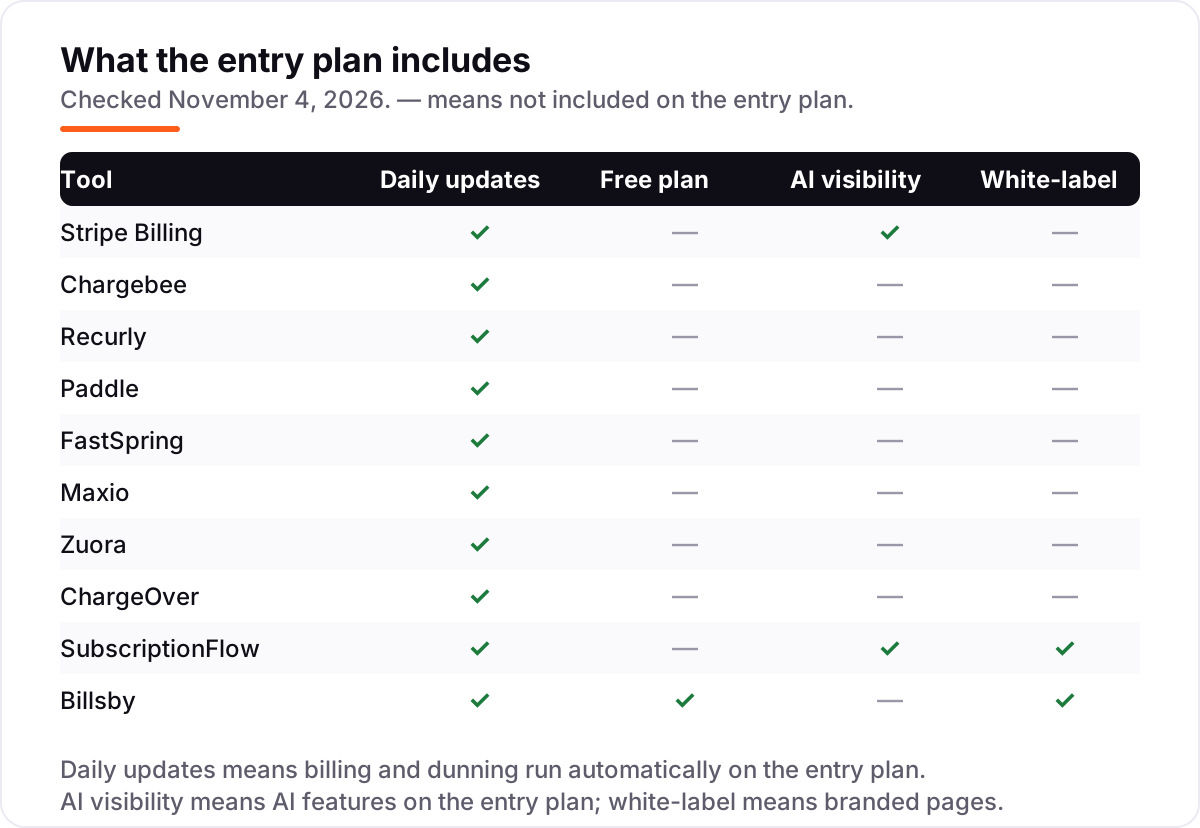
SubscriptionFlow is the budget flat-rate pick: Startup costs $99 a month billed annually, or $199 a month billed monthly, and covers up to $100,000 in invoiced revenue a year. Every plan includes every feature — invoicing, dunning, automation, usage-based charges, tax management and white-label branding — so there is no feature ladder to climb. Rise is $199 a month billed annually for up to $600,000 a year.
The flat fee and all-features-included model make the bill easy to predict, and the platform adds retention tooling that flags customers likely to churn. The limits are scale and polish: only 34 G2 reviews, a smaller integration list than the big platforms, and a dated interface reviewers mention. Pick SubscriptionFlow when a low predictable fee matters most; pick Billsby when you want an even cheaper start with a free plan.
What we like
- Startup is $99/month billed annually ($199 billed monthly) for up to $100,000 in invoiced revenue a year
- Every plan includes every feature — no feature ladder to climb as you grow
- RetentionFlow flags customers likely to churn so you can act before they leave
- White-label branding, custom invoices and custom checkouts included on the entry plan
Watch out for
- Only 34 G2 reviews, so the rating rests on a small base
- Smaller integration list than the big platforms in this list
- Dated interface that reviewers mention, with no mobile-friendly admin view

Billsby
Best for: Founders launching a subscription product who want to set everything up free before going live
Billsby is the cheapest way into this list: the free plan costs $0 and lets you set up unlimited products, plans and cycles before you go live, and Core, the first paid plan, costs $45 a month plus 0.4% on revenue above $15,000 a month. Pro is $135 a month plus 0.5% above $30,000, and the platform is rated 4.8 out of 5 on G2, the highest score here.
Core covers unlimited products and plans, metered billing, automated dunning, customizable branding and a QuickBooks integration, with 5 users included. The trade is scale: the feature set is narrower than Chargebee or Maxio, the integration list is short, and revenue recognition is a paid add-on. Pick Billsby when you are launching a subscription product and want to start free; pick SubscriptionFlow when you want more features at a similar price.
What we like
- The only free plan here: $0 to set up unlimited products, plans and cycles before going live
- Core is $45/month plus 0.4% on revenue above $15,000 a month — the cheapest paid start here
- Rated 4.8/5 on G2, the highest score in this list, from 486 reviews
- Customizable branding, metered billing and automated dunning on the entry paid plan
Watch out for
- Narrower feature set than Chargebee or Maxio, with a short integration list
- Revenue recognition and data exports are paid add-ons on the entry plan
- The 0.4% overage above $15,000 a month in revenue grows the bill as you scale
The best saas billing software turns subscriptions into money without manual work: it creates the plan, charges the card on schedule, retries the failures, handles proration when a customer upgrades, and produces the invoices finance needs at month-end. We ranked the ten tools below by fit for the most common buyer — a SaaS company choosing its billing system — starting with the billing layers that sit on a payment processor and ending with the flat-rate platforms, and every price was checked on the vendor's own pricing page on November 4, 2026.
How to choose the best saas billing software
- Decide who the seller of record is. With Stripe Billing, Chargebee and Recurly, you are the seller and you own tax and chargebacks. With Paddle and FastSpring, they are the seller and they handle tax, VAT and chargebacks for you.
- Price it at your volume, not at the headline. A percentage fee beats a flat fee at low volume and loses at high volume — run your own monthly billing number through the worked example below before you shortlist.
- Check the recovery tooling. Failed payments are the quietest revenue leak in SaaS. Smart retries, dunning emails and card updaters are worth more than a lower platform fee.
- Count the add-ons. Tax, revenue recognition, advanced fraud tools and white-label portals are often separate products. The entry price is only the start of the bill.
- Test the customer portal. Your customers will live in it for plan changes, payment updates and invoices. If it looks cheap or confusing, it costs you renewals.
SaaS billing sits next to your marketing stack, not apart from it. If the business also sells to smaller customers, our guide to billing software for small business covers that side, and the free SERP snippet preview tool shows how your pricing page will look in Google before you publish it.
Whatever you shortlist, run a real billing cycle before you pay. The trials and free plans here are long enough to put a genuine month through — real plans, real invoices, a real failed card — and that month tells you more than any review can. Check two things in the trial: that a failed payment retries itself without your help, and that your accountant can read the invoices without asking you what they mean.
SaaS billing pricing: what you will actually pay
Take a SaaS business billing $50,000 a month in subscriptions. On the platform fee alone, the month costs $185 on Billsby Core ($45 plus 0.4% of the $35,000 above its $15,000 threshold), $199 on SubscriptionFlow Rise billed annually (it covers $600,000 a year, exactly $50,000 a month), $229 on ChargeOver Growth if you have 200 active customers or fewer, $339 on Recurly Starter ($249 plus 0.9% of the $10,000 above its $40,000 allowance), $350 on Stripe Billing pay-as-you-go (0.7% of $50,000), and $400 on Chargebee Flow pay-as-you-go (0.80% of $50,000). Chargebee's commit variant costs more at this volume: $99 plus 0.65% is $424 a month.
Over a year, that is $2,220 on Billsby, $2,388 on SubscriptionFlow billed annually, $2,748 on ChargeOver, $4,068 on Recurly, $4,200 on Stripe Billing and $4,800 on Chargebee. The same $50,000 a month costs $2,220 a year at the cheap end and $4,800 at the dear end — a $2,580 gap that comes entirely from the pricing shape, not from features. Note that Stripe's annual Billing plan starts at $620 a month for up to $100,000 in monthly volume, so at $50,000 a month the $350 pay-as-you-go fee is the cheaper Stripe option.
Two costs sit outside every number above. First, card processing: Stripe Billing, Chargebee, Recurly, ChargeOver, SubscriptionFlow and Billsby all sit on top of a payment processor, so the standard 2.9% plus 30 cents per charge applies on top of the platform fee — about $1,450 a month at this volume. Paddle is the exception that proves the rule: its 5% plus 50 cents per transaction comes to about $2,500 a month at $50,000 in volume, but that single fee already includes processing, tax handling and fraud protection. Second, tax: if you sell worldwide on a billing layer, you still need a tax tool or a merchant of record. If you run a SaaS company rather than a general subscription business, the accounting tools differ too — see our guide to the best accounting software for SaaS.
Know the difference: billing software vs payment processor vs merchant of record
The confusion in this category is between three jobs that sound alike. A payment processor moves money: Stripe Payments charges 2.9% plus 30 cents per successful card charge and settles it to your bank. Billing software decides what to charge and when: Stripe Billing, Chargebee and Recurly create the subscription, generate the invoice, retry the failed payment and handle proration — but they do not move money themselves, so you pay the processor on top.
A merchant of record is a different animal again: Paddle and FastSpring are the legal seller of your product. They take the payment, collect and remit sales tax and VAT, fight chargebacks and answer buyer support questions, all inside one percentage fee. You pay more per transaction — 5% plus 50 cents at Paddle — and you give up checkout control, but you never register for VAT in another country.
There is a third, quieter confusion: invoicing tools are not billing software. An invoicing tool sends bills and tracks payments; it does not run subscription lifecycles, trials, proration or dunning. All ten tools in this list run the subscription lifecycle, which is what the phrase "SaaS billing software" means here. If a tool only invoices, it belongs in a different list.
Quick comparison: tool type by need
| Buyer | Best pick | Why |
|---|---|---|
| SaaS already processing through Stripe | Stripe Billing | Billing inside the stack you use, 0.7% of billing volume |
| Dedicated billing platform, any gateway | Chargebee | Broadest billing feature set, Flow from 0.80% of volume |
| Consumer subscriptions, churn is the leak | Recurly | Strongest recovery tooling, Starter $249/month + 0.9% |
| Selling software worldwide, hate tax admin | Paddle | Merchant of record, 5% + 50¢ covers billing, tax and fraud |
| Enterprise pricing complexity | Zuora | Handles any pricing model, custom quote |
| Flat predictable bill | ChargeOver | $229/month, priced by customers, never by revenue |
| Cheapest start | Billsby | Free plan, Core is $45/month |
Mistakes to avoid
- Comparing a percentage fee with a flat fee without doing the volume math. At $10,000 a month in billings, Stripe Billing costs $70 and ChargeOver costs $229. At $50,000, the order flips. Run your number first.
- Forgetting that processing sits on top. A billing layer's fee is not the whole cost: 2.9% plus 30 cents per charge applies on top of Stripe Billing, Chargebee, Recurly and the flat-fee tools. Only the merchants of record bundle it in.
- Buying on the entry price, then finding the feature is an add-on. Tax, revenue recognition, advanced fraud tools and white-label portals are separate products on several tools here. Price the add-ons before you commit.
- Ignoring the seller-of-record question until tax season. If you sell to customers in other countries, someone has to collect and remit their sales tax. Decide whether that someone is you or a merchant of record before you launch, not after your first VAT notice.
- Choosing an enterprise platform before you have the team to run it. Zuora and Maxio are powerful, but they need billing or RevOps expertise and weeks of setup. A small team gets more from a tool it can run in a day.
How we chose
We checked each vendor's own pricing page on November 4, 2026 and recorded the starting price exactly as shown, including the annual-billing figure where the page lists one, and we ranked the tools by fit for the most common buyer — a SaaS company choosing its billing system — not by brand size. Two prices need a note. Chargebee's Flow figures (0.80% pay-as-you-go, or $99 a month plus 0.65%) come from third-party coverage of the current pricing, because the vendor's pricing page did not expose the figures in readable text when we checked it; older Chargebee tiers quoted elsewhere are retired and are not used here. Recurly's $249 Starter price is the price published on the vendor's own pricing page, confirmed by third-party coverage. This list carries no rating for Paddle because the G2 review page returned a rate-limit error when we tried to open it on November 4, 2026, and we would rather show no rating than a stale or estimated one. No vendor paid for a place in this list, and none of the links here are affiliate links.
What to do next
Start with the free plan or trial of your top pick and run one real billing cycle through it. Check that a failed payment retries itself and the invoices match what finance expects before you commit to a year. If billing is sorted but new customers are not finding you, our monthly SEO service handles the visibility side — or compare the invoicing side in our guide to invoicing software for small business. Once your tools are in place, find out what's holding your rankings back.
Your stack only works if people find you
SerpAstra fixes what keeps your site off page one and makes it easy for AI assistants to recommend.
Get a free audit→Sources we checked (20)
- Stripe pricing — stripe.com/pricing (checked November 4, 2026)
- Chargebee pricing — chargebee.com/pricing (checked November 4, 2026)
- Recurly pricing — recurly.com/pricing (checked November 4, 2026)
- Paddle pricing — paddle.com/pricing (checked November 4, 2026)
- FastSpring pricing — fastspring.com/pricing (checked November 4, 2026)
- Maxio pricing — maxio.com/pricing (checked November 4, 2026)
- Zuora pricing — zuora.com/pricing (checked November 4, 2026)
- ChargeOver pricing — chargeover.com/pricing (checked November 4, 2026)
- SubscriptionFlow pricing — subscriptionflow.com/pricing (checked November 4, 2026)
- Billsby pricing — billsby.com/pricing (checked November 4, 2026)
- Stripe Billing G2 reviews — g2.com/products/stripe-billing/reviews (checked November 4, 2026)
- Chargebee G2 reviews — g2.com/products/chargebee/reviews (checked November 4, 2026)
- Recurly G2 reviews — g2.com/products/recurly/reviews (checked November 4, 2026)
- FastSpring G2 reviews — g2.com/products/fastspring/reviews (checked November 4, 2026)
- Maxio G2 reviews — g2.com/products/maxio/reviews (checked November 4, 2026)
- Zuora G2 reviews — g2.com/products/zuora-zuora/reviews (checked November 4, 2026)
- ChargeOver G2 reviews — g2.com/products/chargeover/reviews (checked November 4, 2026)
- SubscriptionFlow G2 reviews — g2.com/products/subscriptionflow/reviews (checked November 4, 2026)
- Billsby G2 reviews — g2.com/products/billsby/reviews (checked November 4, 2026)
- Chargebee pricing coverage — baremetrics.com/blog/what-is-chargebee (third-party, checked November 4, 2026)
Shamim
Founder of SerpAstra
A full-stack SEO and digital marketer who spends most days on Local SEO for dental practices, AI search visibility and lead generation.
Frequently asked questions
What is the best SaaS billing software?
Stripe Billing is the best fit for most SaaS companies: billing inside the Stripe stack at 0.7% of billing volume, with no monthly fee on pay-as-you-go. Chargebee is the better pick when you want a dedicated billing platform that works with any gateway. Billsby is the best free start, with a $0 plan and Core at $45 a month.
How much does SaaS billing software cost?
It depends on the pricing shape. Flat-fee tools run from $45 to $249 a month. Percentage tools charge 0.7% to 0.8% of billing volume, and merchants of record take 5% or more per transaction. At $50,000 a month in billing volume, the platform fee runs from about $185 to $400 a month before processing.
What is the difference between Stripe Billing and Chargebee?
Stripe Billing is a billing layer inside Stripe Payments, so it only works with Stripe and its 0.7% fee sits on top of processing. Chargebee is a standalone billing platform that connects to 40-plus gateways, so you can keep your existing processor. Chargebee Flow costs 0.80% of billing volume, or $99 a month plus 0.65%.
Do I need a merchant of record like Paddle or FastSpring?
You need one if you sell software worldwide and do not want to register for sales tax and VAT in every market. Paddle and FastSpring act as the legal seller, collect and remit tax, and handle chargebacks. The trade is a higher per-transaction fee and less checkout control than billing on your own processor.
Is there free SaaS billing software?
Only one tool here has a free plan: Billsby, at $0 with unlimited setup time before you go live. Stripe Billing and Chargebee have no monthly fee on their pay-as-you-go plans, so you pay nothing until you bill customers, but they still take a percentage of every charge.
Can I switch SaaS billing software later?
Yes, but plan the move carefully. Export your customer list, subscription plans, payment methods and invoice history from the old tool, then import them into the new one and test renewals before going live. Switching is easiest at a contract renewal, and most vendors offer migration support — ask for it before you sign.
Does SaaS billing software include payment processing?
Usually not. Stripe Billing, Chargebee, Recurly, Maxio and Zuora are billing layers that sit on top of a payment processor, so card processing is billed separately. Paddle and FastSpring are the exception: as merchants of record, their fee includes processing, tax handling and fraud protection in one rate.
Free SEO and AI visibility audit
Find out what is holding your rankings back
Send us your site. Within 2 business days you get a written audit, an AI visibility check and a short fix list ranked by impact. Free, with no contract attached.
Request my free audit→Related guides
 Accounting, Tax & Finance11 Best Billing Software for Small Business in 2026, Compared11 best billing software for small business picks compared on price, free plans and payment fees, with real starting prices checked November 2, 2026.Read guide →
 SEO & AI Search12 Best Accounting Software for SAAS in 2026, Compared12 best accounting software for saas tools compared with real 2026 prices, from $0 billing layers to full ledgers and ERP, sorted by what your SaaS needs.Read guide →
 Accounting, Tax & Finance11 Best Invoicing Software for Small Business in 2026, Compared11 best invoicing software for small business compared on price, free plans and payment fees. Prices checked on vendor pricing pages, November 2, 2026.Read guide →