
8 Best Self-Hosted Apps in 2026, Compared
Compare the 8 best self-hosted apps for websites, analytics, automation, email, BI and ERP on licences, hosted options and real running cost.
 Shamim Mia, Founder, SerpAstraLast verified November 2, 20268 min read
We compare pricing pages, documentation and public reviews. We never accept payment for rankings.
Key takeaways
- Every app in this list is free to self-host; the real cost is the server, your time and the updates you take on.
- Plausible and Matomo are the self-hosted replacements for Google Analytics, and Matomo's On-Premise Community edition has no user or hit limits.
- n8n's self-hosted Community Edition gives unlimited workflow executions, against 2,500 a month on its $20 hosted Starter plan billed annually.
- Most of these apps also sell a hosted version, so you can start self-hosted and move to managed hosting, or the other way round, without changing tools.
On this page
Quick comparison
| Tool | Best for | Starting price | Free plan |
|---|---|---|---|
| n8n | Teams that want to self-host workflow automation with unlimited executions | $20/mo (annual) | Yes (self-hosted) |
| WordPress.org | Businesses that want to own their website software, content and hosting choice | Free (software) | Yes (software free) |
| Ghost | Publishers who want a self-hosted blog, newsletter and membership site in one app | $18/mo | No (14-day trial) |
| Plausible | Site owners who want simple, cookie-free web analytics on their own server | $9/mo | No (30-day trial) |
| Matomo | Organisations that want a full Google Analytics replacement with complete data ownership | €29/mo | Yes (self-hosted) |
| Metabase | Data teams that want self-hosted dashboards non-technical colleagues can use | $100/mo | Yes (open source) |
| listmonk | Teams that send large newsletters and want to avoid per-subscriber email pricing | $0/yr | Yes (free) |
| ERPNext | Small businesses that want a full self-hosted ERP with no per-user licence fees | Free; hosted from $5/mo | Yes (open source) |
Make one of these tools?
We re-check this list every quarter. Send a correction, request a review, or ask about a clearly labeled sponsored spot.
Request a listingThe best self-hosted apps

n8n
Best for: Teams that want to self-host workflow automation with unlimited executions
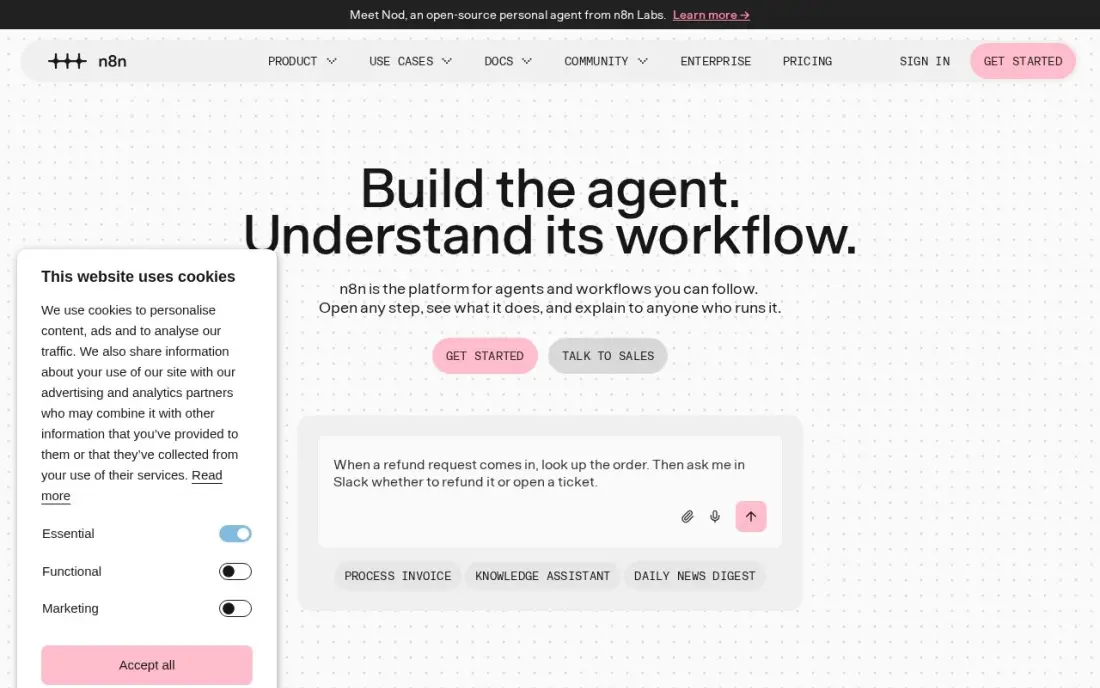
n8n is the strongest self-hosted automation tool. The Community Edition is free to run on your own server with unlimited workflow executions under a fair-code licence, and it connects hundreds of apps, runs AI agent nodes and lets you drop into code when the visual builder runs out. Keeping automations in-house also keeps the data they move off a third-party cloud.
If you outgrow your server or tire of upkeep, the hosted Starter plan costs $20 a month billed annually, or $24 monthly, for 2,500 executions and five active workflows. Self-hosting suits a team with someone comfortable running Docker and updates; otherwise the hosted plan is the faster start.
What we like
- Billed per workflow run, not per step, so a 20-step flow costs the same as a 2-step one
- Self-hosted Community Edition is free with unlimited executions, under a fair-code licence
- Native AI agent nodes and a large integration library, with code when the visual builder runs out
Watch out for
- Needs technical confidence: code nodes, webhooks and self-hosting are part of the appeal, not optional extras
- Starter caps at 5 active workflows and 5 concurrent executions, so busy teams outgrow it fast
- A flow that fires every minute eats the 2,500 monthly executions in under two days

WordPress.org
Best for: Businesses that want to own their website software, content and hosting choice
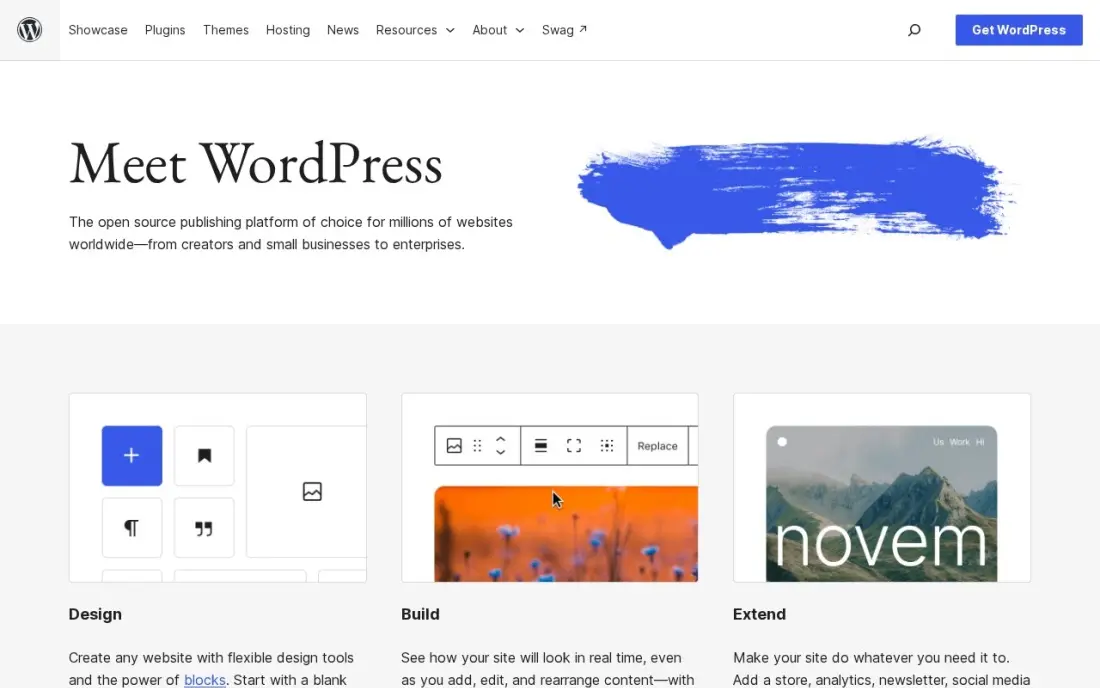
WordPress.org is the most widely used self-hosted app on the web: free, open-source software that runs on almost any web host and powers about 40% of all websites, according to W3Techs data from October 2026. You own the code and the database, choose the host, and extend the site with a huge plugin library, including free SEO plugins such as Rank Math and Yoast SEO.
The software costs nothing, but hosting, a domain, backups, security and updates are yours to arrange or pay for. A badly chosen host or a pile of plugins can slow the site down. For a business that wants full control and no platform lock-in, it remains the default.
What we like
- Free, open-source software that runs on almost any web host, and you own the code and the database
- Largest plugin ecosystem of any platform here, including free SEO plugins such as Rank Math and Yoast SEO
- No platform lock-in: move hosts, change themes and keep your content and data
Watch out for
- You arrange hosting, security, backups and updates yourself, or pay someone to do it
- Speed and security depend on your host and plugin choices, so a badly chosen host or a pile of plugins can slow the site down

Ghost
Best for: Publishers who want a self-hosted blog, newsletter and membership site in one app
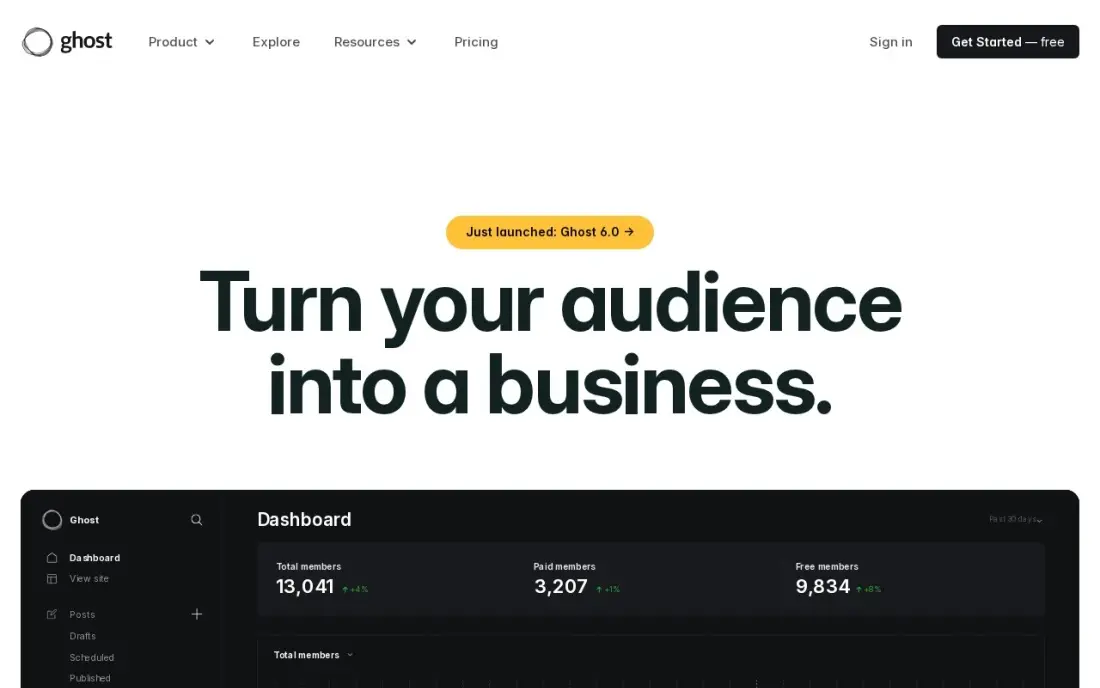
Ghost combines a fast website, an email newsletter and paid memberships in one open-source app, with no plugins to manage and a clean editor built for writing. The self-hosted version is free, and Ghost takes 0% of subscription revenue, so readers' payments go to you apart from Stripe's card fees.
Self-hosting means running a Node.js app, a database and a mail service yourself. If that is more than you want, Ghost's hosted Starter plan costs $15 a month billed annually, or $18 monthly, for 1,000 members, though selling paid subscriptions needs Publisher from $29 a month billed annually. It suits newsletter-led publications that want to own the list.
What we like
- Takes 0% of subscription revenue on every plan
- Newsletters, memberships and the site in one product — no plugins needed
- A fast, clean editor built for publishing, not for page building
- Free to self-host if you run your own server
Watch out for
- Starter cannot sell paid subscriptions — that needs Publisher from $35/month billed monthly ($29/month billed annually)
- The price rises with member count, not just with features
- One staff user and official themes only on Starter

Plausible
Best for: Site owners who want simple, cookie-free web analytics on their own server
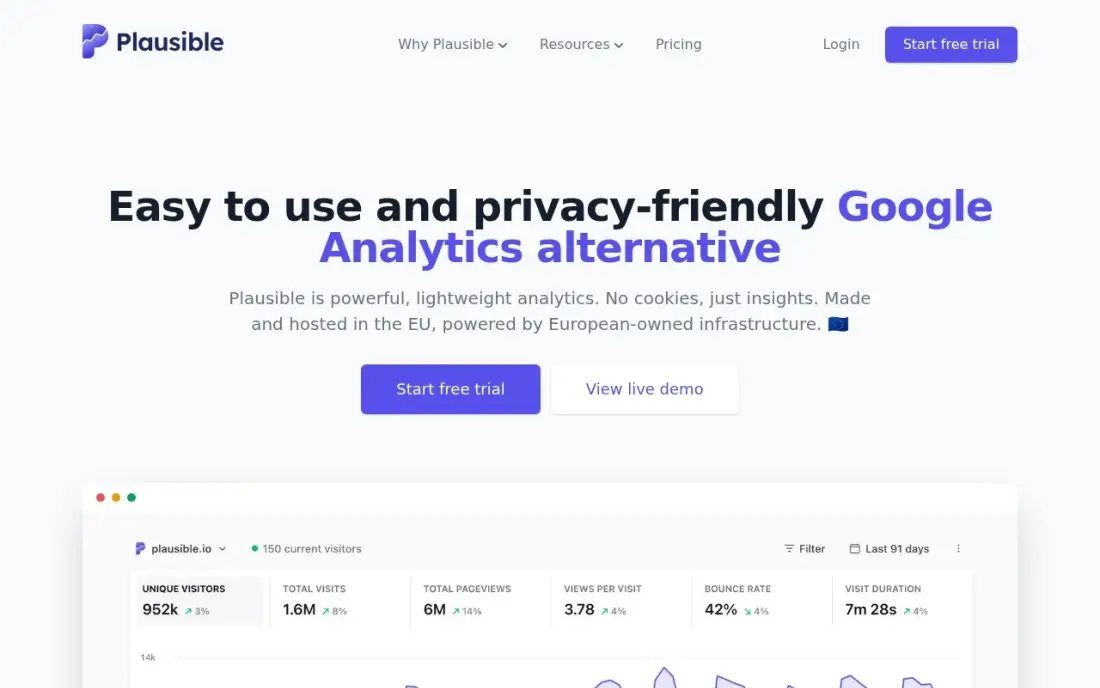
Plausible is the lightest self-hosted analytics app here. Its Community Edition is free to self-host, the tracking script is under 1KB, it sets no cookies and stores no personal data, so most sites need no consent banner for it under GDPR. The dashboard fits traffic, sources, pages and goals on one screen.
The self-hosted edition lacks funnels and revenue goals, which sit in the hosted product. Hosted Starter costs $9 a month for up to 10,000 pageviews, or $90 a year, with a 30-day trial and no free plan, and Business at $19 a month adds funnels and ecommerce revenue. Pick it when you want the numbers without the compliance stack.
What we like
- No cookies and no personal data collected, so most sites need no consent banner under GDPR
- A sub-1KB tracking script that loads fast and shows the whole story on one dashboard screen
- Transparent pageview pricing with no overage fees — one month over the tier needs no action
Watch out for
- No free plan for the hosted service — only a 30-day trial, and the self-hosted edition lacks funnels and revenue goals
- Funnels, user journeys and ecommerce revenue attribution need Business at $19 a month
- Deliberately narrow: no session recordings, heatmaps or product-level funnels

Matomo
Best for: Organisations that want a full Google Analytics replacement with complete data ownership
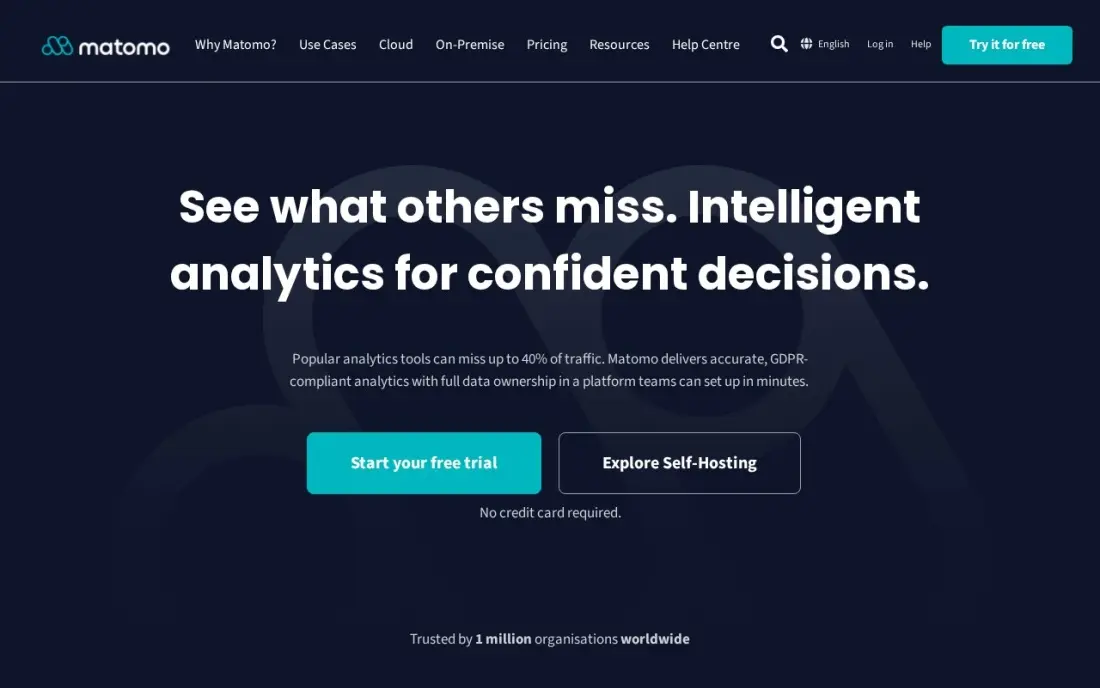
Matomo is the full-featured self-hosted analytics option. The On-Premise Community edition is free forever with unlimited users and hits, data is never sampled, and cookieless tracking is available. It covers the reports most teams use in Google Analytics, and its premium plugins add heatmaps, session recordings and A/B testing in the same interface.
Running it means owning the server, upgrades and report archiving, which takes real resources on a busy site, and premium plugin bundles for On-Premise start at EUR 230 a month. The hosted Cloud Business plan starts at EUR 29 a month, excluding tax, for 50,000 hits. Choose Matomo when EU data rules or privacy policy decide the purchase.
What we like
- Full data ownership, with hosting in Frankfurt and cookieless tracking options
- Only tool here that replaces GA plus a heatmap tool plus an A/B tool in one interface
- On-Premise Community edition is free forever with unlimited users and hits
- No data sampling on any plan, unlike free GA4 explorations
Watch out for
- Cloud pricing is hit-based and climbs with traffic, so high-volume sites pay far more than €29
- Self-hosting means owning the server, upgrades and archiving yourself
- Premium features on On-Premise need paid plugin bundles from €230 a month

Metabase
Best for: Data teams that want self-hosted dashboards non-technical colleagues can use
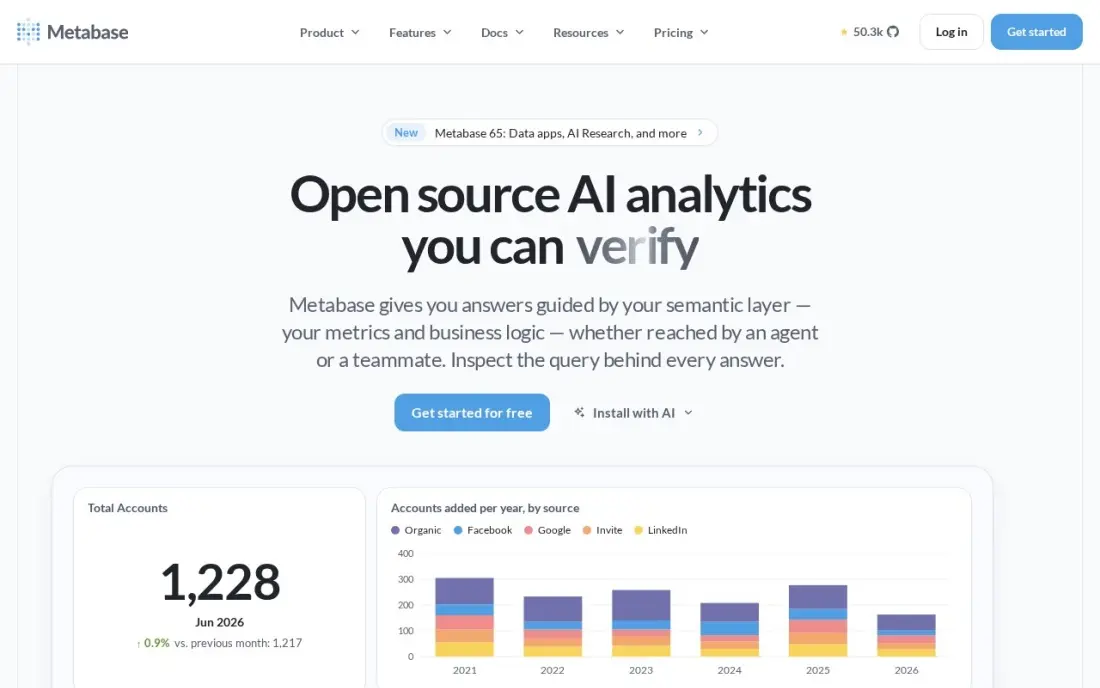
Metabase is the self-hosted business intelligence pick. The open-source edition costs $0 to run on your own server with no user cap, connects to your databases and lets non-technical colleagues build charts and dashboards through a question builder without writing SQL. It is quick to install and has a small learning curve.
The open-source edition needs your own server and upkeep, and some features sit on paid plans: white-label branding needs Pro, and AI features are billed by usage. The hosted Cloud Starter costs $90 a month billed annually, or $100 monthly, for five users. It suits a small data team that wants honest, simple dashboards on infrastructure it controls.
What we like
- A free open-source edition you can self-host with no user cap
- Cloud Starter is $90 a month billed annually for 5 users
- The question builder lets non-technical users explore without SQL
- A clean, fast interface with a small learning curve
Watch out for
- AI features are optional and billed by usage, not included on Starter
- White-label branding needs the Pro plan
- The open-source edition needs your own server and upkeep

listmonk
Best for: Teams that send large newsletters and want to avoid per-subscriber email pricing
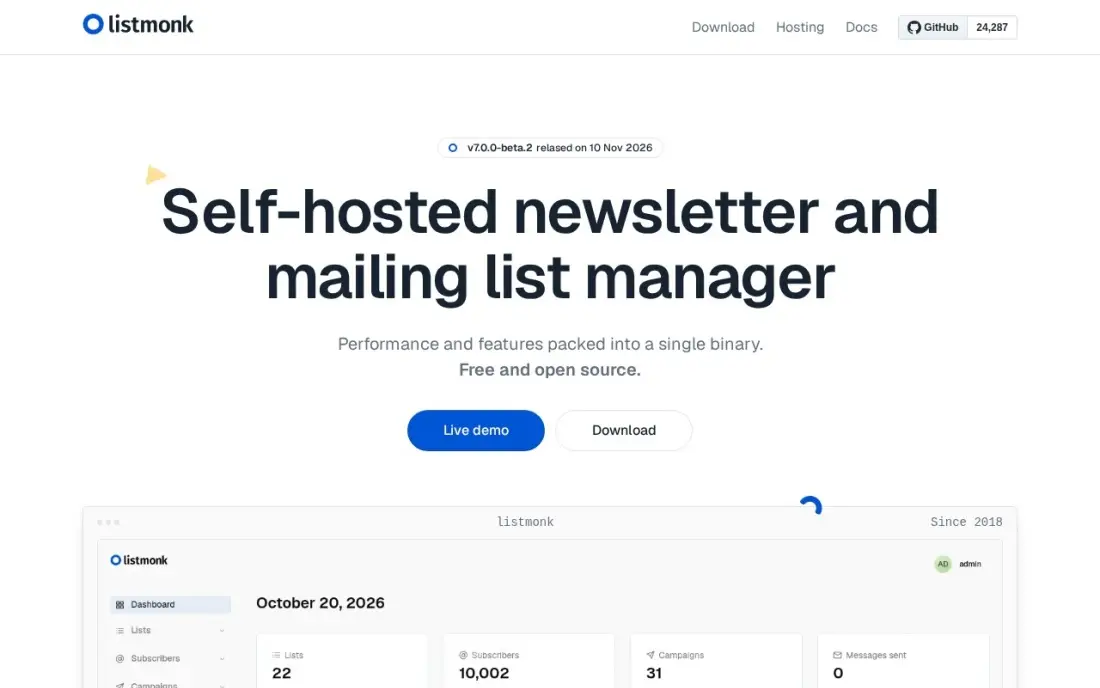
listmonk is a self-hosted newsletter and mailing list manager that ships as a single Go binary with PostgreSQL as its only dependency, so it installs in minutes on modest hardware. It is free under the AGPLv3 with no paid tier, no subscriber caps and no per-send fees, and it includes campaigns, SQL segmentation, transactional email, bounce handling and analytics.
You bring your own sending, either an SMTP relay or a service such as Amazon SES, and there is no visual automation builder, so drip sequences need the API or another tool. For a list of tens of thousands that would cost hundreds a month on a hosted email platform, it is the cheapest way to send.
What we like
- A single Go binary with PostgreSQL as its only dependency — installs in minutes and runs on modest hardware
- Built for volume: it handles millions of subscribers and is used to send millions of emails per campaign
- No subscriber caps, no per-send fees and no paid tier — every feature ships in the free download
- Clean analytics, bounce processing and a public campaign archive included at no cost
Watch out for
- No visual automation builder — drip sequences need the API or an external tool
- You bring your own sending: an SMTP relay or a service such as Amazon SES is required
- Single-tenant by design, so agencies that run many clients need one install per client

ERPNext
Best for: Small businesses that want a full self-hosted ERP with no per-user licence fees
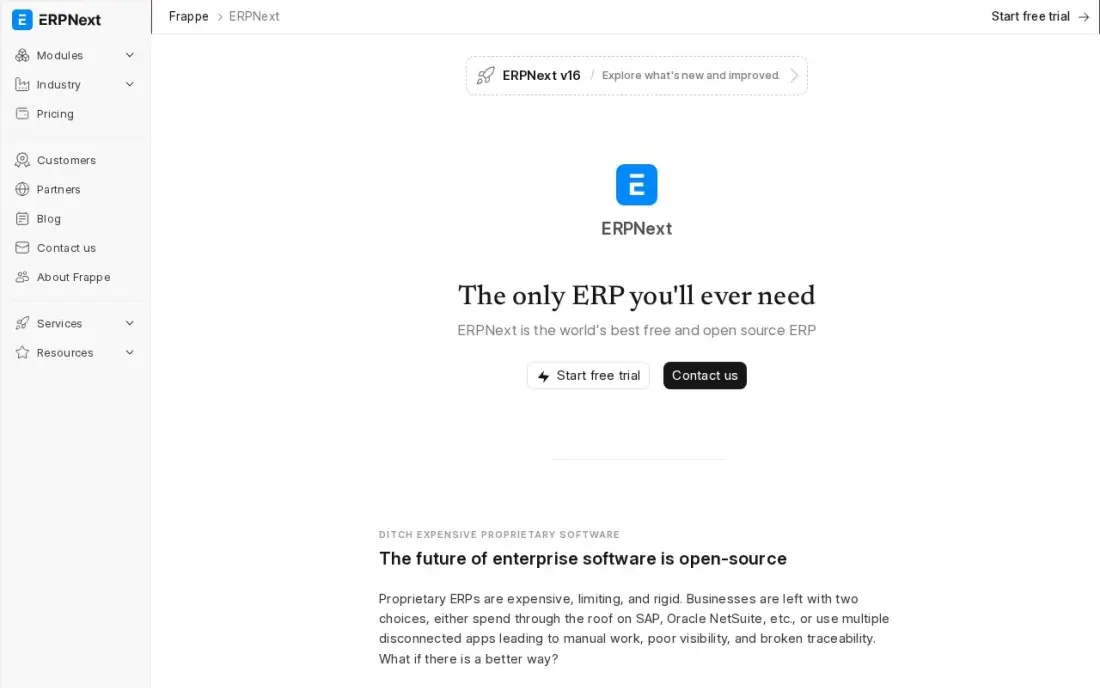
ERPNext is the most complete self-hosted business app here: accounting, inventory, manufacturing, CRM, HR and payroll, projects and a helpdesk in one open-source system under GPLv3. The licence costs $0 with no per-user or per-module fees, so adding staff never raises the software bill.
A free licence is not a free ERP. Someone has to install, configure, migrate data and keep it updated, and Frappe, the company behind it, does no implementation directly, so you need a partner or in-house skill. If you would rather not run the server, Frappe Cloud hosting starts at $5 a month for a site, though a production site usually needs the $40 server plan.
What we like
- The software is free under GPLv3 — every module included, with no per-user, per-module or annual licence fees
- Full ERP scope: accounting, stock, manufacturing, CRM, HR, projects, assets and support in one system
- No per-user meter at any scale, so adding staff never raises the licence bill
- Frappe Cloud hosting starts at $5 a month for a site, with managed upgrades and backups
Watch out for
- Frappe does no implementation directly, so setup, migration and customisation all need a partner or in-house skill
- The $5/month site plan is shared hosting with CPU limits — a production site usually needs the $40/month server plan
- The implementation partner pool is smaller than Odoo's or Microsoft's, so local help can be harder to find
The best self-hosted apps let you run your own website, analytics, automation, email and business software on a server you control, with no per-seat licence and no vendor holding your data. We compared eight open-source apps that a small or mid-sized business can realistically run, and for each we checked the free self-hosted terms and the vendor's hosted price as listed in November 2026, so you can see what self-hosting saves.
How to choose the best self-hosted apps
- Start with the subscription you most want to replace. Self-hosting pays off fastest where a hosted plan charges per seat, per subscriber or per event.
- Check the licence. GPL, AGPL and fair-code licences all allow self-hosting, but they differ on how you can resell or modify the software.
- Look at what the free edition leaves out. Some self-hosted editions hold back features such as funnels, white-labelling or premium plugins.
- Count the upkeep. Every app needs updates, backups and monitoring; a weekly hour per app adds up across five apps.
- Prefer apps with a hosted fallback. If the server becomes a burden, moving to the vendor's hosted plan should be an export, not a migration project.
- Size the server for the busiest app. Analytics and ERP databases grow fastest, so plan storage and memory around them.
If one of your first self-hosted apps is a website or analytics stack, our SEO audit checks that the move has not broken anything search engines rely on, and the free robots.txt generator helps you control what crawlers can reach on a new server.
Self-hosted apps pricing: what you will actually pay
Take a small team that wants analytics, automation and dashboards. Hosted, that is Plausible Starter at $90 a year, n8n Starter at $240 a year billed annually and Metabase Cloud Starter at $1,080 a year billed annually, for a total of $1,410 a year, with limits on pageviews, executions and users. Self-hosted, the three licences cost $0 with no execution or user caps.
The self-hosted bill is the server and the time. A modest virtual server costs a fixed monthly fee from your host, and you add a few hours a month for updates and backups. If that time is worth more to you than about $118 a month, the hosted plans are the better deal. For larger setups the gap widens in favour of self-hosting: listmonk has no subscriber caps or per-send fees at any list size, and ERPNext has no per-user licence however many staff you add, though ERPNext usually needs a paid implementation partner.
Know the difference: self-hosted vs open-source cloud
Self-hosted means you run the software on infrastructure you control, whether a rented virtual server, a company data centre or a box in the office. You choose where data lives, when to update and who can reach it, and you carry the work of security, backups and uptime.
Open-source cloud means the same software run by its vendor. n8n, Ghost, Plausible, Matomo, Metabase and ERPNext all sell hosted versions of their open-source code. You pay a monthly fee, the vendor handles the server, and you keep the option to export and self-host later. For many teams the right answer is a mix: self-host the apps where data control or scale matters most, and pay for hosting on the rest.
Quick comparison: tool type by need
| Buyer | Best pick | Why |
|---|---|---|
| Workflow automation | n8n | Free Community Edition with unlimited executions |
| Websites | WordPress.org | Free software, any host, largest plugin library |
| Newsletters and memberships | Ghost | Free to self-host, 0% revenue cut |
| Simple private analytics | Plausible | Free Community Edition, no cookies |
| Full analytics suite | Matomo | Free On-Premise edition, unlimited users and hits |
| Dashboards and BI | Metabase | Free open-source edition, no user cap |
| Bulk email | listmonk | Free, no subscriber caps or send fees |
| Running operations | ERPNext | Free full ERP with no per-user licence |
Mistakes to avoid
- Skipping backups. A self-hosted app without tested, off-server backups is one failed disk away from losing everything.
- Leaving apps unpatched. Open-source apps publish security fixes regularly; schedule updates rather than waiting for a problem.
- Exposing admin panels to the internet. Put dashboards behind strong passwords, two-factor login or a VPN.
- Ignoring email deliverability. Self-hosted email such as listmonk needs a reputable sending service and correct DNS records, or it lands in spam.
- Self-hosting everything at once. Move one app, run it for a month, then add the next.
Related comparisons: Self Serve Ad Platforms
How we chose
We picked open-source apps that a small or mid-sized business can self-host for real work, and checked each vendor's own pricing or licence page for the self-hosted terms and the hosted plan price, as checked in November 2026. Hosted prices are stated with annual or monthly billing as listed. We ranked the apps by how much they replace, how well documented self-hosting is and whether a hosted fallback exists. Ratings come from G2 pages checked on the dates shown in the sources; listmonk has no verified rating. No vendor paid for a place in this list, and none of the links here are affiliate links.
What to do next
Pick one hosted subscription you would most like to drop, spin up its self-hosted alternative on a small server, and run both side by side for a month before you cancel. If the first app you move is your website, have the change checked before search rankings notice it. Book a free SEO review.
Frequently asked questions
What are the best self-hosted apps?
For most businesses, the most useful self-hosted apps are WordPress.org for websites, n8n for workflow automation, Plausible or Matomo for analytics, Ghost for newsletters and memberships, Metabase for dashboards, listmonk for bulk email and ERPNext for running operations.
Are self-hosted apps really free?
The software licence is free for every app in this list, but you pay for a server, a domain where needed and your time on setup, updates, backups and security. For a small team, managed hosting is often cheaper than the hours self-hosting takes.
What do I need to self-host an app?
Usually a virtual server or home server, a domain name, Docker or the app's install package, a database, HTTPS certificates and a backup routine. listmonk also needs an SMTP relay or Amazon SES to send email.
Is self-hosting more private than using cloud apps?
It can be, because the data stays on infrastructure you control. Plausible and Matomo are popular for this reason. Privacy then depends on how well you secure and update the server.
Can I move from self-hosted to a hosted plan later?
Yes, for most apps here. n8n, Ghost, Plausible, Matomo, Metabase and ERPNext all sell hosted versions, so you can switch without changing tools. listmonk and WordPress.org rely on third-party hosts.
Which self-hosted app should a small business start with?
Start with the app that replaces your most expensive or most privacy-sensitive subscription. For many teams that is analytics with Plausible or Matomo, or automation with n8n.
Sources we checked (15)
- n8n — n8n.io/pricing (checked November 2, 2026)
- n8n reviews on G2 (checked November 2, 2026)
- WordPress.org — wordpress.org (checked November 2, 2026)
- WordPress.org reviews on G2 (checked November 2, 2026)
- Ghost — ghost.org/pricing (checked November 12, 2026)
- Ghost reviews on G2 (checked November 12, 2026)
- Plausible — plausible.io/#pricing (checked November 12, 2026)
- Plausible reviews on G2 (checked November 12, 2026)
- Matomo — matomo.org/pricing (checked November 12, 2026)
- Matomo reviews on G2 (checked November 12, 2026)
- Metabase — www.metabase.com/pricing (checked November 12, 2026)
- Metabase reviews on G2 (checked November 12, 2026)
- listmonk — listmonk.app (checked November 5, 2026)
- ERPNext — erpnext.com (checked November 10, 2026)
- ERPNext reviews on G2 (checked November 10, 2026)
Make one of these tools?
We re-check this list every quarter. Send a correction, request a review, or ask about a clearly labeled sponsored spot.
Request a listingShamim
Founder of SerpAstra
A full-stack digital marketer and SEO strategist covering technical and local SEO, AI search visibility, paid ads and lead generation for local businesses, e-commerce brands and SaaS teams.
Free SEO and AI visibility audit
Find out what is holding your rankings back
Send us your site. Within 2 business days you get a written audit, an AI visibility check and a short fix list ranked by impact. Free, with no contract attached.
Request my free audit→Related buying guides
 Marketing7 Best Open Source Email Marketing Software in 2026, ComparedCompare the 7 best open source email marketing software tools on price, free plans and self-hosting, with every price checked November 5, 2026.Read guide →
 SEO & AI Search Visibility11 Best Open Source SEO Software in 2026, Compared11 best open source seo software compared on price, features and what each one actually does. Every price checked on the vendor's own site, November 1, 2026.Read guide →
 Ecommerce7 Best Open Source Ecommerce Platforms in 2026, ComparedCompare the 7 best open source ecommerce platforms on licence, hosting cost, paid editions and developer effort, with every price checked on vendor pages.Read guide →