
8 Best AI Cloud Platforms in 2026, Compared
Compare the 8 best AI cloud platforms, from hyperscalers to GPU clouds, on GPU hourly rates, free credits, egress and real costs, checked on vendor pages.
 Shamim Mia, Founder, SerpAstraLast verified November 6, 20268 min read
We compare pricing pages, documentation and public reviews. We never accept payment for rankings.
Key takeaways
- Google Cloud is the strongest all-round AI cloud for data teams, with Vertex AI, TPUs and a $300 credit for 90 days; Azure is the fit for Microsoft estates that want OpenAI models under a Microsoft contract.
- AWS has the widest catalog and ecosystem, but its bill is the hardest to forecast and egress runs about $0.09 a GB.
- GPU clouds are far simpler for training and inference: Lambda lists H100 at $4.59 per GPU hour, and RunPod lists H100 PCIe at $2.89 an hour on Secure Cloud, billed per second.
- Databricks suits teams that want data engineering and machine learning on one lakehouse, with a free edition to start.
On this page
Quick comparison
| Tool | Best for | Starting price | Free plan |
|---|---|---|---|
| Google Cloud | Data and AI teams that want managed ML, TPUs and BigQuery in one cloud | Pay as you go | Yes ($300 credit) |
| Microsoft Azure | Microsoft-centred companies that want OpenAI models and ML inside their existing contract | Pay as you go | Yes ($200 credit) |
| Amazon Web Services | Enterprises that want the widest catalog of AI, data and compute services and the biggest ecosystem | Pay as you go | Yes (credits + free tier) |
| Oracle Cloud | Teams moving large datasets or running Oracle databases that want low egress costs | Pay as you go | Yes (Always Free) |
| Databricks | Data teams that want data engineering, warehousing and machine learning on one lakehouse | Custom quote | Yes (free plan) |
| Lambda | AI teams that want on-demand NVIDIA GPUs for training and fine-tuning at a published hourly rate | From $0.79/GPU/hr | No |
| RunPod | Developers and small AI teams that want cheap GPUs by the second and serverless inference | From $0.27/hr | No |
| Vultr | Cost-driven technical teams that want budget GPU instances for inference in many locations | $2.50/mo | No |
Make one of these tools?
We re-check this list every quarter. Send a correction, request a review, or ask about a clearly labeled sponsored spot.
Request a listingThe best AI cloud platforms
Google Cloud
Best for: Data and AI teams that want managed ML, TPUs and BigQuery in one cloud
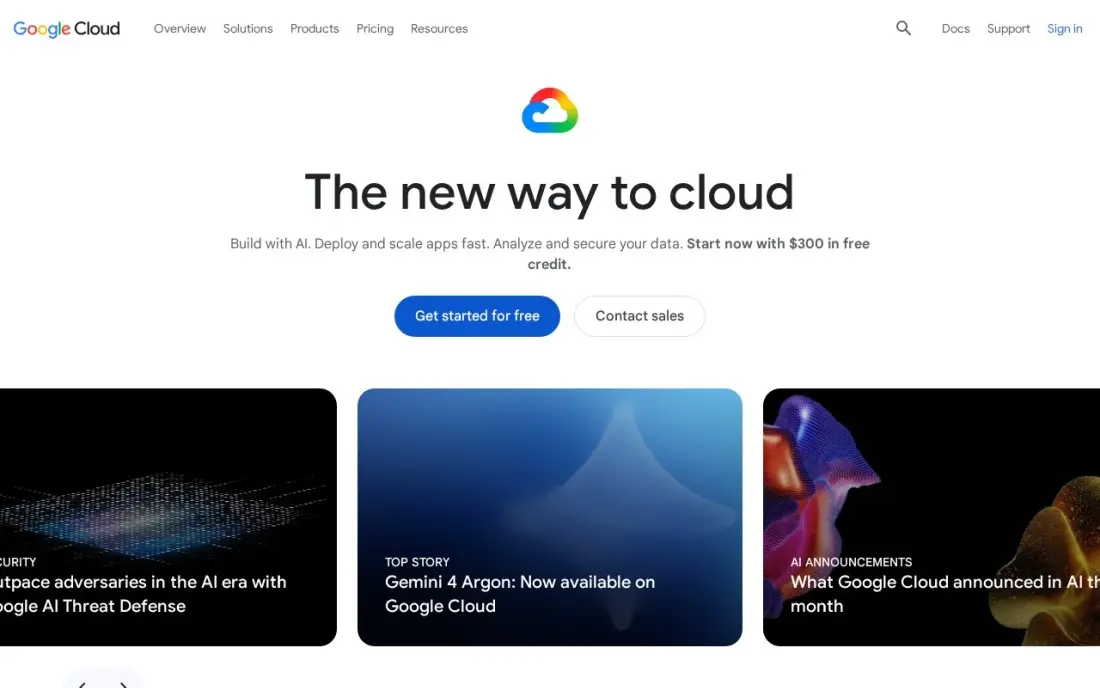
Google Cloud is the hyperscaler with the clearest AI identity. Vertex AI covers model building and deployment, TPUs give an alternative to GPUs for training, and BigQuery sits next to both, so data rarely has to leave the platform. New accounts get a $300 credit for 90 days, and sustained-use discounts apply automatically without a commitment.
Its partner ecosystem and enterprise sales reach are smaller than AWS or Azure, so there are fewer trained hires in many cities, and good support costs extra. For a team whose AI work starts with analytics data and containers, those gaps matter less than the tight fit between its data and ML services. G2 reviewers rate it 4.5 from more than 950 reviews.
What we like
- BigQuery is the benchmark serverless data warehouse, and GKE is a leading managed Kubernetes service
- Sustained-use discounts apply automatically, with no commitment to buy
- Strong AI stack with Vertex AI and TPUs
- List prices on standard compute often land a little below AWS and Azure
Watch out for
- Smaller partner ecosystem and enterprise sales footprint than AWS or Azure
- Fewer regions than Azure, and some services change faster
- Support quality varies by tier, and good support costs extra

Microsoft Azure
Best for: Microsoft-centred companies that want OpenAI models and ML inside their existing contract
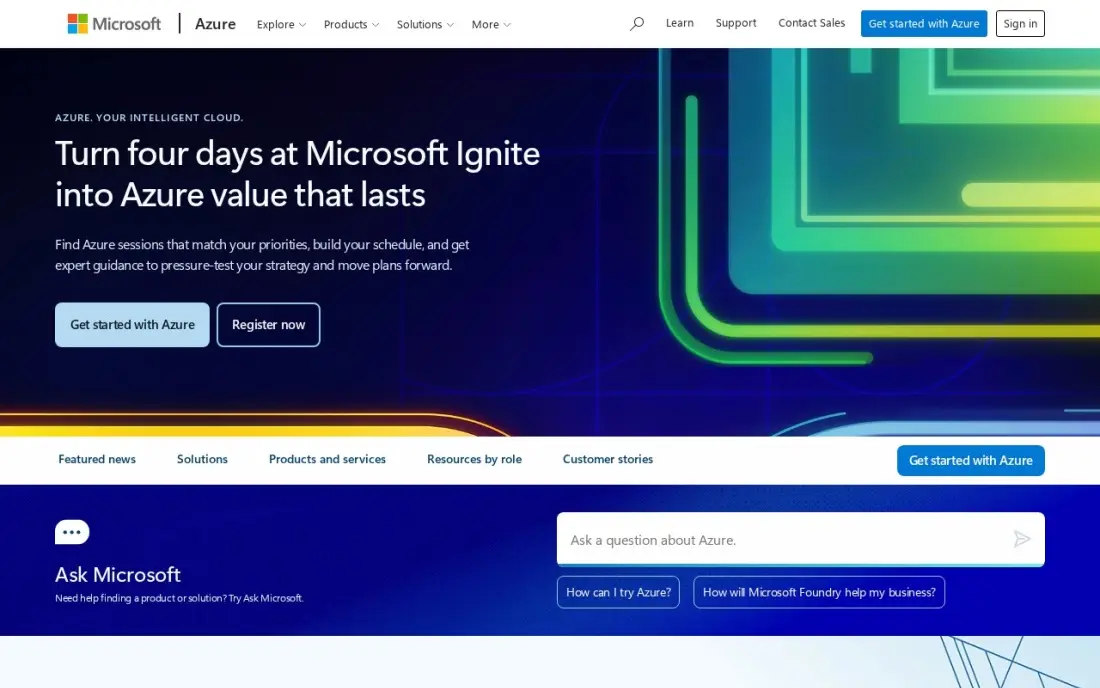
Azure is the AI cloud for companies already on Microsoft. Azure OpenAI gives enterprise access to OpenAI models under a Microsoft agreement, and Azure Machine Learning covers the rest of the model lifecycle with no platform fee, so you pay only for compute and storage. Identity, Microsoft 365 and Power BI connect without extra work.
New accounts get a $200 credit for 30 days and 12 months of free services. The catch is the same as AWS: usage-based billing is hard to forecast, an idle endpoint keeps costing money, and enterprise prices depend on negotiated agreements rather than list rates. Egress runs near $0.08 a GB.
What we like
- The natural home for Windows Server, SQL Server and Active Directory estates
- Strongest hybrid story here: Azure Arc and Azure Hybrid Benefit bridge on-premises and cloud
- The largest region count of the three hyperscalers
- Azure OpenAI gives enterprise access to OpenAI models inside a Microsoft contract
Watch out for
- List prices match AWS on most compute, and real enterprise prices depend on negotiated agreements
- The portal and service naming take time to learn
- Egress near $0.08 per GB adds up fast for media-heavy workloads

Amazon Web Services
Best for: Enterprises that want the widest catalog of AI, data and compute services and the biggest ecosystem
AWS has the widest catalog in cloud computing, with more than 200 services across compute, storage, databases and AI, and the largest pool of partners, consultants and trained engineers. New accounts get up to $200 in credits and more than 30 services have always-free allowances, and Savings Plans cut steady compute costs.
The bill is the hard part. Pricing is difficult to forecast, outbound data transfer runs about $0.09 a GB, which hurts when you move large datasets or model outputs, and paid support costs extra. AWS rewards a team that assigns an owner to cloud cost and sets billing alerts before the first GPU job runs.
What we like
- More than 200 services across compute, storage, databases and AI, the widest catalog in this list
- The largest global region footprint of the big three, with the deepest partner and hiring ecosystem
- New accounts get up to $200 in credits, and 30+ services have always-free allowances
- Savings Plans and Reserved Instances cut steady compute costs sharply
Watch out for
- Pricing is genuinely hard to forecast, and egress at about $0.09 per GB punishes media-heavy workloads
- Paid support plans cost extra on top of usage, and the free tier of support covers billing questions only
- The console and service names take real time to learn

Oracle Cloud
Best for: Teams moving large datasets or running Oracle databases that want low egress costs
Oracle Cloud, known as OCI, competes on price. Its compute list prices undercut the big three, and egress costs around $0.0085 a GB with 10 TB a month free, roughly a tenth of AWS, which matters when training data and model outputs move in and out. New accounts get a $300 credit for 30 days and an Always Free tier.
The trade is breadth. OCI has a smaller service catalog and partner ecosystem, its console works differently from the AWS conventions most engineers know, and Oracle halved the Always Free Arm allowance in mid-2026. For Oracle database estates and data-heavy AI pipelines, price it seriously.
What we like
- The best home for Oracle Database and Oracle enterprise applications, on licensing and performance
- Egress around $0.0085 per GB, far below the big three, with 10 TB free a month
- Always Free tier includes usable Arm compute, two databases and 200 GB of storage
- Aggressive list prices on standard compute
Watch out for
- A smaller service catalog and partner ecosystem than AWS, Azure or Google Cloud
- The console and concepts differ from the AWS norms most engineers know
- Oracle cut the Always Free Arm allowance in half in mid-2026, from 4 OCPUs to 2

Databricks
Best for: Data teams that want data engineering, warehousing and machine learning on one lakehouse
Databricks is not a cloud provider but an AI and data platform that runs on top of one. Engineering, warehousing and machine learning share the same open formats with Apache Spark underneath, and Unity Catalog governs tables and models in one place. A Free Edition covers learning and small experiments at $0.
Pricing is consumption-based: Jobs Compute starts at $0.15 per DBU on the Premium tier in AWS US East, interactive compute costs $0.55, and on classic compute the cloud infrastructure underneath is billed separately. Bills climb without active cost management. It rewards Spark and Python skills, and G2 reviewers rate it 4.6 from more than 1,300 reviews.
What we like
- One platform for warehousing, engineering and machine learning on open formats, with Apache Spark underneath
- Unity Catalog governs data and AI assets in one place, from tables to models
- Serverless compute removes cluster management, and the ecosystem spans ingestion to BI
- Free Edition covers learning and small experiments at $0
Watch out for
- Consumption pricing needs active cost management, or bills climb fast
- Classic compute bills cloud infrastructure separately, on top of the DBU rate
- Rewards Spark and Python skills; pure SQL teams face a learning curve

Lambda
Best for: AI teams that want on-demand NVIDIA GPUs for training and fine-tuning at a published hourly rate
Lambda is a GPU cloud built for training and fine-tuning. On-demand instances are priced per GPU hour on its pricing page: $7.69 for an NVIDIA HGX B200, $4.59 for an H100, $3.19 for an 80 GB A100 and $0.79 for a Tesla V100. Lambda's pricing page also says it charges no egress fees, which removes a common surprise in hyperscaler bills.
For larger jobs, 1-Click Clusters of B200 GPUs run from 16 to 256 or more GPUs on terms of two weeks to a year, from $9.86 per GPU hour at 16 GPUs. It is compute, not a full cloud: there are no managed databases or data warehouses, and reserved capacity needs a sales conversation.
What we like
- Published per-GPU hourly prices for B200, H100, A100 and V100 instances
- 1-Click Clusters of 16 to 256+ B200 GPUs on terms from 2 weeks to a year
- The pricing page says there are no egress fees
Watch out for
- Compute only: no managed data, database or analytics services around the GPUs
- No free tier, and reserved capacity rates are by quote
- On-demand capacity is first-come, so popular GPUs can be unavailable

RunPod
Best for: Developers and small AI teams that want cheap GPUs by the second and serverless inference
RunPod is the low-cost way to rent a GPU for an experiment or an inference service. GPU Pods are billed per second with no commitment, from $0.27 an hour for an RTX A5000 and $0.89 for an RTX 4090 to $2.89 for an H100 PCIe and $2.09 for an A100 PCIe. Community Cloud lists lower rates, such as an H100 PCIe from $1.99.
Serverless GPUs turn a model into an endpoint, at $1.34 an hour on an RTX 4090 and $5.89 on an H100. Watch storage: volume disks cost $0.10 per GB a month while running and $0.20 while idle. It suits developers and small teams; regulated enterprises will want a hyperscaler's controls.
What we like
- GPU Pods billed per second with no commitment
- Wide GPU range, from an RTX A5000 at $0.27 an hour to H100 and A100
- Serverless GPUs for inference endpoints, from $0.58 an hour for 16 GB cards
Watch out for
- Idle volume disks cost $0.20 per GB a month, double the running rate
- No free tier or credits listed on the pricing page
- Fewer managed services and enterprise controls than a hyperscaler

Vultr
Best for: Cost-driven technical teams that want budget GPU instances for inference in many locations
Vultr is a general cloud with a budget GPU line. Alongside virtual machines in more than 30 locations across six continents, it sells bare metal and GPU instances priced for AI inference below hyperscaler GPU rates, with simple hourly billing and a monthly cap. Cloud Compute starts at $2.50 a month for an IPv6-only server.
The managed layer is thinner than DigitalOcean's, support is ticket-based and lean, and there is no free plan and no refunds, so test with a small deposit first. It suits a technical team that wants inference close to users in several regions and is happy to run more of the stack itself.
What we like
- Cloud compute from $2.50 a month, the lowest entry price in this list
- More than 30 locations across six continents, more than most independents
- GPU instances for AI inference at budget prices
- Simple flat pricing with hourly billing and a monthly cap
Watch out for
- The $2.50 plan is IPv6-only and sold in two locations; a usable IPv4 server starts at $3.50
- Fewer managed services than DigitalOcean, and support is ticket-based and lean
- No free plan and no refunds, so test with a small deposit first
The best AI cloud platform gives your team the GPUs, data services and model tools it needs without a bill nobody can predict. We compared eight platforms across three groups — the hyperscalers, a lakehouse AI platform and specialist GPU clouds — and every price below comes from the vendor's own pricing page as checked in November 2026.
How to choose the best AI cloud platform
- Decide what you are running. Training a model, fine-tuning one and serving an API are different workloads with different GPU, storage and uptime needs.
- Price the GPU hour you will actually use. Compare the same GPU across vendors, and check whether billing is per second, per hour or by reserved term.
- Count the data movement. Egress ranges from about $0.09 a GB on AWS to none on Lambda, which can outweigh compute on data-heavy work.
- Check what sits around the GPUs. Hyperscalers add databases, security and managed ML; GPU clouds leave those to you.
- Follow your existing stack. A Microsoft estate fits Azure, an analytics team on BigQuery fits Google Cloud, and a Spark team fits Databricks.
- Plan for capacity. On-demand GPUs can sell out, so ask about reserved capacity before a deadline depends on it.
AI platforms also change how customers find software. Buyers now ask ChatGPT, Gemini and Perplexity for vendor shortlists, and our AI search optimization service helps your product appear in those answers; the free llms.txt generator is a quick first step.
AI cloud platform pricing: what you will actually pay
Take a fine-tuning job that needs 100 H100 GPU hours in a month. On Lambda at $4.59 per GPU hour that is $459. On RunPod Secure Cloud an H100 PCIe at $2.89 an hour is $289, and Community Cloud rates start at $1.99, or $199. Serving the result on RunPod Serverless costs $1.34 an hour on an RTX 4090.
On the hyperscalers, GPU rates depend on instance type, region and commitments, so model your workload in each vendor's calculator. Free credits help with the first experiments: $300 for 90 days on Google Cloud, $300 for 30 days on Oracle Cloud, $200 for 30 days on Azure and up to $200 on AWS. Then add egress: moving 5 TB out costs about $450 on AWS at $0.09 a GB, about $400 on Azure at $0.08, and nothing on Oracle Cloud within its 10 TB monthly free allowance.
Databricks bills by DBU on top of the cloud underneath: Jobs Compute starts at $0.15 per DBU on the Premium tier in AWS US East.
Know the difference: hyperscaler vs GPU cloud
A hyperscaler is a full cloud. AWS, Azure, Google Cloud and Oracle Cloud sell GPUs alongside storage, databases, identity, networking and managed AI services, under enterprise contracts with compliance certifications. You pay for that breadth with complex pricing and a steeper learning curve.
A GPU cloud sells compute for AI and little else. Lambda and RunPod publish simple hourly rates, start instances quickly and keep egress cheap or free, which makes them popular for training runs and inference endpoints. Many teams use both: data and production systems on a hyperscaler, burst GPU work on a GPU cloud.
Quick comparison: tool type by need
| Buyer | Best pick | Why |
|---|---|---|
| Data and AI teams | Google Cloud | Vertex AI, TPUs and BigQuery; $300 credit for 90 days |
| Microsoft estates | Microsoft Azure | Azure OpenAI and Azure Machine Learning |
| Enterprises needing breadth | Amazon Web Services | 200+ services and the largest ecosystem |
| Data-heavy pipelines | Oracle Cloud | Egress around $0.0085/GB with 10 TB free a month |
| Lakehouse ML teams | Databricks | Data and ML on one platform; Free Edition |
| Training and fine-tuning | Lambda | H100 at $4.59/GPU/hour; no egress fees listed |
| Developers on a budget | RunPod | GPUs from $0.27/hour, billed per second |
| Inference in many regions | Vultr | Budget GPUs in 30+ locations |
Mistakes to avoid
- Leaving GPUs running. An idle endpoint or instance bills the same as a busy one; automate shutdowns.
- Ignoring egress. Moving training data and outputs out of a hyperscaler can cost more than the compute.
- Buying the biggest GPU by default. Many inference workloads run well on cheaper cards such as an RTX 4090 or A100.
- Committing before benchmarking. Run the same job on two platforms before signing a reserved term.
- Spreading data across clouds by accident. Keep training data close to the GPUs, or pay to move it every run.
Related comparisons: AI Scraping Tools · Agentic AI Platforms · Voice AI Software Tools · AI Agent Platforms
How we chose
We checked each vendor's own pricing page in November 2026 and recorded starting prices and GPU hourly rates as shown. Lambda's page states that the listed on-demand prices take effect on November 16, 2026. Hyperscaler GPU rates vary by region and instance, so we quote their published credits and egress rates rather than a single GPU price. Ratings come from G2 pages checked on the dates shown in the sources. No vendor paid for a place in this list, and none of the links here are affiliate links.
What to do next
Write down one real workload, such as fine-tuning a model on your own data, and price it on one hyperscaler and one GPU cloud using the same GPU and the same hours. Run it on the cheaper one with billing alerts on. If you sell an AI product and want buyers to find it, book a free strategy call.
Frequently asked questions
What is the best AI cloud platform?
For most data and AI teams, Google Cloud, with Vertex AI, TPUs and BigQuery. Azure suits Microsoft estates that want OpenAI models, AWS suits enterprises that want the widest catalog, and Lambda or RunPod suit teams that mainly need GPUs at published hourly rates.
What is the cheapest cloud for AI training?
Specialist GPU clouds publish the lowest simple rates. RunPod lists an H100 PCIe at $2.89 an hour on Secure Cloud and from $1.99 on Community Cloud, billed per second, and Lambda lists an H100 at $4.59 per GPU hour with no egress fees on its pricing page.
Do AI cloud platforms offer free credits?
The hyperscalers do: Google Cloud gives $300 for 90 days, Oracle Cloud $300 for 30 days, Azure $200 for 30 days and AWS up to $200 for new accounts. Databricks has a free edition. Lambda and RunPod list no free tier.
What is the difference between a hyperscaler and a GPU cloud?
A hyperscaler such as AWS, Azure or Google Cloud sells hundreds of services, including databases, storage, security and managed AI. A GPU cloud such as Lambda or RunPod sells GPU compute with simpler pricing and little else.
Why do AI cloud bills grow unexpectedly?
Idle GPU endpoints, idle storage and data transfer. Egress costs about $0.09 a GB on AWS and $0.08 on Azure, while Oracle Cloud charges around $0.0085 and Lambda says it charges none. Set billing alerts and shut down idle resources.
Can a small team use an AI cloud platform?
Yes. A small team can start on free hyperscaler credits or rent a single GPU on RunPod by the second, then move to reserved capacity once workloads are steady.
What is Microsoft's AI cloud platform?
Microsoft's AI cloud is Azure. Azure OpenAI gives enterprise access to OpenAI models under a Microsoft agreement, and Azure Machine Learning covers the rest of the model lifecycle with no platform fee, so you pay only for compute and storage. New accounts get a $200 credit for 30 days plus 12 months of free services, and identity, Microsoft 365 and Power BI connect without extra work.
Which cloud platforms have the best built-in AI integration?
Google Cloud keeps Vertex AI, TPUs and BigQuery in one cloud, so data rarely has to leave the platform. Azure pairs Azure OpenAI and Azure Machine Learning with Microsoft 365 and Power BI. AWS offers the widest catalog, with more than 200 services across compute, storage, databases and AI. Databricks runs on top of a cloud and puts engineering, warehousing and machine learning on one lakehouse.
Sources we checked (13)
- Google Cloud — cloud.google.com/pricing (checked November 6, 2026)
- Google Cloud reviews on G2 (checked November 6, 2026)
- Microsoft Azure — azure.microsoft.com/en-us/pricing (checked November 6, 2026)
- Microsoft Azure reviews on G2 (checked November 6, 2026)
- Amazon Web Services — aws.amazon.com/pricing (checked November 6, 2026)
- Amazon Web Services reviews on G2 (checked November 6, 2026)
- Oracle Cloud — www.oracle.com/cloud/pricing (checked November 6, 2026)
- Databricks — www.databricks.com/pricing (checked November 6, 2026)
- Databricks reviews on G2 (checked November 6, 2026)
- Lambda — lambda.com/pricing (checked November 16, 2026)
- RunPod — www.runpod.io/pricing (checked November 16, 2026)
- Vultr — www.vultr.com/pricing (checked November 6, 2026)
- Vultr reviews on G2 (checked November 6, 2026)
Make one of these tools?
We re-check this list every quarter. Send a correction, request a review, or ask about a clearly labeled sponsored spot.
Request a listingShamim
Founder of SerpAstra
A full-stack digital marketer and SEO strategist covering technical and local SEO, AI search visibility, paid ads and lead generation for local businesses, e-commerce brands and SaaS teams.
Free SEO and AI visibility audit
Find out what is holding your rankings back
Send us your site. Within 2 business days you get a written audit, an AI visibility check and a short fix list ranked by impact. Free, with no contract attached.
Request my free audit→Related buying guides
 Business Software11 Best Cloud Infrastructure Services Reviews in 2026The 11 best cloud infrastructure services reviews compared on price, free tiers, egress and AI features, with every price checked November 6, 2026.Read guide →
 Data, Analytics & AI10 Best Big Data Analytics Software in 2026, ComparedCompare the 10 best big data analytics software platforms on price, free tiers and AI features, with every price checked on November 6, 2026.Read guide →
 Data, Analytics & AI10 Best Predictive Analytics Tools in 2026 (Free and Paid, Compared)10 best predictive analytics tools compared with prices, free plans and AutoML depth — from free KNIME to enterprise DataRobot. Prices checked Nov 2, 2026.Read guide →