
Best Apps to Track Macros (2026): 8 Apps Worth Downloading
Compare the 8 best app to track macros options on price, free plans, barcode scanning and adaptive targets, with every price checked November 4, 2026.
 Shamim Mia, Founder, SerpAstraLast verified November 4, 202614 min read
We compare pricing pages, documentation and public reviews. We never accept payment for rankings.
Key takeaways
- MyFitnessPal leads for most people at $19.99/month, Cronometer follows at $10.99/month with the deepest micronutrient data, and Carb Manager is the cheapest annual buy at $39.99/year.
- Seven of the eight apps have genuinely free plans — only MacroFactor is paid-only — so you can track macros at $0 before you pay anything.
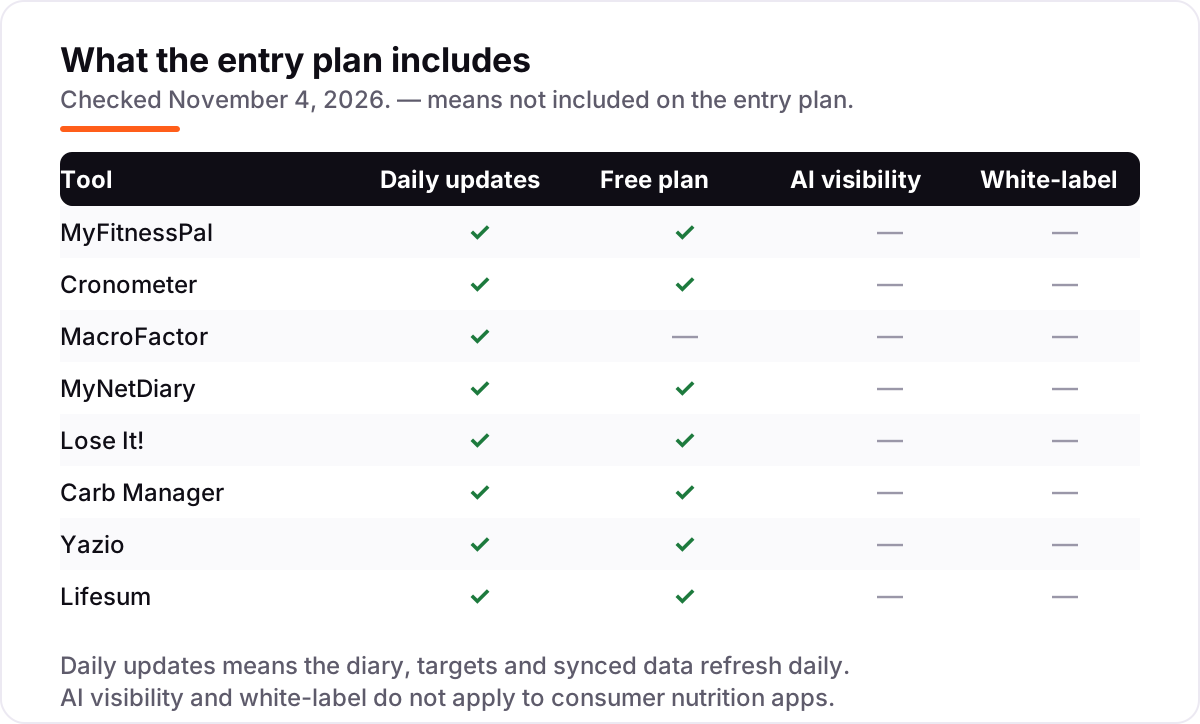
- The single most important buying factor is where the features you need sit: barcode scanning is free in Cronometer and MyNetDiary but paid in MyFitnessPal.
- Watch the billing term: annual plans cost 40–50% less than paying monthly, and three apps sell annual plans only.
On this page
Quick comparison
| Tool | Best for | Starting price | Free plan |
|---|---|---|---|
| MyFitnessPal | Anyone who wants the biggest food database and the tracker most people already use | $19.99/mo | Yes (free plan) |
| Cronometer | Lifters and data-minded eaters who want micronutrients, not just macros | $10.99/mo | Yes (free plan) |
| MacroFactor | Lifters and dieters who want their targets recalculated every week | $11.99/mo | No (7-day trial) |
| MyNetDiary | Budget-conscious trackers who want a strong free plan with a verified database | $8.99/mo | Yes (free plan) |
| Lose It! | Weight-loss trackers who want the simplest possible daily calorie budget | $79.99/yr | Yes (free plan) |
| Carb Manager | Keto and low-carb dieters who track net carbs, not just calories | $8.49/mo | Yes (free plan) |
| Yazio | Budget buyers who want fasting plans and recipes for the lowest annual price | $47.90/yr | Yes (free plan) |
| Lifesum | People who want structured diet programs and meal plans, not just a food diary | $99.99/yr | Yes (free plan) |
Make one of these tools?
We re-check this list every quarter. Send a correction, request a review, or ask about a clearly labeled sponsored spot.
Request a listingThe best macro tracking apps

MyFitnessPal
Best for: Anyone who wants the biggest food database and the tracker most people already use
MyFitnessPal is the tracker most people know, and its size is the reason to pick it. A database of more than 20 million foods means any meal logs in seconds, and the free plan covers food logging, macro viewing and custom recipes. Premium adds the barcode scanner, Meal Scan, voice logging, custom macro goals in grams and an AI Coach, and the app syncs with Apple Health, Google Fit, Fitbit and Garmin.
The catch is the price gap. Premium costs $19.99 a month or $79.99 a year in the app, but $9.99 a month or $49.99 a year on the website, so buy on the web. The crowdsourced database means some entries are wrong or duplicated, so check the numbers on packaged foods. Pick MyFitnessPal when you want the biggest database and the tracker your friends already use.
What we like
- Largest food database here: 20 million-plus foods, so most meals log in seconds
- Free plan still covers food logging, macro viewing and custom recipes
- Barcode scanner, Meal Scan and voice logging on Premium, plus an AI Coach
- Syncs with Apple Health, Google Fit, Fitbit, Garmin and most wearables
Watch out for
- Premium costs $19.99 a month in the app but $9.99 a month on the website — the same plan at two prices
- Barcode scanning moved behind Premium, so the free plan logs by search only
- Crowdsourced database means some entries are wrong or duplicated

Cronometer
Best for: Lifters and data-minded eaters who want micronutrients, not just macros
Cronometer is the accuracy pick. It tracks up to 95 nutrients, so you see vitamins, minerals and amino acids alongside protein, carbs and fat, and its food database is lab-analyzed and curated instead of crowdsourced, which means far fewer wrong entries. The free Basic plan already includes the barcode scanner, custom macro targets and full micronutrient tracking, which is more than most rivals give away.
Gold costs $10.99 a month or $59.99 a year and adds an ad-free app, Photo Log, Voice Log, a fasting timer, the Crono Coach AI and custom charts. The catch is that Gold has no free trial advertised, so the only way to test the paid features is to pay first. Pick Cronometer when the numbers have to be right, not just fast.
What we like
- Tracks up to 95 nutrients, not just macros — vitamins, minerals and amino acids
- Lab-analyzed, curated food database with far fewer wrong entries than crowdsourced rivals
- Free Basic plan includes the barcode scanner, custom macro targets and micronutrient tracking
- Fasting timer, recipe importer and custom charts on Gold
Watch out for
- Gold has no free trial advertised, so you pay before you test the paid features
- Free plan shows ads and limits charts and reports to 7 days
- Smaller recipe library than MyFitnessPal or Yazio

MacroFactor
Best for: Lifters and dieters who want their targets recalculated every week
MacroFactor is the only app here that coaches instead of just counting. Every week it recalculates your calorie and macro targets from what you actually ate and how your weight moved, so the plan adapts when your metabolism does instead of sitting on a formula from day one. One subscription includes every feature — photo, barcode and AI logging, a verified food database and no ads — with no tiered upsells inside the app.
The trade-off is that there is no free plan, only a 7-day trial, and the app says there never will be one. After the trial it costs $11.99 a month, $47.99 for six months or $71.99 a year. Pick MacroFactor when you lift, weigh yourself most days and want the targets to move with you.
What we like
- Weekly check-ins recalculate your calorie and macro targets from logged food and weight trend
- Verified food database built for accuracy, with photo, barcode and AI logging
- One plan includes every feature — no tiered upsells inside the app
- No ads anywhere, and no free-plan limits to work around
Watch out for
- No free plan at all — the 7-day trial is the only way to try it before paying
- English and Japanese only, and there is no desktop version
- The separate Workouts app costs extra, or $89.99 a year bundled

MyNetDiary
Best for: Budget-conscious trackers who want a strong free plan with a verified database
MyNetDiary has the best free plan in this list. It is ad-free, needs no account to start, and still includes the barcode scanner, basic voice logging and macro targets in grams — the features MyFitnessPal moved behind Premium. Its 2 million-plus foods are staff-verified against USDA and NCC sources instead of crowdsourced, so the numbers are more trustworthy than the bigger databases.
Premium costs $8.99 a month or $59.99 a year and adds Meal Scan photo logging, recipe import, fasting and Advanced Autopilot, which re-estimates your expenditure from logged food and weight. A $179.99 lifetime plan is also available. Pick MyNetDiary when you want a serious tracker that costs nothing to start.
What we like
- Free plan is ad-free and includes the barcode scanner, voice logging and macro targets in grams
- Staff-verified database of 2 million-plus foods built on USDA and NCC sources
- Advanced Autopilot on Premium re-estimates your expenditure from logged food and weight
- Premium Plus adds an AI Coach, AI meal suggestions and restaurant menu scanning
Watch out for
- Meal Scan photo logging, fasting and adaptive targets need Premium
- AI Coach and AI voice logging wait for Premium Plus at $14.99 a month
- English only

Lose It!
Best for: Weight-loss trackers who want the simplest possible daily calorie budget
Lose It! is the simplest tracker here. It gives you a daily calorie budget based on how much weight you want to lose each week, and you log food against it with search, barcode or a photo. The free Basic plan covers the budget and the food log, and Premium adds barcode and meal scan, voice logging, custom macro targets and a fasting tracker for $79.99 a year.
There is no monthly plan, so the cheapest way in is the full annual payment — though most users are shown discounted offers in the app, and a one-time Lifetime Premium at $299.99 beats four years at the list price. Pick Lose It! when you want weight loss without a learning curve.
What we like
- Simplest interface here — a daily calorie budget and a photo-based food log
- Premium adds barcode and meal scan, voice logging, custom macros and fasting
- One-time Lifetime Premium at $299.99 beats four years of annual payments
- Frequent in-app discounts cut the $79.99 annual price for many users
Watch out for
- Premium sells as an annual plan only — there is no monthly option
- Most users are shown discounted offers, so the price you pay may not be $79.99
- Premium bought through the App Store does not unlock Android

Carb Manager
Best for: Keto and low-carb dieters who track net carbs, not just calories
Carb Manager is the only app here built for keto from the ground up. It tracks net carbs instead of total carbs, and Premium adds ketone and glucose tracking, a diabetes tracker and 30-plus health metrics, so it works as a health tool as well as a food diary. The free Basic plan already covers net carb tracking and the barcode scanner, and Premium is the cheapest steady annual price here at $39.99 a year.
The trade-off is the narrow focus. If you eat a standard or high-carb diet, the keto framing gets in the way, and meal plans cost extra from $1.99 a week on top of Premium. Pick Carb Manager when keto or low-carb is the diet, not just a phase.
What we like
- Built for keto and low-carb: net carbs, ketone and glucose tracking on Premium
- Free plan covers net carb tracking and the barcode scanner
- Cheapest steady annual price here at $39.99 a year
- Diabetes tracker and 30-plus health metrics on Premium
Watch out for
- Keto focus means the app fits poorly if you eat a standard or high-carb diet
- Meal plans cost extra — from $1.99 a week — on top of Premium
- Some users report slow loading and occasional food-data inconsistencies

Yazio
Best for: Budget buyers who want fasting plans and recipes for the lowest annual price
Yazio is the cheapest annual buy here. PRO costs $47.90 for 12 months at the standard rate, and promotional offers drop it to $23.90, which is less than $2 a month. The free plan still covers calorie and macro tracking, and PRO adds AI photo food logging, detailed nutrient data, fasting plans, meal plans and a large recipe database, in 20 languages across 150-plus countries.
The catch is the pricing itself. The App Store lists PRO purchases from $11.90 to $47.90 without saying which plan length each covers, so check the paywall in the app before you start a trial. Pick Yazio when you want fasting plans and recipes for the lowest annual price.
What we like
- Cheapest annual price here at $47.90 a year, with promotional offers down to $23.90
- Fasting plans, meal plans and a large recipe database on PRO
- AI photo food tracking on PRO, plus 20 languages and 150-plus countries
- Free plan still covers calorie and macro tracking
Watch out for
- The price you are offered varies — App Store listings range from $11.90 to $47.90 with no plan length shown
- Detailed macro tracking and fasting plans sit behind PRO
- AI photo analysis can misjudge portions, per user reviews

Lifesum
Best for: People who want structured diet programs and meal plans, not just a food diary
Lifesum is the meal-plan pick. Instead of handing you a blank diary, Premium gives you structured diet programs and meal plans organized by goal — lose, maintain or gain weight — and by diet, from ketogenic to Scandinavian, with recipes built in. AI logging, fasting programs, habit goals and weekly nutrition reports round out the package, and the interface is the cleanest in this list.
It is also the most expensive annual plan here at $99.99 a year, with a 3-month option at $29.99 and no monthly plan published. The diet programs offer little flexibility for allergies or unpredictable schedules. Pick Lifesum when you want the app to plan the meals, not just count them.
What we like
- Structured diet programs and meal plans by goal — lose, maintain or gain — with recipes
- AI calorie and macro logging, plus intermittent fasting programs on Premium
- Cleanest interface here, with habit goals and weekly nutrition reports
- Syncs with Apple Health, Google Fit, Fitbit and Garmin
Watch out for
- Most expensive annual plan here at $99.99 a year, with no monthly plan published
- Diet programs offer little flexibility for allergies or food preferences
- Free plan is limited — custom macro targets need Premium
The best app to track macros is the one you will still open in month three, not the one with the longest feature list. The eight apps below are ranked by fit for the most common buyer — someone who wants to hit a protein, carb and fat target every day without spending ten minutes per meal — and every price was verified on November 4, 2026.
Seven of the eight have free plans, and the paid tiers run from $39.99 to $99.99 a year, so the real choice is not free versus paid but which features sit behind the paywall. The cards below show the real starting price for each app, what the free plan actually covers, and where the extra charges hide.
How to choose the best app to track macros
- Check what the free plan actually includes. Cronometer, MyNetDiary and Carb Manager put the barcode scanner on the free plan; MyFitnessPal, Lose It! and Yazio keep it behind Premium. A free plan that hides the scanner is a paid plan in practice if you scan every meal.
- Decide whether you need micronutrients. If you only care about protein, carbs and fat, any app here works. If you want vitamins, minerals and amino acids too, Cronometer is the only app that tracks up to 95 nutrients on the free plan.
- Price the billing term, not the headline. Annual plans cost 40–50% less than paying monthly: MyFitnessPal is $19.99 a month but $79.99 a year, and MacroFactor is $11.99 a month but $71.99 a year. Three apps sell annual plans only, so there is no monthly escape hatch.
- Match the app to your diet. Carb Manager is built for keto and tracks net carbs; Lifesum builds whole diet programs; MacroFactor adapts targets for lifters. A general tracker works for a general diet, but a specialist beats it on its own ground.
- Test the scanner on your own food. Install the free plan or trial and scan ten foods you actually eat — packaged snacks, takeaway, leftovers. If the app cannot find them, or the numbers look wrong, the database is the problem, not you.
Tracking macros is one system in your stack, not the whole stack. If the goal is a healthier routine rather than a number on a scale, our guide to Spanish learning apps shows how the same daily-habit approach works for skills, and our monthly SEO service handles the visibility side of a health business. Before you publish new pages for the services you sell, run your titles through the free SERP snippet preview tool — it shows exactly how the title and description will look in Google.
Whatever you shortlist, try it with real meals before you pay. The free plans and trials in this list are long enough to run one genuine week — your food, your portions, your routine — and that week tells you more than any review can. Check two things in the trial: that the barcode scanner finds your food, and that the macro targets are set in grams, not only as percentages.
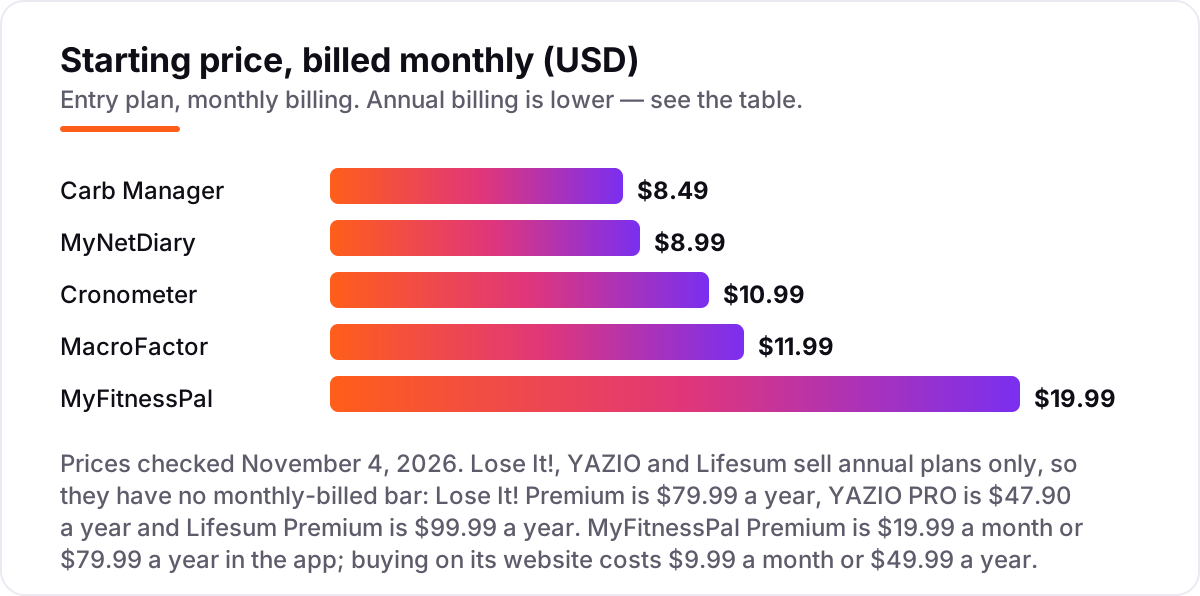
Macro tracking app pricing: what you will actually pay
Take one person tracking macros for a full year on annual billing. The subscription costs $39.99 on Carb Manager, $47.90 on Yazio, $59.99 on MyNetDiary and Cronometer, $71.99 on MacroFactor, $79.99 on MyFitnessPal in the app and on Lose It!, and $99.99 on Lifesum. Buying MyFitnessPal on its website instead of in the app cuts it to $49.99 a year, which makes it the second-cheapest annual plan here rather than joint-second-dearest.
Paying monthly instead of annually changes the picture sharply. Twelve months of monthly billing cost $101.88 on Carb Manager, $107.88 on MyNetDiary, $131.88 on Cronometer, $143.88 on MacroFactor and $239.88 on MyFitnessPal. The same app, the same features, costs two to three times more on monthly billing — the annual discount is the single biggest saving in this list, worth $62 to $160 a year depending on the app.
Three costs sit outside every number above. First, the website-versus-app gap: MyFitnessPal Premium is $30 a year cheaper on the website than in the app, and Yazio and Lifesum show different prices to different users, so the price you are offered is not always the list price. Second, the add-ons that feel mandatory once you are set up: Carb Manager meal plans from $1.99 a week, MyNetDiary Premium Plus at $14.99 a month for the AI Coach, and Lose It! Lifetime at $299.99 if you commit for good. Third, the free-plan ceiling: if the scanner, the fasting timer or custom macro targets sit behind the paywall, the free plan is a trial with no end date, not a plan. If you want the cheapest honest year, Carb Manager at $39.99 is the floor — see our guide to booking flights on mobile for how the same compare-before-you-pay approach works for travel apps.
Know the difference: macros vs calories
The confusion in this category is between a total and a split. Calories are the total: how much energy the food contains. Macros are the split: how much of that energy comes from protein, carbohydrate and fat. Two meals can both be 600 calories and do very different jobs — one with 50 grams of protein keeps you full and feeds muscle, the other with 90 grams of sugar does not. A calorie tracker that only counts the total can hit the number while missing the point.
That split is why the prices look inconsistent. Apps that only count calories can be free, because the total is easy to log. Apps that track macros well charge for the database, the scanner and the targets, because the split has to be right for every food. MacroFactor goes further and adjusts the split every week from your weight trend; Cronometer goes deeper and tracks the vitamins and minerals inside the split. Judge each app on the split, not the total: does it set targets in grams, does it show the split per meal, and does the scanner find your food?
A third distinction worth knowing is fixed targets versus adaptive targets. Fixed targets come from a formula on day one — your age, weight and goal — and never move. Adaptive targets, from MacroFactor and MyNetDiary Premium, re-estimate your expenditure from what you log and weigh, then move the targets. Fixed targets are fine for a steady routine; adaptive targets earn their price when your weight stalls or your training changes.
Quick comparison: tool type by need
| Buyer | Best pick | Why |
|---|---|---|
| Most people starting out | MyFitnessPal | Biggest database, free plan, Premium $19.99/month |
| Accuracy and micronutrients | Cronometer | Verified foods, 95 nutrients, Gold $10.99/month |
| Lifters who want adaptive targets | MacroFactor | Weekly target recalculation, $11.99/month |
| Best free plan | MyNetDiary | Ad-free free plan, Premium $8.99/month |
| Simplest weight-loss tracker | Lose It! | Daily calorie budget, Premium $79.99/year |
| Keto and low-carb | Carb Manager | Net carbs and ketone tracking, $8.49/month |
| Cheapest annual price | Yazio | PRO $47.99/year, often $23.90 on promotion |
| Meal plans and diet programs | Lifesum | Structured programs and recipes, $99.99/year |
Mistakes to avoid
- Paying in the app when the website is cheaper. MyFitnessPal Premium is $19.99 a month in the app and $9.99 a month on its website — the same plan, $120 a year apart. Always check the vendor's website before you subscribe inside the app.
- Budgeting on the annual price while paying monthly. Annual billing is 40–50% cheaper, but it means paying a year upfront. MyFitnessPal is $79.99 a year but $239.88 if you pay monthly for twelve months; MacroFactor is $71.99 a year but $143.88 monthly. Compare apps on the billing term you will actually use.
- Assuming the barcode scanner is free everywhere. It is free in Cronometer, MyNetDiary and Carb Manager, and paid in MyFitnessPal, Lose It! and Yazio. If you scan every meal, a free plan without a scanner is not a free plan.
- Picking a specialist for a general diet. Carb Manager is built for keto and Lifesum builds whole diet programs; both fit poorly if you just want a general macro diary. The specialist wins on its own ground and loses everywhere else.
- Paying for a feature your free plan already has. Macro targets in grams, the barcode scanner and voice logging are free in MyNetDiary and Cronometer. Check the free plan of every app before you pay for the same feature in another one.
How we chose
We checked each vendor's own pricing page and App Store listing on November 4, 2026 and recorded the starting price exactly as shown, including the annual-billing figure where the page lists one, and we ranked the apps by fit for the most common buyer — someone who wants to hit a daily protein, carb and fat target without spending ten minutes per meal — not by brand size. Two prices needed a workaround: MyFitnessPal's Premium page returned a 403 to our automated check, so its $19.99/$79.99 in-app prices and $9.99/$49.99 website prices were confirmed from several independent sources quoting the vendor's own Premium page and App Store listing in October 2026; Yazio's and Lifesum's prices vary by offer, so we show the standard annual figures from Yazio's own pricing document and the App Store listings. Lose It!, Yazio and Lifesum sell annual plans only, so they have no monthly-billed price to chart. No G2, Capterra or Trustpilot page for any of these apps could be verified today, so this list carries no review ratings — app-store ratings are not used, because they measure the app, not the paid plan. No vendor paid for a place in this list, and none of the links here are affiliate links.
What to do next
Start with the free plan or trial of your top pick and log one real week of meals through it. Check that the barcode scanner finds your food, that the macro targets are set in grams, and that the reports show what you need before you commit to a year. If the tracking is sorted but new customers are not finding your health business, our monthly SEO service handles the visibility side — or compare travel apps in our guide to booking flights on mobile. Once your tools are in place, find out what's holding your rankings back.
Your stack only works if people find you
SerpAstra fixes what keeps your site off page one and makes it easy for AI assistants to recommend.
Get a free audit→Sources we checked (10)
- MyFitnessPal Premium — myfitnesspal.com/premium (checked November 4, 2026)
- Cronometer Gold — cronometer.com/gold (checked November 4, 2026)
- MacroFactor — macrofactor.com (checked November 4, 2026)
- MyNetDiary — mynetdiary.com (checked November 4, 2026)
- Lose It! — loseit.com (checked November 4, 2026)
- Carb Manager vs MyFitnessPal — carbmanager.com (checked November 4, 2026)
- Carb Manager on the App Store — apps.apple.com (checked November 4, 2026)
- YAZIO international pricing — filecontent.yazio.com (checked November 4, 2026)
- Lifesum — lifesum.com (checked November 4, 2026)
- MyFitnessPal blog — best value fitness apps, Lifesum pricing (October 5, 2026)
Shamim
Founder of SerpAstra
A full-stack SEO and digital marketer who spends most days on Local SEO for dental practices, AI search visibility and lead generation.
Frequently asked questions
What is the best app to track macros?
MyFitnessPal is the best fit for most people: the biggest food database, a free plan and Premium at $19.99 a month. Cronometer is better when accuracy matters, with verified foods and full micronutrient data. MacroFactor is the better pick when you want your targets recalculated every week from your weight trend.
How much does a macro tracking app cost?
Paid plans run from $39.99 to $99.99 a year on annual billing. Carb Manager is cheapest at $39.99 a year, Yazio follows at $47.90, and Lifesum is dearest at $99.99. Monthly billing costs more: MyFitnessPal is $19.99 a month, or $239.88 over a year, against $79.99 on the annual plan.
Is there a free app to track macros?
Yes, with limits. Seven of the eight apps here have free plans, and MyNetDiary and Cronometer give away the most: barcode scanning, macro targets and, in Cronometer, full micronutrient data. MacroFactor is the exception — it has no free plan, only a 7-day trial, and says there never will be one.
MacroFactor vs MyFitnessPal — which is better?
MacroFactor is better if you lift and weigh yourself most days: it recalculates your targets every week from logged food and weight, and its database is verified. MyFitnessPal is better if you want the biggest database, a free plan and the tracker your friends use. MacroFactor costs $71.99 a year; MyFitnessPal Premium is $79.99.
Do I need to pay for barcode scanning?
Not always. Cronometer, MyNetDiary and Carb Manager include the barcode scanner on their free plans, so you can scan food without paying. MyFitnessPal moved its scanner behind Premium, which costs $19.99 a month in the app or $9.99 a month on its website. Lose It! and Yazio also keep scanning behind their paid plans.
Can I switch macro tracking apps later?
Yes, and it is easier than switching a diet plan. Export your food history and custom foods first — most apps offer a CSV export on the paid plan — then set up the same macro targets in the new app and log one week in both. Your history does not transfer, so keep the old app installed until the new one has a month of data.
Free SEO and AI visibility audit
Find out what is holding your rankings back
Send us your site. Within 2 business days you get a written audit, an AI visibility check and a short fix list ranked by impact. Free, with no contract attached.
Request my free audit→Related guides
 Consumer Apps8 Best Apps for Booking Flights on Mobile in 2026Compare the 8 best app for booking flights on mobile options: every one is free, with price alerts, fare forecasts and flexible search checked November 4, 2026.Read guide →
 AI, Data & Analytics7 Best AI Spanish Learning Apps in 2026: Free and Paid Apps RankedThe 7 best ai spanish learning apps of 2026, ranked with real prices, free plans and AI conversation features — pick the app that fits how you actually study.Read guide →
 Consumer Apps10 Best Spanish Translation Apps in 2026: Free and Paid Apps RankedCompare the 10 best Spanish translation apps on price, free plans, offline mode and accuracy for travel and work, with every price checked November 4, 2026.Read guide →