
8 Best Enterprise AI Platforms in 2026, Compared
Compare the 8 best enterprise AI platforms for building, deploying and governing AI models, with token rates, compute pricing and free tiers checked in 2026.
 Shamim Mia, Founder, SerpAstraLast verified November 2, 20268 min read
We compare pricing pages, documentation and public reviews. We never accept payment for rankings.
Key takeaways
- Pick the enterprise AI platform that sits on your existing cloud: Azure Machine Learning for Microsoft shops, Vertex AI for Google Cloud and Amazon Bedrock for AWS.
- Databricks is the best enterprise AI platform when data engineering and AI must share one governed lakehouse; Snowflake suits SQL-first teams.
- Generative AI is priced per token: Gemini 2.5 Flash-Lite on Vertex AI costs $0.10 per million input tokens, and batch jobs on Vertex AI and Bedrock cost about half.
- DataRobot and H2O.ai suit regulated industries that need governed AutoML; IBM watsonx.ai adds a published Standard plan from $1,110 a month.
On this page
Quick comparison
| Tool | Best for | Starting price | Free plan |
|---|---|---|---|
| Azure Machine Learning | Enterprises standardised on Microsoft 365, Azure and Power BI | Pay as you go | Yes ($200 credit) |
| Google Vertex AI | Enterprises on Google Cloud building generative AI apps on Gemini models | From $0.10/1M tokens | No |
| Amazon Bedrock | AWS enterprises that want a choice of foundation models behind one API | Per token, by model | No |
| Databricks | Enterprises that want data engineering, analytics and AI on one governed lakehouse | From $0.15/DBU | Yes (free plan) |
| Snowflake | SQL-first data teams that want AI close to a managed cloud warehouse | From $2/credit | No (trial only) |
| DataRobot | Large regulated enterprises that need governed AutoML and model monitoring | Custom quote | No (30-day trial) |
| H2O.ai | Regulated organisations that need AI on-premises or in air-gapped environments | Free open source; quote | Yes (open source) |
| IBM watsonx.ai | Enterprises that want published plan pricing, open models and IBM support | From $0; Standard $1,110/mo | Yes, limited |
Make one of these tools?
We re-check this list every quarter. Send a correction, request a review, or ask about a clearly labeled sponsored spot.
Request a listingThe best enterprise AI platforms

Azure Machine Learning
Best for: Enterprises standardised on Microsoft 365, Azure and Power BI
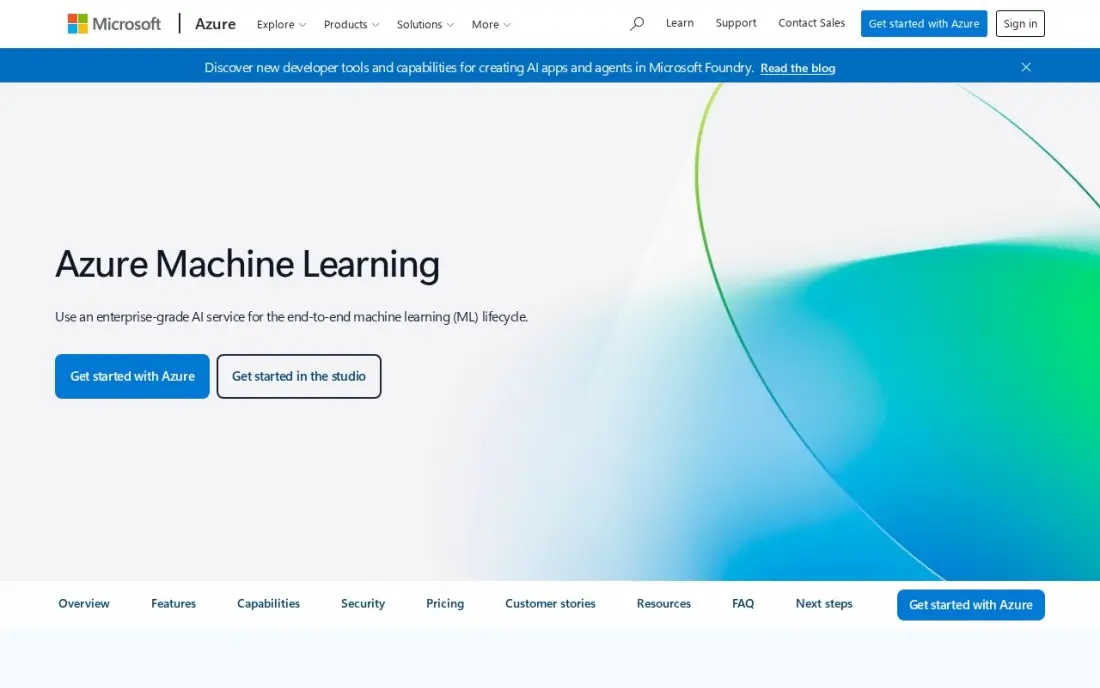
Azure Machine Learning covers the full model lifecycle for organisations already running on Microsoft. Automated ML and a drag-and-drop designer let analysts build models without code, while pipelines, MLOps and responsible-AI tooling take models into governed production. Integration with Power BI and Microsoft 365 keeps results inside the tools staff already use.
There is no platform fee: you pay for the compute and storage your training and scoring use, billed by the second, and a free Azure account comes with $200 in credit. The risk is forecasting, because an idle endpoint or a large GPU run can surprise finance. Reviewers also report a steep learning curve, and it holds a 4.3 G2 score.
What we like
- No platform fee — the service itself is free, and you pay only for compute and storage used
- Automated ML plus a drag-and-drop designer, so both coders and non-coders can build models
- Enterprise MLOps, responsible-AI tooling and deep Power BI and Microsoft 365 integration
Watch out for
- Usage-based billing is hard to forecast — an idle endpoint or large training run can surprise you
- Reviewers cite a steep learning curve and a complex, hard-to-navigate interface
- Full value needs Azure skills; teams outside the Microsoft stack pay a learning tax

Google Vertex AI
Best for: Enterprises on Google Cloud building generative AI apps on Gemini models
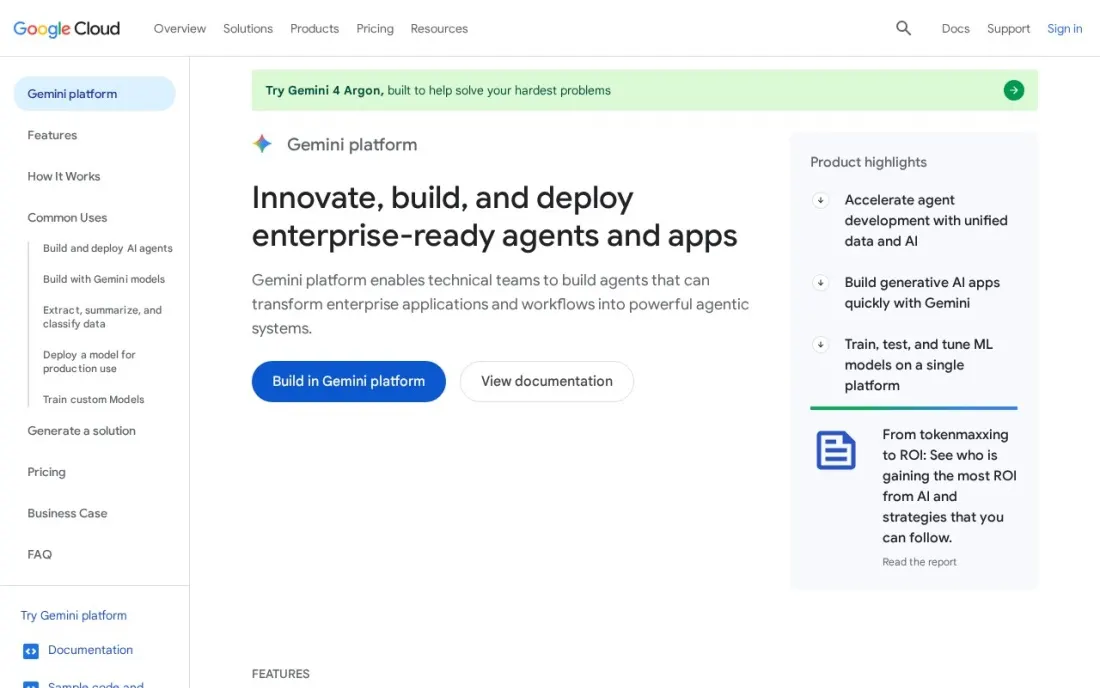
Vertex AI is Google Cloud's platform for building with Gemini and other models, with tuning, grounding, evaluation and deployment managed in one place. Grounding with Google Search lets answers cite current web results, and the first 5,000 grounding queries a month are free, with further queries at $14 per 1,000.
Pricing is per token. Gemini 2.5 Flash-Lite costs $0.10 per million input tokens and $0.40 per million output, and Gemini 3.1 Flash-Lite costs $0.25 and $1.50 at standard context. Batch and Flex jobs run at about half those rates. Several models carry introductory prices that end on set dates, so check the page before signing a budget.
What we like
- Gemini models from low-cost Flash-Lite to Pro on one managed platform
- Batch and Flex processing cost about half the standard token rate
- 5,000 Grounding with Google Search queries and 5,000 Google Maps queries a month at no charge
Watch out for
- Token pricing changes often, with introductory and promotional rates that end on set dates
- Non-global endpoints cost about 10% more than the Global endpoint for most models
- No free token allowance listed on the generative AI pricing page

Amazon Bedrock
Best for: AWS enterprises that want a choice of foundation models behind one API
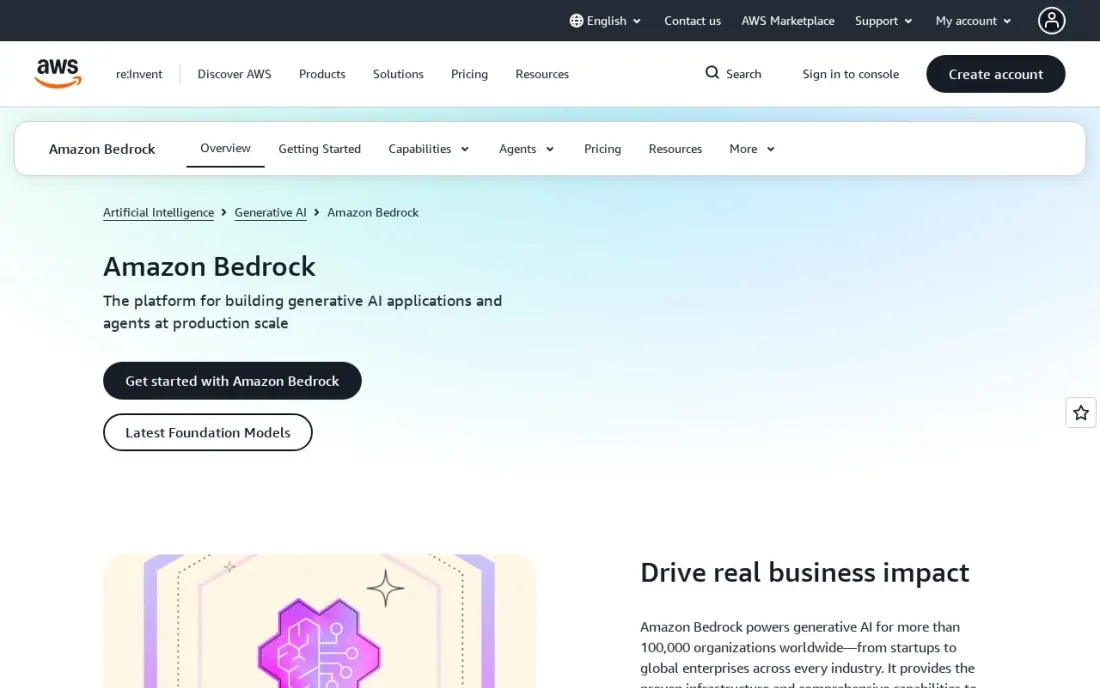
Amazon Bedrock gives AWS customers foundation models from several providers through one managed API, with fine-tuning, custom model import and enterprise controls inside the AWS account they already govern. Teams can switch models without rebuilding their application, which reduces lock-in to any single model provider.
Pricing depends on the model. On demand, Mistral Large 3 costs $0.50 per million input tokens and $1.50 per million output, and DeepSeek v3.2 costs $0.62 and $1.85 in the main US regions. Batch inference and the Flex tier cost 50% less, Priority costs 75% more, and Provisioned Throughput is quoted per model unit by AWS sales.
What we like
- Models from several providers, including Mistral and DeepSeek, behind one AWS API
- Batch inference costs 50% less than on-demand for eligible models
- Provisioned Throughput and service tiers (Standard, Flex, Priority, Reserved) for predictable workloads
Watch out for
- Each model has its own token price, so cost comparisons take work
- Priority tier costs a 75% premium over Standard
- Provisioned Throughput prices need a conversation with AWS sales

Databricks
Best for: Enterprises that want data engineering, analytics and AI on one governed lakehouse
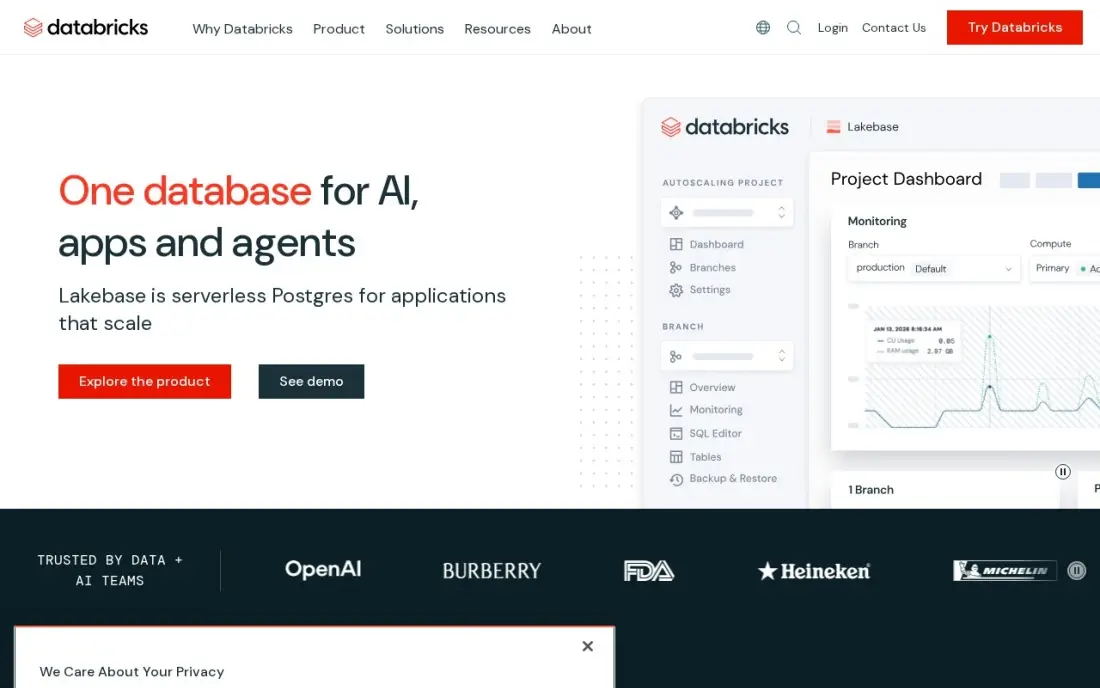
Databricks is the enterprise AI platform for organisations whose models depend on large, messy data. Engineering, warehousing and machine learning run on the same open formats with Apache Spark underneath, and Unity Catalog governs tables, features and models in one place. It holds a 4.6 G2 score from more than 1,300 reviews.
Pricing is consumption-based: Jobs Compute starts at $0.15 per DBU on the Premium tier in AWS US East, interactive compute costs $0.55, and classic compute bills cloud infrastructure on top. A perpetual Free Edition covers learning and small experiments. Without active cost management, bills climb quickly, so assign an owner for spend from day one.
What we like
- One platform for warehousing, engineering and machine learning on open formats, with Apache Spark underneath
- Unity Catalog governs data and AI assets in one place, from tables to models
- Serverless compute removes cluster management, and the ecosystem spans ingestion to BI
- Free Edition covers learning and small experiments at $0
Watch out for
- Consumption pricing needs active cost management, or bills climb fast
- Classic compute bills cloud infrastructure separately, on top of the DBU rate
- Rewards Spark and Python skills; pure SQL teams face a learning curve

Snowflake
Best for: SQL-first data teams that want AI close to a managed cloud warehouse
Snowflake suits enterprises whose analysts live in SQL and want AI work to happen next to governed warehouse data rather than in copies. Storage and compute scale separately, warehouses start and stop in seconds, and secure data sharing lets partners query live tables without moving them.
It is billed in credits: Standard costs $2 a credit on demand in AWS US East, Enterprise $3 and Business Critical $4, with storage billed separately. Needing one Enterprise feature reprices every credit in the account. A 30-day trial includes $400 of credits. Machine learning is less central here than on Databricks, so heavy model training may sit better elsewhere.
What we like
- Storage and compute scale separately, and warehouses start and stop in seconds
- Data sharing lets partners query live tables without copying data
- Analysts write plain SQL while the platform handles all infrastructure
- Marketplace adds third-party datasets to the same queries
Watch out for
- Costs can surprise without governance: every credit burns at the edition rate
- Needing one Enterprise feature reprices every credit in the account to $3
- Streaming and machine learning are less central than on Databricks

DataRobot
Best for: Large regulated enterprises that need governed AutoML and model monitoring
DataRobot runs data through hundreds of algorithms, ranks the results on a leaderboard, then deploys, monitors and governs the chosen model with audit trails. Python and R SDKs sit beside a visual interface, so data scientists and business analysts can work on the same projects. It holds a 4.4 G2 score.
There is no public pricing; enterprise agreements are negotiated, and reviewers call the cost prohibitive below enterprise scale. A 30-day free trial with platform access is offered, so a team can run a real use case before negotiating. It fits banks, insurers and healthcare groups where model governance matters as much as accuracy.
What we like
- AutoML evaluates hundreds of algorithms and ranks them on a live leaderboard
- Full lifecycle in one place: build, deploy, monitor and govern models with audit trails
- Python and R SDKs plus a visual interface, so experts and business users share one platform
Watch out for
- No public pricing — enterprise agreements are typically five to six figures a year
- Overkill for small teams: reviewers call the cost prohibitive below enterprise scale
- Trial limits and post-trial costs are not published

H2O.ai
Best for: Regulated organisations that need AI on-premises or in air-gapped environments
H2O.ai pairs a free open-source core with enterprise tools. H2O-3 is open source and free to self-host, so teams can prototype without a sales call, and Driverless AI automates feature engineering and model tuning for production. It runs in a managed cloud, a private cloud, on-premises or fully air-gapped, which few rivals here match.
Commercial licences are quoted annually on compute and memory, with no published price. Its 4.5 G2 score rests on only 24 reviews, and reviewers say Driverless AI can be expensive for early adoption. It suits government, banking and insurance teams that cannot send data to a public cloud model.
What we like
- H2O-3 is open source and free — teams can prototype before ever talking to sales
- Driverless AI automates feature engineering and model tuning with strong iteration speed
- Runs managed cloud, private cloud, on-premises or fully air-gapped
Watch out for
- Commercial pricing is not published — annual licenses are quoted on compute and memory
- Only 24 G2 reviews, so the review base is thin next to the bigger names here
- Reviewers note Driverless AI can be expensive for early adoption

IBM watsonx.ai
Best for: Enterprises that want published plan pricing, open models and IBM support
IBM watsonx.ai is the enterprise AI studio for teams that want open-source and IBM models, prompt tooling, retrieval-augmented generation, agents and classic machine learning under one contract. The free tier allows up to 300,000 foundation model tokens, 20 compute usage hours and 100 extracted documents a month, enough to prove a use case.
Essentials starts at $0 a month on pay as you go, with machine learning at $0.55 per capacity unit-hour. Standard starts at $1,110 a month and adds LoRA fine-tuning and on-demand model hosting, with an A100 GPU at $6.30 an hour. IBM marks these prices as indicative, and support with SLAs costs from $200 a month.
What we like
- Free tier includes up to 300,000 foundation model tokens, 20 compute usage hours and 100 documents of text extraction a month
- Essentials covers PromptLab, RAG support, AgentLab, a synthetic data generator and ML tools on pay as you go
- Standard adds LoRA and QLoRA fine-tuning and on-demand model hosting
Watch out for
- Fine-tuning and model hosting are not available on Essentials
- Advanced support with SLAs costs from $200 a month extra
- IBM labels prices as indicative and says they vary by country
The best enterprise AI platforms let a large organisation build, deploy and govern AI on its own data without stitching together a dozen tools. We compared eight platforms on where they run, the models and methods they support, governance, and how they charge, whether per token, per compute hour or per credit. Every price below was checked on vendor pricing pages and our verified tool records in November 2026.
How to choose the best enterprise AI platforms
- Start from your cloud and your data. The platform next to your data avoids copies, egress costs and a second security review.
- Separate generative AI from classic machine learning. Token-priced model APIs and compute-priced model training are different budgets.
- Demand governance by default. Look for model registries, access controls, audit trails and data lineage, not just a chat playground.
- Model the cost per use case. Estimate tokens or compute hours for one real workflow before comparing headline rates.
- Check deployment options. Regulated teams may need private cloud, on-premises or air-gapped deployment.
- Keep model choice open. Platforms that host several model families make it easier to switch as prices fall.
As your company publishes more AI-assisted content and product pages, how AI assistants describe your brand matters too. Our AI search optimization service tracks and improves how assistants cite you, and our predictive analytics guide covers AutoML tools in more depth.
Enterprise AI platforms pricing: what you will actually pay
Take a support assistant that handles 100 million input tokens and 20 million output tokens a month. On Vertex AI with Gemini 2.5 Flash-Lite that costs $10 for input and $8 for output, so $18 a month, or $9 on batch. On Gemini 3.1 Flash-Lite it costs $25 plus $30, so $55. On Amazon Bedrock with Mistral Large 3 it costs $50 plus $30, so $80 on demand, with batch inference 50% cheaper on the models that support it.
Platform and compute costs sit on top. IBM watsonx.ai Standard starts at $1,110 a month before usage. Databricks Jobs Compute starts at $0.15 per DBU, and Snowflake credits cost $2 on Standard or $3 on Enterprise. Azure Machine Learning charges no platform fee, only compute and storage. DataRobot and H2O.ai commercial licences are quoted, so get a written estimate for your first year.
Know the difference: AI model platform vs AI data platform
An AI model platform gives you models and the tools around them. Vertex AI, Amazon Bedrock and IBM watsonx.ai host foundation models, let you ground or tune them, and serve them through an API. DataRobot and H2O.ai do the same for predictive models with AutoML. You bring the data; they bring the modelling.
An AI data platform starts from the data. Databricks and Snowflake hold and govern the tables your models need, and add AI features next to them. Most enterprises use one of each: a data platform as the source of truth and a model platform for training and serving, connected under one governance policy.
Quick comparison: tool type by need
| Enterprise | Best pick | Why |
|---|---|---|
| Microsoft shop | Azure Machine Learning | No platform fee, Power BI and Microsoft 365 integration |
| Google Cloud | Google Vertex AI | Gemini models from $0.10 per 1M input tokens |
| AWS | Amazon Bedrock | Several model providers behind one API, batch at 50% off |
| Data and AI together | Databricks | Lakehouse with Unity Catalog governance, from $0.15/DBU |
| SQL-first team | Snowflake | AI next to a managed warehouse, from $2/credit |
| Governed AutoML | DataRobot | Build, deploy, monitor and audit models in one place |
| Air-gapped deployment | H2O.ai | Open-source core, runs on-premises |
| Published plan pricing | IBM watsonx.ai | Free tier; Standard from $1,110/month |
Mistakes to avoid
- Starting with the model instead of the use case. Pick one workflow with a measurable outcome, then choose the platform.
- Ignoring data location. Moving sensitive data to another cloud adds cost, latency and compliance work.
- Budgeting on list token rates alone. Retries, long prompts and retrieval context multiply token counts.
- Leaving endpoints running. Idle deployments and GPU clusters bill by the hour whether used or not.
- Skipping governance until later. Add access controls and model monitoring before the first production launch.
Related comparisons: Enterprise Software · Enterprise AI Search Software · Enterprise Marketing Platforms · Enterprise Budgeting Software
How we chose
We read the Vertex AI, Amazon Bedrock and IBM watsonx pricing pages on 16 November 2026 and took the other platforms from our verified records, checked in November 2026, recording prices exactly as published. We ranked platforms by fit for a large organisation adopting AI at scale, weighting cloud fit, governance, deployment options and how predictable the pricing is. Ratings come from G2 pages on the dates shown in the sources, and tools without a verified rating show none. No vendor paid for a place in this list, and none of the links here are affiliate links.
What to do next
Choose one AI use case, estimate its monthly tokens or compute hours, and price it on the two platforms closest to your existing cloud. To see how AI assistants already describe your company, book a free AI visibility audit.
Frequently asked questions
What is the best enterprise AI platform?
It depends on your cloud. Azure Machine Learning suits Microsoft shops, Google Vertex AI suits Google Cloud and Amazon Bedrock suits AWS. Databricks is the strongest choice when data engineering and AI must share one governed platform.
How are enterprise AI platforms priced?
Generative AI is billed per million tokens, and machine learning is billed for compute. Gemini 2.5 Flash-Lite on Vertex AI costs $0.10 per million input tokens, Databricks Jobs Compute starts at $0.15 per DBU and Snowflake at $2 a credit.
Which enterprise AI platform has a free tier?
IBM watsonx.ai has a free tier with up to 300,000 foundation model tokens a month. Databricks has a perpetual Free Edition, H2O-3 is free open source, and Azure gives new accounts $200 in credit.
How can enterprises cut generative AI costs?
Use batch processing where answers are not needed instantly: Vertex AI batch jobs and Amazon Bedrock batch inference cost about half the standard rate. Also route simple tasks to small models such as Flash-Lite.
Which enterprise AI platform runs on-premises?
H2O.ai runs in a private cloud, on-premises or fully air-gapped, which suits regulated industries. Most other platforms here are cloud services.
Should we build on one cloud or stay multi-model?
Build on the cloud where your data already sits, to avoid moving and securing it twice. Amazon Bedrock and Vertex AI both offer several models behind one platform, so you can change models without changing clouds.
What is an enterprise AI platform, with examples?
An enterprise AI platform is a managed service for building, deploying and governing AI across a company, with access controls, audit trails and model management. Examples here fall into three groups: cloud model platforms like Azure Machine Learning, Google Vertex AI and Amazon Bedrock; data platforms like Databricks and Snowflake; and AutoML platforms like DataRobot, H2O.ai and IBM watsonx.ai.
What criteria should we use to evaluate an enterprise AI platform?
Start with where your data and cloud already live, since the nearby platform avoids copies and a second security review. Then check governance (model registries, access controls, audit trails, lineage), deployment options such as on-premises or air-gapped for regulated teams, model choice, and the cost of one real workflow in tokens or compute hours rather than headline rates.
Sources we checked (13)
- Azure Machine Learning — azure.microsoft.com/en-us/pricing/details/machine-learning (checked November 2, 2026)
- Azure Machine Learning reviews on G2 (checked November 2, 2026)
- Google Vertex AI — cloud.google.com/vertex-ai/generative-ai/pricing (checked November 16, 2026)
- Amazon Bedrock — aws.amazon.com/bedrock/pricing (checked November 16, 2026)
- Databricks — www.databricks.com/pricing (checked November 6, 2026)
- Databricks reviews on G2 (checked November 6, 2026)
- Snowflake — www.snowflake.com/en/pricing (checked November 6, 2026)
- Snowflake reviews on G2 (checked November 6, 2026)
- DataRobot — www.datarobot.com (checked November 2, 2026)
- DataRobot reviews on G2 (checked November 2, 2026)
- H2O.ai — h2o.ai (checked November 2, 2026)
- H2O.ai reviews on G2 (checked November 2, 2026)
- IBM watsonx.ai — www.ibm.com/watsonx/pricing (checked November 16, 2026)
Make one of these tools?
We re-check this list every quarter. Send a correction, request a review, or ask about a clearly labeled sponsored spot.
Request a listingShamim
Founder of SerpAstra
A full-stack digital marketer and SEO strategist covering technical and local SEO, AI search visibility, paid ads and lead generation for local businesses, e-commerce brands and SaaS teams.
Free SEO and AI visibility audit
Find out what is holding your rankings back
Send us your site. Within 2 business days you get a written audit, an AI visibility check and a short fix list ranked by impact. Free, with no contract attached.
Request my free audit→Related buying guides
 Data, Analytics & AI10 Best Predictive Analytics Tools in 2026 (Free and Paid, Compared)10 best predictive analytics tools compared with prices, free plans and AutoML depth — from free KNIME to enterprise DataRobot. Prices checked Nov 2, 2026.Read guide →
 Data, Analytics & AI10 Best Big Data Analytics Software in 2026, ComparedCompare the 10 best big data analytics software platforms on price, free tiers and AI features, with every price checked on November 6, 2026.Read guide →
 Data, Analytics & AI7 Best Enterprise AI Search Software in 2026, Compared7 best enterprise AI search software options compared on price, AI engines and enterprise features, with real prices checked November 1, 2026.Read guide →