
6 Best Investment Tracking Software in 2026, Compared
Compare the 6 best investment tracking software on free plans, dividend and performance reports, net worth and yearly cost, with prices checked November 2026.
 Shamim Mia, Founder, SerpAstraLast verified November 4, 202610 min read
We compare pricing pages, documentation and public reviews. We never accept payment for rankings.

Key takeaways
- Sharesight is the best dedicated tracker for dividends and tax reports, with a free plan for 10 holdings and Starter at $7 a month billed annually.
- Empower's Personal Dashboard is free and links bank, retirement and brokerage accounts for net worth and fee analysis, but expect advisory sales calls.
- Ghostfolio is the open source pick: free to self-host under AGPLv3, with a paid cloud version for those who do not want to run a server.
- Stock Rover suits investors who want research and performance analysis together, from $348 a year; Kubera suits net worth across crypto, real estate and private holdings.
On this page
Quick comparison
| Tool | Best for | Starting price | Free plan |
|---|---|---|---|
| Sharesight | Dividend and long-term investors who want automatic performance and tax reports | Free; $7/mo (annual) | Yes (10 holdings) |
| Empower Personal Dashboard | Investors who want a free net worth, fee and retirement view across every linked account | Free | Yes |
| Ghostfolio | Privacy-minded investors who want an open source tracker they can host themselves | Free (self-hosted) | Yes (self-hosted) |
| Stock Rover | Active investors who want portfolio performance and stock research in one tool | $348/yr | No (14-day trial) |
| Kubera | Investors with crypto, real estate and private holdings who want one net worth view | From $249/yr | No (14-day trial) |
| GnuCash | Hands-on investors who want free, offline investment records in a double-entry ledger | Free | Yes (free) |
Make one of these tools?
We re-check this list every quarter. Send a correction, request a review, or ask about a clearly labeled sponsored spot.
Request a listingThe best investment tracking software
Sharesight
Best for: Dividend and long-term investors who want automatic performance and tax reports
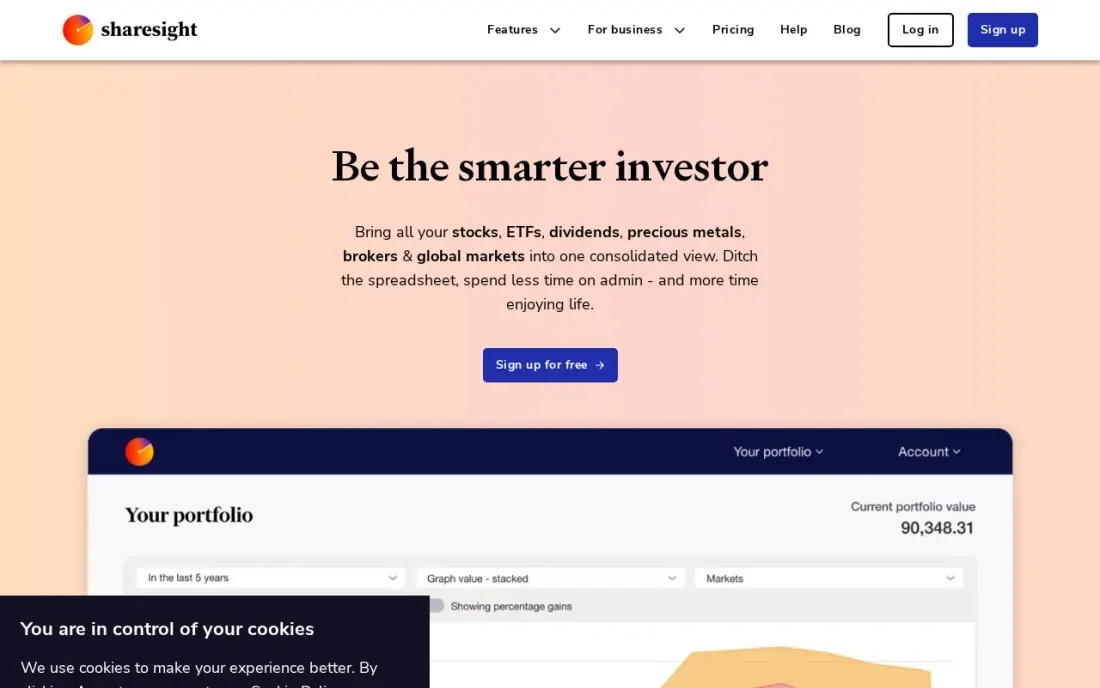
Sharesight is built for investors who care about total return, not just price. Every plan, including free, records dividends and corporate actions automatically and includes the Performance, Sold Securities and All Trades reports. Paid plans add tax reports, and Starter adds diversity and exposure reports plus file attachments, so the paperwork behind each trade sits with it.
The free plan covers 1 portfolio and 10 holdings, counting closed positions. Starter costs $7 a month billed annually, or $9.33 monthly, for 30 holdings; Standard at $18 annually unlocks unlimited holdings, 4 portfolios, multi-currency valuation and Xero; Premium is $23.25 for 10 portfolios. Prices are in US dollars.
What we like
- Automatic dividends and adjustments, plus Performance, Sold Securities and All Trades reports on every plan
- Tax reports on all paid plans, with Xero integration from Standard
- Annual billing saves about 25%, and the mobile app is free for everyone
Watch out for
- The free plan stops at 10 holdings, including closed ones, and has no tax or diversity reports
- Unlimited holdings start on Standard at $18 a month billed annually

Empower Personal Dashboard
Best for: Investors who want a free net worth, fee and retirement view across every linked account
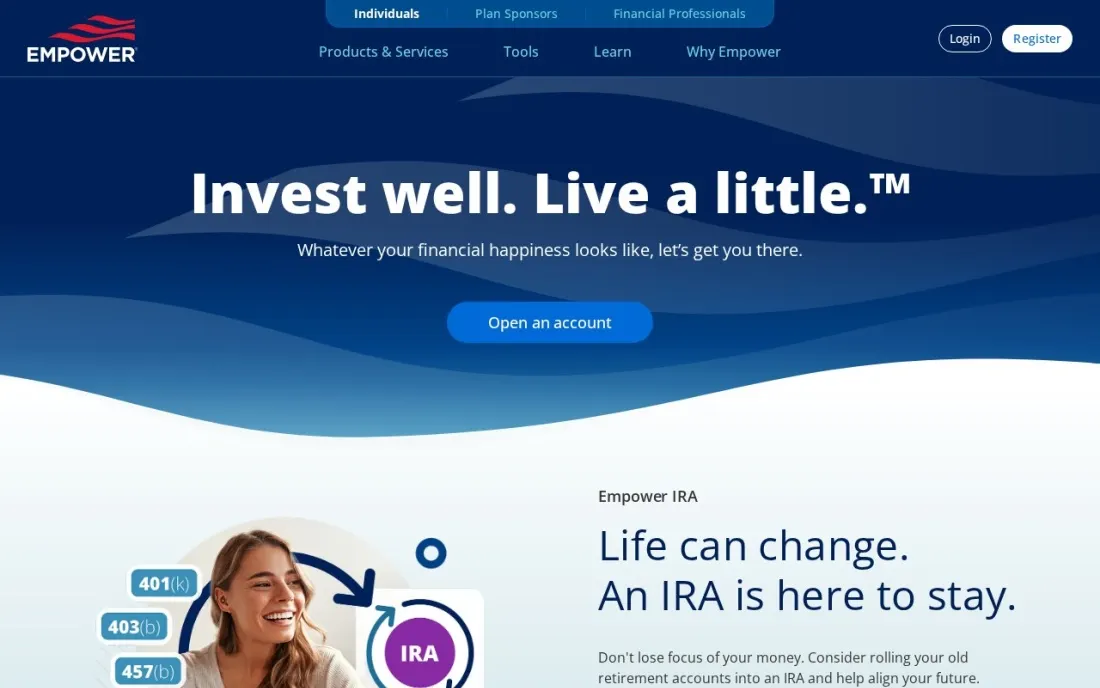
Empower's Personal Dashboard, formerly Personal Capital, is the most popular free way to see everything in one place. You link bank, retirement, brokerage, HSA, credit card and loan accounts, and it tracks net worth automatically. The fee analyzer calculates the weighted expense ratio across your funds, and the retirement planner scores your plan and lets you compare scenarios.
The tools are free because Empower uses them to market its advisory service, which charges from 0.89% a year on the first $1 million, and users report sales calls once linked assets grow. As an investment tracker it is light: there is little holding-level research or dividend analysis. Use it for the big picture, not for portfolio analysis.
What we like
- Free net worth tracking across linked bank, retirement, brokerage, loan and credit card accounts
- Fee analyzer shows the weighted expense ratio across your funds
- Retirement planner scores your plan and compares scenarios
Watch out for
- The free dashboard is a marketing tool for paid advice, so expect calls from advisers
- Limited research and dividend analysis compared with dedicated trackers

Ghostfolio
Best for: Privacy-minded investors who want an open source tracker they can host themselves
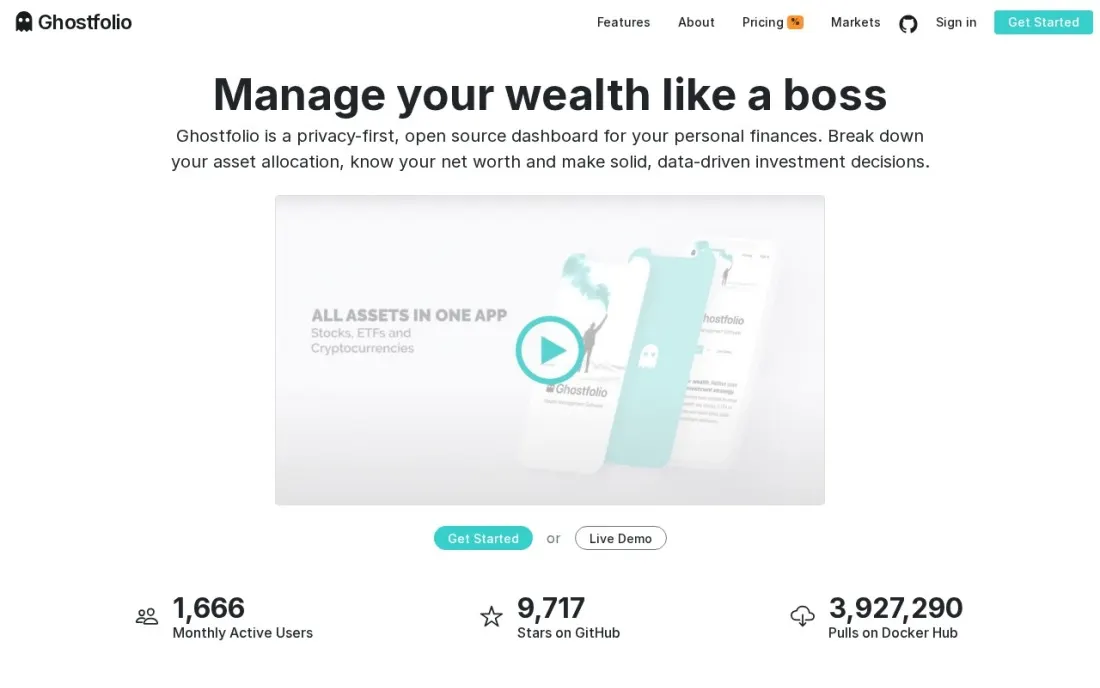
Ghostfolio is open source wealth management software for tracking stocks, ETFs and cryptocurrencies. It is licensed under AGPLv3, ships as official Docker images, and is designed to run continuously on your own server, so your portfolio data never leaves your hands. Features include multi-account management, performance reporting with dividends across time ranges and static analysis that flags portfolio risks.
Transactions are entered manually or imported, which takes discipline but avoids handing your brokerage logins to a third party. Ghostfolio Premium is the official cloud version for those who do not want to self-host, and its revenue funds hosting, market data and development. It works as a mobile-first web app.
What we like
- Free and open source under AGPLv3, with official Docker images for self-hosting
- Tracks stocks, ETFs and cryptocurrencies across multiple accounts
- Performance reports including dividends, risk analysis and a mobile-first web app
Watch out for
- Self-hosting means you run the server, updates and backups
- No automatic brokerage account linking described; transactions are entered or imported

Stock Rover
Best for: Active investors who want portfolio performance and stock research in one tool
Stock Rover combines portfolio tracking with research. You link brokerage accounts, and the Portfolio Performance Report shows internal rate of return and time-weighted returns, risk compared with the S&P 500, projected income by month and fund fees in dollars. Screening and fundamentals sit in the same product, so you can move from what you own to what you might buy.
Plans run $29 to $79 a month billed annually, or $348 to $948 a year, and most new subscribers choose Premium Plus at $588 or Ultimate at $948. There is a 14-day trial of the full feature set with no credit card. It tracks investment accounts only, so pair it with a net worth tool if you want the whole picture.
What we like
- Portfolio Performance Report shows IRR and time-weighted returns from linked brokerage accounts
- Shows risk against the S&P 500, projected monthly income and fund fees in dollars
- 14-day trial of the full feature set with no credit card
Watch out for
- Covers investment accounts only, not bank accounts or net worth
- Plans cost $348 to $948 a year, billed annually

Kubera
Best for: Investors with crypto, real estate and private holdings who want one net worth view
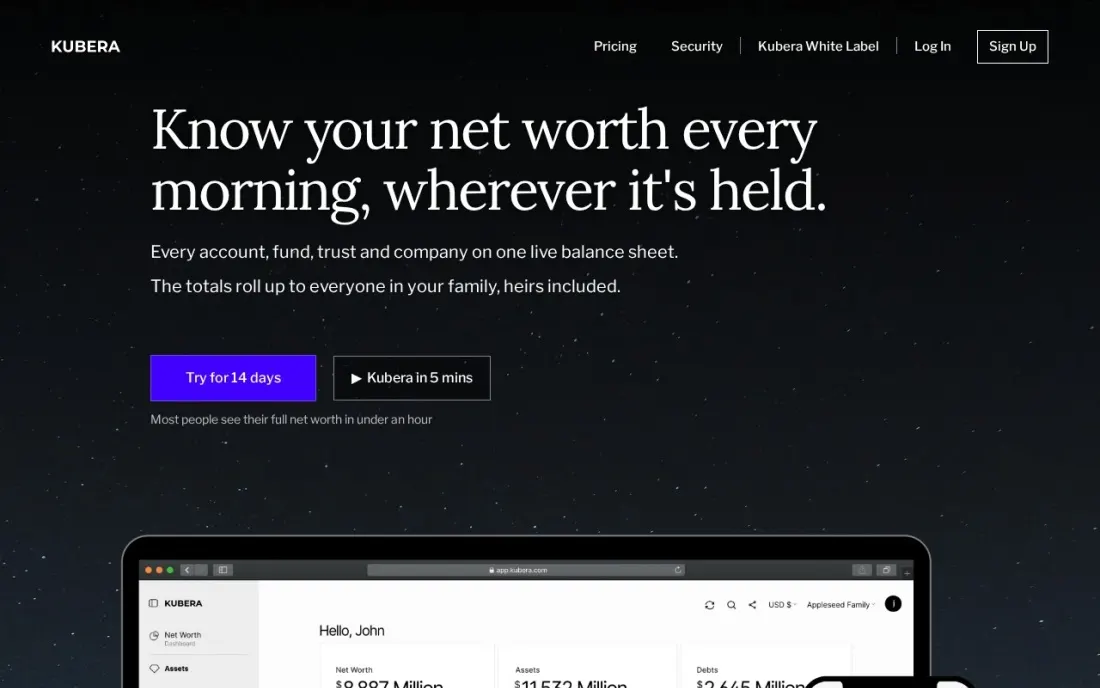
Kubera is a net worth tracker for people whose wealth does not all sit at a brokerage. It brings bank accounts, investment portfolios, crypto, real estate and private holdings into one view, links accounts through Plaid and connects directly to exchanges and wallets such as Coinbase, Kraken, Binance and MetaMask. An API gives programmatic access to the data.
A third-party review we read lists pricing from $249 a year with a 14-day free trial; check Kubera's own site for the current plan. Reviewers note that detailed investment analysis, budgeting and forecasting are lighter than the price suggests, so it suits tracking total wealth rather than analysing a stock portfolio.
What we like
- Tracks bank accounts, investment portfolios, crypto, real estate and private holdings together
- Links accounts through Plaid and connects to Coinbase, Kraken, Binance, PayPal, Wise and MetaMask
- API access to portfolio data
Watch out for
- From $249 a year is a lot for someone moving from a spreadsheet
- Lighter on detailed investment analysis, budgeting and forecasting

GnuCash
Best for: Hands-on investors who want free, offline investment records in a double-entry ledger
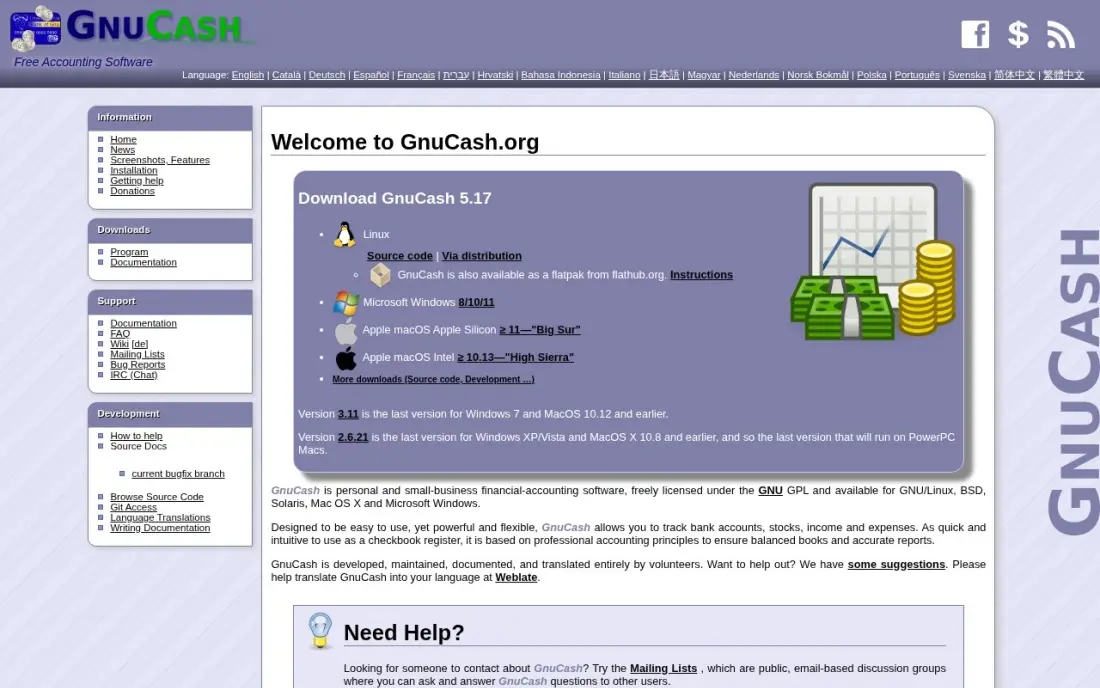
GnuCash is not a portfolio dashboard, but it is a capable free investment record. As a double-entry ledger under the GPL, it tracks investment accounts alongside your bank accounts and budgets, with multi-currency support, and your data is a file on your own computer with no account, no subscription and no vendor lock-in. It runs on Windows, Mac and Linux.
The effort is the catch. There are no automatic bank or brokerage feeds, so trades are typed in or imported as OFX or QIF files, and the interface looks dated. It is single-user only. Choose it if you want precise cost records you control and do not mind entering them.
What we like
- Completely free under the GPL — no subscription, no account, no feature locked behind a paywall
- Real double-entry bookkeeping with budgets, scheduled transactions and investment tracking
- Your data is a file on your computer, readable and portable, with no vendor lock-in
- Runs on Windows, Mac and Linux, and the 5.x releases are actively maintained
Watch out for
- No automatic bank feeds — transactions are entered by hand or imported as OFX/QIF files
- Single-user only, with no built-in multi-user access or cloud sync
- The interface looks dated and the learning curve is steep if you have never done double-entry bookkeeping
The best investment tracking software shows what your portfolio has really returned once dividends, fees and currency moves are counted, across every account you hold. We compared six tools — dedicated portfolio trackers, free net worth dashboards, research platforms and open source options — on free plans, performance and dividend reports, account linking and yearly cost, using vendor pages and reviews checked in November 2026. This is a software comparison, not investment advice.
How to choose the best investment tracking software
- Decide what you are tracking. Portfolio performance and dividends call for Sharesight or Stock Rover; total net worth across houses, crypto and loans calls for Empower or Kubera.
- Count your holdings, including closed ones. Sharesight's free plan counts closed positions toward its 10-holding limit, so long-time investors outgrow it quickly.
- Check how returns are measured. Time-weighted returns compare you with the market; money-weighted returns such as IRR show what your own deposits earned. Good trackers show both.
- Choose between linking and manual entry. Linked accounts stay current automatically; manual tools such as Ghostfolio and GnuCash keep your data private but need regular updates.
- Look for tax help where you file. Capital gains and dividend reports save hours at tax time, but confirm they match your country's rules.
- Know how the free tools are paid for. Empower's dashboard is free because it markets an advisory service, so decide whether you are happy to take that call.
A clear view of your own money is the same discipline a business needs for its marketing spend. If you run a firm in finance or wealth management and want more qualified clients finding you, our AI search optimization service helps you appear in ChatGPT and Google answers, and our guide to investing apps covers where to buy the investments you track.
Which investment tracking software fits your situation
A dividend investor with a small portfolio. Sharesight's free plan records dividends and corporate actions automatically and includes the Performance, Sold Securities and All Trades reports, which may be all you need for up to 10 holdings. Remember that closed positions count toward that limit. Starter at $7 a month billed annually raises it to 30 holdings and adds tax reports, and Standard at $18 unlocks unlimited holdings and multi-currency valuation.
Someone who wants one free view of savings, retirement accounts and debts. Empower's Personal Dashboard links bank, retirement, brokerage, HSA, credit card and loan accounts and tracks net worth for free, with a fee analyzer and retirement planner. It is light on holding-level research and dividend analysis, and the tools exist to market Empower's advisory service, so expect adviser calls as linked assets grow.
A privacy-minded investor who would rather not share brokerage logins. Ghostfolio is free to self-host under AGPLv3 with official Docker images, and tracks stocks, ETFs and crypto with dividend-aware performance reports. You run the server, updates and backups and enter or import trades yourself, or use Ghostfolio Premium in the cloud. GnuCash is the offline alternative if you want precise cost records in a double-entry ledger and accept a dated interface.
An active investor who researches before buying. Stock Rover links brokerage accounts and shows IRR, time-weighted returns, risk against the S&P 500 and fund fees in dollars next to screening and fundamentals. Plans run $348 to $948 a year billed annually, and the 14-day trial needs no credit card. It covers investment accounts only, so pair it with a net worth tool.
An investor whose wealth includes crypto, property or private holdings. Kubera brings bank accounts, portfolios, crypto, real estate and private holdings into one view, connecting to exchanges and wallets such as Coinbase and MetaMask. A third-party review lists it from $249 a year, so check the current price, and expect lighter investment analysis than a dedicated tracker.
Investment tracking software pricing: what you will actually pay
Take an investor with about 40 holdings across two brokerage accounts who wants dividend and performance reports. Sharesight's free plan stops at 10 holdings and Starter at 30, so this investor needs Standard at $18 a month billed annually, or $216 a year, and $24 a month billed monthly, or $288 a year. Stock Rover's plans run $348 to $948 a year billed annually, with most new subscribers choosing Premium Plus at $588. A third-party review lists Kubera from $249 a year.
The free options cost time rather than money. Empower's dashboard is free if you link accounts and accept adviser outreach; its advisory service, which you do not have to use, charges from 0.89% a year on the first $1 million. Ghostfolio is free to self-host on a server or home computer, and GnuCash is free on the desktop, but both need trades entered or imported by hand.
Know the difference: portfolio trackers vs net worth dashboards
A portfolio tracker such as Sharesight or Stock Rover looks inside your investments. It records each buy, sell and dividend, adjusts for splits and corporate actions, and calculates returns, income, diversification and fees holding by holding. It answers the question of whether your investments are doing their job.
A net worth dashboard such as Empower or Kubera looks across your whole financial life. It totals bank balances, retirement accounts, property, crypto and debts into one number and tracks how that number moves. It answers whether you are getting richer overall, but it usually says less about why a particular fund or share did well or badly. Many investors use one of each.
Quick comparison: tool type by need
| Buyer | Best pick | Why |
|---|---|---|
| Dividend and long-term investors | Sharesight | Automatic dividends and tax reports, free for 10 holdings |
| Free whole-picture view | Empower Personal Dashboard | Free net worth, fee analyzer and retirement planner |
| Privacy and self-hosting | Ghostfolio | Open source under AGPLv3, free to self-host |
| Research-minded active investors | Stock Rover | IRR, time-weighted returns and research, from $348/year |
| Crypto, property and private holdings | Kubera | One net worth view across all asset types, from $249/year reported |
| Hands-on record keepers | GnuCash | Free offline double-entry investment records |
Mistakes to avoid
- Ignoring dividends in returns. A share that is flat on price but paid 4% a year in dividends did far better than its chart suggests; use a tracker that counts income.
- Leaving accounts out. A tracker that sees two of your five accounts gives you a confident wrong answer; add old retirement plans and cash accounts too.
- Comparing against the wrong benchmark. A global portfolio measured against one country's index will look better or worse than it is.
- Trusting the free tool without reading why it is free. Free dashboards are often lead generation for paid advice; that is fine if you know it.
- Not exporting your history. Keep a periodic export of transactions so a price rise or a shutdown does not cost you years of records.
Related comparisons: Bill Tracking Software and Apps · SEO Tracking Software · Email Tracking Software · AEO Tracking Software
How we chose
We looked at tools individual investors use to track portfolios and net worth, then compared them on free plans, return and dividend reporting, account linking, privacy and cost. Sharesight prices come from its own pricing page, Ghostfolio's details from its official repository and Stock Rover's from its own site, all read in November 2026. Empower's and Kubera's details come from independent reviews we read on the same dates, and we label them that way. Ratings are shown only where we checked a G2 page. No vendor paid for a place in this list, and none of the links here are affiliate links.
What to do next
Export one year of transactions from your main brokerage and load it into the free plan or trial of one portfolio tracker and one net worth tool. Compare the return each shows with your own records, and keep the one you trust. If you also run a financial business that needs more clients, book a free call with SerpAstra.
Frequently asked questions
What is the best investment tracking software?
Sharesight is the best dedicated tracker for dividends, performance and tax reports, with a free plan for 10 holdings. Empower's Personal Dashboard is the best free net worth view, Ghostfolio is the best open source option, and Stock Rover suits investors who want research and performance analysis together.
Is there free investment tracking software?
Yes. Empower's Personal Dashboard is free, Sharesight's free plan covers 1 portfolio and 10 holdings, Ghostfolio is free to self-host and GnuCash is free open source desktop software. Stock Rover and Kubera offer 14-day trials instead of free plans.
How much does investment tracking software cost?
Sharesight Starter costs $7 a month billed annually, or $9.33 monthly, and Standard costs $18 a month billed annually. Stock Rover plans run $348 to $948 a year. A third-party review lists Kubera from $249 a year. Empower, Ghostfolio self-hosted and GnuCash are free.
Is it safe to link brokerage accounts to a tracker?
Most trackers use read-only connections through aggregators such as Plaid, which cannot place trades. If you prefer not to share access at all, Ghostfolio and GnuCash work from manual entries or file imports, keeping your data on your own machine.
What is the difference between investment tracking and net worth tracking?
Investment tracking measures how your holdings perform, including dividends, fees and returns over time. Net worth tracking totals everything you own and owe. Sharesight and Stock Rover focus on investments; Empower and Kubera focus on the whole balance sheet.
Can investment tracking software help with taxes?
Some can. Sharesight includes tax reports on its paid plans and a Sold Securities report on every plan, which helps with capital gains. Treat any report as a starting point for your accountant, not as a filed return.
What is the difference between investment tracking software and trading software?
Investment tracking software records and reports on what you already own: returns, dividends, fees and tax figures across accounts. It does not place trades. Most trackers here link accounts through read-only connections such as Plaid, which cannot trade, and Ghostfolio and GnuCash work from manual entries or file imports. Stock Rover comes closest to a trading workflow, pairing portfolio performance with stock research, but trades still happen at your brokerage.
Sources we checked (7)
- Sharesight — sharesight.com/pricing (checked November 16, 2026)
- Empower Personal Dashboard — robberger.com/empower-review (checked November 16, 2026)
- Ghostfolio — cdn.jsdelivr.net/gh/ghostfolio/ghostfolio@main/README.md (checked November 16, 2026)
- Stock Rover — www.stockrover.com/?p=46672 (checked November 16, 2026)
- Kubera — thecfoclub.com/tools/kubera-software-review (checked November 16, 2026)
- GnuCash — www.gnucash.org (checked November 4, 2026)
- GnuCash reviews on G2 (checked November 4, 2026)
Make one of these tools?
We re-check this list every quarter. Send a correction, request a review, or ask about a clearly labeled sponsored spot.
Request a listingShamim
Founder of SerpAstra
A full-stack digital marketer and SEO strategist covering technical and local SEO, AI search visibility, paid ads and lead generation for local businesses, e-commerce brands and SaaS teams.
Free SEO and AI visibility audit
Find out what is holding your rankings back
Send us your site. Within 2 business days you get a written audit, an AI visibility check and a short fix list ranked by impact. Free, with no contract attached.
Request my free audit→Related buying guides
 Personal Finance & Investing10 Best Investing Apps in 2026, ComparedCompare the 10 best investing apps on commissions, account minimums, monthly fees and robo-advisor costs, with every fee checked on official pages in Nov 2026.Read guide →
 Personal Finance & Investing7 Best Stock Apps in 2026, ComparedCompare the 7 best stock apps on commissions, options fees, account minimums, research and paid upgrades, with every fee checked on broker pages, November 2026.Read guide →
 Personal Finance & InvestingBest Micro Investing Apps (2026): 7 Apps Worth DownloadingCompare the 7 best micro investing apps on price, minimums and automation, with every price checked November 5, 2026 — from free trading to $12 a month.Read guide →