
7 Best IT Asset Tracking Software in 2026, Compared
Compare the 7 best IT asset tracking software on discovery, license tracking, free editions and real cost per asset or device, with prices checked in 2026.
 Shamim Mia, Founder, SerpAstraLast verified November 7, 20269 min read
We compare pricing pages, documentation and public reviews. We never accept payment for rankings.
Key takeaways
- Snipe-IT is the best free start: the self-hosted edition tracks unlimited assets and users, and managed hosting costs $39.99 a month or $399.99 a year.
- ManageEngine AssetExplorer is the most complete IT asset platform here, with network discovery and a free edition that never expires for 50 cloud nodes.
- AssetTiger is the cheapest paid register at $20 a month for 500 assets with unlimited users, but it has no discovery and no integrations.
- If you already need patching and remote access, NinjaOne or ManageEngine Endpoint Central build the hardware inventory as a side effect of managing each device.
On this page
Quick comparison
| Tool | Best for | Starting price | Free plan |
|---|---|---|---|
| Snipe-IT | Small IT teams that want a free, open-source register for laptops, licenses and accessories | Free; $39.99/mo hosted | Yes (self-hosted) |
| ManageEngine AssetExplorer | IT teams that want network discovery, license compliance and a CMDB in one platform | $115/mo | Yes (50 nodes) |
| EZOfficeInventory | IT teams that check laptops and peripherals in and out and want unlimited users | $44.75/mo | No (14-day trial) |
| AssetTiger | Schools, nonprofits and small offices that want the cheapest paid IT asset register | $20/mo | No (30-day trial) |
| Asset Panda | IT teams with unusual asset types and audit requirements that need custom fields and workflows | Custom quote | No (14-day trial) |
| NinjaOne | IT teams and MSPs that want hardware inventory built from the same agent that patches each device | Custom quote | No (14-day trial) |
| ManageEngine Endpoint Central | IT teams that want endpoint inventory, software metering and patching with a free edition for 25 devices | $795/yr | Yes (free edition) |
Make one of these tools?
We re-check this list every quarter. Send a correction, request a review, or ask about a clearly labeled sponsored spot.
Request a listingThe best IT asset tracking software

Snipe-IT
Best for: Small IT teams that want a free, open-source register for laptops, licenses and accessories
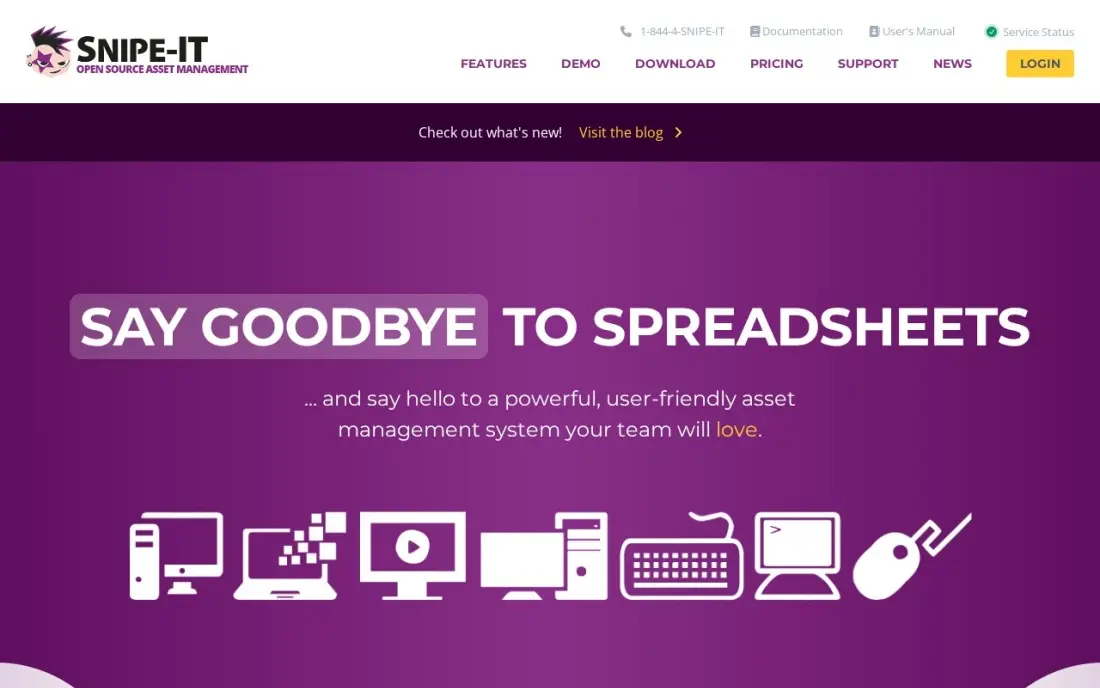
Snipe-IT is the register most small IT teams try first because it costs nothing to self-host and has no cap on assets or users. It tracks hardware, software licenses, accessories and consumables against the person who holds them, so you can see which laptop a leaver still has and which license seats are free before you buy more. Managed hosting starts at $39.99 a month, or $399.99 a year, with backups and upgrades included.
It is a register, not a discovery tool: devices are added by hand, by CSV import or through the API, rather than found on the network. Self-hosting also means your team owns setup, updates and security patching. Choose it when the main job is knowing who has what.
What we like
- Free and open source: self-host with unlimited assets and users at no licence cost
- Tracks hardware, software licenses, accessories and consumables in one register
- Managed hosting starts at $39.99/month with backups, upgrades and email support included
Watch out for
- Self-hosting means your team owns setup, updates, backups and security patching
- No built-in bookings, and the official mobile app is still in beta

ManageEngine AssetExplorer
Best for: IT teams that want network discovery, license compliance and a CMDB in one platform
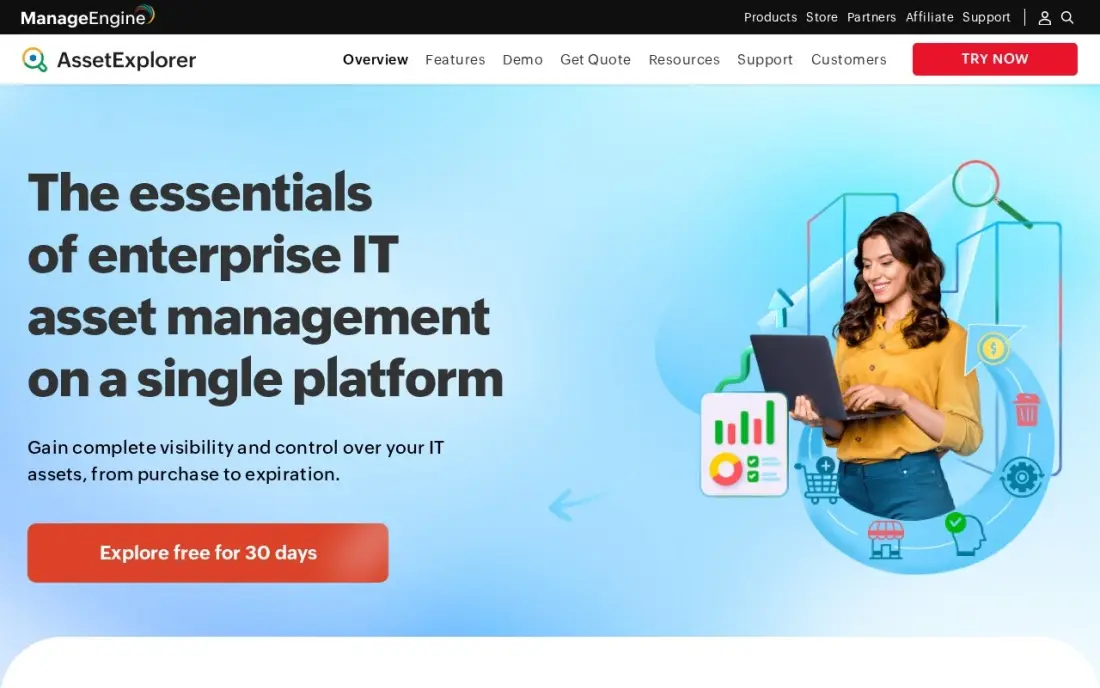
AssetExplorer is the most complete IT asset platform in this list. It discovers hardware and installed software on the network, checks license compliance, keeps a configuration database and handles purchase orders and contracts, so the register stays accurate without someone typing in every new machine. The free edition never expires and covers 50 nodes in the cloud or 25 on-premises.
Paid pricing is node-based and hard to read on the vendor page; third-party reads put cloud at $115 a month for 250 assets, or $1,245 a year billed annually, with unlimited technicians. Get a written quote for your node count. It tracks only IT assets, so furniture and vehicles need another tool.
What we like
- Free edition is fully functional and never expires — hardware and software discovery included
- Hardware and software asset discovery, licence compliance, a CMDB and purchase-order management in one platform
- Unlimited technicians on every paid tier, with cloud or on-premises deployment
- Visual lifecycle workflows and contract management cover the whole asset life, not just the inventory
Watch out for
- Paid pricing is node-based and the vendor's own page does not show the number plainly — budget from a quote or a reseller list
- The free edition caps at 50 nodes in the cloud (25 on-premises), so a 200-device office outgrows it fast
- IT-only: no help for tools, vehicles or other physical assets outside the network

EZOfficeInventory
Best for: IT teams that check laptops and peripherals in and out and want unlimited users
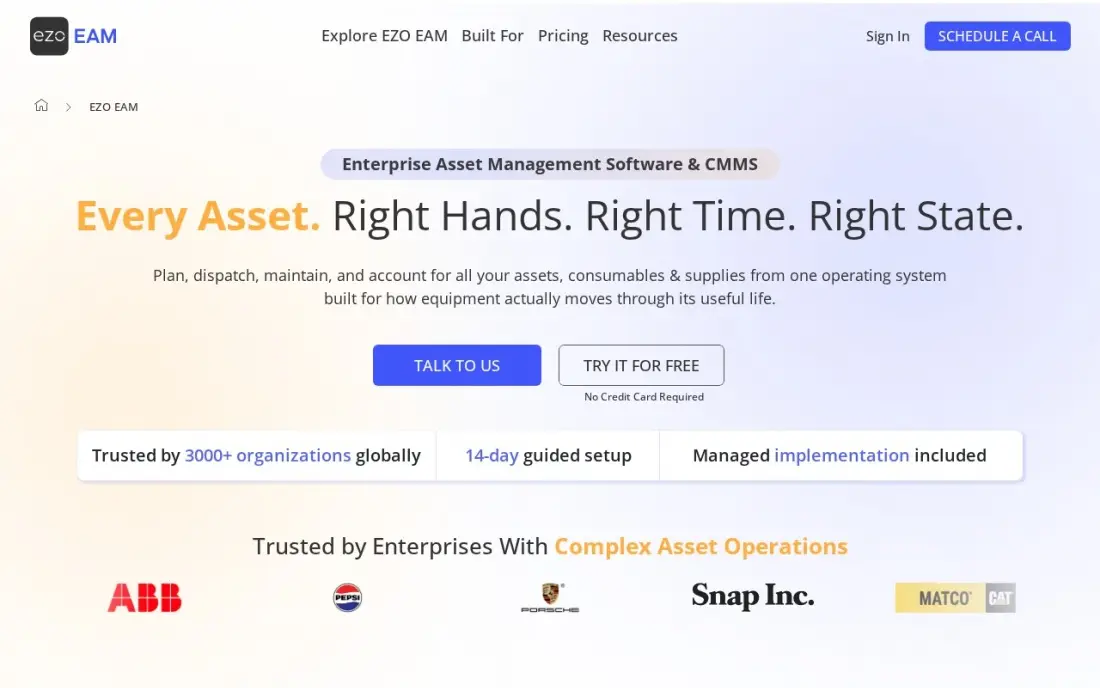
EZOfficeInventory, now branded EZO, suits IT teams that lend equipment: loaner laptops, projectors, test phones and docking stations that move between people. It follows each item through check-out, reservations, service records and retirement, with barcode, QR and RFID tags, and its Zendesk and Jira integrations link an asset to the help desk ticket about it.
Essential costs $44.75 a month billed annually for 100 items, and every plan has unlimited users. The bill follows the item count: 500 items costs $81.41 a month billed annually. There is no network discovery, so pair it with an endpoint tool if you need installed-software data rather than a lending log.
What we like
- Unlimited users on every plan, so the whole team can scan and check items out
- Full asset lifecycle: reservations, service records, RFID and barcode support
- Zendesk and Jira integrations connect asset records to the help desk
Watch out for
- The $44.75 rate covers only 100 items; 500 items costs $81.41/month billed annually
- Preventive maintenance and work orders need the CMMS add-on or Enterprise plan

AssetTiger
Best for: Schools, nonprofits and small offices that want the cheapest paid IT asset register
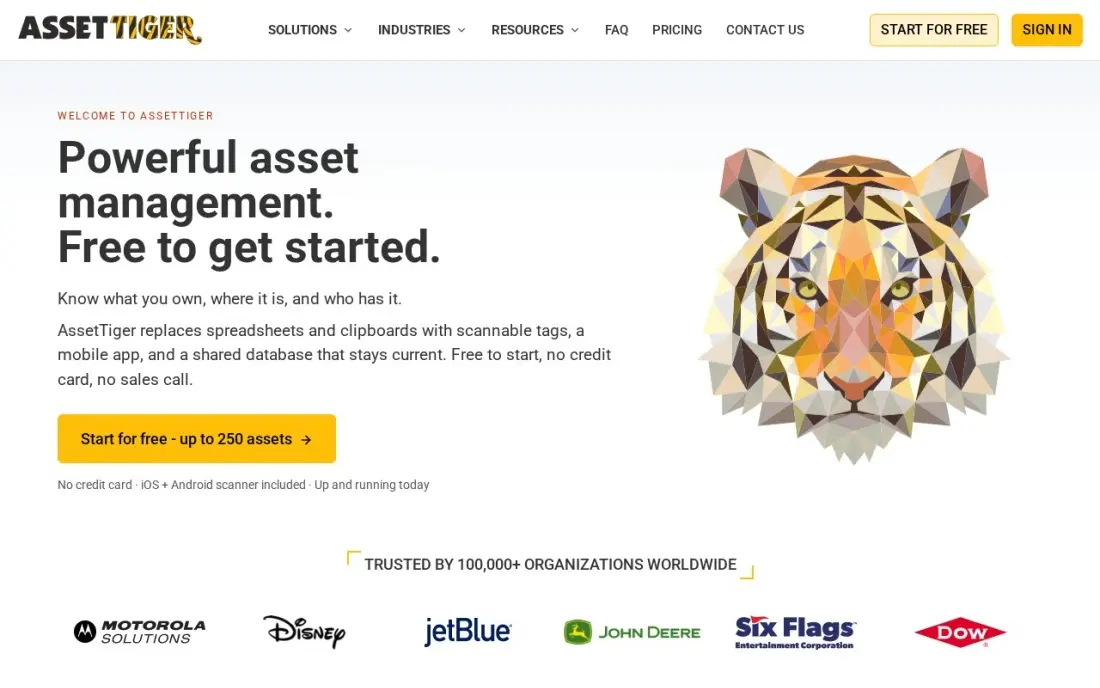
AssetTiger is the cheapest dedicated tracker here: $20 a month covers 500 assets, or $220 a year billed annually, and every paid plan includes unlimited users. A school IT department with 400 Chromebooks and 30 staff who sign devices out pays the same as a five-person office, because the price follows asset count, not headcount. Depreciation, maintenance alerts, contracts and more than 80 report types are included.
The limits are the ones you would expect at the price. There is no free plan, only a 30-day trial for up to 250 assets, no network discovery and no third-party integrations. Pick it when a clean register with check-out records is all you need.
What we like
- Cheapest paid plan here: $20/month covers 500 assets with unlimited users
- Pricing scales only by asset count, so adding staff never raises the bill
- Depreciation, maintenance alerts, contracts and 80-plus built-in report types included
Watch out for
- No free plan since 2026 — only a 30-day trial for up to 250 assets
- No third-party integrations, and reviewers report the mobile app can feel slow

Asset Panda
Best for: IT teams with unusual asset types and audit requirements that need custom fields and workflows
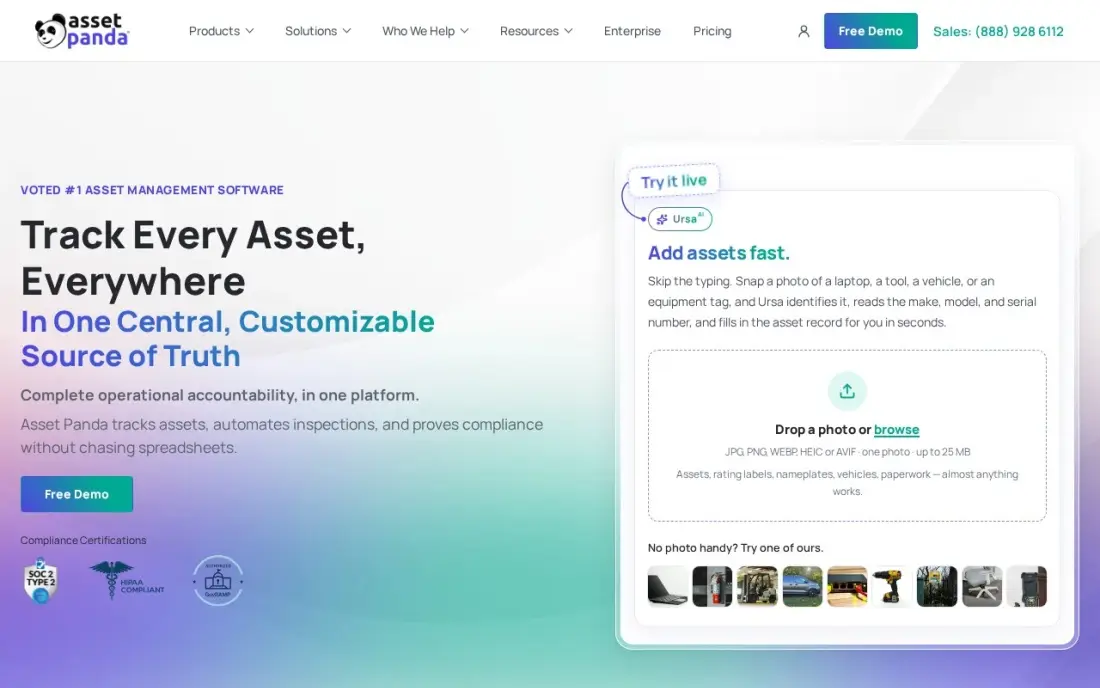
Asset Panda is the pick when a fixed set of fields does not fit what you track. Teams build their own fields, workflows and dashboards without code, then scan barcodes and QR codes from the free iOS and Android app to record condition, raise damage tickets and run audit counts. Five depreciation methods and tamper-proof audit trails suit IT teams that also answer to finance.
The cost is hard to plan. The pricing page is a quote form, and the last public list, archived in February 2026, started at $3,000 a year for 5 users and 1,000 assets. Use the 14-day trial to test whether the custom setup earns that price over Snipe-IT or AssetTiger.
What we like
- Most configurable tracker here: custom fields, workflows and dashboards with no code
- Five depreciation methods with tamper-proof audit trails built for compliance-minded teams
- Mobile barcode and QR scanning with condition capture, damage tickets and audit counts
- Free mobile app for iOS and Android, with asset profiles carrying images, documents and videos
Watch out for
- No published pricing — the pricing page is now a quote form, so budgeting starts with a sales call
- Archived 2026 pricing started at $3,000/year for 5 users, which prices out the smallest teams
- Reviewers consistently call it expensive for the feature set, with costs climbing as asset count grows

NinjaOne
Best for: IT teams and MSPs that want hardware inventory built from the same agent that patches each device
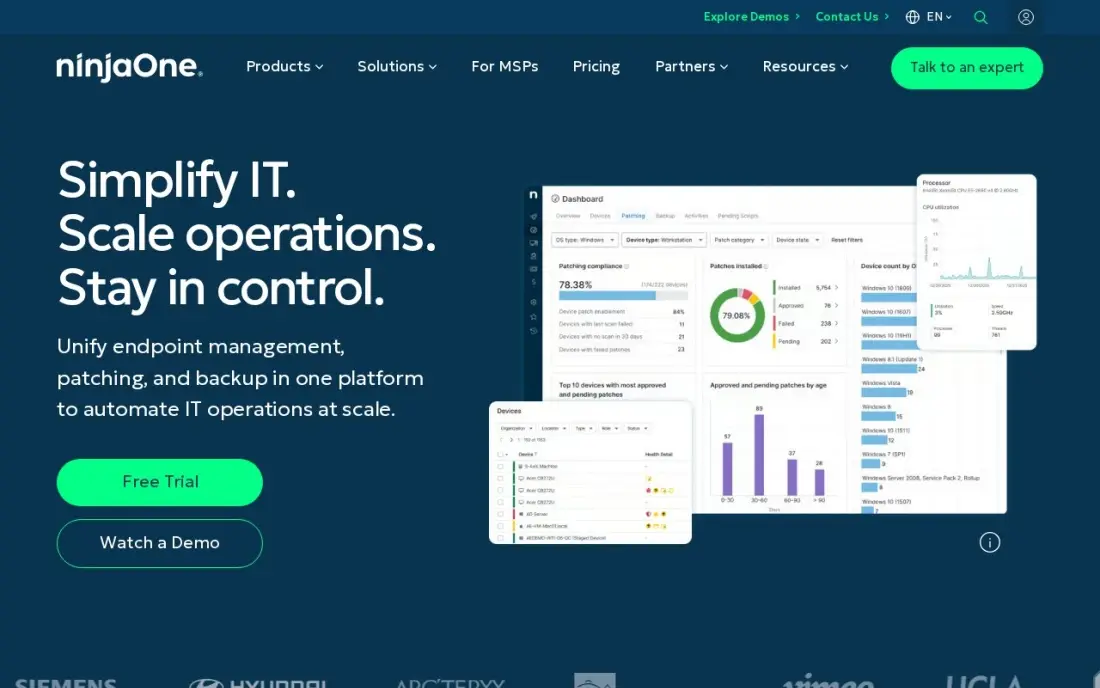
NinjaOne is an endpoint management platform rather than a register, but for many IT teams it answers the asset question better. The agent on each Windows, Mac and Linux device reports hardware and installed software back to one cloud console, so the inventory updates itself while the same tool handles patching, monitoring and remote access.
NinjaOne publishes a per-device range of $1.50 to $3.75 a month by volume, with $3.75 at 50 or fewer endpoints; the exact rate comes from a sales quote. It does not track monitors, phones without an agent or other unmanaged kit, so most teams keep a simple register alongside it.
What we like
- Automated patching across Windows, Mac, Linux and third-party apps from a single cloud console
- Per-device pricing falls with volume — $3.75/device/month at 50 or fewer endpoints, $1.50 at 10,000
- Remote access, monitoring and software deployment included, with free unlimited support and training
- Highest-rated tool in this list on G2 at 4.7/5 from 5,780 reviews
Watch out for
- No fixed plan price — the exact per-device rate comes from a sales quote, so budgeting needs a conversation
- Per-device pricing grows with every endpoint, so a device-heavy office pays more than a flat-rate tool
- Backup, MDM and other modules are separate products, so the full stack costs more than the RMM alone
ManageEngine Endpoint Central
Best for: IT teams that want endpoint inventory, software metering and patching with a free edition for 25 devices
Endpoint Central gives you a live inventory of hardware and installed software as part of managing each endpoint, along with patching across Windows, Mac and Linux and more than 1,000 third-party applications. That makes it a practical way to spot unlicensed or out-of-date software across the fleet. The free edition manages up to 25 endpoints, so a small office can run it at $0.
Professional costs $795 a year for 50 endpoints, so a 10-device office pays the full 50-endpoint price. Perpetual licences are also sold, which helps a stable fleet. The console is deep and can overwhelm a new administrator, and like NinjaOne it only sees devices that run its agent.
What we like
- Automated patching across Windows, Mac, Linux and 1,000+ third-party applications
- Live inventory of hardware and installed software, built as part of managing each endpoint
- Free edition manages up to 25 endpoints, so a tiny office may never pay
- Perpetual licences available alongside annual subscriptions, which lowers long-term cost
Watch out for
- Professional starts at $795 a year for 50 endpoints — a 10-device office pays the full 50-endpoint price
- The console is deep and can overwhelm a new administrator
- Only sees devices that run its agent, so anything without one needs a separate register
The best IT asset tracking software tells you what hardware and software you own, who has it, where it is and when it is due for replacement, without a spreadsheet nobody trusts. We compared seven tools across two approaches — dedicated asset registers and endpoint platforms that build an inventory from an agent on each device — and every price below comes from the vendor's own page or the verified figure we recorded, checked in November 2026.
How to choose the best IT asset tracking software
- Decide how assets get into the system. Manual entry and barcode scans work for 200 devices; past that, look for network discovery or an endpoint agent that reports hardware and software on its own.
- Count what the price is based on. Some tools charge per asset, some per node or endpoint and some per item, so count laptops, monitors, phones and peripherals before you compare.
- Check license tracking. If you pay for per-seat software, the tool should record seats against users so you can reclaim them when someone leaves.
- Look at check-out and audit features. Loaner pools and school device programmes need check-in, check-out and audit counts from a phone, not only a list.
- Ask who runs it. A free self-hosted tool still needs someone to patch the server and run backups; hosted plans move that job to the vendor.
- Plan for the help desk link. An asset record tied to the ticket about it saves technicians from asking which laptop the user has.
Tracking equipment is one part of running a tidy IT function; the public side matters too. If your team also looks after the company website, our SEO audit finds the technical problems that hold pages back, and the free robots.txt tester checks that search engines can reach the pages you want indexed.
IT asset tracking software pricing: what you will actually pay
Take a 60-person office with 150 tracked assets: laptops, monitors, phones and a few shared devices. On published prices, Snipe-IT costs $0 self-hosted or $399.99 a year for managed hosting. AssetTiger costs $220 a year billed annually, because 150 assets sit inside its 500-asset Basic plan. EZOfficeInventory's 100-item Essential plan at $44.75 a month billed annually is too small, so the office moves to the 500-item tier at $81.41 a month, about $977 a year. AssetExplorer's free edition stops at 50 cloud nodes, so this office pays; third-party reads of its pricing put 250 assets at $1,245 a year billed annually.
The endpoint tools price differently. Endpoint Central Professional costs $795 a year for 50 endpoints, so 60 laptops need a larger tier, and NinjaOne at the top of its published range, $3.75 per device a month, would cost $2,700 a year for 60 managed laptops. Those tools also patch and support each machine, which a register does not. Asset Panda publishes no price; its last public list started at $3,000 a year for 5 users and 1,000 assets.
Know the difference: asset register vs endpoint inventory
An asset register is a record you maintain. Snipe-IT, AssetTiger, EZOfficeInventory and Asset Panda hold every item you own, including things that never connect to the network — monitors, docking stations, headsets, spare keyboards — along with who has each one, purchase date, warranty and condition. It is only as accurate as the people updating it, which is why barcode scanning and check-out workflows matter.
An endpoint inventory is a record the devices keep for you. NinjaOne, Endpoint Central and the discovery side of AssetExplorer read hardware specs and installed software directly from each machine, so the data stays current without anyone typing. It misses anything without an agent or a network presence. Most IT teams above 50 people end up with both: the endpoint tool for computers and software, and a register for everything else.
Quick comparison: tool type by need
| Buyer | Best pick | Why |
|---|---|---|
| Small IT team, no budget | Snipe-IT | Free self-hosted with unlimited assets and users; hosting $39.99/month |
| Full IT asset management | ManageEngine AssetExplorer | Discovery, license compliance and CMDB, free for 50 cloud nodes |
| Loaner and check-out pools | EZOfficeInventory | Reservations and RFID with unlimited users, from $44.75/month billed annually |
| Schools and nonprofits | AssetTiger | $20/month for 500 assets with unlimited users |
| Custom fields and audits | Asset Panda | No-code fields and workflows, priced by quote |
| IT teams and MSPs managing devices | NinjaOne | Self-updating inventory from the patching agent, $1.50–$3.75/device/month |
| Endpoint inventory on a free tier | ManageEngine Endpoint Central | Free for 25 endpoints; Professional $795/year for 50 |
Mistakes to avoid
- Tracking only computers. Monitors, docks and phones go missing more often than laptops; a register should hold everything you would charge a leaver for.
- Skipping the offboarding step. The asset record pays for itself when HR's leaver list triggers a check that every device and license seat comes back.
- Choosing self-hosted with no owner. A free server nobody patches becomes a security problem holding a list of every device you own.
- Paying per node for devices you do not manage. Count which assets need discovery or patching before you price an endpoint tool by device.
- Importing a messy spreadsheet as-is. Clean duplicates and agree on naming and tag numbers first, or the new system inherits the old confusion.
Related comparisons: Asset Tracking Software for Small Business · IT Management Software · IT Automation Software · Read IT Later Apps
How we chose
We started from the tools IT teams actually shortlist for tracking hardware and software, then checked each vendor's pricing as recorded in November 2026, keeping annual and monthly billing separate. Where a vendor does not publish a clear price — Asset Panda and AssetExplorer's paid tiers — we say so and give the source of the figure we quote. We ranked by fit for a small to mid-size IT team that needs an accurate register first and automation second. Ratings come from G2 and Capterra pages checked on the dates shown. No vendor paid for a place in this list, and none of the links here are affiliate links.
What to do next
Export whatever list you have today, count the assets by type and decide which need discovery and which only need a tag. Then run a two-week trial of one register and one endpoint tool against that count. If you also want help with the website your IT team supports, book a free SEO review.
Frequently asked questions
What is the best IT asset tracking software?
ManageEngine AssetExplorer is the most complete, with network discovery, license compliance and a free edition for 50 cloud nodes. Snipe-IT is the best free register for small IT teams, and AssetTiger is the cheapest paid option at $20 a month for 500 assets with unlimited users.
Is there free IT asset tracking software?
Yes. Snipe-IT is free and open source when you host it yourself, with unlimited assets and users. ManageEngine AssetExplorer has a free edition for 50 cloud nodes or 25 on-premises, and ManageEngine Endpoint Central has a free edition for up to 25 endpoints.
What is the difference between IT asset tracking and IT asset management?
Tracking records what you own, where it is and who has it. IT asset management adds the full lifecycle: purchase orders, contracts, license compliance, depreciation and retirement. Snipe-IT and AssetTiger are mainly trackers, while AssetExplorer covers the wider management job.
How much does IT asset tracking software cost?
On published prices, AssetTiger costs $20 a month for 500 assets, Snipe-IT hosting costs $39.99 a month, EZOfficeInventory starts at $44.75 a month billed annually for 100 items, and Endpoint Central Professional costs $795 a year for 50 endpoints. Asset Panda and NinjaOne quote prices individually.
Can IT asset tracking software find devices automatically?
Some can. AssetExplorer discovers hardware and software on the network, and NinjaOne and Endpoint Central report inventory from an agent installed on each device. Snipe-IT, AssetTiger, EZOfficeInventory and Asset Panda rely on manual entry, imports, barcode scans or integrations.
Should IT asset tracking include software licenses?
Yes, if you pay for per-seat software. Snipe-IT tracks license seats against users, and AssetExplorer checks installed software against what you have bought, which shows both unused seats you are paying for and installs you are not licensed for.
Which IT asset management software works with a barcode scanner?
EZOfficeInventory and Asset Panda are the strongest picks for scanning. EZOfficeInventory supports barcodes and RFID for check-in and check-out, with unlimited users from $44.75 a month billed annually. Asset Panda adds mobile barcode and QR scanning with condition capture, damage tickets and audit counts in a free iOS and Android app, but pricing is by quote. Snipe-IT is free to self-host, though its official mobile app is still in beta.
Sources we checked (11)
- Snipe-IT — snipeitapp.com/pricing (checked November 10, 2026)
- Snipe-IT reviews on G2 (checked November 10, 2026)
- ManageEngine AssetExplorer — www.manageengine.com/products/asset-explorer (checked November 10, 2026)
- EZOfficeInventory — www.ezofficeinventory.com/pricing (checked November 10, 2026)
- AssetTiger — www.assettiger.com/pricing (checked November 10, 2026)
- AssetTiger reviews on Capterra (checked November 10, 2026)
- Asset Panda — www.assetpanda.com/pricing (checked November 10, 2026)
- NinjaOne — www.ninjaone.com/pricing (checked November 7, 2026)
- NinjaOne reviews on G2 (checked November 7, 2026)
- ManageEngine Endpoint Central — www.manageengine.com/products/desktop-central/pricing.html (checked November 7, 2026)
- ManageEngine Endpoint Central reviews on G2 (checked November 7, 2026)
Make one of these tools?
We re-check this list every quarter. Send a correction, request a review, or ask about a clearly labeled sponsored spot.
Request a listingShamim
Founder of SerpAstra
A full-stack digital marketer and SEO strategist covering technical and local SEO, AI search visibility, paid ads and lead generation for local businesses, e-commerce brands and SaaS teams.
Free SEO and AI visibility audit
Find out what is holding your rankings back
Send us your site. Within 2 business days you get a written audit, an AI visibility check and a short fix list ranked by impact. Free, with no contract attached.
Request my free audit→Related buying guides
 Manufacturing, Maintenance & ERP8 Best Asset Tracking Software for Small Business in 2026, ComparedCompare the 8 best asset tracking software for small business options on price, free plans and check-out features, with prices checked November 10, 2026.Read guide →
 IT Management7 Best IT Management Software in 2026, ComparedCompare the 7 best IT management software for endpoints, service desks, monitoring and IT assets, with free editions and real per-device costs checked.Read guide →
 Accounting & Finance12 Best Fixed Asset Software for Small Business in 2026, Compared12 best fixed asset software for small business compared on price, asset limits, free plans and depreciation — every price checked November 10, 2026.Read guide →