8 Best Zero Trust Platforms in 2026, Compared
Compare the 8 best zero trust platforms for access, identity and segmentation on free tiers, user limits and real per-user cost, checked on vendor pages.
 Shamim Mia, Founder, SerpAstraLast verified November 7, 20269 min read
We compare pricing pages, documentation and public reviews. We never accept payment for rankings.
Key takeaways
- Cloudflare Zero Trust is the best starting point for small and mid-size teams: free for up to 50 users, then $7 a user a month with no seat minimum.
- Twingate is the simplest VPN replacement, free for up to 5 users and $5 a user a month billed yearly on Teams.
- Zero trust needs identity underneath it: Okta, Duo and JumpCloud supply the sign-in, MFA and device checks the access layer relies on.
- Zscaler Internet Access and Illumio are enterprise platforms sold by quote, for large estates that need full traffic inspection or workload segmentation.
On this page
Quick comparison
| Tool | Best for | Starting price | Free plan |
|---|---|---|---|
 Cloudflare Zero Trust | Small and mid-size teams that want zero trust access and web filtering without hardware | Free to 50 users; $7/user/mo | Yes (free plan) |
 Twingate | Small IT teams that want to replace a VPN with per-resource access quickly | $5/user/mo (yearly) | Yes (up to 5 users) |
 NordLayer | Remote and hybrid teams moving from a VPN toward segmented access without hardware | $8/user/mo (annual) | No (14-day guarantee) |
 Okta | Companies with many SaaS apps that need a vendor-neutral identity layer for zero trust | $6/user/mo (annual) | No (30-day trial) |
 Duo | Teams that need strong MFA and device checks as the first step toward zero trust | Free to 10 users; $3/user/mo | Yes (up to 10 users) |
 JumpCloud | Small IT teams that want directory, SSO, MFA and device management in one console | $11/user/mo (annual) | Yes (free tier) |
 Zscaler Internet Access | Large enterprises that need full traffic inspection, DLP and sandboxing in the cloud | Custom quote | No (demo only) |
 Illumio | Enterprise security teams segmenting data centres and clouds to stop lateral movement | Custom quote | No (free trial) |
Make one of these tools?
We re-check this list every quarter. Send a correction, request a review, or ask about a clearly labeled sponsored spot.
Request a listingThe best zero trust platforms
Cloudflare Zero Trust
Best for: Small and mid-size teams that want zero trust access and web filtering without hardware
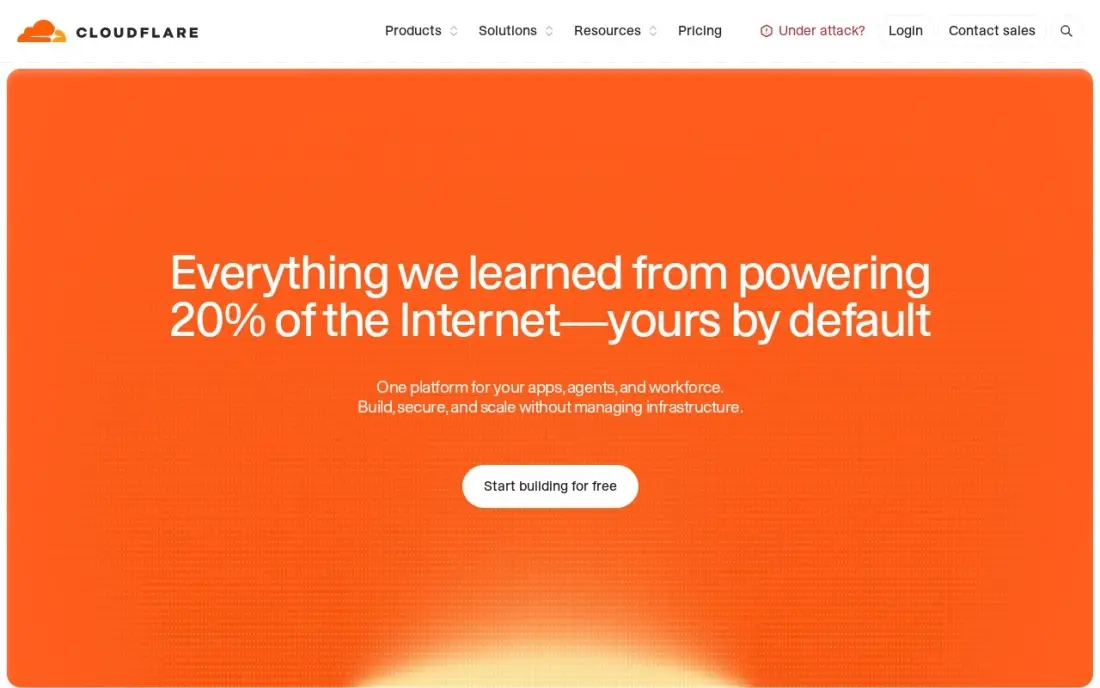
Cloudflare Zero Trust is the most complete free zero trust platform available: up to 50 users get zero trust network access, a secure web gateway and DNS filtering on Cloudflare's global network. Staff reach internal apps through the WARP client instead of a VPN, and policies are set in one dashboard, with no concentrator or appliance to buy.
The 50-user ceiling is a cliff: the 51st user moves every seat to the $7 a user a month pay-as-you-go plan, which has no seat minimum. The free plan keeps logs for 24 hours and offers community support only, and CASB, custom data-loss prevention and browser isolation are paid add-ons or Enterprise features.
What we like
- Free for up to 50 users with Zero Trust access, a secure web gateway and DNS filtering included
- No hardware to buy or VPN concentrator to run — policies are set in a dashboard
- Runs on Cloudflare's global network, so remote staff get the same protection anywhere
- Pay-as-you-go pricing has no seat minimum and no user cap once you outgrow the free plan
Watch out for
- Free plan stops at 50 users — the 51st user moves every seat to the $7/user/month plan
- Free plan keeps logs for 24 hours only and offers community support, not phone or chat
- Advanced features such as CASB, custom data-loss prevention and browser isolation are paid add-ons or Enterprise only
Twingate
Best for: Small IT teams that want to replace a VPN with per-resource access quickly
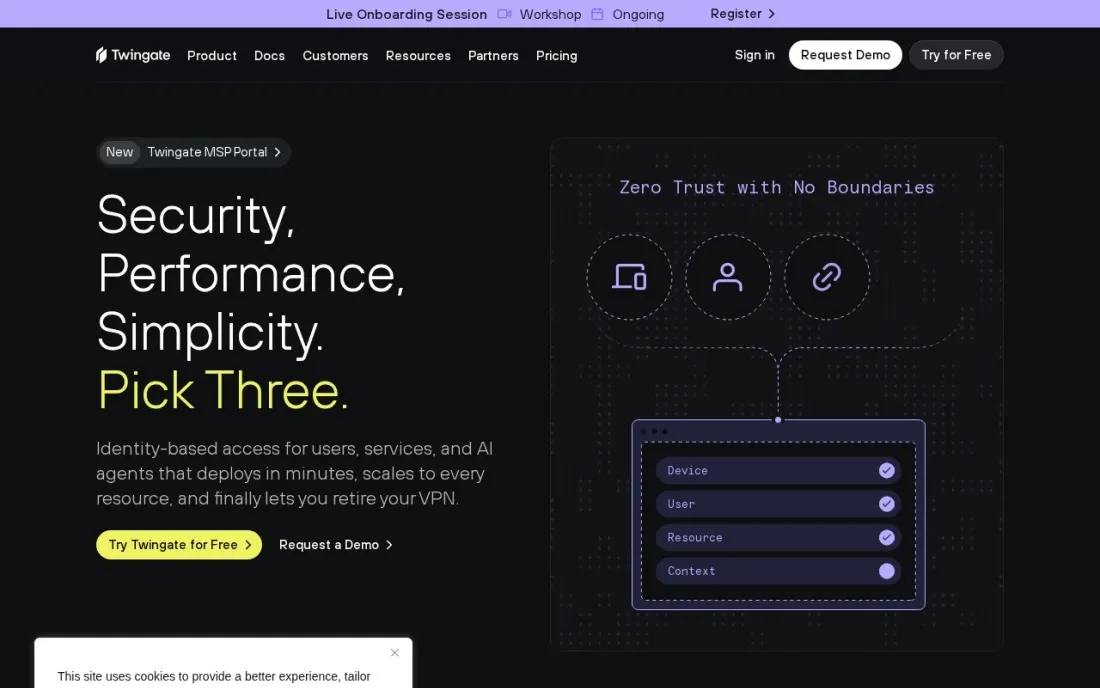
Twingate is built to do one thing well: replace the company VPN with access to specific resources rather than the whole network. The free Starter plan covers up to 5 users and 50 resources with split tunneling and conditional access, and Teams costs $5 a user a month billed yearly for up to 100 users, adding Google Workspace SSO, device posture checks and SaaS app gating.
Business, at $10 a user a month billed yearly for up to 500 users, adds provisioning from an identity provider, Okta and Entra ID sign-in and just-in-time access. Twingate does not include a web gateway the way Cloudflare does, and DNS filtering is an add-on, so it is access control first.
What we like
- Starter is free for up to 5 users and 50 resources, with split tunneling and conditional access
- Teams adds Google Workspace SSO, SaaS app gating, device posture checks and automated least-privilege policies from $5 a user a month billed yearly
- Business adds IdP user provisioning, Okta and Entra ID SSO, and just-in-time access policies at $10 a user a month billed yearly
- Clients for macOS, Windows, Linux, iOS and Android, with peer-to-peer connections
Watch out for
- Teams caps at 100 users and Business at 500, so larger companies go to a custom Enterprise quote
- Teams keeps logs for only 7 days, and DNS filtering and privileged access are add-ons on Business
- The pricing page does not clearly label a month-to-month rate, so confirm monthly billing before you buy
NordLayer
Best for: Remote and hybrid teams moving from a VPN toward segmented access without hardware
NordLayer sits between a business VPN and a zero trust platform. Staff install one app and connect, admins manage access in one dashboard, and single sign-on and multi-factor authentication are included, so access is enforced per user. Lite costs $8 a user a month billed annually, and monthly billing costs more.
The zero trust features grow with the plan: Core adds network access control and segmentation, while Lite is mainly secure access. Every plan has a five-user minimum, and Core and Premium need a dedicated IP server at $40 a month. Choose it if your team already thinks in VPN terms and wants a gentle path toward segmented access.
What we like
- Business VPN with threat prevention from $8/user/month — no hardware, no concentrator to maintain
- Simple setup: staff install one app and connect, with admin controls in a single dashboard
- Core adds network access control and segmentation for teams that outgrow basic VPN access
- Single sign-on and multi-factor authentication included, so access control is enforced per user
Watch out for
- Lite is the only plan without a dedicated IP requirement — Core and Premium add $40/month for a dedicated IP server
- Five-user minimum on every plan, so a two-person business still pays for five seats
- Threat blocking and network segmentation sit on higher tiers — Lite is mainly secure access
Okta
Best for: Companies with many SaaS apps that need a vendor-neutral identity layer for zero trust
Zero trust starts with knowing who is signing in, and Okta is the identity layer most access platforms plug into. Its catalog of pre-built app integrations is one of the largest, so each new SaaS tool can sit behind single sign-on and MFA quickly. Starter costs $6 a user a month billed annually and covers SSO, standard MFA and the directory.
There is a $1,500 annual contract minimum, so a ten-person team pays an effective $12.50 a user a month. Adaptive MFA and lifecycle automation are paid add-ons on Starter. Okta does not broker network access itself; pair it with Cloudflare, Twingate or Zscaler for that.
What we like
- One of the largest catalogs of pre-built app integrations
- Adaptive MFA and lifecycle automation on higher tiers
- Vendor-neutral, so it works across Microsoft, Google and other apps
- Published per-user prices with no sales call needed for Starter
Watch out for
- $1,500 annual contract minimum prices out the smallest teams
- Adaptive MFA and lifecycle management are paid add-ons on Starter
- Connecting and configuring apps takes real project time
Duo
Best for: Teams that need strong MFA and device checks as the first step toward zero trust
Duo covers the verification half of zero trust: push MFA that staff actually like, plus device checks before access is granted. It is free for up to 10 users and costs $3 a user a month on Essentials, which adds single sign-on, phishing-resistant MFA and passwordless options. Setup takes minutes rather than a migration project.
Full identity and directory features need the Advantage or Premier tiers, and device trust checks are lighter than a dedicated device management tool. Self-service licenses are sold in blocks of 10 seats below 100 users. For a team that has to prove MFA to a cyber insurer this quarter, it is the quickest win here.
What we like
- Free for up to 10 users, with push MFA that staff actually like
- Phishing-resistant MFA and complete passwordless on paid tiers
- Setup takes minutes, not a migration project
- AI assistant for administration included on Essentials
Watch out for
- Full IAM and directory features require the Advantage or Premier tiers
- Device trust checks are lighter than a dedicated MDM
- Self-service licenses are sold in blocks of 10 seats under 100 users
JumpCloud
Best for: Small IT teams that want directory, SSO, MFA and device management in one console
JumpCloud gives a small IT team the identity and device foundation zero trust depends on: directory, single sign-on, MFA and device management for Windows, macOS and Linux in one console. It is free for up to 10 users and 10 devices, and the SSO package costs $11 a user a month billed annually, or $13 monthly, with no annual contract minimum.
Pricing is a la carte, so the real total is hard to predict until you choose packages, and mobile device controls are lighter than a dedicated MDM. For a 30-person company with mixed laptops and no directory server, it covers more of the zero trust checklist in one product than anything else here.
What we like
- Directory, SSO, MFA and device management in one console
- Works across Windows, macOS, Linux, iOS and Android
- Free tier for very small teams, with a 30-day full trial
- No annual contract minimum on the published packages
Watch out for
- A la carte pricing makes the real monthly total hard to predict before you buy
- The admin console covers a lot of ground for a one-person IT team
- Mobile device controls are lighter than a dedicated MDM
Zscaler Internet Access
Best for: Large enterprises that need full traffic inspection, DLP and sandboxing in the cloud
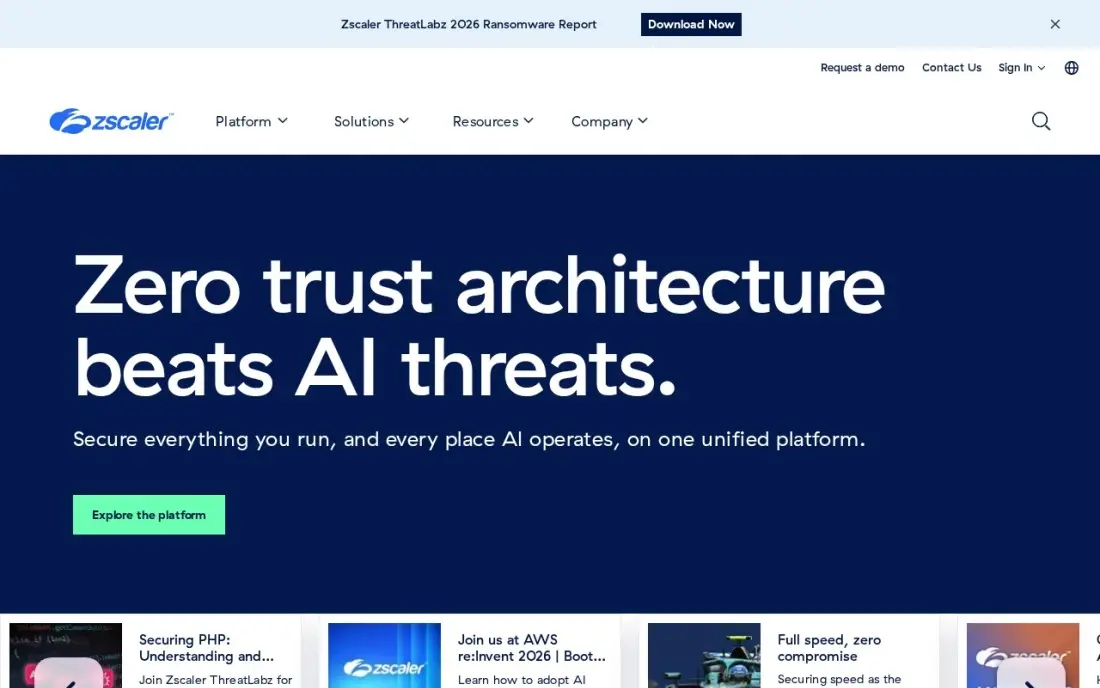
Zscaler Internet Access is the enterprise end of zero trust: web traffic runs through Zscaler's cloud, encrypted traffic is inspected, and DLP, CASB, sandboxing and a cloud firewall come in the same service, so the same policy applies in the office and at home. For an enterprise replacing several appliances, that consolidation is the reason to buy.
Zscaler publishes no ZIA price, offers no free plan or trial, and sells it inside platform bundles, so a quote is the only way in. Reviewers report slow performance at peak hours and complex setup. Below roughly 500 users it is more platform than most teams need.
What we like
- Inspects encrypted traffic with full SSL inspection, unlike DNS-only tools that see domains alone
- Bundles DLP, CASB, sandboxing and a cloud firewall, replacing several appliances with one cloud service
- Runs on the largest security cloud in this list, with consistent policy for office and remote users
Watch out for
- No published price and no free trial: ZIA sells inside platform bundles, so quotes are enterprise-only
- Reviewers report slow performance at peak hours, complex setup and occasional connection issues
- Overkill and overpriced below roughly 500 users, where DNS filters do the job for dollars a month
Illumio
Best for: Enterprise security teams segmenting data centres and clouds to stop lateral movement
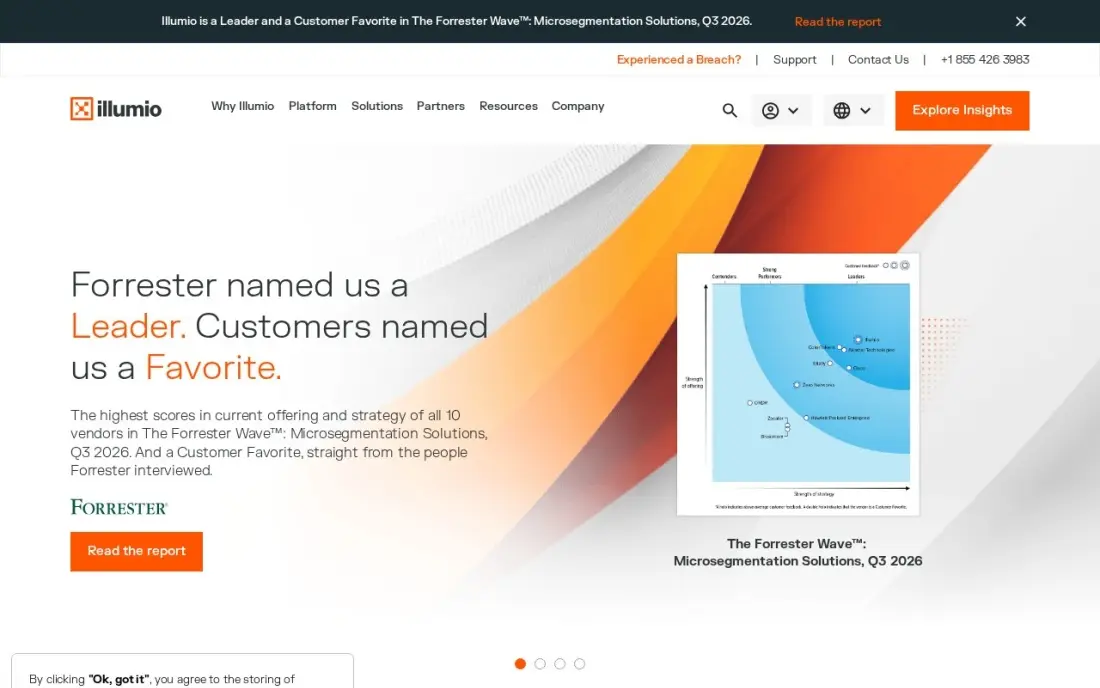
Illumio applies zero trust inside the network rather than at the front door. It uses each host's own firewall to enforce segmentation, so policy follows workloads across data centres, clouds and endpoints, and it builds application dependency maps from observed traffic, so rules start from what systems actually do. It was named a Customers' Choice in Gartner Peer Insights for microsegmentation in 2026.
Every deal is a quote per protected workload, and costs climb steeply at small scale. G2 reviewers note that logs cannot be streamed directly to a SIEM. A free trial is available. It belongs on the list once access and identity are in place and ransomware spread is the next risk.
What we like
- Host-based enforcement uses the operating system's own firewall, so policy follows workloads across data centres, clouds and endpoints
- Application dependency maps are built from observed traffic, so policies start from what workloads actually do, not from guesses
- Named a Customers' Choice in Gartner Peer Insights' 2026 Voice of the Customer for microsegmentation, with 98% of reviewers saying they would recommend it
Watch out for
- No published price — every deal is a quote per protected workload, and costs climb steeply at small scale
- G2 reviewers note logs cannot be streamed directly to a SIEM, which limits some monitoring workflows
The best zero trust platforms replace "inside the network means trusted" with a check on every request: who is this user, is their device healthy, and should they reach this one app. We compared eight platforms across the three layers zero trust needs — access, identity and segmentation — and checked every price on the vendor's own pricing page in November 2026, including free tiers and contract minimums.
How to choose the best zero trust platforms
- Start with access. Replacing the VPN with per-app access is where most teams see the fastest risk reduction; Cloudflare Zero Trust and Twingate both do this.
- Make sure identity is solid. Zero trust decisions are only as good as the sign-in behind them, so put SSO and MFA in place with Okta, Duo or JumpCloud first.
- Check device posture options. The platform should be able to refuse access from an unmanaged or out-of-date laptop.
- Decide whether you need web filtering too. Cloudflare and Zscaler inspect internet traffic as well as private access; Twingate focuses on private access.
- Read user caps and minimums. Cloudflare's free plan stops at 50 users, Twingate Teams at 100, NordLayer needs five seats and Okta a $1,500 annual minimum.
- Leave segmentation for later unless you are large. Illumio-style workload segmentation is powerful but quote-priced and built for big estates.
A secure business still needs a site customers can find and trust. If your security work is solid but your web presence is not, our SEO audit checks the technical side of your site, and our guide to the best network security software for small business covers firewalls and filtering alongside zero trust.
Zero trust platforms pricing: what you will actually pay
Take a 40-person company replacing its VPN and adding MFA. On access, Cloudflare Zero Trust costs $0 because 40 users sit under its 50-user free plan. Twingate Teams costs 40 x $5, or $200 a month and $2,400 a year billed yearly. NordLayer Lite costs 40 x $8, or $320 a month and $3,840 a year billed annually.
On identity, Duo Essentials costs 40 x $3, or $120 a month and $1,440 a year. Okta Starter costs 40 x $6, or $240 a month and $2,880 a year billed annually, which clears its $1,500 minimum. JumpCloud's SSO package costs 40 x $11, or $440 a month and $5,280 a year billed annually, and it also manages the devices.
So the cheapest credible setup for 40 people is Cloudflare Zero Trust plus Duo at about $1,440 a year. The picture changes at 51 users: Cloudflare then charges every seat at $7, or $357 a month. Zscaler Internet Access and Illumio publish no prices and are sold by quote.
Know the difference: ZTNA vs microsegmentation
Zero trust network access (ZTNA) controls how people reach applications. A user signs in, the platform checks identity and device, and it opens a connection to that one app rather than the whole network. Cloudflare Zero Trust, Twingate and, increasingly, NordLayer work at this layer, and it is the natural replacement for a remote-access VPN.
Microsegmentation controls how systems talk to each other inside the network. If one server is compromised, segmentation stops the attacker moving sideways to the database or backup server. Illumio enforces this with each host's own firewall. Most organisations start with ZTNA and identity because the risk is higher and the projects are smaller, then add segmentation once the estate is large enough to justify it.
Quick comparison: tool type by need
| Buyer | Best pick | Why |
|---|---|---|
| Small and mid-size teams | Cloudflare Zero Trust | Access, web gateway and DNS filtering free to 50 users, then $7/user/month |
| Simple VPN replacement | Twingate | Free to 5 users, Teams $5/user/month billed yearly |
| VPN users moving to zero trust | NordLayer | Business VPN with SSO and MFA, segmentation on Core |
| Many SaaS apps | Okta | Large integration catalog, Starter $6/user/month annual |
| MFA first | Duo | Free to 10 users, Essentials $3/user/month |
| Identity plus devices | JumpCloud | Directory, SSO, MFA and device management, free to 10 users |
| Large enterprises | Zscaler Internet Access | Full traffic inspection, DLP and sandboxing, custom quote |
| Workload segmentation | Illumio | Host-based segmentation across data centres and clouds, custom quote |
Mistakes to avoid
- Buying access before fixing identity. A zero trust gateway that trusts a password-only login has moved the problem, not solved it.
- Running the VPN and the new platform forever. Set a cut-off date, or users will keep the old path open.
- Granting broad access by default. Start each group with the few apps it needs and add more on request.
- Ignoring log retention. Short retention on free plans, such as 24 hours on Cloudflare's, makes incident investigation hard.
- Skipping unmanaged devices. Contractors and personal phones are where policy gaps hide; decide how each is handled before rollout.
Related comparisons: Web Security Software · Privacy Apps · Phishing Software Tools · Firewall Security Software · DLP Software · EDR Tools
How we chose
We checked each vendor's own pricing page in November 2026, recording free tiers, user caps, minimums and starting prices exactly as shown; we read Twingate's pricing page directly on November 16, 2026. We grouped tools by the zero trust layer they cover and ranked them by fit for a typical organisation of 20 to 500 people. Zscaler Internet Access and Illumio publish no prices, so we list them as custom quote. Ratings come from G2 pages where we show them. No vendor paid for a place in this list, and none of the links here are affiliate links.
What to do next
List every app your team reaches over the VPN today, put the five most used behind Cloudflare Zero Trust or Twingate on a free plan, and require MFA on all of them. When your systems are secure and you want more of the right visitors reaching them, book a free SEO review.
Frequently asked questions
What is the best zero trust platform?
Cloudflare Zero Trust is the best zero trust platform for most small and mid-size teams, with access, a secure web gateway and DNS filtering free for up to 50 users and $7 a user a month after that. Twingate is the simplest VPN replacement, and Zscaler Internet Access suits large enterprises.
Is there a free zero trust platform?
Yes. Cloudflare Zero Trust is free for up to 50 users and Twingate's Starter plan is free for up to 5 users. For the identity layer, Duo is free for up to 10 users and JumpCloud for up to 10 users and 10 devices.
Is zero trust the same as ZTNA?
No. Zero trust network access (ZTNA) is one part of zero trust: it gives users access to specific apps instead of the whole network. A full zero trust approach also covers identity and MFA, device checks, web traffic inspection and segmentation between workloads.
Can zero trust replace a VPN?
For most remote access, yes. Cloudflare Zero Trust and Twingate both connect users to specific internal resources through a client app, without a VPN concentrator. NordLayer starts as a business VPN and adds segmentation on higher plans.
How much does a zero trust platform cost?
On published prices, Twingate Teams costs $5 a user a month billed yearly, Cloudflare Zero Trust $7 a user a month after 50 free users, NordLayer Lite $8 a user a month billed annually and Okta Starter $6 a user a month with a $1,500 annual minimum. Zscaler Internet Access and Illumio are quote-only.
Do I need an identity provider for zero trust?
Yes. Every access decision depends on knowing who the user is and whether their device is trusted. Okta, Duo and JumpCloud provide sign-in, MFA and device checks, and access platforms such as Cloudflare and Twingate connect to them.
What technologies does zero trust require?
Three layers come first. Identity: SSO and MFA, from tools such as Okta, Duo or JumpCloud, since every access decision depends on the sign-in. Device posture: checks that refuse access from unmanaged or out-of-date laptops. Per-app access that replaces the VPN, such as Cloudflare Zero Trust or Twingate. Web filtering and traffic inspection, as in Zscaler, and workload segmentation, as in Illumio, come later for larger estates.
Sources we checked (14)
- Cloudflare Zero Trust — www.cloudflare.com/plans/zero-trust-services (checked November 7, 2026)
- Cloudflare Zero Trust reviews on G2 (checked November 7, 2026)
- Twingate — www.twingate.com/pricing (checked November 16, 2026)
- NordLayer — nordlayer.com/pricing (checked November 7, 2026)
- NordLayer reviews on G2 (checked November 7, 2026)
- Okta — www.okta.com/pricing (checked November 7, 2026)
- Okta reviews on G2 (checked November 7, 2026)
- Duo — duo.com/pricing (checked November 7, 2026)
- JumpCloud — jumpcloud.com/pricing (checked November 7, 2026)
- JumpCloud reviews on G2 (checked November 7, 2026)
- Zscaler Internet Access — www.g2.com/products/zscaler-internet-access/pricing (checked November 10, 2026)
- Zscaler Internet Access reviews on G2 (checked November 10, 2026)
- Illumio — www.illumio.com/pricing (checked November 10, 2026)
- Illumio reviews on G2 (checked November 10, 2026)
Make one of these tools?
We re-check this list every quarter. Send a correction, request a review, or ask about a clearly labeled sponsored spot.
Request a listingShamim
Founder of SerpAstra
A full-stack digital marketer and SEO strategist covering technical and local SEO, AI search visibility, paid ads and lead generation for local businesses, e-commerce brands and SaaS teams.
Free SEO and AI visibility audit
Find out what is holding your rankings back
Send us your site. Within 2 business days you get a written audit, an AI visibility check and a short fix list ranked by impact. Free, with no contract attached.
Request my free audit→Related buying guides
 IT Security9 Best Network Security Software for Small Business in 2026, ComparedCompare the 9 best network security software for small business options on price, free plans and firewalls, with every price checked November 7, 2026.Read guide →
 IT Security12 Best IAM Software for Small Businesses in 2026, ComparedCompare the 12 best iam software for small businesses on price, free plans, SSO and MFA, with every price checked November 7, 2026 on the vendor's own page.Read guide →
 IT Security9 Best Microsegmentation Tools in 2026 (Free and Paid, Compared)Compare the 9 best microsegmentation tools for 2026 — Illumio, Guardicore, Cisco and more — on enforcement model, free trials and quote-based pricing.Read guide →