
8 Best Data Engineering Tools in 2026, Compared
Compare the 8 best data engineering tools for ingestion, transformation, orchestration and storage, with free tiers and usage pricing checked on vendor sites.
 Shamim Mia, Founder, SerpAstraLast verified November 2, 20269 min read
We compare pricing pages, documentation and public reviews. We never accept payment for rankings.
Key takeaways
- A modern data stack has four layers — ingestion, storage, transformation and orchestration — and most teams pick one tool per layer rather than one tool for everything.
- Fivetran is the managed ingestion pick, free up to 500,000 monthly active rows; Airbyte is the open alternative, free to self-host or from $20 a month on its managed cloud.
- dbt is the standard for SQL transformation: the Developer plan is free for one seat and Starter costs $100 a user a month.
- Every warehouse here bills on usage, so set budgets on day one: BigQuery's first 1 TiB of queries a month is free, Snowflake Standard credits cost $2 on demand and Databricks Jobs Compute starts at $0.15 per DBU.
On this page
Quick comparison
| Tool | Best for | Starting price | Free plan |
|---|---|---|---|
| Databricks | Engineering-led teams that want pipelines, warehousing and machine learning on one lakehouse | From $0.15/DBU | Yes (Free Edition) |
| Snowflake | SQL-first teams that want a warehouse that runs itself and shares data easily | $2/credit (Standard) | No (30-day trial, $400 credits) |
| Google BigQuery | Teams on Google Cloud that want a serverless warehouse with a generous free tier | $6.25/TiB scanned | Yes (1 TiB queries/mo) |
| Amazon Redshift | Data teams whose sources, storage and tooling already live on AWS | Serverless from $1.50/hr | No (trial only) |
| Fivetran | Teams that want managed ingestion from SaaS apps and databases with no connector code to maintain | Free; usage-based | Yes (500,000 MAR/mo) |
| Airbyte | Teams that want open ingestion they can self-host free or run as a cheap managed cloud | Free (self-host); from $20/mo | Yes (self-hosted Core) |
| dbt | Analytics and data engineers who transform warehouse data with tested, version-controlled SQL | Free; $100/user/mo | Yes (1 seat) |
| Apache Airflow | Engineering teams that orchestrate pipelines as Python code and can run their own infrastructure | Free (open source) | Yes (open source) |
Make one of these tools?
We re-check this list every quarter. Send a correction, request a review, or ask about a clearly labeled sponsored spot.
Request a listingThe best data engineering tools

Databricks
Best for: Engineering-led teams that want pipelines, warehousing and machine learning on one lakehouse
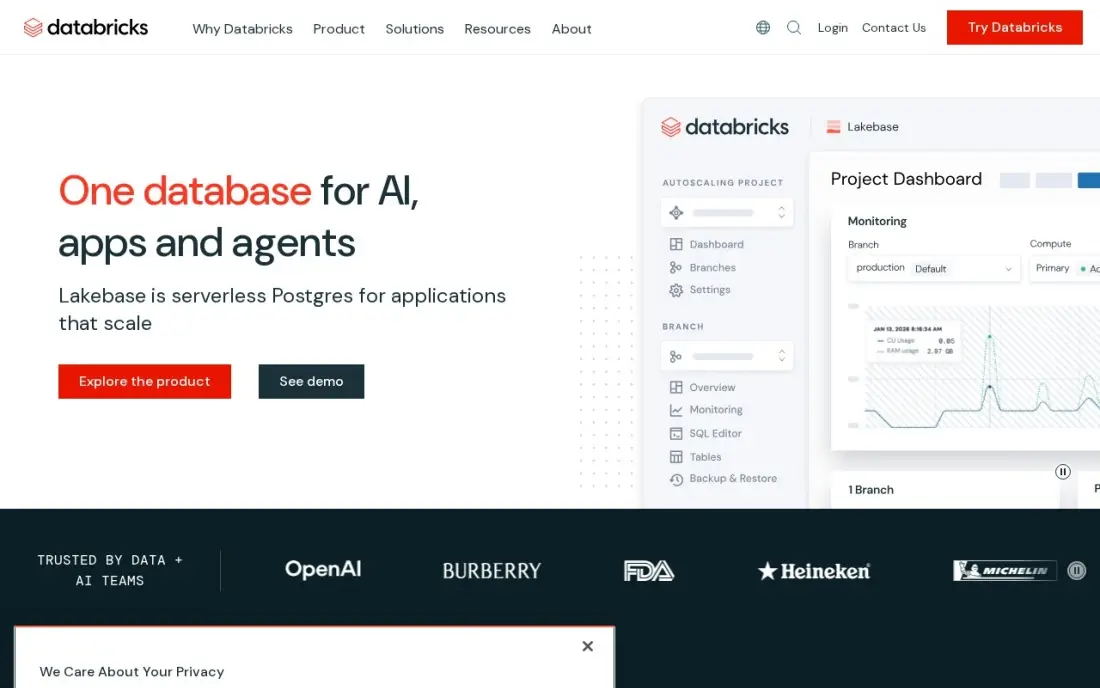
Databricks is the most engineering-centric platform here. Data engineering, warehousing and machine learning run on the same open table formats with Apache Spark underneath, Unity Catalog governs tables and models in one place, and serverless compute removes cluster management. Engineers, analysts and data scientists share one environment instead of passing files between three systems.
Pricing is consumption-based: Jobs Compute starts at $0.15 per DBU on the Premium tier in AWS US East, interactive all-purpose compute costs $0.55, and on classic compute the cloud infrastructure is billed separately. The Free Edition covers learning and small experiments. It rewards Spark and Python skills, so a SQL-only team faces a learning curve. It is rated 4.6 on G2.
What we like
- One platform for warehousing, engineering and machine learning on open formats, with Apache Spark underneath
- Unity Catalog governs data and AI assets in one place, from tables to models
- Serverless compute removes cluster management, and the ecosystem spans ingestion to BI
- Free Edition covers learning and small experiments at $0
Watch out for
- Consumption pricing needs active cost management, or bills climb fast
- Classic compute bills cloud infrastructure separately, on top of the DBU rate
- Rewards Spark and Python skills; pure SQL teams face a learning curve

Snowflake
Best for: SQL-first teams that want a warehouse that runs itself and shares data easily
Snowflake is the warehouse most analytics teams find easiest to run: storage and compute scale separately, warehouses start and stop in seconds, and engineers and analysts work in plain SQL while the platform handles infrastructure. Data sharing lets partners query live tables without copying them, which removes a whole class of export pipelines.
On-demand Standard credits cost $2 each in AWS US East, Enterprise $3 and Business Critical $4, with storage billed separately at about $40 per TB a month. Needing one Enterprise feature reprices every credit in the account, so check feature needs early. A 30-day trial includes $400 in credits. Streaming and machine learning are less central than on Databricks.
What we like
- Storage and compute scale separately, and warehouses start and stop in seconds
- Data sharing lets partners query live tables without copying data
- Analysts write plain SQL while the platform handles all infrastructure
- Marketplace adds third-party datasets to the same queries
Watch out for
- Costs can surprise without governance: every credit burns at the edition rate
- Needing one Enterprise feature reprices every credit in the account to $3
- Streaming and machine learning are less central than on Databricks
Google BigQuery
Best for: Teams on Google Cloud that want a serverless warehouse with a generous free tier
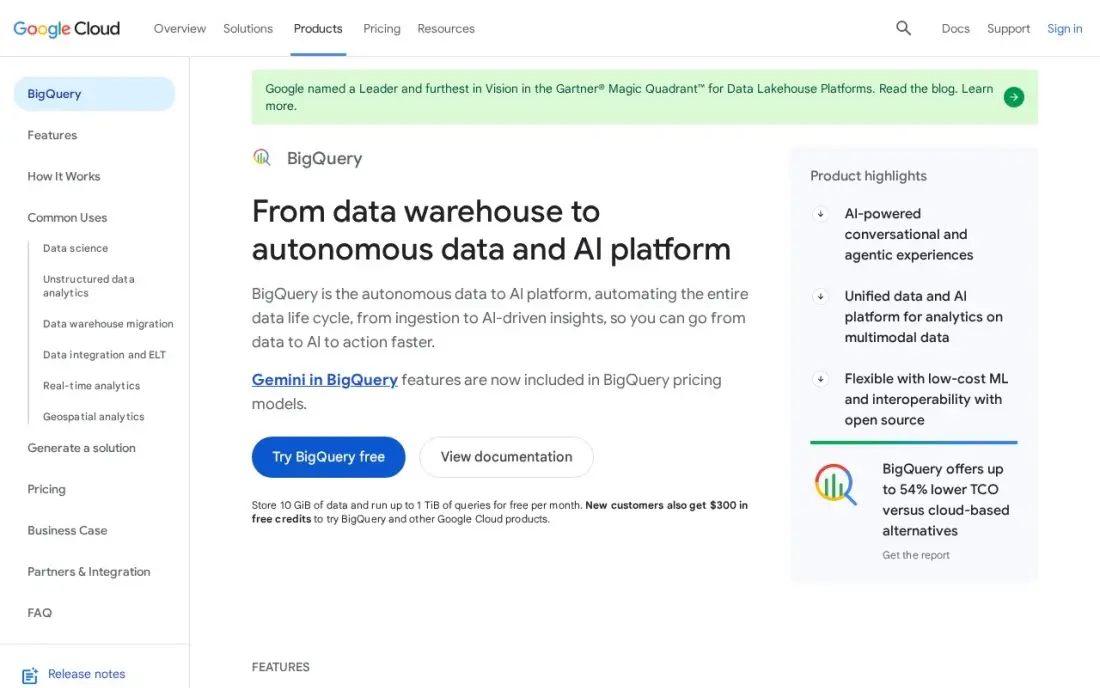
BigQuery is the serverless option: load data, write SQL and Google runs the infrastructure, scaling from a single query to petabytes with no clusters to size. BigQuery ML brings machine learning to SQL users, Gemini helps write and explain queries, and integration with the rest of Google Cloud runs deep, from Vertex AI to Looker Studio.
On-demand queries cost $6.25 per TiB scanned, with the first 1 TiB of queries and 10 GiB of storage free every month, so small pipelines often cost nothing. The risk is a careless query: one unfiltered scan of a large table can burn the free tier. Heavy users move to capacity editions billed per slot-hour. Multi-cloud setups are harder here.
What we like
- Fully serverless: no clusters to size, no servers to patch, automatic scaling
- Generous free tier: 1 TiB of queries and 10 GiB of storage free every month
- BigQuery ML brings machine learning to SQL users, with Gemini help for queries
- Deep Google Cloud integration, from Vertex AI to Looker Studio
Watch out for
- Query costs need monitoring: one unfiltered scan of a large table burns the free tier
- GCP-centric, so multi-cloud strategies get complicated
- Capacity editions add a second pricing model to learn

Amazon Redshift
Best for: Data teams whose sources, storage and tooling already live on AWS
Redshift is the warehouse for AWS teams. Its columnar engine queries data in S3 directly, and it sits beside Glue, Athena, SageMaker and QuickSight, so pipelines built on AWS services land in it with little glue code. Serverless mode scales with the query queue and pauses billing when idle, which removes capacity planning for uneven workloads.
Serverless starts at $1.50 an hour for the 4-RPU minimum, at $0.375 per RPU-hour in US East, and provisioned RA3 nodes start at $0.543 an hour with managed storage at $0.024 per GB a month. A $300 trial credit lasts 90 days. Pricing has many parts — RPU-hours, nodes, storage and Spectrum — so model the bill before you commit.
What we like
- Fast columnar engine that queries data in S3 directly, with no loading step
- Serverless mode scales with the query queue and pauses billing when idle
- Deep AWS integration: Glue, Athena, SageMaker and QuickSight in the same stack
- Reserved capacity and Serverless Reservations cut the on-demand rate
Watch out for
- Pricing is complex: RPU-hours, node-hours, storage and Spectrum all bill separately
- Best inside AWS; the value fades for teams on other clouds
- Concurrency scaling and Spectrum charges can push the bill past the estimate

Fivetran
Best for: Teams that want managed ingestion from SaaS apps and databases with no connector code to maintain
Fivetran is the managed answer to ingestion: pick a source from more than 700 connectors, point it at a warehouse and Fivetran keeps the tables in sync, handling schema changes and API quirks. Standard includes unlimited users, 15-minute syncs, dbt Core integration and REST API access. The Free plan covers 500,000 monthly active rows and 5,000 model runs a month.
Paid usage is billed on monthly active rows at rates that depend on volume and plan, plus a $5 base charge per standard connection. Fivetran publishes examples: a small company's Google Ads connection at median volume costs $48.67 a month at list. Annual contracts earn 5% to 22.6% off, and each new connection gets 14 free days.
What we like
- 700+ managed connectors with unlimited users on Standard
- Free plan up to 500,000 monthly active rows
- Published example costs help estimate the bill before buying
Watch out for
- Per-million MAR spend rates are not published, only examples
- A $5 base charge applies to each standard connection on paid plans
- Free plan freezes connections on a second transformation overage

Airbyte
Best for: Teams that want open ingestion they can self-host free or run as a cheap managed cloud
Airbyte is the open alternative to Fivetran. Airbyte Core is free to self-host under the Elastic License 2.0, so a team with infrastructure skills can run ingestion with no licence cost, and the managed cloud removes that work for a fee. Enterprise Flex adds hybrid deployment that keeps data inside your own network.
Standard starts at $20 a month with 5 credits, about 1 GB of syncs, and syncs as often as hourly. Plus starts at $189 a month for 40 credits with SSO and 15-minute syncs; Pro is capacity-priced by quote. A 14-day trial gives 400 credits, about 100 GB, with no credit card. Self-hosting means your team owns upgrades.
What we like
- Core is free to self-host under the Elastic License 2.0
- Managed Standard plan starts at $20 a month
- 14-day cloud trial with 400 credits and no credit card
Watch out for
- Self-hosting means you run upgrades and monitoring
- Standard syncs at most every hour; faster syncs need Plus or Pro
- Pro and Enterprise Flex are quote-only

dbt
Best for: Analytics and data engineers who transform warehouse data with tested, version-controlled SQL
dbt turns transformation into software engineering: models are SQL select statements in Git, with tests, documentation and lineage generated from the code, and it runs inside your warehouse. The free Developer plan includes one seat, 3,000 successful models a month, one project, the browser IDE, job scheduling and CI checks on GitHub and GitLab.
Starter costs $100 a user a month for up to 5 seats, with 15,000 successful models a month and the semantic layer. Enterprise and Enterprise+ are custom-priced, with 100,000 models and up to 30 or more projects. The pricing page does not publish overage rates, so ask before you scale past the model allowance.
What we like
- Free Developer plan with browser IDE, scheduling and CI checks
- Transformations as version-controlled, tested SQL
- Works with every major warehouse in this list
Watch out for
- Starter at $100 a user a month adds up for a team
- Starter caps at 5 seats and one project
- Overage rates are not published on the pricing page

Apache Airflow
Best for: Engineering teams that orchestrate pipelines as Python code and can run their own infrastructure
Airflow is the most widely used open-source orchestrator for data work. Pipelines are Python DAGs versioned in Git, and the scheduler runs and monitors every step, from an ingestion sync to a dbt run to a report refresh. Its provider ecosystem covers AWS, Google Cloud, Azure, Snowflake and more, so it can coordinate everything else in this list.
It is free under the Apache 2.0 licence, but you run the infrastructure: setup, upgrades, scaling and monitoring are your job, and there is no vendor support or SLA. Managed versions such as Cloud Composer and Amazon MWAA exist for teams that outgrow self-hosting. Non-developers will need engineering help to build workflows.
What we like
- Completely free under the Apache 2.0 licence, with no licence fees at any scale
- Pipelines defined as Python code and versioned in Git like any other software
- Huge provider ecosystem for AWS, GCP, Azure, Snowflake and more
- Managed versions such as Cloud Composer and Amazon MWAA exist if you outgrow self-hosting
Watch out for
- You run the infrastructure: setup, upgrades, scaling and monitoring are your job
- Python-first design means non-developers need engineering help to build workflows
- No vendor support or SLA without a paid managed service
The best data engineering tools get data from where it is created to where it is used, in a shape people can trust, without an engineer babysitting every run. We compared eight tools across the four layers of a modern data stack — ingestion, storage and compute, transformation and orchestration — on what each does best, how it bills and what it costs to start, with every price checked on vendor pages in November 2026.
How to choose the best data engineering tools
- Choose one tool per layer. Ingestion, warehouse, transformation and orchestration are separate jobs; a tool that is excellent at one is rarely best at all four.
- Pick the warehouse first. Your cloud and your team's skills — SQL or Spark and Python — narrow the choice, and every other tool must connect to it.
- Model usage costs. Warehouses and ingestion tools bill on credits, rows or bytes scanned; estimate a month of real volume before you sign.
- Weigh managed against self-hosted. Airflow and Airbyte Core cost nothing to license, but someone has to run them.
- Treat transformations as code. Version control, tests and code review catch broken data before a dashboard does.
- Plan for platform engineering overlap. If your company is also building an internal developer platform, agree who owns orchestration and infrastructure as code.
Clean pipelines matter most when the data drives decisions about growth. If organic search is one of your channels, our SEO audit shows what is holding the site back, and the free UTM builder keeps campaign data consistent before it reaches your warehouse.
Data engineering tools pricing: what you will actually pay
Take a small data team of three building its first stack. Ingestion on Fivetran costs nothing up to 500,000 monthly active rows; beyond that, Fivetran's own examples put a Google Ads connection at $48.67 a month and four typical marketing connectors at $511.15 a month at list. Airbyte's managed Standard plan starts at $20 a month, and self-hosted Core is free.
Transformation on dbt Starter costs $100 a user a month, or $300 a month for three seats; one engineer can stay on the free Developer plan. Orchestration with Airflow is free if you host it. The warehouse is the variable: BigQuery is free for the first 1 TiB of queries a month and then $6.25 per TiB, Snowflake Standard credits cost $2 each on demand, Redshift Serverless starts at $1.50 an hour while running, and Databricks Jobs Compute starts at $0.15 per DBU plus cloud infrastructure on classic compute. Set budget alerts on every usage-billed tool from the first day.
Know the difference: data warehouse vs lakehouse
A data warehouse stores structured tables and is queried with SQL. Snowflake, BigQuery and Redshift work this way, and they are the simplest place for analysts and analytics engineers to work: load data, model it with dbt and point dashboards at the results. They handle semi-structured data well, but machine learning and streaming sit to the side.
A lakehouse, as Databricks builds it, stores data in open file formats on cloud storage and runs SQL, Spark, streaming and machine learning on the same copy. That suits engineering-led teams with data science work and large raw datasets. The trade-off is more to learn and more cost tuning. Many teams choose a warehouse first and add lakehouse capability only when machine learning becomes central.
Quick comparison: tool type by need
| Buyer | Best pick | Why |
|---|---|---|
| Engineering-led lakehouse | Databricks | Pipelines, SQL and ML on one platform, from $0.15/DBU |
| SQL-first warehouse | Snowflake | Separate storage and compute, Standard credits $2 on demand |
| Google Cloud teams | Google BigQuery | Serverless, first 1 TiB of queries free each month |
| AWS teams | Amazon Redshift | Serverless from $1.50/hour, queries S3 directly |
| Managed ingestion | Fivetran | 700+ connectors, free up to 500,000 MAR a month |
| Open ingestion | Airbyte | Free self-hosted Core, managed cloud from $20/month |
| SQL transformation | dbt | Free Developer seat, Starter $100/user/month |
| Orchestration as code | Apache Airflow | Free open source Python DAGs |
Mistakes to avoid
- Leaving usage billing unwatched. One runaway query or sync can cost more than a month of normal use; set alerts and limits.
- Syncing everything. Ingest the tables and columns you need, not whole databases, to keep row counts and costs down.
- Skipping tests. Add dbt tests for uniqueness, nulls and relationships so broken data fails a run instead of a meeting.
- Self-hosting without an owner. Free open-source tools still need someone to upgrade and monitor them.
- Building before defining metrics. Agree what revenue, customer and active user mean before modelling them.
Related comparisons: Engineering AI Platforms · Data Lake Tools · Data Science Platforms · Business Analytics Tools Data Analytics
How we chose
We read each vendor's pricing page in November 2026 and recorded free tiers, plan prices and usage rates exactly as shown, including the cloud region where a rate depends on it. Where a vendor publishes examples rather than a rate card, as Fivetran does, we quote the examples and say so. We picked one or two strong tools per layer of the stack and favoured those a small data team can start on without a sales call. Ratings come from G2 pages checked on the dates shown in the sources. No vendor paid for a place in this list, and none of the links here are affiliate links.
What to do next
Map your sources, your warehouse choice and your first three reports on one page, then build the smallest working pipeline on free tiers: one Fivetran or Airbyte source, one dbt model and one dashboard. If marketing data is part of that pipeline and you want the search side to grow, book a free SEO consultation.
Frequently asked questions
What are the best data engineering tools?
A common stack is Fivetran or Airbyte for ingestion, Snowflake, BigQuery, Databricks or Redshift for storage and compute, dbt for transformation and Airflow for orchestration. Databricks covers several layers at once for engineering-led teams.
Are there free data engineering tools?
Yes. Airflow is free open source, Airbyte Core is free to self-host, dbt's Developer plan is free for one seat, Fivetran is free up to 500,000 monthly active rows, BigQuery includes 1 TiB of queries a month free and Databricks has a Free Edition.
How much do data engineering tools cost?
Most bill on usage. Snowflake Standard credits cost $2 on demand, BigQuery charges $6.25 per TiB scanned after the free tier, Databricks Jobs Compute starts at $0.15 per DBU and Redshift Serverless starts at $1.50 an hour. dbt Starter costs $100 a user a month and Airbyte's managed cloud starts at $20 a month.
What is the difference between ETL and ELT?
ETL transforms data before loading it into the warehouse. ELT loads raw data first and transforms it inside the warehouse, usually with dbt. Cloud warehouses made ELT the default because compute there is cheap and flexible.
What is the difference between data engineering and platform engineering tools?
Data engineering tools move, store and transform data for analytics and machine learning. Platform engineering tools build internal developer platforms — self-service infrastructure, deployment pipelines and service catalogues for software teams. They overlap on orchestration and infrastructure as code, but they serve different users.
Do I need Airflow if I use dbt and Fivetran?
Not always. Fivetran and dbt both schedule their own jobs, which is enough for a simple stack. Add an orchestrator such as Airflow when you need dependencies across tools, custom Python steps or one view of every pipeline.
What languages do data engineering tools use?
Mostly SQL and Python. Snowflake and BigQuery let analysts work in plain SQL, and dbt turns transformations into version-controlled, tested SQL. Apache Airflow defines pipelines as Python code versioned in Git. Databricks runs SQL, Spark, streaming and machine learning on the same data, which suits engineering-led teams. Fivetran and Airbyte handle ingestion through connectors, so they need little code at all.
What tools make up a data engineering stack?
Four layers, usually one tool each. Ingestion moves data in from apps and databases (Fivetran or Airbyte). A warehouse or lakehouse stores and queries it (Snowflake, BigQuery, Redshift or Databricks). Transformation cleans and models it in SQL (dbt). Orchestration schedules the whole pipeline (Apache Airflow). Pick the warehouse first, because every other tool has to connect to it.
Sources we checked (12)
- Databricks — www.databricks.com/pricing (checked November 6, 2026)
- Databricks reviews on G2 (checked November 6, 2026)
- Snowflake — www.snowflake.com/en/pricing (checked November 6, 2026)
- Snowflake reviews on G2 (checked November 6, 2026)
- Google BigQuery — cloud.google.com/bigquery/pricing (checked November 6, 2026)
- Google BigQuery reviews on G2 (checked November 6, 2026)
- Amazon Redshift — aws.amazon.com/redshift/pricing (checked November 6, 2026)
- Amazon Redshift reviews on G2 (checked November 6, 2026)
- Fivetran — www.fivetran.com/pricing (checked November 16, 2026)
- Airbyte — airbyte.com/pricing (checked November 16, 2026)
- dbt — www.getdbt.com/pricing (checked November 16, 2026)
- Apache Airflow — pypi.org/project/apache-airflow/2.10.3rc2 (checked November 2, 2026)
Make one of these tools?
We re-check this list every quarter. Send a correction, request a review, or ask about a clearly labeled sponsored spot.
Request a listingShamim
Founder of SerpAstra
A full-stack digital marketer and SEO strategist covering technical and local SEO, AI search visibility, paid ads and lead generation for local businesses, e-commerce brands and SaaS teams.
Free SEO and AI visibility audit
Find out what is holding your rankings back
Send us your site. Within 2 business days you get a written audit, an AI visibility check and a short fix list ranked by impact. Free, with no contract attached.
Request my free audit→Related buying guides
 Data, Analytics & AI7 Best Data Pipeline Software Reviews in 2026, ComparedOur best data pipeline software reviews compare 7 tools on connectors, pricing model, free plans and who runs the servers, with prices checked on vendor pages.Read guide →
 Data, Analytics & AI10 Best Big Data Analytics Software in 2026, ComparedCompare the 10 best big data analytics software platforms on price, free tiers and AI features, with every price checked on November 6, 2026.Read guide →
 IT Management10 Best Workload Automation Tools in 2026 (Free and Paid, Compared)10 best workload automation tools compared on price, platforms and scheduling depth in 2026. Only two publish a price; the rest are custom quote.Read guide →