
6 Best Remote Monitoring Software in 2026, Compared
Compare the 6 best remote monitoring software (RMM) tools on alerts, patching, remote access and per-device or per-tech cost, with prices from vendor pages.
 Shamim Mia, Founder, SerpAstraLast verified November 7, 202610 min read
We compare pricing pages, documentation and public reviews. We never accept payment for rankings.

Key takeaways
- Atera is the clearest published price for a small team: $79 per technician a month billed annually, with unlimited devices and agents.
- NinjaOne is the highest-rated RMM here on G2, at 4.7 from 5,780 reviews, and publishes a range of $1.50 to $3.75 per device a month.
- SuperOps and Pulseway price per endpoint by quote or configurator; SuperOps has a 150-endpoint minimum but no charge per technician.
- Site24x7 is monitoring only — it watches servers, sites and network links from $9 a month but cannot patch or remote into a device.
On this page
Quick comparison
| Tool | Best for | Starting price | Free plan |
|---|---|---|---|
| NinjaOne | IT teams and MSPs that want the highest-rated RMM with monitoring, patching and remote access in one console | Custom quote | No (14-day trial) |
| Atera | Small IT teams and MSPs with many devices per technician that want a published per-tech price | $79/tech/mo | 30-day trial |
| SuperOps | MSPs that want RMM and a service desk together with unlimited technicians | Quote, per endpoint | Free trial |
| Pulseway | IT teams that want pay-as-you-go RMM priced only for the endpoints they use | Pay as you go | Not stated |
| ManageEngine Endpoint Central | Internal IT teams that want remote monitoring and troubleshooting with on-premises or perpetual licensing | $795/yr | Yes (free edition) |
| Site24x7 | Teams that need remote monitoring of servers, websites and network links without a full RMM | $9/mo | Yes (free plan) |
Make one of these tools?
We re-check this list every quarter. Send a correction, request a review, or ask about a clearly labeled sponsored spot.
Request a listingThe best remote monitoring software

NinjaOne
Best for: IT teams and MSPs that want the highest-rated RMM with monitoring, patching and remote access in one console
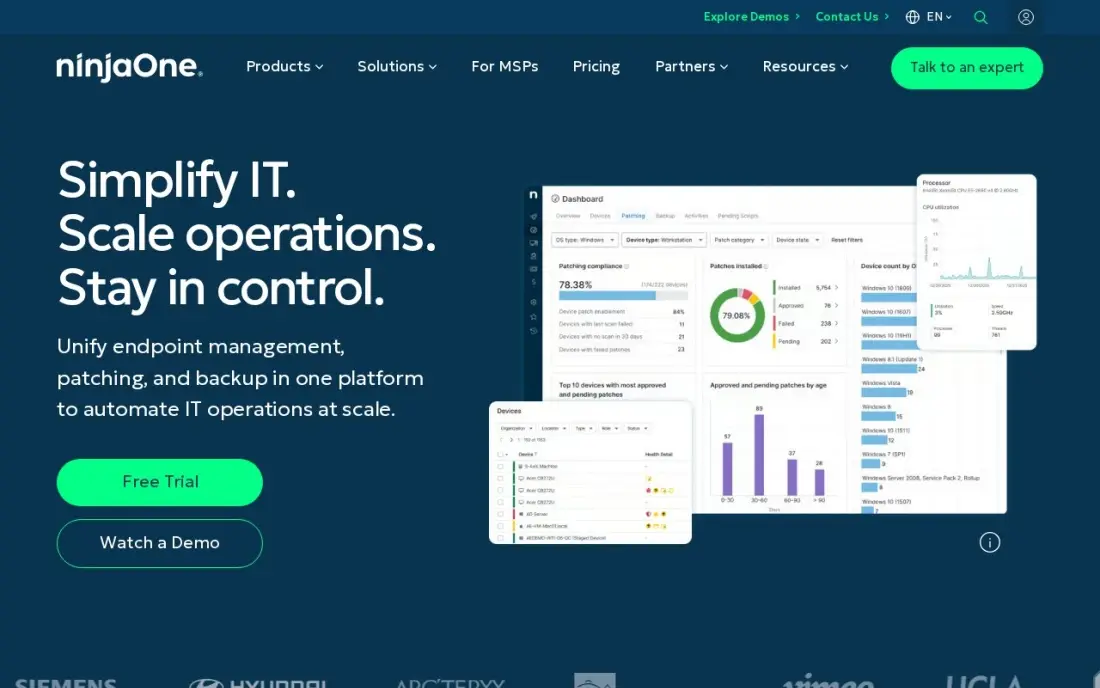
NinjaOne is the benchmark RMM in this list. One cloud console monitors Windows, macOS and Linux devices, raises alerts on the conditions you set, patches the operating system and third-party apps, deploys software and opens a remote session when something breaks. It has the strongest review record here, at 4.7 out of 5 on G2 from 5,780 reviews, and support and training come at no extra charge.
Pricing is per device, published only as a range: $1.50 to $3.75 a month by volume, with the top rate at 50 or fewer endpoints and the exact figure set in a sales quote. Backup and mobile device management are separate products. Pick NinjaOne when you want a mature console and per-device pricing that falls as the fleet grows.
What we like
- Automated patching across Windows, Mac, Linux and third-party apps from a single cloud console
- Per-device pricing falls with volume — $3.75/device/month at 50 or fewer endpoints, $1.50 at 10,000
- Remote access, monitoring and software deployment included, with free unlimited support and training
- Highest-rated tool in this list on G2 at 4.7/5 from 5,780 reviews
Watch out for
- No fixed plan price — the exact per-device rate comes from a sales quote, so budgeting needs a conversation
- Per-device pricing grows with every endpoint, so a device-heavy office pays more than a flat-rate tool
- Backup, MDM and other modules are separate products, so the full stack costs more than the RMM alone

Atera
Best for: Small IT teams and MSPs with many devices per technician that want a published per-tech price
Atera prices by people rather than devices, which suits an IT team where one technician looks after hundreds of machines. Every plan covers unlimited devices and agents. The entry plan costs $79 per technician a month billed annually, or $89 billed monthly, and includes full RMM, automatic monitoring, IT automation, patch management, network inventory and unattended remote access.
Read the plan table before you choose a tier. The entry plan allows only two concurrent unattended remote sessions, and the Mac agent, smartphone app and chat arrive on the second plan at $119 per technician a month billed annually, or $129 monthly. A 30-day trial with no credit card makes it easy to test with your own fleet.
What we like
- Unlimited devices and agents on every plan, priced per technician
- Full RMM, automatic monitoring, patching, network inventory and unattended remote access on the entry plan
- 30-day trial of the full platform with no credit card required
Watch out for
- The entry plan caps unattended remote sessions at 2 at a time
- The Mac agent, the smartphone app and chat start on the second plan at $119 per technician a month billed annually
- Backup and mail protection are paid add-ons

SuperOps
Best for: MSPs that want RMM and a service desk together with unlimited technicians
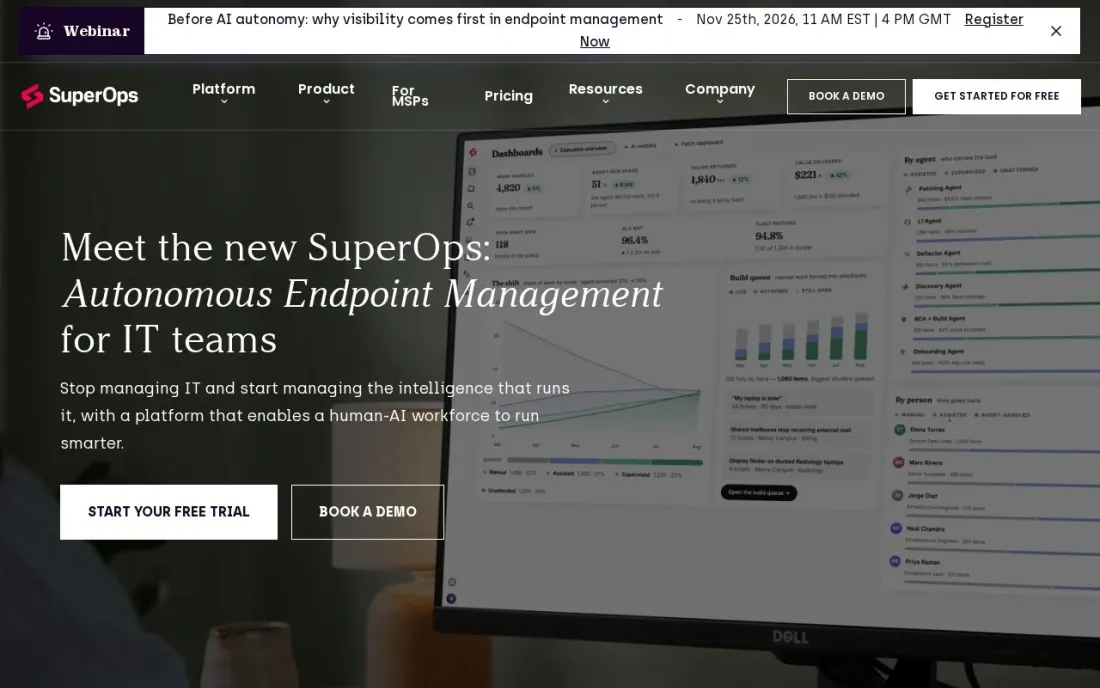
SuperOps combines RMM with a service desk, which is the pairing most MSPs end up buying from two vendors. The Prime plan covers endpoint management for Windows, macOS and Linux, remote troubleshooting, alerting, network monitoring, automated patching, ticketing and a knowledge base. Prime Plus adds mobile device management for iOS, iPadOS and Android, with Apple Business Manager and zero-touch deployment.
Billing is per endpoint per month, with unlimited technicians at no extra charge, free onboarding and no overages. The catch is that both plans say request pricing, and each has a 150-endpoint minimum, so it suits an MSP or IT team already past that size. A free trial is available before you speak to sales.
What we like
- Billed per endpoint with unlimited technicians at no extra charge
- Prime bundles endpoint management, alerting, network monitoring, patching, ticketing and a knowledge base
- Free onboarding, no overage charges and lower per-endpoint rates for larger fleets
Watch out for
- Both plans say request pricing, so there is no number to budget from
- 150-endpoint minimum on each plan
- Mobile device management for iOS and Android needs the higher Prime Plus plan

Pulseway
Best for: IT teams that want pay-as-you-go RMM priced only for the endpoints they use
Pulseway sells RMM on a pay-for-what-you-use basis. Its pricing page is a configurator rather than a rate card: you choose an endpoint count, from a handful up to 5,000 or more, add any security modules, and the page estimates a monthly figure. Pay-as-you-go has no commitment, and longer-term plans and larger fleets cost less per endpoint.
Two costs are fixed: a one-time Advanced Onboarding and Best Practices session at €149, and taxes on top of the estimate. Security add-ons have no published price, and the page does not state a free tier or trial. Pulseway is known for managing tasks from a phone, which customer testimonials on its page praise. Get the configurator figure in writing before comparing it.
What we like
- Pay-as-you-go billing with no commitment, and longer-term plans cost less
- Volume discounts as the endpoint count grows, with a configurator from 0 to 5,000+ endpoints
- Integrates with services such as Zendesk, Slack and PagerDuty, according to customer testimonials on the page
Watch out for
- No per-endpoint rate is printed; the price is an estimate that changes with your selections
- A one-time Advanced Onboarding session costs €149
- Security add-ons carry no published price

ManageEngine Endpoint Central
Best for: Internal IT teams that want remote monitoring and troubleshooting with on-premises or perpetual licensing
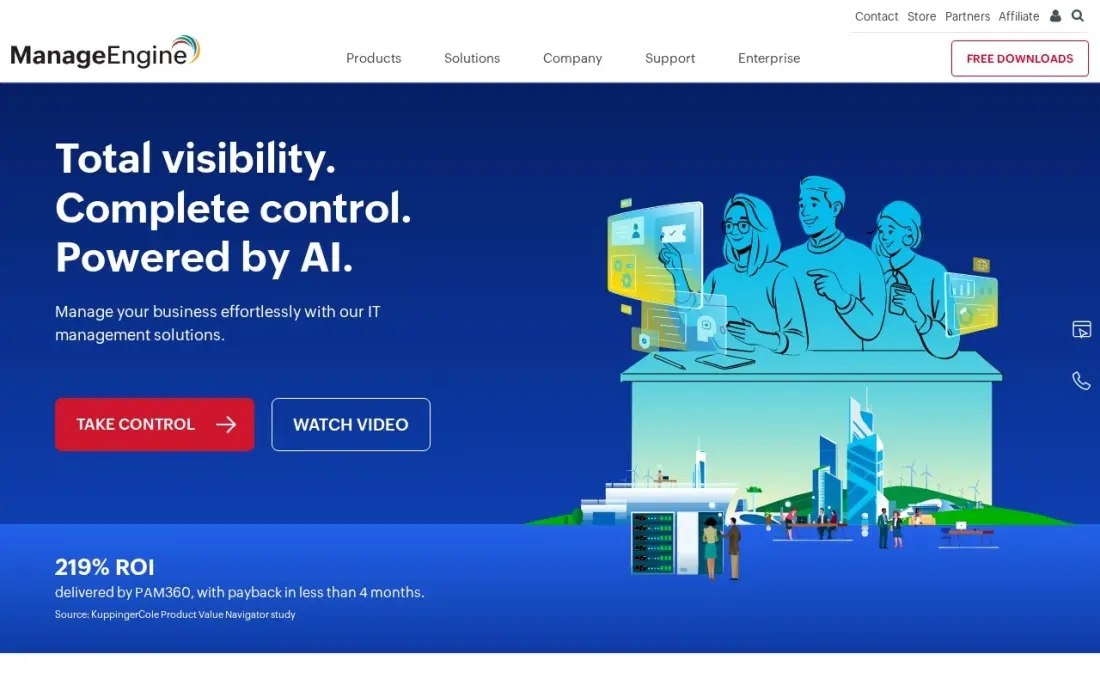
Endpoint Central is the pick for an internal IT department rather than an MSP. It combines remote troubleshooting, patching for Windows, macOS, Linux and 1,000+ third-party apps, software deployment, device control and vulnerability assessment, and it can run in the cloud or on your own server. The free edition manages up to 25 endpoints, and perpetual licences sit alongside annual subscriptions.
Professional starts at $795 a year for 50 endpoints, so a 20-device office pays the 50-endpoint price, and extra security modules cost more. The console is deep and takes time to learn. Choose it when the device count is stable, the data should stay on-premises, or a one-off licence suits the budget better than a monthly bill.
What we like
- Automated patching across Windows, Mac, Linux and 1,000+ third-party applications
- Next-gen antivirus with AI-driven behavioral detection, plus vulnerability assessment and device control
- Free edition manages up to 25 endpoints, so a tiny office may never pay
- Perpetual licences available alongside annual subscriptions, which lowers long-term cost
Watch out for
- Professional starts at $795 a year for 50 endpoints — a 10-device office pays the full 50-endpoint price
- Enterprise depth needs more skill than a consumer suite; the console can overwhelm a new administrator
- Security add-ons such as next-gen antivirus extras and vulnerability management cost more than the base edition

Site24x7
Best for: Teams that need remote monitoring of servers, websites and network links without a full RMM
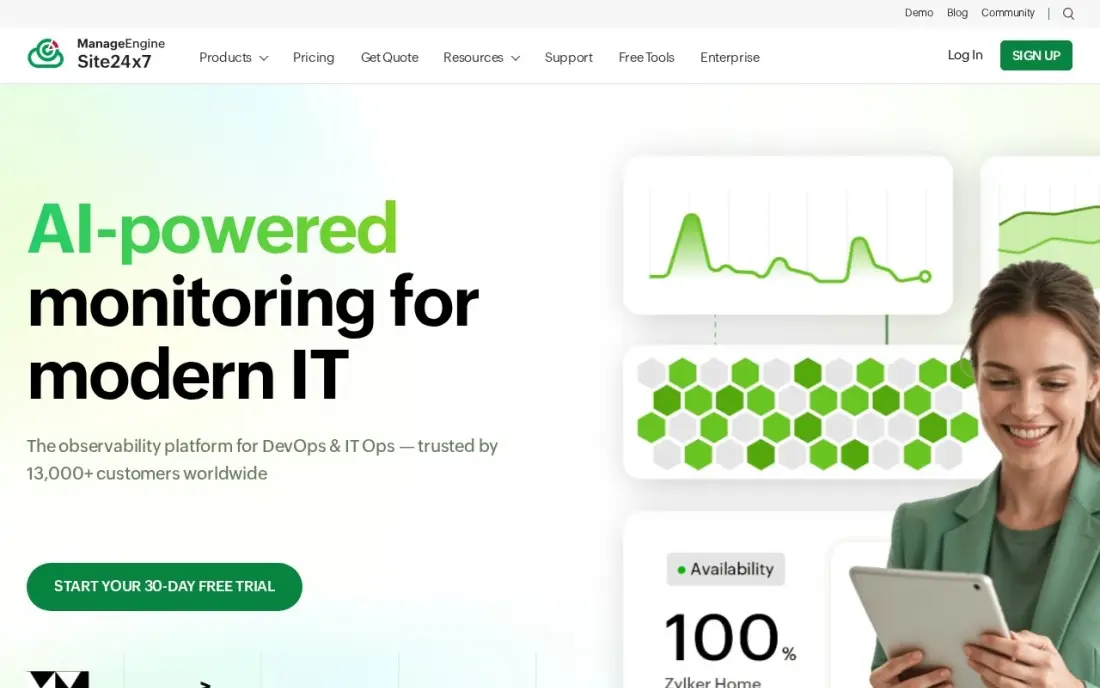
Site24x7 covers the monitoring half of RMM without the management half. It checks websites, servers, networks and cloud services every minute from 130+ locations and alerts by email, SMS and chat the moment something goes down. A free plan covers 5 monitors, paid plans start at $9 a month with 10% off billed annually, and each paid plan has a 30-day trial.
The limit is that it watches and alerts but cannot patch a device, deploy software or open a remote session. The $9 plan covers web uptime only; server, network and application monitoring sit on higher plans. Pair it with a patch tool for a small office, or use it beside an RMM to watch the services the RMM does not see.
What we like
- Website, server, network and cloud monitoring in one console from $9/month
- Checks run every minute from 130+ locations, with instant alerts by email, SMS and chat
- Free plan covers 5 monitors, and every paid plan includes a 30-day free trial
- Part of the ManageEngine and Zoho ecosystem, so it pairs with Endpoint Central in this list
Watch out for
- Monitoring only — it watches and alerts, but it cannot block an attack or patch a device
- The $9 plan covers web uptime; server, network and application monitoring cost more
- Alerting needs someone to act on it — there is no automated remediation on the entry plan
The best remote monitoring software tells you a laptop's disk is full, a server has stopped responding or a backup has failed before anyone files a ticket, and then lets you fix it from where you sit. We compared six tools across the three ways to buy remote monitoring in 2026 — full RMM platforms priced per device, RMM priced per technician, and monitoring-only services — and every price below comes from the vendor's own pricing page as checked in November 2026.
How to choose the best remote monitoring software
- Decide between monitoring and management. Monitoring only tells you something is wrong; RMM also patches, scripts and remotes in to fix it.
- Pick the pricing unit that fits your ratio. Per-technician pricing wins when two people look after 400 devices; per-device pricing wins when ten people look after 200.
- Check the minimums. SuperOps starts at 150 endpoints and Endpoint Central Professional at 50, which matters for a small office.
- Test alert quality, not alert volume. A good RMM lets you set thresholds and quiet hours so the team responds to real problems.
- Confirm Mac and mobile coverage. Some plans cover Windows only on the entry tier, and mobile device management is often a separate plan.
- Look at what else you would replace. Patching, remote access and ticketing inside one console can retire two or three other tools.
Remote monitoring keeps devices healthy; your website needs the same attention. Our SEO audit service finds the technical problems that stop a site ranking, and the free robots.txt tester is a quick check after a server move. If you also need dedicated patching, see our guide to patch management software.
Which remote monitoring software fits your situation
A small office with one IT person and fewer than 25 computers. ManageEngine Endpoint Central's free edition manages up to 25 endpoints, with patching and remote troubleshooting, so a tiny office may never pay. Expect a deep console that takes time to learn. If the office grows past 25, Professional starts at $795 a year for 50 endpoints, even if you only have 30.
An MSP or IT team where two technicians look after hundreds of devices. Atera prices per technician with unlimited devices, so a large fleet costs the same as a small one. The entry plan is $79 per technician a month billed annually, but it allows only two concurrent unattended sessions and has no Mac agent. Budget for the second plan at $119 if any clients run Macs, and use the 30-day trial with no credit card to test it on your own fleet.
An IT team that wants the most proven console and does not mind a quote. NinjaOne has the strongest review record here, 4.7 out of 5 on G2 from 5,780 reviews, with patching across Windows, Mac, Linux and third-party apps, remote access and free support and training. Per-device pricing runs from $3.75 at 50 or fewer endpoints down to $1.50 at volume. Backup and mobile device management are separate products.
An MSP past 150 endpoints that also needs ticketing. SuperOps bundles RMM, alerting, patching, ticketing and a knowledge base, with unlimited technicians, free onboarding and no overages. Both plans are quote-only, and iOS and Android management needs Prime Plus. Pulseway is the alternative if you want pay-as-you-go with no commitment; get the configurator estimate in writing and add the €149 onboarding session.
A team that only needs to know when a server or website goes down. Site24x7 checks websites, servers and networks every minute from 130+ locations and alerts by email, SMS and chat. The free plan covers 5 monitors, and paid plans start at $9 a month, though that plan covers web uptime only. It cannot patch or fix anything, so someone still has to act on each alert.
Remote monitoring software pricing: what you will actually pay
Take an IT team of two technicians looking after 200 Windows and Mac devices. On list prices, Atera's entry plan costs $79 per technician a month billed annually, or $1,896 a year for two, but Mac support needs the second plan at $119, or $2,856 a year for two technicians. Billed monthly, the second plan costs $129 a technician, or $3,096 a year.
NinjaOne charges per device, and its published range of $1.50 to $3.75 a month puts 200 devices between $3,600 and $9,000 a year before the quote sets the exact rate. ManageEngine Endpoint Central Professional starts at $795 a year for 50 endpoints, so ask for a 200-endpoint quote. SuperOps bills per endpoint with unlimited technicians and a 150-endpoint minimum, and Pulseway estimates the price in a configurator and adds €149 for onboarding, so get written figures from both for the same 200 devices. If you only need to watch a handful of servers and the website, Site24x7 starts at $9 a month.
Know the difference: RMM vs monitoring-only tools
An RMM platform puts an agent on every device. The agent reports health, and the console lets a technician act on it: install a patch, run a script, push software or take over the screen. NinjaOne, Atera, SuperOps, Pulseway and Endpoint Central are RMM platforms, and MSPs build their whole service on them.
A monitoring-only tool watches from the outside or through a light agent and alerts when a threshold is crossed, but it cannot change anything on the device. Site24x7 works this way, and so do most uptime and network monitors. It is cheaper and quicker to set up, and it covers services an RMM agent cannot see, such as a public website or a cloud API. Many teams run both.
Quick comparison: tool type by need
| Buyer | Best pick | Why |
|---|---|---|
| Best all-round RMM | NinjaOne | Highest G2 rating here, $1.50–$3.75/device/month |
| Small team, large fleet | Atera | $79/technician/month billed annually, unlimited devices |
| MSPs needing a service desk | SuperOps | RMM plus ticketing, unlimited technicians, per-endpoint quote |
| Pay-as-you-go buyers | Pulseway | Configurator pricing with no commitment |
| On-premises internal IT | ManageEngine Endpoint Central | Free to 25 endpoints, Professional from $795/year |
| Monitoring only | Site24x7 | Servers, sites and networks from $9/month, free for 5 monitors |
Mistakes to avoid
- Turning on every alert. Default alert packs bury real problems in noise; start with disk, offline, failed patch and backup alerts and add more slowly.
- Buying monitoring when you need management. If nobody can act on an alert remotely, a monitoring tool only tells you what is broken.
- Ignoring the Mac and mobile line items. Check which plan covers macOS and phones before comparing headline prices.
- Skipping the security review. An RMM can run code on every device you own, so enforce two-factor sign-in and limit who holds admin rights.
- Comparing quotes for different fleets. Ask every vendor to price the same device count, technician count and add-ons.
Related comparisons: Infrastructure Monitoring Software · Employee Monitoring Software · Apps for Crop Monitoring · Website Change Monitoring Software
How we chose
We read each vendor's own pricing page in November 2026 and recorded the starting price as shown, with the billing period, minimums and what the entry plan includes. Where a vendor prints no rate, as with SuperOps and Pulseway, we say so rather than repeating a third-party estimate. We ranked the tools by fit for the most common buyer, an internal IT team or small MSP looking after 50 to 500 devices. Ratings come from G2 pages where we list them. No vendor paid for a place in this list, and none of the links here are affiliate links.
What to do next
Put the trial agent on twenty real devices, including at least one Mac and one server, and run it for two weeks with only five alerts switched on. If the business website needs the same proactive care, book a free SEO review.
Frequently asked questions
What is the best remote monitoring software?
NinjaOne is the best all-round remote monitoring and management platform, with the highest G2 rating here at 4.7 from 5,780 reviews. Atera is the best published price for small teams at $79 per technician a month billed annually with unlimited devices, and SuperOps suits MSPs that want RMM and a service desk together.
What is RMM software?
RMM stands for remote monitoring and management. An RMM agent on each device reports health and raises alerts, and the same console patches software, runs scripts and opens remote sessions. MSPs use it to look after many clients' devices, and internal IT teams use it to look after their own fleet.
How much does remote monitoring software cost?
On published prices, Atera costs $79 per technician a month billed annually or $89 monthly, NinjaOne publishes $1.50 to $3.75 per device a month, ManageEngine Endpoint Central Professional starts at $795 a year for 50 endpoints and Site24x7 starts at $9 a month. SuperOps and Pulseway quote per endpoint.
Is there free remote monitoring software?
ManageEngine Endpoint Central has a free edition for up to 25 endpoints, and Site24x7 has a free plan for 5 monitors. NinjaOne, Atera and SuperOps offer free trials instead; Atera's runs for 30 days with no credit card.
Per-technician or per-device pricing: which is cheaper?
Per-technician pricing is cheaper when a few technicians look after many devices. Two technicians on Atera's entry plan cost $1,896 a year billed annually however many devices they manage. Per-device pricing such as NinjaOne's is cheaper for a larger team looking after a smaller fleet.
Is remote monitoring the same as employee monitoring?
No. Remote monitoring software watches the health of devices, servers and networks — disk space, failed updates, offline machines. Employee monitoring software tracks what people do at work. The tools in this list are for IT health, not staff activity.
Sources we checked (9)
- NinjaOne — www.ninjaone.com/pricing (checked November 7, 2026)
- NinjaOne reviews on G2 (checked November 7, 2026)
- Atera — www.atera.com/pricing (checked November 16, 2026)
- SuperOps — superops.com/pricing (checked November 16, 2026)
- Pulseway — www.pulseway.com/pricing (checked November 16, 2026)
- ManageEngine Endpoint Central — www.manageengine.com/products/desktop-central/pricing.html (checked November 7, 2026)
- ManageEngine Endpoint Central reviews on G2 (checked November 7, 2026)
- Site24x7 — www.site24x7.com/site24x7-pricing.html (checked November 7, 2026)
- Site24x7 reviews on G2 (checked November 7, 2026)
Make one of these tools?
We re-check this list every quarter. Send a correction, request a review, or ask about a clearly labeled sponsored spot.
Request a listingShamim
Founder of SerpAstra
A full-stack digital marketer and SEO strategist covering technical and local SEO, AI search visibility, paid ads and lead generation for local businesses, e-commerce brands and SaaS teams.
Free SEO and AI visibility audit
Find out what is holding your rankings back
Send us your site. Within 2 business days you get a written audit, an AI visibility check and a short fix list ranked by impact. Free, with no contract attached.
Request my free audit→Related buying guides
 IT Management6 Best MSP Software Tools in 2026, ComparedCompare the 6 best MSP software tools for RMM, PSA, backup, managed EDR and DNS filtering, with per-technician and per-endpoint prices checked in Nov 2026.Read guide →
 IT Management7 Best IT Management Software in 2026, ComparedCompare the 7 best IT management software for endpoints, service desks, monitoring and IT assets, with free editions and real per-device costs checked.Read guide →
 IT Management6 Best Patch Management Software in 2026, ComparedCompare the 6 best patch management software on OS and third-party patching, free tiers and real per-device cost, with every price checked on vendor pages.Read guide →